Adaptive Machine Learning Framework for UAV Trajectory Optimization in O-RAN
Pith reviewed 2026-06-25 22:24 UTC · model grok-4.3
The pith
A model selection mechanism in transfer learning reduces UAV trajectory optimization convergence time by 44 to 56 percent versus retraining from scratch.
A machine-rendered reading of the paper's core claim, the machinery that carries it, and where it could break.
Core claim
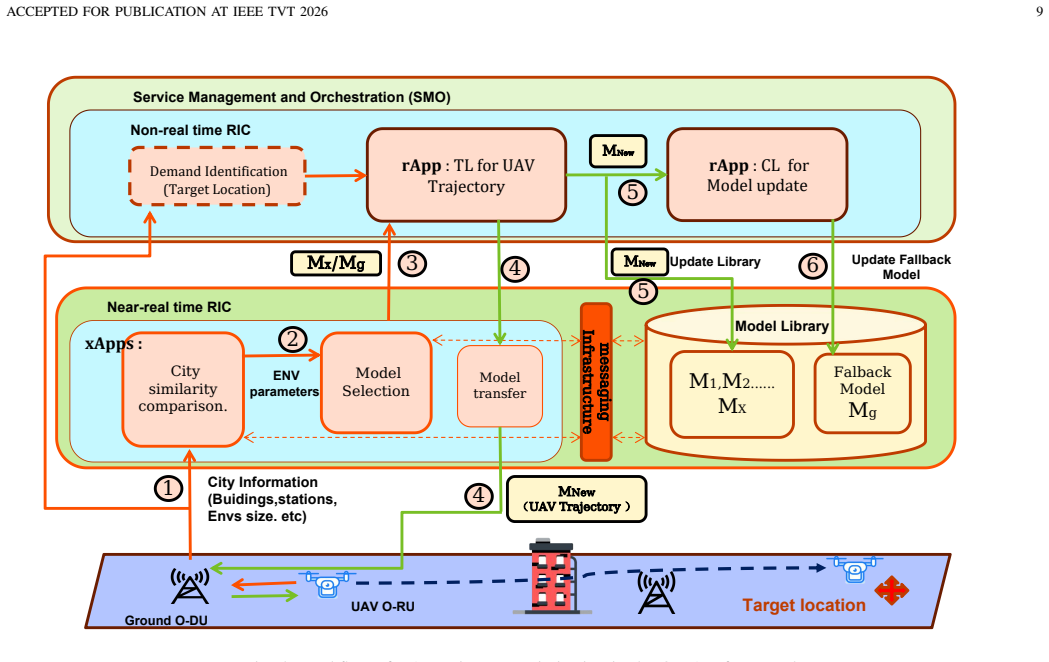
The framework maintains a library of pre-trained models and applies a selection step to transfer the most relevant one into the current UAV trajectory task inside the O-RAN architecture; when no close match exists a continuously refined fallback model supplies baseline performance, yielding convergence times 44 to 56 percent shorter than training from scratch and up to 40 percent shorter than transfer learning without selection.
What carries the argument
The model selection mechanism that picks the most similar pre-trained model from the library before adaptation begins.
If this is right
- UAVs can begin serving new coverage areas after far fewer training episodes than full retraining requires.
- Performance never drops below the fallback level even in completely novel city layouts.
- Ray-tracing data from real maps improves the quality of the learned trajectories.
- The same library and selection logic can be reused across multiple UAVs operating in the O-RAN system.
Where Pith is reading between the lines
- Over time a growing library could make most new environments match an existing model, shrinking adaptation to near zero.
- The same selection-plus-fallback pattern could apply to other wireless control tasks such as power allocation or handover decisions.
- Hardware-in-the-loop tests on actual UAVs would be required to check whether the simulated time savings survive real radio and flight dynamics.
Load-bearing premise
The library will contain at least one model close enough to the new environment for selection to produce the reported speedups, or the fallback model will still deliver usable trajectories when no match is found.
What would settle it
Deploy the system in an urban layout with no pre-trained model within a similarity threshold and measure whether convergence time stays at least 44 percent below the scratch-training baseline.
Figures





read the original abstract
The deployment of unmanned aerial vehicles (UAV) as open radio units (O-RUs) in 6G cellular systems presents a promising opportunity to achieve scalable and adaptive network coverage. However, optimizing UAV trajectories in dynamic and unfamiliar environments remains a critical challenge, particularly due to the need for extensive retraining in each new scenario. In this paper, we introduce a novel UAV trajectory optimization framework that integrates enhanced continual transfer learning within the O-RAN architecture. The proposed system maintains a library of pre-trained models and employs a model selection mechanism to identify and transfer knowledge from the most relevant environments, minimizing adaptation time and improving efficiency. When no sufficiently similar model is available, a fallback model empowered by continuous refinements ensures baseline performance. The framework leverages real-world city maps and ray tracing techniques to enhance learning reliability and improve trajectory planning. Simulation results demonstrate that the proposed model selection-based transfer learning approach reduces convergence time by 44% to 56% compared to retraining from scratch, and up to 40% compared to traditional transfer learning without model selection.
Editorial analysis
A structured set of objections, weighed in public.
Referee Report
Summary. The manuscript proposes an adaptive machine learning framework for UAV trajectory optimization in O-RAN systems. It maintains a library of pre-trained models, employs a model selection mechanism for transfer learning from similar environments, and uses a fallback model with continuous refinement when no close match exists. Simulations using real-world city maps and ray tracing are reported to show 44–56% faster convergence versus retraining from scratch and up to 40% versus traditional transfer learning without model selection.
Significance. If the performance claims can be substantiated with full experimental protocols, the framework could reduce retraining overhead for trajectory optimization in dynamic UAV deployments for 6G networks. The use of ray-tracing on real city maps for realistic channel modeling and the O-RAN integration are concrete strengths that improve applicability.
major comments (3)
- [Abstract] Abstract (simulation results paragraph): The headline claims of 44–56% and up to 40% convergence-time reductions are presented without any description of the experimental setup, including the number of environments stored in the model library, the similarity metric or threshold used for selection, the number of trials, baselines, or statistical tests. These omissions make it impossible to evaluate support for the central claim.
- [Framework description] Framework section (model selection and fallback description): The text states that a fallback model is invoked when no sufficiently similar pre-trained model is found, yet provides no quantitative characterization of how similarity is measured, how many distinct environments are in the library, or the performance degradation that occurs when the nearest stored model remains dissimilar. This assumption directly underpins all reported speedups.
- [Simulation results] Simulation results section: No information is given on how test scenarios were constructed, whether they were chosen to guarantee good library matches, the exact definitions of the 'retraining from scratch' and 'traditional transfer learning' baselines, or any error bars/statistical significance for the percentage improvements.
minor comments (1)
- [Abstract] The abstract would benefit from a single sentence clarifying the O-RAN interface points at which the model library and selection mechanism operate.
Simulated Author's Rebuttal
We thank the referee for the constructive comments, which highlight areas where additional experimental detail will improve the manuscript's clarity and verifiability. We address each major comment below and will revise the manuscript to incorporate the requested information.
read point-by-point responses
-
Referee: [Abstract] Abstract (simulation results paragraph): The headline claims of 44–56% and up to 40% convergence-time reductions are presented without any description of the experimental setup, including the number of environments stored in the model library, the similarity metric or threshold used for selection, the number of trials, baselines, or statistical tests. These omissions make it impossible to evaluate support for the central claim.
Authors: We agree that the abstract would benefit from a concise mention of key experimental parameters to contextualize the reported improvements. In the revised version we will add a brief clause noting the library size, similarity metric and threshold, number of independent trials, and the use of statistical testing, while retaining the full protocol description in the simulation results section. revision: yes
-
Referee: [Framework description] Framework section (model selection and fallback description): The text states that a fallback model is invoked when no sufficiently similar pre-trained model is found, yet provides no quantitative characterization of how similarity is measured, how many distinct environments are in the library, or the performance degradation that occurs when the nearest stored model remains dissimilar. This assumption directly underpins all reported speedups.
Authors: The referee is correct that quantitative details on similarity measurement, library composition, and fallback degradation are currently insufficient. We will expand the framework section with the exact similarity metric and threshold, the number of stored environments, and an additional analysis quantifying performance loss under low-similarity conditions. revision: yes
-
Referee: [Simulation results] Simulation results section: No information is given on how test scenarios were constructed, whether they were chosen to guarantee good library matches, the exact definitions of the 'retraining from scratch' and 'traditional transfer learning' baselines, or any error bars/statistical significance for the percentage improvements.
Authors: We will revise the simulation results section to specify how the test scenarios were generated, confirm that scenario selection was performed independently of library contents, provide precise algorithmic definitions of both baselines, and report error bars together with the statistical tests used to establish significance of the observed improvements. revision: yes
Circularity Check
No circularity; performance metrics are direct simulation outputs
full rationale
The paper's central claims consist of empirical simulation results (44-56% convergence time reduction) obtained by running the proposed transfer-learning framework against baselines in ray-traced city-map environments. These quantities are generated by executing the algorithm, not by algebraic rearrangement or parameter fitting that reduces the reported metric to the input data by construction. No self-definitional equations, fitted-input predictions, or load-bearing self-citations appear in the abstract or framework description. The model-library similarity assumption is an empirical precondition for the observed speedups, but it does not create a circular derivation; the reported deltas remain falsifiable simulation outcomes.
Axiom & Free-Parameter Ledger
Reference graph
Works this paper leans on
-
[1]
Towards sustainability in 6g and beyond: Challenges and opportunities of open ran,
H. Ahmadi, M. Rahmani, S. B. Chetty, E. E. Tsiropoulou, H. Ar- slan, M. Debbah, and T. Quek, “Towards sustainability in 6g and beyond: Challenges and opportunities of open ran,”arXiv preprint arXiv:2503.08353, 2025
-
[2]
Advancing uav communications: A com- prehensive survey of cutting-edge machine learning techniques,
C. Sun, G. Fontanesi, B. Canberk, A. Mohajerzadeh, S. Chatzinotas, D. Graces, and H. Ahmadi, “Advancing uav communications: A com- prehensive survey of cutting-edge machine learning techniques,”IEEE Open Journal of Vehicular Technology, pp. 1–31, 2024
2024
-
[3]
A tutorial on uavs for wireless networks: Applications, challenges, and open problems,
M. Mozaffari, W. Saad, M. Bennis, Y .-H. Nam, and M. Debbah, “A tutorial on uavs for wireless networks: Applications, challenges, and open problems,”IEEE communications surveys & tutorials, vol. 21, no. 3, pp. 2334–2360, 2019
2019
-
[4]
Deep reinforcement learning for dynamic band switch in cellular-connected uav,
G. Fontanesi, A. Zhu, and H. Ahmadi, “Deep reinforcement learning for dynamic band switch in cellular-connected uav,” in2021 IEEE 94th Vehicular Technology Conference (VTC2021-Fall), 2021, pp. 1–5
2021
-
[5]
Autonomous UAV Navigation Using Reinforcement Learning
H. X. Pham, H. M. La, D. Feil-Seifer, and L. V . Nguyen, “Au- tonomous uav navigation using reinforcement learning,”arXiv preprint arXiv:1801.05086, 2018
work page internal anchor Pith review Pith/arXiv arXiv 2018
-
[6]
Intelligent trajectory design in UA V-aided communications with reinforcement learning,
S. Yin, S. Zhao, Y . Zhao, and F. R. Yu, “Intelligent trajectory design in UA V-aided communications with reinforcement learning,”IEEE Transactions on Vehicular Technology, vol. 68, no. 8, pp. 8227–8231, 2019
2019
-
[7]
Autonomous uav navigation: A ddpg-based deep reinforcement learning approach,
O. Bouhamed, H. Ghazzai, H. Besbes, and Y . Massoud, “Autonomous uav navigation: A ddpg-based deep reinforcement learning approach,” in2020 IEEE International Symposium on circuits and systems (ISCAS). IEEE, 2020, pp. 1–5
2020
-
[8]
3D UA V trajectory design and fre- quency band allocation for energy-efficient and fair communication: A deep reinforcement learning approach,
R. Ding, F. Gao, and X. S. Shen, “3D UA V trajectory design and fre- quency band allocation for energy-efficient and fair communication: A deep reinforcement learning approach,”IEEE Transactions on Wireless Communications, vol. 19, no. 12, pp. 7796–7809, 2020
2020
-
[9]
Deep reinforcement learning multi-UA V trajectory control for target tracking,
J. Moon, S. Papaioannou, C. Laoudias, P. Kolios, and S. Kim, “Deep reinforcement learning multi-UA V trajectory control for target tracking,” IEEE Internet of Things Journal, vol. 8, no. 20, pp. 15 441–15 455, 2021
2021
-
[10]
UA V trajectory planning in wireless sensor networks for energy consumption minimization by deep reinforcement learning,
B. Zhu, E. Bedeer, H. H. Nguyen, R. Barton, and J. Henry, “UA V trajectory planning in wireless sensor networks for energy consumption minimization by deep reinforcement learning,”IEEE Transactions on Vehicular Technology, vol. 70, no. 9, pp. 9540–9554, 2021
2021
-
[11]
Rein- forcement learning for energy efficiency improvement in uav-bs access networks: A knowledge transfer scheme,
Z. Hu, Y . Zhang, H. Huang, X. Wen, O. Agbodike, and J. Chen, “Rein- forcement learning for energy efficiency improvement in uav-bs access networks: A knowledge transfer scheme,”Engineering Applications of Artificial Intelligence, vol. 120, p. 105930, 2023
2023
-
[12]
An efficient trajectory planning for cellular-connected uav under the connectivity constraint,
D. Yang, Q. Dan, L. Xiao, and C. Liu, “An efficient trajectory planning for cellular-connected uav under the connectivity constraint,”China Communications, vol. 18, no. 1, pp. 41–52, 2021
2021
-
[13]
Optimal trajectory learning for uav-mounted mobile base stations using rl and greedy algorithms,
A. B. Bhandarkar and S. K. Jayaweera, “Optimal trajectory learning for uav-mounted mobile base stations using rl and greedy algorithms,” in 2021 17th International Conference on Network and Service Manage- ment (CNSM). IEEE, 2021, pp. 1–5
2021
-
[14]
3d uav placement and trajectory optimization in uav assisted wireless networks,
D. S. Lakew, A. Masood, and S.-L. Cho, “3d uav placement and trajectory optimization in uav assisted wireless networks,” in2020 International Conference on Communications (ICC). IEEE, 2020, pp. 1–6
2020
-
[15]
Connectivity-aware uav path planning with aerial coverage maps,
H. Yang, J. Zhang, S. Song, and K. B. Lataief, “Connectivity-aware uav path planning with aerial coverage maps,” in2019 IEEE Wireless Communications and Networking Conference (WCNC). IEEE, 2019, pp. 1–6
2019
-
[16]
Trajectory design for UA V- assisted emergency communications: A transfer learning approach,
X. Zhang, G. Zheng, and S. Lambotharan, “Trajectory design for UA V- assisted emergency communications: A transfer learning approach,” in GLOBECOM 2020-2020 IEEE Global Communications Conference. IEEE, 2020, pp. 1–6
2020
-
[17]
A transfer learning approach for UA V path design with connectivity outage constraint,
G. Fontanesi, A. Zhu, M. Arvaneh, and H. Ahmadi, “A transfer learning approach for UA V path design with connectivity outage constraint,” IEEE Internet of Things Journal, vol. 10, no. 6, pp. 4998–5012, 2022
2022
-
[18]
Knowledge transfer between different UA Vs for trajectory tracking,
Z. Chen, X. Liang, and M. Zheng, “Knowledge transfer between different UA Vs for trajectory tracking,”IEEE Robotics and Automation Letters, vol. 5, no. 3, pp. 4939–4946, 2020
2020
-
[19]
Distributed multi- agent meta learning for trajectory design in wireless drone networks,
HuYe, M. Chen, W. Saad, H. V . Poor, and S. Cui, “Distributed multi- agent meta learning for trajectory design in wireless drone networks,” IEEE Journal on Selected Areas in Communications, vol. 39, no. 10, pp. 3177–3192, 2021
2021
-
[20]
Distributed multi- agent meta learning for trajectory design in wireless drone networks,
Y . Hu, M. Chen, W. Saad, H. V . Poor, and S. Cui, “Distributed multi- agent meta learning for trajectory design in wireless drone networks,” IEEE Journal on Selected Areas in Communications, vol. 39, no. 10, pp. 3177–3192, 2021
2021
-
[21]
Meta-Offline and Distributional Multi-Agent RL for Risk-Aware Decision-Making
E. Eldeeb and H. Alves, “Multi-agent meta-offline reinforcement learn- ing for timely uav path planning and data collection,”arXiv preprint arXiv:2501.16098, 2025
work page internal anchor Pith review Pith/arXiv arXiv 2025
-
[22]
Autonomous uav trajectory for localizing ground objects: A reinforcement learning approach,
D. Ebrahimi, S. Sharafeddine, P.-H. Ho, and C. Assi, “Autonomous uav trajectory for localizing ground objects: A reinforcement learning approach,”IEEE Transactions on Mobile Computing, vol. 20, no. 4, pp. 1312–1324, 2020
2020
-
[23]
Ddqn-based trajectory and resource optimization for uav-aided mec secure communications,
Y . Ding, H. Han, W. Lu, Y . Wang, N. Zhao, X. Wang, and X. Yang, “Ddqn-based trajectory and resource optimization for uav-aided mec secure communications,”IEEE Transactions on Vehicular Technology, vol. 73, no. 4, pp. 6006–6011, 2023
2023
-
[24]
Continuous transfer learning for uav communication-aware trajectory design,
C. Sun, G. Fontanesi, S. B. Chetty, X. Liang, B. Canberk, and H. Ahmadi, “Continuous transfer learning for uav communication-aware trajectory design,” inInternation Conference on Wireless Networks and Mobile Communications (WINCOM), 2024, pp. 1–6
2024
-
[25]
An sbr based ray tracing channel modeling method for thz and massive mimo communications,
Y . Wang, H. Cao, Y . Jin, Z. Zhou, Y . Wang, J. Huang, Y . Li, J. Huang, and C.-X. Wang, “An sbr based ray tracing channel modeling method for thz and massive mimo communications,” in2022 IEEE 96th Vehicular Technology Conference (VTC2022-Fall). IEEE, 2022, pp. 1–6
2022
-
[26]
Energy consumption reduction for uav trajectory training: A transfer learning approach,
C. Sun, S. B. Chetty, G. Fontanesi, J. Zhang, A. Mohajerzadeh, D. Grace, and H. Ahmadi, “Energy consumption reduction for uav trajectory training: A transfer learning approach,” in2025 IEEE Wireless Communications and Networking Conference (WCNC), 2025, pp. 1–6. ACCEPTED FOR PUBLICATION AT IEEE TVT 2026 16
2025
-
[27]
Inc.,Wireless InSite Reference Manual, Version 3.3.3, 2023, available at https://www.remcom.com/wireless-insite
R. Inc.,Wireless InSite Reference Manual, Version 3.3.3, 2023, available at https://www.remcom.com/wireless-insite
2023
discussion (0)
Sign in with ORCID, Apple, or X to comment. Anyone can read and Pith papers without signing in.