REVIEW 3 major objections 4 minor 13 references
Age-Optimal Power Control for Status Update Systems with Packet Based Transmissions
T0 review · 3 major / 4 minor · reviewed 2026-08-14 · deepseek-v4-flash
Pith's one-line read Average age of information under NACK-based power control has a closed form, and optimized power cuts age by over 80 percent at low power.
desk verdict Solid closed-form AoI for NACK-state-dependent power control, but the 'age-optimal' title outruns a heuristic optimizer. read the letter →
The pith
A machine-rendered reading of the paper's core claim, the machinery that carries it, and where it could break.
The reading
What carries the argument
The carrying object is a countable-state Markov chain whose state is the number of consecutive NACKs, with failure probability $\epsilon_m$ in state $m$ and transition back to state 0 on success. The closed-form AoI follows from $\xi_j$, the probability of surviving $j$ consecutive failures, which telescopes the renewal intervals $\tilde{Y}_k$ into the standard formula $\Delta = 1 + E[\tilde{Y}_k^2]/(2E[\tilde{Y}_k])$. Theorem 1 evaluates that ratio as $3/2 + \frac{\sum j \xi_j}{\sum \xi_j}$, giving a directly computable objective for the power-allocation search.
What would settle it
Run the same NACK-based power policy over a block-fading channel whose gains follow an autoregressive process with correlation coefficient $\rho$ between consecutive slots instead of independent draws. For $\rho$ large enough, simulate the average age and compare it with Theorem 1's $\Delta$: a systematic gap that grows with $\rho$ would confirm that the independence assumption is load-bearing, whereas at $\rho = 0$ the formula should match within Monte Carlo error.
Extended reading notes
Core claim
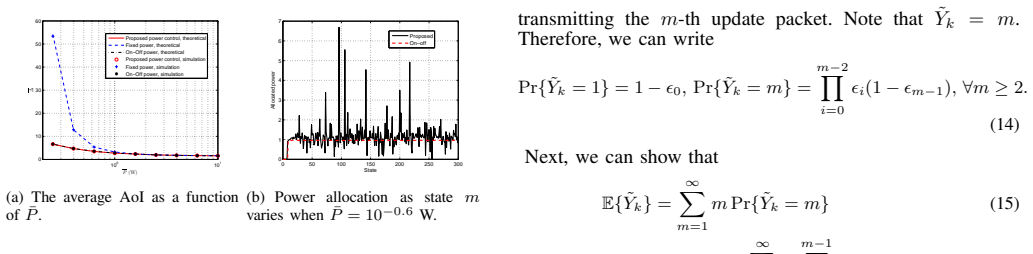
For a status update system in which a new fixed-rate packet is generated every slot, no retransmission is used, and the transmit power $P_m$ is chosen only according to the number $m$ of consecutive NACKs already received, the average age of information over independent block fading is $\Delta = \frac{3}{2} + \frac{\sum_{j=0}^\infty j \xi_j}{\sum_{j=0}^\infty \xi_j}$ with $\xi_0 = 1$, $\xi_j = \prod_{m=0}^{j-1} \epsilon_m$, and $\epsilon_m = \Pr\{z < (2^R - 1)/P_m\}$. This makes age a function only of the state-dependent decoding failure probabilities, so power-control design becomes a nonconvex optimization over those probabilities subject to the average power constraint $\sum_m P_m \pi_m \le \bar{P}$. In Rayleigh fading with $R=1$, the optimized policy jumps transmit power upward after roughly seven consecutive failures, shortening the longest failure runs and cutting average age by more than 80 percent at $\bar{P} = 10^{-0.6}$ W; simulations confirm the closed form.
Load-bearing premise
The derivation assumes the channel fades independently from slot to slot, so the probability that the next attempt fails depends only on the power just used and not on the history of failures; if fading is correlated across slots, the formula does not hold.
Editorial extensions
If this is right
- The closed-form age expression gives a tractable objective, so the power-control policy can be designed offline once channel statistics are known, with each search iteration requiring only the evaluation of the formula.
- In the low-power regime, the optimized policy concentrates power on later failure states, indicating that breaking long failure streaks matters more than protecting the first transmission attempt.
- At high average power, constant-power transmission nearly matches the optimized policy, and both approaches approach the lower bound $\Delta \ge 1.5$.
- An on-off policy that transmits only after at least $\tau$ consecutive failures is nearly age-optimal at low power, offering a simple implementation without per-state power tuning.
Reading between the lines
- The numerical threshold at state 7 suggests a conjecture the paper does not prove: for Rayleigh fading and fixed rate, the optimal NACK-based policy may be exactly on-off; proving that would explain why the on-off heuristic performs so well.
- The formula is specific to independent block fading; under correlated fading or finite-blocklength coding, the factorization $\epsilon_m = \Pr\{z < (2^R-1)/P_m\}$ changes, so the closed form should be treated as a baseline rather than a universal law.
- The reported 80 percent reduction is demonstrated for a particular Rayleigh scenario with $R=1$ and $\bar{P}=10^{-0.6}$ W; transferring that number to other channel distributions or rates is an extrapolation, not a claim of the paper.
Signed reviews
Editorial analysis
A structured set of objections, weighed in public.
Referee Report
Summary. This paper considers a status update system in which the source transmits one fixed-rate packet per slot over a block fading channel and can adapt transmit power based on the number of consecutive NACKs received. The main contribution is a closed-form expression for the average AoI (Theorem 1) in terms of the outage probabilities ε_m. Based on this expression, the authors formulate a non-convex, average-power-constrained AoI minimization problem (11) and propose a simulated-annealing/evolutionary search algorithm (Algorithm 1), together with a simpler on-off power policy. Numerical results over Rayleigh fading show that the proposed policies reduce the average AoI relative to fixed-power transmission, particularly in the low-power regime.
Significance. If Theorem 1 stands, it provides a clean and useful objective for NACK-based power adaptation, which was not available in closed form for this model. The paper validates the formula against simulation and identifies a simple on-off policy that nearly matches the heuristic search, which is a useful engineering insight. However, the optimality claim in the title is not supported: Algorithm 1 is a heuristic with no convergence or optimality certificate, and the algorithm as stated contains undefined variables and does not enforce that candidate probabilities lie in [0,1]. The closed-form derivation and numerical comparison are nevertheless valuable, and the issues are correctable by reframing the claims and tightening the algorithm.
major comments (3)
- [Section III, Eq. (11), Algorithm 1] The paper's title and Section III claim 'age-optimal power control', but Algorithm 1 is a stochastic search with no proof of convergence to a global or even local optimum of (11). It generates candidates via Cauchy perturbations in (12) without enforcing ε'∈[0,1], and it checks the average-power constraint only at evaluated points without a feasibility certificate for the continuous problem. The abstract's phrase 'a feasible solution' is the accurate description. Please revise the title and main claims to reflect that the contribution is a heuristic with empirical improvement, or provide an optimality/convergence analysis.
- [Remark 2] The fixed-power average AoI is computed incorrectly. Substituting ξ_j = p^j into (9) yields Δ = 3/2 + p/(1-p) = (3-p)/(2(1-p)), not (3-2p)/(2(1-p)). This baseline is used in Section IV, so the displayed formula and any theoretical fixed-power curve derived from it must be corrected.
- [Algorithm 1] The temperature schedule in line 5, Tn = T0/n, uses an undefined counter n; as written, n is not initialized or incremented, so the temperature does not decrease. Additionally, lines 7–8 are underspecified: what is 'A' and how is the average power P̂ computed from it? Because candidate ε' is not clamped to [0,1], the Markov chain in (1) may be invalid for generated candidates. Please specify the algorithm precisely and add bounds on ε'.
minor comments (4)
- [References] References [8] and [9] are identical in title and venue; one should be removed or corrected.
- [References] Reference [12] has incomplete publication data ("vol. pp, no. 99"); please provide the full citation.
- [Section II-A] The system model states that 'no retransmission is needed' yet the NACK-based power adaptation implies the source tracks failed packets; clarify that each slot transmits a new packet and NACKs only determine the power level.
- [Fig. 3(b)] The on-off power policy's switch point τ is not indicated in Fig. 3(b); adding a marker or annotation would improve readability.
Circularity Check
No significant circularity: the AoI formula is derived from the stated Markov/renewal model, and the power-control problem uses that derived objective; the absence of an optimality guarantee is a correctness/scope concern, not circularity.
full rationale
The paper's central derivation is self-contained. Theorem 1 is obtained by carrying out the renewal argument in Appendix A: the inter-success interval Y_k has distribution Pr{Y_k=1}=1-eps_0 and Pr{Y_k=m}=prod_{i=0}^{m-2} eps_i (1-eps_{m-1}) for m>=2, and the identities E[Y_k]=sum_j xi_j and E[Y_k^2]=2 sum_j j xi_j + sum_j xi_j are algebraic consequences of the definition xi_j=prod_{m=0}^{j-1} eps_m. Substituting these into the standard trapezoidal age formula Delta=1+E[Y_k^2]/(2E[Y_k]) yields Delta=3/2 + (sum j xi_j)/(sum xi_j). The derivation nowhere assumes the target formula, nor is any fitted parameter renamed as a prediction. The optimization problem (11) minimizes this derived Delta subject to the average-power constraint, which is standard use of a derived objective rather than circular reasoning. The numerical validation compares the formula against simulation of the channel model, providing an external check. The main caveat is that Algorithm 1 is a stochastic search with no optimality certificate, so the paper's title-level 'age-optimal' claim is stronger than what is proven; the abstract appropriately says 'feasible solution,' and this is a correctness risk rather than a circularity. The block-fading independence assumption is explicitly stated and limits scope, but it is not assumed through the conclusion. Self-citations play no load-bearing role: the cited reindexing argument in [11] is used only as background and is reproducible from the paper's own equations. Therefore the appropriate circularity score is 0.
Assumptions & free parameters
free parameters (4)
- Initial temperature T0 =
1
- Minimum temperature Tmin =
not specified in paper
- Inner iterations N =
not specified in paper
- Truncation state M =
300
assumptions (4)
- domain assumption Channel gains z[m] are independent and identically distributed across slots (block fading).
- domain assumption NACK feedback is received without error, and no ACK is needed.
- domain assumption A new status update packet is generated and transmitted every time slot, so there is no queue.
- domain assumption The transmitter knows only the channel distribution, not the instantaneous channel state.
Cite this review
Pith. "Pith review of Age-Optimal Power Control for Status Update Systems with Packet Based Transmissions." pith.science (2026). https://pith.science/paper/6LLKEMKH
@misc{pith2026190802429,
  author       = {Pith},
  title        = {Pith review of: Age-Optimal Power Control for Status Update Systems with Packet Based Transmissions},
  year         = {2026},
  howpublished = {\url{https://pith.science/paper/6LLKEMKH}},
  note         = {Machine review of arXiv:1908.02429}
}
read the original abstract
This paper investigates the average age of information (AoI) minimization in status update systems in which the update packets are transmitted with fixed rate. It is assumed that the source avoids queue-induced delay by generating and sending a new status update packet in each time slot. Assuming that the transmit power can be adapted based on the number of successive NACKs (negative acknowledgements) received, a closed-form expression for the average AoI is derived considering transmissions over block fading channel models. An optimization problem for minimizing the average AoI under average power constraints is formulated and a stochastic optimization algorithm for obtaining a feasible solution is proposed. Numerical results on the proposed power control policy show that more power is preferred to be allocated to packets after a certain number of failure packets in the low-power regime and the proposed power control reduces the average AoI compared to the constant power policy. An alternative on-off power control policy is also proposed and shown to achieve satisfactory performance.
Figures


Reference graph
Works this paper leans on
-
[1]
S. Kaul, R. Y ates, M. Gruteser, Real-time status: How oft en should one update?, in: Proc. IEEE International Conference on Comput er Commu- nications (INFOCOM), 2012. doi:10.1109/INFCOM.2012.619 5689
-
[2]
On the age of in formation in status update systems with packet management,
M. Costa, M. Codreanu, and A. Ephremides, “On the age of in formation in status update systems with packet management,” IEEE Trans. Inf. Theory, vol. 62, no. 4, pp. 1897 - 1910, Apr. 2016
work page 1910
-
[3]
Update or wait: how to keep your data fresh,
Y . Sun et al. , “Update or wait: how to keep your data fresh,” IEEE Trans. Inf. Theory , vol. 63, no. 11, pp. 7492-7508, Nov. 2017
work page 2017
-
[4]
Optimal status update for age of information minimization with an energy harvesting source,
X. Wu, J. Y ang, and J. Wu, “Optimal status update for age of information minimization with an energy harvesting source,” IEEE Trans. Green Commun. Netw., vol. 2, no. 1, pp. 193-204, Mar. 2018
work page 2018
-
[5]
Age of informatio n in energy harvesting status update systems: when to preempt in servic e?
S. Farazi, A. G. Klein, and D. R. Brown, “Age of informatio n in energy harvesting status update systems: when to preempt in servic e?” in 2018 IEEE Internation Symposium on Information Theory (ISIT), p p. 2436- 2440, V ail, Colorado, June 2018
work page 2018
-
[6]
On the age of information with packet deadlines,
C. Kam et al., “On the age of information with packet deadlines,” IEEE Trans. Inf. Theory , vol. 64, no. 9, pp. 6419-6428, Sep. 2018
work page 2018
-
[7]
Average age of inform ation with hybrid ARQ under a resource constraint,
E. Ceran, D. Gunduz, and A. Gyorgy, “Average age of inform ation with hybrid ARQ under a resource constraint,” IEEE WCNC 2018
work page 2018
-
[9]
Age-optimal channel coding blocklength for an M/G/1 queue with HARQ,
H. Sac, T. Bacinoglu, E. Uysal-Biyikoglu, and G. Durisi, “Age-optimal channel coding blocklength for an M/G/1 queue with HARQ,” IE EE SPAWC 2018
work page 2018
Show all 13 references
-
[10]
Age of information for transmissi ons over Markov channels,
L. Huang and L. Qian, “Age of information for transmissi ons over Markov channels,” in 2017 IEEE Global Communications Confe rence (Globecom), Singapore, Dec. 2017
2017
-
[11]
Energy-age tradeoff in stat us update communication systems with retransmission,
J. Gong, X. Chen, and X. Ma, “Energy-age tradeoff in stat us update communication systems with retransmission,” to appear at t he IEEE Globecom 2018. Available: https://arxiv.org/abs/1808.0 1720
2018
-
[12]
On optimi zing power allocation for reliable communication over fading ch annels with uninformed transmitter,
M. M. Butt, E. A. Jorswieck, and N. Marchetti, “On optimi zing power allocation for reliable communication over fading ch annels with uninformed transmitter,” IEEE Trans. Wireless Commun. , vol. pp, no. 99, pp. 1-1, 2018
2018
-
[13]
Fast simulated annealing,
H. Szu and R. Hartley, “Fast simulated annealing,” Physics Letters A , vol. 122, no. 3-4, pp. 157C162, June 1987
1987
-
[14]
Evolutionary programming ma de faster,
X. Y ao, Y . Liu, and G. Lin, “Evolutionary programming ma de faster,” IEEE Trans. Evolution. Comp. , vol. 3, no. 2, pp. 82-102, July 1999. 4
1999
Reviewed August 14, 2026 · model on record in the stance chip above.
Discussion (0). Continue with ORCID to comment.