REVIEW 3 major objections 6 minor 43 references
Learning Predictive Checklists with Probabilistic Logic Programming
T0 review · 3 major / 6 minor · reviewed 2026-08-12 · deepseek-v4-flash
Pith's one-line read This paper proposes ProbChecklist, which learns predictive checklists—'at least T of M binary conditions' rules—directly from images, time series, and text by treating the checklist as a probabilistic logic program.
desk verdict Extends checklist learning to images, time series, and text via a differentiable Poisson-binomial objective; the independence assumption is unstated and the fairness framing overreaches, but the core idea is sound and deserves peer review. read the letter →
The pith
A machine-rendered reading of the paper's core claim, the machinery that carries it, and where it could break.
The reading
What carries the argument
The central object is a probabilistic logic program whose logical rule is the checklist: each learned concept is a probabilistic fact, and the query 'at least T concepts are true' is evaluated by Eq. (3), summing over all binary selection vectors. This equation carries the argument because it converts a discrete combinatorial rule into a differentiable probability: under the assumption that concepts are independent Bernoulli variables, the probability of exactly d true concepts is the sum of products ∏ pi[j]^σ(j)(1−pi[j])^(1−σ(j)), and the positive-class probability is the tail sum d≥T. The same logical-rule machinery is reused for decision trees, with branch probabilities expressed as products over node outcomes, and balanced-tree regularizers are added to keep splits informative.
What would settle it
Take a synthetic dataset where concepts are generated with known correlation, such as two concepts that always share the same value, train ProbChecklist, and compare the predicted probability of a positive label on held-out data with the empirical fraction after binarization at τ. If Eq. (3) is at fault, the predicted probability will be misestimated whenever correlated concepts fire together.
Extended reading notes
Core claim
The central claim is that the discrete structure of a checklist can be learned end-to-end from arbitrary continuous inputs by reformulating it as a probabilistic logic program. Concept extractors map each modality to probabilities pi[j]=P(concept j true), and the checklist rule 'predict positive if at least T concepts are true' becomes a query whose probability is the sum over all subsets of concepts of size T or more of the product of concept probabilities. This query probability is used in a log-likelihood loss, so gradients flow through the concept extractors; at inference the probabilities are binarized with threshold τ and unused concepts are pruned, yielding a discrete checklist. The paper reports that on MNIST synthetic sequences, PhysioNet sepsis, MIMIC-III mortality, and medical abstracts, ProbChecklist outperforms checklist baselines such as ILP and MIP and is competitive with non-interpretable CNN, LSTM, and BERT models, and that a fairness regularizer substantially reduces ΔFPR and ΔFNR across gender and ethnicity subgroups. It also frames decision trees as logical rules and learns a checklist of decision trees as a proof-of-concept.
Load-bearing premise
The load-bearing premise is that the learned binary conditions behave independently when the model combines their probabilities into the chance that at least T are true; if the conditions are actually correlated, the checklist's training probability is misspecified.
Editorial extensions
If this is right
- If ProbChecklist generalizes as reported, predictive checklists can be trained end-to-end on raw clinical time series and images, removing the need to hand-engineer summary features or solve integer programs.
- The threshold τ provides an explicit sensitivity-specificity dial after training, so the same learned concepts can be deployed for conservative screening or specific confirmation.
- Fairness regularization can reduce across-group FPR and FNR gaps, making checklist-based decisions more equitable without abandoning interpretability.
- Because the same probabilistic-logic machinery learns decision trees and checklists of trees, the approach extends the discrete-model family beyond a single linear checklist.
- The reported performance on clinical notes suggests text-based checklists can be generated from documentation alone, easing checklist design in data-rich settings.
Reading between the lines
- The independence assumption in Eq. (3) is untested; a direct extension would be to add pairwise correlation terms or a copula to the concept probabilities and check whether calibrated probability improves, since inference would remain a discrete checklist.
- Because concepts are learned from data, the method can surface candidate clinical findings—such as a rise in heart rate around hours 12–17—that clinicians might not have specified in advance; this hypothesis-generation use is not developed in the paper.
- A reader could test scalability by replacing the exponential 2^M enumeration with relaxed k-subset sampling; the paper mentions this as a future direction, so it is a natural next step rather than a demonstrated result.
- The fairness analysis suggests a broader claim: that checklist classifiers, due to their simplicity, allow fairness gaps to be audited item-by-item; the paper does not make this claim explicitly.
Editorial analysis
A structured set of objections, weighed in public.
Referee Report
Summary. The paper proposes ProbChecklist, a framework for learning predictive checklists from high-dimensional data modalities. For each modality, a neural concept extractor outputs soft concept probabilities; these are passed to a probabilistic logic module that computes the probability that at least T of M concepts fire, yielding a differentiable training objective. At inference, the concept probabilities are thresholded to form a hard checklist. The method is evaluated on a synthetic MNIST checklist task, PhysioNet sepsis prediction (tabular and time series), MIMIC-III mortality prediction, and Medical Abstracts neoplasm detection, with comparisons to ILP/MIP checklist baselines and standard neural baselines. The paper also introduces interpretability regularization, a fairness penalty, and an extension to checklists of decision trees. The central claim is that ProbChecklist is the first approach that learns predictive checklists directly from images, time series, and text while remaining interpretable and competitive with deep classifiers.
Significance. If the result holds, the paper addresses a genuine gap: existing checklist-learning methods are limited to Boolean or tabular inputs, whereas ProbChecklist provides an end-to-end differentiable alternative to integer programming for high-dimensional modalities. The paper has real strengths: it includes a synthetic ground-truth checklist for validation, experiments across images, time series, and text, a fairness analysis, an interpretability study of the learned concepts, and an anonymous code link. The main caveat is that the training probability in Eq. (3) depends on an independence assumption that is not stated; the significance of the empirical results is conditional on that assumption being made explicit and on its robustness being examined. The checklist-of-trees extension is a useful flexibility demonstration, although its experiments are limited to synthetic data.
major comments (3)
- [Section 4.4, Proposition 4.1, Eq. (3)] Equation (3) is exact only under an independence assumption that is never stated: the binary indicators c_i[j] must be conditionally independent given x_i, with margins p_i[j]. The text defines p_i[j] = P(c_i[j] = 1), which gives only marginal probabilities; a joint distribution is needed to compute P(sum_j c_i[j] >= T). If the independence is intended through the probabilistic-logic-programming convention that probabilistic facts are independent, this should be stated explicitly near Eq. (3) and the consequences of correlated concept extractors should be discussed; if it is not intended, Eq. (3) is not the probability of the checklist query. The proof's reference to a 'binomial distribution' is also inaccurate, since the product formula is the Poisson-binomial tail for independent but non-identically distributed Bernoulli variables. Because Eq. (3) defines the training loss, this missing assumption is load-bearing for the claim that the architecture computes the probability of the checklist.
- [Section 5.1 and Appendix E.2] The synthetic MNIST experiment is presented as a validation that ProbChecklist recovers a known checklist, but no quantitative recovery result is reported. Table 1 gives accuracy (96.8%) but not the correspondence between the 16 learned concepts (d'_k = 4 per image, T about 8.4) and the four ground-truth item rules (one per image, T = 3). The qualitative gradient analysis in Figure 4b is suggestive, but it does not establish that the learned checklist matches the intended rule set. Please report a recovery measure, such as per-concept rule match rates, the binarized checklist actually deployed, or an alignment score between learned and ground-truth concepts.
- [Section 4.5 and Appendix E.8] Training optimizes the soft probability in Eq. (3), while deployment uses hard thresholded concepts c_i[j] = I[p_i[j] > tau], with tau chosen after training and not appearing in the loss. Appendix E.8 documents the resulting gap in 'Model' versus 'Checklist' rows, but the paper does not analyze whether the soft objective is a reliable surrogate for the discrete checklist. Since the central deliverable is the discrete checklist, please either incorporate the binarization into the training objective through a differentiable relaxation, or provide a direct analysis of when the gap is small and how the tau selection procedure affects the final checklist's properties.
minor comments (6)
- [Table 1] In the PhysioNet tabular row, the entry '0.815 ± 0.185S' contains a stray 'S', and the row layout makes the values of d'_k, M, and T difficult to parse; please reformat.
- [Section 4.7 and Figure 7] The symbol T is used both for the checklist threshold and for the number of trees ('a total of T trees, with tau the checklist thresholding parameter'), redefining a symbol already introduced in Eq. (1); please use a distinct symbol.
- [Section 4.7 and Appendix A.4] The depth notation is inconsistent: Eq. (6) says L = 2 but uses two leaf probabilities p[2,1] and p[2,2], whereas Appendix A.4 defines L layers with 2^{L-1} leaf nodes; please align the definitions.
- [Abstract and Section 5.1] The abstract and main text refer to 'clinical notes', but the Medical Abstracts TC Corpus consists of medical abstracts; please align the terminology.
- [Section 5.1 and Table 1] Several claims of 'significantly improved performance' are made without significance tests, and on the PhysioNet tabular benchmark ProbChecklist's accuracy (62.579 ± 2.58) is not higher than the MIP baseline's (63.688 ± 2.437); please add statistical tests or soften the wording.
- [Appendix F.1, Eq. (12)] The denominator '||a_j(x_i)||2,||a_l(x_i)||2' appears malformed and should presumably be the product of the two norms; please fix the typo.
Circularity Check
No significant circularity found: the checklist probability is computed directly from concept probabilities, and empirical validation uses independent external benchmarks.
full rationale
The paper's central derivation is self-contained. Equation (3) computes the probability that at least T concepts are true by summing, over all subsets of size d >= T, the product of the individual concept probabilities; this is a direct computation from the model's own probabilistic facts, not an identity with any fitted quantity or with the training labels. The synthetic MNIST checklist is an external ground-truth benchmark constructed independently of the training objective, and the clinical datasets are standard public benchmarks, so the reported evaluations are not derived from the method's inputs. The checklist threshold T and the number of concepts d'_k are explicitly declared hyperparameters, and the binarization threshold tau is tuned on validation data, so no fitted parameter is renamed as a prediction. Self-citations such as Makhija et al. (2022) and Zhang et al. (2021) are presented as prior checklist-learning baselines that the paper extends, not as load-bearing evidence that forces the proposed method. The independence assumption implicit in the product form of Equation (3) is a potential statistical misspecification concern for correlated concepts, but it is a modeling assumption, not circularity: the derivation does not reduce to its inputs by construction. Appendix L candidly lists limitations such as exponential memory complexity and the difficulty of interpreting learnt concepts, and these do not reveal any circular step. Therefore, no equation or claim in the paper is equivalent to its own inputs by definition, and the appropriate circularity score is 0.
Assumptions & free parameters
free parameters (5)
- T (checklist threshold) =
3.6 to 9.6 across datasets
- d'_k (concepts per modality) =
1 to 6 across experiments
- tau (binarization threshold) =
e.g., 0.5 for MNIST (Table 4)
- TANGOS regularization weights =
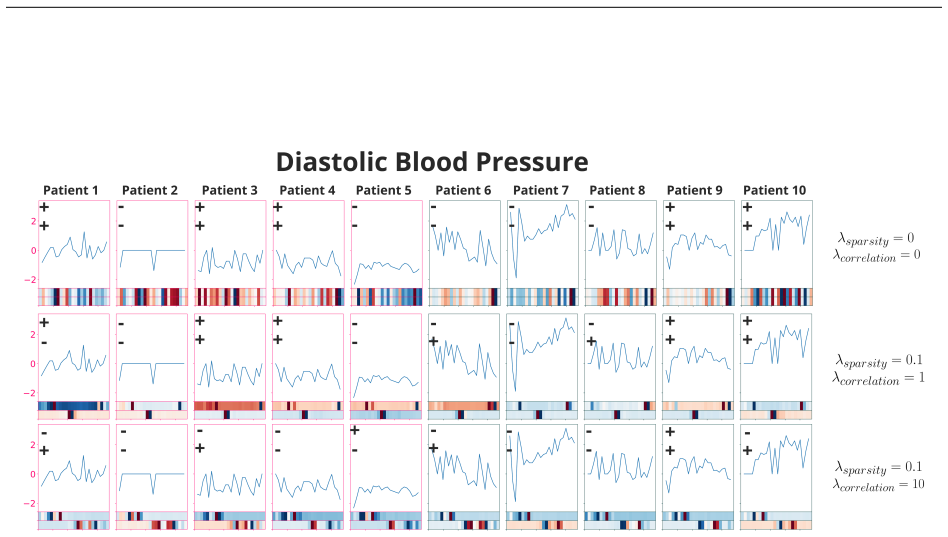
lambda_sparsity and lambda_correlation varied, e.g., 10 and 1, or 0.1 and 10
- Fairness regularization weight lambda =
not specified
assumptions (4)
- domain assumption Concept Bernoulli variables are independent given their probabilities in Eq. (3)
- domain assumption Soft-trained concept probabilities can be binarized at tau with acceptable performance loss
- domain assumption Gradient attributions and token lists provide meaningful interpretations of learned concepts
- domain assumption Top-10 feature selection using logistic regression weights is leakage-free
Cite this review
Pith. "Pith review of Learning Predictive Checklists with Probabilistic Logic Programming." pith.science (2026). https://pith.science/paper/6LO7NGWD
@misc{pith2026241116790,
  author       = {Pith},
  title        = {Pith review of: Learning Predictive Checklists with Probabilistic Logic Programming},
  year         = {2026},
  howpublished = {\url{https://pith.science/paper/6LO7NGWD}},
  note         = {Machine review of arXiv:2411.16790}
}
read the original abstract
Checklists have been widely recognized as effective tools for completing complex tasks in a systematic manner. Although originally intended for use in procedural tasks, their interpretability and ease of use have led to their adoption for predictive tasks as well, including in clinical settings. However, designing checklists can be challenging, often requiring expert knowledge and manual rule design based on available data. Recent work has attempted to address this issue by using machine learning to automatically generate predictive checklists from data, although these approaches have been limited to Boolean data. We propose a novel method for learning predictive checklists from diverse data modalities, such as images and time series. Our approach relies on probabilistic logic programming, a learning paradigm that enables matching the discrete nature of checklist with continuous-valued data. We propose a regularization technique to tradeoff between the information captured in discrete concepts of continuous data and permit a tunable level of interpretability for the learned checklist concepts. We demonstrate that our method outperforms various explainable machine learning techniques on prediction tasks involving image sequences, time series, and clinical notes.
Figures


Figures from the paper (11 more)




Reference graph
Works this paper leans on
-
[1]
Interpretable machine learning in healthcare
Muhammad Aurangzeb Ahmad, Carly Eckert, and Ankur Teredesai. Interpretable machine learning in healthcare. In Proceedings of the 2018 ACM international conference on bioinformatics, computational biology, and health informatics, pp.\ 559--560, 2018
work page 2018
-
[2]
SIMPLE : A gradient estimator for \ k\ -subset sampling
Kareem Ahmed, Zhe Zeng, Mathias Niepert, and Guy Van den Broeck. SIMPLE : A gradient estimator for \ k\ -subset sampling. In ICML 2023 Workshop on Differentiable Almost Everything: Differentiable Relaxations, Algorithms, Operators, and Simulators, 2023. URL https://openreview.net/forum?id=lmYGbAdCLN
work page 2023
-
[3]
Publicly available clinical BERT embeddings
Emily Alsentzer, John Murphy, William Boag, Wei-Hung Weng, Di Jin, Tristan Naumann, and Matthew McDermott. Publicly available clinical BERT embeddings. In Proceedings of the 2nd Clinical Natural Language Processing Workshop, pp.\ 72--78, Minneapolis, Minnesota, USA, June 2019. Association for Computational Linguistics. doi:10.18653/v1/W19-1909. URL https:...
-
[4]
Explainable artificial intelligence (xai): Concepts, taxonomies, opportunities and challenges toward responsible ai
Alejandro Barredo Arrieta, Natalia D \' az-Rodr \' guez, Javier Del Ser, Adrien Bennetot, Siham Tabik, Alberto Barbado, Salvador Garc \' a, Sergio Gil-L \'o pez, Daniel Molina, Richard Benjamins, et al. Explainable artificial intelligence (xai): Concepts, taxonomies, opportunities and challenges toward responsible ai. Information fusion, 58: 0 82--115, 2020
2020
-
[5]
Towards Explainable Neural-Symbolic Visual Reasoning
Adrien Bennetot, Jean-Luc Laurent, Raja Chatila, and Natalia D \' az-Rodr \' guez. Towards explainable neural-symbolic visual reasoning. arXiv preprint arXiv:1909.09065, 2019
work page Pith review arXiv 1909
-
[6]
The measure and mismeasure of fairness: A critical review of fair machine learning, 2018
Sam Corbett-Davies and Sharad Goel. The measure and mismeasure of fairness: A critical review of fair machine learning, 2018
work page 2018
-
[7]
The potential for artificial intelligence in healthcare
Thomas Davenport and Ravi Kalakota. The potential for artificial intelligence in healthcare. Future healthcare journal, 6 0 (2): 0 94, 2019
work page 2019
-
[8]
Predicting the impact of treatments over time with uncertainty aware neural differential equations
Edward De Brouwer, Javier Gonzalez, and Stephanie Hyland. Predicting the impact of treatments over time with uncertainty aware neural differential equations. In International Conference on Artificial Intelligence and Statistics, pp.\ 4705--4722. PMLR, 2022
work page 2022
Show all 43 references
-
[9]
Probabilistic (logic) programming concepts
Luc De Raedt and Angelika Kimmig. Probabilistic (logic) programming concepts. Machine Learning, 100 0 (1): 0 5--47, 2015
2015
-
[10]
Techniques for interpretable machine learning
Mengnan Du, Ninghao Liu, and Xia Hu. Techniques for interpretable machine learning. Communications of the ACM, 63 0 (1): 0 68--77, 2019
2019
-
[11]
A guide to deep learning in healthcare
Andre Esteva, Alexandre Robicquet, Bharath Ramsundar, Volodymyr Kuleshov, Mark DePristo, Katherine Chou, Claire Cui, Greg Corrado, Sebastian Thrun, and Jeff Dean. A guide to deep learning in healthcare. Nature medicine, 25 0 (1): 0 24--29, 2019
2019
-
[12]
Robinson, Jad Farha, Amanda Bradke, Sherita H
Ashraf Fawzy, Tianshi David Wu, Kunbo Wang, Matthew L. Robinson, Jad Farha, Amanda Bradke, Sherita H. Golden, Yanxun Xu, and Brian T. Garibaldi. Racial and Ethnic Discrepancy in Pulse Oximetry and Delayed Identification of Treatment Eligibility Among Patients With COVID-19 . J...
2022
-
[13]
The myth of generalisability in clinical research and machine learning in health care
Joseph Futoma, Morgan Simons, Trishan Panch, Finale Doshi-Velez, and Leo Anthony Celi. The myth of generalisability in clinical research and machine learning in health care. The Lancet Digital Health, 2 0 (9): 0 e489--e492, 2020
2020
-
[14]
A review of challenges and opportunities in machine learning for health
Marzyeh Ghassemi, Tristan Naumann, Peter Schulam, Andrew L Beam, Irene Y Chen, and Rajesh Ranganath. A review of challenges and opportunities in machine learning for health. AMIA Summits on Translational Science Proceedings, 2020: 0 191, 2020
2020
-
[15]
Development of medical checklists for improved quality of patient care
Brigette Hales, Marius Terblanche, Robert Fowler, and William Sibbald. Development of medical checklists for improved quality of patient care . International Journal for Quality in Health Care, 20 0 (1): 0 22--30, 12 2007. ISSN 1353-4505. doi:10.1093/intqhc/mzm062. URL https:/...
2007 doi
-
[16]
Development of medical checklists for improved quality of patient care
Brigette Hales, Marius Terblanche, Robert Fowler, and William Sibbald. Development of medical checklists for improved quality of patient care. International Journal for Quality in Health Care, 20 0 (1): 0 22--30, 2008
2008
-
[17]
A surgical safety checklist to reduce morbidity and mortality in a global population
Alex B Haynes, Thomas G Weiser, William R Berry, Stuart R Lipsitz, Abdel-Hadi S Breizat, E Patchen Dellinger, Teodoro Herbosa, Sudhir Joseph, Pascience L Kibatala, Marie Carmela M Lapitan, et al. A surgical safety checklist to reduce morbidity and mortality in a global populat...
2009
-
[18]
TANGOS : Regularizing tabular neural networks through gradient orthogonalization and specialization
Alan Jeffares, Tennison Liu, Jonathan Crabb \'e , Fergus Imrie, and Mihaela van der Schaar. TANGOS : Regularizing tabular neural networks through gradient orthogonalization and specialization. In The Eleventh International Conference on Learning Representations, 2023. URL http...
2023
-
[19]
Fair multimodal checklists for interpretable clinical time series prediction
Qixuan Jin, Haoran Zhang, Thomas Hartvigsen, and Marzyeh Ghassemi. Fair multimodal checklists for interpretable clinical time series prediction. In NeurIPS 2022 Workshop on Learning from Time Series for Health, 2022. URL https://openreview.net/forum?id=y4mt_fTy6MY
2022
-
[20]
Johnson, Tom J
Alistair E.W. Johnson, Tom J. Pollard, Lu Shen, Li-wei H. Lehman, Mengling Feng, Mohammad Ghassemi, Benjamin Moody, Peter Szolovits, Leo Anthony Celi, and Roger G. Mark. Mimic-iii, a freely accessible critical care database. Scientific Data, 3 0 (1), 2016. doi:10.1038/sdata.2016.35
2016 doi
-
[21]
Learning predictive and interpretable timeseries summaries from icu data
Nari Johnson, Sonali Parbhoo, Andrew Ross, and Finale Doshi velez. Learning predictive and interpretable timeseries summaries from icu data. AMIA ... Annual Symposium proceedings. AMIA Symposium, 2021: 0 581--590, 02 2022
2021
-
[22]
Concept bottleneck models
Pang Wei Koh, Thao Nguyen, Yew Siang Tang, Stephen Mussmann, Emma Pierson, Been Kim, and Percy Liang. Concept bottleneck models. 2020
2020
-
[23]
Introduction to statistical relational learning
Daphne Koller, Nir Friedman, Sa s o D z eroski, Charles Sutton, Andrew McCallum, Avi Pfeffer, Pieter Abbeel, Ming-Fai Wong, Chris Meek, Jennifer Neville, et al. Introduction to statistical relational learning. MIT press, 2007
2007
-
[24]
Bach, and Jure Leskovec
Himabindu Lakkaraju, Stephen H. Bach, and Jure Leskovec. Interpretable decision sets: A joint framework for description and prediction. In Proceedings of the 22nd ACM SIGKDD International Conference on Knowledge Discovery and Data Mining, KDD '16, pp.\ 1675–1684, New York, NY,...
2016
-
[25]
Learning predictive checklists from continuous medical data
Yukti Makhija, Edward De Brouwer, and Rahul G Krishnan. Learning predictive checklists from continuous medical data. arXiv preprint arXiv:2211.07076, 2022
2022 arXiv
-
[26]
Deepproblog: Neural probabilistic logic programming
Robin Manhaeve, Sebastijan Dumancic, Angelika Kimmig, Thomas Demeester, and Luc De Raedt. Deepproblog: Neural probabilistic logic programming. Advances in Neural Information Processing Systems, 31, 2018
2018
-
[27]
Not all neuro-symbolic concepts are created equal: analysis and mitigation of reasoning shortcuts
Emanuele Marconato, Stefano Teso, Antonio Vergari, and Andrea Passerini. Not all neuro-symbolic concepts are created equal: analysis and mitigation of reasoning shortcuts. In Proceedings of the 37th International Conference on Neural Information Processing Systems, NIPS '23, R...
2024
-
[28]
Definitions, methods, and applications in interpretable machine learning
W James Murdoch, Chandan Singh, Karl Kumbier, Reza Abbasi-Asl, and Bin Yu. Definitions, methods, and applications in interpretable machine learning. Proceedings of the National Academy of Sciences, 116 0 (44): 0 22071--22080, 2019
2019
-
[29]
Weakly supervised knowledge transfer with probabilistic logical reasoning for o-object detection
Martijn Oldenhof, \'A d \'a m Arany, Yves Moreau, and Edward De Brouwer. Weakly supervised knowledge transfer with probabilistic logical reasoning for o-object detection. International Conference on Learning Representations (ICLR), 2023
2023
-
[30]
Pytorch: An imperative style, high-performance deep learning library
Adam Paszke, Sam Gross, Francisco Massa, Adam Lerer, James Bradbury, Gregory Chanan, Trevor Killeen, Zeming Lin, Natalia Gimelshein, Luca Antiga, Alban Desmaison, Andreas Kopf, Edward Yang, Zachary DeVito, Martin Raison, Alykhan Tejani, Sasank Chilamkurthy, Benoit Steiner, Lu ...
2019
-
[31]
A review on fairness in machine learning
Dana Pessach and Erez Shmueli. A review on fairness in machine learning. ACM Comput. Surv., 55 0 (3), feb 2022. ISSN 0360-0300. doi:10.1145/3494672. URL https://doi.org/10.1145/3494672
2022 doi
-
[32]
Statistical relational artificial intelligence: Logic, probability, and computation
Luc De Raedt, Kristian Kersting, Sriraam Natarajan, and David Poole. Statistical relational artificial intelligence: Logic, probability, and computation. Synthesis lectures on artificial intelligence and machine learning, 10 0 (2): 0 1--189, 2016
2016
-
[33]
Early prediction of sepsis from clinical data: the physionet/computing in cardiology challenge 2019
Matthew A Reyna, Chris Josef, Salman Seyedi, Russell Jeter, Supreeth P Shashikumar, M Brandon Westover, Ashish Sharma, Shamim Nemati, and Gari D Clifford. Early prediction of sepsis from clinical data: the physionet/computing in cardiology challenge 2019. In 2019 Computing in ...
2019
-
[34]
End-to-end differentiable proving
Tim Rockt \"a schel and Sebastian Riedel. End-to-end differentiable proving. Advances in neural information processing systems, 30, 2017
2017
-
[35]
A simple neural network module for relational reasoning
Adam Santoro, David Raposo, David G Barrett, Mateusz Malinowski, Razvan Pascanu, Peter Battaglia, and Timothy Lillicrap. A simple neural network module for relational reasoning. Advances in neural information processing systems, 30, 2017
2017
-
[36]
Evaluating unsupervised text classification: Zero-shot and similarity-based approaches
Tim Schopf, Daniel Braun, and Florian Matthes. Evaluating unsupervised text classification: Zero-shot and similarity-based approaches. In Proceedings of the 2022 6th International Conference on Natural Language Processing and Information Retrieval, NLPIR '22, pp.\ 6–15, New Yo...
2022
-
[37]
Li, Rodrigo Toro Icarte, and Sheila A
Maayan Shvo, Andrew C. Li, Rodrigo Toro Icarte, and Sheila A. McIlraith. Interpretable sequence classification via discrete optimization. In Proceedings of the 35th AAAI Conference on Artificial Intelligence (AAAI), 2021. URL https://ojs.aaai.org/index.php/AAAI/article/view/17161
2021
-
[38]
Mimic-extract: A data extraction, preprocessing, and representation pipeline for mimic-iii
Shirly Wang, Matthew BA McDermott, Geeticka Chauhan, Marzyeh Ghassemi, Michael C Hughes, and Tristan Naumann. Mimic-extract: A data extraction, preprocessing, and representation pipeline for mimic-iii. In Proceedings of the ACM Conference on Health, Inference, and Learning, pp...
2020
-
[39]
A bayesian framework for learning rule sets for interpretable classification
Tong Wang, Cynthia Rudin, Finale Doshi-Velez, Yimin Liu, Erica Klampfl, and Perry MacNeille. A bayesian framework for learning rule sets for interpretable classification. Journal of Machine Learning Research, 18 0 (70): 0 1--37, 2017. URL http://jmlr.org/papers/v18/16-003.html
2017
-
[40]
Revisiting score function estimators for k -subset sampling, 2024
Klas Wijk, Ricardo Vinuesa, and Hossein Azizpour. Revisiting score function estimators for k -subset sampling, 2024. URL https://arxiv.org/abs/2407.16058
2024 arXiv
-
[41]
Learning optimal predictive checklists
Haoran Zhang, Quaid Morris, Berk Ustun, and Marzyeh Ghassemi. Learning optimal predictive checklists. Advances in Neural Information Processing Systems, 34: 0 1215--1229, 2021
2021
-
[42]
Interpretable convolutional neural networks
Quanshi Zhang, Ying Nian Wu, and Song-Chun Zhu. Interpretable convolutional neural networks. In Proceedings of the IEEE Conference on Computer Vision and Pattern Recognition (CVPR), June 2018
2018
-
[43]
write newline
" write newline "" before.all 'output.state := FUNCTION n.dashify 't := "" t empty not t #1 #1 substring "-" = t #1 #2 substring "--" = not "--" * t #2 global.max substring 't := t #1 #1 substring "-" = "-" * t #2 global.max substring 't := while if t #1 #1 substring * t #2 gl...
Reviewed August 12, 2026 · model on record in the stance chip above.
Discussion (0). Continue with ORCID to comment.