REVIEW 4 major objections 6 minor 2 cited by
How Much Backtracking is Enough? Exploring the Interplay of SFT and RL in Enhancing LLM Reasoning
T0 review · 4 major / 6 minor · reviewed 2026-08-07 · deepseek-v4-flash
Pith's one-line read The paper claims that backtracking detours in SFT warm-up data improve RL training, with harder tasks needing more detours, while trajectory correctness barely matters.
desk verdict A plausible and useful empirical recipe, but the difficulty–backtrack-count law outruns the evidence; worth refereeing with a demand for seeds and a narrower claim. read the letter →
The pith
A machine-rendered reading of the paper's core claim, the machinery that carries it, and where it could break.
The reading
What carries the argument
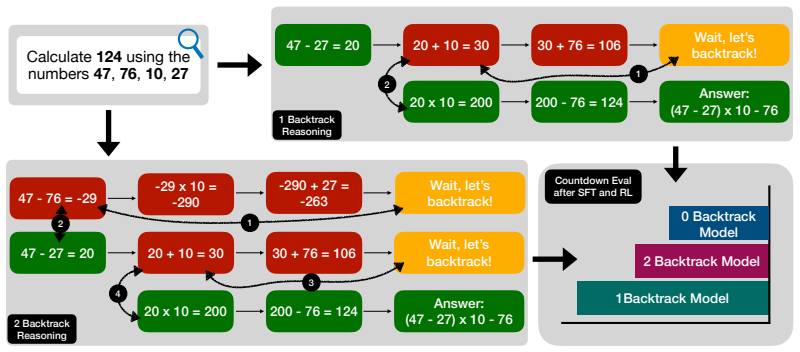
The central object is the synthetic backtracking dataset, constructed by linearizing a search-tree solution and inserting a controlled number of wrong branches as detours: for Countdown and Sudoku, a depth-first-search solver supplies the tree and each backtrack is an incorrect operation or grid fill that is later abandoned; for Arc 1D, a hand-crafted heuristic search creates a detour by choosing an incorrect transformation and retrying. Varying the number of backtracks (0, 1, 2, 3 for Countdown and Arc 1D; 0, 1, 5, 10 for Sudoku) yields SFT warm-up sets that are matched in content correctness but differ in structure. The experimental pipeline then runs PPO or GRPO with rule-based verifiable rewards from each initialization, so differences in reward trajectory and final accuracy isolate the effect of backtrack frequency.
What would settle it
Train the same SFT-plus-RL pipeline on additional tasks with known search-space sizes, using backtracks sampled from the model's own 'wait'-style behavior rather than DFS detours; if optimal backtrack count does not rise with search-space size, or if natural and synthetic backtracks diverge, the paper's central difficulty–backtrack relationship fails.
Extended reading notes
Core claim
On its own terms, the paper establishes that backtracking in SFT warm-up data is a tunable, difficulty-dependent resource for RL with verifiable rewards. Cold-start RL already lifts the base Qwen2.5-3B-Instruct model, and self-sampled short CoT warm-ups add moderate further gains, but the gains fall off on harder tasks. When synthetic SFT datasets are built with depth-first search or heuristic search and a varying number of injected detour branches, RL training follows the backtrack count: for Arc 1D (easiest) zero backtracks is optimal at 90.8% accuracy; for Countdown (moderate) one backtrack is optimal at 69.7% accuracy versus 38.9% with zero; for Sudoku (hardest) five backtracks are optimal at 28.9% versus 14.4% with zero, while one or ten backtracks cause degeneration. The paper further claims that correct and incorrect distilled trajectories converge after RL, so content correctness is not the driver, whereas shuffling prompts against completions inside the backtracking data makes RL collapse to near-zero accuracy. In short, RL amplifies the search structure it is initialized with, and the right amount of structure scales with the size of the problem's search space.
Load-bearing premise
The claim rests on treating an injected wrong branch in a search-derived trace as a faithful 'backtrack,' so the measured difficulty–backtrack curve could be an artifact of synthetic data if natural LLM backtracking behaves differently.
Editorial extensions
If this is right
- SFT warm-up data for RL should be chosen by expected search difficulty: easy tasks are best served by near-optimal traces, while hard tasks gain from several injected backtracking detours.
- Trajectory correctness is a second-order property: suboptimal or even incorrect warm-up traces can yield RL performance comparable to correct ones, so data collection effort can be redirected from filtering to structuring.
- Internal consistency between prompt and completion is load-bearing: shuffled SFT data with the right structure in the wrong place drives RL accuracy to zero on the controlled tasks.
- Backtrack-initialized small models can exceed much larger reasoning baselines on the tested tasks (Countdown 69.7% vs 51.5%, Sudoku 28.9% vs 0.0%, Arc 1D 90.8% vs 24.0% for QwQ-32B).
- Too few or too many backtracks are both harmful on hard tasks, so the optimal SFT mix is not simply more search but a difficulty-matched level of search structure.
Reading between the lines
- If the difficulty–backtrack-count relationship holds beyond the three synthetic tasks, SFT curricula could be generated automatically by estimating search-space size and injecting a proportional number of detours, without running expensive RL sweeps.
- The paper's correctness-indifference result is specific to rule-based final-answer rewards; a natural test is whether process rewards that score intermediate steps would make trajectory correctness matter again.
- Natural LLM backtracks are finer-grained (token-level 'wait' events, partial corrections, nested retries) than whole-branch detours; comparing trace granularity directly would show whether the measured optimum is an artifact of DFS-style detours.
- Shuffled-SFT collapse suggests SFT binds a reasoning template to a problem class; a testable extension is shuffling within a difficulty level to see whether binding or difficulty matching drives the effect.
Signed reviews
Editorial analysis
A structured set of objections, weighed in public.
Referee Report
Summary. The paper investigates how the choice of SFT warm-up data affects subsequent RL post-training for LLM reasoning. It compares cold-start RL against several SFT initializations (self-sampled, distilled, synthetic backtracking, and shuffled) across eight reasoning tasks. The main findings are: (1) short self-sampled CoT warm-ups give moderate gains over cold-start RL on most tasks; (2) the correctness of distilled or self-sampled trajectories has little effect on final RL performance; (3) synthetic backtracks injected into SFT data improve RL training, with the optimal number of backtracks apparently scaling with task difficulty (Arc 1D optimal 0, Countdown optimal 1, Sudoku optimal 5); and (4) shuffled (inconsistent) SFT data severely degrades RL. The paper concludes with a practical recipe: match the backtrack count in SFT warm-up to the difficulty of the task, while content correctness is secondary.
Significance. If the central claims hold, the paper provides actionable guidance for designing SFT warm-up data for verifiable-reward RL: task-matched backtrack density matters more than trajectory correctness. The study is unusually controlled: it uses rule-based rewards, multiple reasoning tasks, and openly released code, and it explicitly contrasts synthetic search-generated traces with distilled traces. The three-task correlation between task difficulty and optimal backtrack count is a striking and potentially useful empirical pattern. However, the evidence for that pattern is currently thin (three tasks, confounded axes, single-run curves), so the generality of the recipe is not yet established. The paper also makes the provocative claim that RL is largely insensitive to the correctness of long CoT traces, which deserves further scrutiny because it is based on comparisons without statistical grounding.
major comments (4)
- [Section 4.3, 'Optimal number of backtracks scales with problem difficulty'] The central claim that more challenging problems need more backtracks is inferred from exactly three tasks (Arc 1D, Countdown, Sudoku) that differ simultaneously in solver type (heuristic search vs DFS), trace length (Sudoku solutions fill 30–60 cells even at zero backtracks), branching factor, reward parsing, and baseline accuracy. The paper uses baseline accuracy as a difficulty proxy, but that measures the model's prior competence, not a property of the search space that would predict backtracking needs. No within-task difficulty manipulation is performed, so the observed ordering (0, 1, 5 backtracks) could equally be explained by trace length or by the number of decision points in the optimal solution. The abstract's claim that 'more challenging problems with larger search space tend to need higher numbers of backtracks' therefore overreaches the evidence. A within-task difficulty sweep (e.g., Countdown with different numbers of input numbers, or Sudoku with different numbers of givens) would be needed to isolate difficulty from task identity.
- [Figure 4(a-c) and Section 4.3 'Optimal number of backtracks'] The reward trajectories in Figure 4 appear to be single runs, and the text reports no seeds, error bars, or variance. The selection of the 'optimal' backtrack counts (Countdown 1, Arc 1D 0, Sudoku 5) is made by visual inspection of these single curves. The claim that certain backtrack counts yield 'more stable' training or that too many backtracks lead to 'model degeneration' is not supported by any measure of run-to-run variability. Given that the optimal counts are load-bearing for the paper's central recipe, the authors should either report multiple seeds with mean±std, or explicitly temper the stability and optimality claims to single-run observations. At minimum, the number of evaluation and training examples per condition should be stated.
- [Section 4.3, 'Building synthetic datasets'] The paper operationalizes 'backtracking' as injected incorrect branches in DFS/heuristic search trajectories. The title and abstract speak of backtracking as a general reasoning behavior, and the introduction motivates the work with LLMs' natural 'wait' and 'verify' tokens. However, the controlled experiments only vary the count of synthetic detours, not the form of natural backtracking (e.g., token-level self-correction, partial rewrites, nested retries). If these synthetic traces do not resemble how LLMs naturally backtrack, the measured relationship between backtrack count and RL performance is an artifact of the data construction. The authors should acknowledge this validity gap and, ideally, compare against a condition using naturally occurring backtracking traces or analyze whether the trained models actually produce 'wait'-type tokens after warm-up.
- [Abstract and Section 4.3, Figure 4d] The abstract states that 'longer CoT with backtracks generally induce better and more stable RL training.' This is not supported across the three tasks studied: Arc 1D shows the opposite trend, with the zero-backtrack model achieving 90.8% accuracy and performance declining as backtrack count increases. The paper's own analysis says Arc 1D is 'the easier task among three' and that 'performance declines as the number of backtracks increases.' The general statement should be qualified to reflect the task-dependent pattern, e.g., 'for sufficiently difficult tasks, longer CoT with backtracks can improve RL training, but for easier tasks backtracking may be unnecessary or harmful.' Without this qualification, the abstract misrepresents the findings.
minor comments (6)
- [Section 4.1] The sentence 'It it also worthwhile noting that short CoTs enable two distinct scaling patterns...' contains a typo ('It it' should be 'It is').
- [Section 4.3] The text says 'A vanilla The Qwen2.5-3B-Instruct baseline solves none of the test instances.' The phrase 'A vanilla The' should be corrected to 'The vanilla Qwen2.5-3B-Instruct baseline.'
- [Table 3] The QwQ-32B baseline table lists only six tasks (AG, CD, ARC, SDK, CCR, LF) and omits Zebra Puzzles and Self Reference; if these were not evaluated, this should be stated explicitly, otherwise the table should include all eight tasks.
- [Section 3.3 and Appendix B] The rollout lengths for RL are described only as '4k to 8k tokens' or '1k to 2k tokens, depending on the tasks.' Exact values for each task and each SFT condition should be listed, otherwise the experiments are not fully reproducible.
- [Section 4.3] When comparing against QwQ-32B, the paper cites reference [18] (Qwen2.5 technical report) for the Countdown accuracy of 51.5%; the correct citation for QwQ-32B is reference [26] (the QwQ blog).
- [Section 4.2, Figure 3] The claim that correct and incorrect SFT lead to 'similar behaviors' and that 'RL prioritizes structural patterns over content correctness' is based on visual inspection of reward curves and point evaluations without error bars or statistical tests; the authors should either add variance estimates or soften the causal language.
Circularity Check
No significant circularity: all load-bearing claims are empirical comparisons with external baselines and independently varied SFT inputs.
full rationale
The paper's central claims are empirical findings derived from controlled experiments, not derivations that fold their conclusions into their inputs. The warm-up comparison (Section 4.1) compares cold-start RL against RL initialized from self-sampled short CoTs; the correctness-insensitivity claim (Section 4.2) compares RL initialized from correct versus incorrect distilled trajectories; and the backtracking claim (Section 4.3) varies the number of synthetically injected backtracking detours as an independent experimental variable and measures RL reward and final accuracy. The 'optimal number of backtracks' is selected post hoc from the training curves, and the difficulty ordering of Countdown, Arc 1D, and Sudoku is based on baseline accuracy and stated search-space size, not on the RL outcome being predicted. No equation or construction defines difficulty in terms of the measured backtrack count, nor is any fitted parameter renamed as a prediction. The paper cites two works involving its own authors (Junlin Wang's [28] and [29]) and one with a coauthor (Dhingra), but these are related-work and inference-time-scaling references, not load-bearing premises for the backtracking conclusion. The skeptic's concerns about a three-task difficulty axis, confounded trace lengths, and differing solvers are legitimate threats to soundness and generalizability, but they are not circularity: the claims remain externally falsifiable comparisons against cold-start RL and QwQ-32B baselines. Therefore the honest finding is no circularity, with a score of 0.
Assumptions & free parameters
free parameters (3)
- Per-task optimal backtrack count =
Countdown: 1, Arc 1D: 0, Sudoku: 5
- Reward weights =
0.1 format, 0.9 answer
- Rollout length =
1k-2k short CoT, 4k-8k long CoT
assumptions (4)
- domain assumption Qwen2.5-3B-Instruct is a representative model for SFT/RL post-training dynamics.
- ad hoc to paper Synthetic DFS/heuristic detours are a valid operationalization of backtracking.
- domain assumption Task difficulty is captured by baseline accuracy and search-space size.
- domain assumption Rule-based final-answer rewards provide a sufficient learning signal.
Cite this review
Pith. "Pith review of How Much Backtracking is Enough? Exploring the Interplay of SFT and RL in Enhancing LLM Reasoning." pith.science (2026). https://pith.science/paper/6LTZIJQX
@misc{pith2026250524273,
  author       = {Pith},
  title        = {Pith review of: How Much Backtracking is Enough? Exploring the Interplay of SFT and RL in Enhancing LLM Reasoning},
  year         = {2026},
  howpublished = {\url{https://pith.science/paper/6LTZIJQX}},
  note         = {Machine review of arXiv:2505.24273}
}
read the original abstract
Recent advancements in large language models (LLMs) suggest that reinforcement learning (RL) effectively internalizes search strategies, yielding significant improvements on challenging reasoning tasks through extended chains of thought. While backtracking is widely viewed as the core mechanism enabling this improvement, its precise dynamics and how SFT and RL interact to optimize for it, remain poorly understood. In this work, we argue that backtracking, the ability to explicitly revisit and revise earlier reasoning steps, is a key operator that enables the transition from linear generation to non-linear tree search for LLMs, unlocking strong performance on combinatorially complex tasks. We motivate this claim by first studying the interplay between supervised fine-tuning (SFT) warm-up and RL across eight reasoning tasks: Countdown, Sudoku, Arc 1D, Advanced Geometry, Color Cube Rotation, List Functions, Zebra Puzzles, and Self Reference. We find that a regular SFT warm-up using self-sampled CoT sequences provides a modest boost to subsequent RL compared to training without any SFT warm-up; however, such gains saturate as tasks become more difficult. Motivated by this failure mode, we introduce a backtracking-centric training recipe. By synthetically varying the number of explicit backtracking steps in the SFT warm-up, we show that (i) longer CoTs containing backtracks stabilize and amplify RL, and (ii) the optimal backtrack depth scales with task difficulty: zero for Arc 1D, one for Countdown, and five or more for Sudoku. Our findings establish that principled backtracking is essential for improving the model's reasoning capability.
Figures


Figures from the paper (4 more)


Forward citations
Cited by 2 Pith papers
-
Search, Fail, Recover: A Training Framework for Correction-Aware Reasoning
Pyligent trains LLMs to search, detect failures via task validators, and backtrack to recoverable prefixes, improving solve rates by 13–73 points over gold-only SFT on hidden graphs, Sudoku, and Blocksworld.
-
SRFT: A Single-Stage Method with Supervised and Reinforcement Fine-Tuning for Reasoning
Entropy-weighted single-stage SFT+RL fine-tuning yields 59.1% average accuracy on five math benchmarks, improving on sequential and zero-RL baselines.
Reviewed August 7, 2026 · model on record in the stance chip above.
Discussion (0). Continue with ORCID to comment.