REVIEW 2 major objections 5 minor 40 references
Social Optima in Robust Mean Field LQG Control: From Finite to Infinite Horizon
T0 review · 2 major / 5 minor · reviewed 2026-08-14 · deepseek-v4-flash
Pith's one-line read A decentralized feedback law asymptotically matches the centralized worst-case social optimum in mean-field LQG populations with common drift uncertainty.
desk verdict The infinite-horizon extension is real, but the main asymptotic-optimality proof in both appendices drops quadratic terms in the perturbation of the adjoint variable; repairable, but not a finished proof. read the letter →
The pith
A machine-rendered reading of the paper's core claim, the machinery that carries it, and where it could break.
The reading
What carries the argument
The load-bearing objects are the forward-backward stochastic differential equation system that determines the worst-case drift and adjoint processes, two Riccati equations that supply the feedback gains $P$ and $K$, and the deterministic consistency ODE system (35) for the finite horizon or (63) for the infinite horizon that makes the mean-field approximation self-consistent. The social variational derivation uses person-by-person optimality: perturbing one agent's control while holding the others fixed, the zero first-order variation condition is rearranged into a single-agent optimal control problem constrained by a backward stochastic differential equation. Uniform convexity of the auxiliary problem in the control variable, meaning uniformly positive second-order curvature, is what allows the eventual $O(1/\sqrt{N})$ bound to be driven only by first-order cross terms.
What would settle it
In the paper's scalar example, set $R_1$ and $R_2$ below the thresholds $C_0 I$ used in Lemma 2.1 and compute, for increasing $N$, the gap between the decentralized cost (40) and the centralized infimum; if the gap does not decay as $O(1/\sqrt{N})$, the theorem's rate claim fails outside the large-penalty regime. For the infinite-horizon result, find parameter values where the Riccati equation (69) has no stabilizing solution; then the consistency argument in Lemma B.1 cannot hold.
Extended reading notes
Core claim
Formally, the paper studies $\inf_{u_i\in \mathcal{U}_i^F} \sup_{f} J_{\mathrm{soc}}^F(u,f)$, the social cost under the worst-case common drift. For fixed controls the adversarial drift is shown to take the feedback form $\hat f = -R_2^{-1}(P x^{(N)}+s)$, where $P$ solves the Riccati equation (10) and $s$ solves a backward stochastic differential equation. Substituting this worst-case drift into the social cost turns the problem into a mean-field LQ team problem, and the first-order variation of the social cost with respect to a single agent's control yields a representative-agent auxiliary LQ problem whose optimal control is $\hat u_i = -R_1^{-1}B^T(K x_i - P l + \phi)$. The main results, Theorems 2.4 and 3.2, state that this decentralized law has $\left|\frac{1}{N} J_{\mathrm{soc}}^{\mathrm{wo}}(\hat u) - \frac{1}{N}\inf_u J_{\mathrm{soc}}^{\mathrm{wo}}(u)\right| = O(1/\sqrt{N})$ in both the finite-horizon and infinite-horizon problems.
Load-bearing premise
The load-bearing premise is that the centralized worst-case problem has strong second-order curvature in the controls, called uniform convexity; the paper proves this only when the control and disturbance penalties are sufficiently large, while the main theorems are stated under plain convexity, so that gap must be closed for the theorems as stated.
Editorial extensions
If this is right
- For large but finite $N$, a designer can precompute mean-field trajectories and give each agent a fixed feedback law, with no online coordination among agents.
- The per-agent worst-case performance loss decays like $O(1/\sqrt{N})$, so the decentralized law is a near-optimal team solution rather than merely an equilibrium.
- The same Riccati-based design carries over to an infinite horizon under discounting and stabilizability conditions, yielding stationary feedback gains.
- The robust formulation covers common environmental shocks such as tax, subsidy, or natural disaster effects that hit every agent identically.
- Because the gap is measured under the worst-case disturbance, the guarantee holds uniformly over admissible drift realizations, not just on average.
Reading between the lines
- The paper does not claim a matching lower bound; whether any decentralized law must lose at least $O(1/\sqrt{N})$ remains an open question.
- The large-penalty conditions $R_1 > C_0 I$, $R_2 > C_0 I$ appear in the proof of uniform convexity but not in the theorem statements, so checking whether plain convexity suffices would determine whether the theorems hold exactly as stated.
- The same variational decomposition could be applied to mean-field teams with common noise whose volatility is also uncertain; the paper flags this direction but does not analyse it.
- If the consistency ODE system (35) or (63) has a solution only on a short time interval, as in the numerical example near $t=0.758$, then the asymptotic claim is confined to horizons where the Riccati and consistency equations do not blow up.
Signed reviews
Editorial analysis
A structured set of objections, weighed in public.
Referee Report
Summary. The paper studies social optimization in a mean-field LQG system with a common adversarial drift uncertainty. For the finite-horizon problem (PF), the authors characterize the worst-case disturbance through an FBSDE/Riccati analysis, construct an auxiliary single-agent problem via person-by-person optimality and a consistency system, and propose decentralized feedback laws (40). Theorem 2.4 claims that these laws are asymptotically robust social optimal with an O(1/sqrt(N)) rate. The infinite-horizon problem (PI) is treated analogously in Section III, with decentralized laws (67) and the corresponding asymptotic optimality claim in Theorem 3.2. A scalar numerical example is given in Section IV.
Significance. Robust mean-field social optimality with a common uncertain drift is a natural and useful extension of the existing mean-field LQG social optimum literature, and the paper provides a systematic construction: FBSDE-based variational analysis, low-dimensional consistency equations, Riccati-based sufficient conditions, and explicit decentralized strategies for both finite and infinite horizons. The explicit O(1/sqrt(N)) rate and the unified treatment of the two horizons are strengths, as is the perturbation framework that connects the centralized worst-case problem to local-information controls. If the proof gaps identified below are repaired, the paper would be a solid contribution to the robust mean-field control literature.
major comments (2)
- [Appendix A, Eq. (A.8); Appendix B] The expansion of J_soc(u) around \hat u is incomplete. Expanding -||P(\hat x^{(N)}+\tilde x^{(N)})+\hat s+\tilde s||^2_{R_2^{-1}} produces, in addition to the terms kept in \tilde J_i and I_i, the quadratic terms -2(P\tilde x^{(N)})^T R_2^{-1}\tilde s - ||\tilde s||^2_{R_2^{-1}} for each i, which sum to -N[2(P\tilde x^{(N)})^T R_2^{-1}\tilde s + ||\tilde s||^2_{R_2^{-1}}] in J_soc. These terms are not included in \tilde J_i or I_i. Since \tilde s is an O(1) linear function of \tilde u^{(N)} through (A.5)-(A.6), the omitted contribution is not negligible at the level of the second-order expansion. Consequently, the assertion that Lemma 2.1 gives \tilde J_i(\tilde u) \ge 0 does not establish nonnegativity of the true second variation; the omitted terms are indefinite and can make the true second variation smaller. The same omission occurs in Appendix B for Theorem 3.2. This gap is repairable—for example, by replacing \tilde J_i with the full second variation and invoking convexity of (P2)/(P2') on that full form, or by bounding the omitted O(1/N) terms directly—but the proof as written is incomplete.
- [Theorem 2.4 and Theorem 3.2; Lemmas 2.1 and 3.1] Theorem 2.4 assumes only that (P2) is convex, and Theorem 3.2 assumes only that (P2') is convex. However, the proofs in Appendices A and B invoke Lemma 2.1 and Lemma 3.1, which require the stronger hypotheses R1 > C0 I and R2 > C0 I (in addition to (A2') and (A5)-(A6), respectively). No argument is supplied that convexity of (P2)/(P2') implies these large-penalty bounds, and in infinite-dimensional LQ problems convexity does not automatically imply uniform convexity. Thus the nonnegativity step used in the asymptotic optimality argument is not justified under the stated assumptions. The theorem statements should either include the large-penalty hypotheses or provide a direct proof that convexity alone yields the needed second-order lower bound.
minor comments (5)
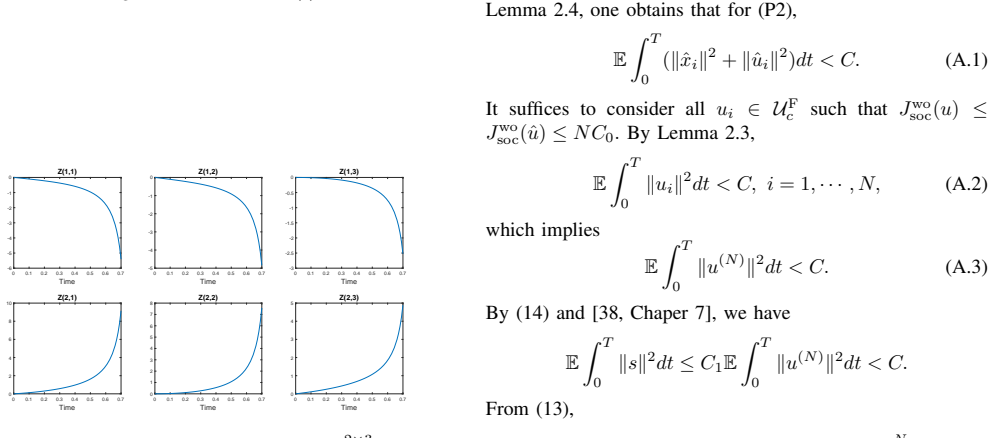
- [Section IV] The numerical example sets T = 1, but the solution Z(t) to (37) is reported to blow up at t = 0.758 and the Riccati equation in (A4) is only verified on [0,0.8]. The text then concludes that on [0,0.7] the assumptions hold and invokes Theorem 2.4, whose horizon is [0,1]. The numerical experiment therefore does not verify the theorem for the stated parameters on the full horizon; please restrict T or choose parameters for which (A3)-(A4) hold on the entire interval.
- [Theorem 3.2] Theorem 3.2 refers to 'the control laws given by (40)', but the infinite-horizon decentralized control is defined in (67); the cross-reference should be corrected.
- [Lemma 2.2 proof] In the proof of Lemma 2.2, the displayed equation for d\hat s omits the minus sign in front of the bracket that appears in (42); please fix this typo.
- [Notation, Lemmas 2.1 and 3.1] The symbol C0 is used both as a generic constant and as the explicit threshold in the statements of Lemmas 2.1 and 3.1; this makes phrases such as 'there exists C0 > 0 with R1 > C0 I' ambiguous and should be cleaned up.
- [Appendix A, proof of Theorem 2.4] The sentence 'By Lemma 2.1, Problem (P2) is uniformly convex ... which with Proposition 2.1 gives \tilde J_i \ge 0' appears to cite the wrong proposition: Proposition 2.1 concerns uniform convexity of (P1') in f, not of (P2) in u. Please correct the citation or rephrase the argument.
Circularity Check
No significant circularity: the decentralized controls are constructed from a consistency system and then verified against the centralized optimum by a standard perturbation argument.
full rationale
The paper's central claim (Theorems 2.4 and 3.2) is that the decentralized laws (40) and (67) achieve asymptotic robust social optimality, i.e., the worst-case social cost under these laws differs from the centralized optimum by O(1/sqrt(N)). This is established by a perturbation expansion in Appendices A and B: the social cost under an arbitrary u is written as the cost at the proposed control plus a second-order term tilde-J_i plus cross terms I_i. The nonnegativity of tilde-J_i is derived from uniform convexity of the centralized auxiliary problem (Lemma 2.1 and Lemma 3.1), which is an assumption on the problem data, not on the target optimality gap. The cross terms are shown to be O(1/sqrt(N)) using the consistency equations (35)/(63) and mean-field approximation lemmas (Lemmas 2.2, 2.5, B.1, B.3); this is a standard verification argument rather than a fit of the result. The controls themselves are designed by solving an auxiliary optimal control problem (P3)/(P5) whose solution is explicit in terms of Riccati equations and FBSDEs; no parameter of the controls is fitted to the centralized optimum or to the optimality gap. Self-citations appear (e.g., [31] as a preliminary conference version, [33] and [35] for methods), but they are used for background, technical tools, or prior results on convexity and person-by-person optimality; none of these citations supplies the asymptotic optimality conclusion or defines the decentralized law in terms of the claimed gap. The proof does contain a technical gap: the expansion in (A.8) omits quadratic terms involving tilde-s, and the stated assumptions of Theorem 2.4 do not include the large-penalty conditions required by Lemma 2.1. That is a correctness or completeness issue, not circularity, because the omitted terms and the convexity assumption do not make the theorem's conclusion an input of the construction. No equation is defined in terms of the quantity it purports to predict, and no fitted input is renamed as a prediction. Therefore the derivation is not circular.
Assumptions & free parameters
assumptions (5)
- standard math Standard FBSDE solvability and Riccati global existence theorems (Ma-Yong, Sun-Li-Yong, Abou-Kandil et al.)
- domain assumption Person-by-person optimality implies social optimality under convexity of the social cost
- ad hoc to paper (A3) and (A7): consistency systems (35) and (63) admit global solutions on the relevant horizon
- ad hoc to paper (A4) and (A8): Riccati equations for P-tilde admit solutions with the stated stability properties
- domain assumption The auxiliary centralized problems (P2) and (P2') are convex, and in the proof uniformly convex with sufficiently large R1 and R2
Cite this review
Pith. "Pith review of Social Optima in Robust Mean Field LQG Control: From Finite to Infinite Horizon." pith.science (2026). https://pith.science/paper/6M2KBWDB
@misc{pith2026190801122,
  author       = {Pith},
  title        = {Pith review of: Social Optima in Robust Mean Field LQG Control: From Finite to Infinite Horizon},
  year         = {2026},
  howpublished = {\url{https://pith.science/paper/6M2KBWDB}},
  note         = {Machine review of arXiv:1908.01122}
}
read the original abstract
This paper studies social optimal control of mean field LQG (linear-quadratic-Gaussian) models with uncertainty. Specially, the uncertainty is represented by a uncertain drift which is common for all agents. A robust optimization approach is applied by assuming all agents treat the uncertain drift as an adversarial player. In our model, both dynamics and costs of agents are coupled by mean field terms, and both finite- and infinite-time horizon cases are considered. By examining social functional variation and exploiting person-by-person optimality principle, we construct an auxiliary control problem for the generic agent via a class of forward-backward stochastic differential equation system. By solving the auxiliary problem and constructing consistent mean field approximation, a set of decentralized control strategies is designed and shown to be asymptotically optimal.
Figures


Reference graph
Works this paper leans on
-
[31]
Social optima in robust mean field LQG control
B. C. Wang and J. Huang, “Social optima in robust mean field LQG control”, Proc. 11th Asian Control Conference , pp. 2089-2094, Gold Coast, Australia, 2017
work page 2017
-
[1]
H. Abou-Kandil, G. Freiling, V . Ionescu, and G. Jank, Matrix Riccati Equations in Control and Systems Theory , Birkhiiuser Verlag, 2003
work page 2003
-
[2]
Team-optimal solution of finite num- ber of mean-field coupled LQG subsystems
J. Arabneydi and A. Mahajan, “Team-optimal solution of finite num- ber of mean-field coupled LQG subsystems”, Proc. 54th IEEE Conf. Decision Control, pp. 5308-5313, Osaka, Japan, 2015
work page 2015
-
[3]
T. Basar and P. Bernhard, H ∞-optimal Control and Related Minimax Design Problems: A Dynamic Game Approach , 2nd ed., Boston, MA: Birkhauser, 1995
work page 1995
-
[4]
A. Bensoussan, J. Frehse, and P. Yam, Mean Field Games and Mean Field Type Control Theory , Springer, New York, 2013
work page 2013
-
[5]
Robust equilibria in indefinite linear-quadratic differential games
W. A. van den Broek, J. C. Engwerda, and J. M. Schumacher, “Robust equilibria in indefinite linear-quadratic differential games”, Journal of Optimization Theory and Applications , vol. 119, no. 3, pp. 565-595, 2003
work page 2003
-
[6]
P. E. Caines, M. Huang, and R. P. Malhame, “Mean field games”, in Handbook of Dynamic Game Theory , T. Basar and G. Zaccour Eds., Springer, Berlin, 2017
work page 2017
-
[7]
Probabilistic analysis of mean-field games
R. Carmona and F. Delarue, “Probabilistic analysis of mean-field games”, SIAM J. Control Optim. , vol. 51, no. 4, pp. 2705-2734, 2013
work page 2013
Show all 40 references
-
[8]
A numerical algorithm to find soft-constrained Nash equilibria in scalar LQ-games
J. Engwerda, “A numerical algorithm to find soft-constrained Nash equilibria in scalar LQ-games”, International Journal of Control , vol. 79, no. 6, pp. 592-603, 2006
2006
-
[9]
Existence and comparison theorems for alge- braic and continuous-time Riccati differential and difference equations
G. Freiling and G. Jank, “Existence and comparison theorems for alge- braic and continuous-time Riccati differential and difference equations”, Journal of Dynamical Control Systems , 2, pp. 529-547, 1996
1996
-
[10]
Mean field games models–a brief survey
D. A. Gomes and J. Saude, “Mean field games models–a brief survey”, Dynamic Games and Applications , vol. 4, no. 2, pp. 110-154, 2014
2014
-
[11]
Team decision theory and information structures
Y . C. Ho, “Team decision theory and information structures”, Proceed- ings of IEEE , vol. 68, pp. 644-654, 1980
1980
-
[12]
R. A. Horn and C. R. Johnson, Matrix Analysis , 2nd ed. Cambridge University Press, 2013
2013
-
[13]
Mean field LQG games with model un- certainty
J. Huang and M. Huang, “Mean field LQG games with model un- certainty”, Proc. 52nd IEEE Conf. Decision Control , pp. 3103-3108, Florence, Italy, 2013
2013
-
[14]
Robust mean field linear-quadratic-Gaussian games with model uncertainty
J. Huang and M. Huang, “Robust mean field linear-quadratic-Gaussian games with model uncertainty”, SIAM J. Control Optim., vol. 55, no. 5, pp. 2811-2840, 2017
2017
-
[15]
Large-population LQG games involving a major player: the Nash certainty equivalence principle
M. Huang, “Large-population LQG games involving a major player: the Nash certainty equivalence principle”, SIAM J. Control Optim. , vol. 48, pp. 3318-3353, 2010
2010
-
[16]
Individual and mass be- haviour in large population stochastic wireless power control problems: Centralized and Nash equilibrium solutions
M. Huang, P. E. Caines, and R. P. Malham ´e, “Individual and mass be- haviour in large population stochastic wireless power control problems: Centralized and Nash equilibrium solutions”, Proc. 52nd IEEE Conf. Decision Control, pp. 98-103, Maui, HI, 2003
2003
-
[17]
Large-population cost- coupled LQG problems with non-uniform agents: individual-mass be- havior and decentralized ε-Nash equilibria
M. Huang, P. E. Caines, and R. P. Malham ´e, “Large-population cost- coupled LQG problems with non-uniform agents: individual-mass be- havior and decentralized ε-Nash equilibria”, IEEE Trans. Autom. Con- trol, vol. 52, pp. 1560-1571, 2007
2007
-
[18]
Social optima in mean field LQG control: centralized and decentralized strategies
M. Huang, P. Caines, and R. Malhame, “Social optima in mean field LQG control: centralized and decentralized strategies”, IEEE Trans. Autom. Control, vol. 57, no. 7, pp. 1736-1751, 2012
2012
-
[19]
Large population stochastic dynamic games: closed-loop McKean-Vlasov systems and the Nash certainty equivalence principle
M. Huang, R. P. Malham ´e, and P. E. Caines, “Large population stochastic dynamic games: closed-loop McKean-Vlasov systems and the Nash certainty equivalence principle”, Communication in Information and Systems, vol. 6, pp. 221-251, 2006
2006
-
[20]
Linear-quadratic mean field teams with a major agent
M. Huang and L. Nguyen, “Linear-quadratic mean field teams with a major agent”, Proc. 55th IEEE Conf. Decision Control , pp. 6958-6963, Las Vegas, USA, 2016
2016
-
[21]
Mean field games
J. M. Lasry, and P. L. Lions, “Mean field games”, Japn. J. Math. , vol. 2, pp. 229-260, 2007
2007
-
[22]
Asymptotically optimal decentralized control for large population stochastic multiagent systems
T. Li and J. F. Zhang, “Asymptotically optimal decentralized control for large population stochastic multiagent systems”, IEEE Trans. Automat. Control, vol. 53, no. 7, pp. 1643-1660, August 2008
2008
-
[23]
Stochastic optimal LQR control with inte- gral quadratic constraints and indefinite control weights
A. Lim and X. Y . Zhou, “Stochastic optimal LQR control with inte- gral quadratic constraints and indefinite control weights”, IEEE Trans. Autom. Control, vol. 44, no. 7, pp. 1359-1369, July, 1999
1999
-
[24]
On social optima of non-cooperative mean field games
S. Li, W. Zhang, and L. Zhao “On social optima of non-cooperative mean field games”, Proc. 55th IEEE Conf. Decision Control , pp. 3584- 3590, Las Vegas, USA, 2016
2016
-
[25]
Ma and J
J. Ma and J. Yong, Forward-backward Stochastic Differential Equations and their Applications , Lecture Notes in Math. 1702, Springer-Verlag, New York, 1999
1999
-
[26]
The time-invariant linear-quadratic optimal control problem
B. P. Molinari, “The time-invariant linear-quadratic optimal control problem”, Automatica, vol. 13, pp. 347-357, 1977
1977
-
[27]
Linear quadratic risk-sensitive and robust mean field games
J. Moon and T. Basar, “Linear quadratic risk-sensitive and robust mean field games”, IEEE Trans. Autom. Control , vol. 62, no. 3, 2017
2017
-
[28]
Open-loop and closed-loop solvabilities for stochastic linear quadratic optimal control problems
J. Sun, X. Li, and J. Yong, “Open-loop and closed-loop solvabilities for stochastic linear quadratic optimal control problems”, SIAM J. Control Optim., vol. 54, no. 5, 2274-2308, 2016
2016
-
[29]
Sun, and J
J. Sun, and J. Yong. Stochastic linear quadratic optimal control problems in infinite horizon, Applied Mathematics & Optimization , pp. 1C39, 2017
2017
-
[30]
Robust linear quadratic mean- field games in crowd-seeking social networks
H. Tembine, D. Bauso, and T. Basar, “Robust linear quadratic mean- field games in crowd-seeking social networks”, Proc. 52nd IEEE Conf. Decision Control, pp. 3134-3139, Florence, Italy, 2013
2013
-
[32]
Mean field games for large-population multiagent systems with Markov jump parameters
B. C. Wang and J. F. Zhang, “Mean field games for large-population multiagent systems with Markov jump parameters”, SIAM J. Control Optim., vol. 50, no. 4, pp. 2308-2334, 2012
2012
-
[33]
Distributed control of multi-agent systems with random parameters and a major agent
B. C. Wang and J. F. Zhang, “Distributed control of multi-agent systems with random parameters and a major agent”, Automatica, vol. 48, no. 9, 2093-2106, 2012
2012
-
[34]
Hierarchical mean field games for multiagent systems with tracking-type costs: Distributed ε-Stackelberg equilibria
B. C. Wang and J. F. Zhang, “Hierarchical mean field games for multiagent systems with tracking-type costs: Distributed ε-Stackelberg equilibria”, IEEE Trans. Autom. Control , vol. 59, no. 8, 2241-2247, 2014
2014
-
[35]
Social optima in mean field linear- quadratic-Gaussian models with Markov jump parameters
B. C. Wang and J. F. Zhang, “Social optima in mean field linear- quadratic-Gaussian models with Markov jump parameters”, SIAM J. Control Optim., vol. 55, no. 1, pp. 429-456, 2017
2017
-
[36]
Markov perfect industry dynamics with many firms
G. Weintraub, C. Benkard, and B. van Roy, “Markov perfect industry dynamics with many firms”, Econometrica, vol. 76, no. 6, pp. 1375- 1411, 2008
2008
-
[37]
J. Xu, J. Shi, and H. Zhang, A leader-follower stochastic linear quadratic differential game with time delay. Science China Information Sciences , vol. 61, no. 3-13, 2018
2018
-
[38]
Yong and X
J. Yong and X. Y . Zhou, Stochastic Controls: Hamiltonian Systems and HJB Equations, Springer-Verlag, New York, 1999
1999
-
[39]
Zhang and Q
H. Zhang and Q. Qi, Optimal control for mean-field system: Discrete- time case. Proc. 55th IEEE Conf. Decision Control , pp. 4474-4480, Las Vegas, USA, 2016
2016
-
[40]
Zhang, J
S. Zhang, J. Xiong, and X. Liu, Stochastic maximum principle for partially observed forward-backward stochastic differential equations with jumps and regime switching, Science China Information Sciences , vol. 61, no. 7, pp. 1-13, 2018. Bingchang Wang received the M.Sc. degree...
2018
Reviewed August 14, 2026 · model on record in the stance chip above.
Discussion (0). Continue with ORCID to comment.