The exact solution of the Koga-Widom-Indekeu model and related models of wetting in fluid mixtures
Pith reviewed 2026-05-22 03:11 UTC · model grok-4.3
The pith
The Koga-Widom-Indekeu model of wetting in fluid mixtures has an exact solution showing critical point wetting is absent when order parameters have local XY symmetry.
A machine-rendered reading of the paper's core claim, the machinery that carries it, and where it could break.
Core claim
The central claim is that the KWI model and related variants can be solved exactly for density profiles and surface tensions using complex analysis, revealing the precise locations and orders of wetting transitions in the surface phase diagram. This confirms the absence of critical point wetting in ternary mixtures with three-phase coexistence. The exact solution also shows that microscopic density profiles map via conformal transform to the shape of a macroscopic drop satisfying the Neumann triangle. Related models demonstrate that critical point wetting occurs only if the order-parameter components follow Ising-like criticality, but is absent under local XY symmetry, suggesting a principle
What carries the argument
The square-gradient free-energy functional solved exactly via complex analysis and the theory of algebraic curves, which fixes surface tensions and maps density profile paths to geometric shapes obeying the Neumann triangle.
Load-bearing premise
The square-gradient free-energy functional accurately captures the essential physics of wetting transitions near critical end points in real fluid mixtures.
What would settle it
An experimental measurement of surface tensions in a ternary fluid mixture with three-phase coexistence that finds critical point wetting occurring would contradict the exact solution's prediction of its absence.
Figures






read the original abstract
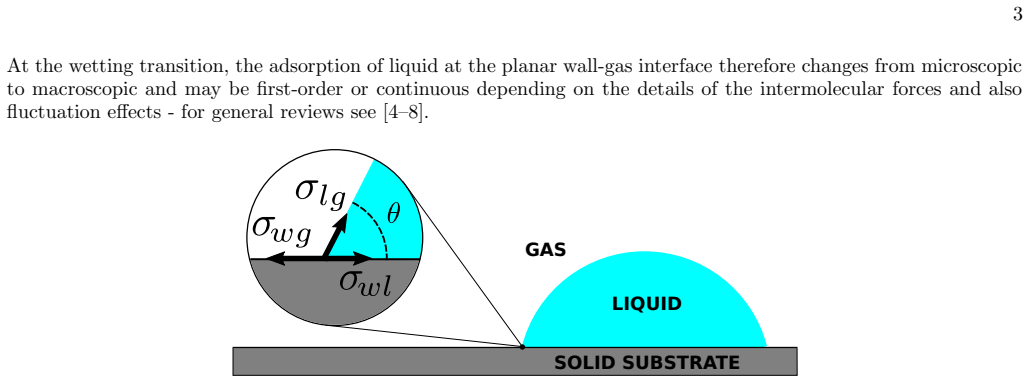
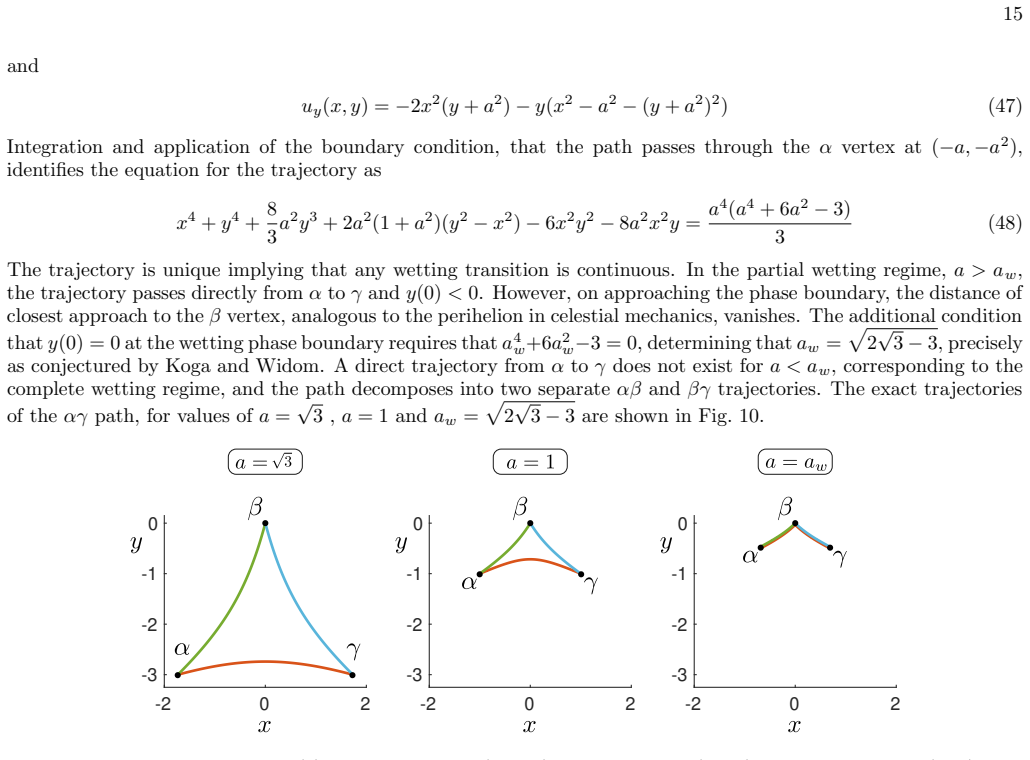
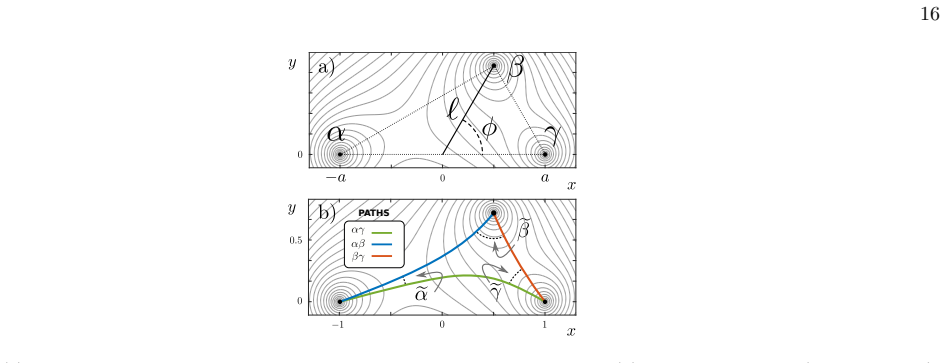
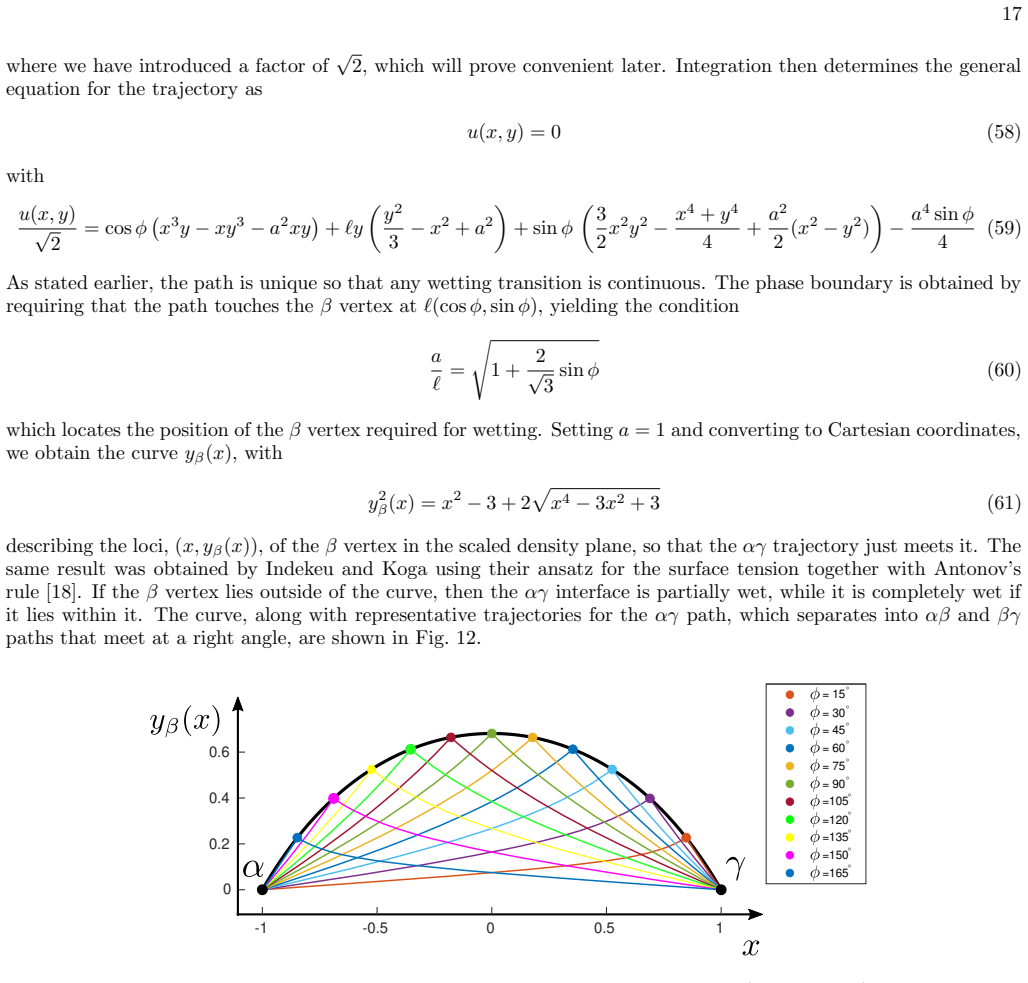
We show how a broad class of two-component square-gradient models of wetting may be solved exactly for the surface tensions and density profile paths, and clarify how the presence or absence of critical point wetting, in binary and ternary mixtures, is related to universality and symmetry principles at critical end points. We begin by solving a model of fluid interfaces, first introduced by Koga and Widom, in ternary mixtures showing three phase coexistence. Numerical studies had revealed interesting wetting transitions, as well as curious geometrical properties of the profile paths in the density plane, and led these authors to conjecture expressions for the surface tensions. These conjectures were extended by Koga and Indekeu and predicted that partial wetting may persist up to the line of critical end points, i.e. critical point wetting was absent. Here, we obtain the exact density profiles and surface tensions for the Koga-Widom-Indekeu (KWI) model using complex analysis and drawing on the theory of algebraic curves. The exact solution determines the location and order of wetting transitions in the surface phase diagram, confirming that critical point wetting is absent. The model also displays the remarkable property that microscopic density profiles are mapped, by a conformal transform, onto the shape of a macroscopic drop near the contact line whose tensions satisfy the Neumann triangle. Two related models, which illustrate the role of the component isotropy, are also discussed. These models suggest that a universality principle governs wetting in fluid mixtures, resolving contradicting results from earlier studies: Critical point wetting is present if the order-parameter components of the mixture describe Ising-like criticality, but is absent if there is a local XY symmetry. Implications for wetting transitions in more microscopic models and in experiments are discussed.
Editorial analysis
A structured set of objections, weighed in public.
Referee Report
Summary. The manuscript presents an exact solution to the Koga-Widom-Indekeu (KWI) square-gradient model for wetting in ternary fluid mixtures, along with related models, using methods from complex analysis and the theory of algebraic curves. The solution provides exact expressions for density profiles and surface tensions, which are used to determine the locations and orders of wetting transitions. It confirms that critical point wetting is absent in this model due to local XY symmetry, in contrast to Ising-like criticality, and discusses universality principles for wetting in fluid mixtures.
Significance. If the results hold, this work is significant for providing a rigorous, exact mathematical treatment that verifies earlier numerical conjectures on wetting transitions without any parameter fitting or data selection. The use of conformal transforms to map microscopic profiles to macroscopic drop shapes satisfying the Neumann triangle is a striking geometric property. The distinction between XY and Ising symmetries in related models helps resolve contradictions in the literature regarding critical point wetting. This contributes parameter-free derivations and clear falsifiable implications for experiments on fluid mixtures near critical end points.
minor comments (3)
- [Introduction] The abstract states that the exact solution confirms the conjectures of Koga and Indekeu; a brief explicit statement in the main text comparing the derived transition locations to those conjectures would aid readability.
- [Results] The discussion of the conformal mapping from microscopic profiles to the macroscopic drop shape is intriguing; adding a short schematic figure or diagram would improve clarity for readers unfamiliar with algebraic-curve methods.
- [Related models] Notation for the order-parameter components in the related models (XY vs. Ising variants) is introduced but could be summarized in a small table for quick reference when comparing the two cases.
Simulated Author's Rebuttal
We thank the referee for the careful reading, positive assessment of the significance of our exact solution to the KWI model, and the recommendation for minor revision. The report correctly identifies the key results on the absence of critical point wetting due to local XY symmetry and the conformal mapping property. We address the points below.
Circularity Check
No significant circularity: exact solution derived directly from model equations
full rationale
The paper constructs an exact solution for the KWI square-gradient model and variants by applying complex analysis and algebraic curve theory to the Euler-Lagrange equations obtained from the free-energy functional. This determines surface tensions, density profiles, and wetting transition locations/orders without presupposing the Koga-Widom-Indekeu conjectures (which are instead confirmed as output). Related models are compared by explicit substitution of isotropy assumptions to isolate XY versus Ising symmetry effects. No self-definitional steps, fitted inputs renamed as predictions, load-bearing self-citations, or ansatzes smuggled via citation appear in the derivation chain; the logic is self-contained against the model's differential equations.
Axiom & Free-Parameter Ledger
axioms (1)
- domain assumption The square-gradient approximation captures the leading interfacial physics in the KWI model and its variants.
Reference graph
Works this paper leans on
-
[1]
+ 2a3 , c wβ(x0.y0) = y3 0 + 3y0(a2 −x 2 0) x0(3y2 0 + 3a2 −x 2 0)−2a 3 (159) which differ only in the sign ofa 3 in the denominator. In the partial wetting regime, the two trajectories, together with the straight liney αβ = 0 representing the freeαβinterface, form a tricuspid in the density plane, with internal angleseα,eβandew– see Fig. 26. Cyclically a...
-
[2]
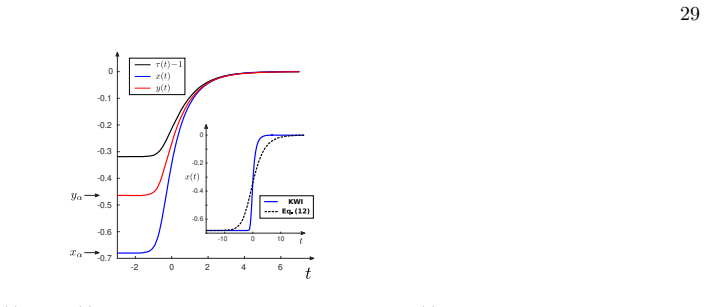
(222) Thusτ(t) itself has an interfacial structure controlling both density profiles,x(t) andy(t), of the full two-component KWI model. The above analysis can be generalized to determine the density profiles for the generalαγpath at wetting or equivalently the separateαβandβγpaths that meet at a right angle. This is, by far, the most algebraically 54 dema...
-
[3]
J. W. Cahn, Critical Point Wetting, J. Chem. Phys.66, 3667 (1977)
work page 1977
-
[4]
C. Ebner and W. F. Saam, New Phase-Transition Phenomena in Thin Argon Films, Phys. Rev. Lett.38, 1486 (1977)
work page 1977
-
[5]
R. Evans, The nature of the liquid-vapour interface and other topics in the statistical mechanics of non-uniform, classical fluids, Adv. Phys.28, 143 (1979)
work page 1979
-
[6]
D. E. Sullivan and M. M. Telo da Gama, Wetting Transitions and Multilayer Adsorption at Fluid Interfaces, inFluid Interfacial Phenomena, edited by C. A. Croxton (John Wiley and Sons Ltd, 1986) Chap. 2
work page 1986
-
[7]
Dietrich, Wetting Phenomena, inPhase Transitions and Critical Phenomena, Vol
S. Dietrich, Wetting Phenomena, inPhase Transitions and Critical Phenomena, Vol. 12, edited by C. Domb and J. Lebowitz (Academic Press Limited, 1988)
work page 1988
-
[8]
Schick, Introduction to Wetting Phenomena, inLiquids at interfaces, edited by J
M. Schick, Introduction to Wetting Phenomena, inLiquids at interfaces, edited by J. Charvolin, J. F. Joanny, and J. Zinn- Justin (Elsevier, 1990)
work page 1990
-
[9]
G. Forgacs, R. Lipowsky, and T. M. Nieuwenhuizen, The Behaviour of Interfaces in Ordered and Disordered Systems, in Phase Transitions and Critical Phenomena, Vol. 14, edited by C. Domb and J. Lebowitz (Academic Press Limited, 1991) p. 135
work page 1991
-
[10]
D. Bonn, J. Eggers, J. O. Indekeu, J. Meunier, and E. Rolley, Wetting and spreading, Rev. Mod. Phys.81, 739–805 (2009)
work page 2009
-
[11]
A. Squarcini, J. M. Romero-Enrique, and A. O. Parry, Casimir Contribution to the Interfacial Hamiltonian for 3D Wetting, Phys. Rev. Lett.128, 195701 (2022)
work page 2022
-
[12]
J. S. Rowlinson and B. Widom,Molecular Theory of Capillarity(Clarendon Press, 1982)
work page 1982
- [13]
-
[14]
A. O. Parry and A. Malijevsk´ y, Surface Phase Diagrams for Wetting with Long-Ranged Forces, Phys. Rev. Lett.131, 136201 (2023)
work page 2023
-
[15]
H. Nakanishi and M. E. Fisher, Multicriticality of Wetting, Prewetting, and Surface Transitions, Phys. Rev. Lett.49, 1565 (1982)
work page 1982
-
[16]
P. G. de Gennes, Effects of long range forces on wetting transitions, C. R. Acad. Sci. Ser. B297, 9–12 (1983)
work page 1983
-
[17]
M. Nightingale and J. O. Indekeu, Examination of the necessity of complete wetting near critical points in systems with long-range forces, Phys. Rev. B32, 3364(R) (1985)
work page 1985
-
[18]
A. O. Parry, A. Malijevsk´ y, and C. Rasc´ on, Critical behaviour of the contact angle within nonwetting gaps, J. Phys.: Condens. Matter36, 17LT01 (2024)
work page 2024
-
[19]
R. B. Griffiths, Thermodynamic model for tricritical points in ternary and quaternary fluid mixtures, J. Chem. Phys.60, 195–206 (1974)
work page 1974
-
[20]
J. O. Indekeu and K. Koga, Wetting and Nonwetting near a Tricritical Point, Phys. Rev. Lett.129, 224501 (2022)
work page 2022
-
[21]
K. Koga and B. Widom, Mean-field density-functional model of a second-order wetting transition, J. Chem. Phys.128, 114716 (2008)
work page 2008
-
[22]
K. Koga and B. Widom, Density functional models of the interfacial tensions near the critical endpoints and tricritical point of three-phase equilibria, J. Phys.: Condens. Matter28, 244016 (2016)
work page 2016
-
[23]
K. Koga and J. O. Indekeu, Three-phase equilibria in density-functional theory: Interfacial tensions, J. Chem. Phys.150, 164701 (2019)
work page 2019
-
[24]
F. A. M. Leermakers and S. A. A. Egorov, No violations of critical-point wetting in ternary three fluid-phase systems with short range interactions, J. Colloid Interface Sci.679, 124–134 (2025)
work page 2025
-
[25]
M. M. Telo da Gama and R. Evans, The structure and surface tension of the liquid-vapour interface near the upper critical end point of a binary mixture of Lennard-Jones fluids I. The two phase region, Mol. Phys.48, 229–250 (1983)
work page 1983
-
[26]
M. M. Telo da Gama and R. Evans, The structure and surface tension of the liquid-vapour interface near the upper critical end point of a binary mixture of Lennard-Jones fluids II. The three phase region and the Cahn wetting transition, Mol. Phys.48, 251–266 (1983)
work page 1983
-
[27]
A. O. Parry and C. Rasc´ on, Wetting, algebraic curves, and conformal invariance, Phys. Rev. Lett.133, 238001 (2024)
work page 2024
-
[28]
E. H. Hauge, Landau theory of wetting in systems with a two-component order parameter, Phys. Rev. B33, 3322 (1986)
work page 1986
-
[29]
C. J. Walden, B. L. Gy¨ orffy, and A. O. Parry, Nonuniversal anisotropy dependence of critical-wetting exponents in a vector model, Phys. Rev. B42, 798 (1989)
work page 1989
- [30]
-
[31]
S. Falkensteiner and J. Sendra, Rationality and parametrizations of algebraic curves under specializations, J. Algebra659, 698–744 (2024)
work page 2024
-
[32]
Krech, Casimir forces in binary liquid mixtures, Phys
M. Krech, Casimir forces in binary liquid mixtures, Phys. Rev. E57, 1642 (1997)
work page 1997
-
[33]
M. Nightingale and J. O. Indekeu, Effect of Criticality on Wetting Layers, Phys. Rev. Lett. , 1824 (1985)
work page 1985
-
[34]
S. Dietrich and M. Napi´ orkowski, Analytic Results for Wetting Transitions in the Presence of van der Waals Tails, Phys. Rev. A43, 1861 (1991). 59
work page 1991
-
[35]
M. E. Fisher and A. J. Jin, Effective Potential, Constraints, and Critical Wetting Theory, Phys. Rev. B44, 1430 (1991)
work page 1991
-
[36]
E. Br´ ezin, B. I. Halperin, and S. Leibler, Critical Wetting in Three Dimensions, Phys. Rev. Lett.50, 1387 (1983)
work page 1983
-
[37]
V. I. Arnold,Mathematical Methods of Classical Mechanics, Graduate Texts in Mathematics (Springer New York, NY, 1989)
work page 1989
-
[38]
A. B. Bhatia and D. E. Thornton, Structural Aspects of the Electrical Resistivity of Binary Alloys, Phys. Rev. B2, 3004 (1970)
work page 1970
-
[39]
E. J. Ding and E. H. Hauge, Some analytic results for a binary fluid mixture, Physica A155, 189–205 (1989)
work page 1989
-
[40]
M. E. Fisher and P. G. de Gennes, Wall Phenomena in a Critical Binary Mixture, C. R. Acad. Sci. Ser. B287, 207 (1978)
work page 1978
-
[41]
M. E. Fisher and P. J. Upton, Universality and interfaces at critical end points, Phys. Rev. Lett.65, 2402 (1990)
work page 1990
-
[42]
F. Samm¨ uller, M. Schmidt, and R. Evans, Neural Density Functional Theory of Liquid-Gas Phase Coexistence, Phys. Rev. X15, 011013 (2025)
work page 2025
-
[43]
S. Robitschko, F. Samm¨ uller, M. Schmidt, and R. Evans, Learning the bulk and interfacial physics of liquid–liquid phase separation with neural density functionals, J. Chem. Phys.163, 161101 (2025)
work page 2025
-
[44]
J. R. Henderson and F. Van Swol, On the approach to complete wetting by gas at a liquid-wall interface, Mol. Phys. , 1313 (1985)
work page 1985
-
[45]
D. Ross, D. Bonn, A. I. Posazhennikova, J. O. Indekeu, and J. Meunier, Crossover from First-Order to Critical Wetting: Short-Range Tricritical Wetting, Phys. Rev. Lett.87, 176103 (2001)
work page 2001
-
[46]
M. Kahlweit, R. Strey, and G. Busse, Weakly to strongly structured mixtures, Phys. Rev. E47, 4197 (1993)
work page 1993
- [47]
-
[48]
G. W. Gibbons and P. K. Townsend, Bogomol’nyi Equation for Intersecting Domain Walls, Phys. Rev. Lett.83, 1727 (1999)
work page 1999
-
[49]
Bogomolny, Stability of Classical Solutions, Sov
E. Bogomolny, Stability of Classical Solutions, Sov. J. Nucl. Phys.24, 449 (1976)
work page 1976
-
[50]
M. K. Prasad and C. Sommerfield, An Exact Classical Solution for the ’t Hooft Monopole and the Julia-Zee Dyon, Phys. Rev. Lett.35, 760–762 (1975)
work page 1975
-
[51]
B. Chibisov and M. Shifman, BPS-saturated walls in supersymmetric theories, Phys. Rev. D56, 7990–8013 (1997)
work page 1997
-
[52]
S. Chen and Y. Yang, Domain wall equations, Hessian of superpotential, and Bogomol’nyi bounds, Nuclear Phys. B904, 470–493 (2016)
work page 2016
-
[53]
S. Abel, Q. Bonnefoy, and D. Chowdhury, BPS solutions for generalised Wess-Zumino models and their applications, J. High Energ. Phys.2019, 242
work page 2019
-
[54]
A. Alonso-Izquierdo, M. G. Le´ on, J. M. Vaquero, and M. T. de la Mayado, Kink scattering in a generalized Wess-Zumino model, Commun. Nonlinear Sci. Numer. Simul.103, 106011 (2021)
work page 2021
- [55]
-
[56]
D. E. Sullivan, Interfacial density profiles of a binary van der Waals fluid, J. Chem. Phys.77, 2632–2638 (1982)
work page 1982
-
[57]
M. M. Telo da Gama and R. Evans, Adsorption and wetting transitions at a model of the interface between a solid and a binary fluid mixture, Mol. Phys.48, 687–714 (1983)
work page 1983
discussion (0)
Sign in with ORCID, Apple, or X to comment. Anyone can read and Pith papers without signing in.