REVIEW 3 major objections 4 minor 1 cited by
Regularized Schr\"odinger Bridge via Distortion-Perception Perturbation for High-Fidelity Speech Enhancement
T0 review · 3 major / 4 minor · reviewed 2026-08-04 · deepseek-v4-flash
Pith's one-line read A training-time perturbation lets Schrödinger Bridge speech enhancement gain fidelity without losing perceived quality.
desk verdict Empirically decent SB training heuristic; the DP-curve theory is not supported and should be reframed as label smoothing. read the letter →
The pith
A machine-rendered reading of the paper's core claim, the machinery that carries it, and where it could break.
The reading
What carries the argument
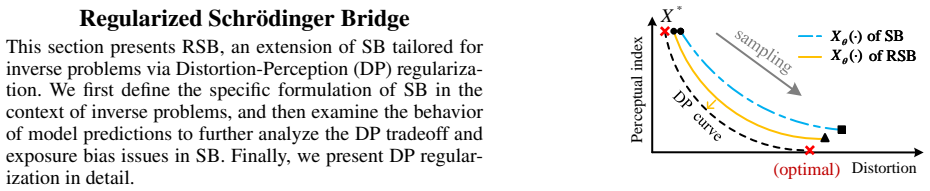
The central object is the distortion-perception perturbation: a time-varying interpolation between the clean signal X (perception-optimal endpoint) and the posterior mean X* (distortion-optimal endpoint), with weight ω_t = t², applied to both the training target (Eq. 6) and the input state (Eq. 7) inside the Schrödinger Bridge training objective (Eq. 8). This perturbation converts training from predicting ground truth into predicting a point on the hypothesized DP curve at each timestep, while the perturbed inputs mimic the model's own sampling errors and therefore reduce the training-inference mismatch responsible for exposure bias.
What would settle it
For a synthetic inverse problem with a known posterior (e.g., Gaussian prior and linear measurement), compute the true optimal DP curve exactly, then train RSB with ω_t = t² and measure the distortion-perception point achieved at each timestep; if the achieved curve does not coincide with or dominate the theoretical DP frontier, the central interpolation claim is falsified.
Extended reading notes
Core claim
The paper's central claim is that a joint input-target perturbation during training simultaneously mitigates exposure bias and shifts the solution toward the optimal distortion-perception tradeoff. Specifically, RSB defines training targets as eX_tgt = (1 - ω_t)X + ω_t X*, where X is the clean signal, X* is the posterior-mean estimate from a pretrained predictive model, and ω_t = t² grows from 0 to 1 over the bridge time. It then samples perturbed intermediate states from the corresponding Schrödinger Bridge marginal and trains the network to predict the perturbed target. This is argued to simulate the prediction errors the model will encounter at inference, preventing error accumulation, an
Load-bearing premise
The load-bearing premise is that the linear interpolation (1 - ω_t)X + ω_t X* with ω_t = t² accurately proxies the optimal distortion-perception curve; if that proxy is wrong, the method is an arbitrary label-smoothing heuristic rather than a way to approach the theoretical tradeoff.
Editorial extensions
If this is right
- RSB improves SI-SDR over vanilla SB on WSJ0+WHAM, WSJ0+Reverb, and VoiceBank+DEMAND, while matching or improving perceptual metrics such as PESQ, CSIG, CBAK, and COVL.
- The per-step prediction-error curve for RSB is flatter than for vanilla SB across 50 sampling steps, indicating slower error accumulation and reduced exposure bias.
- RSB achieves a more favorable distortion-perception tradeoff as the number of sampling steps varies, reaching high PESQ early while preserving SI-SDR better than SB.
- Because the posterior-mean model is used only during training, RSB adds no inference-time dependency, in contrast to cascade strategies that feed the predictive estimate into the sampler.
- The same regularized-training formulation is proposed as applicable to other inverse problems, including image denoising, deblurring, and inpainting.
Reading between the lines
- The fixed ω_t = t² schedule is a heuristic; a testable extension is to learn or adapt the schedule per timestep and compare the achieved distortion-perception frontier with the one reported here.
- RSB's gains depend on the quality of the frozen posterior-mean model X*; jointly training or online-updating that model could further shift the tradeoff, but the paper does not investigate this.
- The interpolation perturbation is formally a label-smoothing technique, suggesting it may transfer to other bridge-based generative models beyond Schrödinger Bridges.
- If the true optimal DP frontier is not a linear blend between X and X*, RSB's claim of 'traversing the DP curve' may reduce to a heuristic regularizer; a synthetic Gaussian experiment could test this directly.
Signed reviews
Editorial analysis
A structured set of objections, weighed in public.
Referee Report
Summary. The paper proposes Regularized Schrödinger Bridge (RSB), a training-time modification of the Schrödinger Bridge (SB) framework for inverse problems, applied to speech enhancement. RSB perturbs the training objective in two ways: it replaces the ground-truth target X with a time-varying interpolation (1−ω_t)X + ω_t X*, where X* is a posterior-mean estimate from a pretrained predictive model, and it samples perturbed intermediate states from the corresponding marginal. The authors claim that this interpolation steers model predictions along the optimal distortion–perception (DP) curve and that the input perturbation simulates inference-time errors, thereby mitigating exposure bias. Experiments on three speech enhancement benchmarks (WSJ0+WHAM, WSJ0+Reverb, VoiceBank+DEMAND) show small but consistent improvements over vanilla SB in distortion metrics (SI-SDR, SI-SIR, SI-SAR) with comparable or slightly better perceptual metrics. An ablation study indicates that joint input–target perturbation performs best.
Significance. If the theoretical claims were sound, RSB would offer a principled approach to addressing the distortion–perception tradeoff and exposure bias in SB-based inverse problems. The experimental setup is clear, the code is promised in the supplementary material, and the results are credible as measured. However, the central theoretical motivation is not rigorous: the prediction-drift analysis is based on a misinterpretation of the L2 objective, and the interpolation form is not supported by the cited DP-tradeoff literature. The empirical gains, while consistent, are modest and may partly follow from the training target being closer to X*. Nevertheless, the method is clearly specified and the ablation is informative; the contribution could be salvaged by reframing RSB as an empirical regularization heuristic rather than a principled DP-optimality result.
major comments (3)
- [DP Tradeoff & Exposure Bias via Prediction Errors (Eq. (4))] The analysis of prediction drift is incorrect. Equation (4) is an L2 regression objective, so its optimum for each (X_t, X_1) is the conditional mean E[X|X_t, X_1]. At t→0, X_t approaches X_0 = X, so the optimal prediction tends to X itself, not to a 'posterior sample' or a 'perception-oriented' estimate. The statement that the objective 'enforces p_X0 to approach p_X' is not derived from Eq. (4). Thus the claimed transition from distortion-oriented to perception-oriented predictions is not established, which undermines the motivation for the interpolation perturbation in Eq. (6).
- [§Perturbation Design, Eq. (6)] The claim that 'the theoretical optimal solutions on the DP curve take an interpolation form (Freirich, Michaeli, and Meir 2021)' is not supported by that reference. Freirich et al. characterize optimal DP solutions as the posterior-mean estimate followed by an optimal transport map to the clean-data distribution; they do not derive a per-sample linear blend between X and E[X|Y]. The interpolation in Eq. (6) is therefore an ad hoc choice, and the weight ω_t = t^2 is selected 'for simplicity' with no theoretical or empirical justification. The central claim of approaching the optimal DP tradeoff via this interpolation is unsupported.
- [Table 1 (Ablation study)] The ablation does not isolate the proposed mechanism. Input-only perturbation already improves SI-SDR by 0.3 dB, and joint perturbation improves it by 1.0 dB relative to vanilla SB. Because the target in Eq. (8) is a convex combination of X and X*, and X* has higher SI-SDR than a posterior sample by construction, the SI-SDR gain may be partly a direct effect of the training target rather than a traversal of an optimal DP frontier. The paper should compare with alternative schedules (e.g., constant ω) or analyze the DP tradeoff of the targets themselves to support the claimed mechanism.
minor comments (4)
- [Title/Abstract] The full-text title ('Regularized Schrödinger Bridge: Alleviating Distortion and Exposure Bias in Solving Inverse Problems') differs from the arXiv title ('Regularized Schrödinger Bridge via Distortion-Perception Perturbation for High-Fidelity Speech Enhancement'). Please align them, and ensure the two abstracts are consistent.
- [Table 2] The sentence 'RSB obtains the best perceptual scores across all MOS-derived metrics' is not accurate for DNSMOS, where RSB (3.73) is slightly below SB (3.74) and NCSN++M (3.77). Specify that the claim refers to PESQ, CSIG, CBAK, and COVL.
- [Figure 2] Figure 2 is difficult to read; the variable labels (e.g., state names) appear garbled. Please redraw it with clear typography.
- [Eq. (5) and sampler] The sampler in Eq. (5) is stated without derivation. Adding a short explanation or a citation to Juki'c et al. (2024) for the first-order SDE discretization would improve reproducibility.
Circularity Check
No significant circularity: RSB's interpolation target is a training input, not a disguised restatement of its evaluation metrics.
full rationale
The paper's derivation chain is: analyze the vanilla SB L2 objective (Eq. 4), propose perturbed training targets (Eq. 6) and states (Eq. 7), optimize the regularized objective (Eq. 8), and evaluate on held-out benchmarks. The main candidate for circularity is that the training target is an interpolation between clean data X and posterior-mean estimate X*, so the model is trained to output a blend of the two. This is not a circular prediction: the reported SI-SDR and PESQ are measured on test data, not computed from the training targets, and the model's final output is generated by an SDE sampler rather than read off from Eq. (6). The claim that this interpolation 'traverses the DP curve' is supported only by an external citation (Freirich, Michaeli, and Meir 2021) and a stated heuristic choice ω_t=t^2 'for simplicity'; the cited theorem is not shown to imply per-sample linear interpolation, and no derivation of the DP-curve claim is given. This is a substantive evidentiary weakness and a correctness risk, but it is not a circular reduction: the paper does not define the DP curve as its own interpolation, and the interpolation is not fitted to the evaluation metrics. There is no load-bearing self-citation chain: the SB framework is cited from Juki'c et al. (2024), which is external to the present authors, and the perturbation is not justified by a uniqueness theorem from the same group. The paper explicitly acknowledges that the perturbation 'can be considered as a label smoothing regularization technique,' so the mechanism is openly disclosed rather than renamed as a new law. Accordingly, no step reduces by definition to its own inputs.
Assumptions & free parameters
free parameters (1)
- ω_t = t^2 (interpolation weight schedule) =
ω_t = t^2
assumptions (5)
- standard math Gaussian SB marginal solution (Eqs. 2–3) is valid for paired data
- ad hoc to paper The optimal DP curve is linearly interpolated between X and X* with weight ω_t
- domain assumption D_phi(Y) approximates the posterior mean E[X|Y] well
- ad hoc to paper Perturbing states sampled from the interpolated target simulates inference-time prediction errors
- ad hoc to paper An L2-trained SB network's predictions at t→0 are posterior samples and perception-oriented
Cite this review
Pith. "Pith review of Regularized Schr\"odinger Bridge via Distortion-Perception Perturbation for High-Fidelity Speech Enhancement." pith.science (2026). https://pith.science/paper/6MUB5TPD
@misc{pith2026251111686,
  author       = {Pith},
  title        = {Pith review of: Regularized Schr\"odinger Bridge via Distortion-Perception Perturbation for High-Fidelity Speech Enhancement},
  year         = {2026},
  howpublished = {\url{https://pith.science/paper/6MUB5TPD}},
  note         = {Machine review of arXiv:2511.11686}
}
read the original abstract
Speech enhancement (SE) requires high-fidelity reconstruction of clean speech that preserves linguistic and paralinguistic cues while maintaining high perceptual quality. Recently, Schr\"odinger Bridge (SB), a family of diffusion-based generative models, has advanced SE by bridging degraded and clean speech distributions in a principled formulation, enabling higher-quality reconstructions with fewer sampling steps. However, diffusion-based SE methods still face two challenges: (1) the fidelity-realism tradeoff, where they often prioritize perceptual realism encouraged by the learned speech prior, at the expense of fidelity; and (2) the exposure bias issue, where iterative multi-step sampling causes early-step prediction errors to accumulate along the sampling trajectory and degrade enhanced speech quality. In this paper, we analyze standard SB training and show that it induces a systematic prediction drift, which biases the multi-step trajectory and amplifies error accumulation. To address this, we propose Regularized Schr\"odinger Bridge (RSB) for high-fidelity SE, a generative approach that reconciles fidelity and realism while mitigating exposure bias. RSB regularizes training with a Distortion-Perception Perturbation that constructs time-varying targets by interpolating between clean speech and posterior-mean estimates, and trains the network on perturbed intermediate states to correct toward the ground truth progressively. By simulating inference-time prediction errors, this perturbation mitigates the training-inference mismatch and thereby alleviates exposure bias. It also injects posterior-mean estimates as fidelity-preserving guidance, thereby improving reconstruction fidelity.
Figures


Figures from the paper (1 more)

Forward citations
Cited by 1 Pith paper
-
PRISM: Principled Reference Identification for Schrodinger Bridge Model
The optimal bridge reference is v = x*(T) P, proportional to the destroyed-information spectrum, but real image statistics break this prediction and favor white noise.
Reference graph
Works this paper leans on
-
[2001]
InProccedings of the IEEE Interna- tional Conference on Acoustics, Speech and Signal Process- ing, 749–752
Perceptual Evaluation of Speech Quality (PESQ)-A New Method for Speech Quality Assessment of Telephone Networks and Codecs. InProccedings of the IEEE Interna- tional Conference on Acoustics, Speech and Signal Process- ing, 749–752. Saharia, C.; Chan, W.; Chang, H.; Lee, C. A.; Ho, J.; Sali- mans, T.; Fleet, D. J.; and Norouzi, M. 2021. Palette: Image- to-...
2021
-
[2019]
Lemercier, J.-M.; Richter, J.; Welker, S.; and Gerkmann, T
SDR – Half-baked or Well Done? InProccedings of the IEEE International Conference on Acoustics, Speech and Signal Processing, 626–630. Lemercier, J.-M.; Richter, J.; Welker, S.; and Gerkmann, T
-
[2023]
Li, M.; Qu, T.; Sun, W.; and Moens, M.-F
StoRM: A Diffusion-Based Stochastic Regeneration Model for Speech Enhancement and Dereverberation.IEEE Transactions on Audio, Speech and Language Processing, 31: 2724–2737. Li, M.; Qu, T.; Sun, W.; and Moens, M.-F. 2023. Alleviating Exposure Bias in Diffusion Models through Sampling with Shifted Time Steps. InInternational Conference on Learn- ing Represe...
2023
Reviewed August 4, 2026 · model on record in the stance chip above.
Discussion (0). Continue with ORCID to comment.