REVIEW 4 major objections 5 minor 1 cited by
Revealing turbulent Dark Matter via merging of self-Gravitating condensates
T0 review · 4 major / 5 minor · reviewed 2026-08-10 · deepseek-v4-flash
Pith's one-line read This paper claims that merging self-gravitating Bose-Einstein condensate dark matter halos pass through a turbulent phase with a Kolmogorov-like $k^{-5/3}$ kinetic energy cascade, offering a spectral fingerprint that distinguishes…
desk verdict Plausible new turbulence signature in self-gravitating BEC dark-matter mergers, but the evidence rests on a single under-resolved grid and needs a convergence study before the exponents are quoted as physical. read the letter →
The pith
A machine-rendered reading of the paper's core claim, the machinery that carries it, and where it could break.
The reading
What carries the argument
The central machinery is the dimensionless Gross-Pitaevskii-Poisson system, $\mathrm{i}\partial_t\psi = (-\tfrac12\nabla^2+\Phi+g|\psi|^2)\psi$ with $\nabla^2\Phi=|\psi|^2$, integrated on a $512^3$ grid with a density-dependent multipole boundary condition for $\Phi$. The initial state is an ansatz for two separated $s=1$ vortex condensates, each multiplied by a velocity phase so that collision speed is controlled by a single parameter $v$. To read the turbulence, the paper decomposes the kinetic energy into incompressible and compressible parts and computes angle-averaged spectra from two-point autocorrelations in position space, using the condensate radius $R_{\rm TF}$, the inter-vortex distance $\ell_0$, and the critical healing length $\xi_c$ to locate cascade ranges. The load-bearing dynamical sequence is: interference fringes, ring soliton formation, snake instability, vortex-antivortex pair creation, turbulent cascade, then outward vortex expulsion with kinetic energy converted into quantum pressure.
What would settle it
A resolution study would settle it: rerun the same merger on grids with spacing $0.2$, $0.1$, and $0.05$ and compare the incompressible spectra. If the $k^{-5/3}$ range shrinks, shifts, or changes slope once the healing length is resolved, the claimed cascade is a numerical artifact. A second check is to increase the scale separation between the condensate radius and the healing length, such as by using a larger halo or weaker self-interaction, and see whether the $k^{-5/3}$ plateau grows accordingly.
Extended reading notes
Core claim
The paper's central discovery claim is that mergers of self-gravitating, self-interacting condensates—the Gross-Pitaevskii-Poisson model of ultralight-boson dark matter—generate genuine quantum turbulence. Immediately after collision, interference fringes between the two halos evolve into dark-ring solitons, and these solitons decay through the snake instability into vortex-antivortex pairs. The vortex dynamics drive an incompressible kinetic energy cascade with $\varepsilon^i_{\rm kin}(k)\propto k^{-5/3}$ over roughly a decade of scales between the Thomas-Fermi radius and the critical vortex core size, together with a $k^{-3}$ scaling at larger wavenumbers that the authors interpret as an enstrophy cascade. The compressible kinetic energy spectrum shows different scaling regimes, including a $k^{-3/2}$ range attributed to weak-wave turbulence, and the density spectrum follows the incompressible cascade as $k^{-11/3}$. The turbulence is not permanent: the exchange-energy analysis shows kinetic energy flowing from both incompressible and compressible components into quantum pressure, and vortices are expelled to the periphery, leaving a relaxed halo. The paper contrasts this $k^{-5/3}$ fingerprint with the $k^{-1.1}$ scaling reported for collisionless fuzzy dark matter halos, so the spectral shape becomes a potential model discriminator.
Load-bearing premise
The load-bearing premise is that the numerical grid ($512^3$ points, spacing $0.1$ in dimensionless units) resolves the vortex cores and the healing length well enough that the observed spectral slopes reflect physical vortex dynamics rather than numerical dissipation, and the paper does not report a resolution or convergence study.
Editorial extensions
If this is right
- If the central claim is right, the energy spectrum of a merging dark matter halo is a diagnostic: a $k^{-5/3}$ incompressible cascade plus $k^{-3}$ enstrophy range would indicate self-interacting BEC dark matter, whereas the same calculation in fuzzy dark matter gives $k^{-1.1}$.
- Collision speed controls the strength of the turbulent phase: faster subcritical collisions generate more ring solitons, more vortex pairs, and a longer inertial-range cascade.
- The turbulent phase is transient; the merged halo relaxes by expelling vortices and converting flow kinetic energy into quantum pressure, so persistent small-scale turbulence should not be expected in old, relaxed halos.
- Gravitational-wave luminosity from halo collisions would show oscillatory, velocity-dependent structure tied to repeated overlaps of the condensates, with frequencies around $10^{-15}$ Hz.
- Compressible-energy agglomeration and density-wave patterns are shaped by the self-gravitating trap rather than by harmonic confinement, so laboratory BEC analogs would need softer-walled traps to reproduce the dark-matter behavior.
Reading between the lines
- If the central claim holds, a direct test beyond the paper would be to vary the healing length at fixed physical parameters and check that the $k^{-5/3}$ range expands proportionally with the scale separation between condensate radius and vortex core size.
- A vortex-line statistics study of the same simulations, tracking total vortex length and reconnection events, would test the causal link between soliton decay and the Kolmogorov cascade that the paper asserts.
- If the merger spectra are ever observable through gravitational-wave or lensing signatures, the $k^{-5/3}$ versus $k^{-1.1}$ distinction could become a statistical classifier for interacting versus non-interacting bosonic dark matter across halo merger catalogs.
- Varying the halo mass in the simulations would reveal whether the turbulent cascade persists across the dwarf-to-cluster mass range where fuzzy dark matter soliton cores are most prominent.
Signed reviews
Editorial analysis
A structured set of objections, weighed in public.
Referee Report
Summary. The paper numerically simulates the head-on merger of two self-gravitating Bose-Einstein condensates with unit circulation, using the Gross-Pitaevskii-Poisson (GPP) equations in a 512^3 grid. For four collision velocities below the quasi-elastic threshold, the authors observe interference fringes that evolve into dark solitons, which then decay via snake instability into vortex-antivortex pairs. They claim that the merged condensate enters a turbulent state characterized by an incompressible kinetic energy spectrum with a Kolmogorov-like k^{-5/3} inertial range and a k^{-3} ultraviolet tail, alongside a compressible spectrum suggesting weak-wave turbulence, and density spectra with k^{-11/3} and k^{-17/2} scaling. They further analyze the time evolution of kinetic energy components, quantum pressure exchange, gravitational wave luminosity, and the eventual expulsion of vortices to the periphery, and they discuss implications for dark matter halo mergers and, speculatively, for binary neutron star mergers.
Significance. If the reported spectral scalings are robust, the paper would make a distinctive contribution: it would show that self-interacting ultralight boson dark matter halos develop a Kolmogorov-like incompressible cascade during mergers, in contrast to the k^{-1.1} scaling seen in non-interacting fuzzy dark matter simulations. This could provide a model-distinguishing observable signature for dark matter. The paper also demonstrates a methodological transfer of quantum-turbulence spectral analysis to self-gravitating BEC systems using an established external package (Ref. [56]), and the authors provide physical parameter mappings that anchor the dimensionless model to astrophysical scales. However, the central spectral claims rest on a single-resolution numerical campaign without convergence checks, error bars, or a demonstration of statistical stationarity, so the significance is conditional on those results being quantitatively secure.
major comments (4)
- [Sec. III C, Fig. 8] The k^{-5/3} and k^{-3} scaling claims are not supported by resolution or statistical evidence. All runs use the same 512^3 grid with dx=0.1, and there is no comparison with finer or coarser grids; the paper reports no error bars on the spectra. The claimed inertial range spans roughly k = 1-10, less than one decade, while k_Nyquist = pi/dx ~ 31, so the k^{-3} tail lies close to the numerical dissipation range. Provide a convergence study (e.g., 256^3 and 1024^3 runs) and fit statistics, and justify the different time-averaging windows used for different velocities, as they can influence the measured exponents.
- [Sec. III C, Figs. 6-8] The spectra are computed by averaging over time intervals during which the system is not statistically stationary: Fig. 6 shows a substantial drop in incompressible kinetic energy and growth of quantum pressure over the averaging windows. The paper claims these averages capture a quasi-stationary turbulent state, but this is an assumption, not a demonstrated property. To support the cascade interpretation, show that the exponents are stable over sub-intervals within the chosen window or analyze time-resolved spectra.
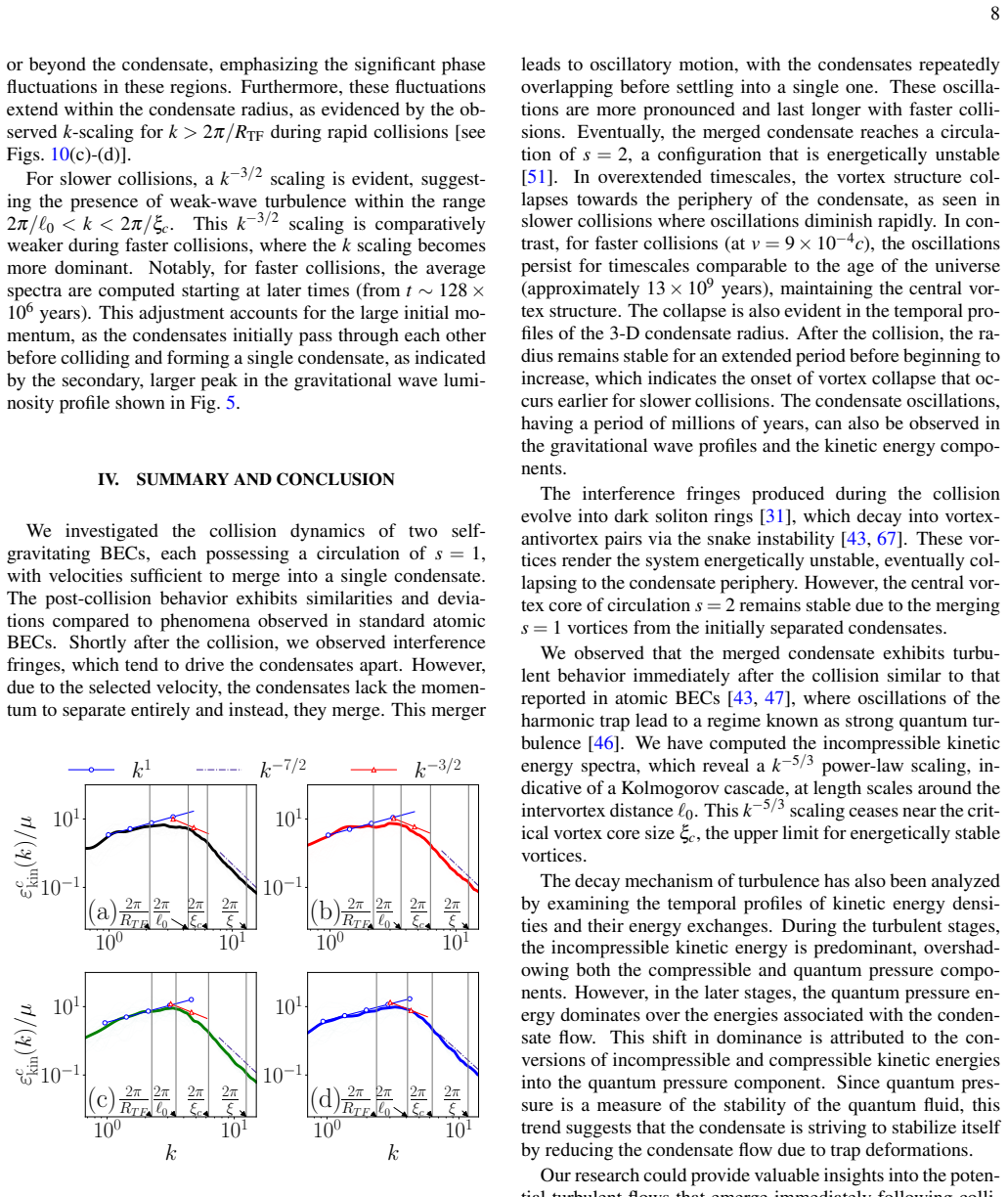
- [Sec. III C, Fig. 10 and text] The compressible spectrum interpretation is presented with less quantitative support than the incompressible one. The text mentions k^{-3/2} weak-wave turbulence for slower collisions but also refers to "k-scaling" without stating an exponent for some panels, and the scalings k^1 and k^{-7/2} are not physically explained. Give the fitted exponents and ranges for each panel, and discuss the mechanisms that produce each scaling.
- [Sec. III C, Fig. 8] The k^{-3} range is labelled an "enstrophy cascade", but in an unbounded 3D condensate the enstrophy cascade is not a standard invariant cascade except in two-dimensional flows. The authors should clarify the physical basis for this nomenclature, and distinguish it from the usual vortex-core spectrum or from numerical dissipation at the grid scale.
minor comments (5)
- [Eq. (10), Sec. II] The sentence "we choose kmin. = 10" contains an extra period, and the definition of n_s(k) (the momentum spectrum of a single-vortex condensate) is not given; please explain how this reference spectrum is obtained and make the notation consistent.
- [Eq. (12), Sec. III B] The constant C in the gravitational wave luminosity formula is dimensionally non-standard; although it is defined, its value or units in the dimensionless simulation units are not given, making it hard to assess the physical magnitude of L_GW.
- [Figures 8-10] In the printed figures the power-law guides (k^{-5/3}, k^{-3}, etc.) are not labelled directly; consider adding text annotations or a legend so that each fit line is unambiguous.
- [General presentation] Several references have incomplete or inconsistent bibliographic entries (e.g., Ref. [8] omits the page/article number and Ref. [25] includes an internal meeting identifier). Please check the reference list for consistency with journal style.
- [Sec. III A, second paragraph] The text states that faster collisions produce ring solitons with a sharper phase difference "and are almost stationary", then two sentences later says the solitons "eventually propagate with a finite velocity"; please rephrase to avoid the apparent contradiction.
Circularity Check
No significant circularity: the spectral claims are direct numerical observations reduced with an external spectral tool; self-citations are used only for comparison and are not load-bearing.
full rationale
The central result—the incompressible kinetic energy spectra exhibiting k^-5/3 and k^-3 scaling—is obtained by solving the Gross-Pitaevskii-Poisson equations with fixed physical parameters and then processing the resulting wave function with the angle-averaged Wiener-Khinchin spectral method of Bradley et al. [56]. No parameter is fitted to the spectra, and the scaling exponents are reported as observed properties of the simulated field rather than derived from the inputs. The variational initial ansatz [51] and the merger velocity choices determine the initial conditions, but they do not encode the spectral slopes. The self-citations [42,43] appear only as consistency comparisons with atomic-BEC merger turbulence, not as proof of the self-gravitating result; the neutron-star remarks citing Refs. [71-73] are speculative and are explicitly qualified by the authors' statement that 'further investigations with sophisticated physics are still needed.' They are not load-bearing for the dark-matter turbulence claim. The absence of a resolution or convergence study is a numerical-validity concern, which falls under correctness risk rather than circularity. No equation in the paper reduces to its own input, so no specific circular step can be quoted.
Assumptions & free parameters
free parameters (3)
- ultralight boson mass m =
3 x 10^-24 eV
- self-interaction strength lambda/(8 pi) =
5.62 x 10^-98
- total particle number N0 =
625
assumptions (5)
- domain assumption The GPP system (Eq. 1) with g=1 is a valid mean-field description of a dark matter halo as a self-gravitating BEC.
- domain assumption The initial wave function (Eq. 4) with a Gaussian density profile, a vortex phase e^{is*theta}, and energy-minimized variational parameters R and eta is a sufficient representation of isolated condensates.
- domain assumption The Poisson potential boundary condition using only monopole and quadrupole moments (Eqs. 6-7) is accurate enough for the merger dynamics.
- standard math The Helmholtz decomposition of the kinetic energy into incompressible and compressible parts (from Refs. [55,56]) remains valid for the GPP density and velocity fields.
- ad hoc to paper The time windows chosen for spectral averaging capture a quasi-stationary turbulent state.
Cite this review
Pith. "Pith review of Revealing turbulent Dark Matter via merging of self-Gravitating condensates." pith.science (2026). https://pith.science/paper/6MUV3EFM
@misc{pith2026250113689,
  author       = {Pith},
  title        = {Pith review of: Revealing turbulent Dark Matter via merging of self-Gravitating condensates},
  year         = {2026},
  howpublished = {\url{https://pith.science/paper/6MUV3EFM}},
  note         = {Machine review of arXiv:2501.13689}
}
abstract
Self-gravitating condensates have been proposed as potential candidates for modelling dark matter. In this paper, we numerically investigate the dynamics of dark matter utilizing the merging of self-gravitating condensates. We have used the Gross-Pitaevskii-Poisson model and identified distinct turbulent regimes based on the merging speed of the condensate. As a result of collision, we notice the appearance of various dark soliton-mediated instabilities that finally lead to the turbulent state characterized by Kolmogorov-like turbulence scaling \( \varepsilon_{\mathrm{kin}}^i \sim k^{-5/3} \) in the infrared and \( \varepsilon_{\mathrm{kin}}^i \sim k^{-3} \) in the ultraviolet regions. The compressible spectrum suggests weak-wave turbulence. The turbulent fluctuations in the condensate cease as the vortices formed via soliton decay are expelled to the condensate's periphery, manifested in the transferring of kinetic energy from incompressible and compressible flows to the quantum pressure energy. We also establish the significant role played by the self-gravitating trap in determining the distribution of compressible kinetic energy and the resulting density waves, which differ markedly from those observed in atomic condensates under harmonic confinement. Our study may offer valuable insights into the merging of binary stars and open new avenues for understanding the structure and dynamics of the dark matter through self-gravitating condensate.
Figures


Figures from the paper (6 more)



Forward citations
Cited by 1 Pith paper
-
Kinematic Imprints of vortex-lines of BEC Dark Matter on Baryonic Matter
Numerical GPP-Euler simulations show BECDM vortex lines stay stable under baryonic collapse, seed gas condensation, and imprint ring-like features that could serve as observational tracers.
Reference graph
Works this paper leans on
-
[56]
A. S. Bradley, R. K. Kumar, S. Pal, and X. Yu, Spectral analy- sis for compressible quantum fluids, Phys. Rev. A 106, 043322 (2022)
work page 2022
-
[1]
M. J. Edmonds, T. Bland, R. Doran, and N. G. Parker, Engineer- ing bright matter-wave solitons of dipolar condensates, New J. Phys. 19, 023019 (2017)
work page 2017
-
[2]
C. G. Böhmer and T. Harko, Can dark matter be a Bose-Einstein condensate?, J. Cosmol. Astropart. Phys. 2007 (06), 025. 10
work page 2007
-
[3]
P.-H. Chavanis, Mass-radius relation of newtonian self- gravitating Bose-Einstein condensates with short-range interac- tions: I. Analytical results, Phys. Rev. D 84, 043531 (2011)
work page 2011
-
[4]
P.-H. Chavanis and T. Harko, Bose-Einstein condensate general relativistic stars, Phys. Rev. D 86, 064011 (2012)
work page 2012
-
[5]
P.-H. Chavanis, Dissipative self-gravitating Bose-Einstein con- densates with arbitrary nonlinearity as a model of dark matter halos, Eur. Phys. J. Plus 132, 248 (2017)
work page 2017
-
[6]
L. Hui, J. P. Ostriker, S. Tremaine, and E. Witten, Ultralight scalars as cosmological dark matter, Phys. Rev. D 95, 043541 (2017)
work page 2017
-
[7]
L. Hui, Wave dark matter, Annu. Rev. Astron. Astrophys.. 59, 247 (2021)
work page 2021
Show all 73 references
-
[8]
Matos, L
T. Matos, L. A. Ureña-López, and J.-W. Lee, Short review of the main achievements of the scalar field, fuzzy, ultralight, wave, BEC dark matter model, Front. Astron. Space Sci.11, 1347518. (2024)
2024
-
[9]
Schive, T
H.-Y . Schive, T. Chiueh, and T. Broadhurst, Cosmic structure as the quantum interference of a coherent dark wave, Nat. Phys 10, 496 (2014)
2014
-
[10]
Matos and L
T. Matos and L. Arturo Ureña-López, Further analysis of a cosmological model with quintessence and scalar dark matter, Phys. Rev. D 63, 063506 (2001)
2001
-
[11]
J. C. Niemeyer, Small-scale structure of fuzzy and axion-like dark matter, Prog. Part. Nucl. Phys. 113, 103787 (2020)
2020
-
[12]
E. J. Madarassy and V . T. Toth, Numerical simulation code for self-gravitating Bose–Einstein condensates, Comput. Phys. Commun. 184, 1339 (2013)
2013
-
[13]
gravitation
S. Giovanazzi, D. O’Dell, and G. Kurizki, Self-binding tran- sition in Bose condensates with laser-induced “gravitation”, Phys. Rev. A 63, 031603 (2001)
2001
-
[14]
O’Dell, S
D. O’Dell, S. Giovanazzi, G. Kurizki, and V . M. Akulin, Bose- Einstein condensates with interatomic attraction: Electromag- netically induced “gravity”, Phys. Rev. Lett. 84, 5687 (2000)
2000
-
[15]
A. B. Migdal, Superfluidity and the moments of inertia of nu- clei, Nucl. Phys. 13, 655 (1959)
1959
-
[16]
Warszawski and A
L. Warszawski and A. Melatos, Gross-Pitaevskii model of pul- sar glitches, Mon. Not. R. Astron. Soc. 415, 1611 (2011)
2011
-
[17]
Warszawski, A
L. Warszawski, A. Melatos, and N. Berloff, Unpinning trig- gers for superfluid vortex avalanches, Phys. Rev. B 85, 104503 (2012)
2012
-
[18]
A. K. Verma, R. Pandit, and M. E. Brachet, Rotating self- gravitating Bose-Einstein condensates with a crust: A model for pulsar glitches, Phys. Rev. Res. 4, 013026 (2022)
2022
-
[19]
Shukla, M
S. Shukla, M. E. Brachet, and R. Pandit, Neutron-superfluid vortices and proton-superconductor flux tubes: Development of a minimal model for pulsar glitches, Phys. Rev. D 110, 083002 (2024)
2024
-
[20]
Shukla, A
S. Shukla, A. K. Verma, M. E. Brachet, and R. Pandit, Gravity- and temperature-driven phase transitions in a model for col- lapsed axionic condensates, Phys. Rev. D 109, 063009 (2024)
2024
-
[21]
Guzmán, J
F. Guzmán, J. González, and J. Cruz-Pérez, Behavior of lumi- nous matter in the head-on encounter of two ultralight BEC dark matter halos, Phys. Rev. D 93, 103535 (2016)
2016
-
[22]
Xiong, T
B. Xiong, T. Yang, and K. A. Benedict, Distortion of inter- ference fringes and the resulting vortex production of merging Bose-Einstein condensates, Phys. Rev. A 88, 043602 (2013)
2013
-
[23]
M. R. Andrews, C. G. Townsend, H.-J. Miesner, D. S. Durfee, D. M. Kurn, and W. Ketterle, Observation of interference be- tween two Bose condensates, Science 275, 637 (1997)
1997
-
[24]
Bloch, T
I. Bloch, T. W. Hänsch, and T. Esslinger, Atom laser with a cw output coupler, Phys. Rev. Lett. 82, 3008 (2006)
2006
-
[25]
G. B. Jo, J. H. Choi, C. Christensen, Y . R. Lee, T. A. Pasquini, W. Ketterle, and D. E. Pritchard, Phase sensitive recombination of two Bose-Einstein condensates on an atom chip, Bull. Am. Phys. Soc. APS Meeting Abstracts, 38, C2.003 (2007)
2007
-
[26]
Paredes and H
A. Paredes and H. Michinel, Interference of dark matter solitons and galactic offsets, Phys. Dark Universe 12, 50 (2016)
2016
-
[27]
R. G. Scott, A. M. Martin, T. M. Fromhold, and F. W. Sheard, Anomalous quantum reflection of Bose-Einstein condensates from a silicon surface: The role of dynamical excitations, Phys. Rev. Lett. 95, 073201 (2005)
2005
-
[28]
Schwabe, J
B. Schwabe, J. C. Niemeyer, and J. F. Engels, Simulations of solitonic core mergers in ultralight axion dark matter cosmolo- gies, Phys. Rev. D 94, 043513 (2016)
2016
-
[29]
Choi, Collision of gravitationally bound Bose-Einstein condensates, Phys
D.-I. Choi, Collision of gravitationally bound Bose-Einstein condensates, Phys. Rev. A 66, 063609 (2002)
2002
-
[30]
Cotner, Collisional interactions between self-interacting non- relativistic boson stars: Effective potential analysis and numer- ical simulations, Phys
E. Cotner, Collisional interactions between self-interacting non- relativistic boson stars: Effective potential analysis and numer- ical simulations, Phys. Rev. D 94, 063503 (2016)
2016
-
[31]
Nikolaieva, Y
Y . Nikolaieva, Y . Bidasyuk, K. Korshynska, E. Gorbar, J. Jia, and A. Yakimenko, Stable vortex structures in colliding self- gravitating Bose-Einstein condensates, Phys. Rev. D 108, 023503 (2023)
2023
-
[32]
Asakawa and M
K. Asakawa and M. Tsubota, Corotation of two quantized vor- tices coupled with collective modes in self-gravitating bose- einstein condensates, Phys. Rev. A 110, 053310 (2024)
2024
-
[33]
Asakawa, H
K. Asakawa, H. Ishihara, and M. Tsubota, Collective excita- tions of self-gravitating Bose-Einstein condensates: Breathing mode and appearance of anisotropy under self-gravity, Prog. Theor. Exp. Phys 2024, 063J01 (2024)
2024
-
[34]
Numasato and M
R. Numasato and M. Tsubota, Numerical analysis of two- dimensional quantum turbulence, J. Phys. Conf. Ser. 150, 032074 (2009)
2009
-
[35]
Numasato and M
R. Numasato and M. Tsubota, Possibility of inverse energy cas- cade in two-dimensional quantum turbulence, J. Low Temp. Phys. 158, 415 (2009)
2009
-
[36]
Numasato, M
R. Numasato, M. Tsubota, and V . S. L’vov, Direct energy cascade in two-dimensional compressible quantum turbulence, Phys. Rev. A 81, 063630 (2010)
2010
-
[37]
S. Das, K. Mukherjee, and S. Majumder, V ortex formation and quantum turbulence with rotating paddle potentials in a two- dimensional binary Bose-Einstein condensate, Phys. Rev. A 106, 023306 (2022)
2022
-
[38]
N. P. Müller, M.-E. Brachet, A. Alexakis, and P. D. Mininni, Abrupt transition between three-dimensional and two- dimensional quantum turbulence, Phys. Rev. Lett. 124, 134501 (2020)
2020
-
[39]
Amette Estrada, M
J. Amette Estrada, M. E. Brachet, and P. D. Mininni, Thermal- ized Abrikosov lattices from decaying turbulence in rotating BECs, A VS Quantum Sci.4, 046201 (2022)
2022
-
[40]
J. A. Estrada, M. E. Brachet, and P. D. Mininni, Turbulence in rotating Bose-Einstein condensates, Phys. Rev. A 105, 063321 (2022)
2022
-
[41]
Mäkinen, S
J. Mäkinen, S. Autti, P. Heikkinen, J. Hosio, R. Hänninen, V . L’vov, P. Walmsley, V . Zavjalov, and V . Eltsov, Rotating quantum wave turbulence, Nat. Phys. 19, 898 (2023)
2023
-
[42]
Sivakumar, P
A. Sivakumar, P. K. Mishra, A. A. Hujeirat, and P. Muru- ganandam, Energy spectra and fluxes of turbulent rotating Bose-Einstein condensates in two dimensions, Phys. Fluids 36, 027149 (2024)
2024
-
[43]
Sivakumar, P
A. Sivakumar, P. K. Mishra, A. A. Hujeirat, and P. Muruganan- dam, Dynamic instabilities and turbulence of merged rotating Bose-Einstein condensates, Phys. Fluids 36, 117121 (2024)
2024
-
[44]
Cidrim, A
A. Cidrim, A. C. White, A. J. Allen, V . S. Bagnato, and C. F. Barenghi, Vinen turbulence via the decay of multicharged vor- tices in trapped atomic Bose-Einstein condensates, Phys. Rev. A 96, 023617 (2017). 11
2017
-
[45]
Á. V . M. Marino, L. Madeira, A. Cidrim, F. E. A. dos San- tos, and V . S. Bagnato, Momentum distribution of vinen turbu- lence in trapped atomic Bose-Einstein condensates, Eur. Phys. J.: Spec. Top. 230, 809 (2021)
2021
-
[46]
Barenghi, H
C. Barenghi, H. Middleton-Spencer, L. Galantucci, and N. Parker, Types of quantum turbulence, A VS Quantum Sci.5, 025601 (2023)
2023
-
[47]
H. A. J. Middleton-Spencer, A. D. G. Orozco, L. Galantucci, M. Moreno, N. G. Parker, L. A. Machado, V . S. Bagnato, and C. F. Barenghi, Strong quantum turbulence in Bose-Einstein condensates, Phys. Rev. Res. 5, 043081 (2023)
2023
-
[48]
P. Mocz, M. V ogelsberger, V . H. Robles, J. Zavala, M. Boylan- Kolchin, A. Fialkov, and L. Hernquist, Galaxy formation with BECDM - I. Turbulence and relaxation of idealized haloes, Mon. Not. R. Astron. Soc. 471, 4559 (2017)
2017
-
[49]
I.-K. Liu, N. P. Proukakis, and G. Rigopoulos, Coherent and incoherent structures in fuzzy dark matter haloes, Mon. Not. R. Astron. Soc. 521, 3625 (2023)
2023
-
[50]
Rindler-Daller and P
T. Rindler-Daller and P. R. Shapiro, Angular momentum and vortex formation in Bose-Einstein-condensed cold dark matter haloes: Angular momentum in BEC-CDM haloes, Mon. Not. R. Astron. Soc. 422, 135 (2012)
2012
-
[51]
Y . O. Nikolaieva, A. O. Olashyn, Y . I. Kuriatnikov, S. I. Vilchynskii, and A. I. Yakimenko, Stable vortex in Bose- Einstein condensate dark matter, Low Temp. Phys. 47, 684 (2021)
2021
-
[52]
Dmitriev, D
A. Dmitriev, D. Levkov, A. Panin, E. Pushnaya, and I. Tkachev, Instability of rotating Bose stars, Phys. Rev. D 104, 023504 (2021)
2021
-
[53]
Kain and H
B. Kain and H. Y . Ling, V ortices in Bose-Einstein condensate dark matter, Phys. Rev. D 82, 064042 (2011)
2011
-
[54]
N. T. Zinner, V ortex structures in a rotating BEC dark matter component, Phys. Res. Int. 2011, 1 (2011)
2011
-
[55]
C. Nore, M. Abid, and M. E. Brachet, Kolmogorov turbu- lence in low-temperature superflows, Phys. Rev. Lett. 78, 3896 (1997)
1997
-
[57]
Zhang, M
X. Zhang, M. H. Chan, T. Harko, S.-D. Liang, and C. S. Leung, Slowly rotating Bose-Einstein condensate galactic dark matter halos, and their rotation curves, Eur. Phys. J. C 78, 346 (2018)
2018
-
[58]
Carbone, C
C. Carbone, C. Baccigalupi, and S. Matarrese, Stochastic grav- itational wave background from cold dark matter halos, Phys. Rev. D 73, 063503 (2006)
2006
-
[59]
Quilis, A
V . Quilis, A. C. González-García, D. Sáez, and J. A. Font, Gravitational waves from galaxy encounters, Phys. Rev. D 75, 104008 (2007)
2007
-
[60]
Quilis, J
V . Quilis, J. M. Ibáñez, and D. Sáez, Gravitational waves from galaxy clusters: A new observable effect, Astrophys. J. 501, L21 (1998)
1998
-
[61]
Muruganandam and S
P. Muruganandam and S. K. Adhikari, Fortran programs for the time-dependent Gross-Pitaevskii equation in a fully anisotropic trap, Comput. Phys. Commun. 180, 1888 (2009)
2009
-
[62]
R. K. Kumar, V . Lonˇcar, P. Muruganandam, S. K. Adhikari, and A. Balaž, C and fortran openmp programs for rotating Bose- Einstein condensates, Comput. Phys. Commun 240, 74 (2019)
2019
-
[63]
L. E. Young-S, P. Muruganandam, S. K. Adhikari, V . Lon ˇcar, D. Vudragovi ´c, and A. Balaž, Openmp gnu and intel for- tran programs for solving the time-dependent Gross-Pitaevskii equation, Comput. Phys. Commun 220, 503 (2017)
2017
-
[64]
Vudragovi ´c, I
D. Vudragovi ´c, I. Vidanovi´c, A. Balaž, P. Muruganandam, and S. K. Adhikari, C programs for solving the time-dependent Gross-Pitaevskii equation in a fully anisotropic trap, Comput. Phys. Commun 183, 2021 (2012)
2012
-
[65]
A. P. Chikkatur, Y . Shin, A. E. Leanhardt, D. Kielpinski, E. Tsikata, T. L. Gustavson, D. E. Pritchard, and W. Ketterle, A continuous source of Bose-Einstein condensed atoms, Science 296, 2193 (2002)
2002
-
[66]
Buchmann, G
L. Buchmann, G. Nikolopoulos, and P. Lambropoulos, Role of the relative phase in the merging of two independent Bose- Einstein condensates, Phys. Rev. A 79, 013631 (2009)
2009
-
[67]
Verma, U
G. Verma, U. D. Rapol, and R. Nath, Generation of dark soli- tons and their instability dynamics in two-dimensional conden- sates, Phys. Rev. A 95, 043618 (2017)
2017
-
[68]
Inagaki, K
T. Inagaki, K. Takahashi, S. Masaki, and N. Sugiyama, System- atic study of gravitational waves from galaxy mergers, Phys. Rev. D 82, 124007 (2010)
2010
-
[69]
Castellanos, C
E. Castellanos, C. Escamilla-Rivera, and J. Mastache, Is a bose–einstein condensate a good candidate for dark matter? A test with galaxy rotation curves, Int. J. Mod. Phys. D 29, 2050063 (2020)
2020
-
[70]
B. P. Abbott, R. Abbott, T. D. Abbott, F. Acernese, K. Ackley, C. Adams, T. Adams, P. Addesso, R. X. Adhikari, et al. (LIGO Scientific Collaboration and Virgo Collaboration), GW170817: Observation of gravitational waves from a binary neutron star inspiral, Phys. Rev. Lett. 119...
2017
-
[71]
A. A. Hujeirat and R. Samtaney, The remnant of GW170817: A trapped neutron star with a massive incompressible superfluid core, J. Mod. Phys. 11, 1785 (2020)
2020
-
[72]
A. A. Hujeirat and R. Samtaney, Glitching pulsars: Unraveling the interactions of general relativistic and quantum fields in the strong field regimes, J. Mod. Phys. 10, 1696 (2019)
2019
-
[73]
A. A. Hujeirat, Glitches: The exact quantum signatures of pul- sars metamorphosis, J. Mod. Phys. 9, 554 (2018)
2018
Reviewed August 10, 2026 · model on record in the stance chip above.
Discussion (0). Continue with ORCID to comment.