REVIEW 4 major objections 6 minor 38 references
Information dynamics, natural computing and Maxwell's demon in two skyrmions system
T0 review · 4 major / 6 minor · reviewed 2026-08-07 · deepseek-v4-flash
Pith's one-line read Two skyrmions confined in a room-temperature trap exchange measurable information, with the strongest directed flow appearing about 10 ms after the cause.
desk verdict First room-temperature transfer entropy map of two interacting skyrmions is worth a look, but the XOR computation claim lacks the control that would make it non-trivial. read the letter →
The pith
A machine-rendered reading of the paper's core claim, the machinery that carries it, and where it could break.
The reading
What carries the argument
The analysis runs on two information-theoretic quantities. Transfer entropy reduces the future uncertainty of one skyrmion's state by knowing the other skyrmion's current state, and is computed with different time separations to locate when information arrives; a three-node variant that includes the previous node checks the Markov assumption. The subsystem time derivative of mutual information, meaning the slope of the mutual information between one skyrmion's present and the other's future, is the paper's criterion for whether one subsystem acts as a Maxwell's demon for the other. The computational test is the mutual information between $X_n = A_n \oplus B_n$, an XOR of the two current binary states, and the future position of skyrmion B. The model calculations use a bipartite Markov jump process governed by the skyrmion interaction energy and a jump rate, with an added feedback potential step of $1 k_BT$ in the demon configuration.
What would settle it
Re-analyze the same 187,500 frames with thresholds at other quantiles, for example 25% and 75%, or with random two-way splits, and with the full continuous positions; if the A-to-B transfer-entropy peak at about 10 ms and the XOR mutual information vanish or move outside the reported statistical errors, the central results are artifacts of the equal-count binarization rather than physical information flow.
Extended reading notes
Core claim
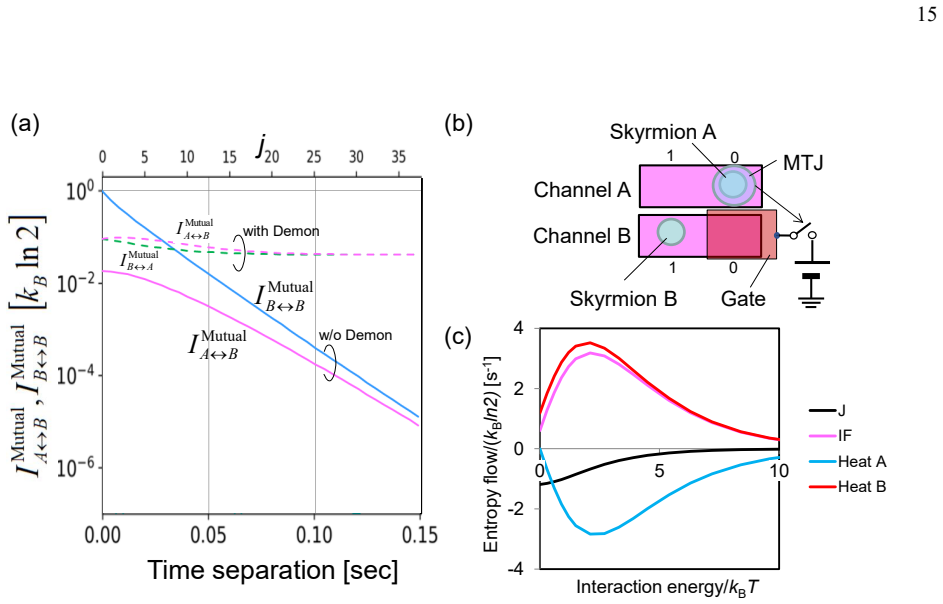
The central claim is that a two-skyrmion system in thermal equilibrium is a weakly information-processing device whose operation can be seen in transfer entropy. Using 250 fps video and 187,500 frames, the authors binarize each skyrmion's horizontal position at an equal-count threshold and find that the A-to-B transfer entropy rises from zero, peaks at a time separation of roughly 10 ms, and then decays with a time constant of about 21 ms; the B-to-B self-transfer entropy decays more slowly, about 26 ms. The initial slope of the mutual information between skyrmion A and future skyrmion B is zero, which in the paper's information-thermodynamics criterion means no Maxwell's-demonic feedback exists in equilibrium. A two-node analysis with an extra past node returns a finite past-to-future mutual information conditioned on the present, demonstrating that the binarized system is non-Markovian. Finally, a master-equation model with magnetic-tunnel-junction detection and voltage-controlled gating, using interaction energy 0.32 $k_BT$ and a jump rate of 19.9 s$^{-1}$, shows a positive A-to-B information flow and a negative reverse flow, which the paper interprets as a built-in Maxwell's demon that cools skyrmion A or extracts work.
Load-bearing premise
The load-bearing assumption is that turning each skyrmion's continuous position into a 0 or 1 at an equal-count threshold does not distort the causal relations between the two skyrmions; if the threshold and binning create the apparent correlations, the 10 ms information peak, the non-Markovianity, and the XOR signal would not describe the real physics.
Editorial extensions
If this is right
- If the analysis is right, directed information flow between two repulsively coupled Brownian skyrmions at room temperature can be measured and has a concrete timescale: about 10 ms to peak and roughly 20 ms to decay.
- The nonzero past-to-future mutual information conditioned on the present means the system carries hidden memory, so hardware built from confined skyrmions should be treated as a hidden Markov system rather than a simple Markov bit.
- The statistically significant XOR mutual information, though only about 0.04% of its maximum, implies that even a minimally structured two-skyrmion pair performs a nonlinear operation on its own thermal fluctuations.
- The model of the feedback-controlled device predicts that the same two-skyrmion setup can act as a room-temperature Maxwell's demon, with information flow from A to B and an accompanying cooling effect on A.
- Scaling skyrmions from 1.5 micrometers toward 10 nanometers would make the estimated operation speed about a nanosecond, which is the paper's stated route toward practical low-energy information engines.
Reading between the lines
- If the hidden trap states are the source of non-Markovianity, then a finer readout than one bit per skyrmion, for example several bits per position or the full coordinates, should increase the measured XOR mutual information; the paper does not attempt this.
- The coincidence between the 10 ms transfer-entropy peak and the skyrmion's diffusion time over its own radius suggests a general speed limit for Brownian information transfer: the propagation delay should scale roughly as distance squared divided by diffusivity, which is testable by changing skyrmion size or confinement.
- Because the demon needs a measurement, the magnetic tunnel junction, and a feedback operation, voltage gating, its net energy balance depends on the cost of that measurement; the paper's entropy-flow calculation alone does not close the full power budget.
- The same transfer-entropy and mutual-information diagnostics could be applied to other room-temperature Brownian tokens, such as domain walls or colloidal particles, to compare which physical systems genuinely perform nonlinear computation rather than just passing correlations.
Editorial analysis
A structured set of objections, weighed in public.
Referee Report
Summary. The paper reports an experimental study of information dynamics in a system of two magnetic skyrmions confined in a square potential well at room temperature. The authors track the Brownian motion of the skyrmions at 250 fps, binarize their x-coordinates, and compute transfer entropies and mutual informations as functions of time separation. They report a peak in transfer entropy from skyrmion A to B at about 10 ms, an attenuation time of roughly 20 ms, an absence of Maxwell's-demon-type information flow in thermal equilibrium, and evidence of non-Markovian behavior attributed to hidden trapping states. They further claim that the system exhibits a small but statistically significant 'XOR computational capability' based on the mutual information I(X_n; B_{n+j}) with X_n = A_n XOR B_n. Finally, they propose and numerically model a skyrmion-based all-solid-state Maxwell's demon operating at room temperature.
Significance. If the central claims are supported, the paper would be a notable experimental demonstration of information-theoretic characterization of stochastic nanomagnetic computation at room temperature, with potential implications for Brownian computing and autonomous information engines. The dataset is large (187,500 frames), and the application of transfer entropy and information thermodynamics to interacting skyrmions is timely. The paper's strengths include the direct measurement of a two-skyrmion system, the explicit check of Markovianity with additional past nodes, and the concrete proposal of a voltage-controlled Maxwell's demon. However, the significance is currently limited because the quantitative claims rest on a data-dependent binarization threshold and on an XOR statistic that lacks the necessary control comparisons.
major comments (4)
- [Section 'In order to investigate information dynamics' (binarization paragraph, near Eq. (1))] The binarization threshold is chosen to equalize the number of 0s and 1s for each skyrmion's x-coordinate. This is a data-dependent preprocessing choice, and the paper does not demonstrate that the resulting binary series preserves the causal information structure of the continuous trajectory. Since each binary state collapses roughly 7-10 trap positions, the binary variable may be a function of the hidden trap state rather than a physical degree of freedom, and the measured transfer entropies and mutual informations could be artifacts of threshold-crossing dynamics. The authors should justify this threshold choice, e.g., by showing that the main conclusions are invariant under a range of thresholds, or by comparing the binarized results with an analysis performed directly on the continuous position series (or on a delay embedding). This is load-bearing because all quantitative claims, including the TE peak and the XOR capability, are computed from the binarized data.
- [Section 'XOR computation' and Eq. (7), Fig. 7] The claim that the two-skyrmion system performs XOR computation is not supported without control comparisons. I(X_n; B_{n+j}) is expected to be positive even if skyrmion A plays no role, because X_n = A_n XOR B_n contains B_n as an input and the paper's own data show that B_n strongly predicts its own future (I_TE^{B->B} is near 1 at j=0 and decays over tens of milliseconds). The paper does not compare I(X_n; B_{n+j}) with I(B_n; B_{n+j}), I(A_n; B_{n+j}), or with a surrogate such as X_n computed from a time-shuffled A_n. Without such controls, the reported 0.04% mutual information cannot be attributed to the nonlinear XOR combination rather than to the trivial self-predictive component of B_n.
- [Section 'Model calculations' and Fig. 4(a)] The master-equation model is fitted to the experimental mutual information using two free parameters (epsilon_I = 0.32 kBT and R0 = 19.9 s^-1), and the residual discrepancy is then attributed post hoc to hidden information associated with trap states. This is a consistency check, not a predictive validation, and it does not independently support the claim that the observed non-Markovianity arises from hidden trap states. To make the Maxwell's demon proposal convincing, the model should be validated on a quantity not used in the fit (for example, the three-node conditional mutual informations in Fig. 5), or the fitted parameters should be compared with independently measured interaction energies and hopping rates.
- [Section 'Statistical errors' (Figs. 2, 3, 5, 7)] The open and closed 'statistical error' markers are mentioned repeatedly, but the method used to compute them is never described. It is not stated whether the errors come from bootstrap resampling, from random surrogate sequences, or from another estimator. Since the paper's significance claims depend on distinguishing signal from statistical error, this omission hampers reproducibility and should be corrected.
minor comments (6)
- [Equation (2)] The notation 'j' is used for the time separation, but the text says the separation is changed from 1 to j time steps; the j=0 case for I_TE^{A->B} is excluded without explanation. Please clarify the indexing convention and how j maps to physical time.
- [Equation numbering around Eq. (5) and Eq. (6)] Two different equations are both labeled (5): the mutual information definitions and the later conditional mutual information definitions. The second should be renumbered (e.g., Eq. (6)) and subsequent equations adjusted.
- [Figure 4 caption] The caption states 'preventing skyrmion A from entering this location,' whereas the main text says the voltage prevents skyrmion B from entering the region. Please reconcile the discrepancy.
- [Throughout] There are numerous typos and grammatical errors, including 'extemely', 'paractical', 'Futthermore', 'equivaent', and 'paprameter'. A thorough proofreading is needed.
- [Abstract and XOR section] The phrase '0.04% of maximum' is ambiguous: clarify whether this is the value of I(X_n; B_{n+j}) relative to the maximum possible mutual information of 1 bit (kB ln 2), and report the absolute value in bits as well.
- [Figure 1 and methods] The sample structure in Fig. 1(a) shows slightly different layer thicknesses from those stated in the text (e.g., Ta 0.22 nm vs 0.24 nm, CoFeB 1.2 nm vs 1.3 nm). Please ensure consistency between the text and the figure.
Circularity Check
No circular derivation: measurements are direct; model parameters are fitted but not called predictions; the XOR statistic is under-controlled but not a reduction-by-construction.
full rationale
The experimental transfer entropy and mutual information are computed directly from binarized position time series, with no fitted parameter being renamed as a prediction. The master-equation model in Fig. 4 is explicitly calibrated by setting ε_I=0.32 kBT and R0=19.9 s^-1 to match one measured mutual-information curve, and the paper openly acknowledges that the model fails to reproduce the self-information decay, attributing the residual to hidden trap states; this is a fit with a post-hoc explanation, not a derivation. The Maxwell's-demon calculation introduces a new parameter (ε_v=1 kBT) in a forward simulation, and its positive information flow is a model output rather than an experimental prediction, so it has independent hypothetical content. The XOR-capability claim uses I(X_n; B_{n+j}) with X_n = A_n ⊕ B_n; because X_n contains B_n as an input and the paper's own Fig. 2(c) shows strong B-to-B self-prediction, the positive value is plausibly contaminated by trivial self-prediction, and no control against I(B_n; B_{n+j}) is provided. This is a statistical-inference weakness rather than a circularity: the measured statistic is not defined as the conclusion, and the paper does not claim to derive the XOR capability from the self-prediction. The self-citations (e.g., ref. [35] for the peak interpretation) are qualitative and not load-bearing for the central quantitative claims. Hence no circular step rises to the level of equivalence-by-construction or fitted-input-called-prediction.
Assumptions & free parameters
free parameters (4)
- binarization threshold =
not given; set so counts of 0 and 1 are equal
- interaction energy epsilon_I =
0.32 kBT
- jumping rate R0 =
19.9 s^-1
- potential rise epsilon_v =
1 kBT
assumptions (4)
- domain assumption The two-skyrmion system is in thermal equilibrium during the experimental observation.
- domain assumption The system can be approximated as a bipartite Markov jump process with two parameters for the model fit.
- ad hoc to paper The hidden trap states observed in the residence-time heatmap are the cause of the non-Markovian behavior.
- domain assumption Magnetic tunnel junctions and voltage-controlled magnetic anisotropy can implement the feedback control described in the Maxwell's demon proposal.
Cite this review
Pith. "Pith review of Information dynamics, natural computing and Maxwell's demon in two skyrmions system." pith.science (2026). https://pith.science/paper/6MY36S4J
@misc{pith2026250612881,
  author       = {Pith},
  title        = {Pith review of: Information dynamics, natural computing and Maxwell's demon in two skyrmions system},
  year         = {2026},
  howpublished = {\url{https://pith.science/paper/6MY36S4J}},
  note         = {Machine review of arXiv:2506.12881}
}
read the original abstract
The probabilistic information flow and natural computational capability of a system with two magnetic skyrmions at room temperature have been experimentally evaluated. Based on this evaluation, an all-solid-state built-in Maxwell's demon operating at room temperature is also proposed. Probabilistic behavior has gained attention for its potential to enable unconventional computing paradigms. However, information propagation and computation in such systems are more complex than in conventional computers, making their visualization essential. In this study, a two-skyrmion system confined within a square potential well at thermal equilibrium was analyzed using information thermodynamics. Transfer entropy and the time derivative of mutual information were employed to investigate the information propagation speed, the absence of a Maxwell's demon in thermal equilibrium, and the system's non-Markovian properties. Furthermore, it was demonstrated that the system exhibits a small but finite computational capability for the nonlinear XOR operation, potentially linked to hidden information in the non-Markovian system. Based on these experiments and analyses, an all-solid-state built-in Maxwell's demon utilizing the two-skyrmion system and operating at room temperature is proposed.
Figures
Reference graph
Works this paper leans on
-
[1]
Sagawa, Masahito Ueda, Physical Review Letters, 102, 250602( 2008)
T. Sagawa, Masahito Ueda, Physical Review Letters, 102, 250602( 2008)
work page 2008
-
[2]
C. H. Bennett, Int. J. of Theor. Phys., 21, 905 (1982)
work page 1982
-
[3]
J. Lee, F. Peper, S. Cotofana, M. Naruse, M. Ohtsu, T. Kawazoe, Y . Takahashi, T. Shimokawa, L. Kish, T. Kubota, Int. J. Unconv. Comput. 12, 341 (2016)
work page 2016
-
[4]
J. V . Koski, A. Kutvonen, I. M. Khaymovich, T. Ala -Nissila, and J. P. Pekola, Phys. Rev. Lett. 115, 260602 (2015)
work page 2015
-
[5]
0", and coordinates larger than the threshold is defined as state
and Brownian computers [6]. Race track memory utilizes the translational motion of skyrmions driven by electric current [7] and their non-volatility. In contrast, Brownian computers leverage the probabilistic behavior resulting from the Brownian motion of skyrmions at room temperature[8-12] and their mutual repulsive interactions[13,14], enabling intellig...
-
[6]
A. Fert, V . Cros, and J. Sampaio, Nature Nanotechnology, 8, 152 (2013) and references in the paper
work page 2013
- [7]
-
[8]
F. Jonietz, S. Mühlbauer, C. Pfleiderer , A. Neubauer, W. Münzer, A. Bauer, T. Adams, R. Georgii, P. Böni, R. A. Duine, K. Everschor, M. Garst, and A. Rosch, Science 330, 1648 (2010)
work page 2010
Show all 38 references
-
[9]
Nozaki, Y
T. Nozaki, Y . Jibiki, M. Goto, E. Tamura, T. Nozaki, H. Kubota, A. Fukushima, S. Yuasa, and Y . Suzuki, Applied Physics Letters 114 (2019)
2019
-
[10]
Schütte, J
C. Schütte, J. Iwasaki, A. Rosch, and N. Nagaosa, Physical Review B 90 (2014)
2014
-
[11]
Zázvorka, F
J. Zázvorka, F. Jakobs, D. Heinze, N. Keil, S. Kromin, S. Jaiswal, K. Litzius, G. Jakob, P. Virnau, D. Pinna, K. Everschor-Sitte, L. Rózsa, A. Donges, U. Nowak, and M. Kläui, Nat Nanotechnol 14, 658 (2019)
2019
-
[12]
S. Miki, Y. Jibiki, E. Tamura, M. Goto, M. Oogane, J. Cho, R. Ishikawa, H. Nomura, and Y. Suzuki, J. Phys. Soc. Jpn. 90, 083601 (2021)
2021
-
[13]
Suzuki, S
Y. Suzuki, S. Miki, Y. Imai, E. Tamura, Physics Letters A, 413, 127603 (2021). 11
2021
-
[14]
S.-Z. Lin, C. Reichhardt, C. D. Batista, and A. Saxena, Physical Review B 87 (2013)
2013
-
[15]
Zhang, M
X. Zhang, M. Ezawa, and Y . Zhou, Sci Rep 5, 9400 (2015)
2015
-
[16]
S. Miki, K. Hashimoto, J. Cho, J. Jung, C. Y . You, R. Ishikawa, E. Tamura, H. Nomura, M. Goto, Y . Suzuki, Applied Physics Letters 122, 202401 (2023)
2023
-
[17]
P. J. Hsu, A. Kubetzka, A. Finco, N. Romming, K. von Bergmann, and R. Wiesendanger, Nat ure Nanotechnology, 12, 123 (2017)
2017
-
[18]
Schott, A
M. Schott, A. Bernand -Mantel, L. Ranno, S. Pizzini, J. V ogel, Hélène Béa, C. Baraduc, S. Auffret, G. Gaudin, D. Givord, Nano Lett 17, 3006 (2017)
2017
-
[19]
Kasagawa, S
M. Kasagawa, S. Miki, K. Tanaka Hashimoto, A. Shimmura, R. Ishikawa, Y. Shiota, M. Goto, H. Nomura, Y. Suzuki, Appl. Phys. Lett. 124, 122407 (2024)
2024
-
[20]
Bourianoff, D
G. Bourianoff, D. Pinna, M. Sitte, and K. Everschor-Sitte, AIP Advances 8 (2018)
2018
-
[21]
U. K. Rossler, A. N. Bogdanov, and C. Pfleiderer, Nature 442, 797 (2006)
2006
-
[22]
K. Raab, M. A. Brems, G. Beneke, T. Dohi, J. Rothorl, F. Kammerbauer, J. H. Mentink, and M. Klaui, Nat Commun 13, 6982 (2022)
2022
-
[23]
Yokouchi, S
T. Yokouchi, S. Sugimoto, B. Rana, S. Seki, N. Ogawa, Y. Shiomi, S. Kasai, and Y. Otani, Science Advances 8, eabq5652 (2022)
2022
-
[24]
Ishikawa, M
R. Ishikawa, M. Goto, H. Nomura, and Y . Suzuki, Applied Physics Letters 119, 072402 (2021)
2021
-
[25]
Schreiber, Physical Review Letters 85, 461 (2000)
T. Schreiber, Physical Review Letters 85, 461 (2000)
2000
-
[26]
An introduction to transfer entropy: Information flow in complex systems
T. Bossomaier, L. Barnett, M. Harrè, and J. T. Lizier, " An introduction to transfer entropy: Information flow in complex systems", Springer Publishing Company (2016)
2016
-
[27]
Chavez, J
M. Chavez, J. Martinerie, and M. Le Van Quyen, J. Neurosci Methods 124, 113 (2003)
2003
-
[28]
S. Ito, M. E. Hansen, R. Heiland, A. Lumsdaine, A. M. Litke, and J. M. Beggs, PLoS One 6, e27431 (2011)
2011
-
[29]
J. T. Lizier, M. Prokopenko, and a. A. Y . Zomaya, ECAL 2007, Springer, 895 (2007)
2007
-
[30]
W.-S. J. Seung Ki Baek and O. K. , Hie-Tae Moon, arXiv:physics/0509014v2 (2005)
2005 arXiv
-
[31]
L. J. Moniz, E. G. Cooch, S. P. Ellner, J. D. Nichols, and J. M. Nichols, Ecological Modelling 208, 145 (2007)
2007
-
[32]
Oka and T
M. Oka and T. Ikegami, PLoS One 8, e60398 (2013)
2013
-
[33]
J. M. Horowitz, and M. Esposito, Phys. Rev. X 4, 0301015 (2014)
2014
-
[34]
C. E. Shannon, The Bell System Technical Journal 27, 379 (1948)
1948
-
[35]
Elements of Information Theory
J. A. T. Thomas M. Cover, "Elements of Information Theory", John Wiley and Sons, New York (2006)
2006
-
[36]
T. Tani, S. Miki, H. Mori, M. Goto, Y . Suzuki, E. Tamura, submitted
-
[37]
J. T. Lizier, M. Prokopenko, and A. Y . Zomaya, Inform. Sci. 208, 39 (2012b)
2012
-
[38]
Inference in Hidden Markov Models (Springer Series in Statistics)
O. Cappé, E. moulines, and T. Rydén, "Inference in Hidden Markov Models (Springer Series in Statistics)" , Springer (2005). 12 Figure 1 (a) Schematic diagram of the sample structure. Skyrmions are formed in the Co₁₆Fe₆₄B₂₀ layer (atomic percentages are indicated in subscript)....
2005
Reviewed August 7, 2026 · model on record in the stance chip above.
Discussion (0). Continue with ORCID to comment.