Cosmology from Clustering of Continuum Galaxies
Pith reviewed 2026-06-25 22:51 UTC · model grok-4.3
The pith
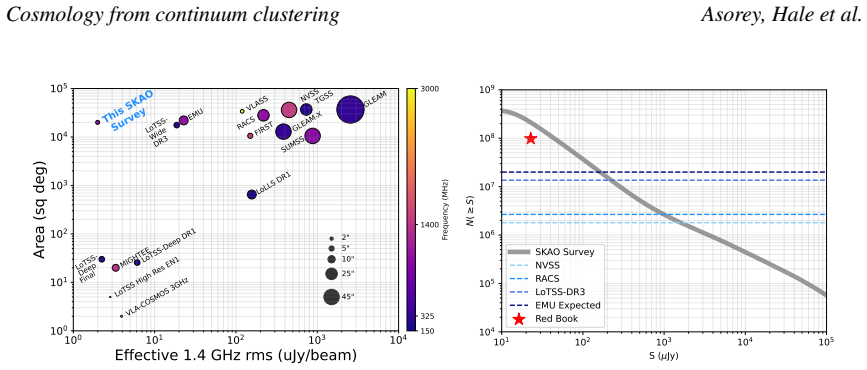
A 20,000 square degree SKAO survey reaches microJansky sensitivity and can detect 300-400 million radio continuum galaxies whose angular clustering probes cosmology.
A machine-rendered reading of the paper's core claim, the machinery that carries it, and where it could break.
Core claim
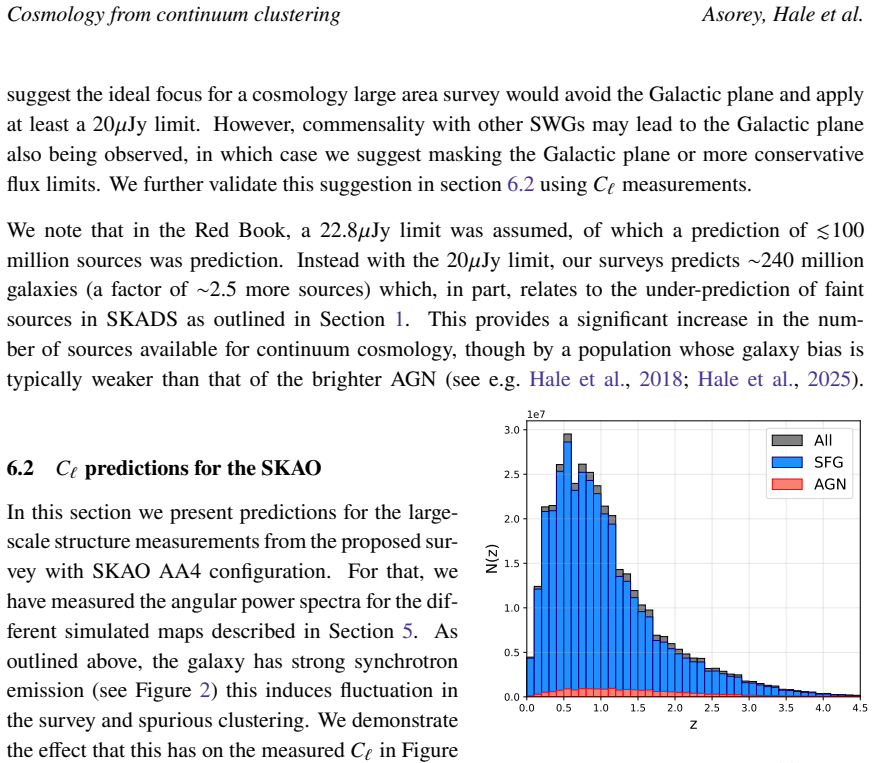
The distribution of radio continuum galaxies is a useful probe of the matter distribution. For the described 20,000 sq. deg. SKAO survey in AA4 configuration with 10,000 hours, O(μJy/beam) sensitivities are reached and O(300-400 million) radio sources are detected. This sample size surpasses the number assumed for the previous SKA cosmology Red Book. Angular clustering is predicted from mocks that include potential telescope systematics, and the paper discusses data corrections required when those systematics cannot be fully modeled.
What carries the argument
Mocks that incorporate potential telescope systematics to forecast the angular clustering of the radio continuum sources.
If this is right
- The survey yields the largest sample of radio continuum galaxies assembled to date.
- The sample exceeds the source numbers used in the prior SKA cosmology Red Book.
- Angular clustering predictions from the mocks indicate which telescope systematics must be corrected to extract cosmology.
- Reliable cosmological inferences from the clustering require accurate inputs for redshift distribution, galaxy bias, and magnification bias.
Where Pith is reading between the lines
- If the required population models prove accurate, cross-correlations between this radio sample and optical or infrared catalogs could supply the missing radial information.
- The same mock-based forecasting approach could be repeated for deeper or wider configurations of other radio arrays to test scalability.
- Deviations between observed and predicted clustering after corrections would point to unmodeled evolution in the radio galaxy population itself.
Load-bearing premise
Accurate measurements or models of the redshift distribution of radio sources, the galaxy bias, and the flux distribution are available so that reliable cosmological inferences can be made from the clustering signal.
What would settle it
A measured source count well below 300 million or an angular clustering amplitude that deviates from the mock predictions after all modeled corrections would show the survey does not deliver the forecasted cosmological information.
Figures
read the original abstract
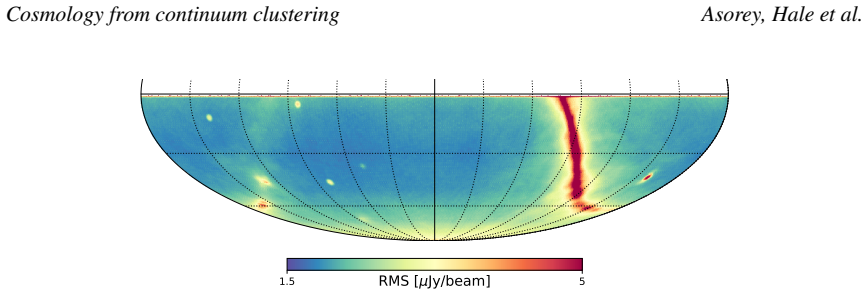
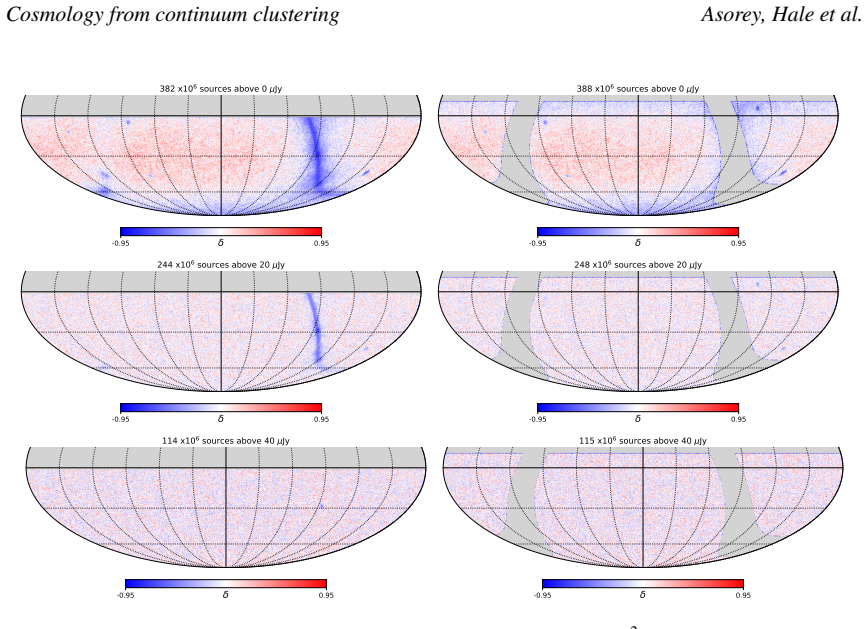
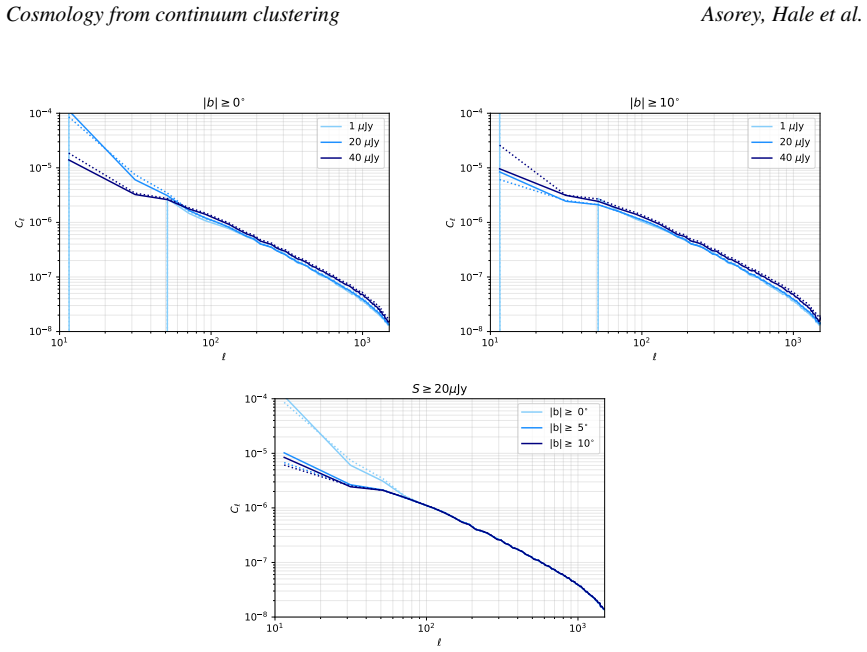
The distribution of radio continuum galaxies is a useful, fast, and accessible probe of the matter distribution in the Universe, enlightening us about the Universe's initial conditions, the physics of dark matter, and the nature of the mysterious dark energy. However, radio continuum galaxies alone cannot easily be localised in the radial direction, and cross-identification of host sources from optical catalogues is challenging across wide area surveys. Moreover, there are several redshift-dependent properties of radio galaxy populations that all need accurate modelling to make reliable inferences about fundamental physics. These include accurate measurements of the redshift distribution of radio sources ($dN/dz$), the coupling between radio galaxies and the underlying matter distribution (quantified by the galaxy bias, $b(z)$), and the true flux distribution $N(S,z)$ of the radio sources (magnification bias). The amount of encoded cosmological information depends on the survey properties and the level of homogeneity across its footprint. In this chapter, we demonstrate the cosmological potential of a 20,000 sq. deg survey with the SKAO in AA4 configuration, using 10,000 hours of observations. Such a survey will reach $\mathcal{O}(\mu\mathrm{Jy/beam)}$ sensitivities and detect $\mathcal{O}$(300-400 million) radio sources, the largest sample of radio continuum galaxies to date. This surpasses the number of sources assumed for the previous SKA cosmology Red Book. We predict the angular clustering of such a survey, using mocks accounting for potential telescope systematics, and discuss which data corrections may be needed when these systematics cannot be accurately modelled.}
Editorial analysis
A structured set of objections, weighed in public.
Referee Report
Summary. The manuscript forecasts the cosmological potential of angular clustering from radio continuum galaxies in a 20,000 sq. deg. SKAO AA4 survey using 10,000 hours of integration. It claims this survey reaches O(μJy/beam) sensitivity and detects O(300-400 million) sources—exceeding prior SKA Red Book assumptions—and predicts the angular clustering signal via mocks that incorporate telescope systematics while discussing required data corrections. The work emphasizes that reliable cosmological inferences require accurate models of dN/dz, galaxy bias b(z), and magnification bias N(S,z).
Significance. If the input population models prove robust and the mocks accurately capture both systematics and clustering, the result would update expectations for the largest radio-continuum sample available for cosmology, potentially strengthening forecasts for constraints on dark energy and initial conditions beyond previous SKA planning documents. The explicit identification of the three key population parameters as prerequisites for inference is a useful clarification.
major comments (2)
- [Abstract] Abstract: the central demonstration consists of predicting angular clustering from mocks that must incorporate dN/dz, b(z) and N(S,z) as inputs, yet no validation, robustness tests against current observational uncertainties, or variation of these inputs is described; because both the quoted source count (300-400 million) and the clustering amplitude derive directly from the same N(S,z) and bias assumptions, any systematic error in those inputs propagates to the claimed cosmological potential and the comparison with the SKA Red Book.
- [Abstract] Abstract: the statement that the survey 'surpasses the number of sources assumed for the previous SKA cosmology Red Book' is presented without a quantitative side-by-side comparison of either the predicted clustering amplitude or the resulting cosmological forecast precision, leaving the improvement in cosmological utility unsubstantiated.
minor comments (1)
- The manuscript is described as 'this chapter'; the relation to any larger volume or book should be clarified for readers.
Simulated Author's Rebuttal
We thank the referee for their careful reading and constructive feedback. The comments correctly identify that our forecasts rely on input population models and that the abstract claim of improvement over the SKA Red Book would benefit from more explicit support. We respond to each point below.
read point-by-point responses
-
Referee: [Abstract] Abstract: the central demonstration consists of predicting angular clustering from mocks that must incorporate dN/dz, b(z) and N(S,z) as inputs, yet no validation, robustness tests against current observational uncertainties, or variation of these inputs is described; because both the quoted source count (300-400 million) and the clustering amplitude derive directly from the same N(S,z) and bias assumptions, any systematic error in those inputs propagates to the claimed cosmological potential and the comparison with the SKA Red Book.
Authors: We agree that the forecasts are tied to the chosen fiducial models for dN/dz, b(z) and N(S,z). The manuscript adopts standard literature values for these quantities to generate the mocks and explicitly states in the introduction that accurate modeling of all three is required for reliable cosmological inference. No robustness tests or parameter variations are performed in the current work, as the emphasis is on survey geometry, depth, and telescope systematics rather than population-model uncertainty. We will revise the abstract and discussion to qualify the results as forecasts under current best-estimate inputs, noting that systematic errors in these inputs would propagate to the quoted source counts and clustering amplitude. This clarification will be added without changing the core analysis. revision: partial
-
Referee: [Abstract] Abstract: the statement that the survey 'surpasses the number of sources assumed for the previous SKA cosmology Red Book' is presented without a quantitative side-by-side comparison of either the predicted clustering amplitude or the resulting cosmological forecast precision, leaving the improvement in cosmological utility unsubstantiated.
Authors: We accept that the claim would be stronger with a direct comparison. The Red Book used earlier sensitivity assumptions that yielded fewer sources than the updated AA4 configuration and 10,000-hour integration considered here. We will insert a brief quantitative comparison (source numbers and, where straightforward, a note on clustering amplitude scaling) in the revised abstract or main text. A full side-by-side cosmological-parameter forecast is outside the present scope but can be flagged as desirable future work. revision: yes
Circularity Check
No significant circularity; forward modeling from standard inputs
full rationale
The paper forecasts source counts and angular clustering for a future SKAO survey by constructing mocks that incorporate external models for dN/dz, b(z) and N(S,z). This is standard forward modeling rather than fitting any parameter to the clustering signal being predicted and then re-presenting the fit as a prediction. No equations or steps in the abstract reduce the output to the inputs by construction, no self-citation chain is load-bearing, and no uniqueness theorem is invoked. The derivation remains independent of the target result and is therefore self-contained.
Axiom & Free-Parameter Ledger
free parameters (3)
- redshift distribution dN/dz
- galaxy bias b(z)
- magnification bias N(S,z)
axioms (1)
- domain assumption Radio continuum galaxies trace the underlying matter distribution sufficiently well for clustering to encode cosmological information.
Reference graph
Works this paper leans on
-
[1]
2026 ,publisher =
Jacobo Asorey&Hale and author2 and author3 and author4 and author5 ,title =. 2026 ,publisher =
2026
-
[2]
2026 ,publisher =
Daniele Bertacca and author2 and author3 and author4 and author5 ,title =. 2026 ,publisher =
2026
-
[3]
2026 ,publisher =
Isabella Prandoni and author2 and author3 and author4 and author5 ,title =. 2026 ,publisher =
2026
-
[4]
2026 ,publisher =
Ian Harrison and author2 and author3 and author4 and author5 ,title =. 2026 ,publisher =
2026
-
[5]
2026 ,publisher =
Suman Chatterjee and author2 and author3 and author4 and author5 ,title =. 2026 ,publisher =
2026
-
[6]
2026 ,publisher =
Jacobo Asorey&C.Hale, and author2 and author3 and author4 and author5 ,title =. 2026 ,publisher =
2026
-
[7]
Cosmic Dipole Measurements
Sebastian Von Hausegger and others. Cosmic Dipole Measurements. 2025
2025
-
[8]
CMB Synergies for Cosmology
Jens Chluba and others. CMB Synergies for Cosmology. 2025
2025
-
[9]
Cosmology from Clustering of Continuum Galaxies
Jacobo Asorey and Catherine Hale and others. Cosmology from Clustering of Continuum Galaxies. 2025
2025
-
[10]
Enhancing Continuum Galaxy Surveys with VLBI
David Parkinson and others. Enhancing Continuum Galaxy Surveys with VLBI. 2025
2025
-
[11]
Galaxy Clusters Viewed with Strong and Weak Lensing
Mamta Pommier and others. Galaxy Clusters Viewed with Strong and Weak Lensing. 2025
2025
-
[12]
Weak Lensing with SKAO: Cosmic Shear Cosmology
Ian Harrison and others. Weak Lensing with SKAO: Cosmic Shear Cosmology. 2025
2025
-
[13]
Weak Lensing II (Shape Measurement)
Priyamvad Tripathi and others. Weak Lensing II (Shape Measurement). 2025
2025
-
[14]
Cosmology from Nx2pt Combinations
Ian Harrison and others. Cosmology from Nx2pt Combinations. 2025
2025
-
[15]
Cosmology with 21cm Intensity Mapping
Laura Wolz and others. Cosmology with 21cm Intensity Mapping. 2025
2025
-
[16]
Observational frontiers in 21cm Intensity Mapping: lesson learned from precursors
Jingying Wang and others. Observational frontiers in 21cm Intensity Mapping: lesson learned from precursors. 2025
2025
-
[17]
Observational frontiers in 21cm Intensity Mapping: lesson learned from pathfinders
Yichao Li and others. Observational frontiers in 21cm Intensity Mapping: lesson learned from pathfinders. 2025
2025
-
[18]
Methodological frontiers in 21cm Intensity Mapping: the treatment of systematics and foreground contanimation
Marta Spinelli and others. Methodological frontiers in 21cm Intensity Mapping: the treatment of systematics and foreground contanimation. 2025
2025
-
[19]
Methodological frontiers in 21cm Intensity Mapping: beyond power spectrum solution for the interpretation of the cosmological signalar Cosmology
Suman Majumdar and others. Methodological frontiers in 21cm Intensity Mapping: beyond power spectrum solution for the interpretation of the cosmological signalar Cosmology. 2025
2025
-
[20]
21cm Intensity Mapping on Small Scales
Laura Wolz and others. 21cm Intensity Mapping on Small Scales. 2025
2025
-
[21]
Simulations of Cosmological HI Signals
Tommaso Ronconi and others. Simulations of Cosmological HI Signals. 2025
2025
-
[22]
Tully-Fisher Cosmology with HI Galaxies
Joel Mayor and others. Tully-Fisher Cosmology with HI Galaxies. 2025
2025
-
[23]
BAO and RSD Cosmolgy with HI Galaxies
Phil Bull and others. BAO and RSD Cosmolgy with HI Galaxies. 2025
2025
-
[24]
Beyond LCDM I (tests of General Relativity)
Stefano Camera and others. Beyond LCDM I (tests of General Relativity). 2025
2025
-
[25]
Beyond LCDM II (tests of Inflation)
Jose Fonseca and others. Beyond LCDM II (tests of Inflation). 2025
2025
-
[26]
Gravitational Wave Synergies for Cosmology
Marta Spinelli and others. Gravitational Wave Synergies for Cosmology. 2025
2025
-
[27]
FRB Synergies for Cosmology
Robert Reischke and others. FRB Synergies for Cosmology. 2025
2025
-
[28]
Synergies between Line Intensity Mapping Experiments
Suman Majumdar and others. Synergies between Line Intensity Mapping Experiments. 2025
2025
-
[29]
Constraints on Particle Dark Matter
Marco Regis and others. Constraints on Particle Dark Matter. 2025
2025
-
[30]
Fast Simultaneous Surveys with On-the-Fly Mapping
Suman Chatterjee and others. Fast Simultaneous Surveys with On-the-Fly Mapping. 2025
2025
-
[32]
2015 , publisher=
Advancing Astrophysics with the Square Kilometre Array (AASKA14) , author=. 2015 , publisher=
2015
-
[33]
Mo, H. J. and White, Simon D. M. , title =. , volume =. 1996 , eprint =
1996
-
[34]
Wilman, R. J. and Miller, L. and Jarvis, M. J. and Mauch, T. and Levrier, F. B. and Abdalla, F. B. and Rawlings, S. and Klöckner, H.-R. and Obreschkow, D. and Olteanu, D. and Young, S. , title =. , volume =. 2008 , eprint =
2008
-
[35]
Probing primordial non-Gaussianity via iSW measurements with SKA continuum surveys , journal =
Alvise Raccanelli and Olivier Dor. Probing primordial non-Gaussianity via iSW measurements with SKA continuum surveys , journal =. 2015 , volume =. 1406.0010 , archivePrefix=
Pith/arXiv arXiv 2015
-
[36]
Ferreira and Julian Borrill , title =
Chris Blake and Pedro G. Ferreira and Julian Borrill , title =. , volume =. 2004 , eprint =
2004
-
[43]
Sheth and H
Ravi K. Sheth and H. J. Mo and Giuseppe Tormen , title =. , volume =. 2001 , eprint =
2001
-
[44]
Abdalla , title =
Anais Rassat and Kate Land and Ofer Lahav and Filipe B. Abdalla , title =. , volume =. 2007 , eprint =
2007
-
[46]
and Santos, Mario G
Ferramacho, Luis D. and Santos, Mario G. and Jarvis, Matt J. and Camera, Stefano , title =. , volume =. 2014 , eprint =
2014
-
[48]
and Sherwin, Blake D
Allison, Rupert and Lindsay, Sam N. and Sherwin, Blake D. and de Bernardis, Francesco and Bond, J. Richard and Calabrese, Erminia and Devlin, Mark J. and Dunkley, Joanna and Gallardo, Patrick and Henderson, Shawn and Hincks, Adam D. and Hlozek, Renee and Jarvis, Matt and Kosowsky, Arthur and Louis, Thibaut and Madhavacheril, Mathew and McMahon, Jeff and M...
2015
-
[49]
Canadian Journal of Physics , year =
Syed Faisal ur Rahman , title =. Canadian Journal of Physics , year =. doi:10.1139/cjp-2014-0339 , eprint =
-
[50]
Lensing corrections to features in the angular two-point correlation function and power spectrum , author =. Phys. Rev. D , volume =. 2008 , month =
2008
-
[53]
Unified Schemes for Radio-Loud Active Galactic Nuclei
Unified Schemes for Radio-Loud Active Galactic Nuclei. , keywords =. doi:10.1086/133630 , archivePrefix =. astro-ph/9506063 , primaryClass =
work page internal anchor Pith review Pith/arXiv arXiv doi:10.1086/133630
-
[59]
The many lives of active galactic nuclei: cooling flows, black holes and the luminosities and colours of galaxies. , keywords =. doi:10.1111/j.1365-2966.2005.09675.x , archivePrefix =. astro-ph/0508046 , primaryClass =
-
[60]
Observational Evidence of AGN Feedback
Observational Evidence of Active Galactic Nuclei Feedback. , keywords =. doi:10.1146/annurev-astro-081811-125521 , archivePrefix =. 1204.4114 , primaryClass =
work page internal anchor Pith review Pith/arXiv arXiv doi:10.1146/annurev-astro-081811-125521
-
[61]
Calibrating Extinction-Free Star Formation Rate Diagnostics with 33GHz Free-Free Emission in NGC6946
Calibrating Extinction-free Star Formation Rate Diagnostics with 33 GHz Free-free Emission in NGC 6946. , keywords =. doi:10.1088/0004-637X/737/2/67 , archivePrefix =. 1105.4877 , primaryClass =
work page internal anchor Pith review Pith/arXiv arXiv doi:10.1088/0004-637x/737/2/67
-
[64]
The Astronomical Journal , volume=
The NRAO VLA sky survey , author=. The Astronomical Journal , volume=. 1998 , publisher=
1998
-
[65]
The LOFAR Two-metre Sky Survey. I. Survey description and preliminary data release. , keywords =. doi:10.1051/0004-6361/201629313 , archivePrefix =. 1611.02700 , primaryClass =
work page internal anchor Pith review Pith/arXiv arXiv doi:10.1051/0004-6361/201629313
-
[68]
EMU: Evolutionary Map of the Universe
EMU: Evolutionary Map of the Universe. , keywords =. doi:10.1071/AS11021 , archivePrefix =. 1106.3219 , primaryClass =
work page internal anchor Pith review Pith/arXiv arXiv doi:10.1071/as11021
-
[71]
Probing the Radio Loud/Quiet AGN dichotomy with quasar clustering
Probing the radio loud/quiet AGN dichotomy with quasar clustering. , keywords =. doi:10.1051/0004-6361/201526433 , archivePrefix =. 1611.08630 , primaryClass =
work page internal anchor Pith review Pith/arXiv arXiv doi:10.1051/0004-6361/201526433
-
[72]
The LOFAR Two-metre Sky Survey Deep Fields. A new analysis of low-frequency radio luminosity as a star-formation tracer in the Lockman Hole region. , keywords =. doi:10.1051/0004-6361/202141286 , archivePrefix =. 2109.06735 , primaryClass =
-
[73]
A new model for NVSS galaxy catalogue using the redshift distribution and halo minimum mass
A new model for NVSS galaxy catalogue using the redshift distribution and halo minimum mass. arXiv e-prints , keywords =. doi:10.48550/arXiv.1312.0530 , archivePrefix =. 1312.0530 , primaryClass =
work page internal anchor Pith review Pith/arXiv arXiv doi:10.48550/arxiv.1312.0530
-
[74]
The clustering of radio galaxies: biasing and evolution versus stellar mass
The Clustering of Radio Galaxies: Biasing and Evolution versus Stellar Mass. , keywords =. doi:10.1088/0004-637X/812/1/85 , archivePrefix =. 1505.06817 , primaryClass =
work page internal anchor Pith review Pith/arXiv arXiv doi:10.1088/0004-637x/812/1/85
-
[75]
The angular two-point correlation of NVSS galaxies revisited
Angular two-point correlation of NVSS galaxies revisited. , keywords =. doi:10.1051/0004-6361/201526956 , archivePrefix =. 1507.02160 , primaryClass =
work page internal anchor Pith review Pith/arXiv arXiv doi:10.1051/0004-6361/201526956
-
[76]
CENSORS: A Combined EIS-NVSS Survey Of Radio Sources - I. Sample definition, radio data and optical identifications. , keywords =. doi:10.1046/j.1365-2966.2003.07125.x , archivePrefix =. astro-ph/0308401 , primaryClass =
-
[77]
CENSORS: A Combined EIS-NVSS Survey of Radio Sources - II. Infrared imaging and the K-z relation. , keywords =. doi:10.1111/j.1365-2966.2005.09916.x , archivePrefix =. astro-ph/0603655 , primaryClass =
-
[78]
A Combined EIS-NVSS Survey Of Radio Sources (CENSORS) - III. Spectroscopic observations. , keywords =. doi:10.1111/j.1365-2966.2008.12786.x , archivePrefix =. 0802.1158 , primaryClass =
-
[79]
The LBDS Hercules sample of mJy radio sources at 1.4 GHz - II. Redshift distribution, radio luminosity function, and the high-redshift cut-off. , keywords =. doi:10.1046/j.1365-8711.2001.04934.x , archivePrefix =. astro-ph/0107048 , primaryClass =
-
[80]
The LOFAR Two-metre Sky Survey. III. First data release: Optical/infrared identifications and value-added catalogue. , keywords =. doi:10.1051/0004-6361/201833564 , archivePrefix =. 1811.07927 , primaryClass =
work page internal anchor Pith review Pith/arXiv arXiv doi:10.1051/0004-6361/201833564
-
[81]
The LOFAR Two-metre Sky Survey. IV. First Data Release: Photometric redshifts and rest-frame magnitudes. , keywords =. doi:10.1051/0004-6361/201833562 , archivePrefix =. 1811.07928 , primaryClass =
work page internal anchor Pith review Pith/arXiv arXiv doi:10.1051/0004-6361/201833562
-
[83]
Cosmology from LOFAR Two-metre Sky Survey Data Release 2: Cross-correlation with the cosmic microwave background. , keywords =. doi:10.1051/0004-6361/202347728 , archivePrefix =. 2412.14825 , primaryClass =
-
[87]
Photometric Redshifts and Stellar Masses for Galaxies from the DESI Legacy Imaging Surveys. , keywords =. doi:10.3847/1538-4365/ab1847 , adsurl =
-
[88]
The VLA-COSMOS 3 GHz Large Project: The cosmic star formation history since z~5
The VLA-COSMOS 3 GHz Large Project: Cosmic star formation history since z 5. , keywords =. doi:10.1051/0004-6361/201629436 , archivePrefix =. 1703.09724 , primaryClass =
work page internal anchor Pith review Pith/arXiv arXiv doi:10.1051/0004-6361/201629436
-
[89]
The VLA-COSMOS 3 GHz Large Project: Cosmic evolution of radio AGN and implications for radio-mode feedback since z 5. , keywords =. doi:10.1051/0004-6361/201730685 , archivePrefix =. 1705.07090 , primaryClass =
work page internal anchor Pith review Pith/arXiv arXiv doi:10.1051/0004-6361/201730685
-
[90]
MIGHTEE: Multi-wavelength counterparts in the COSMOS field. , keywords =. doi:10.1093/mnras/stad3307 , archivePrefix =. 2310.17409 , primaryClass =
-
[91]
EMU: Cross-correlating EMU Pilot Survey 1 with Dark Energy Survey to constrain the radio galaxy redshift distribution. arXiv e-prints , keywords =. doi:10.48550/arXiv.2505.05821 , archivePrefix =. 2505.05821 , primaryClass =
work page internal anchor Pith review doi:10.48550/arxiv.2505.05821
-
[92]
Cross-correlating radio continuum surveys and CMB lensing: constraining redshift distributions, galaxy bias, and cosmology. , keywords =. doi:10.1093/mnras/stab046 , archivePrefix =. 2009.01817 , primaryClass =
-
[95]
The large-scale structure of the universe
-
[102]
The Origin of Radio Emission from Radio-Quiet AGN
The origin of radio emission from radio-quiet active galactic nuclei. Nature Astronomy , keywords =. doi:10.1038/s41550-019-0765-4 , archivePrefix =. 1902.05917 , primaryClass =
work page internal anchor Pith review Pith/arXiv arXiv doi:10.1038/s41550-019-0765-4 1902
-
[103]
MIGHTEE: A first look at MIGHTEE quasars. , keywords =. doi:10.1093/mnras/staf1187 , archivePrefix =. 2507.12046 , primaryClass =
-
[107]
MIGHTEE: the nature of the radio-loud AGN population. , keywords =. doi:10.1093/mnras/stac2140 , archivePrefix =. 2207.12379 , primaryClass =
-
[108]
The star-formation rate-radio luminosity relation at low frequencies
The LOFAR Two-metre Sky Survey Deep Fields. The star-formation rate-radio luminosity relation at low frequencies. , keywords =. doi:10.1051/0004-6361/202039343 , archivePrefix =. 2011.08196 , primaryClass =
-
[110]
The radio emission from active galactic nuclei. , keywords =. doi:10.1051/0004-6361/202140791 , archivePrefix =. 2104.04519 , primaryClass =
-
[111]
The LOFAR Two-metre Sky Survey: Deep Fields Data Release 2: I. The ELAIS-N1 field. , keywords =. doi:10.1051/0004-6361/202452930 , archivePrefix =. 2501.04093 , primaryClass =
-
[112]
The LOFAR Two-meter Sky Survey: Deep Fields Data Release 1. I. Direction-dependent calibration and imaging. , keywords =. doi:10.1051/0004-6361/202038804 , archivePrefix =. 2011.08328 , primaryClass =
-
[113]
GaLactic and Extragalactic All-sky Murchison Widefield Array eXtended (GLEAM-X) survey II: Second Data Release. , keywords =. doi:10.1017/pasa.2024.57 , archivePrefix =. 2406.06921 , primaryClass =
-
[115]
RAS Techniques and Instruments , year = 2024, month = jan, volume =
ContinUNet: fast deep radio image segmentation in the Square Kilometre Array era with U-Net. RAS Techniques and Instruments , year = 2024, month = jan, volume =. doi:10.1093/rasti/rzae019 , adsurl =
-
[116]
PyBDSF: Python Blob Detection and Source Finder
-
[117]
DeepSource: Point Source Detection using Deep Learning
DEEPSOURCE: point source detection using deep learning. , keywords =. doi:10.1093/mnras/stz131 , archivePrefix =. 1807.02701 , primaryClass =
work page internal anchor Pith review Pith/arXiv arXiv doi:10.1093/mnras/stz131
-
[119]
Source-finding for the Australian Square Kilometre Array Pathfinder
Source-Finding for the Australian Square Kilometre Array Pathfinder. , keywords =. doi:10.1071/AS12028 , archivePrefix =. 1208.2479 , primaryClass =
work page internal anchor Pith review Pith/arXiv arXiv doi:10.1071/as12028
-
[126]
Theoretical Models of the Halo Occupation Distribution: Separating Central and Satellite Galaxies
Theoretical Models of the Halo Occupation Distribution: Separating Central and Satellite Galaxies. , keywords =. doi:10.1086/466510 , archivePrefix =. astro-ph/0408564 , primaryClass =
work page internal anchor Pith review Pith/arXiv arXiv doi:10.1086/466510
discussion (0)
Sign in with ORCID, Apple, or X to comment. Anyone can read and Pith papers without signing in.