REVIEW 2 major objections 5 minor 100 references
Generation of Surface Sausage Oscillations of a Current Sheet and Propagating Magnetoacoustic Waves by Impulsive Reconnection
T0 review · 2 major / 5 minor · reviewed 2026-08-06 · deepseek-v4-flash
Pith's one-line read An impulsively reconnecting coronal current sheet self-consistently drives its own leaky surface sausage oscillations and, through them, launches fast and slow magnetoacoustic waves at a common period of about 91 seconds.
desk verdict The paper convincingly demonstrates a self-consistent 91 s oscillation and wave-generation chain in a simulated reconnecting current sheet, but the natural-mode attribution rests on an unquantified boundary-reflection claim that a referee should test. read the letter →
The pith
A machine-rendered reading of the paper's core claim, the machinery that carries it, and where it could break.
The reading
What carries the argument
The load-bearing object is the leaky surface sausage mode of the current sheet: an oscillation in which the sheet's edges move in anti-phase (thinning and fattening its cross-section), whose amplitude decays across the sheet, and which loses energy as outward-propagating fast-mode waves. For a sheet with continuously varying magnetic field, its phase speed is the maximum tube speed $c_T(x) = c_S(x)v_A(x)/\sqrt{c_S(x)^2+v_A(x)^2}$, which is about half the external Alfvén speed for a Harris-type profile; the paper uses the ratio of the sheet length $L$ to this speed to predict a period of $63$–$115$ s, averaging $\approx 89$ s, matching the measured $\approx 91$ s. The Y-points at the sheet ends convert the oscillation and reconnection outflows into the two observed wave modes, so the sheet is simultaneously the oscillator and the wave source.
What would settle it
Re-run the same experiment in a domain at least twice as large, or with explicitly non-reflecting outflow boundaries, and compare the sheet-width, sheet-length, and wave periodicities; if the 91-second signal changes or disappears, boundary reflections were carrying it. A cheaper check is to record the incoming versus outgoing wave amplitude at the boundaries and show the reflected fraction is small, a measurement the paper does not report.
Extended reading notes
Core claim
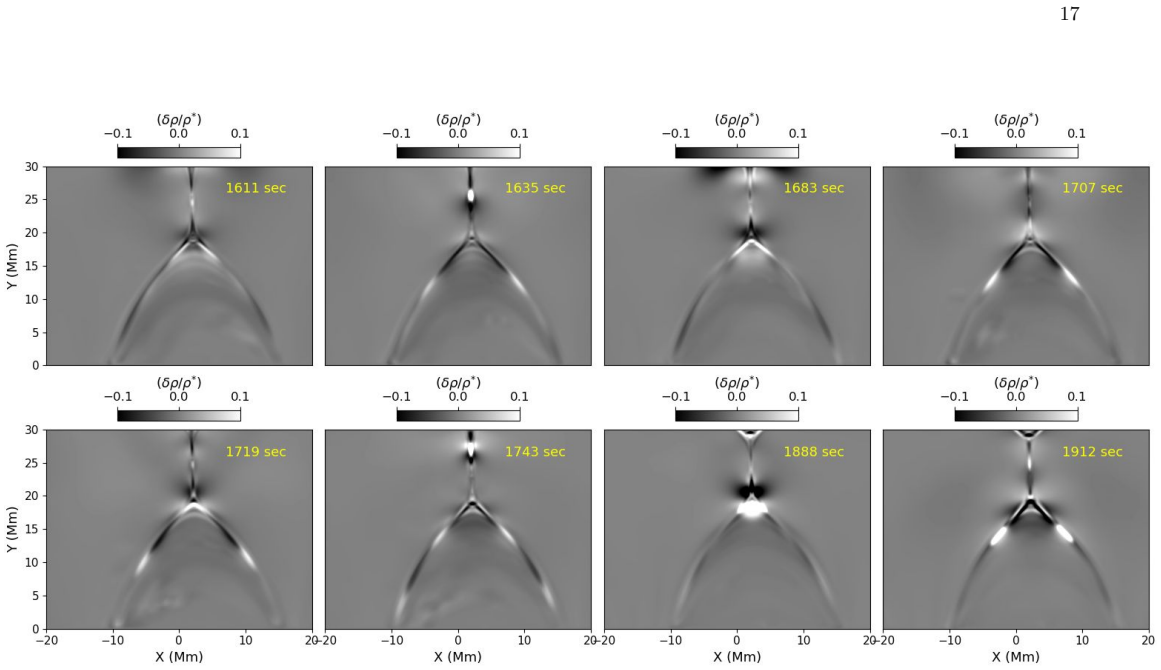
The central claim is that an impulsively reconnecting current sheet behaves as a natural oscillator and as the source of both fast and slow magnetoacoustic waves. The sequence is: two opposite-polarity flux sources converge at the coronal base, a null collapses into a current sheet, secondary tearing makes the reconnection impulsive and bursty, and the bursts excite surface sausage modes in which the two edges of the sheet move in opposite phase. These sausage modes propagate along the sheet, leak energy sideways in the form of fast-mode radiation, and displace the magnetic Y-points at the sheet's ends, so the sheet length oscillates in anti-phase with its width. The repeated impact of plasma bulges, plasmoids, and reconnection outflows on the Y-points generates arc-shaped fast wavefronts in the ambient corona and periodic high-density patches of slow-mode waves along the separatrices. The measured periods of the width oscillation, the length oscillation, and both wave families agree with each other—about 91 seconds—and with the expected tube-speed period $L/\max(c_T)$ for the sheet.
Load-bearing premise
The 91-second oscillation is called a natural mode on the assumption that the outer numerical boundaries do not reflect waves back into the simulation; the paper states its boundary conditions produce very little reflection but does not quantify this, so a significant reflection would make the periodicity partly numerical.
Editorial extensions
If this is right
- Short-period quasi-periodic pulsations in flares, on timescales of tens of seconds, can be produced by the natural sausage oscillation of a reconnecting current sheet rather than by an external oscillation source.
- Large-scale arc-shaped fast-mode wavefronts observed after flares can be traced back to repeated collisions of plasma bulges and plasmoids with the magnetic Y-points, giving the wave period as a diagnostic of the sheet's length and tube speed.
- Slow-mode disturbances along separatrices and low-lying loops should accompany the fast wavefronts and share the same period, providing an observational fingerprint of a reconnection-driven source.
- Reconnection can heat the corona indirectly: some of the released magnetic energy is converted into waves that carry energy away from the sheet and dissipate in the surrounding plasma.
- In three dimensions, current sheets around nulls, separators, and quasi-separators should show the same natural oscillations and act as sources for waves in all directions and along separatrix surfaces.
Reading between the lines
- A testable extension: varying the source separation or the background field should shift the period according to $L/\max(c_T)$; if the measured wavelet periods follow that scaling across runs, the mode interpretation is strengthened, and if they do not, the oscillation is controlled by something else.
- Boundary-reflection caveat aside, the same setup with asynchronous or multiple-step driving could produce several simultaneous periods, which might explain multi-period quasi-periodic pulsations better than a single 91-second clock.
- The predicted anti-phase relation between sheet width and length could be searched for in imaging of flaring current sheets: frames showing minimal sheet width should coincide with maximal sheet length.
- The paired fast-wave/slow-wave emission is a distinctive signature: blast-wave models of coronal waves would not naturally produce slow waves strictly confined to separatrices at the same period, so joint observations could discriminate source mechanisms.
Editorial analysis
A structured set of objections, weighed in public.
Referee Report
Summary. This paper presents a 2D resistive MHD simulation of the coronal response to converging footpoint motions. A magnetic null collapses into a current sheet, which undergoes impulsive bursty reconnection. The authors report that the sheet's width and length oscillate with a ~91 s period, identify the width oscillation as a leaky surface sausage mode, and show that the oscillating Y-points at the sheet ends generate outward fast magnetoacoustic waves and field-aligned slow waves with the same period. The identification rests on anti-correlated oscillations of the two sheet edges and of the Vx components, wavelet period measurements, and pressure-fluctuation phase relations, together with a comparison with the tube-speed period L/max(c_T).
Significance. If the central claim holds, the paper provides a self-consistent mechanism linking impulsive reconnection, natural current-sheet oscillations, and the generation of both fast and slow MHD waves, with direct relevance to quasi-periodic pulsations and coronal heating. Its strengths are the multiplicity of diagnostics—cross-correlations, wavelet significance levels, and mode identification through pressure-phase relations—and the fact that the ~91 s period is an emergent quantity rather than a fitted parameter. The main weakness is that the natural-mode interpretation depends on an unquantified claim that the outer boundaries are essentially non-reflecting.
major comments (2)
- [Section 4] The claim that the 91 s current-sheet oscillation is a natural sausage mode rests on an unquantified assertion about boundary reflections. Section 4 states that the adopted boundary conditions 'produce very little reflection,' but the top and side boundaries use continuous zero-gradient conditions and the bottom uses fixed pressure/density with antisymmetric V_y, none of which is transparent to fast MHD waves. Since the domain is 160 x 80 Mm and the measured fast speed is 469 ± 22 km/s, a wave can cross the domain in roughly 170 s vertically and 340 s horizontally, so multiple reflected passes are kinematically possible within the 469-1984 s analysis window. Please provide a quantitative reflection test (e.g., a larger-domain run, a sponge-layer run, or a measurement of inward-propagating wave amplitudes at the boundaries); without it, the central causal chain from impulsive reconnection to a natural sausage mode to propagating waves is not fully established.
- [Section 3.3.4, Eq. (2)] The theoretical period estimate L/max(c_T) is presented as supporting the natural-mode interpretation, but it is not an independent check: L is the instantaneous simulated current-sheet length and c_T is computed from the simulated fields, and the resulting range (63-115 s, average 89 ± 10 s) brackets the observed 91 s. The broad range means this consistency does not distinguish a true leaky sausage eigenmode from an oscillation forced by reflected waves. A convincing identification would require either the boundary-reflection test above or an explicit comparison with an eigenmode calculation for the simulated background profiles.
minor comments (5)
- [Title] The title contains a line-break typo: 'W aves' should read 'Waves'.
- [Section 1] The text 'Both these example' should read 'Both these examples'.
- [Section 4] The phrase 'important in in coronal heating' contains a duplicated 'in' and should be corrected.
- [Figure 5 caption] The caption lists '(xnull − 1) Mm and (xnull − 1) Mm'; the second instance should presumably be '(xnull + 1) Mm'.
- [Section 3.3] The current-sheet half-width is only about 0.15-0.2 Mm, or 4-5 grid cells at the stated 39 km resolution; a brief comment on the sensitivity of the W and Vx measurements to this resolution would strengthen the quantitative claims.
Circularity Check
No significant circularity: the 91 s period is a measured simulation output; the tube-speed comparison is a self-consistent check, and the SWAR self-citation is framing only.
full rationale
The central result—an impulsively reconnecting current sheet undergoing ~91 s sausage oscillations and launching fast and slow magnetoacoustic waves—is an emergent product of the MHD simulation, not a fitted constant or a consequence of the authors' prior work. The period is obtained by wavelet analysis of simulated quantities ((W-W0)/W0, Vx at the sheet edge, and (L-L0)/L0); none of these is adjusted to reproduce the tube-speed formula. The comparison in Section 3.3.4 uses L and max(cT) measured from the same simulation, so it is an internal consistency check rather than an externally parameter-free prediction; however, the dispersion relation itself is independent prior work (Smith et al. 1997; Edwin & Roberts 1982), no parameter is tuned to force agreement, and a mismatch would have been meaningful. The 'Symbiosis of Waves and Reconnection (SWAR)' concept is cited from the authors' own papers for interpretive framing only; the numerical mechanism is fully specified by the MHD equations and boundary driving and does not depend on that concept. The only notable weakness is the unquantified assertion in Section 4 that the boundary conditions 'produce very little reflection'; this is a robustness or correctness concern about possible numerical artifacts, not circularity, because even a reflection-contaminated 91 s signal would be an emergent simulation output rather than a quantity inserted by construction. No uniqueness theorem is imported from the authors, no ansatz is smuggled in via citation, and no known empirical result is merely renamed. The score of 2 reflects only the minor, non-load-bearing self-citation and the internally parameterized theoretical comparison, not any reduction of the central claim to its inputs.
Assumptions & free parameters
assumptions (5)
- domain assumption Resistive, viscous, thermally conductive MHD equations (Eqs. 3-6) with uniform resistivity and viscosity
- domain assumption 2D geometry, no gravity or stratification
- domain assumption Initial potential field from two magnetic fragments plus overlying uniform field (Eq. 9)
- standard math Surface sausage mode theory for a slab with varying B (Smith et al. 1997), specifically phase speed equal to maximum tube speed cT
- ad hoc to paper The numerical boundary conditions (continuous on top/sides, fixed bottom) are effectively non-reflecting
Cite this review
Pith. "Pith review of Generation of Surface Sausage Oscillations of a Current Sheet and Propagating Magnetoacoustic Waves by Impulsive Reconnection." pith.science (2026). https://pith.science/paper/6MZXBS6Q
@misc{pith2026250709932,
  author       = {Pith},
  title        = {Pith review of: Generation of Surface Sausage Oscillations of a Current Sheet and Propagating Magnetoacoustic Waves by Impulsive Reconnection},
  year         = {2026},
  howpublished = {\url{https://pith.science/paper/6MZXBS6Q}},
  note         = {Machine review of arXiv:2507.09932}
}
read the original abstract
Magnetic reconnection and Magnetohydrodynamic (MHD) waves may well be both playing a role in coronal heating. In this paper, we simulate reconnection in the corona as a response to the convergence of opposite-polarity magnetic sources at the base of the corona. A current sheet forms at a magnetic null and undergoes impulsive bursty reconnection which drives natural modes of oscillation of the current sheet by a process of symbiosis. These are leaky surface sausage modes which cause the length of the current sheet to oscillate. Interaction of the oscillations and reconnection outflows with the magnetic Y-points at the ends of the sheet acts as sources for magnetoacoustic waves. Fast-mode waves propagate outwards into the coronal environment, while slow-mode waves propagate along the separatrices extending from the ends of the current sheet. The periodicities for sausage oscillations of the current sheet, for the current sheet length, and for the propagating large-scale magnetoacoustic waves are all estimated to be approximately 91 s for the parameters of our experiment.
Figures


Figures from the paper (7 more)


Reference graph
Works this paper leans on
-
[1]
, " * write output.state after.block = add.period write newline
ENTRY address archivePrefix author booktitle chapter doi edition editor eprint howpublished institution journal key month number organization pages publisher school series title misctitle type volume year version url label extra.label sort.label short.list INTEGERS output.state before.all mid.sentence after.sentence after.block FUNCTION init.state.consts ...
-
[2]
write newline
" write newline "" before.all 'output.state := FUNCTION format.url url empty "" new.block "" url * "" * if FUNCTION format.eprint eprint empty "" archivePrefix empty "" archivePrefix "arXiv" = new.block " " eprint * " " * new.block " " eprint * " " * if if if FUNCTION format.doi doi empty "" " " doi * " " * if FUNCTION format.pid doi empty eprint empty ur...
-
[3]
!1A Qa
thebibliography [1] 20pt to REFERENCES 6pt =0pt -12pt 10pt plus 3pt =0pt =0pt =1pt plus 1pt =0pt =0pt -12pt =13pt plus 1pt =20pt =13pt plus 1pt \@M =10000 =-1.0em =0pt =0pt 0pt =0pt =1.0em @enumiv\@empty 10000 10000 `\.\@m \@noitemerr \@latex@warning Empty `thebibliography' environment \@ifnextchar \@reference \@latexerr Missing key on reference command E...
2021
-
[4]
M., & Keppens, R.\ 2022, , 668, A47
Brughmans, N., Jenkins, J. M., & Keppens, R.\ 2022, , 668, A47. doi:10.1051/0004-6361/202244071
-
[5]
Cally, P. S.\ 1986, , 103, 277. doi:10.1007/BF00147830
-
[6]
Cao, J. B., Wei, X. H., Duan, A. Y., et al.\ 2013, Journal of Geophysical Research (Space Physics), 118, 1659. doi:10.1002/jgra.50246
-
[7]
Cheng, C. Z. & Choe, G. S.\ 1998, , 505, 376. doi:10.1086/306143
-
[8]
Cheng, X., Priest, E. R., Li, H. T., et al.\ 2023, Nature Communications, 14, 2107. doi:10.1038/s41467-023-37888-w
Show all 100 references
-
[9]
K., Velli, M
Edmondson, J. K., Velli, M. M., & DeVore, C. R.\ 2010, AGU Fall Meeting Abstracts, 2010, SH54C-02
2010
-
[10]
Edwin, P. M. & Roberts, B.\ 1982, , 76, 239. doi:10.1007/BF00170986
1982 doi
-
[11]
M., Roberts, B., & Hughes, W
Edwin, P. M., Roberts, B., & Hughes, W. J.\ 1986, , 13, 373. doi:10.1029/GL013i004p00373
1986 doi
-
[12]
R., Nistic \`o , G., Nakariakov, V
Goddard, C. R., Nistic \`o , G., Nakariakov, V. M., et al.\ 2016, , 594, A96. doi:10.1051/0004-6361/201628478
2016 doi
-
[13]
P.\ 1971, Physica, 53, 412
Goedbloed, J. P.\ 1971, Physica, 53, 412. doi:10.1016/0031-8914(71)90127-3
1971 doi
-
[14]
Goedbloed, J. P. H. & Poedts, S.\ 2004, ``Principles of Magnetohydrodynamics, by J.P.H. Goedbloed and S. Poedts. ISBN 0521626072
2004
-
[15]
P., Keppens, R., & Poedts, S.\ 2010, Advanced Magnetohydrodynamics, by J
Goedbloed, J. P., Keppens, R., & Poedts, S.\ 2010, Advanced Magnetohydrodynamics, by J. P. Goedbloed , Rony Keppens , Stefaan Poedts, Cambridge, UK: Cambridge University Press, 2010
2010
-
[16]
Goossens
Goossens, M.\ 2003, An introduction to plasma astrophysics and magnetohydrodynamics, by M. Goossens. Astrophysics and Space Science Library, Vol. 294. Dordrecht: Kluwer Academic Publishers, 2003. doi:10.1007/978-94-007-1076-4
2003 doi
-
[17]
doi:10.1016/0021-9991(83)90136-5
Harten, A.\ 1983, Journal of Computational Physics, 49, 357. doi:10.1016/0021-9991(83)90136-5
1983 doi
-
[18]
M., & Fludra, A.\ 2014, , 567, A24
Hornsey, C., Nakariakov, V. M., & Fludra, A.\ 2014, , 567, A24. doi:10.1051/0004-6361/201423524
2014 doi
-
[19]
doi:10.3847/1538-4357/ad1993
Hu, J., Ye, J., Chen, Y., et al.\ 2024, , 962, 42. doi:10.3847/1538-4357/ad1993
2024 doi
-
[20]
doi:10.1051/0004-6361/201219891
Jel \' nek, P., Karlick \'y , M., & Murawski, K.\ 2012, , 546, A49. doi:10.1051/0004-6361/201219891
2012 doi
-
[21]
Jenkins, J. M. & Keppens, R.\ 2021, , 646, A134. doi:10.1051/0004-6361/202039630
2021 doi
-
[22]
K., Kolotkov, D
Kashapova, L. K., Kolotkov, D. Y., Kupriyanova, E. G., et al.\ 2021, , 296, 185. doi:10.1007/s11207-021-01934-x
2021 doi
-
[23]
doi:10.1051/0004-6361/201220296
Karlick \'y , M., M \'e sz \'a rosov \'a , H., & Jel \' nek, P.\ 2013, , 550, A1. doi:10.1051/0004-6361/201220296
2013 doi
-
[24]
doi:10.1051/0004-6361/201629652
Karlick \'y , M.\ 2017, , 602, A122. doi:10.1051/0004-6361/201629652
2017 doi
-
[25]
doi:10.1051/0004-6361/202245359
Keppens, R., Popescu Braileanu, B., Zhou, Y., et al.\ 2023, , 673, A66. doi:10.1051/0004-6361/202245359
2023 doi
-
[26]
A., Botha, G
Karampelas, K., McLaughlin, J. A., Botha, G. J. J., et al.\ 2023, , 943, 131. doi:10.3847/1538-4357/acac90
2023 doi
-
[27]
doi:10.1063/1.871559
Klapper, I., Rado, A., & Tabor, M.\ 1996, Physics of Plasmas, 3, 4281. doi:10.1063/1.871559
1996 doi
- [28]
-
[29]
S., & T \"o r \"o k, T.\ 2004, , 413, L23
Kliem, B., Titov, V. S., & T \"o r \"o k, T.\ 2004, , 413, L23. doi:10.1051/0004-6361:20031690
2004 doi
-
[30]
M., & Cho, K.-S.\ 2017, , 844, 149
Kumar, P., Nakariakov, V. M., & Cho, K.-S.\ 2017, , 844, 149. doi:10.3847/1538-4357/aa7d53
2017 doi
-
[31]
C., Wang, S., Wei, C
Lee, L. C., Wang, S., Wei, C. Q., et al.\ 1988, , 93, 7354. doi:10.1029/JA093iA07p07354
1988 doi
-
[32]
doi:10.1051/0004-6361/202245765
Liakh, V., Luna, M., & Khomenko, E.\ 2023, , 673, A154. doi:10.1051/0004-6361/202245765
2023 doi
-
[33]
& Keppens, R.\ 2025, , 696, A158
Liakh, V. & Keppens, R.\ 2025, , 696, A158. doi:10.1051/0004-6361/202453300
2025 doi
-
[34]
doi:10.3847/2041-8213/aaf167
Li, L., Zhang, J., Peter, H., et al.\ 2018, , 868, L33. doi:10.3847/2041-8213/aaf167
2018 doi
-
[35]
Linnell Nemec, A. F. & Nemec, J. M.\ 1985, , 90, 2317. doi:10.1086/113936
1985 doi
-
[36]
M., Zhao, J., et al.\ 2011, , 736, L13
Liu, W., Title, A. M., Zhao, J., et al.\ 2011, , 736, L13. doi:10.1088/2041-8205/736/1/L13
2011 doi
-
[37]
V., et al.\ 2012, , 753, 52
Liu, W., Ofman, L., Nitta, N. V., et al.\ 2012, , 753, 52. doi:10.1088/0004-637X/753/1/52
2012 doi
-
[38]
Longcope, D. W. & Priest, E. R.\ 2007, Physics of Plasmas, 14, 122905. doi:10.1063/1.2823023
2007 doi
-
[39]
F., Schekochihin, A
Loureiro, N. F., Schekochihin, A. A., & Cowley, S. C.\ 2007, Physics of Plasmas, Instability of current sheets and formation of plasmoid chains, 14, 10, 100703. doi:10.1063/1.2783986
2007 doi
- [40]
-
[41]
A., Verth, G., Fedun, V., et al.\ 2012, , 749, 30
McLaughlin, J. A., Verth, G., Fedun, V., et al.\ 2012, , 749, 30. doi:10.1088/0004-637X/749/1/30
2012 doi
-
[42]
A., Nakariakov, V
McLaughlin, J. A., Nakariakov, V. M., Dominique, M., et al.\ 2018, , 214, 45. doi:10.1007/s11214-018-0478-5
2018 doi
-
[43]
S., & Priest, E
Mellor, C., Titov, V. S., & Priest, E. R.\ 2003, Geophysical and Astrophysical Fluid Dynamics, 97, 489. doi:10.1080/0309192032000141483
2003 doi
-
[44]
doi:10.1088/0004-637X/788/1/44
M \'e sz \'a rosov \'a , H., Karlick \'y , M., Jel \' nek, P., et al.\ 2014, , 788, 44. doi:10.1088/0004-637X/788/1/44
2014 doi
-
[45]
K., Mishra, S
Mondal, S., Srivastava, A. K., Mishra, S. K., et al.\ 2023, , 953, 84. doi:10.3847/1538-4357/acd2da
2023 doi
-
[46]
K., Pontin, D
Mondal, S., Srivastava, A. K., Pontin, D. I., Ding Yuan & Priest, E.R.\ 2024, , 963, 139. doi:10.3847/1538-4357/ad2079
2024 doi
-
[47]
K., Pontin, D
Mondal, S., Srivastava, A. K., Pontin, D. I., et al.\ 2024, , 977, 235. doi:10.3847/1538-4357/ad9022
2024 doi
-
[48]
Nakariakov, V. M. & Roberts, B.\ 1995, , 159, 399. doi:10.1007/BF00686541
1995 doi
-
[49]
M., Ofman, L., Deluca, E
Nakariakov, V. M., Ofman, L., Deluca, E. E., et al.\ 1999, Science, 285, 862. doi:10.1126/science.285.5429.862
1999 doi
-
[50]
Nakariakov, V. M. & Verwichte, E.\ 2005, Living Reviews in Solar Physics, 2, 3. doi:10.12942/lrsp-2005-3
2005 doi
-
[51]
M., Foullon, C., Verwichte, E., et al.\ 2006, , 452, 343
Nakariakov, V. M., Foullon, C., Verwichte, E., et al.\ 2006, , 452, 343. doi:10.1051/0004-6361:20054608
2006 doi
-
[52]
Nakariakov, V. M. & Melnikov, V. F.\ 2009, , 149, 119. doi:10.1007/s11214-009-9536-3
2009 doi
-
[53]
Nakariakov, V. M. & Zimovets, I. V.\ 2011, , 730, L27. doi:10.1088/2041-8205/730/2/L27
2011 doi
-
[54]
M., Hornsey, C., & Melnikov, V
Nakariakov, V. M., Hornsey, C., & Melnikov, V. F.\ 2012, , 761, 134. doi:10.1088/0004-637X/761/2/134
2012 doi
-
[55]
J., & Nakariakov, V
Nistic \`o , G., Pascoe, D. J., & Nakariakov, V. M.\ 2014, , 569, A12. doi:10.1051/0004-6361/201423763
2014 doi
-
[56]
V., Schrijver, C
Nitta, N. V., Schrijver, C. J., Title, A. M., et al.\ 2013, , 776, 58. doi:10.1088/0004-637X/776/1/58
2013 doi
-
[57]
H., N \'o brega-Siverio, D., & Carlsson, M.\ 2023, , 675, A97
F rder, . H., N \'o brega-Siverio, D., & Carlsson, M.\ 2023, , 675, A97. doi:10.1051/0004-6361/202346447
2023 doi
-
[58]
G., et al.\ 2001, , 368, 1095
O'Shea, E., Banerjee, D., Doyle, J. G., et al.\ 2001, , 368, 1095. doi:10.1051/0004-6361:20010073
2001 doi
-
[59]
J., Nakariakov, V
Pascoe, D. J., Nakariakov, V. M., & Arber, T. D.\ 2007, , 461, 1149. doi:10.1051/0004-6361:20065986
2007 doi
-
[60]
Pontin, D. I. & Priest, E. R.\ 2022, Living Reviews in Solar Physics, 19, 1. doi:10.1007/s41116-022-00032-9
2022 doi
-
[61]
I., Priest, E
Pontin, D. I., Priest, E. R., Chitta, L. P., et al.\ 2024, , 960, 51. doi:10.3847/1538-4357/ad03eb
2024 doi
-
[62]
R.\ 1986, Mitteilungen der Astronomischen Gesellschaft Hamburg, Magnetic Reconnection on the Sun, 65, 41
Priest, E. R.\ 1986, Mitteilungen der Astronomischen Gesellschaft Hamburg, Magnetic Reconnection on the Sun, 65, 41
1986
-
[63]
S., & Khomenko, E.\ 2023, , 670, A31
Popescu Braileanu, B., Lukin, V. S., & Khomenko, E.\ 2023, , 670, A31. doi:10.1051/0004-6361/202142996
2023 doi
-
[64]
doi:10.1017/CBO9781139020732
Priest, E.\ 2014, Magnetohydrodynamics of the Sun, by Eric Priest, Cambridge, UK: Cambridge University Press, 2014. doi:10.1017/CBO9781139020732
2014 doi
-
[65]
Priest, E. R. & Syntelis, P.\ 2021, , 647, A31. doi:10.1051/0004-6361/202038917
2021 doi
-
[66]
Priest, E. R. & Pontin, D. I.\ 2024, , 534, 3133. doi:10.1093/mnras/stae2294
2024 doi
-
[67]
M., & Benz, A
Roberts, B., Edwin, P. M., & Benz, A. O.\ 1984, , 279, 857. doi:10.1086/161956
1984 doi
-
[68]
Roberts, B.\ 2019, MHD Waves in the Solar Atmosphere, by Bernard Roberts, Cambridge, UK: Cambridge University Press, 2019
2019
-
[69]
Cambridge: Cambridge University Press
Roberts, B.\ 2019, MHD waves in the solar atmosphere, by Roberts, Bernard, 2019. Cambridge: Cambridge University Press. ISBN: 1-108-63358-7
2019
-
[70]
doi:10.1007/s11207-019-1428-4
Rudawy, P., Radziszewski, K., Berlicki, A., et al.\ 2019, , 294, 48. doi:10.1007/s11207-019-1428-4
2019 doi
-
[71]
B., Longcope, D
Scott, R. B., Longcope, D. W., & McKenzie, D. E.\ 2013, , 776, 54. doi:10.1088/0004-637X/776/1/54
2013 doi
-
[72]
& Keppens, R.\ 2022, , 666, A28
Sen, S. & Keppens, R.\ 2022, , 666, A28. doi:10.1051/0004-6361/202244152
2022 doi
-
[73]
& Liu, Y.\ 2012, , 753, 53
Shen, Y. & Liu, Y.\ 2012, , 753, 53. doi:10.1088/0004-637X/753/1/53
2012 doi
-
[74]
doi:10.1007/s11207-013-0395-4
Shen, Y.-D., Liu, Y., Su, J.-T., et al.\ 2013, , 288, 585. doi:10.1007/s11207-013-0395-4
2013 doi
-
[75]
doi:10.3847/1538-4357/
Shen, Y., Liu, Y., Song, T., et al.\ 2018, , 853, 1. doi:10.3847/1538-4357/
2018 doi
-
[76]
D., et al.\ 2018, , 861, 105
Shen, Y., Liu, Y., Liu, Y. D., et al.\ 2018, , 861, 105. doi:10.3847/1538-4357/aac9be
2018 doi
-
[77]
M., Roberts, B., & Oliver, R.\ 1997, , 327, 377
Smith, J. M., Roberts, B., & Oliver, R.\ 1997, , 327, 377
1997
-
[78]
N., Anusha, L
Smitha, H. N., Anusha, L. S., Solanki, S. K., et al.\ 2017, , 229, 17. doi:10.3847/1538-4365/229/1/17
2017 doi
-
[79]
K., Zaqarashvili, T
Srivastava, A. K., Zaqarashvili, T. V., Uddin, W., et al.\ 2008, , 388, 1899. doi:10.1111/j.1365-2966.2008.13532.x
2008
-
[80]
K., Priest, E
Srivastava, A. K., Priest, E. R., Ofman, L., Mondal, Sripan, Kwon, R.-Y., Pontin, D., Murawski, K., Mishra, S. K., Yuan, Ding, Asai, A., 2024, COSPAR 44th Scientific Assembly, Busan, S. Korea, E2.7-0002-24
2024
-
[82]
K., Mondal, S., Priest, E
Srivastava, A. K., Mondal, S., Priest, E. R., et al.\ 2025, , Localized Heating and Dynamics of the Solar Corona due to a Symbiosis of Waves and Reconnection, 984, 1, 36. doi:10.3847/1538-4357/adc379
2025 doi
-
[83]
T., Shen, Y
Su, J. T., Shen, Y. D., Liu, Y., et al.\ 2012, , 755, 113. doi:10.1088/0004-637X/755/2/113
2012 doi
-
[84]
R., & Chitta, L
Syntelis, P., Priest, E. R., & Chitta, L. P.\ 2019, , 872, 32. doi:10.3847/1538-4357/aafaf8
2019 doi
-
[85]
& Priest, E
Syntelis, P. & Priest, E. R.\ 2021, , 649, A101. doi:10.1051/0004-6361/202140474
2021 doi
-
[86]
& Shibata, K.\ 2016, , 823, 150
Takasao, S. & Shibata, K.\ 2016, , 823, 150. doi:10.3847/0004-637X/823/2/150
2016 doi
-
[87]
Tarr, L. A. & Linton, M.\ 2019, , 879, 127. doi:10.3847/1538-4357/ab27c5
2019 doi
-
[88]
O., Pontin, D
Thurgood, J. O., Pontin, D. I., & McLaughlin, J. A.\ 2018, , 855, 50. doi:10.3847/1538-4357/aab0a0
2018 doi
-
[89]
H., et al.\ 2003, , 586, 1, 579
van Driel-Gesztelyi, L., D \'e moulin, P., Mandrini, C. H., et al.\ 2003, , 586, 1, 579. doi:10.1086/367633
2003 doi
-
[90]
doi:10.1016/0021-9991(79)90145-1
van Leer, B.\ 1979, Journal of Computational Physics, 32, 101. doi:10.1016/0021-9991(79)90145-1
1979 doi
-
[91]
doi:10.3847/2041-8213/ac8b79
Wang, J., Yan, X., Xue, Z., et al.\ 2022, , 936, L12. doi:10.3847/2041-8213/ac8b79
2022 doi
-
[92]
doi:10.3847/2041-8213/ab1135
Xue, Z., Yan, X., Jin, C., et al.\ 2019, , 874, L27. doi:10.3847/2041-8213/ab1135
2019 doi
-
[93]
doi:10.1088/0004-637X/800/2/111
Yang, L., Zhang, L., He, J., et al.\ 2015, , 800, 111. doi:10.1088/0004-637X/800/2/111
2015 doi
-
[94]
doi:10.1051/0004-6361/201321435
Yuan, D., Shen, Y., Liu, Y., et al.\ 2013, , 554, A144. doi:10.1051/0004-6361/201321435
2013 doi
-
[95]
doi:10.1051/0004-6361/201525621
Zhang, Y., Zhang, J., Wang, J., et al.\ 2015, , 581, A78. doi:10.1051/0004-6361/201525621
2015 doi
-
[96]
doi:10.3847/1538-4357/aa7142
Zhao, X., Xia, C., Keppens, R., et al.\ 2017, , 841, 106. doi:10.3847/1538-4357/aa7142
2017 doi
-
[97]
doi:10.3847/1538-4357/ab863c
Zheng, R., Chen, Y., Wang, B., et al.\ 2020, , 894, 139. doi:10.3847/1538-4357/ab863c
2020 doi
-
[98]
& Keppens, R.\ 2022, , 928, 45
Zhao, X. & Keppens, R.\ 2022, , 928, 45. doi:10.3847/1538-4357/ac54a4
2022 doi
-
[99]
doi:10.1007/s11207-021-01913-2
Zhou, X., Shen, Y., Su, J., et al.\ 2021, , 296, 169. doi:10.1007/s11207-021-01913-2
2021 doi
-
[100]
doi:10.3847/2041-8213/ad7a68
Zhou, X., Tang, Z., Qu, Z., et al.\ 2024, , 974, L3. doi:10.3847/2041-8213/ad7a68
2024 doi
-
[101]
Zweibel, E. G. & Yamada, M.\ 2009, , 47, 291. doi:10.1146/annurev-astro-082708-101726
2009 doi
Reviewed August 6, 2026 · model on record in the stance chip above.
Discussion (0). Continue with ORCID to comment.