REVIEW 2 major objections 7 minor 39 references
Magnetophoresis of paramagnetic nanoparticles in suspensions under magnetic field gradients
T0 review · 2 major / 7 minor · reviewed 2026-08-07 · deepseek-v4-flash
Pith's one-line read Nonuniform magnetic fields pull weakly paramagnetic nanoparticles out of suspension at a rate independent of starting concentration.
desk verdict Useful experimental study of weakly paramagnetic nanoparticle magnetophoresis; the core depletion results hold, but the field-induced aggregation claim needs independent size data before it can be taken as a finding. read the letter →
The pith
A machine-rendered reading of the paper's core claim, the machinery that carries it, and where it could break.
The reading
What carries the argument
The load-bearing machinery is the total mass-flux equation for suspended particles, which combines Stokes-drag-limited magnetophoretic drift, Stokes-Einstein diffusion, gravitational sedimentation, and bulk convection. The argument is carried by dimensionless ratios distilled from that equation: the magnetic P\'eclet number $\mathrm{Pe}_m$, the gravitational P\'eclet number $\mathrm{Pe}_g$, the magnetic Grashof number $\mathrm{Gr}_m$, and the combined ratio $\mathcal{L} = \mathrm{Pe}_m/\mathrm{Pe}_g$, which depends only on the particle material's susceptibility and density contrast and on the applied field gradient, not on particle size or concentration. The simulations also rely on a three-species particle-size distribution fitted by trial-and-error to match the measured depletion curves; this fitted distribution is then used to infer the presence of field-induced aggregation.
What would settle it
Measure the particle-size distribution in suspension before and during exposure to a known field gradient, for example by time-resolved dynamic light scattering or in-situ microscopy; if the distribution does not shift toward larger radii while the field is on, the claimed field-induced aggregation and the fitted-distribution interpretation would be refuted.
Extended reading notes
Core claim
The central claim is that weakly paramagnetic manganese oxide nanoparticles migrate measurably and rapidly in a nonuniform magnetic field, producing particle depletion in a closed cuvette. The depletion rate does not depend on the initial particle concentration, but it depends strongly on the field gradient and saturates for $(\mathbf{B}\cdot\nabla)\mathbf{B}$ above roughly 62 T$^2$/m. The paper further claims that transient concentration gradients form during magnetophoresis because the magnetic Grashof number is near unity; when $\mathrm{Gr}_m > 1$, induced bulk fluid flows accelerate capture at the regions of maximum field strength. In configurations where magnetophoresis opposes sedimentation, particle-depleted regions form when the ratio of magnetic to gravitational P\'eclet numbers, $\mathcal{L} = \mathrm{Pe}_m/\mathrm{Pe}_g = \Delta\chi_V (\mathbf{B}\cdot\nabla)\mathbf{B}/(\mu_0\Delta\rho g)$, exceeds 1. The numerical simulations suggest that field-induced aggregation occurs for particles with radii of 130 nm or larger, consistent with a shift of the fitted particle-size distribution toward larger sizes when the field is applied.
Load-bearing premise
The paper's quantitative story rests on a particle-size distribution that is fitted by trial-and-error to match the depletion curves, and the same fitted distribution is then used to infer that the applied field creates aggregates.
Editorial extensions
If this is right
- At fixed field gradient, magnetophoretic removal is the same for initial concentrations from 25 to 200 mg/L, so separator design need not be tuned to feed-concentration swings.
- Increasing the field gradient accelerates depletion, but the gain saturates above roughly 62 T$^2$/m, defining a practical operating window near the plateau.
- When magnetophoresis opposes sedimentation, depleted regions appear where $\mathcal{L} > 1$, giving a simple design rule for orienting the magnetic field relative to gravity.
- Concentration gradients form when the magnetic Grashof number is of order one; these gradients drive convection that homogenizes the suspension and accelerates particle capture at field maxima.
- Simulations predict that particles with radius 130 nm or larger can form field-induced aggregates, which would enhance the effective removal of larger particles and pre-existing clusters.
Reading between the lines
- Editorial extension: because $\mathcal{L}$ is independent of particle size and concentration, the $\mathcal{L} > 1$ criterion should transfer to other weakly paramagnetic materials, requiring only their susceptibility and density contrast relative to the carrier fluid.
- Editorial extension: the DLS-measured hydrodynamic radius of about 330 nm, combined with the fitted dominant 80 nm class, suggests some large population may pre-exist before the field is applied; time-resolved in-situ sizing during the experiment could separate pre-existing clusters from true field-induced aggregation.
- Editorial extension: the saturation plateau implies that the separation bottleneck shifts from magnetophoresis to magnetically driven convection; a flow cell engineered to sustain concentration gradients rather than mix them away could extend capture beyond what a plain cuvette achieves.
- Editorial extension: the two-dimensional simulation reproduces average depletion but predicts bottom-corner accumulation not seen experimentally; a three-dimensional simulation with the same field map could test whether that discrepancy is purely a geometric artifact.
Editorial analysis
A structured set of objections, weighed in public.
Referee Report
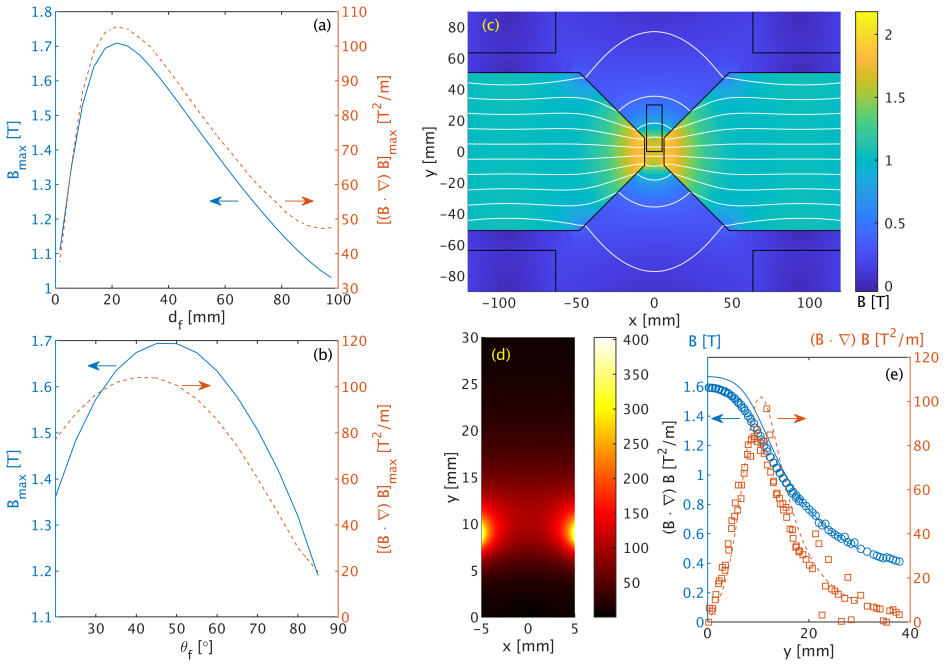
Summary. This manuscript reports a combined experimental and numerical study of the magnetophoresis of weakly paramagnetic manganese(III) oxide nanoparticles in a closed cuvette under the nonuniform field of an electromagnet. The magnetic field model is validated against Hall-probe measurements within 5%, and image-based absorbance is used to track spatially resolved concentration. The main experimental findings are that the normalized depletion rate is independent of initial concentration (25–200 mg/L), increases with magnetic field gradient, and saturates for (B·∇)B above about 62 T²/m; that transient concentration gradients form in the cuvette and are attributed to magnetoconvective flows quantified by a magnetic Grashof number of order 1–10; and that with the cuvette repositioned so magnetophoresis opposes sedimentation, the regions where magnetophoresis dominates are characterized by L = Pem/Peg = ΔχV(B·∇)B/(μ0 Δρ g) > 1. To reproduce the depletion curves, the simulations employ a three-species particle size distribution fitted by trial and error (Table I); the fitted distribution shifts toward larger sizes when the field is applied, which the authors interpret as field-induced aggregation of particles with radii ≥ 130 nm, a threshold also obtained from the Γ and N* criteria of Eqs. (23)–(24). The central experimental results do not depend on the fitted distribution, but the aggregation claim does.
Significance. The experimental core is significant and, as far as I can judge, sound. The paper provides a systematic parametric study of a relatively unexplored regime—weakly paramagnetic nanoparticles at low field gradients—with internally consistent depletion measurements, replicate data at the reference concentration, a magnetic field model validated within 5% against experiment, and an explicit dimensionless framework (Pem, Peg, Grm, L) that yields falsifiable predictions such as the L = 1 boundary for magnetophoresis/sedimentation competition and the Grashof-number scaling of depletion kinetics. The saturation of depletion for (B·∇)B ≳ 62 T²/m and the concentration independence of the normalized depletion are clean experimental results useful for magnetic-separation applications. The field-induced aggregation claim, however, is not secured: it rests on a trial-and-error shift of fitted size classes in a model with no aggregation mechanism, and the fitted distribution is not quantitatively reconciled with the reported DLS size of 330 ± 30 nm.
major comments (2)
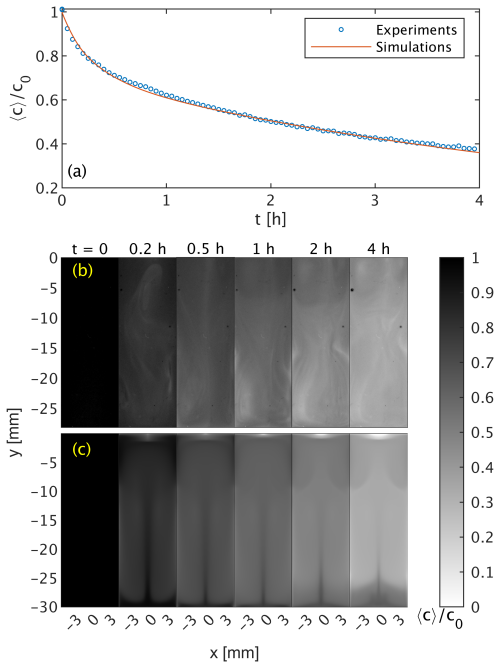
- [§IV.C, §IV.F, Table I] The field-induced aggregation claim rests entirely on the shift between the two trial-and-error fitted 3-species distributions in Table I (the 300 nm mass fraction rises from 0.16 to 0.24 and the largest class moves from 600 nm with f = 0.08 to 800 nm with f = 0.12). This inference is not robust for three reasons. First, the fits are obtained 'through a trial-and-error approach' (Sec. IV.C) without a goodness-of-fit metric, uncertainty bounds on (Rp, f), or an identifiability check, so the statistical significance of the Table I shift is unknown. Second, the transport model (Eqs. 10–11) contains no aggregation mechanism, so any unmodeled physics is necessarily absorbed into the fitted radii; the authors themselves list the omitted effects in Sec. IV.F (concentration-dependent or tensorial diffusivity, hydrodynamic interactions), and the acknowledged 2D approximation (Sec. III.A) could bias the inferred sizes, so an apparent shift to larger classes is equally consistent with missing physics as with genuine aggregation. Third, the asserted 'alignment' of the zero-field fitted distribution with the DLS result (Rp = 330 ± 30 nm, PDI ≈ 0.3; Sec. IV.B) is not quantified; with 8% of the mass in the 600 nm class, an intensity-weighted DLS signal would be dominated by that class and would report a size near 600 nm rather than 330 nm. Because the abstract and Sec. V present field-induced aggregation as a finding, the authors must either supply direct size-distribution measurements under an applied field or recast the claim as one possible interpretation of an effective-parameter shift, with an explicit assessment of the neglected physics enumerated in Sec. IV.F.
- [Abstract; §IV.E, Fig. 11] The abstract states that 'particle depleted regions form when the ratio of magnetic to gravitational Péclet numbers exceeds 1', but the body text describes the opposite relation. In Sec. IV.E, for (B·∇)B = 7 T²/m, L > 1 holds only in two small regions, and the text reports that 'within the regions, the concentration is greater' while the suspension outside is depleted, i.e., particles accumulate in the L > 1 regions. The conclusion (Sec. V) is worded consistently with the body text ('well-defined regions emerge where magnetophoresis dominates over sedimentation'), so the abstract sentence appears to reverse the direction of the effect. The abstract should be reworded to agree with Sec. IV.E, and the paper should state explicitly whether particles accumulate in or are depleted from the L > 1 regions.
minor comments (7)
- [Abstract] The sentence 'The numerical simulations suggest formation field-induced aggregation' should read 'suggest the formation of field-induced aggregation'; in the same sentence, the 130 nm threshold is obtained from the Γ and N* criteria (Eqs. 23–24), not from the simulations, and the wording should attribute the threshold accordingly.
- [§IV.F] The applicability condition 'c0/φ < 0.1' uses the symbol φ without a definition; please define it as the particle volume fraction or the reference concentration used in the model of Ref. 36.
- [Fig. 5, §IV.C] Replicate trials with uncertainty bands are reported only for c0 = 100 mg/L, so the claim that the depletion rate is independent of initial concentration across 25–200 mg/L would be strengthened by replicate measurements at at least one additional concentration.
- [§IV.D, Fig. S2] The scaling laws t ∼ Grm^{-1/2} and [s(c) − s0]/c0 ∼ Grm^{-1/4} are stated in the text but the collapse plot appears only in the Supplementary Information; including the plot and the fitted exponent values with uncertainties in the main text would make these claims assessable.
- [Eq. (21)] Please define the absorbance A explicitly (e.g., A = −log10(I/I0)) and state the concentration range over which the Beer–Lambert calibration was validated.
- [§III.A] The statement that 'analogous 3D simulations are computationally intractable' should be supported by a brief quantification (e.g., mesh element count or solver time), since the 2D approximation is a recurring caveat throughout Sections IV.C–IV.F.
- [Typos] There are typographical issues: 'initical concentration' appears in the Fig. 6(a) description, and the accent in 'P´eclet' is misplaced in several places in Sections II and IV.
Circularity Check
Field-induced aggregation conclusion rests on trial-and-error fitted size distributions, not on a predictive simulation; the core depletion observations are independent.
-
fitted input called prediction
[Section IV.F (and Section IV.C/Table I; Abstract)]
"For each simulation, the particle sizes and relative abundances were tuned such that the simulated results best fit the experimental results. Table I shows the matching particle size distributions for Figs. 3 and 4... Most noteworthy is that the distribution shifts toward larger particles as the field is applied, which indicates that some field-induced aggregation may be occurring."
The two size distributions in Table I are free parameters fitted by trial-and-error to reproduce the measured depletion curves (with and without field). The transport model has no aggregation mechanism, so the fitted shift from (80/300/600 nm, f=0.76/0.16/0.08) to (80/300/800 nm, f=0.64/0.24/0.12) is not a simulated prediction but a change in calibration parameters between two independent fits. Presenting this shift as evidence of field-induced aggregation (and summarizing it as 'numerical simulations suggest formation field induced aggregation' in the abstract) converts fitted input into a claimed physical finding. The independent Γ/N* criterion does predict aggregation for Rp > 130 nm, but the simulation result itself adds no independent support beyond the fitted shift.
full rationale
The paper's central experimental results—concentration-independent depletion, strong dependence on (B·∇)B with saturation near 62 T²/m, and spatial depletion patterns—are directly measured and do not depend on any fitted size distribution. The magnetic-field simulation is validated against Hall-probe data within 5%, and the no-field sedimentation fit is checked against DLS. These parts are self-contained against external benchmarks. The circularity is localized to the field-induced aggregation claim in Section IV.F: the apparent aggregation is read off from two separately fitted 3-species size distributions, and the model contains no aggregation physics, so the inference reduces to a re-labeling of fit parameters. This warrants a partial-circularity score of 6 rather than a higher score, because the main depletion phenomenology remains independent.
Assumptions & free parameters
free parameters (2)
- No-field particle size distribution (3 species) =
Rp=80 nm (f=0.76), 300 nm (f=0.16), 600 nm (f=0.08)
- Field particle size distribution (3 species) =
Rp=80 nm (f=0.64), 300 nm (f=0.24), 800 nm (f=0.12)
assumptions (6)
- domain assumption Stokes drag and Stokes-Einstein diffusion apply to nanoparticles in suspension
- domain assumption Suspension is dilute enough that magnetic susceptibility is linear (M = χV,f H) and concentration does not affect diffusivity
- domain assumption The cuvette-electromagnet apparatus can be represented as a 2D planar cross-section
- domain assumption Beer-Lambert law maps pixel absorbance linearly to particle concentration
- domain assumption Field-induced aggregation criteria Γ>1 and N*>1 from Faraudo et al. apply to this nonuniform-field system
- ad hoc to paper Particle size distribution can be represented by 3 discrete size classes
Cite this review
Pith. "Pith review of Magnetophoresis of paramagnetic nanoparticles in suspensions under magnetic field gradients." pith.science (2026). https://pith.science/paper/6NCNNQ6Y
@misc{pith2026250604273,
  author       = {Pith},
  title        = {Pith review of: Magnetophoresis of paramagnetic nanoparticles in suspensions under magnetic field gradients},
  year         = {2026},
  howpublished = {\url{https://pith.science/paper/6NCNNQ6Y}},
  note         = {Machine review of arXiv:2506.04273}
}
read the original abstract
We systematically investigate the magnetophoresis of weakly paramagnetic manganese oxide nanoparticles under nonuniform magnetic fields using a combination of experiments and multiphysics numerical simulations. Experiments were conducted in a closed cuvette exposed to a nonuniform magnetic field generated by an electromagnet, covering a wide range of particle concentrations 25-200 mgL and magnetic field gradients 0-110 T2m. The experimental results reveal that paramagnetic manganese oxide nanoparticles exhibit significant magnetophoretic behavior, leading to particle depletion within the cuvette. The depletion rate is independent of the initial particle concentration but strongly depends on the magnetic field gradient. At low magnetic field gradients, magnetophoresis progresses slowly, while at higher gradients, the particle depletion rate increases significantly before stabilizing. Transient concentration gradients emerge within the cuvette during magnetophoresis, which we hypothesize are driven by magnetic Grashof numbers near unity. When magnetic Grashof is beyond 1, the formation of concentration gradients induces bulk fluid flows that accelerate particle capture at regions of maximum magnetic field strength. In systems where magnetophoresis opposes sedimentation, particle depleted regions form when the ratio of magnetic to gravitational Peclet numbers exceeds 1. The numerical simulations suggest formation field induced aggregation for manganese oxide nanoparticles with radii of 130 nm or larger. These insights highlight the potential of magnetic separation for sustainable metal recovery, offering a scalable and environmental friendly solution for recycling critical materials from spent electronics.
Figures


Figures from the paper (8 more)



Reference graph
Works this paper leans on
-
[1]
author author S. N. \ Murthy , author S. M. \ Sammeta ,\ and\ author C. Bowers ,\ title title Magnetophoresis for enhancing transdermal drug delivery: Mechanistic studies and patch design , \ @noop journal journal Journal of Controlled Release \ volume 148 ,\ pages 197--203 ( year 2010 ) NoStop
work page 2010
-
[2]
author author A. Alexander , author S. Dwivedi , author T. K. \ Giri , author S. Saraf , author S. Saraf , author D. K. \ Tripathi , et al. ,\ title title Approaches for breaking the barriers of drug permeation through transdermal drug delivery , \ @noop journal journal Journal of controlled release \ volume 164 ,\ pages 26--40 ( year 2012 ) NoStop
work page 2012
-
[3]
author author R. D. \ Ambashta \ and\ author M. Sillanp \"a \"a ,\ title title Water purification using magnetic assistance: a review , \ @noop journal journal Journal of hazardous materials \ volume 180 ,\ pages 38--49 ( year 2010 ) NoStop
work page 2010
-
[4]
author author N. Pamme \ and\ author A. Manz ,\ title title On-chip free-flow magnetophoresis: continuous flow separation of magnetic particles and agglomerates , \ @noop journal journal Analytical chemistry \ volume 76 ,\ pages 7250--7256 ( year 2004 ) NoStop
work page 2004
-
[5]
author author P. Benhal , author M. Garba , author J. Ali , author T. Siegrist , author M. Humayun ,\ and\ author H. Mohammadigoushki ,\ title title Dynamics of transition metal ion transport in high-gradient magnetic fields , \ @noop journal journal The Journal of Physical Chemistry A \ ( year 2025 ) NoStop
work page 2025
-
[6]
author author K.-H. \ Han \ and\ author A. Bruno Frazier ,\ title title Continuous magnetophoretic separation of blood cells in microdevice format , \ @noop journal journal Journal of Applied Physics \ volume 96 ,\ pages 5797--5802 ( year 2004 ) NoStop
work page 2004
-
[7]
author author R. John , author F. J. \ Milford , author R. W. \ Christy , author S. Kunde ,\ and\ author S. Hermiston ,\ @noop title Foundations of electromagnetic theory \ ( publisher Addison-Wesley ,\ year 1967 ) NoStop
work page 1967
-
[8]
author author W. Ge , author A. Encinas , author E. Araujo ,\ and\ author S. Song ,\ title title Magnetic matrices used in high gradient magnetic separation (hgms): A review , \ @noop journal journal Results in physics \ volume 7 ,\ pages 4278--4286 ( year 2017 ) NoStop
work page 2017
Show all 39 references
-
[9]
author author J. Watson ,\ title title Theory of capture of particles in magnetic high-intensity filters , \ @noop journal journal IEEE Transactions on Magnetics \ volume 11 ,\ pages 1597--1599 ( year 1975 ) NoStop
1975
-
[10]
author author J. H. \ Watson ,\ title title Magnetic filtration , \ @noop journal journal Journal of Applied Physics \ volume 44 ,\ pages 4209--4213 ( year 1973 ) NoStop
1973
-
[11]
Iranmanesh \ and\ author J
author author M. Iranmanesh \ and\ author J. Hulliger ,\ title title Magnetic separation: its application in mining, waste purification, medicine, biochemistry and chemistry , \ @noop journal journal Chemical Society Reviews \ volume 46 ,\ pages 5925--5934 ( year 2017 ) NoStop
2017
-
[12]
Ditsch , author S
author author A. Ditsch , author S. Lindenmann , author P. E. \ Laibinis , author D. I. \ Wang ,\ and\ author T. A. \ Hatton ,\ title title High-gradient magnetic separation of magnetic nanoclusters , \ @noop journal journal Industrial & Engineering Chemistry Research \ volume...
2005
-
[13]
author author G. D. \ Moeser , author K. A. \ Roach , author W. H. \ Green , author T. Alan Hatton ,\ and\ author P. E. \ Laibinis ,\ title title High-gradient magnetic separation of coated magnetic nanoparticles , \ @noop journal journal AIChE Journal \ volume 50 ,\ pages 283...
2004
-
[14]
Svoboda ,\ @noop title Magnetic techniques for the treatment of materials \ ( publisher Springer Science & Business Media ,\ year 2004 ) NoStop
author author J. Svoboda ,\ @noop title Magnetic techniques for the treatment of materials \ ( publisher Springer Science & Business Media ,\ year 2004 ) NoStop
2004
-
[15]
author author S. S. \ Leong , author Z. Ahmad , author S. C. \ Low , author J. Camacho , author J. Faraudo ,\ and\ author J. Lim ,\ title title Unified view of magnetic nanoparticle separation under magnetophoresis , \ @noop journal journal Langmuir \ volume 36 ,\ pages 8033--...
2020
-
[16]
author author S. S. \ Leong , author Z. Ahmad ,\ and\ author J. Lim ,\ title title Magnetophoresis of superparamagnetic nanoparticles at low field gradient: hydrodynamic effect , \ @noop journal journal Soft Matter \ volume 11 ,\ pages 6968--6980 ( year 2015 ) NoStop
2015
-
[17]
author author C. T. \ Yavuz , author J. Mayo , author W. W. \ Yu , author A. Prakash , author J. C. \ Falkner , author S. Yean , author L. Cong , author H. J. \ Shipley , author A. Kan , author M. Tomson , et al. ,\ title title Low-field magnetic separation of monodisperse fe3...
2006
-
[18]
Lim , author S
author author J. Lim , author S. P. \ Yeap ,\ and\ author S. C. \ Low ,\ title title Challenges associated to magnetic separation of nanomaterials at low field gradient , \ @noop journal journal Separation and Purification Technology \ volume 123 ,\ pages 171--174 ( year 2014 ) NoStop
2014
-
[19]
a ling , author C. Rusu , author K. Petersson , author J. Wipenmyr , author A. Krozer , author G. Wahnstr \
author author V. Schaller , author U. Kr \"a ling , author C. Rusu , author K. Petersson , author J. Wipenmyr , author A. Krozer , author G. Wahnstr \"o m , author A. Sanz-Velasco , author P. Enoksson ,\ and\ author C. Johansson ,\ title title Motion of nanometer sized magneti...
2008
-
[20]
De Las Cuevas , author J
author author G. De Las Cuevas , author J. Faraudo ,\ and\ author J. Camacho ,\ title title Low-gradient magnetophoresis through field-induced reversible aggregation , \ @noop journal journal The Journal of Physical Chemistry C \ volume 112 ,\ pages 945--950 ( year 2008 ) NoStop
2008
-
[21]
Klokkenburg , author R
author author M. Klokkenburg , author R. P. \ Dullens , author W. K. \ Kegel , author B. H. \ Ern \'e ,\ and\ author A. P. \ Philipse ,\ title title Quantitative real-space analysis of self-assembled structures of magnetic dipolar colloids , \ @noop journal journal Physical re...
2006
-
[22]
Klokkenburg , author B
author author M. Klokkenburg , author B. H. \ Ern \'e , author J. D. \ Meeldijk , author A. Wiedenmann , author . f. A. V. \ Petukhov , author R. P. \ Dullens ,\ and\ author A. P. \ Philipse ,\ title title In situ imaging of field-induced hexagonal columns in magnetite ferrofl...
2006
-
[23]
Socoliuc , author L
author author V. Socoliuc , author L. V \'e k \'a s ,\ and\ author R. Turcu ,\ title title Magnetically induced phase condensation in an aqueous dispersion of magnetic nanogels , \ @noop journal journal Soft Matter \ volume 9 ,\ pages 3098--3105 ( year 2013 ) NoStop
2013
-
[24]
author author J. M. \ Laskar , author J. Philip ,\ and\ author B. Raj ,\ title title Experimental investigation of magnetic-field-induced aggregation kinetics in nonaqueous ferrofluids , \ @noop journal journal Physical Review E—Statistical, Nonlinear, and Soft Matter Physics ...
2010
-
[25]
author author G. P. \ Gajula , author M. T. \ Neves-Petersen ,\ and\ author S. B. \ Petersen ,\ title title Visualization and quantification of four steps in magnetic field induced two-dimensional ordering of superparamagnetic submicron particles , \ @noop journal journal Appl...
2010
-
[26]
Ezzaier , author J
author author H. Ezzaier , author J. Alves Marins , author I. Razvin , author M. Abbas , author A. Ben Haj Amara , author A. Zubarev ,\ and\ author P. Kuzhir ,\ title title Two-stage kinetics of field-induced aggregation of medium-sized magnetic nanoparticles , \ @noop journal...
2017
-
[27]
author author J. S. \ Andreu , author J. Camacho ,\ and\ author J. Faraudo ,\ title title Aggregation of superparamagnetic colloids in magnetic fields: the quest for the equilibrium state , \ @noop journal journal Soft Matter \ volume 7 ,\ pages 2336--2339 ( year 2011 ) NoStop
2011
-
[28]
Faraudo , author J
author author J. Faraudo , author J. S. \ Andreu ,\ and\ author J. Camacho ,\ title title Understanding diluted dispersions of superparamagnetic particles under strong magnetic fields: a review of concepts, theory and simulations , \ @noop journal journal Soft Matter \ volume ...
2013
-
[29]
author author K. H. \ Chan , author J. Anawati , author M. Malik ,\ and\ author G. Azimi ,\ title title Closed-loop recycling of lithium, cobalt, nickel, and manganese from waste lithium-ion batteries of electric vehicles , \ @noop journal journal ACS Sustainable Chemistry & E...
2021
-
[30]
author author M. S. \ Whittingham ,\ title title Lithium batteries and cathode materials , \ @noop journal journal Chemical reviews \ volume 104 ,\ pages 4271--4302 ( year 2004 ) NoStop
2004
-
[31]
author author M. P. \ Cenci , author F. C. \ Dal Berto , author B. W. \ Castillo ,\ and\ author H. M. \ Veit ,\ title title Precious and critical metals from wasted led lamps: characterization and evaluation , \ @noop journal journal Environmental Technology \ volume 43 ,\ pag...
2022
-
[32]
I s ldar , author E
author author A. I s ldar , author E. D. \ van Hullebusch , author M. Lenz , author G. Du Laing , author A. Marra , author A. Cesaro , author S. Panda , author A. Akcil , author M. A. \ Kucuker ,\ and\ author K. Kuchta ,\ title title Biotechnological strategies for the recover...
2019
-
[33]
author author T. H. \ Boyer et al. ,\ title title The force on a magnetic dipole , \ @noop journal journal American Journal of Physics \ volume 56 ,\ pages 688--692 ( year 1988 ) NoStop
1988
-
[34]
Rassolov , author J
author author P. Rassolov , author J. Ali , author T. Siegrist , author M. Humayun ,\ and\ author H. Mohammadigoushki ,\ title title Magnetophoresis of paramagnetic metal ions in porous media , \ @noop journal journal Soft Matter \ volume 20 ,\ pages 2496--2508 ( year 2024 ) NoStop
2024
-
[35]
@noop note _ m,i = _ m,i - M _i / _i M _l / _l _ m,l , where _ m,i is the molar magnetic susceptibility of component i with no correction for the surrounding medium, M _i is the molar mass of component i , _i is the solid phase density of component i (mass of material per unit...
-
[36]
Faraudo , author J
author author J. Faraudo , author J. S. \ Andreu , author C. Calero ,\ and\ author J. Camacho ,\ title title Predicting the self-assembly of superparamagnetic colloids under magnetic fields , \ @noop journal journal Advanced Functional Materials \ volume 26 ,\ pages 3837--3858...
2016
-
[37]
Leighton \ and\ author A
author author D. Leighton \ and\ author A. Acrivos ,\ title title The shear-induced migration of particles in concentrated suspensions , \ @noop journal journal Journal of Fluid Mechanics \ volume 181 ,\ pages 415--439 ( year 1987 ) NoStop
1987
-
[38]
Qiu , author X
author author X. Qiu , author X. Wu , author J. Xue , author D. Pine , author D. Weitz ,\ and\ author P. M. \ Chaikin ,\ title title Hydrodynamic interactions in concentrated suspensions , \ @noop journal journal Physical review letters \ volume 65 ,\ pages 516 ( year 1990 ) NoStop
1990
-
[39]
write newline
" write newline "" before.all 'output.state := FUNCTION n.dashify 't := "" t empty not t #1 #1 substring "-" = t #1 #2 substring "--" = not "--" * t #2 global.max substring 't := t #1 #1 substring "-" = "-" * t #2 global.max substring 't := while if t #1 #1 substring * t #2 gl...
Reviewed August 7, 2026 · model on record in the stance chip above.
Discussion (0). Sign in to comment.