REVIEW 3 major objections 5 minor 21 references
Dependence Control for Reliability Optimization in Vehicular Networks
T0 review · 3 major / 5 minor · reviewed 2026-08-14 · deepseek-v4-flash
Pith's one-line read This paper argues that maximizing Blomqvist's beta, a copula-based concordance measure, is equivalent to maximizing the joint reliability that all V2V safety messages meet their deadlines, and that the resulting power allocation achieves…
desk verdict The idea is fresh but Theorem 1's survival-copula term is misdefined, so the optimized objective isn't Blomqvist's beta and the reliability claim is not supported. read the letter →
The pith
A machine-rendered reading of the paper's core claim, the machinery that carries it, and where it could break.
The reading
What carries the argument
The load-bearing object is the multivariate Blomqvist's $\beta$, $\beta = (2^{M-1}[C(1/2,\ldots,1/2)+\hat C(1/2,\ldots,1/2)]-1)/(2^{M-1}-1)$, a copula-based scalar that measures concordance of the delay vector at the center of the unit cube. The paper pairs this measure with the concordance order definition $X\le_c Y$ if and only if $P(X_1\le s_1,\ldots,X_M\le s_M)\le P(Y_1\le s_1,\ldots,Y_M\le s_M)$ for all $s_i$, which connects higher dependence to larger joint reliability. Theorem 1 supplies explicit stochastic-geometry expressions for the marginal CDFs $F_i$ and the joint CDF $H$ under a 1-D PPP of interferers and Rayleigh fading, so that $\beta$ becomes a function of the transmit powers and can be optimized. The dual update method, with subgradients and ellipsoid updates, then converts the $\beta$-maximization into an iterative power-allocation algorithm.
What would settle it
Run the two-link simulation with Table I parameters over many independent channel and interferer realizations, estimate the empirical copula of the delay pair and its center values $C(1/2,1/2)$ and $\hat C(1/2,1/2)$, and compare them with the right-hand side of Eq. (8) across the power range used by the dual update. If the analytic $\beta$ does not track the empirical concordance, especially the $H(1-F_1^{-1}(1/2),1-F_2^{-1}(1/2))$ term, then the equivalence between maximizing Eq. (8) and maximizing $P(t_1\le\tau_1,t_2\le\tau_2)$ is broken.
Extended reading notes
Core claim
The central claim is that a wireless resource allocator can improve the reliability of a V2V system by increasing the dependence between the delays of co-existing links, not merely by improving their marginal statistics. Concretely, the paper asserts that the joint reliability $P(t_1\le\tau_1,\ldots,t_M\le\tau_M)$ is increasing in the concordance of the delay vector, and that this concordance can be measured by the multivariate Blomqvist's $\beta$ $\beta$ at the center of the copula. Theorem 1 derives $\beta$ in closed form for Rayleigh fading and interferers distributed as a one-dimensional Poisson point process, making $\beta$ a function of the transmit powers. Maximizing $\beta$ is therefore proposed as an equivalent reformulation of maximizing the joint reliability, and the dual-update solution of that reformulation is shown in simulations to lift reliability by up to 25% compared with random power allocation.
Load-bearing premise
The load-bearing premise is that the formula for Blomqvist's beta in Theorem 1 truly measures the concordance of the delay vector: the survival-copula term must actually equal the probability that all delays are above their median values, because if it does not, the objective being optimized is not the dependence that controls joint reliability.
Editorial extensions
If this is right
- A roadside unit or base station can improve joint V2V reliability by solving the concordance-maximization problem instead of the intractable joint-deadline problem.
- The benefit of dependence control is not monotone in traffic density: it grows as interference starts to bind, then shrinks when interference becomes severe, so the largest gains appear at intermediate vehicle densities.
- The reliability gain is obtained within the existing power budget and without extra bandwidth, purely by reshaping how delays are coupled.
- The dual update method produces a sub-optimal allocation with convergence in $O(49\log(1/\eta))$ iterations, giving a practical implementation path.
Reading between the lines
- A natural extension is to apply the same concordance-maximizing power control to any group of wireless links that share a common interferer field, such as multi-connectivity or platoon coordination, beyond the two-link highway scenario simulated here.
- Because Blomqvist's beta samples only the center of the copula, an online estimate of the empirical copula could be used to re-tune powers as traffic density changes, making dependence control adaptive rather than tied to the closed-form model.
- The reported 25% gain is evaluated at a particular delay threshold; a practical follow-up would map how beta and joint reliability track each other across the full range of delay requirements, which would show whether the mechanism also serves stricter pre-crash latency targets.
- A direct calibration test of the paper's equivalence would compare Eq. (8) with empirical copula estimates over many runs; this would also provide a deployment check before relying on the closed-form beta for power control.
Signed reviews
Editorial analysis
A structured set of objections, weighed in public.
Referee Report
Summary. This paper proposes a power-allocation scheme for vehicle-to-vehicle (V2V) networks that aims to improve the joint reliability P(t_1 ≤ τ_1, ..., t_M ≤ τ_M) by explicitly controlling the dependence among the communication delays of coexisting links. The delays are modeled under Rayleigh fading and a one-dimensional Poisson point process of interferers; the authors derive a marginal CDF F_i(v) and a joint CDF H(u_1,...,u_M) by stochastic geometry, introduce Blomqvist's beta as a copula-based concordance measure, and reformulate the reliability optimization as the maximization of beta. A dual update method is then used to obtain a suboptimal power allocation. Simulations for M=2 report that the proposed dependence-control method outperforms random power allocation and can yield up to 25% reliability gain.
Significance. If the central claim were correct, the paper would offer a novel and practically useful idea: deliberately shaping the dependence among V2V link delays in order to improve the probability that all safety messages meet their deadlines. The stochastic-geometry derivation of the marginal and joint CDFs is plausible under the stated assumptions and is supported by the simulation matching in Fig. 2. However, the manuscript's central technical step, the expression for Blomqvist's beta in Theorem 1, is incorrect, and the reformulation in Section III-C is not an equivalence. Because the optimized objective is not a valid concordance measure and the link to the joint reliability objective is not established, the main contribution and the reported performance gains do not follow from the presented analysis.
major comments (3)
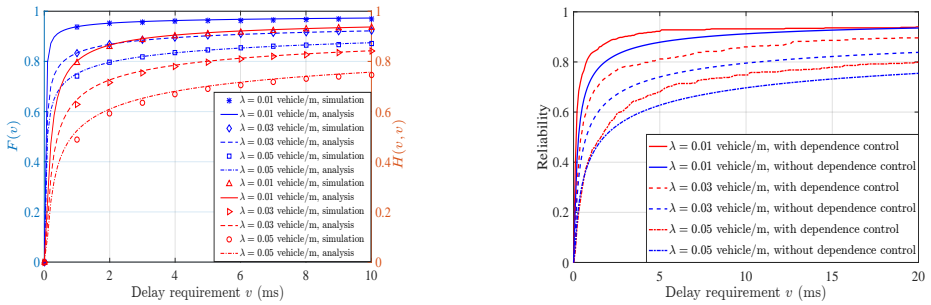
- [Section III-B and Theorem 1, Eq. (8)] The survival copula is misdefined. The paper states that \hat C(u_1,...,u_M)=H(1-F_1^{-1}(u_1),...,1-F_M^{-1}(u_M)) and then evaluates H(1-F_1^{-1}(1/2),...,1-F_M^{-1}(1/2)) in Eq. (8). Since H in Eq. (10) is the joint CDF of delay values, while F_i^{-1}(1/2) is a median delay, the quantity 1-F_i^{-1}(1/2) is not a probability and is not an argument of a survival copula. The correct survival copula is \hat C(u_1,...,u_M)=\bar H(\bar F_1^{-1}(u_1),...,\bar F_M^{-1}(u_M)), where \bar H is the joint survival function; for continuous margins, \hat C(1/2,...,1/2)=P(t_1>F_1^{-1}(1/2),...,t_M>F_M^{-1}(1/2)) (for M=2 this equals H(F_1^{-1}(1/2),F_2^{-1}(1/2))). Consequently, Theorem 1 does not compute Blomqvist's beta, the objective in (11) is not a valid concordance measure, and the claimed connection to the joint reliability objective in (3) is broken.
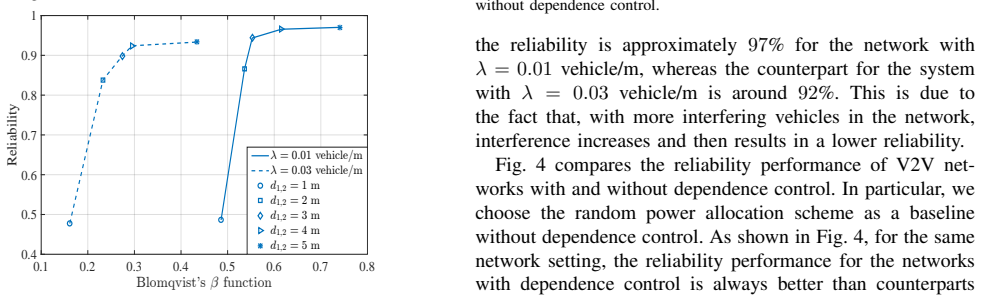
- [Section III-C, Eqs. (3) and (11)] The reformulation of the reliability problem as maximizing Blomqvist's beta is not an equivalence. Blomqvist's beta is a scalar concordance measure; it is order-preserving in the sense that if X is smaller than Y in concordance order then beta(X) <= beta(Y), but the converse is false. Maximizing beta does not imply that the delay vector is larger in concordance order, nor that P(t_1<=t_1,...,t_M<=t_M) is maximized at the specific thresholds of interest. The paper asserts the equivalence based on the monotonicity of beta with concordance, but monotonicity in one direction is not sufficient. Since the power-allocation solution is obtained by maximizing this invalid objective, the reliability gains in Fig. 4 are not attributable to the claimed dependence control.
- [Section III-C, dual update method] The dual update method is applied to a nonconvex optimization problem without a proof of zero duality gap or an explicit bound on the suboptimality of the resulting power allocation. The paper only states that the dual problem is convex and that the ellipsoid method converges, but for a nonconvex primal the dual solution generally provides an upper bound rather than a feasible near-optimal point. Since the paper explicitly claims only a suboptimal solution, this issue is secondary to the objective error, but the convergence and optimality statements should be qualified or supported.
minor comments (5)
- [Section III-A, Eq. (5)] The concordance order definition is written as 'for s_i in {-infinity, infinity}', which is not meaningful; it should state 'for all s_i in the extended real line' or 'for all s_i'. Similarly, the stochastic order definition in the preceding paragraph should be E f(X) <= E f(Y), not 'Ef(X) <=_st Ef(Y)'.
- [Eq. (10)] The integrand in the exponential term of H is misprinted: '1 - dx_k(...)' should be '1 - 1/((1 + ... )(1 + ...))'. As written, Eq. (10) is not a correctly formed integral.
- [Section III-B, Eqs. (7)-(10)] The notation overloads u_i: in the copula definitions u_i are probabilities in [0,1], but in Eq. (10) H is evaluated at delay values. This is particularly confusing in Theorem 1, where F_i^{-1}(1/2) is a delay while 1-F_i^{-1}(1/2) is not a probability. The manuscript should distinguish copula arguments from delay arguments clearly.
- [Section IV, Fig. 4] The reported 'up to 25% reliability gain' at v=1 ms should be presented together with the absolute reliability values; a large relative gain at very small absolute probabilities can be misleading. Reporting only the relative gain obscures the operating point.
- [Appendix A, Eq. (15)] The approximation in step (a), in which the SINR is replaced by the SIR, is made without justification. A sentence explaining why noise is neglected, or a verification of this approximation, would improve the rigor of the marginal CDF derivation.
Circularity Check
No significant circularity: the derivation chain is self-contained; the Eq. (8) defect is a correctness issue, not a circular reduction.
full rationale
Walking the paper's derivation chain, the stochastic-geometry expressions for the marginal CDF F_i and the joint CDF H in Theorem 1 are derived from the system model (1-D PPP interference, independent Rayleigh fading) via the PGFL of the PPP; they are not fitted to the reliability objective. The Monte Carlo validation in Fig. 2 verifies those closed forms against simulation of the same stochastic model, which is a standard self-consistency check rather than a fitted-input-called-prediction pattern. No parameter is calibrated to a subset of the reliability data and then repackaged as a prediction. The paper's self-citations ([1], [8], [11], [21]) supply background material and a delay-requirement constant; none carries a load-bearing uniqueness theorem or an ansatz that is itself unverified. The central claim that maximizing Blomqvist's beta maximizes joint reliability rests on the external copula/concordance literature ([16]-[18]) plus an unproved assertion in Section III-C; that assertion is a logical-support gap, not a circularity. Blomqvist's beta is not defined in terms of the target reliability P(t1 <= tau1, ..., tM <= tauM) by construction, and no equation in the paper makes the reformulated objective equal to the reported reliability metric. The apparent defect in Eq. (8)--the survival-copula term H(1 - F^{-1}(1/2), ...) rather than the joint survival function at the marginal medians--is a mathematical correctness issue, which per the review rules belongs under correctness risk rather than circularity. The omitted proof of subgradients and the unproved equivalence between (3) and (11) are omissions, but they do not make the derivation circular. Therefore the circularity score is 0.
Assumptions & free parameters
assumptions (5)
- domain assumption Interfering vehicles follow a 1D PPP with density lambda; all channels are independent Rayleigh fading
- domain assumption SINR is approximated by SIR (noise ignored)
- ad hoc to paper Maximizing Blomqvist's beta is equivalent to maximizing the joint reliability at the thresholds
- ad hoc to paper The dual update method yields a near-optimal solution to the nonconvex power allocation problem
- standard math Standard copula theory and PGFL of PPP
Cite this review
Pith. "Pith review of Dependence Control for Reliability Optimization in Vehicular Networks." pith.science (2026). https://pith.science/paper/6NFMLDPO
@misc{pith2026190801182,
  author       = {Pith},
  title        = {Pith review of: Dependence Control for Reliability Optimization in Vehicular Networks},
  year         = {2026},
  howpublished = {\url{https://pith.science/paper/6NFMLDPO}},
  note         = {Machine review of arXiv:1908.01182}
}
read the original abstract
Vehicular networks will play an important role in enhancing road safety, improving transportation efficiency, and providing seamless Internet service for users on the road. Reaping the benefit of vehicular networks is contingent upon meeting stringent wireless communication performance requirements, particularly in terms of delay and reliability. In this paper, a dependence control mechanism is proposed to improve the overall reliability of vehicular networks. In particular, the dependence between the communication delays of different vehicle-to-vehicle (V2V) links is first modeled. Then, the concept of a concordance order, stemming from stochastic ordering theory, is introduced to show that a higher dependence can lead to a better reliability. Using this insight, a power allocation problem is formulated to maximize the concordance, thereby optimizing the overall communication reliability of the V2V system. To obtain an efficient solution to the power allocation problem, a dual update method is introduced. Simulation results verify the effectiveness of performing dependence control for reliability optimization in a vehicular network, and show that the proposed mechanism can achieve up to 25% reliability gain compared to a baseline system that uses a random power allocation.
Figures

Reference graph
Works this paper leans on
-
[1]
A vision of 6G wireless systems: Applications, trends, technologies, and open research problems,
W. Saad, M. Bennis, and M. Chen, “A vision of 6G wireless systems: Applications, trends, technologies, and open research problems,” IEEE Network, 2019
work page 2019
-
[2]
Connected vehicles: Solutions and challenges,
N. Lu, N. Cheng, N. Zhang, X. Shen, and J. W. Mark, “Connected vehicles: Solutions and challenges,” IEEE Internet of Things Journal , vol. 1, no. 4, pp. 289–299, Aug 2014
work page 2014
-
[3]
Ultra reli- able, low latency vehicle-to-infrastructure wireless communications with edge computing,
M. M. K. Tareq, O. Semiari, M. A. Salehi, and W. Saad, “Ultra reli- able, low latency vehicle-to-infrastructure wireless communications with edge computing,” in 2018 IEEE Global Communications Conference (GLOBECOM), Dec 2018
work page 2018
-
[4]
P. Papadimitratos, A. D. La Fortelle, K. Evenssen, R. Brignolo, and S. Cosenza, “Vehicular communication systems: Enabling technologies, applications, and future outlook on intelligent transportation,” IEEE Communications Magazine, vol. 47, no. 11, pp. 84–95, November 2009
work page 2009
-
[5]
LTE-V: A TD-LTE-based V2X solution for future vehicular network,
S. Chen, J. Hu, Y . Shi, and L. Zhao, “LTE-V: A TD-LTE-based V2X solution for future vehicular network,” IEEE Internet of Things Journal, vol. 3, no. 6, pp. 997–1005, Dec 2016
work page 2016
-
[6]
K. Lee, J. Kim, Y . Park, H. Wang, and D. Hong, “Latency of cellular- based v2x: Perspectives on tti-proportional latency and tti-independent latency,” IEEE Access, vol. 5, pp. 15 800–15 809, 2017
work page 2017
-
[7]
5GPPP Association, “5G automotive vi- sion,” https://5g-ppp.eu/wp-content/uploads/2014/02/ 5G-PPP-White-Paper-on-Automotive-Vertical-Sectors.pdf, Oct. 2015.[8] O. Semiari, W. Saad, M. Bennis, and M. Debbah, “Integrated millimeter wave and sub-6 ghz wireless networks: A roadmap for joint mobile broadband and ultra-reliable low-latency communications,” IEEE...
work page 2014
-
[9]
Power control in D2D-based vehicular communication networks,
Y . Ren, F. Liu, Z. Liu, C. Wang, and Y . Ji, “Power control in D2D-based vehicular communication networks,” IEEE Transactions on Vehicular Technology, vol. 64, no. 12, pp. 5547–5562, Dec 2015
work page 2015
Show all 21 references
-
[10]
A latency and reliability guaranteed resource allocation scheme for LTE V2V com- munication systems,
J. Mei, K. Zheng, L. Zhao, Y . Teng, and X. Wang, “A latency and reliability guaranteed resource allocation scheme for LTE V2V com- munication systems,” IEEE Transactions on Wireless Communications , vol. 17, no. 6, pp. 3850–3860, June 2018
2018
-
[11]
Dynamic resource allocation for optimized latency and reliability in vehicular networks,
M. I. Ashraf, C. Liu, M. Bennis, W. Saad, and C. S. Hong, “Dynamic resource allocation for optimized latency and reliability in vehicular networks,” IEEE Access, vol. 6, pp. 63 843–63 858, 2018
2018
-
[12]
Ultra-reliable and low-latency vehicular trans- mission: An extreme value theory approach,
C. Liu and M. Bennis, “Ultra-reliable and low-latency vehicular trans- mission: An extreme value theory approach,” IEEE Communications Letters, vol. 22, no. 6, pp. 1292–1295, June 2018
2018
-
[13]
Haenggi, Stochastic geometry for wireless networks
M. Haenggi, Stochastic geometry for wireless networks . Cambridge University Press, 2012
2012
-
[14]
Shaked and J
M. Shaked and J. G. Shanthikumar, Stochastic orders. Springer Science & Business Media, 2007
2007
-
[15]
Applications of stochastic ordering to wireless communications,
C. Tepedelenlioglu, A. Rajan, and Y . Zhang, “Applications of stochastic ordering to wireless communications,” IEEE Transactions on Wireless Communications, vol. 10, no. 12, pp. 4249–4257, December 2011
2011
-
[16]
Müller and D
A. Müller and D. Stoyan, Comparison methods for stochastic models and risks. Wiley New York, 2002
2002
-
[17]
R. B. Nelsen, An introduction to copulas. Springer Science & Business Media, 2007
2007
-
[18]
Multivariate versions of blomqvist’s beta and spear- man’s footrule,
M. Úbeda-Flores, “Multivariate versions of blomqvist’s beta and spear- man’s footrule,” Annals of the Institute of Statistical Mathematics , vol. 57, no. 4, pp. 781–788, 2005
2005
-
[19]
Dual methods for nonconvex spectrum optimiza- tion of multicarrier systems,
W. Yu and R. Lui, “Dual methods for nonconvex spectrum optimiza- tion of multicarrier systems,” IEEE Transactions on Communications , vol. 54, no. 7, pp. 1310–1322, July 2006
2006
-
[20]
Boyd and L
S. Boyd and L. Vandenberghe, Convex optimization . Cambridge university press, 2004
2004
-
[21]
Joint communication and control for wireless autonomous vehicular platoon systems,
T. Zeng, O. Semiari, W. Saad, and M. Bennis, “Joint communication and control for wireless autonomous vehicular platoon systems,” IEEE Transactions on Communications , 2019
2019
-
[22]
[Online]
California path website. [Online]. Available: http://path.berkeley.edu
Reviewed August 14, 2026 · model on record in the stance chip above.
Discussion (0). Continue with ORCID to comment.