REVIEW 3 major objections 5 minor 1 cited by
Singularity with and without disorder at AKLT points
T0 review · 3 major / 5 minor · reviewed 2026-08-12 · deepseek-v4-flash
Pith's one-line read AKLT point can be singular without being a disorder point.
desk verdict A genuinely new singularity type in an AKLT chain—exact at the AKLT point, but the claimed non-analyticity rests on finite-bond iMPS fits that a referee should push on. read the letter →
The pith
A machine-rendered reading of the paper's core claim, the machinery that carries it, and where it could break.
The reading
What carries the argument
The central object is the infinite-MPS transfer matrix T_L of the ground state, a non-Hermitian matrix whose subleading eigenvalue gives the correlation length and wave vector via \xi = -N/\log|t| and q = \mathrm{Im}\log t / N. The key selection rule is the distance $d^{{(n)}}$ at which an eigenvalue's contribution to the connected correlator falls to a threshold \lambda_{\mathrm{th}}=$10^{{-5}}$, used to discard unphysical eigenvalues that arise from numerical noise. The paper proves that when the physical representation is self-conjugate the transfer matrix is Hermitian at the AKLT point, while for the 3-box symmetric SU(3) representation it is not; two conjugate eigenvalue pairs coalesce at the AKLT point, giving the square-root singularities.
What would settle it
A high-precision bond-dimension extrapolation of the transfer-matrix eigenvalue spectrum near \beta_{\mathrm{AKLT}} that shows the two conjugate eigenvalue pairs do not actually coalesce (e.g., the wave-vector difference q_+-q_- remains finite as \chi\to\infty) would falsify the claim of a true singularity.
Extended reading notes
Core claim
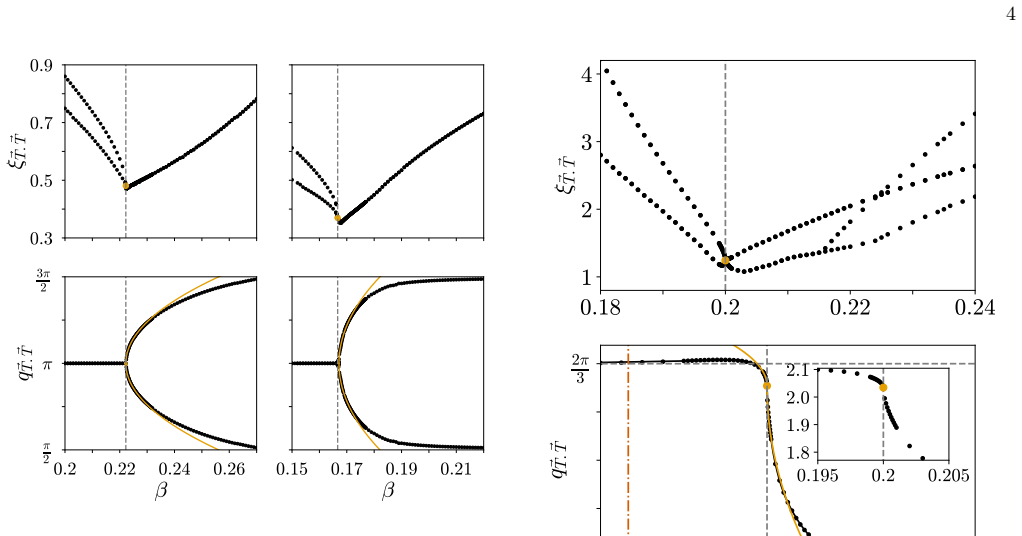
The central discovery is that the AKLT point of the 3-box symmetric SU(3) chain is a singular point of the short-range correlations without being a disorder point. Correlations are incommensurate on both sides of the AKLT point, so the point does not separate a commensurate from an incommensurate regime. Nevertheless, the wave vector q obeys q - q_{\mathrm{AKLT}} \approx \$\alpha$ \sqrt{|\beta_{\mathrm{AKLT}} - \$\beta$|} with \$\alpha$ \approx 1.2 for \$\beta$ < \beta_{\mathrm{AKLT}} and \$\alpha$ \approx -4.2 for \$\beta$ > \beta_{\mathrm{AKLT}}. This non-analytic behavior is explained by the coalescence of two conjugate pairs of eigenvalues of the transfer matrix, producing a kink in the correlation length and an infinite slope of the wave vector at the AKLT point.
Load-bearing premise
The load-bearing premise is that the finite-bond iMPS transfer matrix, after discarding eigenvalues by the \lambda_{\mathrm{th}}=$10^{{-5}}$ threshold, faithfully captures the thermodynamic-limit spectrum near the AKLT point.
Editorial extensions
If this is right
- For the 3-box symmetric SU(3) chain, the AKLT point is not a disorder point; it lies inside an incommensurate phase.
- The correlation length has a kink at the AKLT point, and the wave vector has an infinite derivative with asymmetric square-root behavior on the two sides.
- For SU(n) chains with self-conjugate physical representations, such as the adjoint-representation chains, the AKLT point remains a conventional commensurate-incommensurate disorder point.
- The singularity is a coalescence (exceptional point) of transfer-matrix eigenvalues, not a phase transition between commensurate and incommensurate orders.
Reading between the lines
- If the conjecture is correct, similar incommensurate-incommensurate singularities should appear at AKLT points of SU(n) chains with non-self-conjugate representations, such as the proposed SU(4) state |45;15,15\rangle, and could be searched for numerically.
- The observed singularity may be a generic feature of non-Hermitian transfer matrices in gapped one-dimensional systems, not limited to AKLT points.
- The classical two-dimensional models that originally motivated disorder points might also exhibit such singularities entirely inside incommensurate phases, as the authors suggest.
- A testable prediction is that the momentum gap from 2\pi/3 decays very slowly (approximately Gaussian) below the AKLT point, which could be checked with higher-precision numerics or other methods.
Signed reviews
Editorial analysis
A structured set of objections, weighed in public.
Referee Report
Summary. The paper studies SU(n) AKLT chains and shows, for the 3-box symmetric SU(3) model, that the AKLT point lies inside an incommensurate phase, yet the wavevector of short-range correlations appears to have a square-root singularity on both sides of the AKLT point. For self-conjugate representations (e.g., the adjoint of SU(n)), the AKLT point remains a conventional disorder point separating commensurate and incommensurate regimes. The authors conjecture that this behavior is generic for AKLT states whose physical representation is not self-conjugate, so that the transfer matrix is non-Hermitian at the AKLT point.
Significance. If the singularity claim holds, the paper introduces a new phenomenon: a non-analyticity of the correlation wavevector located entirely inside an incommensurate gapped phase. The exact transfer-matrix calculation at the 3-box AKLT point (complex conjugate eigenvalues -0.2 ± 0.4i) is a clean, checkable contribution, and the benchmark against the SU(2) spin-1 case is a useful methodological validation. The numerical evidence for the square-root behavior on both sides of the AKLT point, however, lacks bond-dimension extrapolation, so the central claim is not yet fully established in the thermodynamic limit.
major comments (3)
- [Methods and Fig. 2] The claimed square-root singularities in q - q_AKLT with fitted exponents alpha ≈ 1.2 (beta < beta_AKLT) and alpha ≈ -4.2 (beta > beta_AKLT) rest entirely on finite-bond iMPS transfer-matrix spectra. The Methods section explicitly states 'we will not perform the standard extrapolation schemes', and no chi-scaling analysis is provided for the coalescence point or for the fitted exponents. A finite-chi non-Hermitian transfer matrix can exhibit exceptional points at isolated parameters even when the infinite-dimensional transfer matrix remains analytic in beta, so the thermodynamic-limit non-analyticity is not established by the present data. The authors should either add a scaling analysis showing that the coalescence point and alpha converge with increasing bond dimension, or clearly re-frame the singularity on both sides as a conjecture supported by finite-bond data.
- [Eq. (12) and the preceding paragraph] The selection of 'physical' eigenvalues uses the threshold lambda_th = 10^{-5}, which is a free parameter. Near the coalescence point, left and right eigenvectors become nearly parallel, so small tensor errors are strongly amplified; the stated independence of lambda_th in the range 10^{-6}–10^{-4} does not rule out the possibility that the two coalescing branches are stitched together from different sectors of the finite-bond spectrum. Please test the robustness of the coalescence by tracking eigenvalues within a fixed symmetry sector without the lambda_th filter, or by quantifying the condition number of the relevant eigenvectors as a function of beta.
- [Introduction and Conclusions] The explanation that the singularity is 'caused' by coalescence of transfer-matrix eigenvalues is, in part, a restatement of the numerical observation from which the singularity is inferred. The exact transfer-matrix result at the AKLT point proves incommensurability only at that point; it does not by itself imply the square-root behavior away from the point. The paper should explicitly separate the exact statement from the numerical conjecture and avoid presenting the coalescence mechanism as independent evidence for the singularity.
minor comments (5)
- [Fig. 2 caption] The caption states that the AKLT point 'remains a disorder point', which contradicts the abstract's statement that the AKLT point is not a disorder point; rephrase to something like 'singular point separating two incommensurate regimes'.
- [Fig. 1 and Fig. 4 captions] Both captions contain the phrase 'following Eq. ()' with an empty equation reference; insert the appropriate equation number (Eq. (11) or (13)).
- [Appendix C and Fig. 2 caption] There are several typos: 'Firtly' should be 'Firstly', 'incertitude' should be 'uncertainty', and 'withing' should be 'within'.
- [Appendix A title] The title contains 'AKL T' instead of 'AKLT'.
- [Eq. (13)] The definition of tilde-q uses a ratio of overlaps; clarify that the phase of the ratio is taken and note the possibility that the denominator vanishes for operators with zero overlap in adjacent unit cells.
Circularity Check
No significant circularity: the central singularity claim is a numerical observation extracted from transfer-matrix eigenvalues, not a fitted input relabeled as a prediction.
full rationale
The paper's main new claim—that the 3-box symmetric SU(3) AKLT point lies inside an incommensurate phase while the wavevector remains singular on both sides—is presented as a numerical finding, not as a derivation from an input that already contains that conclusion. The wavevector is read from transfer-matrix eigenvalues through Eq. (11), and the square-root fits q - q_AKLT = alpha * sqrt(|beta_AKLT - beta|) are explicitly labeled as numerical fits with fitted constants alpha, not as predicted values. The exact incommensurate value at the AKLT point follows from the exact single-site transfer-matrix eigenvalues (-0.2 +/- 0.4i), which are parameter-free and independently checkable. The statement that the non-analytic behavior is 'explained by the coalescence of two eigenvalues' is a restatement of the same eigenvalue data in the language of non-Hermitian exceptional points: since q is defined as the phase of the relevant transfer-matrix eigenvalue, eigenvalue coalescence and wavevector singularity are mathematically the same phenomenon, not an input used to manufacture the output. The paper's reliance on prior work for the parent Hamiltonian and the Haldane gap of the 3-box symmetric model is standard external support from published literature, including co-authored work, but it is not a load-bearing self-citation chain invoked to forbid alternatives. The main legitimate concern is numerical robustness: the authors explicitly forgo bond-dimension extrapolation and use an ad hoc eigenvalue-selection threshold lambda_th = 10^-5, so the thermodynamic-limit interpretation of the singularity is not rigorously established. That is a correctness or evidence-quality concern, not a circularity, and the paper itself flags the associated numerical instability. No step in the derivation reduces by construction to its own input, so the appropriate circularity score is 0.
Assumptions & free parameters
free parameters (1)
- lambda_th =
10^-5
assumptions (4)
- domain assumption The two-point connected correlation function decays as an Ornstein-Zernike form with a single correlation length and momentum for sufficiently separated operators (Eq. 6).
- ad hoc to paper The transfer-matrix eigenvalues with the largest distance d, defined via the threshold lambda_th, determine the long-range behavior of the correlations (Eqs. 10 to 12).
- domain assumption The parent Hamiltonian (Eq. 4) is Hermitian, positive semi-definite, and has the AKLT state as a unique ground state up to edge states, following Refs. [17,18].
- standard math The Wigner-Eckart theorem and the reality of Clebsch-Gordan coefficients for SU(n) underpin the proof that the transfer matrix is Hermitian for self-conjugate representations (App. B3).
Cite this review
Pith. "Pith review of Singularity with and without disorder at AKLT points." pith.science (2026). https://pith.science/paper/6NVZEPMQ
@misc{pith2026241117848,
  author       = {Pith},
  title        = {Pith review of: Singularity with and without disorder at AKLT points},
  year         = {2026},
  howpublished = {\url{https://pith.science/paper/6NVZEPMQ}},
  note         = {Machine review of arXiv:2411.17848}
}
read the original abstract
The Affleck-Kennedy-Lieb-Tasaki (AKLT) point of the bilinear-biquadratic spin-1 chain is a cornerstone example of a disorder point where short-range correlations become incommensurate, and correlation lengths and momenta are non-analytic. While the presence of singularities appears to be generic for AKLT points, we show that for a family of SU(N) models, the AKLT point is not a disorder point: It occurs entirely within an incommensurate phase yet the wave vector remains singular on both sides of the AKLT point. We conjecture that this new possibility is generic for models where the representation is not self-conjugate and the transfer matrix non-Hermitian, while for self-conjugate representations the AKLT points remain disorder points.
Figures


Figures from the paper (1 more)

Forward citations
Cited by 1 Pith paper
-
Valence-bonds, spin liquids and unconventional criticality in a 1D Kondo insulator
Tuning the hopping anisotropy in a 1D Kondo lattice drives transitions between featureless Kondo insulators, a valence-bond solid, and gapless spin liquids, with a spiral spin liquid as the critical point between two ...
Reference graph
Works this paper leans on
-
[1]
author author Ian \ Affleck , author Tom \ Kennedy , author Elliott H. \ Lieb , \ and\ author Hal \ Tasaki ,\ title title Rigorous results on valence-bond ground states in antiferromagnets , \ 10.1103/PhysRevLett.59.799 journal journal Phys. Rev. Lett. \ volume 59 ,\ pages 799--802 ( year 1987 ) NoStop
-
[2]
author author F. D. M. \ Haldane ,\ title title Nonlinear field theory of large-spin heisenberg antiferromagnets: Semiclassically quantized solitons of the one-dimensional easy-axis n\'eel state , \ 10.1103/PhysRevLett.50.1153 journal journal Phys. Rev. Lett. \ volume 50 ,\ pages 1153--1156 ( year 1983 a ) NoStop
-
[3]
author author F.D.M. \ Haldane ,\ title title Continuum dynamics of the 1-d heisenberg antiferromagnet: Identification with the o(3) nonlinear sigma model , \ https://doi.org/10.1016/0375-9601(83)90631-X journal journal Physics Letters A \ volume 93 ,\ pages 464--468 ( year 1983 b ) NoStop
-
[4]
author author Ian \ Affleck , author Tom \ Kennedy , author Elliott H. \ Lieb , \ and\ author Hal \ Tasaki ,\ title title Valence bond ground states in isotropic quantum antiferromagnets , \ 10.1007/BF01218021 journal journal Communications in Mathematical Physics \ volume 115 ,\ pages 477--528 ( year 1988 ) NoStop
-
[5]
author author Ulrich \ Schollwöck ,\ title title The density-matrix renormalization group in the age of matrix product states , \ https://doi.org/10.1016/j.aop.2010.09.012 journal journal Annals of Physics \ volume 326 ,\ pages 96--192 ( year 2011 ) ,\ note january 2011 Special Issue NoStop
-
[6]
author author Andreas \ L\"auchli , author Guido \ Schmid , \ and\ author Simon \ Trebst ,\ title title Spin nematics correlations in bilinear-biquadratic s=1 spin chains , \ 10.1103/PhysRevB.74.144426 journal journal Phys. Rev. B \ volume 74 ,\ pages 144426 ( year 2006 ) NoStop
-
[7]
author author G. De Chiara , author M. Lewenstein , \ and\ author A. Sanpera ,\ title title Bilinear-biquadratic spin-1 chain undergoing quadratic zeeman effect , \ 10.1103/PhysRevB.84.054451 journal journal Phys. Rev. B \ volume 84 ,\ pages 054451 ( year 2011 ) NoStop
-
[8]
author author Tom \ Kennedy \ and\ author Hal \ Tasaki ,\ title title Hidden z _ 2 z _ 2 symmetry breaking in haldane-gap antiferromagnets , \ 10.1103/PhysRevB.45.304 journal journal Phys. Rev. B \ volume 45 ,\ pages 304--307 ( year 1992 ) NoStop
Show all 40 references
-
[9]
author author Frank \ Pollmann , author Ari M. \ Turner , author Erez \ Berg , \ and\ author Masaki \ Oshikawa ,\ title title Entanglement spectrum of a topological phase in one dimension , \ 10.1103/PhysRevB.81.064439 journal journal Phys. Rev. B \ volume 81 ,\ pages 064439 (...
-
[10]
author author Assa \ Auerbach ,\ @noop title Interacting Electrons and Quantum Magnetism \ ( publisher Springer-Verlag ,\ year 1994 ) NoStop
1994
-
[11]
Verstraete \ and\ author J
author author F. Verstraete \ and\ author J. I. \ Cirac ,\ https://arxiv.org/abs/cond-mat/0407066 title Renormalization algorithms for quantum-many body systems in two and higher dimensions , \ ( year 2004 a ),\ http://arxiv.org/abs/cond-mat/0407066 arXiv:cond-mat/0407066 [con...
2004 arXiv
-
[12]
Verstraete \ and\ author J
author author F. Verstraete \ and\ author J. I. \ Cirac ,\ title title Valence-bond states for quantum computation , \ 10.1103/PhysRevA.70.060302 journal journal Phys. Rev. A \ volume 70 ,\ pages 060302 ( year 2004 b ) NoStop
2004 doi
-
[13]
Schollw\"ock , author Th
author author U. Schollw\"ock , author Th. \ Jolic ur , \ and\ author T. Garel ,\ title title Onset of incommensurability at the valence-bond-solid point in the s=1 quantum spin chain , \ 10.1103/PhysRevB.53.3304 journal journal Phys. Rev. B \ volume 53 ,\ pages 3304--3311 ( y...
-
[14]
author author Marcel \ den Nijs ,\ title title The domain wall theory of two-dimensional commensurate-incommensurate phase transitions , \ @noop journal journal Phase Transitions and Critical Phenomena \ volume 12 ,\ pages 219 ( year 1988 ) NoStop
1988
-
[15]
\ Majumdar \ and\ author Dipan K
author author Chanchal K. \ Majumdar \ and\ author Dipan K. \ Ghosh ,\ title title On Next‐Nearest‐Neighbor Interaction in Linear Chain. I , \ 10.1063/1.1664978 journal journal Journal of Mathematical Physics \ volume 10 ,\ pages 1388--1398 ( year 1969 ) NoStop
-
[16]
author author Steven R. \ White \ and\ author Ian \ Affleck ,\ title title Dimerization and incommensurate spiral spin correlations in the zigzag spin chain: Analogies to the kondo lattice , \ 10.1103/PhysRevB.54.9862 journal journal Phys. Rev. B \ volume 54 ,\ pages 9862--986...
-
[17]
author author Samuel \ Gozel , author Didier \ Poilblanc , author Ian \ Affleck , \ and\ author Frédéric \ Mila ,\ title title Novel families of su(n) aklt states with arbitrary self-conjugate edge states , \ https://doi.org/10.1016/j.nuclphysb.2019.114663 journal journal Nucl...
-
[18]
note We can always choose H_2 = @ @ _j h_ j+ 1 2 ^2 if h_ j+ 1 2 is not positive definite. Stop
-
[19]
author author Jutho , author Lukas , author Markus \ Hauru , author maartenvd , author ho oto , author Gertian , author Lander \ Burgelman , author tangwei94 , author Julia \ TagBot , author Stefanos \ Carlström , author Xiaoyu , \ and\ author qmortier ,\ 10.5281/zenodo.126338...
-
[20]
author author Maarten \ Van Damme , author Lukas \ Devos , \ and\ author Jutho \ Haegeman ,\ 10.5281/zenodo.13175814 title Mpskit , \ ( year 2024 ) NoStop
2024 doi
-
[21]
author author Arne \ Alex , author Matthias \ Kalus , author Alan \ Huckleberry , \ and\ author Jan \ von Delft ,\ title title A numerical algorithm for the explicit calculation of SU(N) and SL(N, C) Clebsch–Gordan coefficients , \ 10.1063/1.3521562 journal journal Journal of ...
-
[22]
\ White ,\ title title Density matrix formulation for quantum renormalization groups , \ 10.1103/PhysRevLett.69.2863 journal journal Phys
author author Steven R. \ White ,\ title title Density matrix formulation for quantum renormalization groups , \ 10.1103/PhysRevLett.69.2863 journal journal Phys. Rev. Lett. \ volume 69 ,\ pages 2863--2866 ( year 1992 ) NoStop
1992 doi
-
[23]
Vidal ,\ title title Classical simulation of infinite-size quantum lattice systems in one spatial dimension , \ 10.1103/PhysRevLett.98.070201 journal journal Phys
author author G. Vidal ,\ title title Classical simulation of infinite-size quantum lattice systems in one spatial dimension , \ 10.1103/PhysRevLett.98.070201 journal journal Phys. Rev. Lett. \ volume 98 ,\ pages 070201 ( year 2007 ) NoStop
-
[24]
author author I. P. \ McCulloch ,\ title title Infinite size density matrix renormalization group, revisited , \ https://api.semanticscholar.org/CorpusID:118257570 \ http://arxiv.org/abs/0804.2509 arXiv:0804.2509 NoStop
-
[25]
Zauner-Stauber , author L
author author V. Zauner-Stauber , author L. Vanderstraeten , author M. T. \ Fishman , author F. Verstraete , \ and\ author J. Haegeman ,\ title title Variational optimization algorithms for uniform matrix product states , \ 10.1103/PhysRevB.97.045145 journal journal Phys. Rev....
-
[26]
\ volume 10 ,\ pages 040 ( year 2021 ) NoStop
author author Markus \ Hauru , author Maarten Van \ Damme , \ and\ author Jutho \ Haegeman ,\ title title Riemannian optimization of isometric tensor networks , \ 10.21468/SciPostPhys.10.2.040 journal journal SciPost Phys. \ volume 10 ,\ pages 040 ( year 2021 ) NoStop
-
[27]
Hubig , author I
author author C. Hubig , author I. P. \ McCulloch , author U. Schollw\"ock , \ and\ author F. A. \ Wolf ,\ title title Strictly single-site dmrg algorithm with subspace expansion , \ 10.1103/PhysRevB.91.155115 journal journal Phys. Rev. B \ volume 91 ,\ pages 155115 ( year 201...
-
[28]
author author L. S. \ Ornstein \ and\ author F. Zernike ,\ title title Accidental deviations of density and opalescence at the critical point of a single substance , \ @noop journal journal Proc. Acad. Sci. Amsterdam \ volume 17 ( year 1914 ) NoStop
1914
-
[29]
author author V Zauner , author D Draxler , author L Vanderstraeten , author M Degroote , author J Haegeman , author M M \ Rams , author V Stojevic , author N Schuch , \ and\ author F Verstraete ,\ title title Transfer matrices and excitations with matrix product states , \ 10...
-
[30]
author author Marek M. \ Rams , author Piotr \ Czarnik , \ and\ author Lukasz \ Cincio ,\ title title Precise extrapolation of the correlation function asymptotics in uniform tensor network states with application to the bose-hubbard and xxz models , \ 10.1103/PhysRevX.8.04103...
-
[31]
author author Bram \ Vanhecke , author Jutho \ Haegeman , author Karel \ Van Acoleyen , author Laurens \ Vanderstraeten , \ and\ author Frank \ Verstraete ,\ title title Scaling hypothesis for matrix product states , \ 10.1103/PhysRevLett.123.250604 journal journal Phys. Rev. ...
-
[32]
author author Martin \ Greiter \ and\ author Stephan \ Rachel ,\ title title Valence bond solids for SU(n) spin chains: Exact models, spinon confinement, and the haldane gap , \ 10.1103/PhysRevB.75.184441 journal journal Phys. Rev. B \ volume 75 ,\ pages 184441 ( year 2007 ) NoStop
-
[33]
author author Martin \ Greiter , author Stephan \ Rachel , \ and\ author Dirk \ Schuricht ,\ title title Exact results for su(3) spin chains: Trimer states, valence bond solids, and their parent hamiltonians , \ 10.1103/PhysRevB.75.060401 journal journal Phys. Rev. B \ volume ...
-
[34]
author author Hosho \ Katsura , author Takaaki \ Hirano , \ and\ author Vladimir E \ Korepin ,\ title title Entanglement in an su(n) valence-bond-solid state , \ 10.1088/1751-8113/41/13/135304 journal journal Journal of Physics A: Mathematical and Theoretical \ volume 41 ,\ pa...
-
[35]
author author Takahiro \ Morimoto , author Hiroshi \ Ueda , author Tsutomu \ Momoi , \ and\ author Akira \ Furusaki ,\ title title z _ 3 symmetry-protected topological phases in the su(3) aklt model , \ 10.1103/PhysRevB.90.235111 journal journal Phys. Rev. B \ volume 90 ,\ pag...
-
[36]
author author Samuel \ Gozel , author Pierre \ Nataf , \ and\ author Fr\'ed\'eric \ Mila ,\ title title Haldane gap of the three-box symmetric su(3) chain , \ 10.1103/PhysRevLett.125.057202 journal journal Phys. Rev. Lett. \ volume 125 ,\ pages 057202 ( year 2020 ) NoStop
-
[37]
author author Lukas \ Devos , author Laurens \ Vanderstraeten , \ and\ author Frank \ Verstraete ,\ title title Haldane gap in the su(3) [3 0 0] heisenberg chain , \ 10.1103/PhysRevB.106.155103 journal journal Phys. Rev. B \ volume 106 ,\ pages 155103 ( year 2022 ) NoStop
-
[38]
author author Miklós \ Lajkó , author Kyle \ Wamer , author Frédéric \ Mila , \ and\ author Ian \ Affleck ,\ title title Generalization of the haldane conjecture to su(3) chains , \ https://doi.org/10.1016/j.nuclphysb.2017.09.015 journal journal Nuclear Physics B \ volume 924 ...
2017 doi
-
[39]
author author Kyle \ Wamer , author Miklós \ Lajkó , author Frédéric \ Mila , \ and\ author Ian \ Affleck ,\ title title Generalization of the haldane conjecture to su(n) chains , \ https://doi.org/10.1016/j.nuclphysb.2020.114932 journal journal Nuclear Physics B \ volume 952 ...
2020
-
[40]
author author Pierre \ Nataf \ and\ author Fr\'ed\'eric \ Mila ,\ title title Density matrix renormalization group simulations of su( n ) heisenberg chains using standard young tableaus: Fundamental representation and comparison with a finite-size bethe ansatz , \ 10.1103/Phys...
Reviewed August 12, 2026 · model on record in the stance chip above.
Discussion (0). Continue with ORCID to comment.