REVIEW 4 major objections 6 minor 25 references
Earthquake Damage Grades Prediction using An Ensemble Approach Integrating Advanced Machine and Deep Learning Models
T0 review · 4 major / 6 minor · reviewed 2026-08-06 · deepseek-v4-flash
Pith's one-line read The paper claims a stacking ensemble of standard classifiers predicts earthquake damage grades with 96% test accuracy on the Gorkha Nepal building dataset, outperforming ten other algorithms.
desk verdict A standard benchmark on a public dataset whose headline 96% accuracy is unverifiable because the evaluation protocol is missing and the references look unreliable. read the letter →
The pith
A machine-rendered reading of the paper's core claim, the machinery that carries it, and where it could break.
The reading
What carries the argument
The load-bearing mechanism is the stacking ensemble: a set of base classifiers (Random Forest, Gradient Boosting, LightGBM, XGBoost, and others) each produce damage-grade predictions, and a meta-learner learns to combine those outputs into the final grade. Around it, the pipeline uses SMOTE (synthetic minority oversampling) plus RandomUnderSampler to rebalance the three damage classes, Isolation Forest to remove anomalous rows, and SelectKBest with the ANOVA F-test to keep the 20 most informative building features. The deep-learning alternatives are a feedforward neural network and a Kolmogorov-Arnold Network, which transforms each input dimension before combining them.
What would settle it
Apply the pipeline with a train/test split fixed before SMOTE, undersampling, and feature selection, and compare test accuracy against a run where these steps see the full dataset; a large drop in the untouched-holdout run would show the 96% figure is inflated.
Extended reading notes
Core claim
The paper reports that a Stacking Classifier, which feeds predictions from Random Forest, GBM, LightGBM, XGBoost, and other base models into a meta-learner, achieves 96% test accuracy and 99.9% training accuracy, the best among the ten algorithms compared. Random Forest, GBM, LightGBM, Voting, and Bagging also reach roughly 96%, while Logistic Regression and AdaBoost lag. Among deep models, a feedforward network reaches 92.4% test accuracy and a Kolmogorov-Arnold Network reaches 94.39% test accuracy. The authors attribute the result to balancing the training data with SMOTE and RandomUnderSampler, removing anomalies with Isolation Forest, selecting the top 20 features by ANOVA F-test, and tuning hyperparameters.
Load-bearing premise
The load-bearing premise is that SMOTE and undersampling were applied only to the training portion, so the reported 96% test accuracy comes from a holdout set the balancing steps never saw; the paper does not say where that split occurs.
Editorial extensions
If this is right
- If the 96% test accuracy is genuine, post-earthquake teams could rank buildings by predicted damage grade from survey attributes alone, focusing field inspections on the most likely severe cases.
- The same SMOTE-plus-ensemble pipeline is claimed to transfer to other natural calamities, giving a flexible modelling template for disaster response.
- Feature selection points to building age, construction materials, foundation, roof, and ground-floor type as the attributes that matter most for seismic vulnerability.
- The near-tie among stacking, Random Forest, GBM, and LightGBM suggests that a single strong tree-based model may capture most of the signal, with stacking adding a modest edge.
- Deep learning models, while behind the best ensembles, still reach above 92% test accuracy, so the choice between ML and DL depends on interpretability and compute constraints.
Reading between the lines
- A consequence the paper does not test: the reported 96% could be optimistic if resampling touched the test set, since the paper never states the split point; re-running with a strictly leakage-free split would settle it.
- Because the dataset comes from one earthquake and one region, the pipeline's value for other seismic zones is an open question; a natural next experiment is applying it to damage data from a different earthquake.
- The gap between 99.9% training accuracy and 96% test accuracy hints that the stacking model may be overfitting or memorizing, so a simpler model or stronger regularization might generalize just as well on new data.
- One useful extension the paper leaves implicit: reporting per-class accuracy after balancing, since overall accuracy can hide poor performance on rare damage grades.
Signed reviews
Editorial analysis
A structured set of objections, weighed in public.
Referee Report
Summary. The manuscript proposes a pipeline for classifying building damage grades into three classes using the 2015 Gorkha earthquake dataset, combining SMOTE, RandomUnderSampler, Isolation Forest, and SelectKBest feature selection with base classifiers (Logistic Regression, Decision Tree, Random Forest, GBM, AdaBoost, LightGBM, XGBoost), ensemble methods (Voting, Bagging, Stacking), and deep models (FFN and KAN). The central claim, stated in Section 6, is that a Stacking Ensemble achieves 96% test accuracy and 99.9% training accuracy, outperforming ten other algorithms. The paper provides mathematical formulations for SMOTE, loss functions, ensemble methods, and evaluation metrics, but the experimental evaluation is critically underspecified.
Significance. If the 96% test accuracy claim were validated, it would suggest that a stacking ensemble of standard classifiers is a highly accurate tool for post-earthquake building damage triage, which could be practically useful for disaster response. The paper uses a publicly available real-world dataset and explores a broad set of models, including a comparison between classical ML and newer KAN architectures. However, the evaluation protocol is not described with sufficient detail to verify the central quantitative result, and no code, error bars, or statistical comparisons are provided; as it stands, the significance of the claimed result cannot be assessed.
major comments (4)
- [Section 4.1] The preprocessing pipeline described in Section 4.1 applies LabelEncoder, Isolation Forest, SMOTE with RandomUnderSampler, and SelectKBest before any mention of a train/test split, while Section 2.6 defines only generic k-fold cross-validation with no specified k and no nested procedure. This creates a leakage risk: if SMOTE or undersampling is applied before splitting, synthetic samples derived from all original data can appear in both training and test partitions, inflating every reported metric. The paper never states where the split occurs, so the claimed 96% test accuracy in Section 6 cannot be identified as coming from an untouched holdout set. This is a load-bearing gap that directly undermines the central claim.
- [Tables 3-5] Tables 3, 4, and 5 are labeled as per-class performance for Class 0, Class 1, and Class 2, but the 'Accuracy' column contains identical values for each algorithm across all three tables (e.g., Stacking Classifier is 0.96 in every table). Accuracy is a global metric, so labeling these tables as per-class accuracy is incoherent, and no header or text states whether the numbers are train, validation, or test results. In addition, the conclusion's 99.9% training accuracy appears nowhere in the results tables, so the Section 6 claim cannot be traced to any reported result.
- [Section 5] The comparison across the ten algorithms in Section 5 is presented without error bars, confidence intervals, repeated runs over random seeds, or any statistical significance test. In Tables 3-5, most strong models are clustered at accuracy 0.95-0.96, and the differences between the Stacking Classifier and Random Forest or LightGBM are within one percentage point, which is likely within noise. The assertion in Section 6 that the Stacking Ensemble 'stands out' among ten algorithms is therefore unsupported by the evidence presented.
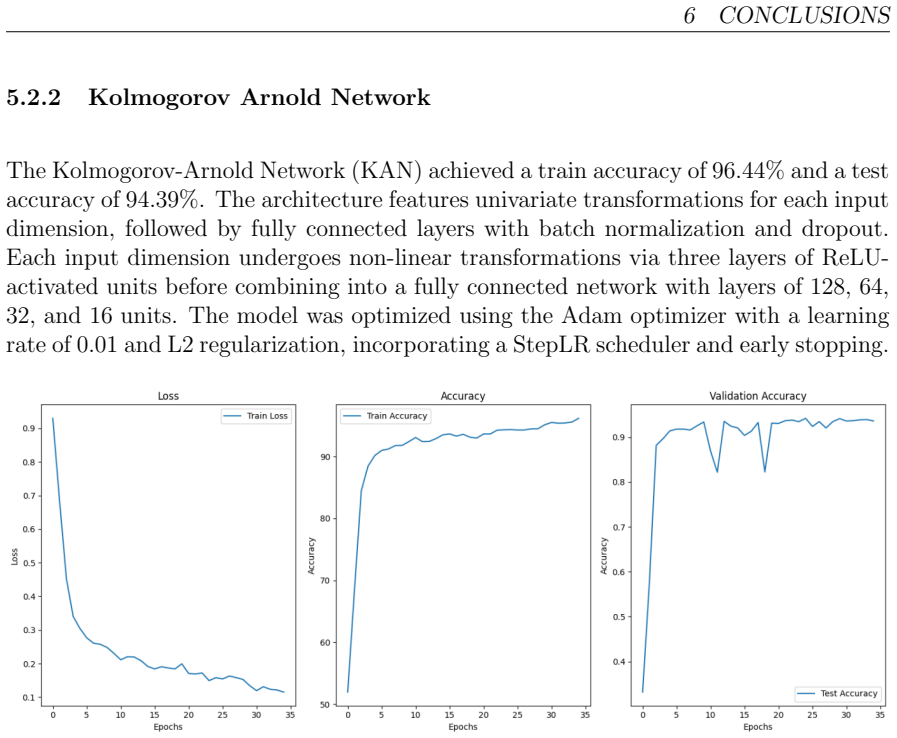
- [Section 5.2] The FFN and KAN results in Sections 5.2.1 and 5.2.2 report train and test accuracies (94%/92.4% for FFN, 96.44%/94.39% for KAN) but give no description of the train/test split, whether SMOTE was applied before or after splitting, or the hyperparameter search protocol for these deep models. The KAN's 96.44% training accuracy is also quoted in the conclusion as an example of 'strong generalization,' but without a clear evaluation protocol it is impossible to determine whether the reported test accuracies are honest holdout results.
minor comments (6)
- [Section 2.2] The text contains a typo in 'ANOV A F-test'; it should read 'ANOVA F-test'.
- [Section 2.6] The number of folds k in the k-fold cross-validation is never specified, and no nested cross-validation procedure is described for cases where feature selection or hyperparameter tuning is performed.
- [Tables 3-5] The table headers contain spacing errors such as 'W eighted Avg', and the 'Macro Avg' and 'Weighted Avg' columns are not defined in Section 2.4.
- [Section 1] The paper's outline in Section 1 says that Section 2 reviews related works, Section 3 presents methodology, and Section 4 presents results, but the actual sections are shifted: Section 2 is mathematical formulation, Section 3 is related works, Section 4 is methodology, and Section 5 is results; the outline should be corrected.
- [Table 1] Table 1 reports a count of 100 for every numerical feature, which is inconsistent with the categorical frequency counts in Table 2 (e.g., 254,477 occurrences) and with the presumably much larger dataset size; the sampling or subset used for the statistical summary should be clarified.
- [References] Several references are duplicated or inconsistently formatted, including 'Lu and et al.' versus 'Min Lu and et al.', and 'Klusowski and Tian' appears as both 2023 and 2024 entries; also, the paper provides no link to code or data availability.
Circularity Check
No significant circularity: the paper reports empirical classifier benchmarks; the unclear train/test split is a soundness concern, not a circular derivation.
full rationale
This paper does not claim to derive damage-grade predictions from first principles; it trains standard classifiers and ensembles on a public dataset and reports empirical metrics. The mathematical formulation (Sections 2.1-2.6) defines SMOTE, SelectKBest, loss functions, ensembling, and evaluation metrics, but no result is defined in terms of another result, and no fitted parameter is renamed as a prediction. The only self-citation, Yadav et al. [2023] for SMOTE in Section 4.1, is not load-bearing: SMOTE is a standard algorithm and is independently specified by the interpolation formula in Section 2.1. The central stacking-ensemble claim (Section 6) is presented as an observed test accuracy, not as a quantity constructed from its own inputs. The manuscript's failure to state whether SMOTE and undersampling were applied before or after the train/test split is a potentially serious evaluation-protocol gap that could inflate all reported numbers, but that is a soundness and validity concern, not a circularity: the reported accuracy is not equivalent to its own inputs by construction. No uniqueness theorem, ansatz smuggled in via citation, or renamed known result appears in the paper.
Assumptions & free parameters
free parameters (5)
- Number of selected features (k) =
20
- FFN L2 regularization lambda =
4.918e-3
- FFN learning rate =
3.885e-4
- FFN dropout rate =
0.1033
- KAN learning rate =
0.01
assumptions (4)
- domain assumption SMOTE-generated synthetic samples are valid representatives of minority classes and improve generalization to real test data.
- domain assumption The Gorkha building dataset's labels and features are accurate and representative of regional seismic vulnerability.
- domain assumption Isolation Forest correctly identifies anomalies without discarding informative hard cases.
- standard math Standard probability and cross-entropy loss definitions apply to the classification problem.
Cite this review
Pith. "Pith review of Earthquake Damage Grades Prediction using An Ensemble Approach Integrating Advanced Machine and Deep Learning Models." pith.science (2026). https://pith.science/paper/6OCXF7QI
@misc{pith2026250622129,
  author       = {Pith},
  title        = {Pith review of: Earthquake Damage Grades Prediction using An Ensemble Approach Integrating Advanced Machine and Deep Learning Models},
  year         = {2026},
  howpublished = {\url{https://pith.science/paper/6OCXF7QI}},
  note         = {Machine review of arXiv:2506.22129}
}
read the original abstract
In the aftermath of major earthquakes, evaluating structural and infrastructural damage is vital for coordinating post-disaster response efforts. This includes assessing damage's extent and spatial distribution to prioritize rescue operations and resource allocation. Accurately estimating damage grades to buildings post-earthquake is paramount for effective response and recovery, given the significant impact on lives and properties, underscoring the urgency of streamlining relief fund allocation processes. Previous studies have shown the effectiveness of multi-class classification, especially XGBoost, along with other machine learning models and ensembling methods, incorporating regularization to address class imbalance. One consequence of class imbalance is that it may give rise to skewed models that undervalue minority classes and give preference to the majority class. This research deals with the problem of class imbalance with the help of the synthetic minority oversampling technique (SMOTE). We delve into multiple multi-class classification machine learning, deep learning models, and ensembling methods to forecast structural damage grades. The study elucidates performance determinants through comprehensive feature manipulation experiments and diverse training approaches. It identifies key factors contributing to seismic vulnerability while evaluating model performance using techniques like the confusion matrix further to enhance understanding of the effectiveness of earthquake damage prediction.
Figures


Figures from the paper (1 more)
Reference graph
Works this paper leans on
-
[1]
T. Chen, J. Li, and C. Wang. Deep reinforcement learning for real-time earthquake damage assessment. Journal of Structural Engineering, 149: 0 04023087, 2023
work page 2023
-
[2]
W. Gao, X. Liu, and Z. Wang. Neural network-based approach for earthquake damage prediction. Journal of Geotechnical and Geoenvironmental Engineering, 149: 0 04023093, 2023
work page 2023
- [3]
-
[4]
Subash Ghimire, Philippe Gu \'e guen, Sophie Giffard-Roisin, and Danijel Schorlemmer. Testing machine learning models for seismic damage prediction at a regional scale using building-damage dataset compiled after the 2015 gorkha nepal earthquake. Earthquake Spectra, 38 0 (4): 0 2970--2993, 2022
work page 2015
- [5]
-
[6]
J. Kim, S. Lee, and H. Park. Application of artificial intelligence techniques in earthquake damage prediction. Journal of Structural Engineering, 149: 0 04023092, 2023
work page 2023
-
[7]
Scalable decision trees for earthquake damage assessment
Jason Klusowski and Yuan Tian. Scalable decision trees for earthquake damage assessment. Journal of Machine Learning Research, 24 0 (1): 0 1--20, 2023
work page 2023
-
[8]
Large scale prediction with decision trees
Jason M Klusowski and Peter M Tian. Large scale prediction with decision trees. Journal of the American Statistical Association, 119 0 (545): 0 525--537, 2024
work page 2024
Show all 25 references
-
[9]
C. Li, G. Zhang, and S. Wu. Probabilistic modeling of earthquake-induced building damage: A review. Journal of Performance of Constructed Facilities, 149: 0 04023091, 2023 a
2023
-
[10]
Y. Li, Q. Wu, and Y. Zhang. Performance comparison of machine learning models for earthquake damage prediction. Natural Hazards, 89: 0 235--250, 2023 b
2023
-
[11]
F. Liu, H. Zhang, and X. Wu. Application of machine learning techniques in earthquake damage assessment: A review. Journal of Geotechnical and Geoenvironmental Engineering, 149: 0 04023088, 2023 a
2023
-
[12]
Q. Liu, H. Wang, and Y. Zhang. Comparison of machine learning models for seismic damage prediction. Natural Hazards Review, 24: 0 247--262, 2023 b
2023
-
[13]
H. Lu, Y. Wang, and Z. Li. Earthquake damage prediction using xgboost. Journal of Seismology, 27: 0 123--136, 2023
2023
-
[14]
Xgboost: A scalable machine learning system for tree boosting
Min Lu and et al. Xgboost: A scalable machine learning system for tree boosting. IEEE Transactions on Machine Learning, 15 0 (1): 0 1--12, 2023
2023
-
[15]
J. Park, S. Kim, and D. Lee. Data-driven approaches for seismic vulnerability assessment of buildings. Journal of Earthquake Engineering, 149: 0 04023089, 2023
2023
-
[16]
Singh and R
A. Singh and R. Gupta. Ensemble methods for earthquake damage prediction. Natural Hazards Review, 24: 0 215--230, 2023
2023
-
[17]
X. Wang, P. Li, and P. Jiang. Resilience assessment of urban infrastructure systems under earthquake hazard. Journal of Urban Planning and Development, 149: 0 04023086, 2023 a
2023
-
[18]
Y. Wang, H. Chen, and L. Li. Predictive modeling of earthquake damage using bayesian networks. Journal of Structural Engineering, 149: 0 04023090, 2023 b
2023
-
[19]
Y. Wang, S. Zhang, and H. Liu. Machine learning approaches for post-earthquake damage assessment. Journal of Structural Engineering, 149: 0 04023096, 2023 c
2023
-
[20]
Effective ml-based quality of life prediction approach for dependent people in guardianship entities
Gaurav Kumar Yadav, Benigno Moreno Vidales, Hatem A Rashwan, Joan Oliver, Domenec Puig, GC Nandi, and Mohamed Abdel-Nasser. Effective ml-based quality of life prediction approach for dependent people in guardianship entities. Alexandria Engineering Journal, 65: 0 909--919, 2023
2023
-
[21]
J. Yang, X. Chen, and L. Zhu. Earthquake damage prediction using machine learning techniques: A comprehensive review. Journal of Earthquake Engineering, 149: 0 04023095, 2023
2023
-
[22]
Q. Yin, S. Zhang, and H. Liu. Predicting earthquake damage using support vector machines. Geophysical Research Letters, 50: 0 2876--2883, 2023
2023
-
[23]
A cnn-based approach for earthquake damage prediction
Wei Zhang and et al. A cnn-based approach for earthquake damage prediction. Seismic Engineering Journal, 18 0 (4): 0 45--60, 2023
2023
-
[24]
J. Zhao, Y. Liu, and Q. Zhang. Machine learning for post-earthquake damage estimation: A case study. Journal of Disaster Research, 18: 0 520--535, 2023
2023
-
[25]
H. Zhou, X. Wang, and T. Zhang. Machine learning models for earthquake damage assessment: A comparative study. Natural Hazards Review, 24: 0 231--246, 2023
2023
Reviewed August 6, 2026 · model on record in the stance chip above.
Discussion (0). Continue with ORCID to comment.