Asymptotic Approximant for the Falkner-Skan Boundary-Layer equation
Pith reviewed 2026-05-24 19:47 UTC · model grok-4.3
The pith
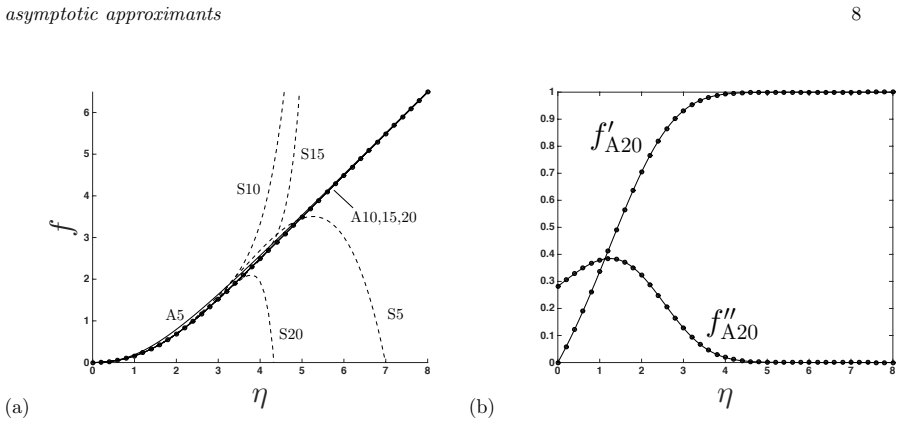
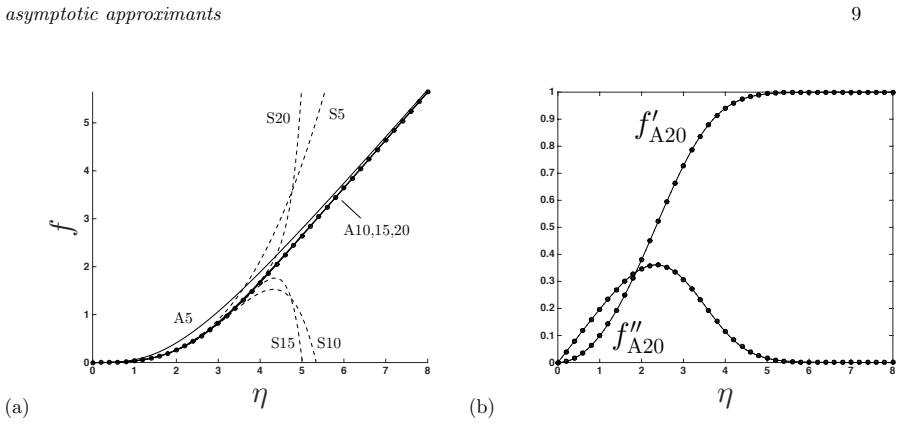
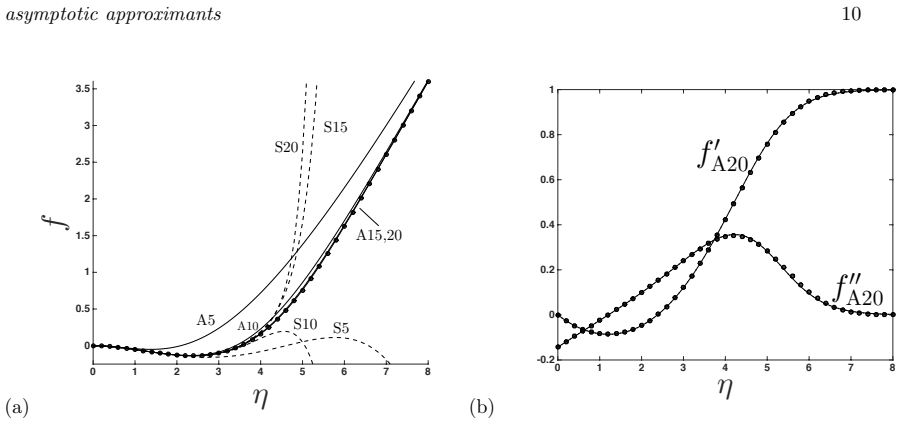
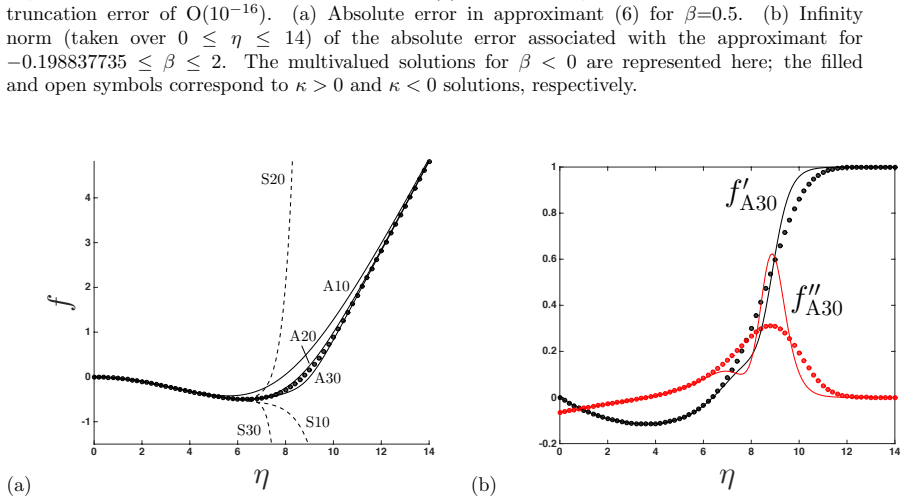
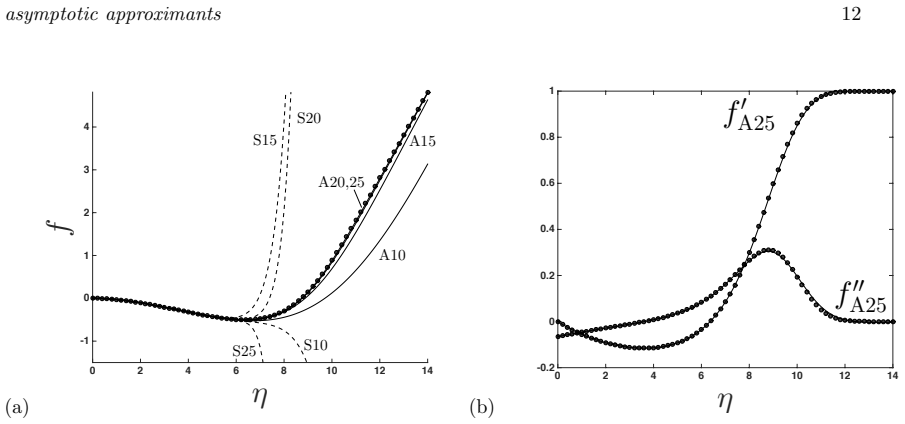
The asymptotic approximant developed for Blasius flow extends to deliver accurate closed-form analytic solutions for the Falkner-Skan equation across wedge angles with beta from -0.1988 to 1.
A machine-rendered reading of the paper's core claim, the machinery that carries it, and where it could break.
Core claim
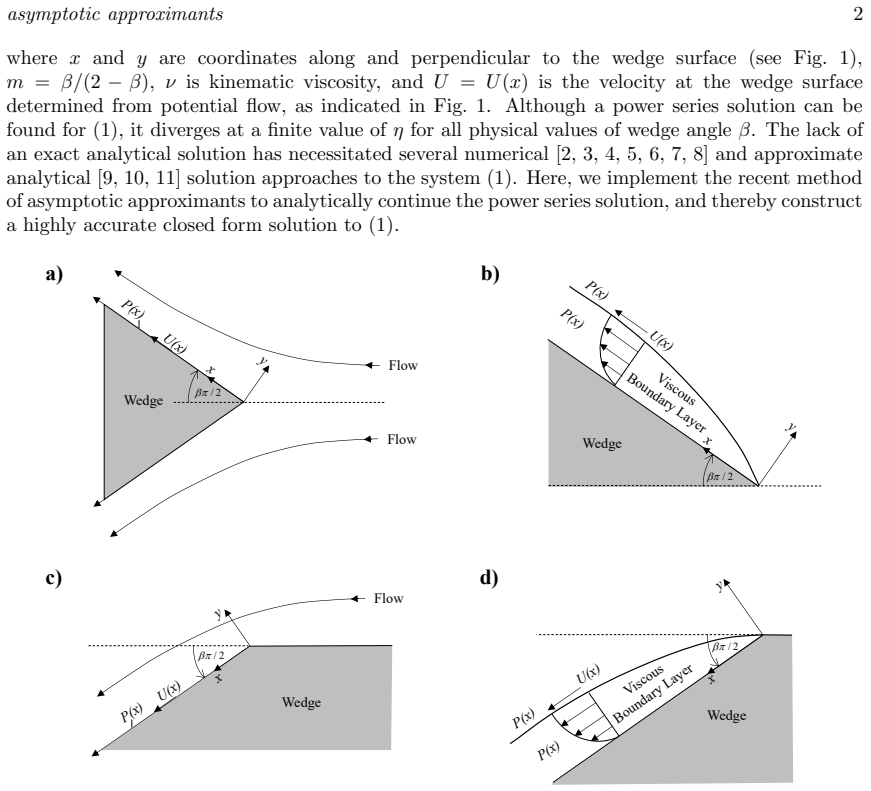
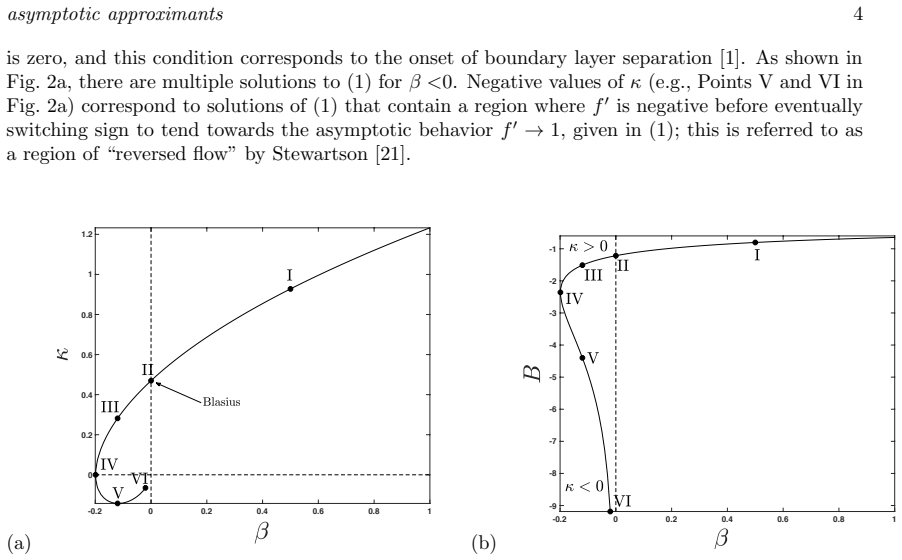
The asymptotic approximant applied to the Blasius boundary layer flow over a flat plate yields accurate analytic closed-form solutions to the Falkner-Skan boundary layer equation for flow over a wedge having angle βπ/2 to the horizontal, for β∈[-0.198837735,1], accurately representing the previously established non-unique solutions for β<0 having positive and negative shear rates along the wedge.
What carries the argument
The asymptotic approximant: a recursively constructed analytic function that matches the near-wedge power series to the far-field asymptotic behavior of the Falkner-Skan solution.
If this is right
- Accurate closed-form representations exist for both unique and non-unique solutions across the full practical range of wedge angles.
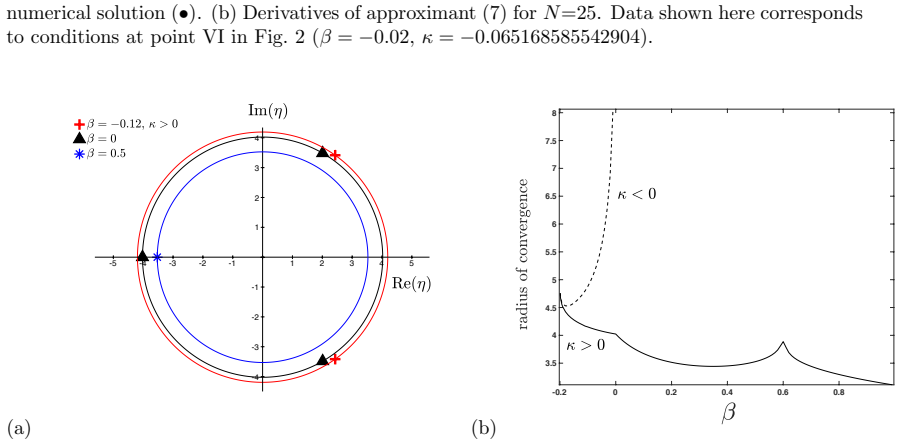
- Complex-plane singularities that set the radius of convergence of the power series can be read directly from the approximant.
- The approximant is constructed by recursion without matrix inversion, in contrast to traditional Padé methods.
- Benchmark constants characterizing the far-field asymptotic decay are obtained for each beta.
Where Pith is reading between the lines
- The same recursive matching procedure may transfer without modification to other nonlinear boundary-layer ODEs that possess similar far-field decay.
- Rapid analytic parameter studies over beta become feasible once the approximant coefficients are tabulated.
- The extracted complex singularities could guide the construction of improved series resummations for related fluid-mechanics problems.
Load-bearing premise
The recursive construction rules and matching conditions developed for the Blasius case remain valid when the pressure-gradient parameter beta is introduced and when multiple solutions exist for beta less than zero.
What would settle it
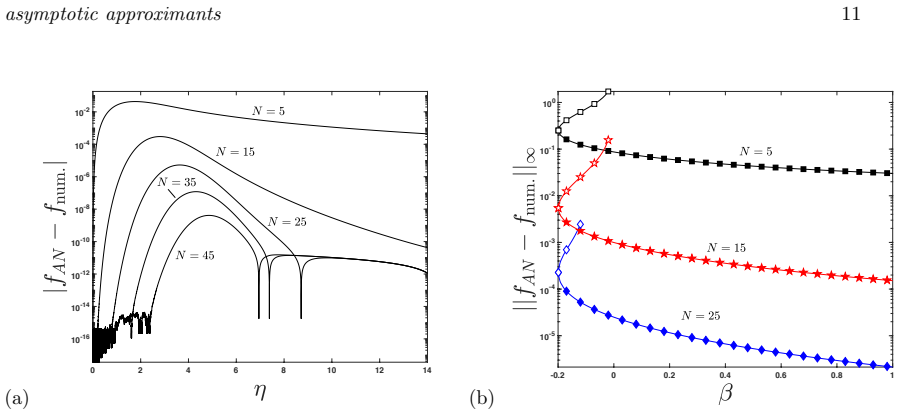
High-precision numerical integration of the Falkner-Skan equation for any beta inside the claimed interval that deviates from the approximant by more than the expected truncation error would falsify the accuracy claim.
Figures
read the original abstract
We demonstrate that the asymptotic approximant applied to the Blasius boundary layer flow over a flat plat (Barlow et al., 2017 Q. J. Mech. Appl. Math., 70(1): 21-48) yields accurate analytic closed-form solutions to the Falkner-Skan boundary layer equation for flow over a wedge having angle $\beta\pi/2$ to the horizontal. A wide range of wedge angles satisfying $\beta\in[-0.198837735, 1]$ are considered, and the previously established non-unique solutions for $\beta<0$ having positive and negative shear rates along the wedge are accurately represented. The approximant is used to determine the singularities in the complex plane that prescribe the radius of convergence of the power series solution to the Falkner-Skan equation. An attractive feature of the approximant is that it may be constructed quickly by recursion compared with traditional Pad\'e approximants that require a matrix inversion. The accuracy of the approximant is verified by numerical solutions, and benchmark numerical values are obtained that characterize the asymptotic behavior of the Falkner-Skan solution at large distances from the wedge.
Editorial analysis
A structured set of objections, weighed in public.
Referee Report
Summary. The manuscript claims that the asymptotic approximant previously developed for the Blasius boundary-layer equation (β=0) directly produces accurate closed-form analytic solutions to the Falkner-Skan equation f''' + f f'' + β(1 - (f')²) = 0 for wedge flows over the range β ∈ [-0.198837735, 1]. It asserts that the same recursive construction accurately represents the non-unique solutions for β < 0, locates singularities in the complex plane that determine the power-series radius of convergence, and supplies benchmark values for the far-field asymptotic behavior, all verified against independent numerical solutions.
Significance. If the extension of the approximant holds, the work supplies a computationally inexpensive analytic representation for a classic family of boundary-layer problems, with the practical advantage of recursive construction that avoids the matrix inversion required by Padé approximants. The provision of benchmark asymptotic constants and complex-plane singularity locations would also be of direct use to the computational fluid-dynamics community.
major comments (3)
- [§3] §3 (construction of the approximant): the recursion and matching conditions are presented as a direct carry-over from the Blasius case (Barlow et al., 2017). Because the β term modifies both the recurrence relation for the power-series coefficients a_n and the far-field decay rate of f' → 1, the manuscript must explicitly derive or adjust the recursion for nonzero β; without this step the claimed applicability to the full Falkner-Skan family is not established.
- [§4] §4 (multiple solutions for β < 0): the paper states that both the positive- and negative-shear branches are accurately represented, yet no separate error tables or convergence plots are supplied for the negative-shear branch at, e.g., β = −0.1. The central claim that the same approximant captures both branches therefore lacks the quantitative support required to be load-bearing.
- [§5] §5 (complex singularities): the radius-of-convergence results are obtained by locating poles of the approximant, but the manuscript does not demonstrate that these poles remain accurate when β is varied away from zero; a direct comparison of the predicted radius versus the numerically determined radius of convergence for at least two additional β values is needed.
minor comments (2)
- [Abstract] The abstract cites the range β ∈ [-0.198837735, 1] but does not state the precise numerical criterion used to truncate the interval at the lower end; a brief sentence in §2 would clarify this choice.
- [Figures] Figure captions should explicitly label which curve corresponds to the positive-shear and which to the negative-shear branch when β < 0.
Simulated Author's Rebuttal
We thank the referee for the careful reading and constructive comments. We address each major comment below.
read point-by-point responses
-
Referee: [§3] §3 (construction of the approximant): the recursion and matching conditions are presented as a direct carry-over from the Blasius case (Barlow et al., 2017). Because the β term modifies both the recurrence relation for the power-series coefficients a_n and the far-field decay rate of f' → 1, the manuscript must explicitly derive or adjust the recursion for nonzero β; without this step the claimed applicability to the full Falkner-Skan family is not established.
Authors: We agree that an explicit derivation of the recursion for general β is required. In the revised manuscript we will substitute the power series into the Falkner-Skan equation, collect terms, and display the resulting recurrence relation that incorporates the β-dependent contributions to the coefficients a_n together with the adjusted far-field matching conditions. revision: yes
-
Referee: [§4] §4 (multiple solutions for β < 0): the paper states that both the positive- and negative-shear branches are accurately represented, yet no separate error tables or convergence plots are supplied for the negative-shear branch at, e.g., β = −0.1. The central claim that the same approximant captures both branches therefore lacks the quantitative support required to be load-bearing.
Authors: We acknowledge the need for dedicated quantitative support. The revised manuscript will include separate error tables and convergence plots for the negative-shear branch, with explicit results shown at β = −0.1 and at least one additional negative value. revision: yes
-
Referee: [§5] §5 (complex singularities): the radius-of-convergence results are obtained by locating poles of the approximant, but the manuscript does not demonstrate that these poles remain accurate when β is varied away from zero; a direct comparison of the predicted radius versus the numerically determined radius of convergence for at least two additional β values is needed.
Authors: We will add a direct comparison of approximant-predicted radii against numerically computed radii of convergence for at least two additional β values (β = 0.5 and β = −0.1) to confirm accuracy of the singularity locations away from the Blasius case. revision: yes
Circularity Check
Minor self-citation of approximant method; central extension to Falkner-Skan is independently verified
full rationale
The paper cites its own prior work (Barlow et al. 2017) for the asymptotic approximant construction developed on the Blasius equation (β=0). However, the present manuscript applies the method to the Falkner-Skan equation for a range of β values, determines singularities, and explicitly verifies accuracy against independent numerical solutions. The load-bearing claim does not reduce solely to the self-citation; the numerical benchmarks and explicit demonstration for nonzero β supply external grounding. This qualifies as normal self-citation of a method with independent validation rather than circularity.
Axiom & Free-Parameter Ledger
axioms (1)
- domain assumption The asymptotic approximant form and recursion rules developed for the Blasius equation remain valid when the Falkner-Skan pressure-gradient parameter β is introduced.
Reference graph
Works this paper leans on
-
[1]
Introduction The Falkner-Skan equation describes boundary layer flow over a wedge of angle βπ/2 to the horizontal that is driven by an external pressure gradient predicted from potential flow (see Fig. 1). The equation also applies to regimes where the pressure gradient opposes the flow when β < 0 (Fig. 1c,d) for which boundary layer separation may occur. Th...
work page internal anchor Pith review Pith/arXiv arXiv 1907
-
[2]
Asymptotic properties and series expansion of the F alkner-Skan equation Solutions to the Falkner-Skan equation system (1) are found for a given flow by fixing the parameter β, which is related to the wedge angle shown in Fig. 1. Note that this parameter incorporates the effect of wedge angle on the potential flow that drives the fluid motion in the boundary l...
work page 1988
-
[3]
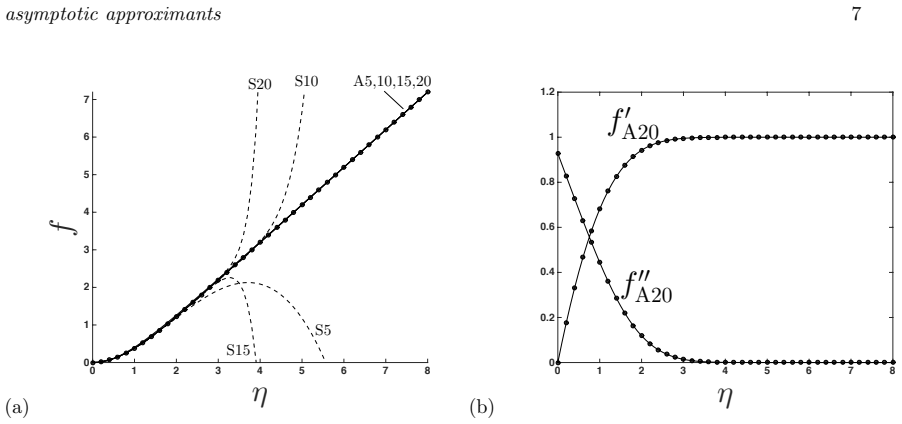
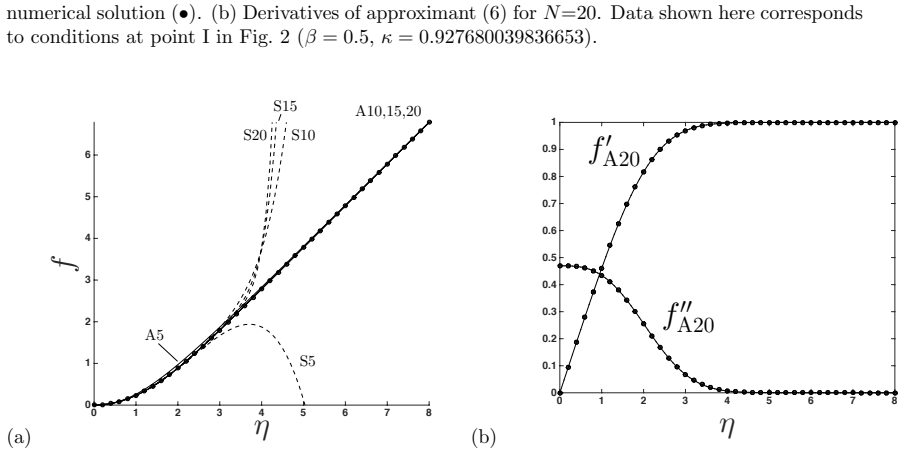
Asymptotic Approximant The divergence of the Falkner-Skan series (4) demonstrated in Figs. 3a through 9a is overcome using the method of asymptotic approximants, which constrains the analytic continuation of the series via an asymptotic behavior away from the point of expansion [15]. An approximant that satisfies the η→∞ behavior (5) is given as fA = η + B...
-
[4]
Conclusions Asymptotic approximants provide nearly exact closed-form solutions to the Falkner-Skan boundary layer equation for varying wedge angle. This adds to the increasing number of problems in disparate areas of mathematical physics to which asymptotic approximants have been applied successfully [12, 13, 14, 15, 18, 17]. Advantages of asymptotic appr...
-
[5]
H. Schlichting. Boundary Layer Theory . McGraw-Hill, seventh edition, 1979
work page 1979
-
[6]
T. Cebeci and H. B. Keller. Shooting and parallel shooting methods for solving the Falkner-Skan boundary-layer equation. J. Comp. Phys. , 7:289–300, 1971
work page 1971
-
[7]
C. Laine and L. Reinhart. Further numerical methods for the Falkner-Skan equaitons: shooting and continuation techniques. I. J. Num. Meth. Fluids , 4:833–852, 1984
work page 1984
-
[8]
R. Fazio. A novel approach to the numerical solution of boundary value problems on infinite intervals. SIAM J. Num. Anal. , 33(4):1473–1483, 1996
work page 1996
-
[9]
A. Asaithambi. A finite-difference method for the Falkner-Skan equation. Appl. Math. Comp. , 92:135–141, 1998
work page 1998
-
[10]
S. S. Motsa and P. Sibanda. An efficient numerical method for solving Falkner-Skan boundary layer flows. I. J. Num. Meth. Fluids , 69:499–508, 2012
work page 2012
-
[11]
R. Fazio. Blasius problem and Falkner-Skan model: T¨ opfer’s algorithm and its extension. Comp. Fluids , 73(15):202–209, 2013
work page 2013
-
[12]
C-S. Liu. An iterative method based-on eigenfunctions and adjoint eigenfunctions for solving the Falkner-Skan equation. Appl. Math. Lett. , 67:33–39, 2017
work page 2017
-
[13]
H. Bararnia, N. Haghparast, M. Miansari, and A. Barari. Flow analysis for the Falkner-Skan wedge flow. Curr. Sci., 103(2):169–177, 2012
work page 2012
-
[14]
B. I. Yun. New approximate analytical solutions of the Falkner-Skan equation. J. Appl. Math. , 2012:170802: 1–12, 2012
work page 2012
-
[15]
A. Khidir. A note on the solution of general Falkner-Skan problem by two novel semi-analytical techniques. Propul. Power Res. , 4(4):212–220, 2015
work page 2015
-
[16]
N. S. Barlow, A. J. Schultz, S. J. Weinstein, and D. A. Kofke. An asymptotically consistent approximant method with application to soft- and hard-sphere fluids. J. Chem. Phys. , 137:204102, 2012
work page 2012
-
[17]
N. S. Barlow, A. J. Schultz, S. J. Weinstein, and D. A. Kofke. Critical isotherms from virial series using asymptotically consistent approximants. AIChE J. , 60(9):3336–3349, 2014
work page 2014
-
[18]
N. S. Barlow, A. J. Schultz, S. J. Weinstein, and D. A. Kofke. Communication: Analytic continutation of the virial series through the critical point using parametric approximants. J. Chem. Phys. , 143:071103:1–5, 2015
work page 2015
-
[19]
N. S. Barlow, C. R. Stanton, N Hill, S. J. Weinstein, and A. G. Cio. On the summation of divergent, truncated, and underspecified power series via asymptotic approximants. Q. J. Mech. Appl. Math. , 70(1):21–48, 2017
work page 2017
-
[20]
C. M. Bender and S. A. Orszag. Advanced Mathematical Methods for Scientists and Engineers I: Asymptotic Methods and Perturbation Theory . McGraw-Hill, 1978
work page 1978
-
[21]
R. J. Beachley, M. Mistysyn, J. A. Faber, S. J. Weinstein, and N. S. Barlow. Accurate closed-form trajectories of light around a kerr black hole using asymptotic approximants. Class. Quant. Grav. , 35(20):1–28, 2018
work page 2018
-
[22]
N. S. Barlow, S. J. Weinstein, and J. A. Faber. An asymptotically consistent approximant for the equatorial bending angle of light due to kerr black holes. Class. Quant. Grav. , 34(135017):1–16, 2017
work page 2017
-
[23]
J. P. Boyd. The Blasius function: Computations before computers, the value of tricks, undergraduate projects, and open research problems. SIAM Rev., 50(4):791–804, 2008
work page 2008
-
[24]
S. Anil Lal and Neeraj Paul M. An accurate Taylor series solution with high radius of convergence for the Blasius function and parameters of asymptotic variation. JAFM, 7(4):557–564, 2014
work page 2014
-
[25]
K. Stewartson. Further solutions of the Falkner-Skan equation. Proc. Roy. Phil. Soc. , 50:454–465, 1954
work page 1954
-
[26]
See (insert url provided by journal) for a spreadsheet of values that were computed in this work
-
[27]
P. L. Sachdev, R. B. Kudenatti, and N. M. Bujurke. Exact analytic solution of a boundary value problem for the Falkner-Skan equation. Stud. Appl. Math , 120:1–16, 2008
work page 2008
-
[28]
W. A. Coppel. On a differential equation of boundary layer theory. Phil. Trans. R. Soc. Lond. A , 253(1023):101– 136, 1960
work page 1960
-
[29]
R. V. Churchill. Complex Variables. McGraw-Hill, 1948
work page 1948
- [30]
-
[31]
G. A. Baker Jr. and J. L. Gammel. The Pad´ e approximant. J. Math. Anal. Appl. , 2:21–30, 1961
work page 1961
-
[32]
E. C. Titchmarsh. The Theory of Functions . Oxford University Press, 2 edition, 1968
work page 1968
- [33]
-
[34]
A. J. Guttmann and I. Jensen. Series analysis. In Polygons, Polyominoes, and Polycubes , pages 181–202. Springer, 2009
work page 2009
-
[35]
J. P. Boyd. The Blasius function in the complex plane. Exper. Math., 8(4):381–394, 1999
work page 1999
discussion (0)
Sign in with ORCID, Apple, or X to comment. Anyone can read and Pith papers without signing in.