The Relativistic Gravitational Field of a Spherically Symmetric Extended Body
Pith reviewed 2026-05-22 00:47 UTC · model grok-4.3
The pith
The gravitational field outside a spherically symmetric extended body depends weakly on its internal mass distribution through higher-order corrections.
A machine-rendered reading of the paper's core claim, the machinery that carries it, and where it could break.
Core claim
Within the Extended Relativity framework, the gravitational field of an extended spherically symmetric body is obtained by integrating the retarded contributions from its mass elements, yielding a metric that reproduces point-source time dilation and GR tests but includes higher-order corrections dependent on the internal mass distribution.
What carries the argument
The relativistic superposition principle for retarded gravitational fields, which integrates contributions from individual mass elements to produce the metric of the extended body.
If this is right
- The external metric depends weakly on internal mass distribution through higher-order corrections that decay rapidly with distance.
- Near compact objects such as neutron stars, the corrections noticeably modify the local light-velocity structure.
- For Earth, the corrections produce measurable differences in round-trip light travel times to the ISS.
- The formalism derives motion equations for test particles and compares extended-body predictions to point-source models.
Where Pith is reading between the lines
- The same superposition approach could be applied to non-spherical or rotating bodies to examine how internal structure affects their external fields.
- Precision satellite timing experiments might serve as a test to distinguish the size-dependent corrections from standard point-mass predictions.
- The derived admissible-velocity geometry offers a concrete way to explore flat-background alternatives for modeling strong-field gravitational effects.
Load-bearing premise
The gravitational field of the extended body can be obtained by direct relativistic superposition of retarded fields from its individual mass elements on a Minkowski background.
What would settle it
A precision measurement of round-trip light travel times between Earth and the ISS that either matches or deviates from the small timing differences predicted by the extended-body metric versus the pure point-source model.
Figures
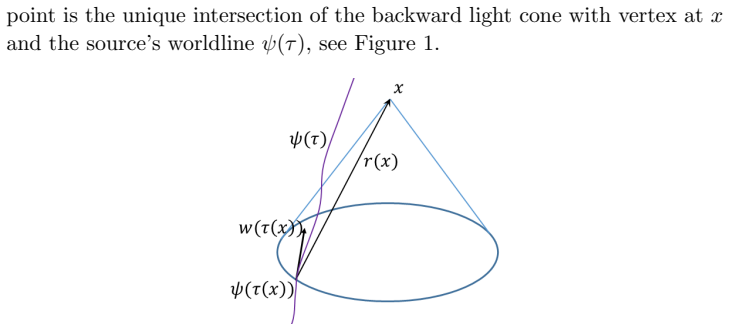


read the original abstract
We investigate the gravitational field of an extended spherically symmetric body within the framework of Extended Relativity (ER), a Lorentz-covariant formulation of relativistic gravity on a Minkowski background. Using a relativistic superposition principle for retarded gravitational fields, we derive an explicit metric for an extended body by integrating the contributions of its mass elements. The resulting metric reproduces the standard gravitational time dilation of a point source and agrees with the classical tests of General Relativity in the appropriate limits. However, unlike the exact Newtonian shell theorem and the Schwarzschild exterior solution, the external field depends weakly on the internal mass distribution through higher-order corrections. These corrections decay rapidly with distance but become significant near compact objects. We analyze the corresponding admissible-velocity geometry, derive the motion equations for test particles, and compare the predictions of extended-body and point-source models. For neutron stars, the corrections noticeably modify the local light-velocity structure near the surface. For the Earth, the corrections are small but produce measurable differences in round-trip light travel times to the International Space Station. The formalism provides a transparent relativistic description of extended gravitational sources and offers a framework for studying relativistic corrections due to internal structure in strong-field and precision-measurement regimes.
Editorial analysis
A structured set of objections, weighed in public.
Referee Report
Summary. The manuscript derives an explicit metric for the gravitational field of a spherically symmetric extended body in the Extended Relativity (ER) framework on a Minkowski background. Using a relativistic superposition of retarded fields from individual mass elements, the resulting metric is shown to reproduce standard gravitational time dilation for a point source and to agree with classical tests of General Relativity in appropriate limits. Unlike the Newtonian shell theorem or the Schwarzschild exterior solution, the external field exhibits weak dependence on the internal mass distribution through higher-order corrections that decay rapidly with distance but become relevant near compact objects. The work further analyzes the admissible-velocity geometry, derives equations of motion for test particles, and compares predictions of extended-body versus point-source models, claiming noticeable effects for neutron stars and measurable differences in round-trip light travel times to the ISS for Earth.
Significance. If the derivation and consistency checks hold, the result would be significant for offering a transparent, Lorentz-covariant treatment of extended sources that permits internal-structure dependence in the exterior field, in contrast to Birkhoff's theorem. The explicit integration procedure and concrete comparisons for neutron stars and Earth-based precision measurements provide a framework for studying relativistic corrections due to finite size in strong-field and weak-field regimes. The absence of free parameters and the focus on falsifiable predictions for light-travel times are strengths.
major comments (3)
- [§3] §3 (metric derivation): The central claim that higher-order corrections depend on internal mass distribution requires an explicit demonstration that the integrated retarded-field metric satisfies the ER field equations for the composite body. Without this verification step, the corrections could arise as an artifact of the superposition ansatz or normalization choices already fixed to recover the point-mass limit, rather than as an independent physical prediction.
- [§4] §4 (GR tests and limits): The assertion of agreement with classical GR tests is made without quantitative error estimates, explicit post-Newtonian expansions for the extended-body metric, or direct comparison of observables (e.g., perihelion precession or light deflection) between the extended and point-source cases. This is load-bearing for the claim that the corrections are both present and physically relevant while still reproducing GR limits.
- [§5] §5 (neutron-star and Earth applications): The statements that corrections 'noticeably modify the local light-velocity structure' for neutron stars and produce 'measurable differences' in ISS light-travel times lack supporting numerical magnitudes or error budgets relative to the point-source model. These claims are central to the practical significance but rest on the unverified integrated metric.
minor comments (2)
- The abstract refers to an 'explicit metric' but the main text should present the full integrated expression (including the form of the higher-order terms) at the earliest possible point for reader accessibility.
- Notation for retarded times, integration limits over the mass distribution, and the definition of the admissible-velocity geometry could be clarified with a short table or additional inline definitions to avoid ambiguity.
Simulated Author's Rebuttal
We thank the referee for the careful and constructive review of our manuscript. We address each major comment below and will revise the manuscript to incorporate the suggested improvements, thereby strengthening the verification of our results and the quantitative support for our claims.
read point-by-point responses
-
Referee: [§3] §3 (metric derivation): The central claim that higher-order corrections depend on internal mass distribution requires an explicit demonstration that the integrated retarded-field metric satisfies the ER field equations for the composite body. Without this verification step, the corrections could arise as an artifact of the superposition ansatz or normalization choices already fixed to recover the point-mass limit, rather than as an independent physical prediction.
Authors: We agree that an explicit check is needed to confirm the corrections are not artifacts. The derivation relies on the linearity of the retarded-field solutions in the ER framework for individual mass elements in the weak-field regime, with the composite metric obtained by integration. To address the concern directly, we will add an appendix that substitutes the integrated metric back into the ER field equations and verifies consistency for the extended source up to the order of the higher corrections, including the source term matching the total mass distribution. revision: yes
-
Referee: [§4] §4 (GR tests and limits): The assertion of agreement with classical GR tests is made without quantitative error estimates, explicit post-Newtonian expansions for the extended-body metric, or direct comparison of observables (e.g., perihelion precession or light deflection) between the extended and point-source cases. This is load-bearing for the claim that the corrections are both present and physically relevant while still reproducing GR limits.
Authors: We accept that quantitative comparisons are required. We will revise §4 to include the post-Newtonian expansion of the extended-body metric to the relevant orders, with explicit error estimates for deviations from the point-source limit. Direct calculations of perihelion precession and light deflection will be added for solar-system parameters, showing that differences fall below current observational thresholds while remaining detectable near compact objects. revision: yes
-
Referee: [§5] §5 (neutron-star and Earth applications): The statements that corrections 'noticeably modify the local light-velocity structure' for neutron stars and produce 'measurable differences' in ISS light-travel times lack supporting numerical magnitudes or error budgets relative to the point-source model. These claims are central to the practical significance but rest on the unverified integrated metric.
Authors: We agree that numerical magnitudes and error budgets are essential. We will update §5 with explicit computations: the fractional correction to the local light speed near a neutron-star surface as a function of radius and internal density profile, and the differential round-trip light travel time to the ISS with an error budget that includes uncertainties in Earth's mass distribution. These will be contrasted directly with the point-source predictions. revision: yes
Circularity Check
No significant circularity; derivation self-contained via superposition on Minkowski background
full rationale
The paper constructs the exterior metric by direct integration of retarded contributions from individual mass elements under the ER superposition principle on a flat background. This yields higher-order internal-distribution dependence while recovering point-source time dilation and GR limits in the appropriate regimes. No load-bearing step reduces by construction to a fitted parameter, self-citation chain, or ansatz that is itself defined in terms of the target result. The reproduction of standard limits is a consistency check on the integrated expression rather than a normalization choice that forces the corrections. The derivation remains independent of the final metric form and is externally falsifiable against light-travel-time measurements and neutron-star observables.
Axiom & Free-Parameter Ledger
axioms (1)
- domain assumption A relativistic superposition principle exists for retarded gravitational fields on a Minkowski background
Lean theorems connected to this paper
-
IndisputableMonolith/Foundation/AlexanderDuality.leanalexander_duality_circle_linking unclear?
unclearRelation between the paper passage and the cited Recognition theorem.
Using a relativistic superposition principle for retarded gravitational fields, we derive an explicit metric for an extended body by integrating the contributions of its mass elements... the external field depends weakly on the internal mass distribution through higher-order corrections.
-
IndisputableMonolith/Cost/FunctionalEquation.leanwashburn_uniqueness_aczel unclear?
unclearRelation between the paper passage and the cited Recognition theorem.
h_μν(x) = Σ 2M_j l_jμ(x) l_jν(x) ... deviation tensor ... linear in the source mass
What do these tags mean?
- matches
- The paper's claim is directly supported by a theorem in the formal canon.
- supports
- The theorem supports part of the paper's argument, but the paper may add assumptions or extra steps.
- extends
- The paper goes beyond the formal theorem; the theorem is a base layer rather than the whole result.
- uses
- The paper appears to rely on the theorem as machinery.
- contradicts
- The paper's claim conflicts with a theorem or certificate in the canon.
- unclear
- Pith found a possible connection, but the passage is too broad, indirect, or ambiguous to say the theorem truly supports the claim.
Reference graph
Works this paper leans on
-
[1]
Newton,Philosophia Naturalis Principia Mathematica, 1st ed., Lon- don, U.K.: Royal Society, 1687
I. Newton,Philosophia Naturalis Principia Mathematica, 1st ed., Lon- don, U.K.: Royal Society, 1687
-
[2]
D. Kleppner and R. Kolenkow,An Introduction to Mechanics, 2nd ed. Cambridge: Cambridge University Press, 2013
work page 2013
-
[3]
Die Feldgleichungen der Gravitation,
A. Einstein, “Die Feldgleichungen der Gravitation,”Sitzungsber. Preuss. Akad. Wiss. Berlin, pp. 844–847, 1915
work page 1915
-
[4]
C. W. Misner, K. S. Thorne, and J. A. Wheeler,Gravitation, San Fran- cisco, CA, USA: W. H. Freeman, 1973
work page 1973
-
[5]
L. D. Landau and E. M. Lifshitz,The Classical Theory of Fields, 4th ed. Oxford, U.K.: Pergamon Press, 1975
work page 1975
-
[6]
Grøn,Lecture Notes on the General Theory of Relativity, New York, NY, USA: Springer, 2009
Ø. Grøn,Lecture Notes on the General Theory of Relativity, New York, NY, USA: Springer, 2009
work page 2009
-
[7]
S. Kopeikin, M. Efroimsky, and G. Kaplan,Relativistic Celestial Me- chanics of the Solar System, Weinheim, Germany: Wiley-VCH, 2011
work page 2011
-
[8]
¨Uber das Gravitationsfeld eines Massenpunktes nach der Einsteinschen Theorie,
K. Schwarzschild, “ ¨Uber das Gravitationsfeld eines Massenpunktes nach der Einsteinschen Theorie,”Sitzungsber. Koenigl. Preuss. Akad. Wiss., vol. 7, pp. 189–196, 1916
work page 1916
-
[9]
Gravitational field of a spinning mass as an example of algebraically special metrics,
R. P. Kerr, “Gravitational field of a spinning mass as an example of algebraically special metrics,”Phys. Rev. Lett., vol. 11, no. 26, pp. 237–238, 1963
work page 1963
-
[10]
G. D. Birkhoff and R. E. Langer,Relativity and Modern Physics, Cam- bridge, MA, USA: Harvard University Press, 1923. 27
work page 1923
-
[11]
S. Hawking and G.F.R. Ellis. The Large Scale Structure of Space-Time. Cambridge Monographs on Mathematical Physics. Cambridge Univer- sity Press, 1973
work page 1973
-
[12]
H. Lin, “Revisit Birkhoff’s Theorem: The Post-Newtonian Metric of a Self-Gravitating and Collapsing Thin Spherical Shell,”Symmetry, vol. 16, no. 5, 998, 2024
work page 2024
-
[13]
Schwarzschild black hole revisited: Before the complete so- lution,
J. Ovalle, “Schwarzschild black hole revisited: Before the complete so- lution,”Phys. Rev. D, vol. 109, no. 10, 104035, 2024
work page 2024
-
[14]
Generalized Birkhoff theorem in the Poincar´ e gauge gravity theory,
Y. N. Obukhov, “Generalized Birkhoff theorem in the Poincar´ e gauge gravity theory,”Phys. Rev. D, vol. 102, no. 10, 104059, 2020
work page 2020
-
[15]
Realistic anisotropic neutron stars: Pressure effects,
L. Becerra, S. Ilijic, R. Narayan, and A. Rubio, “Realistic anisotropic neutron stars: Pressure effects,”Phys. Rev. D, vol. 109, no. 4, 043025, 2024
work page 2024
-
[16]
C. W. Misner and J. A. Wheeler. Classical physics as geometry.Annals of Physics, 2(6):525–603, 1957
work page 1957
-
[17]
G. Ludwig. Geometrodynamics of electromagnetic fields in the Newman-Penrose formalism.Communications in Mathematical Physics, 17(2):98–108, 1970
work page 1970
-
[18]
M. Ferraris and J. Kijowski. Unified geometric theory of electromag- netic and gravitational interactions.General Relativity and Gravitation, 14(1):37–47, Jan 1982
work page 1982
-
[19]
Zum Unit¨ atsproblem in der Physik
Kaluza, T. Zum Unit¨ atsproblem in der Physik. Sitzungsber. Preuss. Akad. Wiss., Berlin 966 (1921)
work page 1921
-
[20]
The Atomicity of Electricity as a Quantum Theory Law, Nature118516 (1926)
Klein, O. The Atomicity of Electricity as a Quantum Theory Law, Nature118516 (1926)
work page 1926
-
[21]
A unifying physically meaningful relativistic ac- tion,
Y. Friedman, “A unifying physically meaningful relativistic ac- tion,”Sci. Rep., vol. 12, no. 1, p. 10843, 2022. [Online]. https://www.nature.com/articles/s41598-022-14740-7
work page 2022
-
[22]
Y. Friedman and T. Scarr,A Novel Approach to Relativistic Dynam- ics: Integrating Gravity, Electromagnetism and Optics, Fundamental Theories of Physics, vol. 210, Cham, Switzerland: Springer, 2023
work page 2023
-
[23]
Superposition Principle in Relativistic Gravity,
Y. Friedman, “Superposition Principle in Relativistic Gravity,”Phys. Scr., vol. 99, 105045 (2024) https://doi.org/10.1088/1402-4896/ad7a31 28
-
[24]
Griffiths,Introduction to Electrodynamics, 3rd ed
D. Griffiths,Introduction to Electrodynamics, 3rd ed. Dorling Kinders- ley, New Delhi, India, 1999
work page 1999
-
[25]
J. L. Synge, “Orbits and rays in the gravitational field of a finite sphere according to the theory of A. N. Whitehead,”Proc. Roy. Soc. London, vol. 211, pp. 303–319, 1952
work page 1952
-
[26]
A. N. Whitehead,The Principle of Relativity, Cambridge, U.K.: Cam- bridge University Press, 1922
work page 1922
-
[27]
On the multiple deaths of Whitehead’s theory of gravity,
G. W. Gibbons and C. M. Will, “On the multiple deaths of Whitehead’s theory of gravity,”Stud. Hist. Philos. Mod. Phys., vol. 39, no. 1, pp. 41–61, 2008
work page 2008
-
[28]
Mukhanov,Physical Foundations of Cosmology, Cambridge Univer- sity Press, 2005
V. Mukhanov,Physical Foundations of Cosmology, Cambridge Univer- sity Press, 2005
work page 2005
-
[29]
Weinberg,Cosmology, Oxford University Press, 2008
S. Weinberg,Cosmology, Oxford University Press, 2008
work page 2008
-
[30]
Some algebraically degenerate solutions of Einstein’s gravitational field equations,
R. P. Kerr and A. Schild, “Some algebraically degenerate solutions of Einstein’s gravitational field equations,”Proc. Symp. Appl. Math., vol. 17, pp. 199–209, Providence, RI, USA: American Mathematical Society, 1965
work page 1965
- [31]
- [32]
-
[33]
Y. Friedman and S. Stav, “New metrics of a spherically symmetric grav- itational field passing classical tests of General Relativity,”Europhys. Lett., vol. 126, p. 29001, 2019; Erratum:Europhys. Lett., vol. 127, p. 19901, 2019
work page 2019
-
[34]
Covariant equations of motion of extended bodies with arbitrary mass and spin multipoles,
S. M. Kopeikin, “Covariant equations of motion of extended bodies with arbitrary mass and spin multipoles,”Phys. Rev. D, vol. 99, no. 8, p. 084008, 2019. doi: 10.1103/PhysRevD.99.084008
-
[35]
L. Bel, T. Damour, N. Deruelle, J. Ibanez, and J. Martin, “Poincar´ e- invariant gravitational field and equations of motion of two pointlike objects: The postlinear approximation of General Relativity,”Gen. Rel. Grav., vol. 13, no. 10, pp. 963–1004, 1981. 29
work page 1981
-
[36]
J. D. Jackson,Classical Electrodynamics, 3rd ed., Hoboken, NJ, USA: John Wiley & Sons, 1998
work page 1998
-
[37]
J. M. Lattimer and M. Prakash, “The physics of neutron stars,”Science, vol. 304, no. 5670, pp. 536–542, 2004. doi: 10.1126/science.1090720. 30 8 Appendix I. Deviation Tensor of the Extended Body In this appendix, we will calculate the deviation tensorhµν for the spherically symmetric body discussed in section 5. First we will calculate deviation tensorh ′...
-
[38]
= (I−H) −1 α λ Gλ µν ˙xµ ˙xν.(78) With this notation, the equation of motion (77) takes the compact form ¨xα = ¨xα
-
[39]
˙xα,(79) which is exactly equation (48) in the main text. 36 11 Appendix IV - The Gravitational Field Tensor Gα µν of the Extneded Body In this appendix, we will calculate the gravitational field tensorG α µν for the spherically symmetric body discussed in section 7. First we will calculate gravitational tensorG ′α µν for a spherical shell. To do so, we w...
-
[40]
The first integral is similar toG ′3 00, and it’s equal to −2M ′ ρ2
Therefore, G′3 00 =G ′3 03 = −M ′ ρ2 .(91) G′3 11 =G ′3 22 = M ′ 4π Z 2π 0 Z π 0 −2(1−qcosθ ′) ρ2g3(q, θ′) sinθ ′dθ′dφ′+ M ′ 4π Z 2π 0 Z π 0 3q2 sin2 θ′ cos2 φ′(1−qcosθ ′) ρ2g5(q, θ′) sinθ ′dθ′dφ′. The first integral is similar toG ′3 00, and it’s equal to −2M ′ ρ2 . The second integral is similar toG ′1 13, and it’s equal to M ′q2 ρ2 . Therefore G′3 11 =...
discussion (0)
Sign in with ORCID, Apple, or X to comment. Anyone can read and Pith papers without signing in.