REVIEW 4 minor 89 references
A Pluto-Charon Sonata III. Growth of Charon from a Circum-Pluto Ring of Debris
T0 review · 0 major / 4 minor · reviewed 2026-08-14 · deepseek-v4-flash
Pith's one-line read Graze-and-merge impact cannot explain Pluto's small moons if debris was 145–230 km rocks
desk verdict A well-executed simulation study that identifies a new debris-clearing mechanism, but the headline negative result is explicitly conditional on the debris size distribution, so it narrows rather than closes the graze-and-merge channel. read the letter →
The pith
A machine-rendered reading of the paper's core claim, the machinery that carries it, and where it could break.
The reading
What carries the argument
The machinery is a hybrid coagulation and n-body code that tracks massive planetesimals plus 14,000 massless tracer particles around Pluto. Tracers act as proxies for small collisional debris; the dynamical channel that carries the argument is the ejection of leftover 145–230 km planetesimals by the growing Pluto–Charon binary, which sweeps through the tracers' orbital plane and removes them on decade timescales.
What would settle it
Run the same growth calculation with an initial swarm of 10–20 km planetesimals including collisional fragmentation. If a Charon analog still forms but a circumbinary ring of tracers survives at 30–60 Pluto radii for 100 years, the paper's negative conclusion would fail for that debris size; additionally, measuring the actual size distribution of debris in SPH graze-and-merge simulations would show whether the 145–230 km population used here is realistic.
Extended reading notes
Core claim
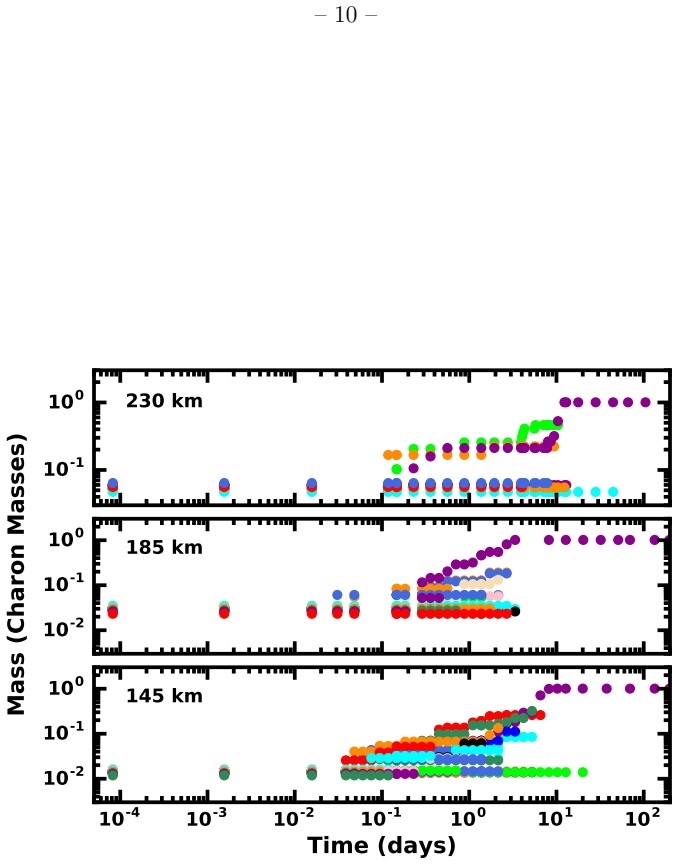
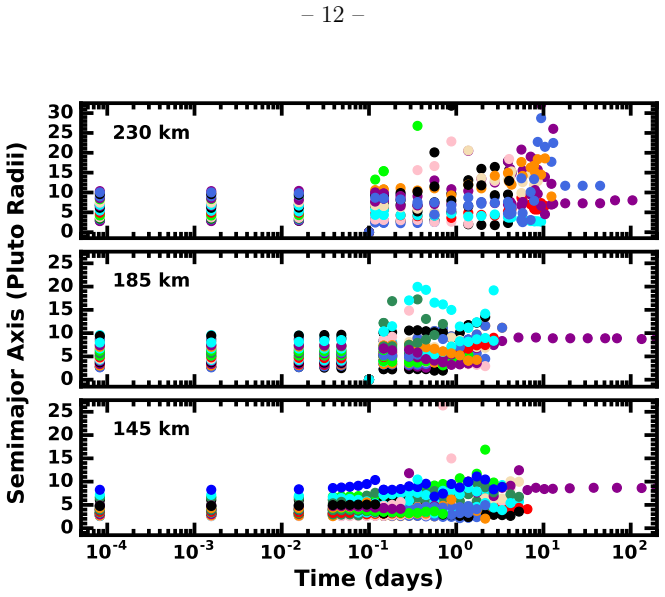
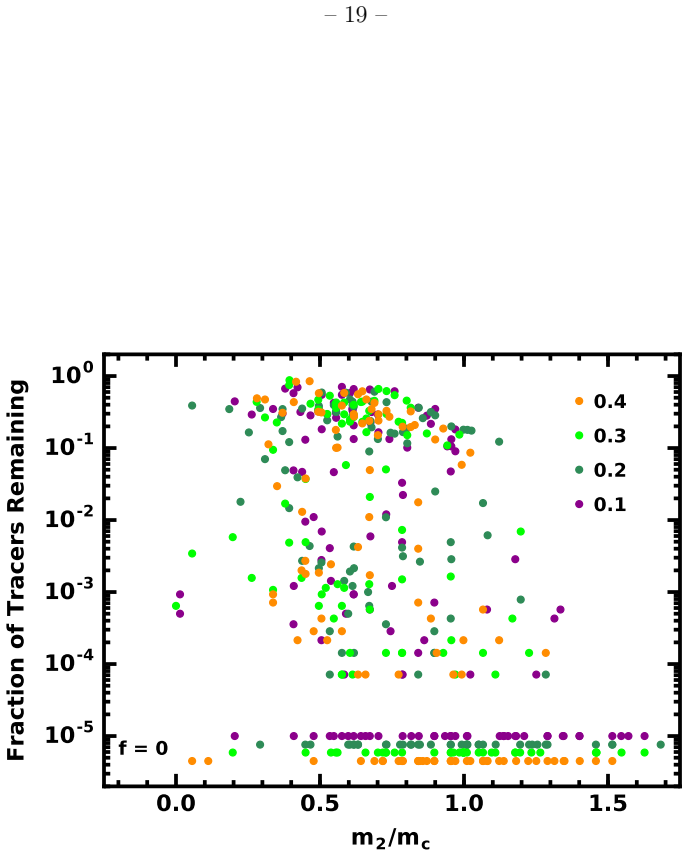
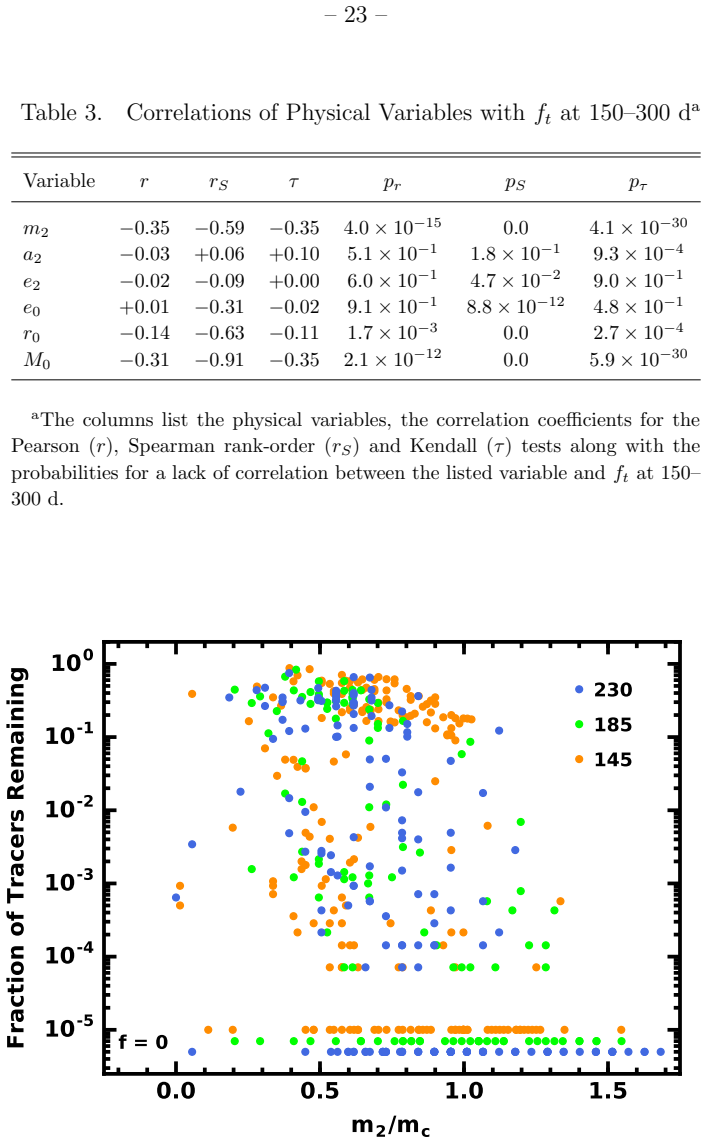
The central claim is that a Pluto–Charon binary formed by graze-and-merge cannot simultaneously produce Charon and the four small circumbinary satellites, when the debris disk is made of 145–230 km planetesimals. In the simulations, a Charon analog assembles in roughly 30–100 days on an orbit similar to hit-and-run survivors, but the newly formed binary dynamically ejects several leftover massive planetesimals through the disk plane; each such ejection scatters and removes the small tracer particles that stand in for the debris from which the small moons would form. At 10–100 years, systems that form a Charon-mass satellite retain at most a handful of tracers, and usually none. The authors conclude that the known small satellites cannot be the leftover of a graze-and-merge impact under these initial conditions, while leaving open the possibility that much smaller debris (10–20 km bodies) could survive.
Load-bearing premise
The argument assumes the debris left by a graze-and-merge impact was dominated by planetesimals 145–230 km in radius and that fragmentation debris from their collisions is negligible; if the real debris was mostly bodies smaller than about 10–20 km, the small particles could survive and the graze-and-merge channel would remain plausible.
Editorial extensions
If this is right
- If Charon forms by accretion in a circum-Pluto disk of 145–230 km planetesimals, the small satellites Styx, Nix, Kerberos, and Hydra cannot be debris left over from the same event.
- Charon analogs reach their final mass in weeks, so the tidal expansion of the Pluto–Charon binary would begin from orbits similar to those produced by hit-and-run encounters.
- The clearing of small debris takes only 10–100 yr, much faster than the million-year tidal expansion, so any circumbinary material must either be delivered later or survive as much smaller particles.
- If the debris disk is instead dominated by 10–20 km bodies, graze-and-merge remains a plausible formation channel for both Charon and the small satellites.
Reading between the lines
- A general lesson likely extends beyond Pluto: a massive moon growing inside a circumplanetary debris ring may clean the outer region by flinging leftover planetesimals through it, so systems that combine a large moon with small outer moons require either small debris or a later source of material.
- The paper's tracer-clearing mechanism suggests a testable distinction between formation channels: hit-and-run should leave more small debris in the 30–60 Pluto-radius zone than graze-and-merge, which could be checked with high-resolution simulations of each impact geometry.
- If future simulations with 10–20 km planetesimals and fragmentation succeed, the main obstacle to graze-and-merge would shift from the growth of Charon to the survival of small debris through tidal expansion of the binary.
Signed reviews
Editorial analysis
A structured set of objections, weighed in public.
Referee Report
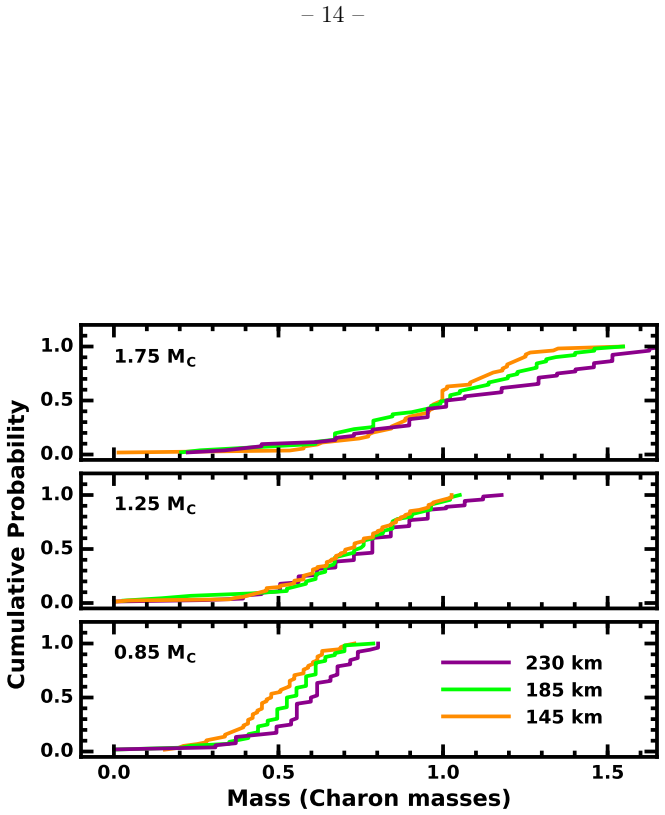
Summary. This paper uses the Orchestra hybrid n-body/coagulation code to simulate the growth of a Charon-mass satellite from a circum-Pluto disk of planetesimals and the concurrent dynamical evolution of massless tracer particles intended to represent small debris. A broad grid of initial swarm masses (0.85–1.75 Charon masses), planetesimal radii (145, 185, 230 km), and eccentricities (0.1–0.4) is explored with 12–15 realizations per setup. Charon analogs form on timescales of 10–100 days with semimajor axes of 5–6 Pluto radii and eccentricities of 0.1–0.3. In systems where the analog reaches roughly 0.9–1.1 Charon masses, the Pluto–Charon binary ejects leftover 145–230 km planetesimals that remove nearly all tracers within 10–100 years, leaving no circumbinary debris. The authors conclude that graze-and-merge formation is ruled out when the debris has this size distribution, while explicitly leaving open the possibility that a disk of 10–20 km objects could retain the small circumbinary satellites.
Significance. If the simulations are correct, they provide a sharp, falsifiable constraint on the graze-and-merge scenario: the survival of Styx, Nix, Kerberos, and Hydra depends on the size distribution of the debris produced by the giant impact. The paper has several strengths. The ensemble is large (~475 calculations), the outcomes are characterized with K-S, Pearson, Spearman, and Kendall statistics, the results are insensitive to initial eccentricity, and the simulation outputs and reading software are publicly available through a DOI. No parameters are fitted to reproduce Charon; the initial conditions bracket SPH impact outcomes, and the comparison to observed satellite masses is an evaluation, not a fit. The principal limitation, acknowledged in the manuscript, is that the decisive condition—debris dominated by 145–230 km planetesimals—is an input assumption rather than a derived outcome of giant-impact modeling. I regard the conditional framing as a strength rather than a flaw, provided the concluding sections keep the condition visible.
minor comments (4)
- [Abstract and §6] The abstract and §6 already state the size dependence, but the summary sentence 'Thus, there is no circumbinary disk of solids in which to grow satellites with properties similar to the known small satellites' could be misread as a general conclusion. I suggest adding an explicit qualifier such as 'for a debris disk dominated by 100–200 km solids' at the start of that sentence to preserve the conditional nature of the result in the concluding section.
- [Abstract] The abstract refers to '100–200 km particles' while the simulations and Table 1 use r0 = 145, 185, and 230 km; please harmonize the reported size range.
- [§5.2, Eq. (7)] Equation (7) is inconsistent with the preceding relation U = NkT = E/2: if U = NkT, then T = E/(2Nk), not E/(3Nk). The quoted T ≈ 70–90 K follows from the E/(3Nk) version, so either the text should justify the factor 3 or the equation and the derived temperatures should be corrected.
- [§4, paragraph following Fig. 8] In the sentence 'seven have ft ≲ 10−3 at 150–30 d', the time range should read '150–300 d'.
Circularity Check
No significant circularity: the central result is an emergent n-body dynamical outcome, with initial conditions bracketing prior SPH debris states and no parameter fitted to the observed satellites.
full rationale
Walking the paper's derivation chain, the central claim is not equivalent to its inputs by construction. The simulations start from circum-Pluto debris disks with M0 = 0.85-1.75 Charon masses, planetesimal radii r0 = 145, 185, or 230 km, and eccentricities e0 = 0.1-0.4. These choices bracket the outcomes of published SPH graze-and-merge impact calculations rather than being tuned to reproduce the observed Pluto-Charon circumbinary satellites. The key tracer-clearing result is an emergent dynamical outcome: the growing Charon analog ejects leftover massive n-bodies, and those ejections remove the massless tracers. The surviving tracer fraction ft is measured from the simulations, not imposed. The constraint Ms ~ ft fs M0 with MSNKH <~ 1e20 g is an evaluation of the simulation output against observed satellite masses, not a fit. The negative conclusion is explicitly conditional: the paper states that graze-and-merge formation is ruled out 'when the formation of Charon within a circum-Pluto disk leads to the ejection of several 100-200 km particles,' and immediately acknowledges that 'If a growing Charon ejects only much smaller particles, however, graze-and-merge impacts are a plausible formation channel.' The main assumption, ignoring fragmentation, is stated in Section 2 and is an input restriction rather than a disguised prediction; the paper also verifies internally that collisions eject less than 1% of the combined mass. Self-citations to Kenyon & Bromley for growth-time scaling, collisional damping, and Nix/Hydra mass constraints are used as consistency checks or independent inputs, not as the derivation of the central tracer-clearing result. No fitted parameter is renamed as a prediction, and no load-bearing claim reduces to a self-citation chain by construction.
Assumptions & free parameters
free parameters (6)
- Initial planetesimal radius r0 =
145, 185, 230 km (surveyed)
- Initial swarm mass M0 =
0.85, 1.25, 1.75 Charon masses (surveyed)
- Initial eccentricity e0 =
0.1, 0.2, 0.3, 0.4 (surveyed)
- Disk radial extent =
3-11 Pluto radii
- Surface density slope n =
1.7-1.8
- Mass density of solids rho0 =
1.75 g cm^-3
assumptions (5)
- domain assumption Two particles merge unless the sum of their radii exceeds their mutual Hill sphere (Eqs. 1-2).
- domain assumption 150-250 km solids are stable against tidal disruption outside about 2 Pluto radii and recover structure after passing inside the Roche limit.
- domain assumption Fragmentation in collisions of 100+ km icy bodies removes less than 1% of mass as debris, so it can be neglected.
- ad hoc to paper The initial disk has surface density distribution Sigma proportional to a^-n with n = 1.7-1.8 over 3-11 Pluto radii.
- domain assumption Massless tracers do not interact with each other or exert gravity; collisional damping is treated only in a simplified test model (Eqs. 3-5).
Cite this review
Pith. "Pith review of A Pluto-Charon Sonata III. Growth of Charon from a Circum-Pluto Ring of Debris." pith.science (2026). https://pith.science/paper/6OZT5B5Q
@misc{pith2026190801776,
  author       = {Pith},
  title        = {Pith review of: A Pluto-Charon Sonata III. Growth of Charon from a Circum-Pluto Ring of Debris},
  year         = {2026},
  howpublished = {\url{https://pith.science/paper/6OZT5B5Q}},
  note         = {Machine review of arXiv:1908.01776}
}
read the original abstract
Current theory considers two options for the formation of the Pluto-Charon binary (Canup 2005, 2011; Desch 2015). In the `hit-and-run' model, a lower mass projectile barely hits the more massive Pluto, kicks up some debris, and remains bound to Pluto (see also Asphaug et al. 2006). In a `graze-and-merge' scenario, the projectile ejects substantial debris as it merges with Pluto (see also Canup 2001). To investigate the graze-and-merge idea in more detail, we consider the growth of Charon-mass objects within a circum-Pluto ring of solids. Numerical calculations demonstrate that Charon analogs form rapidly within a swarm of planetesimals with initial radii of 145-230 km. On time scales of roughly 30-100 days, newly-formed Charon analogs have semimajor axes, a = 5-6 Pluto radii, and orbital eccentricities, e = 0.1-0.3, similar to Charon analogs that remain bound after hit-and-run collisions with Pluto. Although the early growth of Charon analogs generates rings of small particles at a = 50-275 Pluto radii, ejection of several 145-230 km leftovers by the central Pluto-Charon binary removes these small solids in 10-100 yr. Simple estimates suggest small particles might survive the passage of 10-20 km objects ejected by the central binary. Our results indicate that the Pluto-Charon circumbinary satellite system was not formed by a graze-and-merge impact when the formation of Charon within a circum-Pluto disk leads to the ejection of several 100-200 km particles through the orbital plane of the Pluto-Charon binary. If a growing Charon ejects only much smaller particles, however, graze-and-merge impacts are a plausible formation channel for the Pluto-Charon binary and an ensemble of small, circumbinary satellites.
Figures


Figures from the paper (8 more)




Reference graph
Works this paper leans on
-
[1]
R., & Oberbeck, V
Aggarwal, H. R., & Oberbeck, V. R. 1974, ApJ, 191, 577
1974
-
[2]
B., Canup, R
Agnor, C. B., Canup, R. M., & Levison, H. F. 1999, Icarus, 142, 219
1999
-
[3]
2019, Nature Astronomy, 358
Arakawa, S., Hyodo, R., & Genda, H. 2019, Nature Astronomy, 358
2019
-
[4]
2016, ApJ, 832, L19
Arakawa, S., & Nakamoto, T. 2016, ApJ, 832, L19
2016
-
[5]
Armitage, P. J. 2013, Astrophysics of Planet Formation (Cambridge University Press, Cam- bridge, UK)
2013
-
[6]
2014, Annual Review of Earth and Planetary Sciences, 42, 551
Asphaug, E. 2014, Annual Review of Earth and Planetary Sciences, 42, 551
2014
-
[7]
B., & Williams, Q
Asphaug, E., Agnor, C. B., & Williams, Q. 2006, Nature, 439, 155
2006
-
[8]
Barr, A. C. 2016, Journal of Geophysical Research (Planets), 121, 1573
2016
Show all 89 references
-
[9]
C., & Bruck Syal, M
Barr, A. C., & Bruck Syal, M. 2017, MNRAS, 466, 4868
2017
-
[10]
C., & Collins, G
Barr, A. C., & Collins, G. C. 2015, Icarus, 246, 146
2015
-
[11]
1999, Icarus, 142, 5
Benz, W., & Asphaug, E. 1999, Icarus, 142, 5
1999
-
[12]
J., Nimmo, F., & McKinnon, W
Bierson, C. J., Nimmo, F., & McKinnon, W. B. 2018, Icarus, 309, 207
2018
-
[13]
P., & Brauer, F
Birnstiel, T., Dullemond, C. P., & Brauer, F. 2010, A&A, 513, A79+
2010
-
[14]
2016, Space Sci
Birnstiel, T., Fang, M., & Johansen, A. 2016, Space Sci. Rev., 205, 41
2016
-
[15]
2018, Space Sci
Blum, J. 2018, Space Sci. Rev., 214, 52
2018
-
[16]
1976, Journal of Computational Physics, 22, 171
Brahic, A. 1976, Journal of Computational Physics, 22, 171
1976
-
[17]
P., & Henning, T
Brauer, F., Dullemond, C. P., & Henning, T. 2008, A&A, 480, 859
2008
-
[18]
C., & Kenyon, S
Bromley, B. C., & Kenyon, S. J. 2006, AJ, 131, 2737 —. 2011, ApJ, 731, 101 —. 2013, ApJ, 764, 192 —. 2015, ApJ, 809, 88 Brozovi´ c, M., Showalter, M. R., Jacobson, R. A., & Buie, M. W. 2015, Icarus, 246, 317 – 35 –
2006
-
[19]
Canup, R. M. 2005, Science, 307, 546 —. 2011, AJ, 141, 35
2005
-
[20]
M., & Asphaug, E
Canup, R. M., & Asphaug, E. 2001, Nature, 412, 708
2001
-
[21]
M., Barr, A
Canup, R. M., Barr, A. C., & Crawford, D. A. 2013, Icarus, 222, 200
2013
-
[22]
M., & Esposito, L
Canup, R. M., & Esposito, L. W. 1995, Icarus, 113, 331
1995
-
[23]
2008, Icarus, 198, 256
Chambers, J. 2008, Icarus, 198, 256
2008
-
[24]
Chambers, J. E. 2001, Icarus, 152, 205 —. 2013, Icarus, 224, 43 —. 2016, ApJ, 825, 63
2001
-
[25]
Chiang, E., & Youdin, A. N. 2010, Annual Review of Earth and Planetary Sciences, 38, 493
2010
-
[26]
Desch, S. J. 2015, Icarus, 246, 37
2015
-
[27]
J., & Neveu, M
Desch, S. J., & Neveu, M. 2017, Icarus, 287, 175
2017
-
[28]
R., Peale, S
Dobrovolskis, A. R., Peale, S. J., & Harris, A. W. 1997, Dynamics of the Pluto-Charon Binary, ed. S. A. Stern & D. J. Tholen, 159 Dra˙ zkowska, J., & Dullemond, C. P. 2018, A&A, 614, A62
1997
-
[29]
P., & Dominik, C
Dullemond, C. P., & Dominik, C. 2005, A&A, 434, 971
2005
-
[30]
2019, ApJ, 875, 95
Emsenhuber, A., & Asphaug, E. 2019, ApJ, 875, 95
2019
-
[31]
M., & Valsecchi, G
Farinella, P., Milani, A., Nobili, A. M., & Valsecchi, G. B. 1979, Moon and Planets, 20, 415
1979
-
[32]
2015, ApJ, 810, 136
Genda, H., Kobayashi, H., & Kokubo, E. 2015, ApJ, 810, 136
2015
-
[33]
2012, ApJ, 744, 137 Giuliatti Winter, S
Genda, H., Kokubo, E., & Ida, S. 2012, ApJ, 744, 137 Giuliatti Winter, S. M., Winter, O. C., Vieira Neto, E., & Sfair, R. 2013, MNRAS, 430, 1892 —. 2014, MNRAS, 439, 3300 – 36 – —. 2015, Icarus, 246, 339
2012
-
[34]
2004, ARA&A, 42, 549
Goldreich, P., Lithwick, Y., & Sari, R. 2004, ARA&A, 42, 549
2004
-
[35]
P., Barr, A
Hammond, N. P., Barr, A. C., & Parmentier, E. M. 2016, Geophys. Res. Lett., 43, 6775
2016
-
[36]
Hansen, B. M. S., & Murray, N. 2012, ApJ, 751, 158
2012
-
[37]
K., & Davis, D
Hartmann, W. K., & Davis, D. R. 1975, Icarus, 24, 504
1975
-
[38]
A., & Michel, P
Holsapple, K. A., & Michel, P. 2006, Icarus, 183, 331 —. 2008, Icarus, 193, 283
2006
-
[39]
2014, ApJ, 787, 56
Hyodo, R., & Ohtsuki, K. 2014, ApJ, 787, 56
2014
-
[40]
M., & Stewart, G
Ida, S., Canup, R. M., & Stewart, G. R. 1997, Nature, 389, 353
1997
-
[41]
2006, ApJ, 636, 1121
Johansen, A., Klahr, H., & Henning, T. 2006, ApJ, 636, 1121
2006
-
[42]
2017, Annual Review of Earth and Planetary Sciences, 45, 359
Johansen, A., & Lambrechts, M. 2017, Annual Review of Earth and Planetary Sciences, 45, 359
2017
-
[43]
S., Mac Low, M.-M., et al
Johansen, A., Oishi, J. S., Mac Low, M.-M., et al. 2007, Nature, 448, 1022
2007
-
[44]
Kenyon, S. J. 2002, PASP, 114, 265
2002
-
[45]
J., & Bromley, B
Kenyon, S. J., & Bromley, B. C. 2006, AJ, 131, 1837 —. 2008, ApJS, 179, 451 —. 2009, ApJ, 690, L140 —. 2010, ApJS, 188, 242 —. 2012, AJ, 143, 63 —. 2014, AJ, 147, 8 —. 2015, ApJ, 811, 60 —. 2016, ApJ, 817, 51 —. 2017, ApJ, 839, 38 —. 2019a, AJ, 157, 79 – 37 – —. 2019b, AJ, 158, 69
2006
-
[46]
J., Najita, J
Kenyon, S. J., Najita, J. R., & Bromley, B. C. 2016, ApJ, 831, 8
2016
-
[47]
2012, A&A, 544, A32
Lambrechts, M., & Johansen, A. 2012, A&A, 544, A32
2012
-
[48]
2018, Space Sci
Lammer, H., & Blanc, M. 2018, Space Sci. Rev., 214, 60
2018
-
[49]
M., Marcus, R
Leinhardt, Z. M., Marcus, R. A., & Stewart, S. T. 2010, ApJ, 714, 1789
2010
-
[50]
M., & Richardson, D
Leinhardt, Z. M., & Richardson, D. C. 2002, Icarus, 159, 306
2002
-
[51]
M., & Stewart, S
Leinhardt, Z. M., & Stewart, S. T. 2012, ApJ, 745, 79
2012
-
[52]
T., Klahr, H., & Birnstiel, T
Lenz, C. T., Klahr, H., & Birnstiel, T. 2019, ApJ, 874, 36
2019
-
[53]
F., & Morbidelli, A
Levison, H. F., & Morbidelli, A. 2003, Nature, 426, 419
2003
-
[54]
F., Morbidelli, A., Vanlaerhoven, C., Gomes, R., & Tsiganis, K
Levison, H. F., Morbidelli, A., Vanlaerhoven, C., Gomes, R., & Tsiganis, K. 2008, Icarus, 196, 258
2008
-
[55]
Lissauer, J. J. 1987, Icarus, 69, 249 —. 1993, ARA&A, 31, 129
1987
-
[56]
2008, ArXiv e-prints, arXiv:0802.2939
Lithwick, Y., & Wu, Y. 2008, ArXiv e-prints, arXiv:0802.2939
2008 arXiv
-
[57]
2013, Icarus, 225, 763 —
Malamud, U., & Prialnik, D. 2013, Icarus, 225, 763 —. 2015, Icarus, 246, 21
2013
-
[58]
McKinnon, W. B. 1989, ApJ, 344, L41
1989
-
[59]
B., Nimmo, F., Wong, T., et al
McKinnon, W. B., Nimmo, F., Wong, T., et al. 2016, Nature, 534, 82
2016
-
[60]
B., Stern, S
McKinnon, W. B., Stern, S. A., Weaver, H. A., et al. 2017, Icarus, 287, 2
2017
-
[61]
F., & Gomes, R
Morbidelli, A., Levison, H. F., & Gomes, R. 2008, in The Solar System Beyond Neptune, ed
2008
-
[62]
R., & Kenyon, S
Najita, J. R., & Kenyon, S. J. 2014, MNRAS, 445, 3315
2014
-
[63]
Nakajima, M., & Stevenson, D. J. 2014, Icarus, 233, 259
2014
-
[64]
M., et al
Nimmo, F., Umurhan, O., Lisse, C. M., et al. 2017, Icarus, 287, 12 – 38 –
2017
-
[65]
R., & Ida, S
Ohtsuki, K., Stewart, G. R., & Ida, S. 2002, Icarus, 155, 436
2002
-
[66]
2013, AJ, 146, 25
Ohtsuki, K., Yasui, Y., & Daisaka, H. 2013, AJ, 146, 25
2013
-
[67]
Peale, S. J. 1999, ARA&A, 37, 533
1999
-
[68]
H., Teukolsky, S
Press, W. H., Teukolsky, S. A., Vetterling, W. T., & Flannery, B. P. 1992, Numerical recipes in FORTRAN. The art of scientific computing (Cambridge: University Press)
1992
-
[69]
C., Giannella, D., Shaw, J
Quillen, A. C., Giannella, D., Shaw, J. G., & Ebinger, C. 2016, Icarus, 275, 267
2016
-
[70]
V., Barclay, T., Borucki, W
Quintana, E. V., Barclay, T., Borucki, W. J., Rowe, J. F., & Chambers, J. E. 2016, ApJ, 821, 126
2016
-
[71]
N., Izidoro, A., & Morbidelli, A
Raymond, S. N., Izidoro, A., & Morbidelli, A. 2018, arXiv e-prints, arXiv:1812.01033
2018 arXiv
-
[72]
N., Armitage, P
Raymond, S. N., Armitage, P. J., Moro-Mart´ ın, A., et al. 2011, A&A, 530, A62
2011
-
[73]
2011, Icarus, 216, 426
Robuchon, G., & Nimmo, F. 2011, Icarus, 216, 426
2011
-
[74]
E., Fuentes, C
Schlichting, H. E., Fuentes, C. I., & Trilling, D. E. 2013, AJ, 146, 36
2013
-
[75]
2009, Icarus, 200, 636
Sharma, I. 2009, Icarus, 200, 636
2009
-
[76]
T., & Burns, J
Sharma, I., Jenkins, J. T., & Burns, J. A. 2006, Icarus, 183, 312
2006
-
[77]
R., & Hamilton, D
Showalter, M. R., & Hamilton, D. P. 2015, Nature, 522, 45
2015
-
[78]
A., & Kratter, K
Smullen, R. A., & Kratter, K. M. 2017, MNRAS, 466, 4480
2017
-
[79]
A., & Colwell, J
Stern, S. A., & Colwell, J. E. 1997, AJ, 114, 841
1997
-
[80]
A., Grundy, W
Stern, S. A., Grundy, W. M., McKinnon, W. B., Weaver, H. A., & Young, L. A. 2018, ARA&A, 56, 357
2018
-
[81]
A., Bagenal, F., Ennico, K., et al
Stern, S. A., Bagenal, F., Ennico, K., et al. 2015, Science, 350, aad1815
2015
-
[82]
R., & Wetherill, G
Stewart, G. R., & Wetherill, G. W. 1988, Icarus, 74, 542
1988
-
[83]
J., & Levison, H
Walsh, K. J., & Levison, H. F. 2015, AJ, 150, 11
2015
-
[84]
R., & Canup, R
Ward, W. R., & Canup, R. M. 2006, Science, 313, 1107
2006
-
[85]
A., Buie, M
Weaver, H. A., Buie, M. W., Buratti, B. J., et al. 2016, Science, 351, aae0030 – 39 –
2016
-
[86]
J., Chapman, C
Weidenschilling, S. J., Chapman, C. R., Davis, D. R., & Greenberg, R. 1984, in IAU Colloq. 75: Planetary Rings, ed. R. Greenberg & A. Brahic, 367–415
1984
-
[87]
Winter, S. M. G., Winter, O. C., Guimar˜ aes, A. H. F., & Silva, M. R. 2010, MNRAS, 404, 442
2010
-
[88]
Woo, J. M. Y., & Lee, M. H. 2018, AJ, 155, 175
2018
-
[89]
N., & Goodman, J
Youdin, A. N., & Goodman, J. 2005, ApJ, 620, 459 This preprint was prepared with the AAS LATEX macros v5.2
2005
Reviewed August 14, 2026 · model on record in the stance chip above.
Discussion (0). Continue with ORCID to comment.