Radiative Corrections in Bound States: Recent Results
Pith reviewed 2026-06-29 01:08 UTC · model grok-4.3
The pith
Precise calculations resolve long-standing discrepancy in bound muon decay rates for light nuclei and show Z boson suppresses parapositronium three-photon decay by many orders of magnitude.
A machine-rendered reading of the paper's core claim, the machinery that carries it, and where it could break.
Core claim
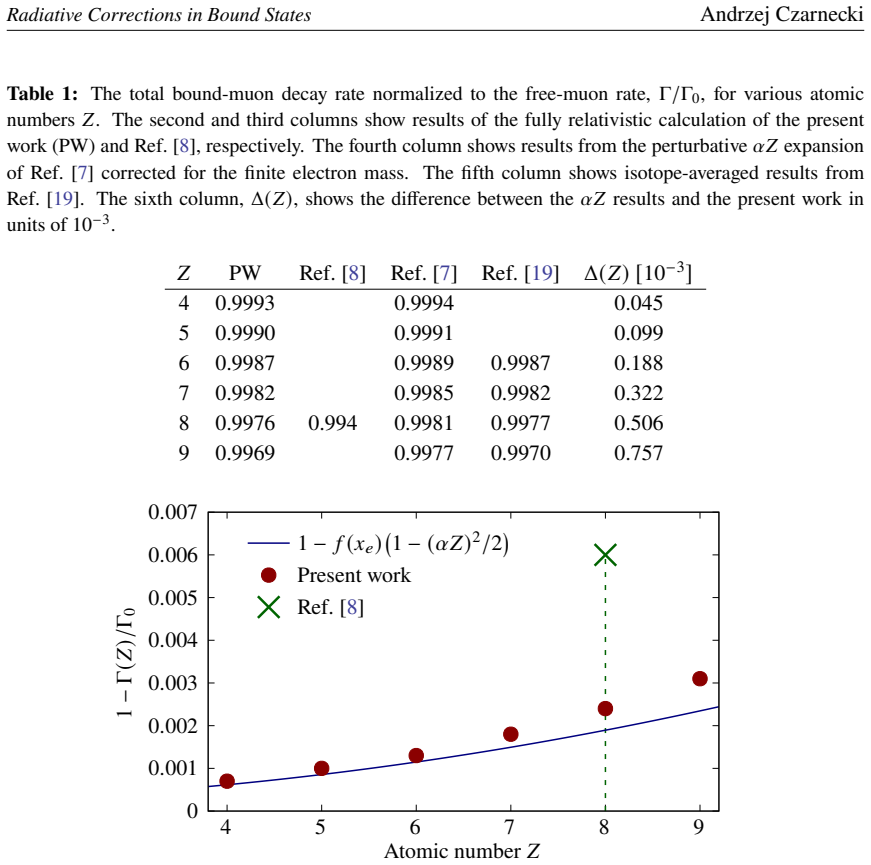
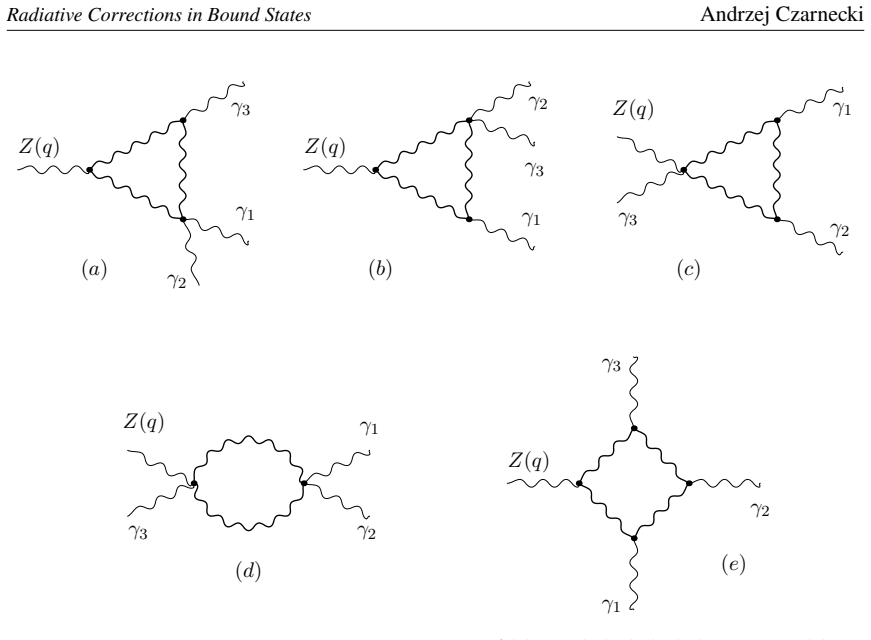
The change of the decay rate of a muon bound to a light nucleus has been calculated for several light nuclei 4≤Z≤9 with high precision, resolving a long-standing discrepancy between analytical and numerical results for oxygen (Z=8). The decay of parapositronium into three photons has been calculated including effects of the Z boson. The resulting rate is many orders of magnitude smaller than previously estimated.
What carries the argument
Radiative corrections to bound-state decay rates, including electromagnetic and weak Z-boson contributions.
If this is right
- Updated decay rates for bound muons improve accuracy of lifetime predictions in exotic atoms.
- Resolution of the oxygen discrepancy validates consistency between analytical and numerical methods.
- The reduced parapositronium rate shows this channel contributes negligibly compared to prior estimates.
- Results supply refined benchmarks for testing quantum electrodynamics in bound systems.
Where Pith is reading between the lines
- Similar calculations could be extended to other nuclei to map how corrections scale with Z.
- Negligible three-photon rate may allow simpler models in positronium lifetime studies by dropping this channel.
- If confirmed, these corrections could adjust interpretations of precision measurements in atomic and particle physics.
Load-bearing premise
The standard perturbative framework for radiative corrections is complete and no unaccounted higher-order or non-perturbative effects change the precision or the order-of-magnitude suppression.
What would settle it
A high-precision experimental measurement of the muon decay rate for oxygen that deviates from the calculated value beyond the stated uncertainty, or a parapositronium three-photon decay rate not suppressed by many orders of magnitude.
Figures
read the original abstract
Two recent studies of radiative corrections to bound state properties are discussed. The change of the decay rate of a muon bound to a light nucleus has been calculated for several light nuclei $4\leq Z \leq 9$ with high precision, resolving a long-standing discrepancy between analytical and numerical results for oxygen ($Z=8$). The decay of parapositronium into three photons has been calculated including effects of the $Z$ boson. The resulting rate is many orders of magnitude smaller than previously estimated.
Editorial analysis
A structured set of objections, weighed in public.
Referee Report
Summary. The paper discusses two recent studies of radiative corrections to bound state properties. The change of the decay rate of a muon bound to a light nucleus has been calculated for several light nuclei 4≤Z≤9 with high precision, resolving a long-standing discrepancy between analytical and numerical results for oxygen (Z=8). The decay of parapositronium into three photons has been calculated including effects of the Z boson. The resulting rate is many orders of magnitude smaller than previously estimated.
Significance. If the underlying external calculations hold, the results are significant for precision QED in bound systems: they resolve an analytical-numerical discrepancy in bound-muon decay rates for light nuclei and demonstrate that Z-boson contributions to parapositronium three-photon decay are suppressed by many orders of magnitude, rendering them negligible at current experimental precisions. The manuscript itself functions as a concise summary of external work rather than presenting new derivations, error budgets, or numerical methods.
minor comments (1)
- [Abstract] The abstract could include explicit citations to the two external studies to improve immediate accessibility for readers.
Simulated Author's Rebuttal
We thank the referee for the positive assessment and the recommendation to accept the manuscript. The report accurately summarizes the content and significance of the work.
Circularity Check
No significant circularity; paper reports external results only
full rationale
The manuscript is a short discussion summarizing results from two external recent studies on radiative corrections (bound-muon decay rates for 4≤Z≤9 and parapositronium→3γ including Z-boson effects). No derivation chain, equations, fitted parameters, or self-citations are presented within the paper itself that could reduce to inputs by construction. The central claims are reports of calculations performed elsewhere, with no internal steps that qualify as self-definitional, fitted-input predictions, or load-bearing self-citations. This is a normal non-finding for a results-summary paper.
Axiom & Free-Parameter Ledger
Reference graph
Works this paper leans on
- [1]
-
[2]
J. E. J. Matias, A. S. Lemos, and F. Dahia,Probing Short-Distance Modifications of Gravity viaSpin-IndependentandSpin-DependentEffectsinMuonicAtoms(2025),arxiv:2511.00719
arXiv 2025
-
[3]
Miscetti,Status of the Mu2e experiment, Nucl
S. Miscetti,Status of the Mu2e experiment, Nucl. Instrum. Meth. A1073, 170257 (2025). 8 Radiative Corrections in Bound StatesAndrzej Czarnecki
2025
-
[4]
M. Aoki et al.,Charged Lepton Flavour Violations searches with muons: present and future (2025), arxiv:2503.22461
arXiv 2025
-
[5]
H.Nishiguchi,Asearchformuon-to-electronconversionatJ-PARC:TheCOMETexperiment, PoSICHEP2024, 469 (2025)
2025
-
[6]
Yamamoto,DeeMe – Muon-Electron Conversion Search Experiment, Phys
K. Yamamoto,DeeMe – Muon-Electron Conversion Search Experiment, Phys. Sci. Forum8, 39 (2023)
2023
-
[7]
H.Überall,Decayof𝜇 − MesonsBoundintheKShellofLightNuclei,Phys.Rev.119,365–376 (1960)
1960
-
[8]
Watanabe, K
R. Watanabe, K. Muto, T. Oda, T. Niwa, H. Ohtsubo, R. Morita, and M. Morita,Asymmetry and energy spectrum of electrons in bound-muon decay, Atomic Data and Nucl. Data Tables 54, 165 (1993)
1993
-
[9]
A. Czarnecki, A. O. Davydov, and M. Y. Kaygorodov,Total decay rate of a muon bound to a light nucleus, Phys. Rev. D113, 036028 (2026),2512.23023
arXiv 2026
-
[10]
Gilinsky and J
V. Gilinsky and J. Mathews,Decay of bound muons, Phys. Rev.120, 1450 (1960)
1960
-
[11]
M.J.Aslam,A.Czarnecki,G.Zhang,andA.Morozova,Decayofaboundmuonintoabound electron, Phys. Rev. D102, 073001 (2020),2005.07276
arXiv 2020
-
[12]
A. Czarnecki, X. Garcia i Tormo, and W. J. Marciano,Muon decay in orbit: spectrum of high-energy electrons, Phys. Rev.D84, 013006 (2011),1106.4756
Pith/arXiv arXiv 2011
-
[13]
Watanabe, M
R. Watanabe, M. Fukui, H. Ohtsubo, and M. Morita,Angular distribution of electrons in bound muon decay, Prog. Theor. Phys.78, 114 (1987)
1987
-
[14]
M.Y.Kaygorodov,Y.S.Kozhedub,A.V.Malyshev,A.O.Davydov,Y.Wu,andS.B.Zhang, Studyofatomiceffectsonelectronspectruminbound-muondecayprocess,Chin.Phys.C50, 063103 (2026),2506.02416
arXiv 2026
-
[15]
M. E. Rose,Relativistic Electron Theory, John Wiley, New York (1961)
1961
-
[16]
Salvat, J
F. Salvat, J. M. Fernández-Varea, and W. Williamson Jr,Accurate numerical solution of the radial Schrödinger and Dirac wave equations, Computer Physics Communications90, 151–168 (1995)
1995
-
[17]
Salvat and J
F. Salvat and J. M. Fernández-Varea,RADIAL: A Fortran subroutine package for the solution oftheradialSchrödingerandDiracwaveequations,ComputerPhysicsCommunications240, 165–177 (2019)
2019
-
[18]
Piessens, E
R. Piessens, E. de Doncker-Kapenga, C. W. Überhuber, and D. K. Kahaner,QUADPACK: a subroutine package for automatic integration, Springer, Berlin (2012)
2012
-
[19]
9 Radiative Corrections in Bound StatesAndrzej Czarnecki
Y.Uesaka,T.Naito,S.Ebata,andM.Niikura,ComprehensivetableofcalculatedHufffactors, Atomic Data and Nuclear Data Tables page 101809 (2026), arXiv:2602.07501. 9 Radiative Corrections in Bound StatesAndrzej Czarnecki
arXiv 2026
-
[20]
N. U. Sani, M. J. Aslam, and I. Ahmed,Weak decay of the positronium ion(2026), arXiv:2606.25433
Pith/arXiv arXiv 2026
-
[21]
S. D. Bass,QED and Fundamental Symmetries in Positronium Decays, Acta Phys. Polon. B 50, 1319 (2019),1902.01355
Pith/arXiv arXiv 2019
-
[22]
Bernreuther and O
W. Bernreuther and O. Nachtmann,Weak Interaction Effects in Positronium, Z. Phys.C11, 235 (1981)
1981
-
[23]
A.PokrakaandA.Czarnecki,Parapositroniumcandecayintothreephotons,Phys.Rev.D96, 093002 (2017),1707.09466
Pith/arXiv arXiv 2017
-
[24]
A. Czarnecki, D. Dagia, T. Gao, and R. Toor,Parapositronium decay into three photons and implications for the neutral pion, Phys. Rev. D113, 073002 (2026),2602.14899
arXiv 2026
-
[25]
E. W. N. Glover and A. G. Morgan,𝑍boson decay into photons, Z. Phys.C60, 175–180 (1993)
1993
-
[26]
A. Denner and S. Dittmaier,Electroweak Radiative Corrections for Collider Physics, Phys. Rept.864, 1–163 (2020),1912.06823. 10
arXiv 2020
discussion (0)
Sign in with ORCID, Apple, or X to comment. Anyone can read and Pith papers without signing in.