REVIEW 4 major objections 3 minor 48 references
Grid Influenced Peer-to-Peer Energy Trading
T0 review · 4 major / 3 minor · reviewed 2026-08-14 · deepseek-v4-flash
Pith's one-line read A single peak-hour grid price can shift all contracted prosumer demand into peer-to-peer trading, with the grid's cost falling to zero.
desk verdict A sensible grid-influenced P2P trading scheme with a serious hole in its central proof: the claimed stable cooperative Stackelberg equilibrium is not actually established, and the zero-cost outcome is baked into the price rule. read the letter →
The pith
A machine-rendered reading of the paper's core claim, the machinery that carries it, and where it could break.
The reading
What carries the argument
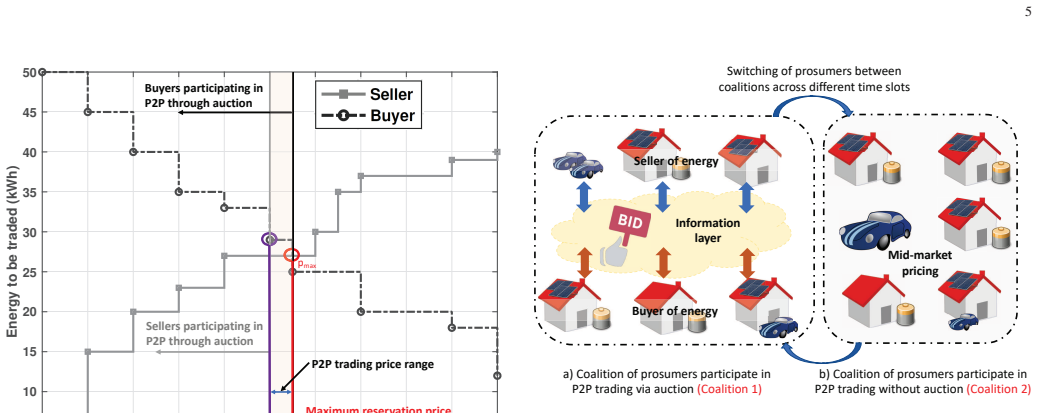
The argument is carried by three linked objects. First is the equal-burden double auction: buyers and sellers submit bids, the auctioneer orders them, sets the auction price $p_{\mathrm{auc}}$ at the intersection of the supply and demand curves, and when aggregate supply exceeds demand each seller is allocated a reduction $\eta_n = \frac{1}{S_a}\left(\sum_{n\in S_a} E_{n,s} - \sum_{n\in B_a} E_{n,b}\right)$; the equal sharing of this burden is what makes truthful bidding the best response and grounds the strategy-proofness claim. Second is the two-coalition structure: prosumers cleared by the auction trade at $p_{\mathrm{auc}}$, and the remaining prosumers trade among themselves at the mid-market price $p_{\mathrm{mid}} = (p_{\mathrm{auc}} + p_{\mathrm{FiT}})/2$, with the stability of that coalition taken from a cited result on mid-market P2P trading. Third is the equilibrium notion Dhp stability, meaning no prosumer can leave its coalition and join another to obtain better utility; the paper argues that this stability, combined with the fixed leader price, yields a unique and stable cooperative Stackelberg equilibrium.
What would settle it
Take a concrete instance with three sellers and two buyers whose reservation prices are chosen so that one seller's reservation price lies just above $p_{\mathrm{auc}}$ while one buyer's value lies above $p_{\mathrm{mid}}$; compute whether that seller and that buyer can strike a direct trade at any price between $p_{\mathrm{mid}}$ and $p_{\mathrm{auc}}$ that improves both payoffs. If such a mutually profitable deviation exists, the two-coalition structure is not Dhp stable and the claimed unique CSE fails.
Extended reading notes
Core claim
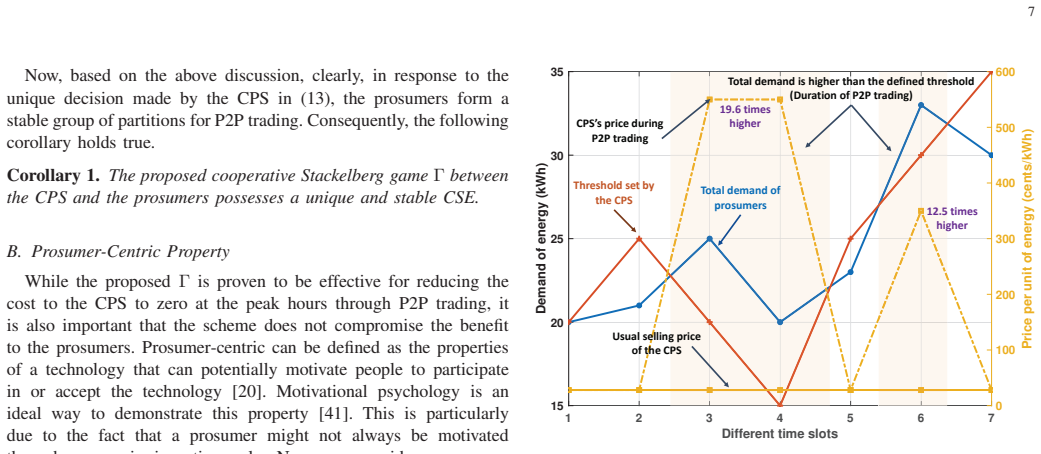
The central claim is that when prosumer demand $E_D(t)$ exceeds a threshold $E_T(t)$, the grid can announce a selling price $p^*_{g,s}(t) = 2a^*(E_D(t)-E_T(t)) + b^*$ (with $b^*$ satisfying condition (10)) that makes it irrational for prosumers to buy grid energy, and the prosumers then form exactly two coalitions: those admitted by the double auction trade at the auction price $p_{\mathrm{auc}}$, and the rest trade at the mid-market price $p_{\mathrm{mid}} = (p_{\mathrm{auc}} + p_{\mathrm{FiT}})/2$. The authors argue that the auction is strategy-proof because the equal-burden rule fixes each seller's allocated sale, and that excluded prosumers prefer the single mid-market coalition over noncooperation, so the two-coalition structure is Dhp stable: no player can split from its coalition and join another to get a better utility. Consequently the cooperative Stackelberg game has a unique and stable equilibrium at which the CPS's cost $J_c(t)$ is zero. Numerical cases with twelve prosumers show sellers earning on average 22% more than by selling to the grid and buyers paying roughly 97% less than the high grid price.
Load-bearing premise
The load-bearing premise is that no prosumer can profitably leave the two-coalition assignment that the auction and mid-market rule produce: truthful bidding is best in the equal-burden auction, and excluded prosumers genuinely prefer the single mid-market coalition; if that premise fails, the unique and stable equilibrium does not follow.
Editorial extensions
If this is right
- If the equilibrium claim holds, the grid can set its peak-hour selling price once, using the closed form $p^*_{g,s}(t)$, and its cost for serving contracted prosumers drops to zero at that time slot.
- Prosumers do not need to be individually commanded: the double auction and mid-market rule automatically sort them into two coalitions, and the case study shows buyers saving about 97% and sellers gaining about 22% relative to grid trading.
- The scheme scales to larger prosumer populations in the case studies: the CPS cost stays zero while the per-prosumer cost remains well below the non-P2P alternative.
- Because the model is a single-leader, multiple-follower Stackelberg game, the algorithm's computational complexity is comparable to existing demand-response schemes, making it feasible to run repeatedly in each time slot.
- If the grid can forecast total prosumer demand accurately enough to detect when $E_D(t) > E_T(t)$, the algorithm terminates with the stable coalition structure at every peak slot.
Reading between the lines
- The mechanism effectively turns P2P trading into a demand-response instrument: the grid never needs to know which prosumer matches with which, only the aggregate threshold violation, so the scheme could pair with distribution-level forecasting and settlement layers.
- The uniqueness of the equilibrium may be sensitive to the equal-burden rule; replacing it with, say, a proportional burden rule would require re-deriving the strategy-proofness argument, so a natural stress test is to vary the burden-allocation rule and check whether the two-coalition stability survives.
- A testable extension is to relax the accurate-forecast assumption and let $E_T(t)$ be estimated with error; under such uncertainty the closed-form price would need a robustification, and the stable-coalition argument would have to be checked against stochastic deviations.
- The two-coalition outcome can be read as a market-clearing hierarchy: the auction price discovers the value of scarce local energy, while the mid-market price acts as a fallback; one could extend the model to multiple mid-market tiers to handle heterogeneous prosumer preferences.
Signed reviews
Editorial analysis
A structured set of objections, weighed in public.
Referee Report
Summary. The manuscript proposes a grid-influenced peer-to-peer energy trading scheme in which a centralized power system (CPS) acts as a Stackelberg leader and sets a peak-hour selling price, while prosumers respond as followers by forming coalitions and trading among themselves through a double auction and a mid-market mechanism. The paper claims that the resulting cooperative Stackelberg game has a unique and stable equilibrium in which the CPS's cost is zero, and it supports this with a closed-form price expression, an equilibrium algorithm, and numerical case studies. The main analytical contributions are the price derivation in Eq. (7), the strategy-proofness claim in Theorem 1, the stability claim in Theorem 2, and the resulting Corollary 1 on the unique stable CSE.
Significance. If the central equilibrium claim were rigorously established, the paper would offer a practically attractive mechanism: a single peak-hour price signal that reliably shifts all contracted prosumer demand into P2P trading and reduces the CPS's cost to zero. The problem is timely, the numerical illustrations are clearly presented, and Eq. (7) is a clean calculus result for the quadratic cost function. However, the load-bearing theoretical claims — strategy-proofness of the auction, Dhp stability of the two-coalition structure, and uniqueness of the CSE — are not convincingly proved, and the zero-cost outcome is largely built into the construction via condition (10). The paper does not provide machine-checked proofs or reproducible code, so the numerical case studies cannot compensate for the gaps in the analytical argument.
major comments (4)
- [Section IV-A, Theorem 1, Definition 3, Eqs. (18)–(19)] Theorem 1 does not establish strategy-proofness in the standard sense. Definition 3 simply asserts that participants reveal their true strategies and do not cheat, which is the property to be proved, not a definition of it. The proof compares the burden expression (18) with the altered expression (19) and concludes that the altered burden is 'impossible,' but it never shows that a misreport cannot increase the cheater's payoff. In fact, under the equal-burden allocation of Eqs. (15)–(16), a seller who over-reports its sale quantity by delta increases its own traded quantity by delta*(1 - 1/Sa), which is strictly positive when Sa > 1, so truthful bidding is not a dominant strategy. Consequently, the strategy-proofness claim, and everything built on it, is unsupported.
- [Section IV-A, Theorem 2] Dhp stability of the two-coalition structure is not established. The first step of the proof says that no auction participant leaves because the auction is strategy-proof, but strategy-proofness concerns bid revelation within the auction, not a player's option to leave the coalition or act noncooperatively; these are different decisions and require separate payoff comparisons. The second step cites [20] for the claim that excluded prosumers always prefer a single mid-market coalition, but the cited result is not adapted to the utility functions in Eqs. (2)–(3), the mid-market prices in Eq. (17), or the specific two-coalition partition induced by the auction. Without a proof that no prosumer can improve its payoff by switching coalitions or trading with the CPS, the stability claim in Theorem 2 and the unique stable CSE in Corollary 1 do not follow.
- [Section II-B, Eqs. (9)–(10), and Section V-A, Fig. 4] The headline zero-cost outcome is forced by construction rather than discovered at equilibrium. Condition (10) is designed so that p*_{g,s} exceeds alpha_max/ln2, which, through Eq. (5), makes each prosumer's desired grid purchase en,g(t) equal to zero; with ED(t)=0, the cost function (6) gives Jc(t)=0. The case study in Fig. 4 then reports exactly this zero cost. This is a consistency check of the design, not an independent validation, and it should be presented as such rather than as a beneficial property emergent from the game.
- [Corollary 1 and Eq. (13)] Uniqueness of the CSE is not proved. The leader's strategy in Eq. (13) contains a* and b* that are only constrained by inequality (10), so there is no demonstrated unique price p*_{g,s}(t). The text says the CPS's strategy delivers a unique outcome 'for any value of b that satisfies (10),' but this does not establish uniqueness of the equilibrium across admissible choices of the design parameters. A uniqueness claim requires either a unique optimal choice of (a,b) or a proof that all admissible choices lead to the same equilibrium outcome for the followers; neither is provided.
minor comments (3)
- [Definition 1] Definition 1 says the followers respond to p*_{g,b}(t), but the leader's strategy is the selling price p*_{g,s}(t); p_{g,b}(t) is the grid's buying price elsewhere in the nomenclature. This appears to be a typo.
- [Algorithm 1, lines 3–4] Algorithm 1 appears to invert the activation condition: line 3 says the CPS forecasts the total demand ET(t), but ET(t) is the threshold, and line 4 terminates the algorithm when ET(t) < ED(t), whereas the text and Section II say P2P trading is invoked when ED(t) > ET(t).
- [Section V-A, Fig. 4] Figure 4 labels negative cost as revenue of the CPS, which is understandable but inconsistent with the definition of Jc(t) in Eq. (6); a consistent sign convention would improve readability.
Circularity Check
Zero-cost CSE and Dhp stability are written into definitions, and the mid-market coalition is imported from the authors' prior [20], so the central equilibrium claim is forced rather than derived.
-
self definitional
[Section IV-A, Definition 3 and Theorem 1 proof (Eqs. (18)-(19))]
"An auction mechanism is said to be strategy-proof, if the participants reveal their true strategies during the auction process and do not cheat and deviate from their chosen strategies during the trading. ... which is impossible. This is due to the fact that, as the scheme is proposed, the burden, which is shared equally by all seller prosumers only possess the value η∗n only if all ∀n ∈ Sa stick to E∗n,s for trading, as they revealed during the auction."
Strategy-proofness is defined as 'participants reveal their true strategies and do not cheat' rather than as the property that truthful revelation is a dominant strategy. The proof then says a deviating seller's burden equation (19) is 'impossible' because the burden formula takes the reported values as fixed, i.e., the proof assumes no deviation. It never compares the cheater's payoff under the true and false reports. Since Theorem 2 and Corollary 1 use this 'strategy-proof' property to rule out coalition switching, the central stability claim rests on an assumption stated as a definition.
-
fitted input called prediction
[Section II-B, Eqs. (9)-(10); Section III-A, Eq. (13); Section V-A]
"a set of strategies (p∗g,s(t), e∗(t), p∗p2p(t)) constitutes a CSE of the proposed Γ, if Jc(p∗g,s)(t) = 0 and the followers’ strategies (e∗, p∗p2p) in response to p∗g,b(t) establish a Dhp stable coalition structure. ... However, for the proposed scheme, the price set by the CPS instructs the prosumers to participate in P2P trading instead of buying the energy from the CPS. This subsequently reduces the cost to the CPS to zero as no excess energy needs to be generated."
CSE is defined to require Jc=0, and condition (10) is derived from (9) as the parameter choice that makes the price exceed every prosumer's reservation price αn/ln2, so from (5) each prosumer's desired grid purchase is pushed to zero. The case study then reports the cost to the CPS as zero. The zero-cost headline is therefore written into the equilibrium definition and into the price-design condition; it is not an independently obtained result.
2 more flagged steps
-
uniqueness imported from authors
[Section IV-A, Theorem 2, second paragraph]
"Nonetheless, it is shown in [20] that at a mid market pricing for P2P trading, prosumers always benefit more by forming a single coalition with one another instead of acting noncooperatively or forming multiple disjoint coalitions. Therefore, it is reasonable to consider that, as a rational entity, each prosumer in N \ (Sa ∪ Ba) will always choose to form a coalition among themselves without acting noncooperatively."
The stability of the second coalition, which is half of the two-coalition Dhp-stable structure needed for Corollary 1, is not proved here; it is imported from [20]. Reference [20] is the authors' own prior IEEE Access paper (Tushar, Saha, Yuen, Liddell, Bean, Poor). The quoted 'always' claim is used as if it were an external uniqueness theorem, and its assumptions are not adapted to the present utilities (2)-(3), prices (13)/(17), or the specific partition N minus (Sa ∪ Ba). Thus the uniqueness of the coalition structure is carried by self-citation.
-
self definitional
[Section IV-A, Theorem 2, first paragraph; Algorithm 1, line 15]
"Since the auction process is strategy-proof, as proven in Theorem 1, no participating prosumers in the auction would leave the coalition and become a part of another new coalition or act noncooperatively during that particular time slot."
Dhp stability (Definition 2) requires showing that no player has an interest to split for a better utility. This step does not compare utilities across alternative partitions; it treats any departure as 'acting noncooperatively,' which Definition 3 had already defined as a prohibited deviation. Algorithm 1 line 15 simply declares 'A stable coalition structure is formed' before any stability computation. Hence the two-coalition structure's stability is asserted, not derived.
full rationale
Theorem 1's strategy-proofness proof is Definition 3 restated: the property to be proven (no deviation from revealed strategies) is already assumed in the definition, and the proof's 'impossible' argument only says the burden equation is defined for the reported quantities. Theorem 2's first half inherits that assumption and directly identifies non-cheating with not leaving a coalition, which is exactly Dhp stability. Theorem 2's second half imports the single-mid-market-coalition 'always' claim from the authors' own [20], making the uniqueness of the coalition structure depend on a self-citation rather than on a proof adapted to this paper's utilities and prices. In addition, Definition 1 makes Jc=0 part of the definition of a cooperative Stackelberg equilibrium, and condition (10) is chosen precisely so that the price exceeds every prosumer's reservation price and the desired grid purchase is zero; the case study then reports the resulting zero cost as a benefit. The paper does contain independent modeling content and numerical simulations, but its central claims — the unique and stable CSE, Dhp stability of the two-coalition structure, and zero cost to the CPS — reduce to assumptions, definitions, and the authors' prior work rather than to a demonstrated derivation. This warrants a score of 8: the result is forced by the self-citation chain and by definition, though not entirely identical to a single input equation.
Assumptions & free parameters
free parameters (5)
- a (CPS cost coefficient)
- b (CPS cost coefficient/offset)
- ET(t) (peak demand threshold)
- alpha_n(t) (prosumer preference parameter)
- beta (subscription fee coefficient)
assumptions (5)
- domain assumption Prosumer utility is logarithmic with linear money terms, as in Eqs. (2)-(3).
- domain assumption Prosumers only participate in P2P trading when the grid price is very high at peak hours; otherwise they trade with the CPS.
- domain assumption The CPS can contractually instruct prosumers not to draw energy at peak and can set a very high price.
- domain assumption The result from [20] that prosumers always benefit more by forming a single coalition at mid-market pricing.
- domain assumption Accurate forecast of total demand ED(t).
Cite this review
Pith. "Pith review of Grid Influenced Peer-to-Peer Energy Trading." pith.science (2026). https://pith.science/paper/6P6XH4NG
@misc{pith2026190809449,
  author       = {Pith},
  title        = {Pith review of: Grid Influenced Peer-to-Peer Energy Trading},
  year         = {2026},
  howpublished = {\url{https://pith.science/paper/6P6XH4NG}},
  note         = {Machine review of arXiv:1908.09449}
}
read the original abstract
This paper proposes a peer-to-peer energy trading scheme that can help the centralized power system to reduce the total electricity demand of its customers at the peak hour. To do so, a cooperative Stackelberg game is formulated, in which the centralized power system acts as the leader that needs to decide on a price at the peak demand period to incentivize prosumers to not seeking any energy from it. The prosumers, on the other hand, act as followers and respond to the leader's decision by forming suitable coalitions with neighboring prosumers in order to participate in P2P energy trading to meet their energy demand. The properties of the proposed Stackelberg game are studied. It is shown that the game has a unique and stable Stackelberg equilibrium, as a result of the stability of prosumers' coalitions. At the equilibrium, the leader chooses its strategy using a derived closed-form expression, while the prosumers choose their equilibrium coalition structure. An algorithm is proposed that enables the centralized power system and the prosumers to reach the equilibrium solution. Numerical case studies demonstrate the beneficial properties of the proposed scheme.
Figures

Reference graph
Works this paper leans on
-
[20]
Peer to peer energy trading with sustainable user particip ation: A game theoretic approach,
W. Tushar, T. K. Saha, C. Y uen, P . Liddell, R. Bean, and H. V . Poor., “Peer to peer energy trading with sustainable user particip ation: A game theoretic approach,” IEEE Access, vol. 6, pp. 62 932–62 943, Oct. 2018
work page 2018
-
[1]
J. Kang, R. Y u, X. Huang, S. Maharjan, Y . Zhang, and E. Hoss ain, “Enabling localized peer-to-peer electricity trading amo ng plug-in hybrid electric vehicles using consortium blockchains,” IEEE Transactions on Industrial Informatics , vol. 13, no. 6, pp. 3154–3164, Dec. 2017. 5Total number of prosumer was considered instead of just buye r prosumers to ...
work page 2017
-
[2]
En ergy crowdsourcing and peer-to-peer energy trading in blockcha in-enables smart grids,
S. Wang, A. F. Taha, J. Wang, K. Kvaternik, and A. Hahn, “En ergy crowdsourcing and peer-to-peer energy trading in blockcha in-enables smart grids,” IEEE Transactions on Systems, Man and Cybernetics ,
-
[3]
Blockchain-assisted cr owdsourced energy systems,
S. Wang, A. F. Taha, and J. Wang, “Blockchain-assisted cr owdsourced energy systems,” in Proc. IEEE PES General Meeting , Portland, OR, Aug. 2018
work page 2018
-
[4]
W. Tushar, C. Y uen, H. Mohsenian-Rad, T. Saha, H. V . Poor, and K. L. Wood, “Transforming energy networks via peer-to-peer ener gy trading: The potential of game-theoretic approaches,” IEEE Signal Processing Magazine, vol. 35, no. 4, pp. 90–111, July 2018
work page 2018
-
[5]
Designing microgrid energy markets - A case s tudy: The Brooklyn Microgrid,
E. Mengelkamp, J. G¨ arttner, K. Rock, S. Kessler, L. Orsi ni, and C. Weinhardt, “Designing microgrid energy markets - A case s tudy: The Brooklyn Microgrid,” Applied Energy , vol. 210, pp. 870–880, Jan. 2018
work page 2018
-
[6]
Consort ium blockchain for secure energy trading in industrial interne t of things,
Z. Li, J. Kang, R. Y u, D. Y e, Q. Deng, and Y . Zhang, “Consort ium blockchain for secure energy trading in industrial interne t of things,” IEEE Transactions on Industrial Informatics , vol. 14, no. 8, pp. 3690– 3700, Aug. 2018
work page 2018
-
[7]
Evaluation of peer-to-peer e nergy sharing mechanisms based on a multiagent simulation framework,
Y . Zhou, J. Wu, and C. Long, “Evaluation of peer-to-peer e nergy sharing mechanisms based on a multiagent simulation framework,” Applied Energy, vol. 222, pp. 993–1022, July 2018
work page 2018
Show all 48 references
-
[8]
Consensus-based appro ach to peer-to- peer electricity markets with product differentiation,
E. Sorin, L. Bobo, and P . Pinson, “Consensus-based appro ach to peer-to- peer electricity markets with product differentiation,” IEEE Transactions on Power Systems , vol. 34, no. 2, pp. 994–1004, 2019
2019
-
[9]
Local electricity market designs for peer-to-peer trading: The r ole of battery flexibility,
A. L. amd Jan Martin Zepter, P . C. del Granado, and R. Eggin g, “Local electricity market designs for peer-to-peer trading: The r ole of battery flexibility,” Applied Energy , vol. 229, pp. 1233–1243, Nov. 2018
2018
-
[10]
Peer-to-peer en ergy sharing through a two-stage aggregated battery control in a communi ty micro- grid,
C. Long, J. Wu, Y . Zhou, and N. Jenkins, “Peer-to-peer en ergy sharing through a two-stage aggregated battery control in a communi ty micro- grid,” Applied Energy , vol. 226, pp. 261–276, Sep. 2018
2018
-
[11]
Peer-to-peer energy trading in a microgrid,
C. Zhang, J. Wu, Y . Zhou, and M. C. C. Long, “Peer-to-peer energy trading in a microgrid,” Applied Energy, vol. 220, pp. 1–12, June 2018
2018
-
[12]
Bilate ral contract networks for peer-to-peer energy trading,
T. Morstyn, A. Teytelboym, and M. D. McCulloch, “Bilate ral contract networks for peer-to-peer energy trading,” IEEE Transactions on Smart Grid, vol. 10, no. 2, pp. 2026–2035, Mar. 2019
2026
-
[13]
Decentrali zed P2P energy trading under network constraints in a low-voltage n etwork,
J. Guerrero, A. C. Chapman, and G. V erbiˇ c, “Decentrali zed P2P energy trading under network constraints in a low-voltage n etwork,” IEEE Transactions on Smart Grid , 2018. [Online]. Available: 10.1109/TSG.2018.2878445
2018
-
[14]
A technical approach to the energy blockchain in mic rogrids,
M. L. Di Silvestre, P . Gallo, M. G. Ippolito, E. R. Sansev erino and G. Zizzo, “A technical approach to the energy blockchain in mic rogrids,” IEEE Transactions on Industrial Informatics , vol. 14, no. 11, pp. 4792–4803, Nov. 2018
2018
-
[15]
A technical approach to the energy blockchain in m icrogrids,
M. L. Di Silvestre, P . Gallo, M. G. Ippolito, E. R. Sansev erino, and G. Zizzo, “A technical approach to the energy blockchain in m icrogrids,” IEEE Transactions on Industrial Informatics , vol. 14, no. 11, pp. 4792– 4803, Nov. 2018
2018
-
[16]
A graph-based loss allocation framework for transactive energy markets i n unbalanced radial distribution networks,
A. Nikolaidis, C. A. Charalambous, and P . Mancarella, “ A graph-based loss allocation framework for transactive energy markets i n unbalanced radial distribution networks,” IEEE Transactions on Power Systems , 2018, early access. [Online]. Available: 10.1109/TPWRS.2 018.2832164
2018 doi
-
[17]
Peer-to-peer control system for D C micro- grids,
A. Werth, A. Andre, D. Kawamoto, T. Morita, S. Tajima, D. Y anagidaira, M. Tokoro, and K. Tanaka, “Peer-to-peer control system for D C micro- grids,” IEEE Transactions on Smart Grid , vol. PP , no. 99, pp. 1–1, 2016
2016
-
[18]
Multi-class energy manag ement for peer-to-peer energy trading driven by prosumer prefere nces,
T. Morstyn and M. McCulloch, “Multi-class energy manag ement for peer-to-peer energy trading driven by prosumer prefere nces,” IEEE Transactions on Power Systems , 2018. [Online]. Available: 10.1109/TPWRS.2018.2834472
2018
-
[19]
Using peer-to-peer energy-trading platforms to incentivize pro sumers to form federated power plants,
T. Morstyn, N. Farrell, S. J. Darby, and M. D. McCulloch, “Using peer-to-peer energy-trading platforms to incentivize pro sumers to form federated power plants,” Nature Energy, vol. 3, no. 2, pp. 94–101, Feb 2018
2018
-
[21]
Peer-to-peer and community-based markets: A comprehensi ve review,
T. Sousa, T. Soares, P . Pinson, F. Moret, T. Baroche, and E. Sorin, “Peer-to-peer and community-based markets: A comprehensi ve review,” Renewable and Sustainable Energy Reviews , vol. 104, pp. 367–378, Apr. 2019
2019
-
[22]
State-of-the-art and prospects for p eer-to-peer transaction-based energy system,
O. Jogunola, A. Ikpehai, K. Anoh, B. Adebisi, M. Hammoud eh, S.- Y . Son, and G. Harris, “State-of-the-art and prospects for p eer-to-peer transaction-based energy system,” Energies, vol. 10, no. 12, pp. 1–28, 2017
2017
-
[23]
Three-party energy management with distribute d energy resources in smart grid,
W. Tushar, B. Chai, C. Y uen, D. B. Smith, K. L. Wood, Z. Y an g, and H. V . Poor, “Three-party energy management with distribute d energy resources in smart grid,” IEEE Transactions on Industrial Electronics , vol. 62, no. 4, pp. 2487–2498, Apr. 2015
2015
-
[24]
Dependable demand response management in the smart grid: A stackelberg game approach,
S. Maharjan, Q. Zhu, Y . Zhang, S. Gjessing, and T. Basar, “Dependable demand response management in the smart grid: A stackelberg game approach,” IEEE Transactions on Smart Grid , vol. 4, no. 1, pp. 120– 132, Mar. 2013
2013
-
[25]
Economic s of electric vehicle charging: A game theoretic approach,
W. Tushar, W. Saad, H. V . Poor, and D. B. Smith, “Economic s of electric vehicle charging: A game theoretic approach,” IEEE Transactions on Smart Grid , vol. 3, no. 4, pp. 1767–1778, Dec 2012
2012
-
[26]
A stackelberg ga me approach for multiple energies trading in integrated energ y systems,
F. Wei, Z. X. Jing, P . Z. Wu, and Q. H. Wu, “A stackelberg ga me approach for multiple energies trading in integrated energ y systems,” Applied Energy , vol. 200, pp. 315–329, Aug. 2017
2017
-
[27]
Energy storage sharing in smart grid: A modified auc tion- based approach,
W. Tushar, B. Chai, C. Y uen, S. Huang, D. B. Smith, H. V . Po or, and Z. Y ang, “Energy storage sharing in smart grid: A modified auc tion- based approach,” IEEE Transactions on Smart Grid , vol. 7, no. 3, pp. 1462–1475, May 2016
2016
-
[28]
Optimizing th e spinning reserve requirements using a cost/benefit analysis,
M. A. Ortega-V azquez and D. S. Kirschen, “Optimizing th e spinning reserve requirements using a cost/benefit analysis,” IEEE Transactions on Power Systems , vol. 22, no. 1, pp. 24–33, Feb. 2007
2007
-
[29]
Neural network based optimization approach for energy demand prediction i n smart grid,
K. Muralitharan, R. Sakthivel, and R. Vishnuvarthan, “ Neural network based optimization approach for energy demand prediction i n smart grid,” Neurocomputing, vol. 273, pp. 199–208, Jan. 2018
2018
-
[30]
PHEV chargin g and discharging cooperation in V2G networks: A coalition game a pproach,
R. Y u, J. Ding, W. Zhong, Y . Liu, and S. Xie, “PHEV chargin g and discharging cooperation in V2G networks: A coalition game a pproach,” IEEE Internet of Things Journal , vol. 1, no. 6, pp. 578–589, Dec. 2014
2014
-
[31]
Managing energy ef ficiency of buildings in China: A survey of energy performance contract ing (EPC) in building sector,
M. Zhang, M. Wang, and C. Xia-Bauer, “Managing energy ef ficiency of buildings in China: A survey of energy performance contract ing (EPC) in building sector,” Energy Policy, vol. 114, pp. 13–21, Mar. 2018
2018
-
[32]
CONSORT Bruny island battery trial: Project final report - Projects results and lessons learnt,
S. Thi´ ebaux, A. Chapman, E. Franklin, A. Fraser, D. Gor don, V . Hann, A. Harwood, L. Jones, H. Lovell, S. Mhanna, L. Osborne, H. RansanCooper, A. Reid, P . Scott, G. V erbiˇ c, and P . Watson, “CONSORT Bruny island battery trial: Project final report - Projects results and l...
2019
-
[33]
Coalitional game theory for communication networks,
W. Saad, Z. Han, M. Debbah, A. Hjøorungnes, and T. Bas ¸ar, “Coalitional game theory for communication networks,” IEEE Signal Processing Magazine, vol. 26, no. 5, pp. 77–97, Sept. 2009
2009
-
[34]
Blockchain technology in the e nergy sector: A systematic review of challenges and opportunitie s,
M. Andoni, V . Robu, D. Flynn, S. Abram, D. Geach, D. Jenki ns, P . McCallum, and A. Peacock, “Blockchain technology in the e nergy sector: A systematic review of challenges and opportunitie s,” Renewable and Sustainable Energy Reviews , vol. 100, pp. 143–174, Feb. 2019
2019
-
[35]
A noncooperat ive game for double auction-based energy trading between phevs and d istribution grids,
W. Saad, Z. Han, H. V . Poor, and T. Bas ¸ar, “A noncooperat ive game for double auction-based energy trading between phevs and d istribution grids,” in Proc. IEEE International Conference on Smart Grid Communi- cations (SmartGridComm) , Brussels, Belgium, Oct. 2011, pp. 267–272
2011
-
[36]
Peer- to-peer energy trading in a community microgrid,
C. Long, J. Wu, C. Zhang, L. Thomas, M. Cheng, and N. Jenki ns, “Peer- to-peer energy trading in a community microgrid,” in Proc. IEEE PES General Meeting, Chicago, IL, July 2017, pp. 1–5
2017
-
[37]
Counterspeculation, auctions, and compe titive sealed ten- ders,
W. Vickrey, “Counterspeculation, auctions, and compe titive sealed ten- ders,” The Journal of Finance , vol. 16, no. 1, pp. 8–37, Mar. 1961
1961
-
[38]
Design of a m ulti-unit double auction e-market,
P . Huang, A. Scheller-Wolf, and K. Sycara, “Design of a m ulti-unit double auction e-market,” Computational Intelligence , vol. 18, no. 4, pp. 596–617, Nov. 2002
2002
-
[39]
Robust power system state estimation from rank-one measurements,
G. Wang, H. Zhu, G. B. Giannakis, and J. Sun, “Robust power system state estimation from rank-one measurements, ” IEEE Transactions on Control of Network Systems , 2019. [Online]. Available: 10.1109/TCNS.2019.2890954
2019
-
[40]
Feasibility study of financial P2P energy trading in a grid-tied power net work,
M. I. Azim, S. A. Pourmousavi, W. Tushar, and T. K. Saha, “ Feasibility study of financial P2P energy trading in a grid-tied power net work,” in Proc. IEEE PES General Meeting , Atlanta, GA, Aug. 2019
2019
-
[41]
A motivational game theoretic approac h for peer-to-peer energy trading in the smart grid,
W. Tushar, T. K. Saha, C. Y uen, T. Morstyn, M. D. McCulloc h, H. V . Poor, and K. L. Wood, “A motivational game theoretic approac h for peer-to-peer energy trading in the smart grid,” Applied Energy, 2019, in press
2019
-
[42]
Rational choice and the fra ming of decisions,
A. Tversky and D. Kahneman, “Rational choice and the fra ming of decisions,” The Journal of Business , vol. 4, no. 2, pp. S251–S278, Oct. 1986
1986
-
[43]
Motivating home energy action - A handbo ok of what works,
M. Shipworth, “Motivating home energy action - A handbo ok of what works,” Australian Greenhouse Office, Australia, Report, A pr. 2000
2000
-
[44]
D. H. Hockenbury and S. E. Hockenbury, Psychology. Gordonsville, V A: Worth Publishers, 2003
2003
-
[45]
R. E. Petty and J. T. Cacioppo, Communication and Persuasion: Central and Peripheral Routes to Attitude Change . New Y ork, NY: Springer- V erlag, 1986
1986
-
[46]
29 November 2017 - High Energy Price SA,
AEMO, “29 November 2017 - High Energy Price SA,” website, Jan. 2018. [Online]. Available: https://www.aemo.com.au/-/media/Files/Electricity/NEM/Market Notices and Events/Pricing-Event-Reports/Nov-2017/29-November-2 017---High-Energy-Price-SA.pdf
2017
-
[47]
A dynamic game for electricity load management in neighborho od area networks,
C. P . Mediwaththe, E. R. Stephens, D. B. Smith, and A. Mah anti, “A dynamic game for electricity load management in neighborho od area networks,” IEEE Transactions on Smart Grid , vol. 7, no. 3, pp. 1329– 1336, May 2016
2016
-
[2019]
Available: https://arxiv.org/abs/1901
[Online]. Available: https://arxiv.org/abs/1901. 02390
1901
Reviewed August 14, 2026 · model on record in the stance chip above.
Discussion (0). Continue with ORCID to comment.