REVIEW 4 major objections 5 minor 21 references
Self-supervised Attention Model for Weakly Labeled Audio Event Classification
T0 review · 4 major / 5 minor · reviewed 2026-08-14 · deepseek-v4-flash
Pith's one-line read Training attention on the model's own binarized segment predictions matches strong-label supervision in weakly labeled audio event classification.
desk verdict Self-supervised attention supervision via pseudo-labels is a real idea with solid experiments, but the abstract overstates gains and a missing control muddies the mechanism. read the letter →
The pith
A machine-rendered reading of the paper's core claim, the machinery that carries it, and where it could break.
The reading
What carries the argument
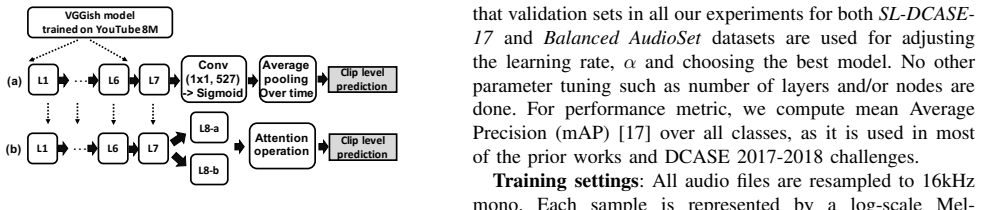
The load-bearing object is the pseudo-strong label matrix $P$ generated on every forward pass. An entry $P_{c,t}$ is set to 1 only if class $c$ occurs in the clip and the segment-level prediction $X^a_{c,t}$ is at least the threshold $\theta$, where $\theta$ is the average prediction of the model over classes that are absent from the clip; otherwise it is 0. This matrix is used exactly where ground-truth strong labels would be used in the attention loss, while the attention matrix itself is $A = X^b / \sum_{i=1}^{T} X^b_i$. The mechanism makes the type of supervision interchangeable: the same architecture and loss function can take human strong labels, self-generated pseudo labels, or both, and the paper finds the attention-loss weight $\alpha = 1$ best.
What would settle it
Train the same architecture on balanced AudioSet with pseudo-strong labels whose segment positions are randomly shuffled within each clip, keeping class presence intact; this removes localization information from the attention loss. If mAP stays close to the claimed 27.4 instead of falling toward the 23.1 of the unsupervised attention model, the reported benefit is not caused by self-supervised localization.
Extended reading notes
Core claim
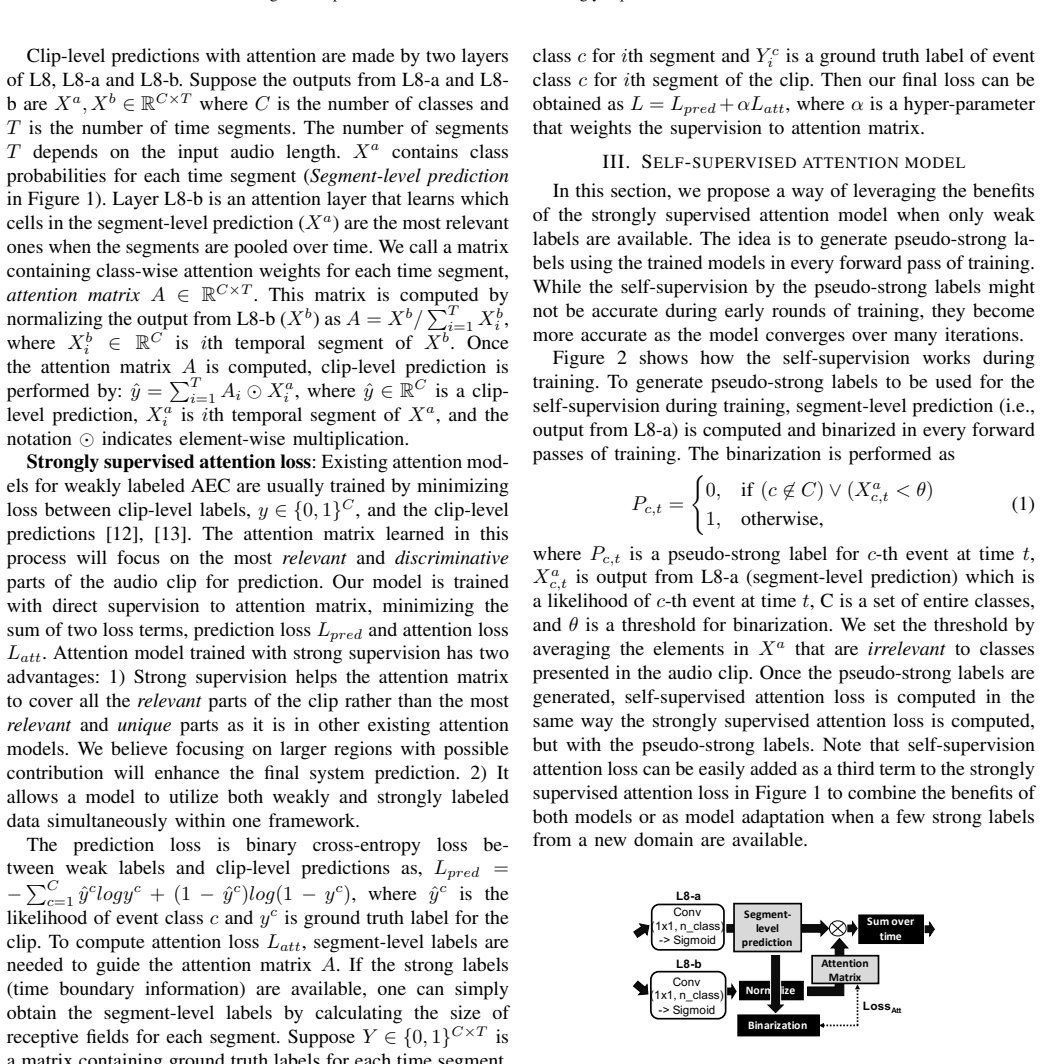
The central claim is that direct supervision of the attention matrix is the missing ingredient for weakly labeled audio event classification. The paper proposes a fully convolutional architecture with two parallel output branches: L8-a produces class probabilities per time segment, and L8-b produces weights that are normalized to an attention matrix $A$; the clip-level prediction is $\hat{y} = \sum_{i=1}^{T} A_i \odot X^a_i$. In the strongly supervised variant, segment-level ground-truth labels contribute an attention loss $L_{\mathrm{att}}$ added to the clip-level prediction loss. In the self-supervised variant, the model binarizes its own segment-level predictions (Eq. 1) to form pseudo-strong labels $P_{c,t}$ and computes the same attention loss against them. With only weak labels, the self-supervised model performs on par with the strongly supervised upper bound (55.9 vs. 56.3 mAP on SL-DCASE-17 with two-step transfer) and clearly better than an unsupervised attention model (27.4 vs. 23.1 mAP on balanced AudioSet). The paper also reports that the gains are statistically significant over 20 training trials and are largest for short, low-density events such as horns and screams.
Load-bearing premise
The method assumes that the model's own thresholded segment-level predictions are accurate enough, or at least improve over training, to teach the attention layer rather than reinforcing whatever errors the model already makes.
Editorial extensions
If this is right
- If the central claim is right, weakly labeled audio tagging can approach strong-label performance without time-boundary annotations, reducing labeling cost substantially.
- Attention models should be trained with direct attention supervision by default; the reported experiments show unsupervised attention can even hurt performance (23.1 vs. 26.4 mAP for the no-attention model on balanced AudioSet).
- Short audio events, which are the hardest for pooling-based tagging, benefit most from attention supervision, so the method is relevant for transient sounds like alarms and screams.
- The unified loss allows a few strong labels to be combined with many weak labels in one training run, a semi-supervised setting the paper explicitly enables.
- Two-step transfer learning from a large weakly labeled corpus to a smaller target corpus contributes a substantial part of the gains, and the reported recipe fixes early layers and fine-tunes the rest.
Reading between the lines
- Editorial inference: because the pseudo-labels come from the model itself, early training could reinforce initial mistakes; a testable extension is to anneal the attention-loss weight or tighten the threshold $\theta$ as training progresses.
- Editorial inference: the threshold $\theta$ is a single global mean over irrelevant classes, so per-class thresholds might improve detection of rare short events; the paper does not report such an ablation.
- Editorial inference: the same binarize-and-teach attention recipe should transfer to other weakly supervised sequence tasks, such as weakly labeled sound event detection or medical time-series tagging, wherever attention localization is needed.
- Editorial inference: the framework suggests a semi-supervised recipe the paper does not evaluate: fine-tune with the self-supervised loss on large unlabeled or weakly labeled collections and add the strong-label loss only for the few annotated clips.
Signed reviews
Editorial analysis
A structured set of objections, weighed in public.
Referee Report
Summary. The paper proposes two ways to supervise the attention module in a weakly labeled audio event classification (AEC) system. The first is a strongly supervised attention model, trained with ground-truth segment-level labels. The second is a self-supervised attention model, in which pseudo-strong labels are generated by binarizing the model's own segment-level predictions (Eq. 1) during training, and an attention loss is computed against these pseudo-labels. The architecture is a VGGish-initialized fully convolutional network with class-wise attention pooling. Experiments on a custom SL-DCASE-17 partition and on balanced AudioSet report that the self-supervised attention model achieves 55.9 mAP (two-step transfer) and 27.4 mAP respectively, outperforming the unsupervised attention baseline and performing comparably to the strongly supervised variant. The authors additionally report that self-supervised attention is especially beneficial for short audio events.
Significance. If the central claim holds, the paper makes a useful contribution: it obtains part of the benefit of strong supervision for attention without requiring strong labels, and the method is simple to integrate into existing attention-based weakly labeled AEC systems. The experimental protocol is a strength: 20 trials per configuration and Wilcoxon signed-rank tests are used for the main internal comparisons, and the authors release the YouTube IDs for SL-DCASE-17. The main quantitative claim in the abstract, however, is not supported by the body's comparison, and the ablation design does not cleanly identify the source of the improvement. These issues are fixable, but they are central enough that the paper needs revision before publication.
major comments (4)
- [Abstract and §IV, Table I] The abstract's claim of an 8.8% relative mAP improvement over state-of-the-art for SL-DCASE-17 is not supported by the body. The only state-of-the-art comparison reported for SL-DCASE-17 is against the DCASE17 Task 4 winner [20], which reaches 53 mAP; the proposed self-supervised model reaches 55.9 mAP, which is a 5.5% relative improvement, not 8.8%. The 8.8% figure matches the improvement over the paper's own no-attention two-step model (51.4 to 55.9). The abstract should be corrected to state the actual comparison baseline, and the body should make clear which number corresponds to which baseline.
- [§III, Eq. (1); Tables I and II] The experiments do not include a control that separates the content of the pseudo-labels from the effect of adding an auxiliary attention loss. The self-supervised model differs from the unsupervised attention model by both adding a loss term and providing specific binarized targets P, so the observed gains (Table II: 23.1 to 27.4 mAP; Table I two-step: 53.9 to 55.9 mAP) could result from the auxiliary loss regularizing the attention matrix rather than from semantic information in P. This concern is especially salient because Table II shows the unsupervised attention model (23.1) is worse than the no-attention model (26.4), so any stabilizing auxiliary loss might recover part of the gap. I request an additional control, e.g., training with the same attention loss against shuffled, random, or fixed uniform pseudo-labels, to show that the pseudo-label content is the active ingredient.
- [§III, Eq. (1)] The definition of the binarization threshold is unclear and potentially problematic. The text says θ is set by averaging elements in X a that are irrelevant to classes present in the clip, but Eq. (1) writes the condition (c ∉ C) where C is described as the set of entire classes, which makes the condition impossible. If c ∉ C is intended to mean 'classes not present in the clip,' then both the pseudo-labels and the threshold are computed from the same network's outputs, and the paper does not specify whether a stop-gradient or detached teacher is used. Self-training from the model's own outputs can reinforce early errors; the manuscript asserts that the pseudo-labels become more accurate as training converges but provides no analysis or safeguard. Please clarify the intended semantics, specify the implementation (e.g., detach, no-gradient), and add a discussion of this confirmation-bias risk.
- [§I and §IV (SL-DCASE-17)] The competitive comparison with the DCASE17 winner is described in a way that complicates interpretation. The authors state that some of their test examples are included in the training set of DCASE17 Task 4, meaning the baseline may have seen test material; this is a caveat that should be stated prominently in the results section, not only in passing. It does not invalidate the comparison, but the exact overlap and its implications for the claimed improvement need to be quantified or at least discussed more carefully.
minor comments (5)
- [§III, Eq. (1)] The notation for the pseudo-label condition should be corrected: C is used both for the set of all classes and for the set of classes present in a clip, and the current formula makes the first disjunct trivially false for every class in the label set.
- [Figure 2] The word 'psuedo' in the figure caption should be spelled 'pseudo.'
- [Table I] The check-mark columns in Table I are difficult to read without an explicit row legend; adding short row names (e.g., 'no attention, strong', 'unsupervised attention, weak') would greatly improve clarity.
- [§IV, Dataset] The description of SL-DCASE-17 is confusing: the training set is said to combine the evaluation and test sets of DCASE17, while the test set is subsequently sampled from AudioSet Eval. Please specify the exact relation between these partitions and the original DCASE17 splits.
- [§IV, Training settings] The threshold θ is described only verbally as 'averaging the elements in X a that are irrelevant to classes presented in the audio clip'; a precise formula or pseudocode for computing θ would be needed for reproducibility.
Circularity Check
No circularity: the self-supervised pseudo-labeling scheme is an empirical training method anchored by external weak-label loss and held-out test evaluation.
full rationale
This paper makes an empirical claim about a training procedure, not a formal derivation. The pseudo-strong labels in Eq. (1) are binarized segment-level predictions from the same network, but the training objective remains anchored by the external clip-level weak-label loss L_pred (binary cross-entropy between the attention-pooled prediction and the annotated clip label), and the reported numbers are mAP on held-out test sets from 20 trials, with no test-set parameters tuned. The threshold theta is computed from the model's own outputs, and the paper explicitly acknowledges that the pseudo-labels may be inaccurate in early training; that is a known self-training robustness risk, not a logical circularity, because the final evaluation uses independent ground-truth labels rather than the pseudo-labels themselves. There is no load-bearing self-citation: the references to VGGish, AudioSet, DCASE, and prior attention work are external baselines and building blocks, and no uniqueness theorem or derivation from the authors' prior work is invoked. The skeptic's missing-control concern (whether gains come from pseudo-label content or from the auxiliary loss term acting as a regularizer) is a legitimate experimental-design question about identifying the active ingredient, but it does not reduce the claimed result to its input by construction. For those reasons, no circular step can be exhibited, and the analysis is self-contained with respect to circularity.
Assumptions & free parameters
free parameters (3)
- alpha (attention loss weight) =
1
- theta (binarization threshold) =
per-clip mean of predictions over classes absent from the clip
- learning rates =
0.001 (AudioSet), 0.0001 (SL-DCASE-17)
assumptions (3)
- domain assumption VGGish features pre-trained on YouTube-8M provide a useful initialization for audio event classification
- domain assumption Pseudo-labels generated by binarizing the model's own segment-level predictions become accurate enough during training to supervise the attention module
- domain assumption AudioSet weak labels are reliable for training and evaluation
Cite this review
Pith. "Pith review of Self-supervised Attention Model for Weakly Labeled Audio Event Classification." pith.science (2026). https://pith.science/paper/6QOAHIZN
@misc{pith2026190802876,
  author       = {Pith},
  title        = {Pith review of: Self-supervised Attention Model for Weakly Labeled Audio Event Classification},
  year         = {2026},
  howpublished = {\url{https://pith.science/paper/6QOAHIZN}},
  note         = {Machine review of arXiv:1908.02876}
}
read the original abstract
We describe a novel weakly labeled Audio Event Classification approach based on a self-supervised attention model. The weakly labeled framework is used to eliminate the need for expensive data labeling procedure and self-supervised attention is deployed to help a model distinguish between relevant and irrelevant parts of a weakly labeled audio clip in a more effective manner compared to prior attention models. We also propose a highly effective strongly supervised attention model when strong labels are available. This model also serves as an upper bound for the self-supervised model. The performances of the model with self-supervised attention training are comparable to the strongly supervised one which is trained using strong labels. We show that our self-supervised attention method is especially beneficial for short audio events. We achieve 8.8% and 17.6% relative mean average precision improvements over the current state-of-the-art systems for SL-DCASE-17 and balanced AudioSet.
Figures

Figures from the paper (1 more)

Reference graph
Works this paper leans on
-
[20]
Surrey-CVSSP system for DCASE2017 challenge task4,
Yong Xu, Qiuqiang Kong, Wenwu Wang, and Mark D. Plumbley, “Surrey-CVSSP system for DCASE2017 challenge task4,” Tech. Rep., DCASE2017 Challenge, September 2017
work page 2017
-
[1]
Audio set: An ontology and human-labeled dataset for audio events,
Jort F Gemmeke, Daniel PW Ellis, Dylan Freedman, Aren Jansen, Wade Lawrence, R Channing Moore, Manoj Plakal, and Marvin Ritter, “Audio set: An ontology and human-labeled dataset for audio events,” in ICASSP, 2017, pp. 776–780
work page 2017
-
[2]
Acoustic Scene Classification Using Deep Neural Network and Frame- Concatenated Acoustic Feature,
Gen Takahashi, Takeshi Yamada, Shoji Makino, and Nobutaka Ono, “Acoustic Scene Classification Using Deep Neural Network and Frame- Concatenated Acoustic Feature,” in DCASE2016 Chall., 2016
work page 2016
-
[3]
Feature Analysis and Selection for Acoustic Event Detection,
Xiaodan Zhuang, Xi Zhou, Thomas S Huang, and Mark Hasegawa- Johnson, “Feature Analysis and Selection for Acoustic Event Detection,” in Int. conf. on Acoustics, Speech and Signal Processing (ICASSP), 2008
work page 2008
-
[4]
Cnn architectures for large-scale audio classification,
Shawn Hershey, Sourish Chaudhuri, Daniel PW Ellis, Jort F Gemmeke, Aren Jansen, R Channing Moore, Manoj Plakal, Devin Platt, Rif A Saurous, Bryan Seybold, et al., “Cnn architectures for large-scale audio classification,” in Int. conf. on Acoustics, Speech and Signal Processing (ICASSP). IEEE, 2017, pp. 131–135
work page 2017
-
[5]
Imagenet classification with deep convolutional neural networks,
Alex Krizhevsky, Ilya Sutskever, and Geoffrey E Hinton, “Imagenet classification with deep convolutional neural networks,” in Advances in neural information processing systems , 2012, pp. 1097–1105
work page 2012
-
[6]
Audio event and scene recognition: A unified approach using strongly and weakly labeled data,
Anurag Kumar and Bhiksha Raj, “Audio event and scene recognition: A unified approach using strongly and weakly labeled data,” in 2017 International Joint Conference on Neural Networks (IJCNN) . IEEE, 2017, pp. 3475–3482
work page 2017
-
[7]
Deep CNN Framework for Audio Event Recognition using Weakly Labeled Web Data
Anurag Kumar and Bhiksha Raj, “Deep CNN framework for audio event recognition using weakly labeled web data,” arXiv preprint arXiv:1707.02530, 2017
work page Pith review arXiv 2017
Show all 21 references
-
[8]
A first attempt at polyphonic sound event detection using connectionist temporal classification,
Yun Wang and Florian Metze, “A first attempt at polyphonic sound event detection using connectionist temporal classification,” in International Conference on Acoustics, Speech and Signal Processing, ICASSP 2017, New Orleans, LA, USA, March 5-9, 2017 , 2017, pp. 2986–2990
2017
-
[9]
Convolutional recurrent neural networks for polyphonic sound event detection,
Giambattista Parascandolo, Toni Heittola, Heikki Huttunen, Tuomas Virtanen, et al., “Convolutional recurrent neural networks for polyphonic sound event detection,” IEEE/ACM Transactions on Audio, Speech, and Language Processing, vol. 25, no. 6, pp. 1291–1303, 2017
2017
-
[10]
Adaptive pooling operators for weakly labeled sound event detection,
Brian McFee, Justin Salamon, and Juan Pablo Bello, “Adaptive pooling operators for weakly labeled sound event detection,” Trans. Audio, Speech and Lang. Proc. , vol. 26, no. 11, pp. 2180–2193, Nov. 2018
2018
-
[11]
Class- aware self-attention for audio event recognition,
Shizhe Chen, Jia Chen, Qin Jin, and Alexander Hauptmann, “Class- aware self-attention for audio event recognition,” in Proceedings of the 2018 ACM on International Conference on Multimedia Retrieval , New York, NY , USA, 2018, ICMR ’18, pp. 28–36, ACM
2018
-
[12]
Learning to recognize transient sound events using attentional supervision,
Szu-Yu Chou, Jyh-Shing Jang, and Yi-Hsuan Yang, “Learning to recognize transient sound events using attentional supervision,” in IJCAI-18. 7 2018, pp. 3336–3342, International Joint Conferences on Artificial Intelligence Organization
2018
-
[13]
Audio set classification with attention model: A probabilistic perspective,
Qiuqiang Kong, Yong Xu, Wenwu Wang, and Mark D. Plumbley, “Audio set classification with attention model: A probabilistic perspective,” CoRR, vol. abs/1711.00927, 2017
2017 arXiv
-
[14]
Tell me where to look: Guided attention inference network,
Kunpeng Li, Ziyan Wu, Kuan-Chuan Peng, Jan Ernst, and Yun Fu, “Tell me where to look: Guided attention inference network,” in Conference on Computer Vision and Pattern Recognition , 2018, pp. 9215–9223
2018
-
[15]
Knowledge transfer from weakly labeled audio using convolutional neural network for sound events and scenes,
Anurag Kumar, Maksim Khadkevich, and Christian F ¨ugen, “Knowledge transfer from weakly labeled audio using convolutional neural network for sound events and scenes,” in International Conference on Acoustics, Speech and Signal Processing (ICASSP) . IEEE, 2018, pp. 326–330
2018
-
[16]
DCASE 2017 Challenge setup: Tasks, datasets and baseline system,
Annamaria Mesaros, Toni Heittola, Aleksandr Diment, Benjamin Elizalde, Ankit Shah, Emmanuel Vincent, Bhiksha Raj, and Tuomas Virtanen, “DCASE 2017 Challenge setup: Tasks, datasets and baseline system,” in DCASE 2017 - Workshop on Detection and Classification of Acoustic Scenes ...
2017
-
[17]
Retrieval evaluation with in- complete information,
Chris Buckley and Ellen M. V oorhees, “Retrieval evaluation with in- complete information,” in Proceedings of the 27th Annual International ACM SIGIR Conference on Research and Development in Information Retrieval, New York, NY , USA, 2004, SIGIR ’04, pp. 25–32, ACM
2004
-
[18]
Youtube-8m: A large-scale video classification benchmark,
Sami Abu-El-Haija, Nisarg Kothari, Joonseok Lee, Paul Natsev, George Toderici, Balakrishnan Varadarajan, and Sudheendra Vijayanarasimhan, “Youtube-8m: A large-scale video classification benchmark,” arXiv preprint arXiv:1609.08675, 2016
2016 arXiv
-
[19]
A closer look at weak label learning for audio events,
Ankit Shah, Anurag Kumar, Alexander G. Hauptmann, and Bhiksha Raj, “A closer look at weak label learning for audio events,” CoRR, vol. abs/1804.09288, 2018
2018 arXiv
-
[21]
Attention and localization based on a deep convolutional recurrent model for weakly supervised audio tagging,
Yong Xu, Qiuqiang Kong, Qiang Huang, Wenwu Wang, and Mark Plumbley, “Attention and localization based on a deep convolutional recurrent model for weakly supervised audio tagging,” in Proceedings of Interspeech 2017 . 2017, pp. 3083–3087, ISCA
2017
Reviewed August 14, 2026 · model on record in the stance chip above.
Discussion (0). Continue with ORCID to comment.