Ferroelastic domain wall motion and collective domain switching in RbSCN
Pith reviewed 2026-06-30 05:17 UTC · model grok-4.3
The pith
Anomalies at T* in RbSCN arise from collective ferroelastic domain switching when critical pinning stress falls below applied stress.
A machine-rendered reading of the paper's core claim, the machinery that carries it, and where it could break.
Core claim
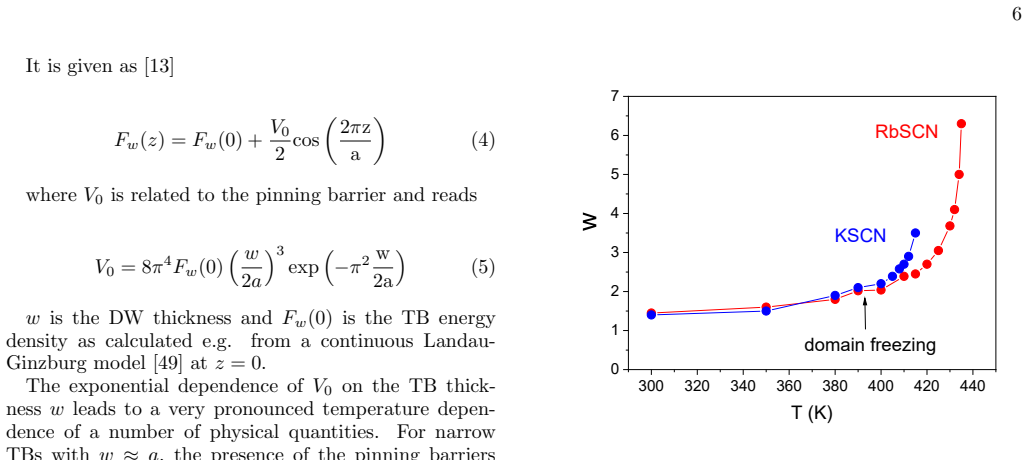
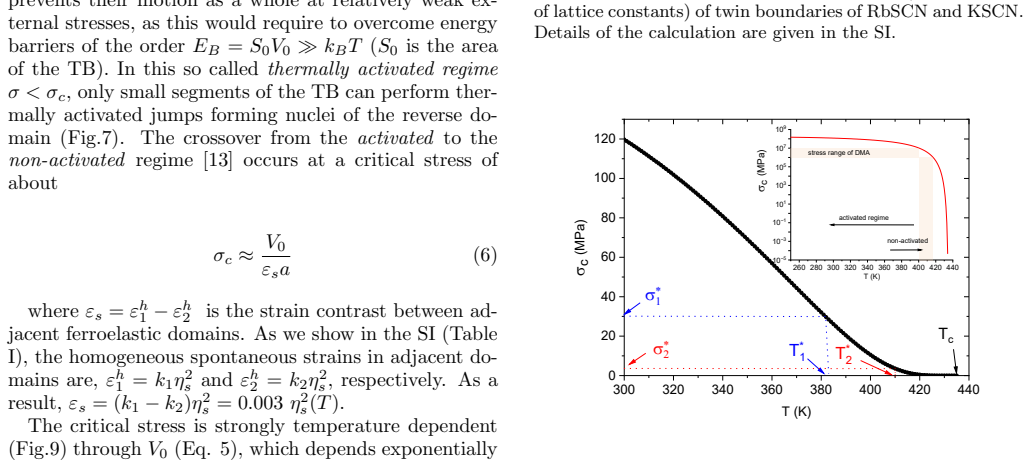
The anomalies around T* result from collective domain switching events that are induced when the temperature dependent critical pinning stress, σ_c(T) falls below the applied external stress σ, implying that T*(σ=σ_c). This interpretation is supported by calculations of the temperature dependences of twin boundary widths w and energies F_w, as well as the Peierls potential V_0 using a compressible pseudospin model, which leads to a critical pinning stress, σ_c(T) that is in excellent agreement with experimental values of T*(σ_c).
What carries the argument
Compressible pseudospin model calculations of twin boundary widths w, energies F_w and Peierls potential V_0 that generate the critical pinning stress σ_c(T).
If this is right
- Domain-wall motion and the associated superelastic softening can be erased by a thermal cycle above T*.
- The same pinning-stress mechanism accounts for the absence of a discontinuous jump in the related compound KSCN.
- The critical stress σ_c is set by the temperature evolution of boundary width and Peierls barrier rather than by extrinsic defects.
- Applied stress shifts the location of T* in a manner predictable from the model's σ_c(T) curve.
Where Pith is reading between the lines
- Similar pinning-stress thresholds may produce abrupt changes in other order-disorder ferroelastics when domain walls are mobile.
- Macroscopic strain or polarization devices using RbSCN-like materials could exhibit history-dependent stiffness once operated near T*.
- The model supplies a route to estimate T* for any chosen applied stress without new elastic measurements.
Load-bearing premise
The model's temperature-dependent twin boundary width, energy and Peierls barrier produce an independent σ_c(T) curve that matches the observed T* without parameters adjusted to the discontinuity itself.
What would settle it
Direct observation of the onset of collective domain switching events exactly at the measured T* under controlled applied stress, or a mismatch between the model's predicted σ_c(T) and new measurements of T*(σ).
Figures
read the original abstract
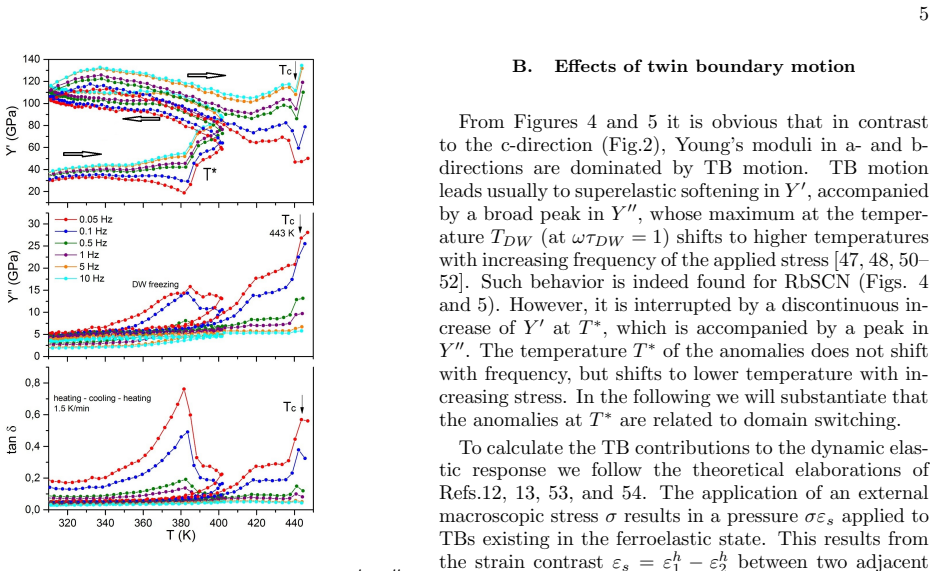
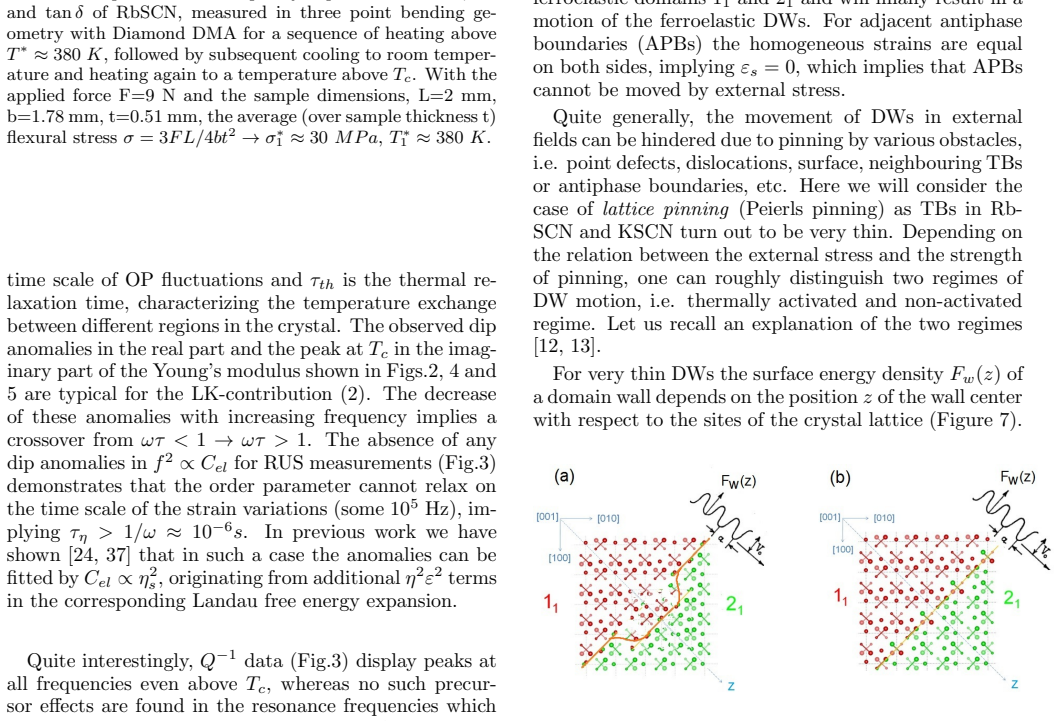
Low frequency (0.05 - 40 Hz) dynamic elastic measurements and resonant ultrasound spectroscopy measurements (100-600 kHz) of RbSCN have been performed in the temperature region of the order-disorder improper ferroelastic phase transition at T$_c \approx$ 435~K. Quite similar to KSCN, the low frequency data show - in addition to the intrinsic phase transition anomalies - superelastic softening in a- and b-directions, resulting from movements of ferroelastic domain walls under dynamic stress. However, in contrast to KSCN, a sudden discontinuous increase of Young's modulus appears in RbSCN at { T$^{\ast} < T_c $}, which is accompanied by a frequency dependent damping peak. This behaviour is reminiscent of a first order phase transition.\\ Heating RbSCN slightly above T$^{\ast}$, followed by subseqent cooling, removes all {signs of domain wall dynamics}. The results demonstrate, that the anomalies in RbSCN around $T^{\ast}$ result from collective domain switching events that are induced when the {temperature dependent critical pinning stress, $\sigma_c(T)$ falls below the applied external stress $\sigma$, implying that $T^{\ast}(\sigma=\sigma_c)$. This interpretation is supported by calculations of the temperature dependences of twin boundary widths $w$ and energies $F_w$, as well as the Peierls potential $V_0$ using a compressible pseudospin model, which leads to a critical pinning stress, $\sigma_c(T)$ that is in excellent agreement with experimental values of $T^{\ast}(\sigma_c)$. }
Editorial analysis
A structured set of objections, weighed in public.
Referee Report
Summary. The manuscript presents low-frequency dynamic elastic and resonant ultrasound spectroscopy measurements on RbSCN near its improper ferroelastic transition at Tc ≈ 435 K. In addition to intrinsic transition anomalies, the data show superelastic softening from domain-wall motion, followed by a discontinuous jump in Young's modulus at T* < Tc accompanied by a frequency-dependent damping peak. The authors interpret the T* anomaly as collective domain switching triggered when the temperature-dependent critical pinning stress σ_c(T) drops below the applied stress σ. This interpretation is supported by compressible pseudospin-model calculations of twin-boundary width w(T), energy F_w(T), and Peierls potential V_0(T) that produce a σ_c(T) curve stated to be in excellent agreement with the measured T*(σ_c) locus.
Significance. If the model parameters are fixed independently of the T* data, the work supplies a microscopic, parameter-constrained account of how temperature-dependent domain-wall pinning produces an apparently first-order-like discontinuity in a material whose transition is otherwise continuous. Such a link between collective switching and measurable elastic anomalies would be useful for other improper ferroelastics and for interpreting similar “extra” transitions reported in related SCN compounds.
major comments (2)
- [Abstract, §4] Abstract and §4 (model section): the statement that the compressible pseudospin model yields σ_c(T) 'in excellent agreement with experimental values of T*(σ_c)' is load-bearing for the central claim, yet the text does not specify how the pseudospin coupling constants, compressibility, and anisotropy parameters were obtained. If any were varied to place the calculated σ_c(T) through the measured (T*,σ) points, the agreement is a consistency check rather than an independent test.
- [§3.2, Fig. 7] §3.2 and Fig. 7: the experimental T*(σ) locus is extracted from the location of the discontinuous modulus jump; the model σ_c(T) is then compared to this locus. Without an explicit statement that the model parameters were fixed from independent data (e.g., lattice constants, elastic moduli above Tc, or neutron scattering), the comparison risks circularity.
minor comments (2)
- [Abstract, §3] Notation: the symbol σ_c is used both for the critical pinning stress and, implicitly, for the applied stress at which T* is observed; a clearer distinction (e.g., σ_app vs. σ_c(T)) would avoid confusion.
- [§2] The frequency range 0.05–40 Hz versus 100–600 kHz is stated, but the precise resonance modes and sample orientations for the RUS data are not tabulated; a short table would help readers reproduce the elastic-constant extraction.
Simulated Author's Rebuttal
We thank the referee for the careful and constructive review. The two major comments both concern the independence of the pseudospin-model parameters from the T* data. We address each point below and have revised the manuscript to make the provenance of the parameters explicit.
read point-by-point responses
-
Referee: [Abstract, §4] Abstract and §4 (model section): the statement that the compressible pseudospin model yields σ_c(T) 'in excellent agreement with experimental values of T*(σ_c)' is load-bearing for the central claim, yet the text does not specify how the pseudospin coupling constants, compressibility, and anisotropy parameters were obtained. If any were varied to place the calculated σ_c(T) through the measured (T*,σ) points, the agreement is a consistency check rather than an independent test.
Authors: The coupling constants, compressibility, and anisotropy parameters were fixed prior to the σ_c(T) calculation using three independent data sets: (i) room-temperature lattice constants and thermal-expansion coefficients from X-ray diffraction, (ii) elastic moduli measured above Tc by RUS, and (iii) the order-parameter temperature dependence reported in prior neutron-scattering studies. No parameter was adjusted to reproduce the measured T*(σ) locus. We have added a dedicated paragraph at the beginning of §4 that lists each parameter, its numerical value, and the exact literature or experimental source. The revised text now states explicitly that σ_c(T) is a parameter-free prediction of the model. revision: yes
-
Referee: [§3.2, Fig. 7] §3.2 and Fig. 7: the experimental T*(σ) locus is extracted from the location of the discontinuous modulus jump; the model σ_c(T) is then compared to this locus. Without an explicit statement that the model parameters were fixed from independent data (e.g., lattice constants, elastic moduli above Tc, or neutron scattering), the comparison risks circularity.
Authors: We agree that the absence of such a statement creates an appearance of circularity. As detailed in the new §4 paragraph, all model parameters were determined exclusively from the three independent sources listed above; the T*(σ) data were never used in the fitting procedure. We have also revised the caption of Fig. 7 and the opening sentence of §3.2 to cross-reference this statement and to emphasize that the plotted σ_c(T) curve is the model prediction, not a fit to the experimental points. revision: yes
Circularity Check
No significant circularity; model-derived σ_c(T) presented as independent corroboration
full rationale
The abstract states that compressible pseudospin model calculations of w(T), F_w(T) and V_0(T) produce σ_c(T) in excellent agreement with measured T*(σ_c), but supplies no equations, parameter values, or fitting procedure showing that any input was taken from the observed discontinuity itself. No self-citation is quoted as load-bearing for a uniqueness theorem or ansatz, and the derivation chain does not reduce by construction to the target data. The central claim therefore retains independent content from the model.
Axiom & Free-Parameter Ledger
Reference graph
Works this paper leans on
-
[1]
and are separated by antiphase boundaries (APBs), and DSs 11 and 21 and 11 and 22 are related by 90 ◦ rotations, and are separated by ferroelas- tic DWs, also known as twin boundaries (TBs). The PT properties of RbSCN were previously studied in detail by a number of experimental methods, including NMR [29], neutron scattering [30], Raman- and Infrared mea...
-
[2]
Fig.3 displays results from resonant ultrasound spec- troscopy (RUS) measurements, primary spectra were col- lected in the instrument described in Ref.44
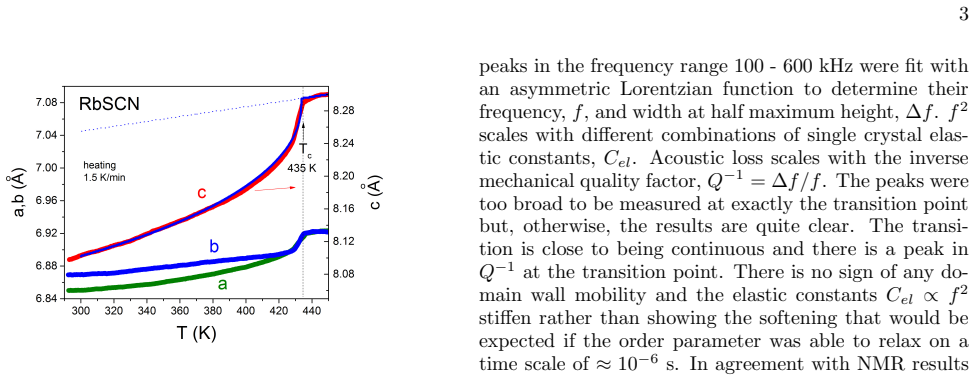
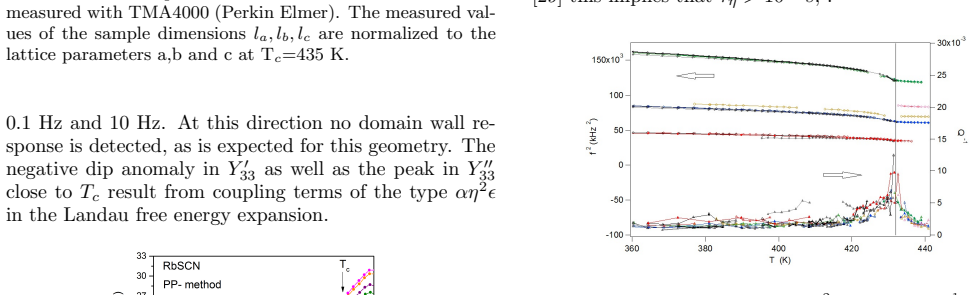
whenωτ th <1→ωτ th >1.τ th is the thermal relaxation time, which is of the order of 0.01 s. Fig.3 displays results from resonant ultrasound spec- troscopy (RUS) measurements, primary spectra were col- lected in the instrument described in Ref.44. Individual peaks in the frequency range 100 - 600 kHz were fit with an asymmetric Lorentzian function to deter...
-
[3]
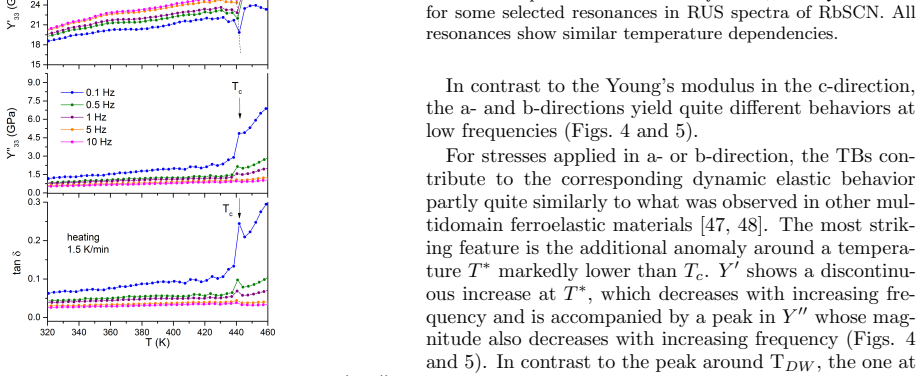
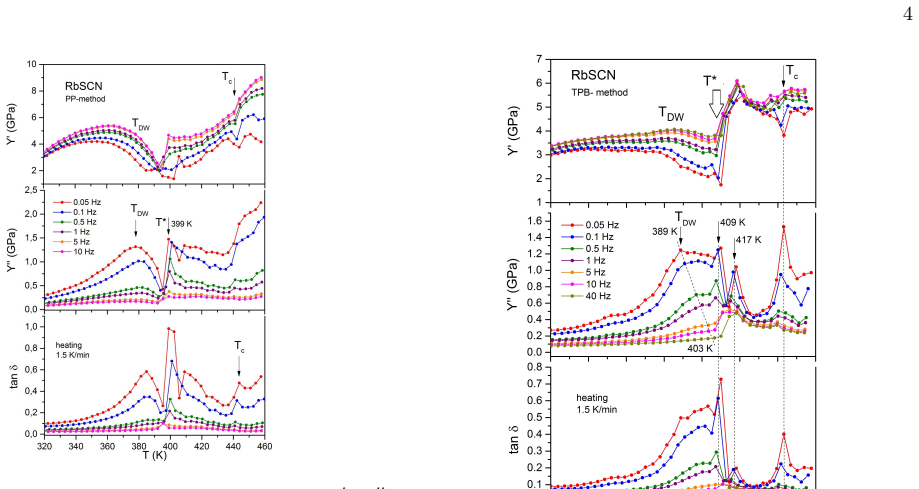
this implies thatτ η >10 −6s, . FIG. 3. Temperature evolution off 2 ∝C el andQ −1 ∝tanδ for some selected resonances in RUS spectra of RbSCN. All resonances show similar temperature dependencies. In contrast to the Young’s modulus in the c-direction, the a- and b-directions yield quite different behaviors at low frequencies (Figs. 4 and 5). For stresses a...
-
[4]
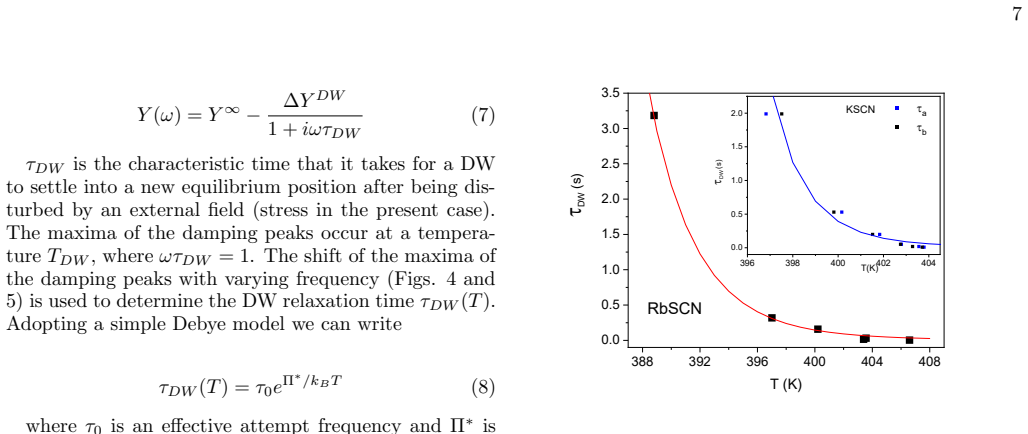
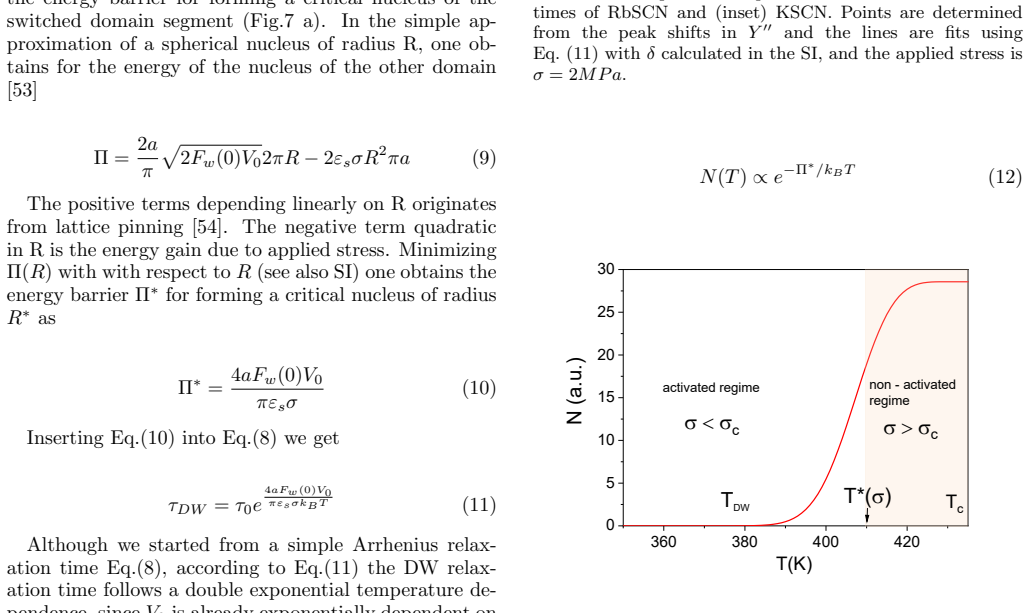
is used to determine the DW relaxation timeτ DW (T). Adopting a simple Debye model we can write τDW (T) =τ 0eΠ∗/kB T (8) whereτ 0 is an effective attempt frequency and Π ∗ is the energy barrier for forming a critical nucleus of the switched domain segment (Fig.7 a). In the simple ap- proximation of a spherical nucleus of radius R, one ob- tains for the en...
-
[5]
Salje, Phase Transitions in ferroeleastic and co- elastic crystals, Cambridge University Press, Cambridge UK (1993)
E.K.H. Salje, Phase Transitions in ferroeleastic and co- elastic crystals, Cambridge University Press, Cambridge UK (1993). ISBN 05214293666
1993
-
[6]
P. Gao, J. Britson, C.T. Nelson, J.R. Jokisaari, C. Duan, M. Trassin, S.-H. Baek, H. Guo, L. Li, Y. Wang, Y.-H. Chu, A.M. Minor, C.-B. Eom, R. Ramesh, L.-Q. Chen, X. Pan, Ferroelastic domain switching dynamics under electrical and mechanical excitations, Nat Commun5, 3801 (2014). https://doi.org/10.1038/ncomms4801
-
[7]
G. Catalan, J. Seidel, R. Ramesh and J. F. Scott, Domain wall nanoelectronics, Rev. Mod. Phys.84, 119 (2012). https://doi.org/10.1103/RevModPhys.84.119
-
[8]
D. Meier, J. Seidel, M. Gregg, R. Ramesh, Do- main Walls: From Fundamental Properties to Nan- otechnology Concepts, Oxford University Press (2020). https://doi.org/10.1093/oso/9780198862499.001.0001
-
[9]
R.J. Harrison, E.K.H. Salje, The noise of the needle Avalanches of a single progressing nee- dle domain in LaAlO 3, APL97, 021907 (2010). https://doi.org/10.1063/1.3460170
-
[10]
E. K. H. Salje, X. Ding, Z. Zhao, T. Look- man, and A. Saxena, Thermally activated avalanches: Jamming and the progression of nee- dle domains, Phys. Rev. B83, 104109 (2011). https://doi.org/10.1103/PhysRevB.83.104109
-
[11]
S. Puchberger, V. Soprunyuk, W. Schranz, A. Tr¨ oster, K. Roleder, A. Majchrowski, M.A. Carpenter and E.K.H. Salje, The noise of many needles, APL Materials5, 046012 (2017). https://doi.org/10.1063/1.4979616
-
[12]
S. Puchberger, V. Soprunyuk, W. Schranz and M.A. Carpenter, Segmental front line dynam- ics of randomly pinned ferroelastic domain walls, Phys. Rev. Materials2, 013603 (2018). https://doi.org/10.1103/PhysRevMaterials.2.013603
-
[13]
G.F. Nataf, E. K. H. Salje, Avalanches in ferroelectric, ferroelastic and coelastic materials: phase transition, do- main switching and propagation, Ferroelectrics,569:1, 82-107 (2020), DOI: 10.1080/00150193.2020.1791662
-
[14]
B. Casals, G.F. Nataf, E.K.H. Salje, Avalanche critical- ity during ferroelectric/ferroelastic switching, Nat. Com- mun.12, 345 (2021). https://doi.org/10.1038/s41467- 020-20477-6
-
[15]
Salje, Ferroelastic materials, Annu
E.K.H. Salje, Ferroelastic materials, Annu. Rev. Mater. Res.42, 265 (2012). https://doi.org/10.1146/annurev- matsci-070511-155022
-
[16]
Tagantsev, L.E
A.K. Tagantsev, L.E. Cross, and J. Fousek,Domains in Ferroic Crystals and Thin Films. Springer, New York; 2010
2010
-
[17]
A. Sidorkin, Dynamics of domain walls in ferroelectrics and ferroelastics, Ferroelectrics,191, 109-128 (1997). https://doi.org/10.1080/00150199708015628
-
[18]
A. Bhattacharya, M.A. Zaeem, Mechanism of nucleation in ferroelastic domain switch- ing, Scripta Materialia252, 116273 (2024). https://doi.org/10.1016/j.scriptamat.2024.116273
-
[19]
A. Bhattacharya, M.A. Zaeem, Kinetics of ferroelas- tic domain switching with and without back-switching events: A phase-field study, Acta Materialia286, 120702 (2025). https://doi.org/10.1016/j.actamat.2024.120702
-
[20]
G. Lu, S. Li, X. Ding, J. Sun, E.K.H. Salje, Electrically driven ferroelastic domain walls, do- main wall interactions, and moving needle do- mains, Phys. Rev. Materials3, 114405 (2019). DOI:10.1103/PhysRevMaterials.3.114405
-
[21]
X. He, S. Li, X. Ding, J. Sun, S. Kustov, E.K.H. Salje, Internal friction in complex ferroelastic twin patterns, Acta Materialia228, 117787 (2022)
2022
-
[22]
Barkhausen, Zwei mit Hilfe der neuen Verst¨ arker ent- deckte Erscheinugen
H. Barkhausen, Zwei mit Hilfe der neuen Verst¨ arker ent- deckte Erscheinugen. Z. Physik20, 401 - 403 (1919)
1919
-
[23]
S. Zapperi, P. Cizeau, G. Durin, H. E. Stanley, Dynamics of a ferromagnetic domain wall: Avalanches, depinning transition, and the Barkhausen effect, Phys. Rev. B58, 6353 (1998). https://doi.org/10.1103/PhysRevB.58.6353
-
[24]
P. Paruch, J. Guyonnet, Nanoscale studies of ferroelectric domain walls as pinned elastic interfaces,14, 667–684 (2013). http://dx.doi.org/10.1016/j.crhy.2013.08.004
-
[25]
S. Lemerle, J. Ferr´ e, C. Chappert, V. Mathet, T. Gia- marchi, P. Le Doussal, Domain wall creep in an Ising ultrathin magnetic film, Phys. Rev. Lett.80, 849 (1998). https://doi.org/10.1103/PhysRevLett.80.849
-
[26]
Kleemann, Universal domain wall dy- namics in disordered ferroic materials, Annu
W. Kleemann, Universal domain wall dy- namics in disordered ferroic materials, Annu. Rev. Mater. Res.37, 415 (2007). https://doi.org/10.1146/annurev.matsci.37.052506.084243
-
[27]
A. Shlyaykher, T. Pippinger, T. Schleid, O. Reck- eweg and F. Tambornino, Syntheses, crystallographic characterization, and structural relations of Rb[SCN]. Zeitschrift f¨ ur Kristallographie - Crystalline Materials 237, no. 1-3, 69 (2022). https://doi.org/10.1515/zkri- 2022-0015
-
[28]
V. Soprunyuk, P. K¨ onig, A. Tr¨ oster, W. Schranz, M.A. Carpenter and E.K.H. Salje, Domain glass dynamics of potassium thiocyanate KSCN, J. Appl. Phys.137(14), 145101 (2025). https://doi.org/10.1063/5.0263285 10
-
[29]
Y. Yamada, and T. Watanabe, The Phase Transition of Crystalline Potassium Thiocyanate, KSCN. II. X- Ray Study, Bull. Chem. Soc. Jpn.36, 1032 (1963). https://doi.org/10.1246/bcsj.36.1032
-
[30]
S. Yamamoto, M. Sakuno, and Y. Shinnaka, Structure Analysis of the Phase Transition in KSCN, J. Phys. Soc. Jpn.56, 4393 (1987). https://doi.org/10.1143/JPSJ.56.4393
-
[31]
V. Janovec, W. Schranz, H. Warhanek, and Z. Zikmund, Symmetry analysis of domain structure in KSCN crystals, Ferroelectrics98, 483 (1989). https://doi.org/10.1080/00150198908217581
-
[32]
W. Schranz, I. Rychetsky and J. Hlinka, Polar- ity of domain boundaries in nonpolar materials derived from order parameter and layer group symmetry, Phys. Rev. B100, 184105 (2019). https://doi.org/10.1103/PhysRevB.100.184105
-
[33]
R. Blinc, J. Seliger, T. Apih, J. Dolinsek, A. Fuith, W. Schranz and H. Warhanek, 87Rb NMR of the structural phase transition in RbSCN, Phys. Rev. B52, 833 (1995). https://doi.org/10.1103/physrevb.52.833
-
[34]
O. Blaschko, W. Schwarz, W. Schranz and A. Fuith, Do- main formation in the order-disorder phase transition of RbSCN, J. Phys.: Condensed Matter6, 3469 (1994). DOI 10.1088/0953-8984/6/19/002
-
[35]
S. Sathaiah and H.D. Bist, Structural phase transition and internal fields in rubidium thio- cyanate probed through vibrational spectroscopy, Z. Phys. B - Condens. Matter84, 423 (1991). https://doi.org/10.1007/BF01314017
-
[36]
M.M. Ossowski, J.R. Hardy and R.W. Smith, Molecular-dynamics of phase transitions in al- kali thiocyanates, Phys. Rev. B62, 3136 (2000). https://doi.org/10.1103/PhysRevB.60.15094
-
[38]
W. Schranz, H. Warhanek, R. Blinc, and B. Zeks, Pseu- dospin model for KSCN, Phys. Rev. B40, 7141 (1989). https://doi.org/10.1103/PhysRevB.40.7141
-
[39]
W. Schranz, Static and dynamic properties of the order-disorder phase transition in KSCN and related crystals, Phase Transitions,51(1–2), 1–66 (1994). https://doi.org/10.1080/01411599408201180
-
[40]
W. Schranz and D. Havlik, Heat-Diffusion Central Peak in the Elastic Susceptibility of KSCN, Phys. Rev. Lett.73, 2575 (1994). https://doi.org/10.1103/PhysRevLett.73.2575
-
[41]
W. Schranz, A. Fuith, A. Tr¨ oster, and J. Kroupa, Dynamic Acoustic Anomalies in KSCN near the Improper Ferroelastic Phase Tran- sition. Ferroelectrics, 314(1), 189–199 (2005). https://doi.org/10.1080/00150190590926436
-
[42]
R. Blinc, J. Seliger, T. Apih, J. Dolinek, I. Zupani, O. Plyushch, A. Fuith, W. Schranz, H. Warhanek, B. Topi, and U. Haeberlen, 39 K NMR study of the antiferroelectric phase transition in potas- sium thiocyanate, Phys. Rev. B43, 569 (1991). https://doi.org/10.1103/PhysRevB.43.569
-
[43]
O. Blaschko, W. Schwarz, W. Schranz, and A. Fuith, Order-disorder phase transition in potas- sium thiocyanate, Phys. Rev. B44, 9159 (1991). https://doi.org/10.1103/PhysRevB.44.9159
-
[44]
O. Blaschko,W. Schranz, M. Fally, G. Krexner, and Z. Lodziana, Strain-stabilized precursor clusters in potas- sium thiocyanate, Phys. Rev. B58, 8362 (1998). https://doi.org/10.1103/PhysRevB.58.8362
-
[45]
K. Parlinski, Computer simulation of domain for- mation in the order-disorder phase transition of the KSCN model, Phys. Rev. B50, 59 (1994). https://doi.org/10.1103/PhysRevB.50.59
-
[46]
Lodziana and K Parl´ nski, Computer sim- ulation of diffuse scattering from KSCN crys- tal
Z. Lodziana and K Parl´ nski, Computer sim- ulation of diffuse scattering from KSCN crys- tal. Phase Transitions58(4), 273–283 (1996). https://doi.org/10.1080/01411599608241824
-
[47]
A. Tr¨ oster, W. Schranz, G. Krexner, A. V. Ki- tyk, and Z. Lodziana, Suppression of the Or- der Parameter Correlation Length by Inhomoge- neous Strains, Phys. Rev. Lett.85, 2765 (2000). https://doi.org/10.1103/PhysRevLett.85.2765
-
[48]
R. E. A. McKnight, T. Moxon, A. Buckley, P. A. Tay- lor, T. W. Darling and M. A. Carpenter, Grain size dependence of elastic anomalies accompanying theα− βphase transition in polycrystalline quartz, J. Phys.: Condens. Matter20, 075229 (2008). 10.1088/0953- 8984/20/7/075229
-
[49]
Tr¨ oster,et al
A. Tr¨ oster,et al. MC simulations of a compressible pseu- dospin model including inhomogeneous strains, to be published
-
[50]
A. Fuith,The KSCN family: Structural prop- erties and phase transitions of crystals with three-atomic linear anions, Phase Transitions: A Multinational Journal,62:1-2,1-93 (1997). https://doi.org/10.1080/01411599708220061
-
[51]
Schranz, Superelastic softening in per- ovskites, Phys
W. Schranz, Superelastic softening in per- ovskites, Phys. Rev. B83, 094120 (2011). https://doi.org/10.1103/PhysRevB.83.094120
-
[52]
W. Schranz, H. Kabelka, A. Sarras and M. Burock, Giant domain wall response of highly twinned ferroe- lastic materials, Appl. Phys. Lett.101, 141913 (2012). https://doi.org/10.1063/1.4757992
-
[53]
I. Rychetsky and W. Schranz, Ferroelastic domain walls in Hg 2Br2 and KSCN, J. Phys.: Condens. Matter6, 11159 (1994). DOI 10.1088/0953-8984/6/50/023
-
[54]
R.J. Harrison, S.A.T. Redfern and E.K.H. Salje, Dynam- ical excitation and anelastic relaxation of ferroelastic do- main walls in LaAlO 3, Phys. Rev. B69, 144101 (2004). https://doi.org/10.1103/PhysRevB.69.144101
-
[55]
S. Puchberger, V. Soprunyuk, A. Majchrowski, K. Roleder and W. Schranz, Domain wall motion and pre- cursor dynamics in PbZrO 3, Phys. Rev. B94, 214101 (2016). https://doi.org/10.1103/PhysRevB.94.214101
-
[56]
A.V. Kityk, W. Schranz, P. Sondergeld, D. Hav- lik, E.K.H. Salje and J.F. Scott, Low frequency superelasticity and non linear elastic behavior of SrTiO3 crystals. Phys. Rev. B61, 946 (2000). https://doi.org/10.1103/PhysRevB.61.946
-
[57]
Sidorkin, Domain boundaries in Ferroelectrics, Journal of Advanced Dielectrics2, 1230013 (2012)
A.S. Sidorkin, Domain boundaries in Ferroelectrics, Journal of Advanced Dielectrics2, 1230013 (2012). https://doi.org/10.1142/S2010135X12300137
-
[58]
B. M. Darinskii and A. S. Sidorkin, The mo- tion of the domain boundaries in crystals of KH2PO4 group, Ferroelectrics,71, 269 (1987). https://doi.org/10.1080/00150198708224841
-
[60]
E.K.H. Salje and M.A. Carpenter, Domain glasses: Twin planes, Bloch lines, and Bloch points, Phys. Status Solidi B252, 2639–2648 (2015). https://doi.org/10.1002/pssb.201350242
discussion (0)
Sign in with ORCID, Apple, or X to comment. Anyone can read and Pith papers without signing in.