REVIEW 4 major objections 5 minor 47 references
IMP-HRL claims that adding stiffness-parameterized behavior primitives, a compliance-promoting affordance, and an adaptive stiffness controller to hierarchical RL improves success and lowers interaction forces on contact-rich sequential tas
Reviewed by Pith at T0; open to challenge. T0 means a machine referee read the full paper against a public rubric. the ladder, T0–T4 →
IMP-HRL augments the MAPLE hierarchical RL framework with impedance primitives and an adaptive stiffness controller, improving compliance and success rates on sequential contact tasks, especially wiping.
T0 review reviewed 2026-08-05 challenge →
load-bearing objection Competent integration of variable impedance into hierarchical primitives with a promising Wipe result, but the missing stiffness-affordance equation and reward-mismatched baseline make the headline claim underdetermined. the 4 major comments →
Impedance Primitive-augmented Hierarchical Reinforcement Learning for Sequential Tasks
The pith
A machine-rendered reading of the paper's core claim, the machinery that carries it, and where it could break.
The reading
Core claim
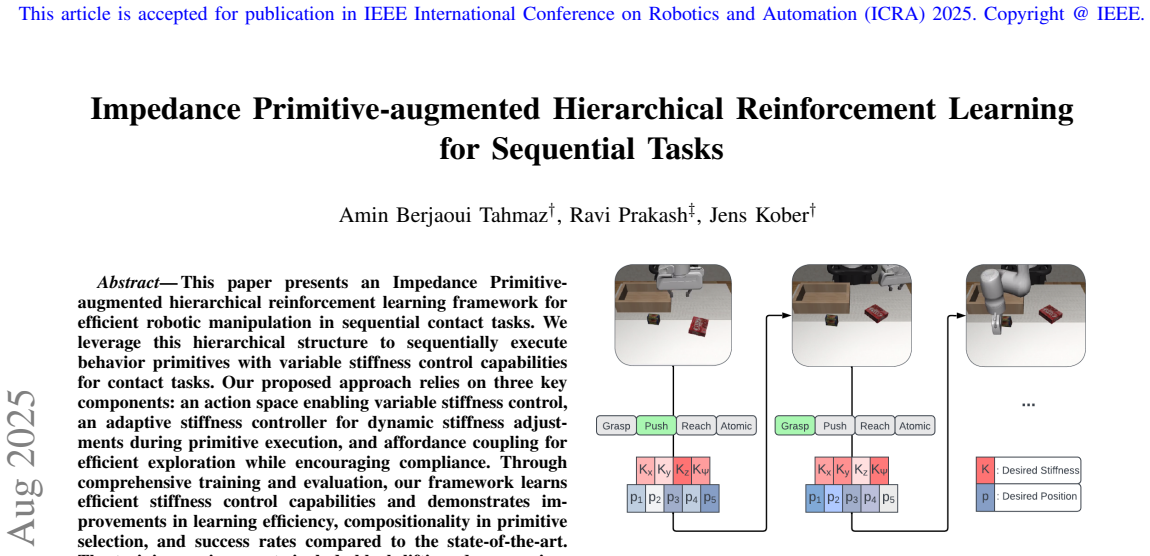
At the core of the paper is the claim that stiffness should be a first-class decision variable in hierarchical manipulation, not a fixed controller setting. IMP-HRL extends MAPLE's parameterized action space so that each behavior primitive (reach, grasp, push, atomic motion) carries initial stiffness values Kx, Ky, Kz, Kψ; damping is set to critical damping. A coupled affordance reward blends the original position affordance with a stiffness affordance that rewards low stiffness, so exploration is drawn toward compliant interaction without per-task reward tuning. During execution, an adaptive controller adjusts stiffness online according to Kdot = β|ε| − γE, raising stiffness when tracking e
What carries the argument
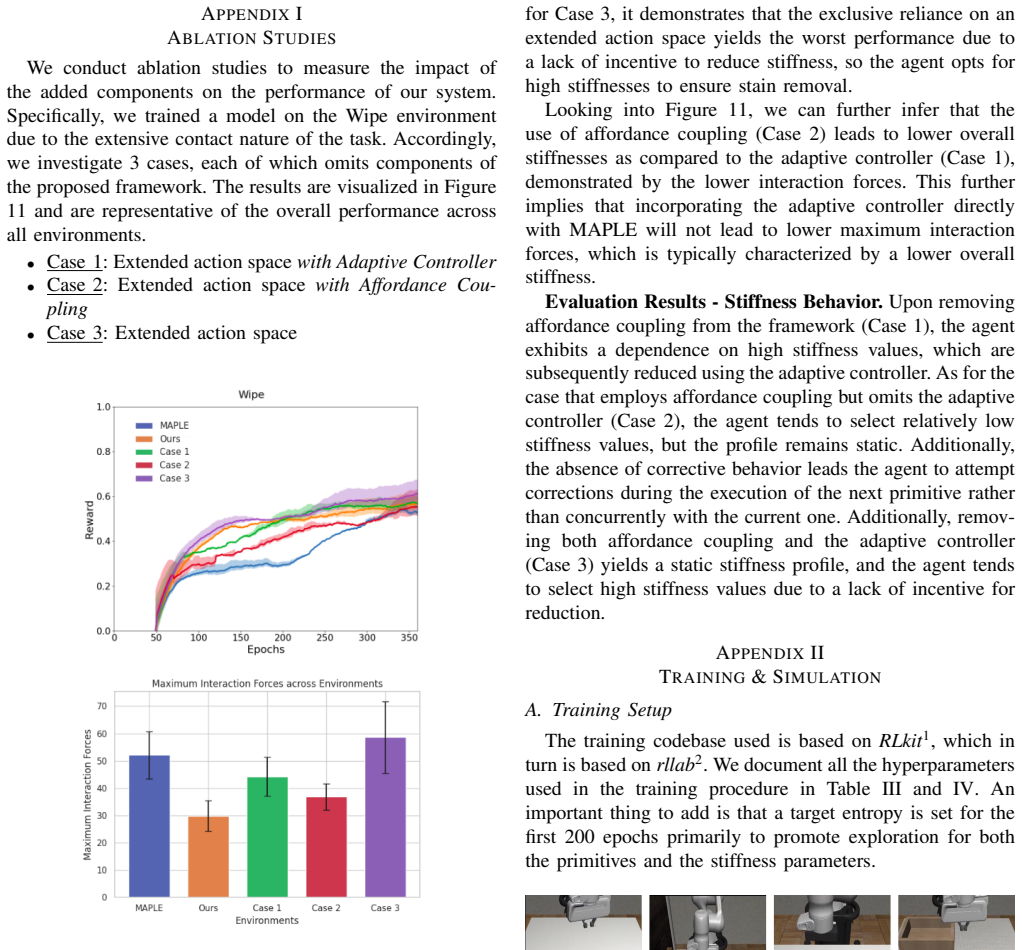
The central mechanism is the impedance primitive: a behavior primitive whose parameter vector includes per-axis stiffness values alongside target positions, with critically damped D = 2√K. Two new learning components carry the argument: (i) affordance coupling, which merges the position affordance with a stiffness affordance in the reward to make low-stiffness exploration attractive; and (ii) the adaptive controller Kdot = β|ε| − γE, which starts from the policy's stiffness estimate and adjusts it online based on tracking error and joint energy. Together they let the hierarchical policy keep its structured compositionality while the low level modulates compliance. Ablation studies isolate th
Load-bearing premise
The two scalar gains β and γ in the adaptive stiffness controller, fitted once from 15 kinesthetic demonstrations of linear motions, are assumed to transfer across every task and primitive and to speed up learning; the ablation shows the adaptive controller alone can hurt, so if those gains do not generalize the reported compliance and learning gains do not carry over.
What would settle it
Take the trained Wipe policy and replace the adaptive stiffness controller with the policy's initial stiffness held constant for the whole primitive, then compare success and peak forces to the 86% success and low-force result. If success collapses toward the 42% MAPLE level or forces rise, the adaptive controller is load-bearing; if success and forces stay about the same, the controller is not doing the claimed work.
If this is right
- On wiping, success rises from 42% to 86% in simulation, and the real robot reaches 70% without fine-tuning, suggesting stiffness adaptation is the missing ingredient for surface-cleaning tasks.
- Maximum interaction forces drop and vary less across randomizations, which makes sim-to-real transfer safer and reduces wear on the environment.
- Primitive selection becomes more repeatable in door and wipe tasks, and cleanup needs fewer primitive executions, indicating more consistent task decomposition.
- Because the stiffness affordance removes the need for manually tuned penalties on high stiffness, the same reward design transfers to new environments without per-task reward engineering.
- The compliance-for-precision tradeoff is explicit: in cleanup, success drops from 91% to 87%, showing that blanket compliance can hurt when precise alignment matters.
Where Pith is reading between the lines
- The one-time fit of β and γ from 15 kinesthetic demonstrations of linear motions is a convenient but fragile piece; a natural extension the authors do not explore is to make these gains policy outputs or task-conditioned, which could recover the cleanup deficit.
- The real-world wipe gap (70% vs 86% simulated) is consistent with perception error in stain segmentation rather than controller stiffness; improving the perception front should bring real wipe closer to simulation.
- Affordance coupling as a scalar bonus favors low stiffness everywhere; a state-conditioned stiffness affordance that only rewards compliance during contact phases could avoid penalizing the stiffness needed for precise grasping.
Editorial analysis
A structured set of objections, weighed in public.
Referee Report
Summary. The paper proposes IMP-HRL, a hierarchical reinforcement learning framework that extends MAPLE by adding stiffness-parameterized behavior primitives, a stiffness affordance coupling term, and an adaptive stiffness controller. The high-level policy selects primitives while the low-level policy outputs both target positions and stiffness gains; stiffness is then adapted online via a hand-tuned/fitted controller. The authors evaluate on four contact-rich Robosuite tasks (Lift, Door, Wipe, Cleanup) against MAPLE, reporting learning curves, maximum interaction forces, compositionality, and success rates, plus real-world Franka Panda deployments for three tasks without fine-tuning. The central claim is that IMP-HRL achieves comparable or better success than MAPLE, with lower forces, particularly a large Wipe improvement (86% vs 42%), and that the adaptive stiffness controller transfers successfully to the real robot.
Significance. If fully validated, the work would be a meaningful step toward integrating variable impedance control into hierarchical RL for long-horizon contact-rich manipulation, with a useful sim-to-real demonstration. The paper's strengths include the use of multiple environments, domain randomization, five seeds, real-robot deployment without fine-tuning, and an ablation study that partially isolates the contributions of the action-space extension, affordance coupling, and adaptive controller. The main conceptual contribution—treating stiffness as a primitive-level parameter and coupling it with position affordances—is plausible and relevant to the robotics community. However, the evaluation as presented has several load-bearing gaps: the stiffness affordance equation is missing, the MAPLE comparison is confounded by different reward functions, and the ablations do not report success rates. These issues prevent the current version from supporting the headline quantitative claims.
major comments (4)
- [Sec. V-A] The stiffness affordance is never actually written down. The text states 'This stiffness affordance is modeled as' and is followed by a blank equation. This term is a central component of the proposed method and is the source of the reward difference with MAPLE. Without its explicit form, the reader cannot determine whether the reported gains (especially Wipe 86% vs 42%) come from the impedance primitive, the adaptive controller, or simply from an added reward-shaping term. The equation must be supplied, and the reward used in training should be stated in full.
- [Sec. VI-B and Table II] The comparison against MAPLE is confounded by the fact that IMP-HRL and MAPLE are trained with different reward functions, as the paper itself admits ('direct comparisons with MAPLE may not be appropriate since the reward functions are different'). The success-rate gap in Table II is therefore not attributable to the proposed impedance mechanisms alone. To support the central claim, either train MAPLE with the same stiffness-affordance reward in a controlled ablation, or report success rates for IMP-HRL without the stiffness-affordance term so the incremental contribution can be isolated.
- [Appendix I] The ablation study reports only convergence time and maximum interaction force, not success rates. Since the headline result is the success-rate improvement on Wipe, the ablations do not establish whether the proposed combination is necessary for that improvement. For example, Case 2 (affordance coupling without adaptive controller) may achieve the same success rate with lower force, or Case 1 may succeed but require more interaction force. At minimum, the final success rate (over 20 rollouts, as in Table II) should be reported for each ablation configuration.
- [Sec. V-B and Appendix IV] The adaptive controller gains β and γ are fitted once from 15 kinesthetic demonstrations of reach, push, and atomic primitives, and then used across all environments and primitives. The paper's own ablation shows that using the adaptive controller without affordance coupling can degrade learning performance, and the conclusion section acknowledges that β and γ require task-specific tuning or demonstrations. This raises a generalization concern for the central claim that the adaptive controller is a broadly beneficial component. The authors should provide a sensitivity study (e.g., varying β and γ on at least one task) or otherwise justify that the fitted values are not tuned to the specific evaluation tasks.
minor comments (5)
- [Throughout] Typos and grammar issues: 'parametrized' should be 'parameterized' in several places; 'diferent' (Sec. VI-B); 'primitve' (Fig. 10 caption); 'This yields β and γ parameters that closely resemble human stiffness behavior' is awkward; 'this of parameter acquisition' in Appendix IV is missing a word; 'the end-effector move along' should be 'moves along'.
- [Sec. V-A] The blank equation after 'This stiffness affordance is modeled as' is not just a clarity issue but also breaks the numbering of equations; subsequent references to equations or the affordance formula are impossible to follow.
- [Table II] Success rates are reported as mean ± standard deviation over 20 runs, but no confidence intervals or statistical significance tests are provided. Several differences are small (e.g., Cleanup 87% vs 91%); without error bars or tests, the reader cannot tell whether these differences are meaningful.
- [Fig. 7] The learning curves are normalized between 0 and 1 with the maximum reward defined, but the reward definitions are not given; please state the reward components and scaling so the convergence comparison is interpretable.
- [Sec. VI-B, Maximum Interaction Force] The paper states that average forces were computed only across successful trials to avoid bias, but it does not state how many successful trials were available for each condition or whether the force comparison is statistically reliable given the differences in success rates.
Circularity Check
No significant circularity: the proposed impedance action space, adaptive controller, and affordance coupling are not defined in terms of the evaluation metrics; the MAPLE reward-function confound is an experimental limitation, not equation-level circularity.
full rationale
I walked the paper's claimed derivation chain. The proposed method extends MAPLE by (i) adding stiffness parameters Kx,Ky,Kz,Kpsi to the primitive parameter space, (ii) adding a stiffness affordance to the reward, and (iii) adding an adaptive stiffness controller Kdot = beta|epsilon| - gamma E (Eq. 2). None of these components is defined in terms of the headline success rates, convergence times, or interaction forces, so the headline results do not reduce by construction to the inputs. The beta and gamma parameters are fitted once from 15 kinesthetic demonstrations by minimizing MSE against the demonstration Kdot values, but this is a calibration of two controller gains, not a prediction of the evaluation quantities; the paper explicitly allows iterative tuning instead, and the ablation shows the adaptive controller alone can hurt learning, which would not be expected if the controller trivially forced the reported gains. The paper itself admits that 'direct comparisons with MAPLE may not be appropriate since the reward functions are different,' but this is an experimental confound and under-specification, not circularity. The stiffness-affordance equation is missing from Section V-A ('This stiffness affordance is modeled as' followed by a blank), which prevents verifying the exact reward term, but the absence of an equation means no specific reduction can be exhibited, and per the hard rules circularity cannot be claimed without quoting the specific reduction. The real-world controller cites prior work by a co-author [45], but that citation is not load-bearing for the central learning claim and is an independently usable impedance controller. No self-citation chain, imported uniqueness theorem, or ansatz-smuggling pattern is present. Therefore the honest finding is no significant circularity: score 0.
Axiom & Free-Parameter Ledger
free parameters (4)
- beta =
not reported
- gamma =
not reported
- target entropy schedule =
first 200 epochs
- affordance scale lambda =
10.0
axioms (4)
- domain assumption The adaptive stiffness controller model Kdot = beta|epsilon| - gamma E (Eq. 2) captures useful stiffness behavior for all tested tasks and primitives.
- domain assumption The stiffness affordance and affordance coupling improve exploration and learning without reward weight tuning.
- domain assumption Critical damping D(t) = 2*sqrt(K(t)) is an appropriate reduction of the impedance parameter space.
- domain assumption Reward comparison with MAPLE is meaningful despite different reward functions.
invented entities (2)
-
stiffness affordance (affordance coupling)
no independent evidence
-
impedance primitive
no independent evidence
Cite this review
Pith. "Pith review of Impedance Primitive-augmented Hierarchical Reinforcement Learning for Sequential Tasks." pith.science (2026). https://pith.science/paper/6QUE2I7L
@misc{pith2026250819607,
  author       = {Pith},
  title        = {Pith review of: Impedance Primitive-augmented Hierarchical Reinforcement Learning for Sequential Tasks},
  year         = {2026},
  howpublished = {\url{https://pith.science/paper/6QUE2I7L}},
  note         = {Machine review of arXiv:2508.19607}
}
read the original abstract
This paper presents an Impedance Primitive-augmented hierarchical reinforcement learning framework for efficient robotic manipulation in sequential contact tasks. We leverage this hierarchical structure to sequentially execute behavior primitives with variable stiffness control capabilities for contact tasks. Our proposed approach relies on three key components: an action space enabling variable stiffness control, an adaptive stiffness controller for dynamic stiffness adjustments during primitive execution, and affordance coupling for efficient exploration while encouraging compliance. Through comprehensive training and evaluation, our framework learns efficient stiffness control capabilities and demonstrates improvements in learning efficiency, compositionality in primitive selection, and success rates compared to the state-of-the-art. The training environments include block lifting, door opening, object pushing, and surface cleaning. Real world evaluations further confirm the framework's sim2real capability. This work lays the foundation for more adaptive and versatile robotic manipulation systems, with potential applications in more complex contact-based tasks.
Figures






Reference graph
Works this paper leans on
-
[1]
Residual feedback learning for contact-rich manipulation tasks with uncertainty,
A. Ranjbar, N. A. Vien, H. Ziesche, J. Boedecker, and G. Neumann, “Residual feedback learning for contact-rich manipulation tasks with uncertainty,” in IEEE/RSJ International Conference on Intelligent Robots and Systems (IROS) , 2021
work page 2021
-
[2]
Object dexterous manipulation in hand based on finite state machine,
Q. Li, M. Meier, R. Haschke, H. Ritter, and B. Bolder, “Object dexterous manipulation in hand based on finite state machine,” inIEEE International Conference on Mechatronics and Automation , 2012
work page 2012
-
[3]
S. Nguyen, O. Oguz, V . Hartmann, and M. Toussaint, “Self-supervised learning of scene-graph representations for robotic sequential manip- ulation planning,” in Conference on Robot Learning , 2021
work page 2021
-
[4]
Z. Zhao, Z. Zhou, M. Park, and Y . Zhao, “Sydebo: Symbolic- decision-embedded bilevel optimization for long-horizon manipulation in dynamic environments,” IEEE Access, vol. 9, pp. 128 817–128 826, 2021
work page 2021
-
[5]
Hierarchical reinforcement learning and decision making,
M. M. Botvinick, “Hierarchical reinforcement learning and decision making,” Current Opinion in Neurobiology , vol. 22, no. 6, pp. 956– 962, 2012
work page 2012
-
[6]
Endpoint stiffness of the arm is directionally tuned to instability in the environment,
D. W. Franklin, G. Liaw, T. E. Milner, R. Osu, E. Burdet, and M. Kawato, “Endpoint stiffness of the arm is directionally tuned to instability in the environment,” Journal of Neuroscience , vol. 27, no. 29, pp. 7705–7716, 2007
work page 2007
-
[7]
A framework for robot manipulation: Skill formalism, meta learning and adaptive con- trol,
L. Johannsmeier, M. Gerchow, and S. Haddadin, “A framework for robot manipulation: Skill formalism, meta learning and adaptive con- trol,” in IEEE International Conference on Robotics and Automation (ICRA), 2019
work page 2019
-
[8]
R. Mart ´ın-Mart´ın, M. A. Lee, R. Gardner, S. Savarese, J. Bohg, and A. Garg, “Variable impedance control in end-effector space: An action space for reinforcement learning in contact-rich tasks,” in IEEE/RSJ International Conference on Intelligent Robots and Systems (IROS) , 2019
work page 2019
-
[9]
Force-based vari- able impedance learning for robotic manipulation,
F. J. Abu-Dakka, L. Rozo, and D. G. Caldwell, “Force-based vari- able impedance learning for robotic manipulation,” Robotics and Autonomous Systems, vol. 109, pp. 156–167, 2018
work page 2018
-
[10]
A robot skill learning framework based on compliant movement primitives,
S. Dou, J. Xiao, W. Zhao, H. Yuan, and H. Liu, “A robot skill learning framework based on compliant movement primitives,” Journal of Intelligent & Robotic Systems , vol. 104, no. 3, p. 53, 2022
work page 2022
-
[11]
I.-A. Gal, A.-C. Cioc ˆırlan, and M. M˘arg˘aritescu, “State machine-based hybrid position/force control architecture for a waste management mobile robot with 5DOF manipulator,” Applied Sciences , vol. 11, no. 9, p. 4222, 2021
work page 2021
-
[12]
Y . Onishi and M. Sampei, “Priority-based state machine synthesis that relaxes behavior design of multi-arm manipulators in dynamic environments,” Advanced Robotics, vol. 37, no. 5, pp. 395–405, 2023
work page 2023
-
[13]
Learning behavior trees from demonstration,
K. French, S. Wu, T. Pan, Z. Zhou, and O. C. Jenkins, “Learning behavior trees from demonstration,” in International Conference on Robotics and Automation (ICRA) , 2019
work page 2019
-
[14]
Extended behavior trees for quick definition of flexible robotic tasks,
F. Rovida, B. Grossmann, and V . Kr ¨uger, “Extended behavior trees for quick definition of flexible robotic tasks,” in IEEE/RSJ International Conference on Intelligent Robots and Systems (IROS) , 2017
work page 2017
-
[15]
LEAGUE: Guided skill learning and abstrac- tion for long-horizon manipulation,
S. Cheng and D. Xu, “LEAGUE: Guided skill learning and abstrac- tion for long-horizon manipulation,” IEEE Robotics and Automation Letters, vol. 8, no. 10, pp. 6451–6458, 2023
work page 2023
-
[16]
STAP: Sequencing task- agnostic policies,
C. Agia, T. Migimatsu, J. Wu, and J. Bohg, “STAP: Sequencing task- agnostic policies,” in IEEE International Conference on Robotics and Automation (ICRA), 2023
work page 2023
-
[17]
Example-driven model-based reinforcement learning for solving long-horizon visuomotor tasks,
B. Wu, S. Nair, L. Fei-Fei, and C. Finn, “Example-driven model-based reinforcement learning for solving long-horizon visuomotor tasks,” in Conference on Robot Learning , 2022
work page 2022
-
[18]
Understanding Multi-Modal Perception Using Behavioral Cloning for Peg-In-a-Hole Insertion Tasks
Y . Liu, D. Romeres, D. K. Jha, and D. Nikovski, “Understanding multi- modal perception using behavioral cloning for peg-in-a-hole insertion tasks,” arXiv preprint arXiv:2007.11646 , 2020
work page internal anchor Pith review Pith/arXiv arXiv 2007
-
[19]
Deep imitation learning for complex manipulation tasks from virtual reality teleoperation,
T. Zhang, Z. McCarthy, O. Jow, D. Lee, X. Chen, K. Goldberg, and P. Abbeel, “Deep imitation learning for complex manipulation tasks from virtual reality teleoperation,” in IEEE International Conference on Robotics and Automation (ICRA) , 2018
work page 2018
-
[20]
B. Wu, F. Xu, Z. He, A. Gupta, and P. K. Allen, “SQUIRL: Ro- bust and efficient learning from video demonstration of long-horizon robotic manipulation tasks,” in IEEE/RSJ International Conference on Intelligent Robots and Systems (IROS) , 2020
work page 2020
-
[21]
Learning sensorimo- tor primitives of sequential manipulation tasks from visual demon- strations,
J. Liang, B. Wen, K. Bekris, and A. Boularias, “Learning sensorimo- tor primitives of sequential manipulation tasks from visual demon- strations,” in International Conference on Robotics and Automation (ICRA), 2022
work page 2022
-
[22]
GTI: Learning to generalize across long-horizon tasks from human demonstrations,
A. Mandlekar, D. Xu, R. Mart ´ın-Mart´ın, S. Savarese, and L. Fei-Fei, “GTI: Learning to generalize across long-horizon tasks from human demonstrations,” in Robotics: Science and Systems , 2020
work page 2020
-
[23]
Neural task graphs: Generalizing to unseen tasks from a single video demonstration,
D.-A. Huang, S. Nair, D. Xu, Y . Zhu, A. Garg, L. Fei-Fei, S. Savarese, and J. C. Niebles, “Neural task graphs: Generalizing to unseen tasks from a single video demonstration,” in IEEE/CVF Conference on Computer Vision and Pattern Recognition , 2019
work page 2019
-
[24]
Augmenting reinforcement learning with behavior primitives for diverse manipulation tasks,
S. Nasiriany, H. Liu, and Y . Zhu, “Augmenting reinforcement learning with behavior primitives for diverse manipulation tasks,” in Interna- tional Conference on Robotics and Automation (ICRA) , 2022
work page 2022
-
[25]
Accelerating robotic reinforcement learning via parameterized action primitives,
M. Dalal, D. Pathak, and R. R. Salakhutdinov, “Accelerating robotic reinforcement learning via parameterized action primitives,” Advances in Neural Information Processing Systems, vol. 34, pp. 21 847–21 859, 2021
work page 2021
-
[26]
Stap: Sequencing task- agnostic policies,
C. Agia, T. Migimatsu, J. Wu, and J. Bohg, “Stap: Sequencing task- agnostic policies,” in IEEE International Conference on Robotics and Automation (ICRA), 2023
work page 2023
-
[27]
Learning and force adaptation for interactive actions,
Y . Zhou, M. Do, and T. Asfour, “Learning and force adaptation for interactive actions,” in IEEE-RAS Iinternational Conference on Humanoid Robots (HUMANOIDS) , 2016
work page 2016
-
[28]
Transfer of assembly operations to new workpiece poses by adaptation to the desired force profile,
B. Nemec, F. J. Abu-Dakka, B. Ridge, A. Ude, J. A. Jørgensen, T. R. Savarimuthu, J. Jouffroy, H. G. Petersen, and N. Kr ¨uger, “Transfer of assembly operations to new workpiece poses by adaptation to the desired force profile,” in IEEE International Conference on Advanced Robotics (ICAR), 2013
work page 2013
-
[29]
Learning and generalization of motor skills by learning from demonstration,
P. Pastor, H. Hoffmann, T. Asfour, and S. Schaal, “Learning and generalization of motor skills by learning from demonstration,” in IEEE International Conference on Robotics and Automation , 2009
work page 2009
-
[30]
Incremental local online Gaussian mixture regression for imitation learning of multiple tasks,
T. Cederborg, M. Li, A. Baranes, and P.-Y . Oudeyer, “Incremental local online Gaussian mixture regression for imitation learning of multiple tasks,” in IEEE/RSJ International Conference on Intelligent Robots and Systems, 2010
work page 2010
-
[31]
Force, impedance, and trajectory learning for contact tooling and haptic identification,
Y . Li, G. Ganesh, N. Jarrass ´e, S. Haddadin, A. Albu-Schaeffer, and E. Burdet, “Force, impedance, and trajectory learning for contact tooling and haptic identification,” IEEE Transactions on Robotics , vol. 34, no. 5, pp. 1170–1182, 2018
work page 2018
-
[32]
Learning impedance control of antagonistic systems based on stochastic optimization principles,
D. Mitrovic, S. Klanke, and S. Vijayakumar, “Learning impedance control of antagonistic systems based on stochastic optimization principles,” The International Journal of Robotics Research , vol. 30, no. 5, pp. 556–573, 2011
work page 2011
-
[33]
Learned graphical models for probabilistic planning provide a new class of movement primitives,
E. A. R ¨uckert, G. Neumann, M. Toussaint, and W. Maass, “Learned graphical models for probabilistic planning provide a new class of movement primitives,”Frontiers in computational neuroscience, vol. 6, p. 97, 2013
work page 2013
-
[34]
A generalized path integral control approach to reinforcement learning,
E. Theodorou, J. Buchli, and S. Schaal, “A generalized path integral control approach to reinforcement learning,” The Journal of Machine Learning Research, vol. 11, pp. 3137–3181, 2010
work page 2010
-
[35]
J. Rey, K. Kronander, F. Farshidian, J. Buchli, and A. Billard, “Learn- ing motions from demonstrations and rewards with time-invariant dynamical systems based policies,” Autonomous Robots, vol. 42, pp. 45–64, 2018
work page 2018
-
[36]
Scape: Learning stiffness control from augmented position control experiences,
M. Kim, S. Niekum, and A. D. Deshpande, “Scape: Learning stiffness control from augmented position control experiences,” in Conference on Robot Learning , 2022
work page 2022
-
[37]
Learning variable impedance control for contact sensitive tasks,
M. Bogdanovic, M. Khadiv, and L. Righetti, “Learning variable impedance control for contact sensitive tasks,” IEEE Robotics and Automation Letters, vol. 5, no. 4, pp. 6129–6136, 2020
work page 2020
-
[38]
Learning force control for contact-rich manipulation tasks with rigid position-controlled robots,
C. C. Beltran-Hernandez, D. Petit, I. G. Ramirez-Alpizar, T. Nishi, S. Kikuchi, T. Matsubara, and K. Harada, “Learning force control for contact-rich manipulation tasks with rigid position-controlled robots,” IEEE Robotics and Automation Letters , vol. 5, no. 4, pp. 5709–5716, 2020
2020
-
[39]
P. Kulkarni, J. Kober, R. Babu ˇska, and C. Della Santina, “Learning assembly tasks in a few minutes by combining impedance control and residual recurrent reinforcement learning,” Advanced Intelligent Systems, vol. 4, no. 1, p. 2100095, 2022
work page 2022
-
[40]
Reinforcement learning with parameterized actions,
W. Masson, P. Ranchod, and G. Konidaris, “Reinforcement learning with parameterized actions,” in AAAI Conference on Artificial Intelli- gence, 2016
work page 2016
-
[41]
Evolving Rewards to Automate Reinforcement Learning
A. Faust, A. Francis, and D. Mehta, “Evolving rewards to automate reinforcement learning,” arXiv preprint arXiv:1905.07628 , 2019
work page internal anchor Pith review Pith/arXiv arXiv 1905
-
[42]
Learning robotic manipulation skills using an adaptive force-impedance action space,
M. Ulmer, E. Aljalbout, S. Schwarz, and S. Haddadin, “Learning robotic manipulation skills using an adaptive force-impedance action space,” arXiv preprint arXiv:2110.09904 , 2021
Pith/arXiv arXiv 2021
-
[43]
robosuite: A modular simulation framework and benchmark for robot learning,
Y . Zhu, J. Wong, A. Mandlekar, R. Mart´ın-Mart´ın, A. Joshi, S. Nasiri- any, and Y . Zhu, “robosuite: A modular simulation framework and benchmark for robot learning,” arXiv preprint arXiv:2009.12293 , 2020
Pith/arXiv arXiv 2009
-
[44]
Deep object pose estimation for semantic robotic grasping of household objects,
J. Tremblay, T. To, B. Sundaralingam, Y . Xiang, D. Fox, and S. Birch- field, “Deep object pose estimation for semantic robotic grasping of household objects,” arXiv preprint arXiv:1809.10790 , 2018
Pith/arXiv arXiv 2018
-
[45]
Ilosa: Interactive learning of stiffness and attractors,
G. Franzese, A. M ´esz´aros, L. Peternel, and J. Kober, “Ilosa: Interactive learning of stiffness and attractors,” in 2021 IEEE/RSJ International Conference on Intelligent Robots and Systems (IROS) , 2021
work page 2021
-
[46]
Impedance learning for robotic contact tasks using natural actor-critic algorithm,
B. Kim, J. Park, S. Park, and S. Kang, “Impedance learning for robotic contact tasks using natural actor-critic algorithm,” IEEE Transactions on Systems, Man, and Cybernetics, Part B (Cybernetics), vol. 40, no. 2, pp. 433–443, 2009. APPENDIX I ABLATION STUDIES We conduct ablation studies to measure the impact of the added components on the performance of ...
work page 2009
-
[47]
Further details regarding observation acquisition are provided in Appendix III
to estimate the 6D pose of the objects in the environ- ment. Further details regarding observation acquisition are provided in Appendix III. Robot Control. The impedance controller used was the human-friendly controller 5 [45]. Since our model only out- puts stiffness parameters and target positions, we used these parameters as input to the impedance cont...
This paper was first reviewed by deepseek-v4-flash on August 5, 2026.
discussion (0)
Sign in with ORCID, Apple, or X to comment. Anyone can read and Pith papers without signing in.