REVIEW 4 major objections 5 minor 79 references
Semi-Supervised Self-Growing Generative Adversarial Networks for Image Recognition
T0 review · 4 major / 5 minor · reviewed 2026-08-14 · deepseek-v4-flash
Pith's one-line read A self-growing GAN rivals supervised accuracy using only 4% of labels.
desk verdict A plausible but unverified pseudo-label step sits at the center of an otherwise useful empirical combination; worth serious review, not desk rejection. read the letter →
The pith
A machine-rendered reading of the paper's core claim, the machinery that carries it, and where it could break.
The reading
What carries the argument
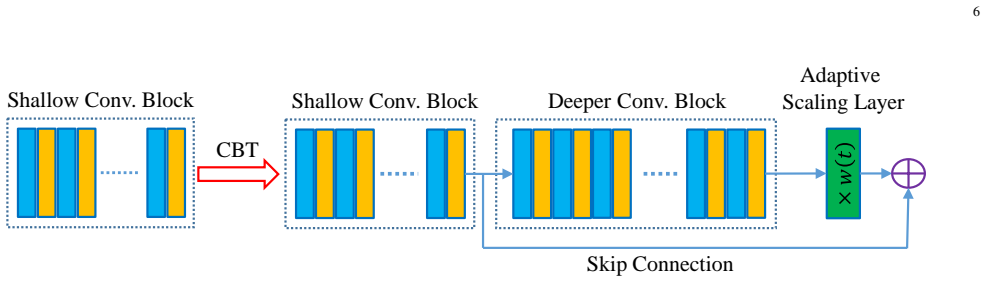
Three mechanisms carry the argument. Label inference: the discriminator's softmax probability is treated as a confidence score, and any unlabeled image with predicted probability above $\alpha=0.98$ is assigned that predicted label and moved into the training pool. Convolution-block-transformation (CBT): when the network grows from baby to junior to senior, newly added convolution blocks are initialized with Gaussian noise, an identity shortcut is added, and their output is scaled by the adaptive factor $w(t)=1-e^{-t}$, so the shallow network's learned function is preserved while the deeper block gradually takes over. Maximum mean discrepancy (MMD), computed with an inner-product kernel, replaces the $\ell^1$ distance in the generator's feature-matching objective, which the authors find stabilizes training and avoids mode collapse. The discriminator plays two roles at once: adversary in the min-max game and semi-supervised classifier whose confident outputs create new training labels.
What would settle it
Measure the precision of the discriminator's predictions on held-out labeled images at the 0.98 threshold: if a substantial fraction of these high-confidence predictions are wrong, or if a variant that randomly flips a small percentage of pseudo-labels matches the original accuracy, then the label-inference assumption is not what drives the reported gains.
Extended reading notes
Core claim
On its own terms, the paper claims that a single training pipeline can start from a small GAN, use the trained discriminator to pseudo-label unlabeled images with confidence above $\alpha=0.98$, grow the generator and discriminator deeper via convolution-block-transformation, and repeat. On the CelebA face attribute dataset, SGGAN trained with 7,200 labeled images (about 4% of the training set) reaches an average accuracy around 86%, only slightly below the fully supervised LNet+ANet at 87% and above all other compared methods, including Improved GAN and fine-tuned VGG-16 and ResNet-50 at the same label budget. On CIFAR-10 and SVHN, SGGAN reports lower test error than Improved GAN at every label budget tested, with the largest gap at 4,000 CIFAR-10 labels (15.65% versus 18.63%). The authors also report that using MMD as the feature-matching objective lowers the generator's training loss compared with the $\ell^1$ distance, and that the senior generator produces visibly better samples than the baby one.
Load-bearing premise
The method assumes that unlabeled images the discriminator labels with probability above 0.98 are correct often enough that adding them as pseudo-labeled training data improves the classifier rather than injecting noise; if the error rate among those high-confidence predictions is not very low, the self-training loop can amplify errors.
Editorial extensions
If this is right
- With only about 4% labeled facial attributes on CelebA, SGGAN matches leading fully supervised methods and beats other semi-supervised GANs on most attributes.
- On CIFAR-10 and SVHN, SGGAN lowers test error relative to Improved GAN at each reported label budget, a direct corollary of its claimed label-inference and stabilization gains.
- Adding a large external pool of unlabeled images (CelebA) improves LFW-a accuracy by about 6 percentage points, showing the method converts unlabeled volume into accuracy.
- The self-growing route through all three generations beats any single-generation model, indicating that depth growth is itself part of the performance gain.
- Using MMD instead of $\ell^1$ for feature matching lowers the generator's training loss, which the paper ties to more stable GAN training.
Reading between the lines
- The fixed threshold $\alpha=0.98$ is chosen on a validation set per attribute; a calibrated or per-class threshold might extend the method to datasets with skewed classes, a test the paper does not run.
- CBT is a general weight-transfer recipe: nothing limits it to GANs, so the same grow-deeper-while-preserving-features idea could apply to any deep classifier trained with scarce labels.
- The claim that 4% labeled data suffices is demonstrated on face attributes; a natural extension is to test whether the same recipe transfers to domains with less structured or more ambiguous classes, such as medical images or scene recognition.
- If the discriminator's probabilities are miscalibrated, the 0.98 threshold may not mean high precision; checking precision-recall on a hold-out set at that threshold would tell whether pseudo-labels are truly clean.
Signed reviews
Editorial analysis
A structured set of objections, weighed in public.
Referee Report
Summary. The paper proposes a semi-supervised generative adversarial network called SGGAN for image recognition. The method combines three components: (i) a self-training label-inference step in which unlabeled images whose predicted confidence exceeds a threshold (set to 0.98) are added to the labeled pool; (ii) a self-growing network architecture in which baby, junior, and senior generator/discriminator pairs are trained successively, with weights transferred through a proposed convolution-block-transformation (CBT) technique; and (iii) a feature-matching objective based on maximum mean discrepancy (MMD) instead of the L1 distance used in Improved GANs. Experiments are reported on CIFAR-10, SVHN, CelebA, and LFW-a. The abstract's headline claim is that with only about 4% labeled facial attributes (7,200 images) on CelebA, SGGAN achieves accuracy comparable to fully supervised deep learning methods trained on all labels.
Significance. If the results hold, the paper would make a useful contribution: it would demonstrate that a self-growing GAN with pseudo-labeling can approach supervised performance on face attribute recognition with a very small labeled fraction, and it provides evidence that MMD feature matching and the CBT growth mechanism improve training stability on the tested datasets. The paper has several concrete strengths: experiments span four datasets; ablations isolate the self-growing route, the MMD versus L1 objective, and the CBT versus no-CBT transfer; and comparisons include both semi-supervised GAN baselines and fully supervised VGG/ResNet baselines. The main reservation is that the central mechanism, threshold-based pseudo-label inference, is never directly validated by measuring the correctness of the selected pseudo-labels or by ablating the label-inference step, so the significance of the headline claim is conditional on an assumption that remains untested.
major comments (4)
- [III.A.3, III.E.2, IV.B, Table V] The central claim that SGGAN matches supervised accuracy with 4% labeled CelebA attributes rests on the assumption that unlabeled images with predicted probability above alpha=0.98 are labeled correctly by the discriminator. This assumption is asserted in Section III.A.3 and Section III.E.2 but never verified. The paper does not report the precision of the pseudo-labels selected at this threshold, the number of selected images per class, or the class distribution of the selected set, and the ablation study in Section IV.B does not include a run with the label-inference step disabled while MMD and CBT are kept active. Without such an ablation, the gains in Table VII could in principle come from adding systematically biased high-confidence examples rather than from correct label inference. The non-monotonic CIFAR-10 row in Table V (15.65% error with 4,000 labels versus 16.51% with 8,000 labels) is consistent with pseudo-label noise and further motivates this measurement. Please add (i) a direct evaluation of pseudo-label precision and selection statistics on the validation set, (ii) a "no label inference" ablation, and (iii) a per-dataset justification of the 0.98 threshold rather than transferring the CelebA-tuned value to CIFAR-10 and SVHN.
- [III.D, Eq. (5)] The discriminator loss in Eq. (5) is not well specified. The text states that xi, gi, and ui represent outputs before the softmax activation, but the supervised term is written as -sum_i label_i * log(x_i); log of a pre-softmax logit is not the cross-entropy loss. If xi is instead intended to be the softmax output, then the statement "before softmax activation" is wrong. This is a load-bearing technical detail because Eq. (5) defines the training objective of the method. Please rewrite Eq. (5) with a clear distinction between logits and posterior probabilities, or state explicitly that the fake-class logit is fixed to zero and that the labeled term uses softmax probabilities.
- [III.C, Eq. (2)] The witness function in Eq. (2) is written incorrectly. The standard RKHS witness function for the MMD is f(.) = E_{x~p_data}[K(x, .)] - E_{z~p_z}[K(G(z), .)], a function of a single argument; Eq. (2) as printed mixes the free variable x and the generator variable G(z) inside the kernel in a way that does not define a valid witness function. Although Eq. (3) and Eq. (4) are recognizably the correct squared-MMD expressions, the error in Eq. (2) makes the method description inconsistent and should be corrected.
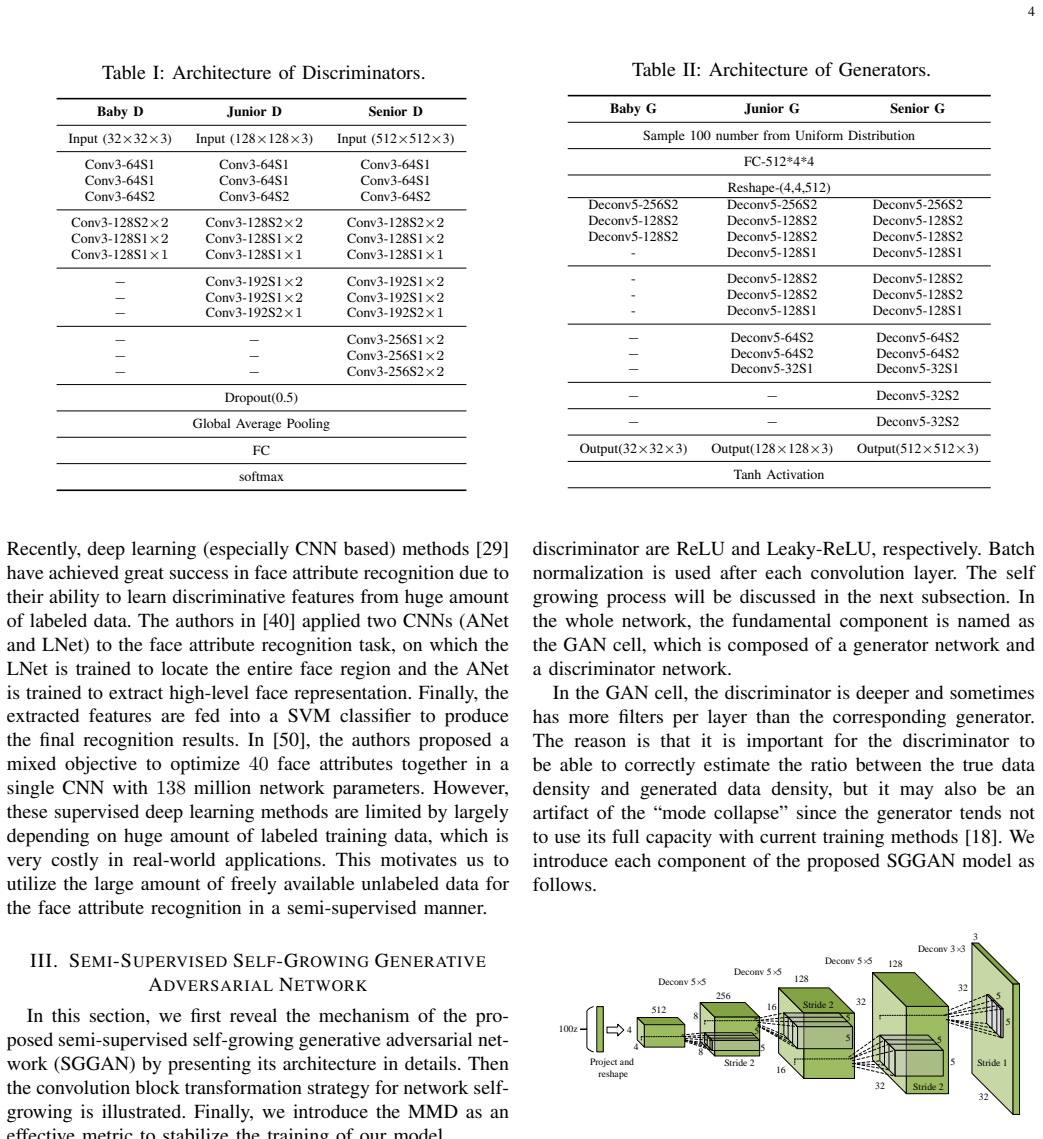
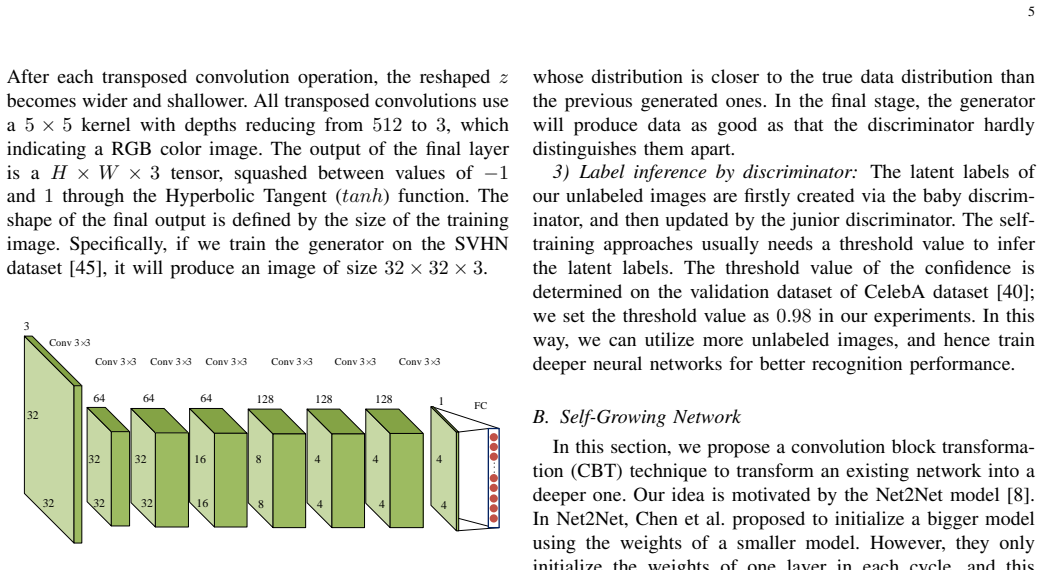
- [III.A, Tables I and II, Section IV.C] The self-growing schedule is not explained for the 32x32 image datasets. Table I lists the junior discriminator as taking 128x128x3 input and the senior discriminator as taking 512x512x3 input, while CIFAR-10 and SVHN experiments use 32x32 images. The paper does not state whether the junior and senior cells are trained at all on these datasets, whether images are resized or upscaled, or whether only the baby cell is used for the results in Tables V and VI. This is essential for reproducibility and for interpreting the claimed benefit of self-growing on CIFAR-10/SVHN. Please specify the exact growth schedule for each dataset or, if only the baby cell is used, say so explicitly.
minor comments (5)
- [IV.A (CelebA description)] The dataset split description is internally inconsistent: it first says 19,962 images are used as the testing set and the others as training/validation, but then says a small subset is randomly selected as the training set and the others as the testing set. Please clarify the exact split used for CelebA.
- [Figure 10 caption] The caption of Figure 10 says "The loss function of the SGGAN model trained with the CBT v.s. without CBT" but the vertical axis is labeled "Accuracy". The caption should be corrected.
- [Algorithm 1] Step 11 of Algorithm 1 ("Initialize a deeper model by using CBT preservation technique") appears visually outside the epoch/batch loops, which makes the timing of the self-growing step ambiguous. Indicate explicitly whether this step is executed after every epoch, after a fixed schedule, or once after the loop.
- [III.A.3 and III.E.2] The text says in Section III.A.3 that the threshold is determined on the validation set of CelebA, while Section III.E.2 says the threshold is determined by grid search on the validation set of benchmark datasets. Please state which validation set was used for each dataset and report the grid search range.
- [III.E.2] There is a grammatical error in the phrase "Comparing to the than the shallower network" in Section III.E.2; the sentence should be rewritten.
Circularity Check
No circularity: the 4%-labeled accuracy claim is an empirical, held-out test result; the pseudo-label threshold is a validation-set hyperparameter.
full rationale
The paper's derivation chain is entirely empirical: SGGAN is constructed from published components (Improved GAN feature matching [52], MMD [14,19], and a Net2Net-inspired convolution-block transformation [8]) and is evaluated on held-out test sets against external baselines, so the central 4%-labeled claim is not an input to the method. The pseudo-label threshold alpha=0.98 is selected on the CelebA validation set (Section III.A.3) and used only as a training hyperparameter; it is not later reported as a prediction, and no equation equates the reported accuracy with this fit. Algorithm 1's feedback loop—the discriminator labels unlabeled examples and is then trained on them—is the algorithm itself, not a derived result, so it does not constitute self-definitional circularity in the sense of a claimed derivation. Self-citations in the reference list are numerous but none is load-bearing; the MMD and feature-matching losses are credited to external prior work [14,19,52]. Two non-circular weaknesses should be flagged: Section I contains a literal '[?]' placeholder in the semi-supervised learning citation list, and the contribution list asserts without proof that 'We prove it is easier to train a model growing from a shallow network to a deep one'; additionally, the paper does not report pseudo-label precision at alpha=0.98, which is a reproducibility and correctness concern rather than a circularity. No circular step was found.
Assumptions & free parameters
free parameters (3)
- alpha (label inference threshold) =
0.98
- self-growing route (baby+junior+senior) =
baby+junior+senior
- adaptive scaling function w(t) =
1-e^{-t} with t ambiguously defined
assumptions (4)
- domain assumption Self-training assumption: high-confidence discriminator predictions on unlabeled data are mostly correct and can be used as labels.
- domain assumption Deeper networks generalize better and can learn from pseudo-labeled data.
- domain assumption MMD with inner product kernel is a suitable feature matching objective.
- ad hoc to paper The Improved GAN loss can be written with the fake logit fixed to zero.
Cite this review
Pith. "Pith review of Semi-Supervised Self-Growing Generative Adversarial Networks for Image Recognition." pith.science (2026). https://pith.science/paper/6QVLTOAJ
@misc{pith2026190803850,
  author       = {Pith},
  title        = {Pith review of: Semi-Supervised Self-Growing Generative Adversarial Networks for Image Recognition},
  year         = {2026},
  howpublished = {\url{https://pith.science/paper/6QVLTOAJ}},
  note         = {Machine review of arXiv:1908.03850}
}
read the original abstract
Image recognition is an important topic in computer vision and image processing, and has been mainly addressed by supervised deep learning methods, which need a large set of labeled images to achieve promising performance. However, in most cases, labeled data are expensive or even impossible to obtain, while unlabeled data are readily available from numerous free on-line resources and have been exploited to improve the performance of deep neural networks. To better exploit the power of unlabeled data for image recognition, in this paper, we propose a semi-supervised and generative approach, namely the semi-supervised self-growing generative adversarial network (SGGAN). Label inference is a key step for the success of semi-supervised learning approaches. There are two main problems in label inference: how to measure the confidence of the unlabeled data and how to generalize the classifier. We address these two problems via the generative framework and a novel convolution-block-transformation technique, respectively. To stabilize and speed up the training process of SGGAN, we employ the metric Maximum Mean Discrepancy as the feature matching objective function and achieve larger gain than the standard semi-supervised GANs (SSGANs), narrowing the gap to the supervised methods. Experiments on several benchmark datasets show the effectiveness of the proposed SGGAN on image recognition and facial attribute recognition tasks. By using the training data with only 4% labeled facial attributes, the SGGAN approach can achieve comparable accuracy with leading supervised deep learning methods with all labeled facial attributes.
Figures

Figures from the paper (7 more)


Reference graph
Works this paper leans on
-
[1]
A pid controller approach for stochastic optimization of deep networks
Wangpeng An, Haoqian Wang, Qingyun Sun, Jun Xu, Qionghai Dai, and Lei Zhang. A pid controller approach for stochastic optimization of deep networks. In The IEEE Conference on Computer Vision and Pattern Recognition (CVPR), June 2018
work page 2018
-
[2]
Towards principled methods for training generative adversarial networks
Martin Arjovsky and L ´eon Bottou. Towards principled methods for training generative adversarial networks. In ICLR, 2017
work page 2017
-
[3]
Wasserstein generative adversarial networks
Mart ´ın Arjovsky, Soumith Chintala, and L ´eon Bottou. Wasserstein generative adversarial networks. In Proceedings of the 34th International Conference on Machine Learning, ICML 2017, Sydney, NSW, Australia, 6-11 August 2017 , pages 214–223, 2017
work page 2017
-
[4]
Thomas Berg and Peter Belhumeur. Poof: Part-based one-vs.-one features for fine-grained categorization, face verification, and attribute estimation. In CVPR, 2013
work page 2013
-
[5]
Describing people: A poselet-based approach to attribute classification
Lubomir Bourdev, Subhransu Maji, and Jitendra Malik. Describing people: A poselet-based approach to attribute classification. In ICCV, 2011
work page 2011
-
[6]
Olivier Chapelle, Bernhard Schlkopf, and Alexander Zien. Semi- Supervised Learning. The MIT Press, 1st edition, 2010
work page 2010
-
[7]
K. Chen and W. Tao. Convolutional regression for visual tracking. IEEE Transactions on Image Processing , PP(99):1–1, 2018
work page 2018
-
[8]
Goodfellow, and Jonathon Shlens
Tianqi Chen, Ian J. Goodfellow, and Jonathon Shlens. Net2net: Accel- erating learning via knowledge transfer. In ICLR, 2016
work page 2016
Show all 79 references
-
[9]
Semi-supervised multimodal deep learning for rgb-d object recognition
Yanhua Cheng, Xin Zhao, Rui Cai, Zhiwei Li, Kaiqi Huang, and Yong Rui. Semi-supervised multimodal deep learning for rgb-d object recognition. In IJCAI, 2016
2016
-
[10]
Semi-supervised learning of facial attributes in video
Neva Cherniavsky, Ivan Laptev, Josef Sivic, and Andrew Zisserman. Semi-supervised learning of facial attributes in video. In ECCV, 2010
2010
-
[11]
Semi-supervised sequence learning
Andrew M Dai and Quoc V Le. Semi-supervised sequence learning. In C. Cortes, N. D. Lawrence, D. D. Lee, M. Sugiyama, and R. Garnett, editors, Advances in Neural Information Processing Systems 28 , pages 3079–3087. Curran Associates, Inc., 2015
2015
-
[12]
J. Deng, W. Dong, R. Socher, L.-J. Li, K. Li, and L. Fei-Fei. ImageNet: A Large-Scale Hierarchical Image Database. In CVPR, 2009. 13
2009
-
[13]
Adversarial feature learning
Jeff Donahue, Philipp Kr ¨ahenb¨uhl, and Trevor Darrell. Adversarial feature learning. arXiv preprint arXiv:1605.09782 , 2016
2016 arXiv
-
[14]
Training generative neural networks via maximum mean discrepancy optimization
Gintare Karolina Dziugaite, Daniel M Roy, and Zoubin Ghahramani. Training generative neural networks via maximum mean discrepancy optimization. UAI, 2015
2015
-
[15]
Z. Feng, J. Lai, and X. Xie. Learning view-specific deep networks for person re-identification. IEEE Transactions on Image Processing , PP(99):1–1, 2018
2018
-
[16]
Yuan Gao, Jiayi Ma, and Alan L. Yuille. Semi-supervised sparse representation based classification for face recognition with insufficient labeled samples. CoRR, abs/1609.03279, 2016
2016 arXiv
-
[17]
Generative adversarial nets
Ian Goodfellow, Jean Pouget-Abadie, Mehdi Mirza, Bing Xu, David Warde-Farley, Sherjil Ozair, Aaron Courville, and Yoshua Bengio. Generative adversarial nets. In NIPS, 2014
2014
-
[18]
Goodfellow
Ian J. Goodfellow. NIPS 2016 tutorial: Generative adversarial networks. CoRR, abs/1701.00160, 2017
2016 arXiv
-
[19]
A kernel two-sample test
Arthur Gretton, Karsten M Borgwardt, Malte J Rasch, Bernhard Sch¨olkopf, and Alexander Smola. A kernel two-sample test. Journal of Machine Learning Research , 13(Mar):723–773, 2012
2012
-
[20]
Digital selection and analogue amplifi- cation coexist in a cortex-inspired silicon circuit
Richard HR Hahnloser, Rahul Sarpeshkar, Misha A Mahowald, Rodney J Douglas, and H Sebastian Seung. Digital selection and analogue amplifi- cation coexist in a cortex-inspired silicon circuit. Nature, 405(6789):947, 2000
2000
-
[21]
Deep residual learning for image recognition
Kaiming He, Xiangyu Zhang, Shaoqing Ren, and Jian Sun. Deep residual learning for image recognition. In CVPR, 2016
2016
-
[22]
Nlh: A blind pixel-level non-local method for real-world image denoising, 2019
Yingkun Hou, Jun Xu, Guanghai Liu, Li Liu, Fan Zhu, and Ling Shao. Nlh: A blind pixel-level non-local method for real-world image denoising, 2019
2019
-
[23]
Hospedales, and Jakob Verbeek
Guosheng Hu, Xiaojiang Peng, Yongxin Yang, Timothy M. Hospedales, and Jakob Verbeek. Frankenstein: Learning deep face representations using small data. IEEE Trans. Image Processing, 27(1):293–303, 2018
2018
-
[24]
Huang, Manu Ramesh, Tamara Berg, and Erik Learned-Miller
Gary B. Huang, Manu Ramesh, Tamara Berg, and Erik Learned-Miller. Labeled faces in the wild: A database for studying face recognition in unconstrained environments. Technical Report 07-49, 2007
2007
-
[25]
Batch normalization: Accelerating deep network training by reducing internal covariate shift
Sergey Ioffe and Christian Szegedy. Batch normalization: Accelerating deep network training by reducing internal covariate shift. CoRR, abs/1502.03167, 2015
2015 arXiv
-
[26]
Semi-supervised learning with deep generative models
Diederik P Kingma, Shakir Mohamed, Danilo Jimenez Rezende, and Max Welling. Semi-supervised learning with deep generative models. In Advances in Neural Information Processing Systems , pages 3581– 3589, 2014
2014
-
[27]
Suspect identification based on descriptive facial attributes
Brendan F Klare, Scott Klum, Joshua C Klontz, Emma Taborsky, Tayfun Akgul, and Anil K Jain. Suspect identification based on descriptive facial attributes. In IJCB, 2014
2014
-
[28]
Learning multiple layers of features from tiny images
Alex Krizhevsky. Learning multiple layers of features from tiny images. 2009
2009
-
[29]
Imagenet classification with deep convolutional neural networks
Alex Krizhevsky, Ilya Sutskever, and Geoffrey E Hinton. Imagenet classification with deep convolutional neural networks. In NIPS, 2012
2012
-
[30]
Facetracer: A search engine for large collections of images with faces
Neeraj Kumar, Peter Belhumeur, and Shree Nayar. Facetracer: A search engine for large collections of images with faces. In ECCV, 2008
2008
-
[31]
Describable visual attributes for face verification and image search
Neeraj Kumar, Alexander Berg, Peter N Belhumeur, and Shree Nayar. Describable visual attributes for face verification and image search. IEEE Transactions on Pattern Analysis and Machine Intelligence , 33(10):1962–1977, 2011
1962
-
[32]
Attribute and simile classifiers for face verification
Neeraj Kumar, Alexander C Berg, Peter N Belhumeur, and Shree K Nayar. Attribute and simile classifiers for face verification. In ICCV, 2009
2009
-
[33]
Gradient-based learning applied to document recognition
Yann LeCun, L ´eon Bottou, Yoshua Bengio, and Patrick Haffner. Gradient-based learning applied to document recognition. Proceedings of the IEEE , 86(11):2278–2324, 1998
1998
-
[34]
Mmd gan: Towards deeper understanding of moment matching network
Chun-Liang Li, Wei-Cheng Chang, Yu Cheng, Yiming Yang, and Barnabas Poczos. Mmd gan: Towards deeper understanding of moment matching network. In I. Guyon, U. V . Luxburg, S. Bengio, H. Wallach, R. Fergus, S. Vishwanathan, and R. Garnett, editors, Advances in Neural Information...
2017
-
[35]
J. Li, B. Li, J. Xu, R. Xiong, and W. Gao. Fully connected network- based intra prediction for image coding. IEEE Transactions on Image Processing, PP(99):1–1, 2018
2018
-
[36]
A hybrid l1-l0 layer decomposition model for tone mapping
Zhetong Liang, Jun Xu, David Zhang, Zisheng Cao, and Lei Zhang. A hybrid l1-l0 layer decomposition model for tone mapping. In The IEEE Conference on Computer Vision and Pattern Recognition (CVPR) , June 2018
2018
-
[37]
Classification and regression by randomforest
Andy Liaw, Matthew Wiener, et al. Classification and regression by randomforest. R news, 2(3):18–22, 2002
2002
-
[38]
D. Liu, Z. Wang, Y . Fan, X. Liu, Z. Wang, S. Chang, X. Wang, and T. S. Huang. Learning temporal dynamics for video super-resolution: A deep learning approach. IEEE Transactions on Image Processing , PP(99):1–1, 2018
2018
-
[39]
Liu and J
N. Liu and J. Han. A deep spatial contextual long-term recurrent convolutional network for saliency detection. IEEE Transactions on Image Processing, PP(99):1–1, 2018
2018
-
[40]
Deep learning face attributes in the wild
Ziwei Liu, Ping Luo, Xiaogang Wang, and Xiaoou Tang. Deep learning face attributes in the wild. In ICCV, 2015
2015
-
[41]
Auxiliary deep generative models
Lars Maaløe, Casper Kaae Sønderby, Søren Kaae Sønderby, and Ole Winther. Auxiliary deep generative models. arXiv preprint arXiv:1602.05473, 2016
2016 arXiv
-
[42]
Maas, Awni Y
Andrew L. Maas, Awni Y . Hannun, and Andrew Y . Ng. Rectifier nonlinearities improve neural network acoustic models. 2013
2013
-
[43]
Distributional smoothing with virtual adversarial training
Takeru Miyato, Shin-ichi Maeda, Masanori Koyama, Ken Nakae, and Shin Ishii. Distributional smoothing with virtual adversarial training. arXiv preprint arXiv:1507.00677 , 2015
2015 arXiv
-
[44]
Nascimento and Gustavo Carneiro
Jacinto C. Nascimento and Gustavo Carneiro. Deep learning on sparse manifolds for faster object segmentation. IEEE Trans. Image Processing, 26(10):4978–4990, 2017
2017
-
[45]
Reading digits in natural images with unsupervised feature learning
Yuval Netzer, Tao Wang, Adam Coates, Alessandro Bissacco, Bo Wu, and Andrew Y Ng. Reading digits in natural images with unsupervised feature learning. In ICCV workshop, 2011
2011
-
[46]
Learning to generate reviews and discovering sentiment
Alec Radford, Rafal J ´ozefowicz, and Ilya Sutskever. Learning to generate reviews and discovering sentiment. CoRR, abs/1704.01444, 2017
2017 arXiv
-
[47]
Unsupervised representation learning with deep convolutional generative adversarial networks
Alec Radford, Luke Metz, and Soumith Chintala. Unsupervised representation learning with deep convolutional generative adversarial networks. In ICLR, 2016
2016
-
[48]
Semi-supervised learning with ladder networks
Antti Rasmus, Mathias Berglund, Mikko Honkala, Harri Valpola, and Tapani Raiko. Semi-supervised learning with ladder networks. In NIPS, 2015
2015
-
[49]
Semi- supervised self-training of object detection models
Chuck Rosenberg, Martial Hebert, and Henry Schneiderman. Semi- supervised self-training of object detection models. 2005
2005
-
[50]
Moon: A mixed objective optimization network for the recognition of facial attributes
Ethan M Rudd, Manuel G ¨unther, and Terrance E Boult. Moon: A mixed objective optimization network for the recognition of facial attributes. In ECCV, 2016
2016
-
[51]
Berg, and Li Fei-Fei
Olga Russakovsky, Jia Deng, Hao Su, Jonathan Krause, Sanjeev Satheesh, Sean Ma, Zhiheng Huang, Andrej Karpathy, Aditya Khosla, Michael Bernstein, Alexander C. Berg, and Li Fei-Fei. ImageNet Large Scale Visual Recognition Challenge. IJCV, 115(3):211–252, 2015
2015
-
[52]
Goodfellow, Wojciech Zaremba, Vicki Cheung, Alec Radford, and Xi Chen
Tim Salimans, Ian J. Goodfellow, Wojciech Zaremba, Vicki Cheung, Alec Radford, and Xi Chen. Improved techniques for training gans. In NIPS, 2016
2016
-
[53]
Simonyan and A
K. Simonyan and A. Zisserman. Very deep convolutional networks for large-scale image recognition. In ICLR, 2015
2015
-
[54]
Unsupervised and semi-supervised learning with categorical generative adversarial networks
Jost Tobias Springenberg. Unsupervised and semi-supervised learning with categorical generative adversarial networks. 2016
2016
-
[55]
Least squares support vector machine classifiers
Johan AK Suykens and Joos Vandewalle. Least squares support vector machine classifiers. Neural processing letters , 9(3):293–300, 1999
1999
-
[56]
Going deeper with convolutions
Christian Szegedy, Wei Liu, Yangqing Jia, Pierre Sermanet, Scott Reed, Dragomir Anguelov, Dumitru Erhan, Vincent Vanhoucke, and Andrew Rabinovich. Going deeper with convolutions. In CVPR, 2015
2015
-
[57]
Learning multi- instance deep discriminative patterns for image classification
Peng Tang, Xinggang Wang, Bin Feng, and Wenyu Liu. Learning multi- instance deep discriminative patterns for image classification. IEEE Trans. Image Processing, 26(7):3385–3396, 2017
2017
-
[58]
Video salient object de- tection via fully convolutional networks
Wenguan Wang, Jianbing Shen, and Ling Shao. Video salient object de- tection via fully convolutional networks. IEEE Trans. Image Processing, 27(1):38–49, 2018
2018
-
[59]
Ranet: Ranking attention network for fast video object segmentation
Ziqin Wang, Jun Xu, Li Liu, Fan Zhu, and Ling Shao. Ranet: Ranking attention network for fast video object segmentation. In The IEEE International Conference on Computer Vision (ICCV) , Oct 2019
2019
-
[60]
Empirical evaluation of rectified activations in convolutional network
Bing Xu, Naiyan Wang, Tianqi Chen, and Mu Li. Empirical evaluation of rectified activations in convolutional network. CoRR, abs/1505.00853, 2015
2015 arXiv
-
[61]
J. Xu. Nonlocal self-similarity based prior modeling for image denois- ing. PhD thesis, The Hong Kong Polytechnic University, 2018
2018
-
[62]
J. Xu, Y . Huang, L. Liu, F. Zhu, X. Hou, and L. Shao. Noisy-as-clean: Learning unsupervised denoising from the corrupted image, 2019
2019
-
[63]
J. Xu, H. Li, Z. Liang, D. Zhang, and L. Zhang. Real-world noisy image denoising: A new benchmark. arXiv:1804.02603, 2018
2018 arXiv
-
[64]
J. Xu, D. Ren, L. Zhang, and D. Zhang. Patch group based bayesian learning for blind image denoising. Asian Conference on Computer Vision Workshop, pages 79–95, 2016
2016
-
[65]
J. Xu, L. Zhang, and D. Zhang. External prior guided internal prior learning for real-world noisy image denoising. IEEE Transactions on Image Processing, 27(6):2996–3010, June 2018
2018
-
[66]
J. Xu, L. Zhang, and D. Zhang. A trilateral weighted sparse coding scheme for real-world image denoising. In ECCV, 2018. 14
2018
-
[67]
J. Xu, L. Zhang, D. Zhang, and X. Feng. Multi-channel weighted nuclear norm minimization for real color image denoising. In ICCV, 2017
2017
-
[68]
J. Xu, L. Zhang, W. Zuo, D. Zhang, and X. Feng. Patch group based nonlocal self-similarity prior learning for image denoising. In ICCV, pages 244–252, 2015
2015
-
[69]
Sparse, collabora- tive, or nonnegative representation: Which helps pattern classification? Pattern Recognition, 88:679 – 688, 2019
Jun Xu, Wangpeng An, Lei Zhang, and David Zhang. Sparse, collabora- tive, or nonnegative representation: Which helps pattern classification? Pattern Recognition, 88:679 – 688, 2019
2019
-
[70]
Reweighted sparse subspace clustering
Jun Xu, Kui Xu, Ke Chen, and Jishou Ruan. Reweighted sparse subspace clustering. Computer Vision and Image Understanding , 138(0):25–37, 2015
2015
-
[71]
Star: A structure and texture aware retinex model, 2019
Jun Xu, Mengyang Yu, Li Liu, Fan Zhu, Dongwei Ren, Yingkun Hou, Haoqian Wang, and Ling Shao. Star: A structure and texture aware retinex model, 2019
2019
-
[72]
Tstss: A two-stage training subset selection framework for cross version defect prediction
Zhou Xu, Shuai Li, Xiapu Luo, Jin Liu, Tao Zhang, Yutian Tang, Jun Xu, Peipei Yuan, and Jacky Keung. Tstss: A two-stage training subset selection framework for cross version defect prediction. Journal of Systems and Software , 2019
2019
-
[73]
Cross version defect prediction with representative data via sparse subset selection
Zhou Xu, Shuai Li, Yutian Tang, Xiapu Luo, Tao Zhang, Jin Liu, and Jun Xu. Cross version defect prediction with representative data via sparse subset selection. In Proceedings of the 26th Conference on Program Comprehension, ICPC ’18, pages 132–143. ACM, 2018
2018
-
[74]
Panda: Pose aligned networks for deep attribute modeling
Ning Zhang, Manohar Paluri, Marc’Aurelio Ranzato, Trevor Darrell, and Lubomir Bourdev. Panda: Pose aligned networks for deep attribute modeling. In CVPR, 2014
2014
-
[75]
newdna-prot: Prediction of dna-binding proteins by employing support vector machine and a comprehensive sequence representation
Yanping Zhang, Jun Xu, Wei Zheng, Chen Zhang, Xingye Qiu, Ke Chen, and Jishou Ruan. newdna-prot: Prediction of dna-binding proteins by employing support vector machine and a comprehensive sequence representation. Computational Biology and Chemistry , 52(0):51–59, 2014
2014
-
[76]
Energy-based generative adversarial network
Junbo Jake Zhao, Micha ¨el Mathieu, and Yann LeCun. Energy-based generative adversarial network. CoRR, abs/1609.03126, 2016
2016 arXiv
-
[77]
Semi-supervised regression with co- training
Zhi-Hua Zhou and Ming Li. Semi-supervised regression with co- training. In IJCAI, volume 5, pages 908–913, 2005
2005
-
[78]
Introduction to semi-supervised learning
Xiaojin Zhu and Andrew B Goldberg. Introduction to semi-supervised learning. Synthesis lectures on artificial intelligence and machine learning, 3:1–130, 2009
2009
-
[79]
Zhuang, Z
L. Zhuang, Z. Zhou, S. Gao, J. Yin, Z. Lin, and Y . Ma. Label information guided graph construction for semi-supervised learning. IEEE Transactions on Image Processing , 26(9):4182–4192, Sept 2017
2017
Reviewed August 14, 2026 · model on record in the stance chip above.
Discussion (0). Continue with ORCID to comment.