REVIEW 3 major objections 5 minor 77 references
Stochastic Forces Enhance Tracer Diffusion in Non-motile Active Matter
T0 review · 3 major / 5 minor · reviewed 2026-08-05 · deepseek-v4-flash
Pith's one-line read Random reciprocal particle forces can enhance tracer diffusion beyond its bare value, even without self-propulsion or nonreciprocity.
desk verdict A careful microscopic derivation of a stochastic-force coarse-grained theory, with one honest verification gap: the tracer enhancement is shown in the continuum, not in the original lattice model. read the letter →
The pith
A machine-rendered reading of the paper's core claim, the machinery that carries it, and where it could break.
The reading
What carries the argument
The load-bearing object is the coarse-grained Gaussian field equation, Eq. (3): d_t phi = D0 d^2 phi - gamma d^4 phi + sqrt(2D1) d.Lambda + sqrt(A) d^2 xi. It is derived from a lattice model of partial exclusion augmented with two-particle hops that conserve center of mass and break detailed balance. The sqrt(A) d^2 xi term encodes the stochastic attractive interactions, vanishes when the interaction rate kr = 0, and is what makes the effective temperature depend on wavevector. The tracer calculation then reduces to a momentum integral, Eq. (9), in which this elevated short-wavelength temperature competes with the tracer's own deformation of the field.
What would settle it
Simulate the original lattice model with a weakly coupled tracer at parameters where Eq. (9) predicts Deff > Dy, for example n_bar = 4, kappa = 6, Dr about equal to kr, and h = 0.5, then measure the tracer's long-time mean-squared displacement; if Deff never exceeds Dy in the regime where D0 and gamma make the A-correction positive, the linearized field theory is not capturing the tracer transport.
Extended reading notes
Core claim
The paper's central claim is that interaction fluctuations, not directed motion, can make a tracer more diffusive. The coarse-grained density field has a wavevector-dependent effective temperature Teff(q) = T + (A/2mu_phi) q^2, where A is set by the stochastic pair-interaction rate. Computing the tracer's long-time diffusivity to second order in the tracer-field coupling h gives Eq. (9); the term proportional to A can make Deff/Dy exceed 1 when D0 and gamma satisfy the stated sign condition, and sufficiently large A then guarantees enhancement. The paper shows this cannot happen for equilibrium field dynamics with reciprocal coupling, so the enhancement is a genuinely nonequilibrium signatur
Load-bearing premise
The result stands on the assumption that the approximate linearized Gaussian field equation, Eq. (3), which discards higher-order gradient terms, correctly predicts tracer transport in the original particle-lattice model; the paper validates it against lattice simulations only for density correlation functions, not for the tracer's self-diffusion coefficient.
Editorial extensions
If this is right
- Dense phases can become better diffusers than dilute ones: tracer mobility can increase, not decrease, with suspension density under stochastic reciprocal interactions.
- The enhancement is non-monotonic in the interaction rate: it requires diffusion and interaction timescales to be comparable and is maximized at a finite kr, a regime the authors compare to stochastic resonance.
- The effective mobility of a dragged tracer is unaffected by A, so only spontaneous diffusivity is enhanced; forced response does not show the same activity-induced boost.
- The continuum equation is generic enough to apply to systems with isotropic active stresses, such as pili-mediated bacterial aggregates and cell tissues with junctional tension fluctuations.
- Since equilibrium Model B field dynamics always reduce Deff under reciprocal coupling, the sign of Deff - Dy provides a clean diagnostic for non-equilibrium interaction noise.
Reading between the lines
- Beyond the paper: direct lattice-model simulations of tracer mean-squared displacement at the same parameters as Fig. 3 would give the decisive test, because the paper validates Eq. (3) against the lattice model only for density correlations, not for the predicted tracer enhancement.
- Beyond the paper: because the Laplacian noise is isotropic, the same tracer enhancement should persist in two and three dimensions; extending the momentum integral there would test whether the sign condition survives changes in the ultraviolet cutoff.
- Beyond the paper: the finite-kr peak suggests an experimental signature: tune pili or adhesion binding/unbinding rates in a dense bacterial or cellular aggregate and measure tracer diffusivity, looking for a peak at intermediate rates.
- Beyond the paper: since mobility is unchanged while Deff increases, measuring both on the same tracer would yield a quantitative violation of the Einstein relation, a clean marker of this nonequilibrium noise.
Signed reviews
Editorial analysis
A structured set of objections, weighed in public.
Referee Report
Summary. This Letter studies whether purely reciprocal, stochastic pairwise interactions can enhance the diffusion of an external tracer particle in a non-motile active suspension. The authors introduce a one-dimensional lattice model with diffusive hopping and center-of-mass-conserving pairwise hops that break detailed balance. Using a Martin-Siggia-Rose action and gradient expansions, they derive a Gaussian field theory, Eq. (3), for density fluctuations with an additional Laplacian noise term proportional to sqrt(A). They validate this field theory against lattice simulations for density fluctuations only. They then couple a Brownian tracer to the field, compute its self-diffusion coefficient perturbatively to O(h^2), and obtain Eq. (9). They show that, under a stated condition on D0, gamma, and the ultraviolet cutoff, sufficiently large interaction-noise amplitude A can make D_eff > D_y. The analytic result is checked against numerical simulations of the same continuum coupled particle-field equations. The paper concludes that stochastic reciprocal forces are a generic route to enhanced tracer diffusivity in non-motile active matter.
Significance. If the microscopic-to-continuum step were fully closed, the paper would make a worthwhile contribution: it provides an explicit derivation of noise coefficients from a lattice model, identifies a q-dependent effective temperature T_eff(q), and demonstrates that the resulting non-equilibrium fluctuations can, in principle, reverse the usual decrease of tracer diffusivity under reciprocal coupling. The paper is careful in places, acknowledging that the coarse-graining is uncontrolled a priori and testing the density correlations quantitatively. It also makes a useful connection to prior work on hyperuniformity and fluctuating active stresses. However, the central advertised result, enhanced tracer diffusion in the active suspension, is not directly verified at the microscopic level. The paper ships no lattice-level tracer simulation, and the tracer calculation is carried out entirely within the coarse-grained Gaussian theory. As written, the claim that 'purely reciprocal stochastic interactions provide a distinct and generic route to enhanced diffusivity' is therefore stronger than the evidence supports.
major comments (3)
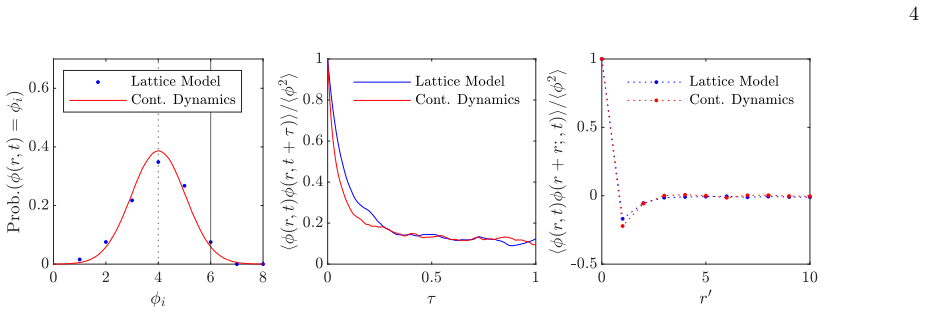
- [Self-diffusion coefficient section, Eq. (9) and Fig. 1] The central claim D_eff > D_y is established only for the continuum field theory Eq. (3), not for the original lattice model. Figure 1 and Supplementary §I.C validate the coarse-grained field only through the distribution of particle numbers and two-point density correlations. No tracer is ever defined or simulated in the lattice model, so the step from 'microscopic stochastic pairwise forces' to 'enhanced tracer diffusion' is not closed. Since Eq. (9) depends on the q^4 noise coefficient A and on the full tracer-field coupling h, agreement of low-q, equal-time and two-time density correlations in Fig. 1 is insufficient support. I request either (i) a lattice-level tracer simulation measuring the long-time MSD, or (ii) an explicit reframing of the result as a statement about the coarse-grained field theory with parameters derived from the lattice model.
- [Supplementary §II.E, Eq. (53); main-text Eq. (9)] The supplement states that Eq. (53) 'exactly matches Eq. (43) in Ref. [7] after replacing T_phi with T_phi Upsilon(q)'. With the identifications in §II.F, Eq. (9) is precisely the Dean–Demery result with T_phi replaced by T_eff(q). This is a valid and useful observation, and the microscopic derivation of T_eff(q) from the lattice model is the substantive new content. However, the main text presents the calculation as a new extension ('we extend these approaches...') without noting that the final transport expression follows from a direct substitution into a known formula. This overstates the novelty of the transport calculation and invites concerns about circularity. Please state the relation to Refs. [29,30] explicitly and position the contribution as the microscopic derivation of q-dependent effective temperature and its consequences.
- [After Eq. (2), Eq. (3), and the sign-condition discussion after Eq. (9)] The coarse-graining rests on two uncontrolled steps: discarding higher-order gradients and linearizing in phi. The paper acknowledges this, but the subsequent tracer calculation inherits both approximations, and the microscopic validation does not test them for the tracer observable. In addition, the sign condition for enhancement is stated through the ultraviolet cutoff: the text says that if -1 + D0 + gamma q_max^2 < 0 the A correction is negative, and otherwise it can be positive. This condition should be stated with the dependence on D_y made explicit (in the simulations D_y appears to be set to 1 without being stated in the main text), and the pointwise versus integrated sign of the A contribution should be clarified. As written, the criterion is not precise enough to be a reliable predictor, especially because the integrand of Eq. (9) contains denominators that weigh different q-re
minor comments (5)
- [Text after Eq. (7)] Typo: 'seperation' should be 'separation'.
- [Eq. (2)] The discrete Laplacian in the exponential e^{-∇^2 \tilde n_i} is not defined; please specify that centered finite differences are used.
- [Fig. 2 caption] The caption states D0 = gamma = D1 = 1 but does not list the tracer bare diffusivity D_y or the value of A used. Please provide the full parameter set, including the number of Fourier modes and the cutoff.
- [Supplementary §III] The Fourier-space simulation uses only Nq = 10 modes with q_i = {2π/Nq, ..., 2π}. A short convergence statement (e.g., insensitivity of D_eff to Nq) would strengthen the numerical comparison in Fig. 2.
- [Eq. (9) text] The expression 'in the case where −1 + D0 + γq_max^2 < 0' uses q_max but the integrand depends on q pointwise; the wording should distinguish the sign of the A-proportional part of the integrand from the sign of the full integrated correction.
Circularity Check
No significant circularity: the field theory is derived from the lattice rates without fitting; the tracer result is an acknowledged extension of known path-integral methods; validation is by direct simulation.
full rationale
The derivation chain is self-contained and non-circular. The coarse-grained equation (3) is obtained from the lattice master equation via an MSR action (Eq. (2) and Supp. I.B), with coefficients D0, gamma, D1 and A expressed explicitly in terms of microscopic rates (Eqs. (4)-(5)); no parameter is fitted to the tracer or to the field. The approximation of discarding higher-order gradient terms is explicitly labelled 'a priori uncontrolled' (main text after Eq. (2)) and is checked independently against lattice simulations for the particle-number distribution and two-point correlations (Fig. 1, Supp. I.C), not assumed. The tracer self-diffusion result (Eq. (9)) is derived from the coupled field-tracer dynamics (Eq. (7)) by perturbation theory; Fig. 2 simulates those same continuum equations, so it verifies the algebra rather than the coarse-graining, but this is a standard internal check, not a circular input. The paper honestly notes in Supp. II.E that the self-diffusion expression 'exactly matches that of Eq. (43) in Ref. [7] after replacing T_phi in their work with T_phi Upsilon(q)'; this is transparency about the method's lineage, not a renaming that substitutes for derivation, and the new physical content is the microscopic origin of Upsilon(q) and the resulting sign condition for D_eff > D_y. Self-citations to Refs. [41,52] provide background and prior modelling context but are not load-bearing for the tracer calculation, and no uniqueness theorem is imported. The genuine weakness is that no tracer is simulated in the original lattice model, so the enhancement is verified only at the continuum level; this is an external-validity limitation, not circularity.
Assumptions & free parameters
assumptions (7)
- domain assumption Linearization phi << nbar around mean-field density nbar is valid; only leading-order terms in phi are kept.
- ad hoc to paper Higher-order gradient terms in the coarse-grained action are dominated by leading-order terms and can be discarded.
- domain assumption The tracer and suspension dynamics are separated in length scales, and the tracer is weakly coupled (h small) so a perturbative expansion to order h^2 applies.
- ad hoc to paper A minimum wavelength (UV cutoff qmax = 2 pi) is imposed to avoid high-mode divergences.
- domain assumption D0 > 0 so the linearized dynamics are stable; the system is studied above the spinodal.
- standard math The MSR path-integral formalism and Wick's theorem provide exact manipulations for the lattice and field actions.
- domain assumption The lattice model with hopping rates alpha and beta captures the essential physics of stochastic reciprocal attractive forces in dense biological suspensions (pili, actin-myosin tension fluctuations).
Cite this review
Pith. "Pith review of Stochastic Forces Enhance Tracer Diffusion in Non-motile Active Matter." pith.science (2026). https://pith.science/paper/6QVUK6TW
@misc{pith2026250818882,
  author       = {Pith},
  title        = {Pith review of: Stochastic Forces Enhance Tracer Diffusion in Non-motile Active Matter},
  year         = {2026},
  howpublished = {\url{https://pith.science/paper/6QVUK6TW}},
  note         = {Machine review of arXiv:2508.18882}
}
read the original abstract
Stochasticity is a defining feature of the pairwise forces governing interactions in biological systems-from molecular motors to cell-cell adhesion-yet its consequences on large-scale dynamics remain poorly understood. Here, we show that reciprocal but randomly fluctuating interactions between particles create active suspensions which can enhance the diffusion of an external tracer particle, even in the absence of self-propulsion or non-reciprocity. Starting from a lattice model with pairwise dynamics that minimally break detailed balance, we derive a coarse-grained dynamical theory for spatio-temporal density fluctuations and reveal an elevated effective temperature at short wavelengths. We then compute the self-diffusion coefficient of a tracer particle weakly coupled to our active fluid, demonstrating that purely reciprocal stochastic interactions provide a distinct and generic route to enhanced diffusivity in dense non-equilibrium suspensions.
Figures


Figures from the paper (2 more)

Reference graph
Works this paper leans on
-
[7]
G. S. Redner, M. F. Hagan, and A. Baskaran, Structure and dynamics of a phase-separating active colloidal fluid, Phys. Rev. Lett. 110, 055701 (2013)
work page 2013
-
[1]
A. Einstein, ¨Uber die von der molekularkinetischen the- orie der ¨ arme geforderte bewegung von in ruhenden 6 fl¨ ussigkeiten suspendierten teilchen, Annalen der Physik 322, 549 (1905)
work page 1905
-
[2]
Einstein, Eine neue bestimmung der molek¨ uldimensionen, Annalen der Physik 324, 289 (1906)
A. Einstein, Eine neue bestimmung der molek¨ uldimensionen, Annalen der Physik 324, 289 (1906)
work page 1906
-
[3]
eine neue bestimmung der molek¨ uldimensionen
A. Einstein, Berichtigung zu meiner arbeit: “eine neue bestimmung der molek¨ uldimensionen”, Annalen der Physik 339, 591 (1911)
work page 1911
-
[4]
Vicsek, A
T. Vicsek, A. Czir´ ok, E. Ben-Jacob, I. Cohen, and O. Shochet, Novel type of phase transition in a system of self-driven particles, Phys. Rev. Lett. 75, 1226 (1995)
1995
-
[5]
J. Toner and Y. Tu, Long-range order in a two- dimensional dynamical xy model: How birds fly together, Phys. Rev. Lett. 75, 4326 (1995)
work page 1995
-
[6]
Y. Fily and M. C. Marchetti, Athermal phase separation of self-propelled particles with no alignment, Phys. Rev. Lett. 108, 235702 (2012)
work page 2012
- [8]
Show all 77 references
-
[9]
Besse, G
M. Besse, G. Fausti, M. E. Cates, B. Delamotte, and C. Nardini, Interface roughening in nonequilibrium phase-separated systems, Phys. Rev. Lett. 130, 187102 (2023)
2023
-
[10]
M. C. Marchetti, J. F. Joanny, S. Ramaswamy, T. B. Liverpool, J. Prost, M. Rao, and R. A. Simha, Hydrody- namics of soft active matter, Rev. Mod. Phys. 85, 1143 (2013)
2013
-
[11]
Bechinger, R
C. Bechinger, R. Di Leonardo, H. L¨ owen, C. Reichhardt, G. Volpe, and G. Volpe, Active particles in complex and crowded environments, Reviews of Modern Physics 88, 045006 (2016)
2016
-
[12]
Tailleur, G
J. Tailleur, G. Gompper, M. C. Marchetti, J. M. Yeo- mans, and C. Salomon, Active Matter and Nonequi- librium Statistical Physics: Lecture Notes of the Les Houches Summer School (Oxford University Press, Ox- ford, 2022)
2022
-
[13]
M. J. Bowick, N. Fakhri, M. C. Marchetti, and S. Ra- maswamy, Symmetry, thermodynamics, and topology in active matter, Phys. Rev. X 12, 010501 (2022)
2022
-
[14]
Gompper, R
G. Gompper, R. G. Winkler, T. Speck, A. Solon, C. Nar- dini, F. Peruani, H. L¨ owen, R. Golestanian, U. B. Kaupp, L. Alvarez, T. Kiørboe, E. Lauga, W. C. K. Poon, A. DeSimone, S. Mui˜ nos-Landin, A. Fischer, N. A. S¨ oker, F. Cichos, R. Kapral, P. Gaspard, M. Ripoll, F. Sagues...
2020
-
[15]
Seifert, Entropy Production along a Stochastic Tra- jectory and an Integral Fluctuation Theorem, Phys
U. Seifert, Entropy Production along a Stochastic Tra- jectory and an Integral Fluctuation Theorem, Phys. Rev. Lett. 95, 040602 (2005)
2005
-
[16]
M. E. Cates and J. Tailleur, Motility-induced phase sep- aration, Annual Review of Condensed Matter Physics 6, 219 (2015)
2015
-
[17]
Chat´ e, Dry aligning dilute active matter, Annual Re- view of Condensed Matter Physics 11, 189 (2020)
H. Chat´ e, Dry aligning dilute active matter, Annual Re- view of Condensed Matter Physics 11, 189 (2020)
2020
-
[18]
Baconnier, O
P. Baconnier, O. Dauchot, V. D´ emery, G. D¨ uring, S. Henkes, C. Huepe, and A. Shee, Self-aligning polar active matter, Rev. Mod. Phys. 97, 015007 (2025)
2025
-
[19]
Bouchaud and A
J.-P. Bouchaud and A. Georges, Anomalous diffusion in disordered media: Statistical mechanisms, models and physical applications, Physics Reports 195, 127 (1990)
1990
-
[20]
D. S. Dean, I. T. Drummond, and R. R. Horgan, Ef- fective transport properties for diffusion in random me- dia, Journal of Statistical Mechanics: Theory and Exper- iment 2007, P07013 (2007)
2007
-
[21]
P. C. Bressloff and J. M. Newby, Stochastic models of intracellular transport, Rev. Mod. Phys. 85, 135 (2013)
2013
-
[22]
P. C. Bressloff, Stochastic Processes in Cell Biology (Springer International Publishing, 2014)
2014
-
[23]
Wu and A
X.-L. Wu and A. Libchaber, Particle diffusion in a quasi- two-dimensional bacterial bath, Phys. Rev. Lett. 84, 3017 (2000)
2000
-
[24]
K. C. Leptos, J. S. Guasto, J. P. Gollub, A. I. Pesci, and R. E. Goldstein, Dynamics of enhanced tracer diffusion in suspensions of swimming eukaryotic microorganisms, Phys. Rev. Lett. 103, 198103 (2009)
2009
-
[25]
R. D. Leonardo, L. Angelani, D. Dell’Arciprete, G. Ruocco, V. Iebba, S. Schippa, M. P. Conte, F. Mecarini, F. D. Angelis, and E. D. Fabrizio, Bacterial ratchet motors, Proceedings of the National Academy of Sciences 107, 9541 (2010)
2010
-
[26]
Sokolov, M
A. Sokolov, M. M. Apodaca, B. A. Grzybowski, and I. S. Aranson, Swimming bacteria power microscopic gears, Proceedings of the National Academy of Sciences 107, 969 (2010)
2010
-
[27]
Granek, Y
O. Granek, Y. Kafri, and J. Tailleur, Anomalous trans- port of tracers in active baths, Phys. Rev. Lett. 129, 038001 (2022)
2022
-
[28]
Granek, Y
O. Granek, Y. Kafri, M. Kardar, S. Ro, J. Tailleur, and A. Solon, Colloquium: Inclusions, boundaries, and disor- der in scalar active matter, Rev. Mod. Phys. 96, 031003 (2024)
2024
-
[29]
D. S. Dean and V. D´ emery, Diffusion of active tracers in fluctuating fields, Journal of Physics: Condensed Matter 23, 234114 (2011)
2011
-
[30]
D´ emery and D
V. D´ emery and D. S. Dean, Perturbative path-integral study of active- and passive-tracer diffusion in fluctuating fields, Phys. Rev. E 84, 011148 (2011)
2011
-
[31]
D´ emery, O
V. D´ emery, O. B´ enichou, and H. Jacquin, Generalized langevin equations for a driven tracer in dense soft col- loids: construction and applications, New Journal of Physics 16, 053032 (2014)
2014
-
[32]
Benois, M
A. Benois, M. Jardat, V. Dahirel, V. D´ emery, J. Agudo- Canalejo, R. Golestanian, and P. Illien, Enhanced diffu- sion of tracer particles in nonreciprocal mixtures, Phys. Rev. E 108, 054606 (2023)
2023
-
[33]
Agudo-Canalejo and R
J. Agudo-Canalejo and R. Golestanian, Active phase sep- aration in mixtures of chemically interacting particles, Phys. Rev. Lett. 123, 018101 (2019)
2019
-
[34]
S. A. M. Loos and S. H. L. Klapp, Irreversibility, heat and information flows induced by non-reciprocal interactions, New Journal of Physics 22, 123051 (2020)
2020
-
[35]
S. Saha, J. Agudo-Canalejo, and R. Golestanian, Scalar active mixtures: The nonreciprocal cahn-hilliard model, Phys. Rev. X 10, 041009 (2020)
2020
-
[36]
Fruchart, R
M. Fruchart, R. Hanai, P. B. Littlewood, and V. Vitelli, Non-reciprocal phase transitions, Nature 592, 363 (2021)
2021
-
[37]
S. A. M. Loos, S. H. L. Klapp, and T. Martynec, Long- range order and directional defect propagation in the nonreciprocal XY model with vision cone interactions, 7 Phys. Rev. Lett. 130, 198301 (2023)
2023
-
[38]
Alston, L
H. Alston, L. Cocconi, and T. Bertrand, Irreversibil- ity across a nonreciprocal PT -symmetry-breaking phase transition, Phys. Rev. Lett. 131, 258301 (2023)
2023
-
[39]
Suchanek, K
T. Suchanek, K. Kroy, and S. A. M. Loos, Irreversible mesoscale fluctuations herald the emergence of dynamical phases, Phys. Rev. Lett. 131, 258302 (2023)
2023
-
[40]
Cocconi, H
L. Cocconi, H. Alston, and T. Bertrand, Active bound states arising from transiently nonreciprocal pair inter- actions, Phys. Rev. Res. 5, 043032 (2023)
2023
-
[41]
Alston, L
H. Alston, L. Cocconi, and T. Bertrand, Non-equilibrium thermodynamics of diffusion in fluctuating potentials, Journal of Physics A: Mathematical and Theoretical 55, 274004 (2022)
2022
-
[42]
Bonazzi, V
D. Bonazzi, V. Lo Schiavo, S. Machata, I. Djafer- Cherif, P. Nivoit, V. Manriquez, H. Tanimoto, J. Husson, N. Henry, H. Chat´ e, R. Voituriez, and G. Dum´ enil, In- termittent pili-mediated forces fluidize neisseria menin- gitidis aggregates promoting vascular colonization, Cel...
2018
-
[43]
H.-S. Kuan, W. P¨ onisch, F. J¨ ulicher, and V. Zaburdaev, Continuum theory of active phase separation in cellular aggregates, Phys. Rev. Lett. 126, 018102 (2021)
2021
-
[44]
Tennenbaum, Z
M. Tennenbaum, Z. Liu, D. Hu, and A. Fernandez- Nieves, Mechanics of fire ant aggregations, Nature Mate- rials 15, 54 (2016)
2016
-
[45]
Oriola, M
D. Oriola, M. Marin-Riera, K. Anla¸ s, N. Gritti, M. Sanaki-Matsumiya, G. Aalderink, M. Ebisuya, J. Sharpe, and V. Trivedi, Arrested coalescence of multi- cellular aggregates, Soft Matter 18, 3771 (2022)
2022
-
[46]
Mongera, P
A. Mongera, P. Rowghanian, H. J. Gustafson, E. Shelton, D. A. Kealhofer, E. K. Carn, F. Serwane, A. A. Lucio, J. Giammona, and O. Camp` as, A fluid-to-solid jamming transition underlies vertebrate body axis elongation, Na- ture 561, 401 (2018)
2018
-
[47]
Krajnc, Solid–fluid transition and cell sorting in ep- ithelia with junctional tension fluctuations, Soft Matter 16, 3209 (2020)
M. Krajnc, Solid–fluid transition and cell sorting in ep- ithelia with junctional tension fluctuations, Soft Matter 16, 3209 (2020)
2020
-
[48]
S. Kim, M. Pochitaloff, G. A. Stooke-Vaughan, and O. Camp` as, Embryonic tissues as active foams, Nature Physics 17, 859 (2021)
2021
-
[49]
Alston and T
H. Alston and T. Bertrand, Boosting macroscopic dif- fusion with local resetting, Phys. Rev. E 111, 034114 (2025)
2025
-
[50]
Tailleur, J
J. Tailleur, J. Kurchan, and V. Lecomte, Mapping out- of-equilibrium into equilibrium in one-dimensional trans- port models, Journal of Physics A: Mathematical and Theoretical 41, 505001 (2008)
2008
-
[51]
Floreani, F
S. Floreani, F. Redig, and F. Sau, Hydrodynamics for the partial exclusion process in random environment, Stochastic Processes and their Applications 142, 124 (2021)
2021
-
[52]
Alston, A
H. Alston, A. O. Parry, R. Voituriez, and T. Bertrand, Intermittent attractive interactions lead to microphase separation in nonmotile active matter, Phys. Rev. E 106, 034603 (2022)
2022
-
[53]
Lef` evre and G
A. Lef` evre and G. Biroli, Dynamics of interacting parti- cle systems: stochastic process and field theory, Journal of Statistical Mechanics: Theory and Experiment 2007, P07024 (2007)
2007
-
[54]
A. G. Thompson, J. Tailleur, M. E. Cates, and R. A. Blythe, Lattice models of nonequilibrium bacterial dy- namics, Journal of Statistical Mechanics: Theory and Experiment 2011, P02029 (2011)
2011
-
[55]
See Supplementary Material at [...]
-
[56]
Hexner and D
D. Hexner and D. Levine, Noise, diffusion, and hyperuni- formity, Phys. Rev. Lett. 118, 020601 (2017)
2017
-
[57]
J. H. Han, E. Lake, and S. Ro, Scaling and localization in multipole-conserving diffusion, Phys. Rev. Lett. 132, 137102 (2024)
2024
-
[58]
D. T. Gillespie, Exact stochastic simulation of coupled chemical reactions, The Journal of Physical Chemistry 81, 2340 (1977)
1977
-
[59]
Torquato, Hyperuniform states of matter, Physics Re- ports 745, 1 (2018), hyperuniform States of Matter
S. Torquato, Hyperuniform states of matter, Physics Re- ports 745, 1 (2018), hyperuniform States of Matter
2018
-
[60]
Hexner and D
D. Hexner and D. Levine, Hyperuniformity of critical ab- sorbing states, Phys. Rev. Lett. 114, 110602 (2015)
2015
-
[61]
Galliano, M
L. Galliano, M. E. Cates, and L. Berthier, Two- dimensional crystals far from equilibrium, Phys. Rev. Lett. 131, 047101 (2023)
2023
-
[62]
Keta and S
Y.-E. Keta and S. Henkes, Long-range order in two- dimensional systems with fluctuating active stresses (2024), arXiv:2410.14840 [cond-mat.soft]
2024 arXiv
-
[64]
Wittkowski, A
R. Wittkowski, A. Tiribocchi, J. Stenhammar, R. J. Allen, D. Marenduzzo, and M. E. Cates, Scalar ϕ-4 field theory for active-particle phase separation, Nature Com- munications 5, 4351 (2014)
2014
-
[65]
Fausti, E
G. Fausti, E. Tjhung, M. E. Cates, and C. Nardini, Cap- illary interfacial tension in active phase separation, Phys. Rev. Lett. 127, 068001 (2021)
2021
-
[66]
the field does not feel the force of the particle, can exhibit increases in the self-diffusion of the tracer upon coupling [29]
The case where the coupling is not reciprocal, i.e. the field does not feel the force of the particle, can exhibit increases in the self-diffusion of the tracer upon coupling [29]
-
[67]
Jung and P
P. Jung and P. H¨ anggi, Amplification of small signals vi a stochastic resonance, Phys. Rev. A 44, 8032 (1991)
1991
-
[68]
Gammaitoni, P
L. Gammaitoni, P. H¨ anggi, P. Jung, and F. Marchesoni, Stochastic resonance, Rev. Mod. Phys. 70, 223 (1998)
1998
-
[69]
Wellens, V
T. Wellens, V. Shatokhin, and A. Buchleitner, Stochasti c resonance, Reports on Progress in Physics 67, 45 (2003). Supplementary Material: Stochastic Forces Enhance Tracer Diffusion in Non-m otile Active Matter Henry Alston, 1, 2 Rapha¨ el Voituriez,3, 4 and Thibault Bertrand 1...
2003
-
[70]
Tailleur, J
J. Tailleur, J. Kurchan, and V. Lecomte, Mapping out-of-equ ilibrium into equilibrium in one-dimensional transport models , Journal of Physics A: Mathematical and Theoretical 41, 505001 (2008)
2008
-
[71]
Floreani, F
S. Floreani, F. Redig, and F. Sau, Hydrodynamics for the parti al exclusion process in random environment, Stochastic Processes and their Applications 142, 124 (2021)
2021
-
[72]
Lef` evre and G
A. Lef` evre and G. Biroli, Dynamics of interacting particle sy stems: stochastic process and field theory, Journal of Statisti cal Mechanics: Theory and Experiment 2007, P07024 (2007)
2007
-
[73]
J. H. Han, E. Lake, and S. Ro, Scaling and localization in m ultipole-conserving diffusion, Phys. Rev. Lett. 132, 137102 (2024)
2024
-
[74]
P. C. Hohenberg and B. I. Halperin, Theory of dynamic critical phenomena, Rev. Mod. Phys. 49, 435 (1977)
1977
-
[75]
D. S. Dean and V. D´ emery, Diffusion of active tracers in fluctuati ng fields, Journal of Physics: Condensed Matter 23, 234114 (2011)
2011
-
[76]
D´ emery and D
V. D´ emery and D. S. Dean, Perturbative path-integral study of a ctive- and passive-tracer diffusion in fluctuating fields, Phys. Rev. E 84, 011148 (2011)
2011
-
[77]
D´ emery, O
V. D´ emery, O. B´ enichou, and H. Jacquin, Generalized lang evin equations for a driven tracer in dense soft colloids: con- struction and applications, New Journal of Physics 16, 053032 (2014)
2014
-
[78]
A. C. Bra´ nka and D. M. Heyes, Algorithms for brownian dynamics computer simulations: Multivariable case, Phys. Rev. E 60, 2381 (1999)
1999
Reviewed August 5, 2026 · model on record in the stance chip above.
Discussion (0). Continue with ORCID to comment.