REVIEW 3 major objections 5 minor 37 references
Gradient expansion approximation of the inhomogeneous electron-gas revisited: Higher-order corrections
T0 review · 3 major / 5 minor · reviewed 2026-08-04 · deepseek-v4-flash
Pith's one-line read This paper derives the next-to-leading correction to the electron-gas gradient-expansion coefficient and proves the r_s ln r_s term is exact, giving a hard constraint for GGA functionals.
desk verdict Careful analytic work on the r_s^3 ln r_s coefficient of the gradient expansion, but the 'exact' claim outruns the proof and the B_xc conversion has a factor-of-two error. read the letter →
The pith
A machine-rendered reading of the paper's core claim, the machinery that carries it, and where it could break.
The reading
What carries the argument
The central object is the static proper-polarization function Π*(q,0), whose q^2 coefficient b_xc is related to the gradient coefficient B_xc by a kernel identity. The computation is organized by the RPA-based reorganized perturbative expansion (RPARPE), where diagrams are ordered by the number of screened interaction lines. The technical engine is a decomposition of the two-dimensional integrals into Region 1 (x∈(0,1/2]) and Region 2 (x∈(1/2,∞)), followed by an expansion of the integrands near x=0 through special integral kinds Γ^{2n+1}_{lm}(r_s,y). These produce the logarithmic r_s ln r_s behavior, while Region 2 yields only power-law contributions. The exclusion of all other diagrams rest
What would settle it
Numerically evaluate the kite-like self-energy integral shown in Eqs. G8-G10; if its leading r_s behavior contains ln r_s or diverges because the denominator (q_2 - p)·k |p - q_2|^2 k^2 vanishes, the claimed exactness collapses. Alternatively, compute the r_s^3 ln r_s coefficient from the full RPARPE series through second order and check whether it matches -29/1944 e^4(m a_B)^3/π^5.
Extended reading notes
Core claim
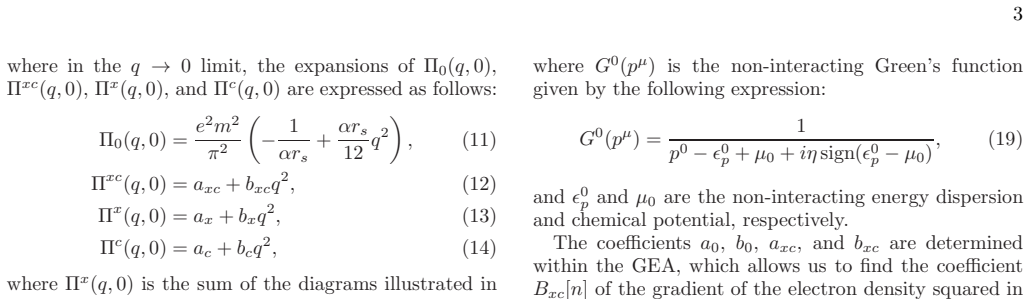
In the paper's own terms, the static proper-polarization function's long-wavelength q^2 coefficient has the small-r_s expansion b_xc = b_xc^(0) r_s^2 + b_xc^(1) r_s^3 ln r_s + O(r_s^3), with b_xc^(1) = -29/1944 e^4(m a_B)^3/π^5; in atomic units the equivalent constraint on the gradient coefficient is B_xc[n] = r_s^{-4} [0.029116 - (29/(864π^3)) r_s ln r_s]. The paper claims this coefficient is exact, in the sense that no proper-polarization diagrams beyond the RPA-reorganized set considered can contribute to it. The calculation combines the Fock and ring self-energy, the screened-interaction diagrams, and an exact evaluation of the resulting two-dimensional integrals; the r_s ln r_s term eme
Load-bearing premise
The exactness claim rests on the unproven assertion that every proper-polarization diagram outside the considered RPA-reorganized set contributes at order r_s^3 or higher, with no r_s^3 ln r_s enhancement, anchored by the leading self-energy-insertion family and the kite-like diagram.
Editorial extensions
If this is right
- Any GGA functional that reproduces the gradient expansion in the high-density slowly-varying limit must contain the r_s ln r_s term with the derived coefficient.
- The exchange and correlation contributions to the gradient coefficient cannot be assigned independent regulator-invariant values; only their sum b_xc is physical, so functionals should be constrained on the total, not on separate components.
- The next-to-next-to-leading r_s^3 coefficient is not fixed by the diagrams used here; extracting it requires going beyond the leading RPARPE order.
- The q^4 term of the response kernel, which yields the (∇^2 n)^2 term in the energy, has a leading r_s^6 behavior, while the |∇n|^4 term's coefficient starts at r_s^{-4} in the same high-density limit.
Reading between the lines
- One could test the exactness claim directly by computing the r_s^3 ln r_s coefficient from an independent diagrammatic resummation at second order; a mismatch would indicate a diagram beyond the claimed family contributes.
- If exact, the logarithmic term provides a stringent benchmark for semi-empirical and machine-learned density functionals: they must reproduce this single number in the high-density limit without fitting.
- The integral-kind expansion may transfer to higher-order gradient terms, but the paper's own caveat that a rigorous analysis of the underlying integrals is required suggests the no-corrections theorem is the part most worth scrutinizing.
- The regulator-dependence argument implies that functionals built by combining separately fitted exchange and correlation gradient coefficients are conceptually suspect; an exact total constraint should be used instead.
Editorial analysis
A structured set of objections, weighed in public.
Referee Report
Summary. The manuscript claims to compute the next-to-leading-order term in the high-density expansion of the gradient-expansion coefficient B_xc[n], finding b_xc = b_xc^(0) r_s^2 + b_xc^(1) r_s^3 ln r_s + O(r_s^3), with the logarithmic coefficient b_xc^(1) = -29/1944 e^4 (m a_B)^3 / π^5 asserted to be exact, i.e. receiving no corrections from any omitted higher-order diagrams. The derivation decomposes b_c into four contributions (b'_c, b''_c, b'''_c, b^r_c), extracts the r_s^3 ln r_s coefficient from each through a systematic region-splitting and Taylor-expansion procedure, and combines them with the regulator-independent b_x to obtain the final value. The exactness claim rests on a power-counting argument in Sec. IV.G based on the RPA-based reorganized perturbative expansion (RPARPE), with the first excluded diagram family, the kite-like self-energy, claimed to contribute only at order r_s^3.
Significance. If the central claim were fully established, the result would be a valuable exact constraint for GGA functionals in the high-density slowly-varying limit: any valid functional would have to reproduce the coefficient -29/(864π^3) in atomic units. The manuscript's systematic treatment of the integral decompositions is a notable methodological contribution, and the displayed arithmetic for the four sub-coefficients C'_L3, C''_L3, C'''_L3, and C^r_L3 appears internally consistent and independently verifiable from the listed integrals. However, the exactness theorem is the load-bearing part of the paper, and it is not proven; the manuscript itself concedes that a rigorous analysis of higher-order terms is required. The B_xc conversion also contains an unresolved factor-of-two inconsistency. The significance of the paper therefore depends on whether these gaps can be closed.
major comments (3)
- [Sec. IV.G and Appendix G] The exactness claim that no higher-order diagrams contribute to the r_s^3 ln r_s coefficient is not established. The argument requires that the kite-like self-energy Σ_2b(k_F,0) contributes only a constant at leading order in r_s. Appendix G displays the integral (G8)-(G10) but does not evaluate it, does not prove convergence, and the denominator D_2 = (q_2-p)·k |p-q_2|^2 k^2 vanishes on surfaces inside the integration region. The text at the end of Sec. IV.G explicitly states that 'a rigorous analysis of the underlying integral expressions for each term in Π_xc^EH is required.' Without that analysis, the claimed 'no-corrections theorem' is an assertion, not a proof. If Σ_2b(k_F,0) contains a logarithmic k_F dependence, Eq. (198) would generate a contribution exactly at r_s^3 ln r_s, invalidating the headline coefficient.
- [Eqs. (4) and (210)] There is a factor-of-two inconsistency in the conversion from b_xc to B_xc. In atomic units Eq. (4) gives the logarithmic coefficient of B_xc as -29/(864π^3) r_s^{-3} ln r_s. Eq. (210), using α^3 = 4/(9π), gives -29/(1728π^3) r_s^{-3} ln r_s, i.e. exactly half. The text states that Eq. (210) is the same as Eq. (4), but it is not. This is not a mere typo in an ancillary formula: Eq. (4) is the advertised constraint for GGA functionals. The authors must reconcile this discrepancy and specify the value of a_xc used in Eq. (21), which is not given in the manuscript.
- [Sec. IV.G generally] The power-counting heuristic that each diagram set S_i is anchored by the self-energy-insertion family of Fig. 5 is asserted rather than demonstrated. The text says that tracking the RPARPE order of this family is simple, but the step from 'the LO of this representative family' to 'the LO of every diagram in the set' is not justified. Higher-order members of the set could in principle have additional log-enhancements or stronger infrared behavior. This is the same gap identified in Appendix G, but it applies to the entire exclusion argument. The exactness claim therefore needs either a proof for all diagram topologies or a weakening of the claim from 'exact' to 'the contribution computed from the displayed diagrams.'
minor comments (5)
- [Title/Abstract] The title contains a typo: 'ele ctron-gas' should be 'electron-gas'. The abstract says 'proof' of no corrections, which overstates what is actually demonstrated in the body.
- [Eq. (21)] The quantity a_xc appears in the expression for K''_xc but its value or derivation is not provided in this manuscript. The reader is left to infer it from Ref. [1]; this should be stated explicitly.
- [Appendix G] The statement 'This proves that Σ_2b(k_F,0) only contributes as a constant' is premature given that Eq. (G8) is not evaluated and its convergence is not established. The word 'proves' should be replaced with a description of the intended power-counting argument.
- [Table V] The units row says 'τ2 = (mαa_B)^3 e^4/π^4', but the table entries are dimensionless coefficients multiplying this factor. This is fine, but it would be clearer to write the dimensionful prefactor explicitly in the table header.
- [Appendix C] Some function labels are inconsistent: e.g. f_6^{(2n+1)} is written without the second superscript in Eq. (175). Minor notation cleanup would help reproducibility.
Circularity Check
NLO coefficient itself is computed from explicit integrals, but the 'exactness' no-corrections claim rests on a self-defined diagram hierarchy rather than an evaluation.
-
self definitional
[Section IV.G (after Eq. 198) and Appendix G, Eqs. (G8)-(G10)]
"we can always find a set of diagrams that share the same LO contribution in rs in the high-density limit... we denote such a set of diagrams as Si, where a higher index i ∈ N corresponds to a higher-order LO rs contribution deriving from the proper-polarization diagrams within that specific set... subsequent sets Si (for i > 1) contributing to Π_xc^EH(q,0) are anchored by higher-order members of this family; this guarantees a strictly higher-order rs contribution than the previous set."
The no-corrections theorem asserts that no diagram beyond those already computed can contribute at order r_s^3 ln r_s. The proof in Sec. IV.G defines the sets Si by the property 'higher index = higher-order LO rs contribution', then assigns the m=2 kite self-energy to S2 by asserting (not evaluating) that it contributes only a constant, and finally concludes that all higher sets are strictly higher order. The conclusion is therefore contained in the defining/asserted hierarchy, not derived from an independent evaluation. Appendix G displays the kite integral (G8)-(G10) but does not evaluate it or prove convergence; the sentence 'This proves that Σ2b(kF,0) only contributes as a constant' is an assertion of the needed result. Thus the exactness of CL3 reduces to the self-imposed RPARPE power
full rationale
The numerical NLO coefficient CL3 = -29/1944 e^4(m a_B)^3/π^5 is obtained by explicitly evaluating displayed integrals (V1, V2, V3, V4, D0,1, etc.) in Sections IV.C-IV.F, with the sub-coefficients checked from Tables II and III. I found no fitted parameter renamed as a prediction and no direct reduction of the final coefficient to the paper's inputs. The central number therefore has independent computational grounding. The circularity concern is confined to the stronger 'exact, no corrections' claim: Section IV.G does not prove that all higher-order RPARPE diagrams are free of r_s^3 ln r_s contributions; it defines sets by their rs order and asserts the m=2 kite self-energy is a constant based on an unevaluated integral. The paper itself concedes 'a rigorous analysis of the underlying integral expressions for each term in Π_xc^EH is required' before substituting the set-tracking heuristic. Additionally, Eq. (4) and Eq. (210) give coefficients for the r_s^{-3} ln r_s term in B_xc that differ by a factor of 2 (-29/(864π^3) vs -29/(1728π^3) after using α^3=4/(9π)); this is an internal consistency/correctness issue, not circularity. Overall, the exactness theorem is partially circular/self-citation-loaded, while the computed coefficient is not circular.
Assumptions & free parameters
assumptions (5)
- domain assumption Standard many-body perturbation theory for the proper polarization function, including the RPA re-summation of the screened interaction (Eqs. 15-19).
- domain assumption RPARPE reorganization: re-summing standard perturbation theory into diagrams with RPA-screened interaction lines, with m-th order counting those lines (Sec. IV.G).
- ad hoc to paper Power-counting heuristic: the leading r_s behavior of every higher-order diagram set S_i is anchored by the self-energy-insertion family of Fig. 5; the kite-like self-energy (App. G) contributes a constant at LO in r_s.
- domain assumption Regulator-scheme independence of b_xc and scheme dependence of b_x, b_c separately (Ref. 1, Table I).
- standard math Mathematical identities used to reduce integrals: contour deformation in App. D (no poles enclosed), the beta-function identity Eq. 200, and the D_nm/beta_n master integrals (App. F).
Cite this review
Pith. "Pith review of Gradient expansion approximation of the inhomogeneous electron-gas revisited: Higher-order corrections." pith.science (2026). https://pith.science/paper/6R3RLIDP
@misc{pith2026260802524,
  author       = {Pith},
  title        = {Pith review of: Gradient expansion approximation of the inhomogeneous electron-gas revisited: Higher-order corrections},
  year         = {2026},
  howpublished = {\url{https://pith.science/paper/6R3RLIDP}},
  note         = {Machine review of arXiv:2608.02524}
}
abstract
In our recently published work (our Ref. 1) we revisited the gradient expansion approximation (GEA) of the interacting electron gas, and recalculated the leading-order contribution$-$with respect to the Wigner-Seitz radius $r_s$$-$to the coefficient $B_{xc}[n]$ of the square of the gradient of the electron density in the high-density and slowly varying limits. That work resolved historical controversies regarding these coefficients and demonstrated that serious misconceptions have led to incorrect constraints being imposed on popular functionals within the generalized gradient approximation (GGA). In the present paper, we extend this calculation to obtain the coefficient of the next-to-leading term, which scales as $r_s \ln(r_s)$ relative to the leading order. First, we establish a systematic framework to evaluate the integral expressions for the $b_{xc}$ coefficient of the leading term ($\sim q^2$) of the density-density response function in the long-wavelength limit ($q \to 0$)$-$a prerequisite for computing $B_{xc}[n]$. The significance of the calculation stems from the proof that the coefficient of this $r_s \ln(r_s)$ term receives no corrections from higher-order diagrammatic expressions. Consequently, our derived value serves as an exact, definitive constraint for future GGA functional development; in the high-density slowly-varying limit, any valid functional must reproduce the exact constraints established in both our previous work and the present paper.
Figures


Figures from the paper (5 more)


Reference graph
Works this paper leans on
-
[1]
D-type contributions can be further categorized into D1 and D2 sub-types
D-type contribution In this subsection, we discuss the D-type contribu- tion to every coefficient of the terms arising from the rs → 0 expansion that originates from both bc-primed coefficients, b ′′′ c , and Σ r(kF , 0). D-type contributions can be further categorized into D1 and D2 sub-types. After applying the first two steps of our systematic approach, D1-...
-
[2]
These hybrid-type contributions arise by taking into account higher-order terms in the Taylor expansion of Q(x, y) in the x → 0 limit
H-type contribution We discuss the H-type contributions to every coeffi- cient in the rs-expansion, which arise exclusively from the integral kinds L1 im(rs), since Region 2 provides only D-type contributions. These hybrid-type contributions arise by taking into account higher-order terms in the Taylor expansion of Q(x, y) in the x → 0 limit. Con- sequently...
-
[3]
156 by now defining βn(a) as follows βn(a) = ∫ ∞ 0 dy 1 a + y2 , (F1) where we can calculate β1(a) by doing the change of vari- able y = au
Calculating βn We modify the expression for βn in Eq. 156 by now defining βn(a) as follows βn(a) = ∫ ∞ 0 dy 1 a + y2 , (F1) where we can calculate β1(a) by doing the change of vari- able y = au. We obtain β1(a) = π 2 a− 1 2 , a > 0. (F2) By applying the ( n − 1)-th order partial derivative to β1(a) with respect to the variable a, we obtain ∂n−1 ∂an−1 β1(a)...
-
[4]
By doing this, we obtain D0,1 = ∫ ∞ 0 du u − tan−1(u) u(1 + u2)
Calculating some of the integral kind D0,1 We calculate the integral kind D0,1 starting from its definition D0,1 = ∫ ∞ 0 dy R(y) (1 + y2) , (F8) where we can perform the change of variable u = 1 /y. By doing this, we obtain D0,1 = ∫ ∞ 0 du u − tan−1(u) u(1 + u2) . (F9) Using a partial fraction decomposition, we have 1 u(1 + u2) = 1 u − u 1 + u2 , (F10) whe...
-
[5]
Calculating some of the integral kind Dn,5 (for n = 0, 2, 4, 6, 8) Calculating the integral kinds Dn,5 (for n = 0, 2, 4, 6, 8), we use the definition given by Eq. 153. How- ever, only the terms corresponding to n = 0, 2, 4, 6 can be handled with the same systematic method used through- out this appendix. For D8,5, we will see that it requires a different tr...
-
[6]
Benites, A
M. Benites, A. Rosado, and E. Manousakis, Gradient- expansion of the inhomogeneous electron gas revisited, Physical Review B 113, 115136 (2026)
2026
-
[7]
Kohn and L
W. Kohn and L. J. Sham, Self-consistent equations in- cluding exchange and correlation effects, Phys. Rev. 140, A1133 (1965)
1965
-
[8]
Wigner, On the interaction of electrons in metals, Phys
E. Wigner, On the interaction of electrons in metals, Phys. Rev. 46, 1002 (1934)
1934
Show all 37 references
-
[9]
Bohm and D
D. Bohm and D. Pines, A collective description of elec- tron interactions. i. magnetic interactions, Phys. Rev. 82, 625 (1951)
1951
-
[10]
Pines and D
D. Pines and D. Bohm, A collective description of elec- tron interactions: Ii. collective vs individual particle a s- pects of the interactions, Phys. Rev. 85, 338 (1952)
1952
-
[11]
Bohm and D
D. Bohm and D. Pines, A collective description of elec- tron interactions: Iii. coulomb interactions in a degener- ate electron gas, Phys. Rev. 92, 609 (1953)
1953
-
[12]
Pines, A collective description of electron interaction s: Iv
D. Pines, A collective description of electron interaction s: Iv. electron interaction in metals, Phys. Rev. 92, 626 (1953)
1953
-
[13]
Gell-Mann and K
M. Gell-Mann and K. A. Brueckner, Correlation energy of an electron gas at high density, Phys. Rev. 106, 364 (1957)
1957
-
[14]
Nozi` eres and D
P. Nozi` eres and D. Pines, Electron interaction in solids. general formulation, Phys. Rev. 109, 741 (1958)
1958
-
[15]
Hedin, New method for calculating the one-particle green’s function with application to the electron-gas problem, Phys
L. Hedin, New method for calculating the one-particle green’s function with application to the electron-gas problem, Phys. Rev. 139, A796 (1965)
1965
-
[16]
Hohenberg and W
P. Hohenberg and W. Kohn, Inhomogeneous electron gas, Phys. Rev. 136, B864 (1964)
1964
-
[17]
Ma and K
S.-K. Ma and K. A. Brueckner, Correlation energy of an electron gas with a slowly varying high density, Phys. Rev. 165, 18 (1968)
1968
-
[18]
D. J. W. Geldart and R. Taylor, Wave-number depen- 26 dence of the static screening function of an interact- ing electron gas. i. lowest-order hartree–fock correction s, Canadian Journal of Physics 48, 155 (1970)
1970
-
[19]
D. J. W. Geldart and M. Rasolt, Exchange and correla- tion energy of an inhomogeneous electron gas at metallic densities, Phys. Rev. B 13, 1477 (1976)
1976
-
[20]
L. J. Sham, Approximations of the exchange and cor- relation potentials, in Computational Methods in Band Theory, edited by P. M. Marcus, J. F. Janak, and A. R. Williams (Springer US, Boston, MA, 1971) pp. 458–468
1971
-
[21]
D. C. Langreth and J. P. Perdew, Theory of nonuniform electronic systems. i. analysis of the gradient approxima- tion and a generalization that works, Physical Review B 21, 5469 (1980)
1980
-
[22]
D. M. Ceperley and B. J. Alder, Ground state of the electron gas by a stochastic method, Phys. Rev. Lett. 45, 566 (1980)
1980
-
[23]
E. K. U. Gross and R. M. Dreizler, Gradient expansion of the coulomb exchange energy, Zeitschrift f¨ ur Physik A Atoms and Nuclei 302, 103 (1981)
1981
-
[24]
Kleinman, Exchange density-functional gradient ex- pansion, Physical Review B 30, 2223 (1984)
L. Kleinman, Exchange density-functional gradient ex- pansion, Physical Review B 30, 2223 (1984)
1984
-
[25]
P. R. Antoniewicz and L. Kleinman, Kohn-sham ex- change potential exact to first order in ρ(k→)/ρ0, Phys. Rev. B 31, 6779 (1985)
1985
-
[26]
Kleinman and S
L. Kleinman and S. Lee, Gradient expansion of the exchange-energy density functional: Effect of taking lim- its in the wrong order, Physical Review B 37, 4634 (1988)
1988
-
[27]
Engel and S
E. Engel and S. H. Vosko, Wave-vector dependence of the exchange contribution to the electron-gas response functions: An analytic derivation, Physical Review B 42, 4940 (1990)
1990
-
[28]
P. S. Svendsen and U. von Barth, Gradient expansion of the exchange energy from second-order density response theory, Physical Review B 54, 17402 (1996)
1996
-
[29]
P. S. Svendsen and U. Von Barth, On the gradient ex- pansion of the exchange energy within linear response theory and beyond, International Journal of Quantum Chemistry 56, 351 (1995)
1995
-
[30]
Giuliani and G
G. Giuliani and G. Vignale, The quantum theory of the electron liquid (Cambridge University Press, Cambridge, 2005)
2005
-
[31]
Benites, A
M. Benites, A. Rosado, and E. Manousakis, Accurate electron correlation energy functional: Expansion in the interaction renormalized by the random-phase approxi- mation, Phys. Rev. B 110, 195151 (2024)
2024
-
[32]
A. L. Fetter and J. D. Walecka, Quantum Theory of Many-Particle Systems (McGraw-Hill, New York, 1971)
1971
-
[33]
Mahan, Many-Particle Physics (Kluwer Aca- demic/Plenum, New York, 2000)
G. Mahan, Many-Particle Physics (Kluwer Aca- demic/Plenum, New York, 2000)
2000
-
[34]
Pines, The Many-Body Problem (W
D. Pines, The Many-Body Problem (W. A. Benjamin, N.Y, 1961)
1961
-
[35]
A. A. Abrikosov, L. P. Gor’kov, and I. E. Dzyaloshin- ski, Methods of quantum field theory in statistical physics (Dover Publications, New York, 1963)
1963
-
[36]
J. P. Perdew, K. Burke, and M. Ernzerhof, Generalized gradient approximation made simple, Phys. Rev. Lett. 77, 3865 (1996)
1996
-
[37]
J. P. Perdew, A. Ruzsinszky, G. I. Csonka, O. A. Vydrov, G. E. Scuseria, L. A. Constantin, X. Zhou, and K. Burke, Restoring the density-gradient expansion for exchange in solids and surfaces, Physical Review Letters 100, 136406 (2008)
2008
Reviewed August 4, 2026 · model on record in the stance chip above.
Discussion (0). Continue with ORCID to comment.