REVIEW 3 major objections 6 minor 34 references
Black hole mimickers as relativistic stars calculated from the Tolman-Oppenheimer-Volkoff equations
T0 review · 3 major / 6 minor · reviewed 2026-08-16 · deepseek-v4-flash
Pith's one-line read The Tolman-Oppenheimer-Volkoff equations produce horizonless black hole mimickers, 'dynamical gravastars,' when a high-pressure phase transition drives the energy density negative.
desk verdict A clean mini-review of the author's own gravastar program, with a genuinely useful rescaling trick, but the formation claim rests on an unstable EOS branch that has not been checked. read the letter →
The pith
A machine-rendered reading of the paper's core claim, the machinery that carries it, and where it could break.
The reading
What carries the argument
The load-bearing object is the two-branch equation of state of Eq. (10), $\rho(p)=3p$ below the pressure $p_{\rm jump}$ and $\rho(p)=-p+\beta$ above it. Because $p$ and $m$ must be continuous across the transition while $\rho$ may jump, the TOV equations convert the equation-of-state switch into a kink in $D(r)=1-2m(r)/r$, producing an effective 'mock horizon' at $r\simeq 2M$. In the scale-invariant variables $\alpha=m/r$ and $\delta=4\pi r^2p$, the exterior equations become the autonomous two-dimensional system of Eq. (8), whose solutions are analytic wherever $\alpha\neq 1/2$; the author conjectures that initial values $\alpha_0<1/2$, $\delta_0>0$, and $3\delta_0-\alpha_0>0$ always yield a kink solution.
What would settle it
Find an equation of state for the relevant high-density matter, from neutron-star merger constraints, gravitational-wave tidal deformability, or lattice QCD at high baryon density, that keeps $\rho(p)$ nonnegative and at least $3p$ at all accessible pressures. If such an equation of state is established, the negative-energy branch required for the mock horizon is unavailable, and the dynamical-gravastar mechanism cannot form in a real star.
Extended reading notes
Core claim
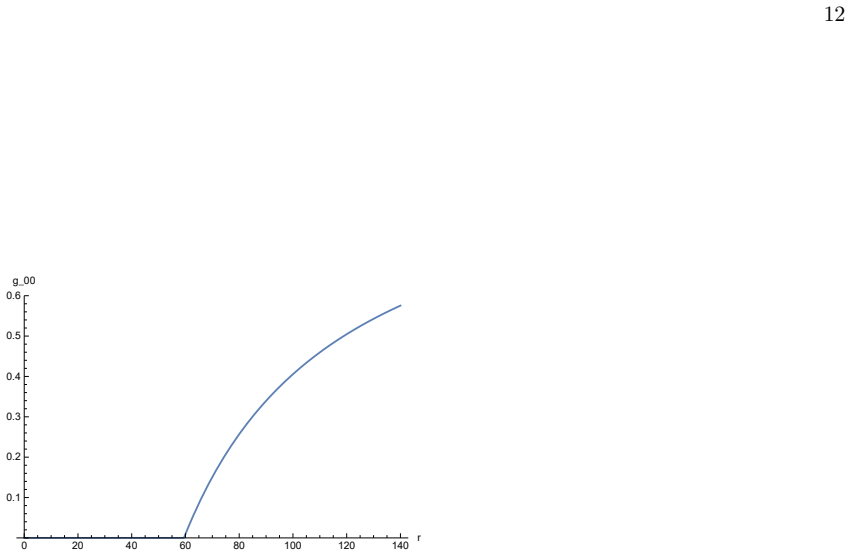
On its own terms, the paper's central claim is that the TOV equations for relativistic matter, with the two-branch equation of state $\rho(p)=3p$ for $p\leq p_{\rm jump}$ and $\rho(p)=-p+\beta$ for $p>p_{\rm jump}$, generate kink solutions that function as black hole mimickers without a horizon. Tuning the initial value of $\nu(0)$ by a two-step matching to the asymptotic Schwarzschild metric makes the exterior agree with Schwarzschild outside $r=2M$, while in the interior $g_{00}=e^{\nu}$ remains strictly positive yet exponentially small. The transition layer, the analog of a gravastar 'skin,' emerges from the equations rather than being inserted as a model parameter. The author concludes that if matter at super-high pressure undergoes a phase transition to negative energy density, then the TOV equations give a natural mechanism for forming horizonless black hole mimickers.
Load-bearing premise
The model's existence rests on a physical phase transition, at pressures above $p_{\rm jump}$, to a state with energy density well below pressure and eventually negative enough to satisfy $\rho(p)=-p+\beta$; if no such state exists in nature, the mock-horizon solutions are mathematical artifacts even though the TOV integration is correct.
Editorial extensions
If this is right
- Every observed black hole could in principle be a horizonless object, so the singularities and information-loss puzzles tied to horizons would not apply.
- The exterior metric of a dynamical gravastar is observationally indistinguishable from Schwarzschild to high precision, meaning shadow, orbit, and ringdown data alone may not settle whether real black holes have horizons.
- The mock-horizon radius and transition-layer thickness are outputs of the TOV equations, not tunable inputs, removing the arbitrary skin radii of earlier gravastar models.
- Astrophysical 'black holes' could be leaky, re-emitting infalling matter as a delayed wind, which would give supermassive objects a direct role in galaxy formation and evolution.
Reading between the lines
- A proof of the kink conjecture might come from treating Eq. (8) as a two-dimensional autonomous flow: its fixed points and stable manifolds determine which initial data reach the pole at $\alpha=1/2$, so phase-plane methods are the natural next step.
- Because the mock horizon is a static-equilibrium feature, the open question is dynamical formation; a time-dependent collapse simulation with the same two-branch equation of state would test whether the kink is actually reached.
- If the negative-energy branch is real, it could also cap neutron-star masses below the range expected from ordinary dense-matter equations of state, giving a mass-radius signature that gravitational-wave observations could look for.
Signed reviews
Editorial analysis
A structured set of objections, weighed in public.
Referee Report
Summary. The paper is a mini-review of the author's 'dynamical gravastar' model, in which static spherically symmetric solutions of the Tolman-Oppenheimer-Volkoff equations are constructed with a two-branch equation of state: rho(p)=3p for p<=p_jump and rho(p)=-p+beta for p>p_jump. The central claim is that the exterior region rho=3p generically develops a 'mock horizon' at r approximately 2M when the interior negative-energy branch supplies a sufficiently negative integrated mass at the inner boundary, yielding a metric that approaches Schwarzschild outside but has g00 positive and exponentially small inside. The paper also presents a rescaling-invariant autonomous form of the TOV equations, an argument for C-infinity smoothness away from alpha=1/2, and a post-publication appendix connecting the model to JWST 'little red dots'.
Significance. If the construction were dynamically stable and physically realized, it would provide an explicit counterexample to the necessity of event horizons for compact objects and would offer a concrete calculational framework for horizonless mimickers, with the mock-horizon scale emerging from the field equations rather than being dialed in. The manuscript is commendably transparent: it includes complete Mathematica notebooks, the two-step nu(0) tuning method is clearly explained, and the rescaling-invariant flow formulation is a useful contribution. However, the physical significance is currently contingent on the existence of a stable high-pressure phase with negative energy density, which the paper does not establish.
major comments (3)
- [Sec. IV.A, Eq. (10)] The high-pressure branch rho(p)=-p+beta has dp/drho=-1, corresponding to a negative squared sound speed. Such a branch is a spinodal/unstable region for an isotropic fluid, not a settled equilibrium phase, and it is not a standard first-order phase transition because the pressure is not constant across coexistence. Since the paper's stated conclusion in Sec. V is that the TOV equations give a 'natural mechanism for forming' horizonless mimickers, a radial stability analysis (or at minimum an explicit statement that the solutions are static and unstable toy models) is required before the formation claim can be accepted.
- [Sec. IV.C and the Conjecture] The claim that mock-horizon formation is 'a generic property of the exterior region TOV equations' and 'does not require the specific interior equation of state' is not supported by the presented evidence. The parameter survey in [5] is numerical, and the exterior boundary data alpha0, delta0 that produce deep kinks (e.g., alpha0=-2000, delta0=2000 in Fig. 1) require a large negative integrated mass, which in this model is generated precisely by the assumed interior branch rho=-p+beta. Without that branch, or an equivalent negative-energy mechanism, the boundary condition does not arise; the property is therefore conditional on the same speculative physics that the paper seeks to avoid.
- [Appendix C and Sec. V] The discussion of 'little red dots' as dynamical gravastars in formation is explicitly not supported by a time-dependent calculation; the text concedes that the calculations are static and 'do not show what happens as this structure forms in a collapse'. The repeated use of 'forming' in Sec. V and the Appendix therefore overstates what the TOV analysis demonstrates. Either a dynamical collapse simulation or a substantial revision of the language is needed before the astrophysical formation claim can be taken seriously.
minor comments (6)
- [Abstract and Introduction] The phrase 'principle content' should be 'principal content', and Sec. II contains the typo 'condtion' for 'condition'.
- [Sec. IV.B, Eq. (11)] The argument invoking Birkhoff's theorem is only approximate, since rho(r) is small but not zero outside 2M; the text should say 'approximately Schwarzschild' rather than invoking the uniqueness theorem directly.
- [Fig. 5 caption and Sec. IV.C] The vertical line is at the equation-of-state jump r=48.895, while the nearby text refers to a cusp near r=59.43754; the caption should clarify that the mock horizon is at the cusp, not at the equation-of-state jump.
- [Sec. III.E] The statement that solutions are 'analytic' may be overly strong for the full system because of the pole at alpha=1/2; the paper already restricts to alpha avoiding 1/2, so the claim should be stated consistently as 'analytic away from alpha=1/2'.
- [Appendices A and B] The variable 'bet' used in Appendix B conflicts with the parameter beta used in the main text; a distinct symbol would avoid confusion.
- [References] Appendix C cites the arXiv version of this same manuscript as reference [29]; the published version should be cited instead.
Circularity Check
No circularity found: the mock horizon is an emergent output of the TOV initial-value problem, not an input encoded in the equation of state or in the boundary-condition tuning.
full rationale
The paper's only fitted quantity is nuinit, fixed in Sec. IV.B by the asymptotic condition ν(∞)=0. This tuning does not determine the existence, radius, or shape of the mock horizon; it merely fixes the constant shift in ν that is free in Eqs. (2), and the exterior Schwarzschild form then follows from Birkhoff's theorem once m(r) has become constant. The kink and the positive-but-exponentially-small g00 emerge from integrating the TOV equations with the assumed equation of state Eq. (10), which is an explicit physical assumption rather than a derived conclusion. The paper states the conditional nature of the claim: 'If there is a phase transition of matter at super-high pressure to a state with negative energy density, then the TOV equations for relativistic matter have kink solutions that generate a simulated or mock horizon.' The Mathematica notebook in Appendix A and the scale-invariant equations in Sec. III.E make the computation reproducible, and the self-citations to [3]-[6] are for the model's origin and parameter surveys, not for a premise that already contains the mock-horizon conclusion. No equation is defined in terms of the claimed prediction, and no fitted parameter is renamed as a predicted quantity. Therefore no circular step is exhibited.
Assumptions & free parameters
free parameters (3)
- beta (β) =
0.1, 0.01, 0.001 in surveys; 0.01 in the main example
- pjump =
0.95 in the main example, with central pressure p(0)=1
- nuinit =
-23.62026189186466 in Appendix A
assumptions (5)
- standard math The Einstein equations in the spherically symmetric TOV form, Eq. (2)
- domain assumption All physical quantities are bounded
- domain assumption Relativistic-matter equation of state rho(p)=3p for p≤pjump
- domain assumption A high-pressure phase transition to negative energy density, rho(p)=−p+beta for p>pjump
- standard math Birkhoff's uniqueness theorem for matching to Schwarzschild at large radius
Cite this review
Pith. "Pith review of Black hole mimickers as relativistic stars calculated from the Tolman-Oppenheimer-Volkoff equations." pith.science (2026). https://pith.science/paper/6ROHEI25
@misc{pith2026250418690,
  author       = {Pith},
  title        = {Pith review of: Black hole mimickers as relativistic stars calculated from the Tolman-Oppenheimer-Volkoff equations},
  year         = {2026},
  howpublished = {\url{https://pith.science/paper/6ROHEI25}},
  note         = {Machine review of arXiv:2504.18690}
}
read the original abstract
This mini-review summarizes and simplifies the principle content of our papers on ``Dynamical Gravastars'', formulated using the Tolman-Oppenheimer-Volkoff equations, and surveyed numerically using Mathematica notebooks that we document here in Appendices.
Figures


Figures from the paper (3 more)


Reference graph
Works this paper leans on
-
[5]
S. L. Adler and B. Doherty, Dynamical gravastar simullated horizon from the Tolman-Op enheimer- Volkoff equation initial value problem with relativistic ma tter, arXiv:2309.13380
-
[1]
V. Cardoso and P. Pani, Living Rev. Relativ. 22, 4 (2019), arXiv:1904.05363
arXiv 2019
-
[2]
Mottola, Gravitational Vacuum Condensate Stars , in C
E. Mottola, Gravitational Vacuum Condensate Stars , in C. Bambi, ed., Regular Black Holes: Towards a New Paradigm of Gravitational Collapse , Chapt. 8, 283-352 (Springer Verlag), arXiv:2302.09690
-
[3]
S. L. Adler, Phys. Rev. D 106, 104061 (2022), arXiv:2209.02537
arXiv 2022
-
[4]
S. L. Adler, Phys. Rev. D 109, 024020 (2024), arXiv:2301.11821
work page Pith review arXiv 2024
-
[6]
S. L. Adler, Simplified TOV Equations for Relativistic Matter , https://www.ias.edu/sns/Talks Memos (2025)
work page 2025
-
[7]
S. L. Adler, Mod. Phys. Lett. A 36, 2130027 (2021)
work page 2021
-
[8]
S. L. Adler and F. M. Ramazano˘ glu, Int. J. Mod. Phys. D 24, 1550011 (2015), arXiv:1308.1448
work page Pith review arXiv 2015
Show all 34 references
-
[9]
E. B. Gliner, J. Exptl. Theoret. Phys. 49, 542 (1965); translation in Sov. Phys. JETP 22, 378 (1966)
1965
-
[10]
Chapline, E
G. Chapline, E. Hohlfield, R. B. Laughlin, and D. I. Santiago, Phil. Mag. B 81, 235 (2001)
2001
-
[11]
Chapline, E
G. Chapline, E. Hohlfield, R. B. Laughlin, and D. I. Santiago, Int. J. Mod. Phys. A 18, 3587 (2003), arXiv:gr-qc/0012094
2003 arXiv
-
[12]
M. Yu. Khlopov, R. V. Konoplich, S. G. Rubin, and A. S. Sakharov , Grav. Cosmol. 6, 153 (2000), arXiv:hep-ph/9912422
2000 arXiv
-
[13]
Dymnikova and M
I. Dymnikova and M. Khlopov, Int. J. Mod. Phys. D 24, 1545002 (2015), arXiv:1510.01351
2015 arXiv
-
[14]
P. O. Mazur and E. Mottola, Gravitational Condensate Stars , arXiv:gr-qc/0109035 (2001). See also Proc. Nat. Acad. Sci. 101, 9545 (2004), arXiv:gr-qc/0407075
2001 arXiv
-
[15]
S. A. Bludman and M. A. Ruderman, Phys. Rev. 170, 1176 (1968); Phys. Rev. D 1, 3243 (1970)
1968
-
[16]
R. M. Wald, General Relativity, The University of Chicago Press (1984), p. 410
1984
-
[17]
S. W. Hawking and G. F. R. Ellis, The Large Scale Structure of Space-Time , Cambridge Univ. Press (1973), Sec. 4.3
1973
-
[18]
The 1965 Penrose singularity theorem
J. M. M. Senovilla and D. Garfinkle, “The 1965 Penrose singularity theorem”, arXiv:1410.5226
1965 arXiv
-
[19]
Ya. B. Zeldovich and I. D. Novikov, Stars and Relativity , The University of Chicago Press (1971), pp. 256-257
1971
-
[20]
Camenzind, Compact Objects in Astrophysics , Springer (2007), Secs
M. Camenzind, Compact Objects in Astrophysics , Springer (2007), Secs. 4.1-4.2
2007
-
[21]
J. R. Oppenheimer and G. M. Volkoff, Phys. Rev. 55, 374 (1938)
1938
-
[22]
Weinberg, Lectures on Astrophysics , Cambridge University Press (2020), Sec
S. Weinberg, Lectures on Astrophysics , Cambridge University Press (2020), Sec. 1.1. 18
2020
-
[23]
Little Red Dots
with a fraction of entering particles exiting in the for m of a black hole “wind”. This allows the supermassive black holes that are believed to lur k at the center of every galaxy to play a direct role in nucleating galaxy formation, as sugg ested in articles by us [25], [26]...
2000
-
[24]
S. L. Adler, Int. J. Mod. Phys. D 31, 2250070 (2022), arXiv:2107.11816
2022 arXiv
-
[25]
Ya. B. Zeldovich and I. D. Novikov, Stars and Relativity , The University of Chicago Press (1971), pp. 195-196
1971
-
[26]
S. L. Adler, Int. J. Mod. Phys. D 31, 2242007 (2022), arXiv:2112.12491
2022 arXiv
-
[27]
S. L. Adler, Astrophysics and Space Science 369:65 (2024), arXiv:2210.03742
2024 arXiv
-
[28]
J. Silk, M. C. Begelman, C. Norman, A. Nusser, and R. F. G. Wyse , Astrophys. J. Lett. 961, L29 (2024), arXiv:2401.02482
2024 arXiv
-
[29]
Cendes et al., Astrophys
Y. Cendes et al., Astrophys. Journ. 971, 185 (2024), arXiv:2308.13595
2024 arXiv
-
[30]
S. L. Adler, Black hole mimickers as relativistic stars calculated fr om the Tolman-Oppenheimer-Volkoff equations, Mod. Phys. Lett. A 40,No. 26 (2025) 253009, arXiv:2504.18690v3
2025 arXiv
-
[31]
The Discovery of Little Red Dots in the Local Universe: Signatur es of Cool Gas Envelopes, arXiv:2507.10569 (2025)
2025 arXiv
-
[32]
Exploring the Nature of Little Red Dots: Constraints on AGN and Stellar Contributions from PRIMER MIRI Imagina, arXiv:2411.12005
-
[33]
M. C. Begelman and J. Dexter, little Red Dots As Late-stage Qua si-stars, arXiv:2507.09085
-
[34]
apparent horizon
M. C. Begelman, E. M. Rossi, and P. J. Armitage, Quasi-stars: a ccreting black holes inside massive en- velopes. Monthly Notices ofthe Royal Astronomical Society, 387( 4), 1649-1659 (2008), arXiv:0711.4078. 19 FIG. 5: In this figure the three plots of Figs. 2, 3, and 4 are stac...
2008 arXiv
Reviewed August 16, 2026 · model on record in the stance chip above.
Discussion (0). Continue with ORCID to comment.