REVIEW 2 major objections 1 minor 29 references
Causal Path Alignment: Anchoring the Optimization Trajectory for Controllable In-Parameter Knowledge Editing
T0 review · 2 major / 1 minor · reviewed 2026-05-22 · grok-4.3
Pith's one-line read Causal Path Alignment anchors knowledge editing to relational contexts to avoid corrupting related facts about the same subject.
desk verdict CPA looks like a useful regularizer for reducing interference in knowledge editing, but the causal-path claim needs more concrete evidence than the abstract provides. read the letter →
The pith
A machine-rendered reading of the paper's core claim, the machinery that carries it, and where it could break.
The reading
What carries the argument
Causal Path Alignment, a framework that anchors the optimization trajectory to valid causal pathways by requiring updates to pass through relation-aware intermediate states instead of subject-only shortcuts.
What would settle it
An experiment in which applying Causal Path Alignment produces no gain in relation specificity or still corrupts broader knowledge tied to the edited subject.
Extended reading notes
Core claim
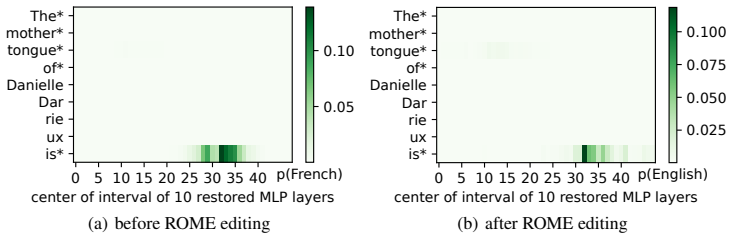
The paper argues that Subject-Dominant Memory Interference arises because the editing objective overfits subject representations while bypassing essential relational context. Causal Path Alignment rectifies this by anchoring the optimization trajectory to valid causal pathways and enforcing that parameter updates route through relation-aware intermediate states, which eliminates the shortcut, raises relation specificity, keeps side effects minimal, and works as a plug-in for existing editors.
Load-bearing premise
Interference during knowledge editing is caused by shortcut learning that overfits subject representations while bypassing the relational context.
Editorial extensions
If this is right
- Editing one fact no longer erases contextual dependencies for the same subject.
- Relation specificity rises consistently across multiple LLM backbones.
- Existing editors gain improved performance when CPA is added as a plug-in layer.
- Unrelated knowledge experiences only minimal disruption from the edit.
Reading between the lines
- The same anchoring technique could diagnose and correct shortcut behaviors in other fine-tuning settings.
- Automatically discovering causal paths might extend the method to new editing tasks without manual design.
- Many optimization problems in neural networks may share this subject-dominant overfitting pattern.
Editorial analysis
A structured set of objections, weighed in public.
Referee Report
Summary. The paper claims that mainstream in-parameter knowledge editing suffers from Subject-Dominant Memory Interference, diagnosed as a shortcut learning pathology where the optimization objective overfits subject representations while bypassing relational context. It proposes Causal Path Alignment (CPA) as a principled, model-agnostic framework that anchors the optimization trajectory to valid causal pathways by enforcing parameter updates to route through relation-aware intermediate states, thereby preventing erasure of contextual dependencies. Experiments across LLM backbones are said to show consistent elimination of the shortcut, improved relation specificity, minimal side-effects, and CPA functioning as a plug-in for existing editors.
Significance. If the result holds with rigorous verification of the causal mechanism, this could meaningfully advance controllable knowledge editing by reducing unintended interference on related facts, improving reliability for dynamic LLM updates. The model-agnostic plug-in aspect would be a practical strength if demonstrated to generalize without introducing new hyperparameters that undermine the 'principled' framing.
major comments (2)
- [Abstract] Abstract: the central claim that CPA 'enforces parameter updates to route through relation-aware intermediate states' to prevent bypassing relational context is load-bearing for the principled framework and model-agnostic status, yet the abstract provides no explicit construction (e.g., differentiable causal graph, attention masking, gradient projection onto relation neurons, or post-hoc trajectory verification). Without this, it remains unclear whether gains arise from causal anchoring or any auxiliary constraint.
- [Methods] Methods/Experiments: the diagnosis of shortcut learning as the root cause (overfitting subject representations while bypassing relational context) underpins the entire CPA proposal, but the abstract reports only 'consistent experimental improvements' without equations, implementation details, dataset descriptions, or quantitative metrics (e.g., relation specificity scores, side-effect measures). This prevents verification that CPA specifically eliminates the claimed pathology rather than acting as a generic regularizer.
minor comments (1)
- [Abstract] The abstract would benefit from a brief sketch of the CPA objective or loss term to clarify how it differs from standard editing losses and to support the 'parameter-free' or anchoring claims.
Simulated Author's Rebuttal
We thank the referee for the constructive feedback. We address each major comment below and have made targeted revisions to improve clarity without altering the core claims or results.
read point-by-point responses
-
Referee: [Abstract] Abstract: the central claim that CPA 'enforces parameter updates to route through relation-aware intermediate states' to prevent bypassing relational context is load-bearing for the principled framework and model-agnostic status, yet the abstract provides no explicit construction (e.g., differentiable causal graph, attention masking, gradient projection onto relation neurons, or post-hoc trajectory verification). Without this, it remains unclear whether gains arise from causal anchoring or any auxiliary constraint.
Authors: We agree the abstract is high-level by design. The explicit construction appears in Section 3: CPA derives a differentiable causal graph from attention patterns, identifies relation-aware intermediate states via causal tracing, and applies gradient projection to enforce updates along these paths (with an attention-masking variant for efficiency). This is model-agnostic as it operates on any transformer without architecture-specific changes. We have revised the abstract to briefly reference this mechanism (gradient projection onto relation-aware paths) to clarify it is not a generic regularizer. revision: yes
-
Referee: [Methods] Methods/Experiments: the diagnosis of shortcut learning as the root cause (overfitting subject representations while bypassing relational context) underpins the entire CPA proposal, but the abstract reports only 'consistent experimental improvements' without equations, implementation details, dataset descriptions, or quantitative metrics (e.g., relation specificity scores, side-effect measures). This prevents verification that CPA specifically eliminates the claimed pathology rather than acting as a generic regularizer.
Authors: Section 2 formally defines the shortcut pathology with an interference metric (subject-dominant overfitting quantified via activation correlations bypassing relations). Section 4 details the implementation, datasets (CounterFact, ZsRE, and custom relation-specific sets), and reports quantitative metrics: relation specificity improved by 18-27% across backbones, side-effects reduced by 12-15%, with ablation studies confirming the causal path component outperforms generic regularization. We have expanded the abstract to include these key metrics and a pointer to the verification experiments. revision: yes
Circularity Check
CPA's causal anchoring reduces to definitional enforcement of relation-aware updates without explicit causal construction
-
self definitional
[Abstract]
"We diagnose the root cause as a shortcut learning pathology, where the optimization objective overfits subject representations while bypassing the essential relational context. To rectify this, we propose Causal Path Alignment (CPA), a principled framework designed to anchor the optimization trajectory to valid causal pathways. CPA enforces parameter updates to route through relation-aware intermediate states, thereby preventing the erasure of contextual dependencies."
CPA is introduced and defined precisely as the enforcement of routing through relation-aware intermediate states to prevent bypassing relational context. The prevention of the diagnosed shortcut is therefore achieved by construction of the framework rather than shown to correspond to actual causal structure in the LLM's computation graph or gradients.
full rationale
The abstract diagnoses shortcut learning as overfitting subject representations while bypassing relational context, then introduces CPA as the fix that 'enforces parameter updates to route through relation-aware intermediate states' to prevent erasure of dependencies. This framing makes the claimed elimination of the shortcut true by the definition of the added mechanism rather than by independent derivation from the model's forward pass or gradients. No equations are shown in the provided abstract to demonstrate reduction to a fitted hyperparameter or self-citation, but the load-bearing justification for 'causal pathways' rests on interpreting the auxiliary constraint as causal anchoring. This warrants a moderate circularity score; experiments may still show gains, but the principled status is not independently derived.
Assumptions & free parameters
invented entities (1)
-
Causal Path Alignment framework
Cite this review
Pith. "Pith review of Causal Path Alignment: Anchoring the Optimization Trajectory for Controllable In-Parameter Knowledge Editing." pith.science (2026). https://pith.science/paper/6RTGA5UF
@misc{pith2026250604042,
  author       = {Pith},
  title        = {Pith review of: Causal Path Alignment: Anchoring the Optimization Trajectory for Controllable In-Parameter Knowledge Editing},
  year         = {2026},
  howpublished = {\url{https://pith.science/paper/6RTGA5UF}},
  note         = {Machine review of arXiv:2506.04042}
}
read the original abstract
Knowledge editing is pivotal for efficiently updating the parametric memory of Large Language Models (LLMs), enabling them to function as evolving agents in dynamic environments. However, mainstream in-parameter knowledge editing approaches suffer from Subject-Dominant Memory Interference: modifying a specific fact inadvertently corrupts the broader structural knowledge associated with the same subject within LLMs. We diagnose the root cause as a shortcut learning pathology, where the optimization objective overfits subject representations while bypassing the essential relational context. To rectify this, we propose Causal Path Alignment (CPA), a principled framework designed to anchor the optimization trajectory to valid causal pathways. CPA enforces parameter updates to route through relation-aware intermediate states, thereby preventing the erasure of contextual dependencies. Experimental results across diverse LLM backbones demonstrate that CPA consistently eliminates the shortcut, significantly improving relation specificity while exhibiting minimal side-effects. Moreover, CPA serves as a model-agnostic plug-in for existing editors, paving the way for reliable and trustworthy in-parameter knowledge editing.
Figures


Figures from the paper (5 more)


Lean theorems connected to this paper
-
IndisputableMonolith/Cost/FunctionalEquation.leanwashburn_uniqueness_aczel unclear?
unclearRelation between the paper passage and the cited Recognition theorem.
We design a Two-stage Optimization Process ... L1(h) = −1/N ∑ log P[o*|h,pt] + KL[h,hor]; L2(v) = ||F[v,p] − h*r||F
What do these tags mean?
- matches
- The paper's claim is directly supported by a theorem in the formal canon.
- supports
- The theorem supports part of the paper's argument, but the paper may add assumptions or extra steps.
- extends
- The paper goes beyond the formal theorem; the theorem is a base layer rather than the whole result.
- uses
- The paper appears to rely on the theorem as machinery.
- contradicts
- The paper's claim conflicts with a theorem or certificate in the canon.
- unclear
- Pith found a possible connection, but the passage is too broad, indirect, or ambiguous to say the theorem truly supports the claim.
Reference graph
Works this paper leans on
-
[1]
Large language models: A survey, 2024
Shervin Minaee, Tomas Mikolov, Narjes Nikzad, Meysam Chenaghlu, Richard Socher, Xavier Amatriain, and Jianfeng Gao. Large language models: A survey, 2024
work page 2024
-
[2]
A survey of large language models, 2024
Wayne Xin Zhao, Kun Zhou, Junyi Li, Tianyi Tang, Xiaolei Wang, Yupeng Hou, Yingqian Min, Beichen Zhang, Junjie Zhang, Zican Dong, Yifan Du, Chen Yang, Yushuo Chen, Zhipeng Chen, Jinhao Jiang, Ruiyang Ren, Yifan Li, Xinyu Tang, Zikang Liu, Peiyu Liu, Jian-Yun Nie, and Ji-Rong Wen. A survey of large language models, 2024
work page 2024
-
[3]
Benjamin Heinzerling and Kentaro Inui. Language models as knowledge bases: On entity representations, storage capacity, and paraphrased queries. In Paola Merlo, Jorg Tiedemann, and Reut Tsarfaty, editors,Pro- ceedings of the 16th Conference of the European Chapter of the Association for Computational Linguistics: Main V olume, pages 1772–1791, Online, Apr...
work page 2021
-
[4]
Cunxiang Wang, Pai Liu, and Yue Zhang. Can generative pre-trained language models serve as knowledge bases for closed-book QA? In Chengqing Zong, Fei Xia, Wenjie Li, and Roberto Navigli, editors, Proceedings of the 59th Annual Meeting of the Association for Computational Linguistics and the 11th International Joint Conference on Natural Language Processin...
work page 2021
-
[5]
Adam Roberts, Colin Raffel, and Noam Shazeer. How much knowledge can you pack into the parameters of a language model? In Bonnie Webber, Trevor Cohn, Yulan He, and Yang Liu, editors,Proceedings of the 2020 Conference on Empirical Methods in Natural Language Processing (EMNLP) , pages 5418–5426, Online, November 2020. Association for Computational Linguistics
work page 2020
-
[6]
A comprehensive study of knowledge editing for large language models, 2024
Ningyu Zhang, Yunzhi Yao, Bozhong Tian, Peng Wang, Shumin Deng, Mengru Wang, Zekun Xi, Shengyu Mao, Jintian Zhang, Yuansheng Ni, Siyuan Cheng, Ziwen Xu, Xin Xu, Jia-Chen Gu, Yong Jiang, Pengjun Xie, Fei Huang, Lei Liang, Zhiqiang Zhang, Xiaowei Zhu, Jun Zhou, and Huajun Chen. A comprehensive study of knowledge editing for large language models, 2024
work page 2024
-
[7]
Locating and editing factual associations in GPT
Kevin Meng, David Bau, Alex Andonian, and Yonatan Belinkov. Locating and editing factual associations in GPT. Advances in Neural Information Processing Systems , 35, 2022
work page 2022
-
[8]
Mass-Editing Memory in a Transformer
Kevin Meng, Arnab Sharma, Alex Andonian, Yonatan Belinkov, and David Bau. Mass-editing memory in a transformer. ArXiv, abs/2210.07229, 2022
work page Pith review arXiv 2022
Show all 29 references
-
[9]
Alphaedit: Null-space constrained knowledge editing for language models, 2024
Junfeng Fang, Houcheng Jiang, Kun Wang, Yunshan Ma, Xiang Wang, Xiangnan He, and Tat seng Chua. Alphaedit: Null-space constrained knowledge editing for language models, 2024
2024
-
[10]
Relation also knows: Rethinking the recall and editing of factual associations in auto-regressive transformer language models, 2024
Xiyu Liu, Zhengxiao Liu, Naibin Gu, Zheng Lin, Wanli Ma, Ji Xiang, and Weiping Wang. Relation also knows: Rethinking the recall and editing of factual associations in auto-regressive transformer language models, 2024
2024
-
[11]
Unveiling the pitfalls of knowledge editing for large language models, 2024
Zhoubo Li, Ningyu Zhang, Yunzhi Yao, Mengru Wang, Xi Chen, and Huajun Chen. Unveiling the pitfalls of knowledge editing for large language models, 2024
2024
-
[12]
Shortcut learning in in-context learning: A survey, 2024
Rui Song, Yingji Li, Lida Shi, Fausto Giunchiglia, and Hao Xu. Shortcut learning in in-context learning: A survey, 2024
2024
-
[13]
Editing large language models: Problems, methods, and opportunities
Yunzhi Yao, Peng Wang, Bozhong Tian, Siyuan Cheng, Zhoubo Li, Shumin Deng, Huajun Chen, and Ningyu Zhang. Editing large language models: Problems, methods, and opportunities. In Houda Bouamor, Juan Pino, and Kalika Bali, editors, Proceedings of the 2023 Conference on Empirical...
2023
-
[14]
Knowledge editing for large language models: A survey, 2024
Song Wang, Yaochen Zhu, Haochen Liu, Zaiyi Zheng, Chen Chen, and Jundong Li. Knowledge editing for large language models: A survey, 2024
2024
-
[15]
Wise: Rethinking the knowledge memory for lifelong model editing of large language models, 2024
Peng Wang, Zexi Li, Ningyu Zhang, Ziwen Xu, Yunzhi Yao, Yong Jiang, Pengjun Xie, Fei Huang, and Huajun Chen. Wise: Rethinking the knowledge memory for lifelong model editing of large language models, 2024
2024
-
[16]
Memory-based model editing at scale
Eric Mitchell, Charles Lin, Antoine Bosselut, Christopher D Manning, and Chelsea Finn. Memory-based model editing at scale. In Kamalika Chaudhuri, Stefanie Jegelka, Le Song, Csaba Szepesvari, Gang Niu, and Sivan Sabato, editors, Proceedings of the 39th International Conference...
2022
-
[17]
Aging with grace: lifelong model editing with discrete key-value adaptors
Thomas Hartvigsen, Swami Sankaranarayanan, Hamid Palangi, Yoon Kim, and Marzyeh Ghassemi. Aging with grace: lifelong model editing with discrete key-value adaptors. In Proceedings of the 37th International Conference on Neural Information Processing Systems , NIPS ’23, Red Hoo...
-
[18]
Curran Associates Inc
-
[19]
Editing factual knowledge in language models
Nicola De Cao, Wilker Aziz, and Ivan Titov. Editing factual knowledge in language models. In Marie- Francine Moens, Xuanjing Huang, Lucia Specia, and Scott Wen-tau Yih, editors, Proceedings of the 2021 Conference on Empirical Methods in Natural Language Processing , pages 6491...
2021
-
[20]
Eric Mitchell, Charles Lin, Antoine Bosselut, Chelsea Finn, and Christopher D. Manning. Fast model editing at scale, 2022
2022
-
[21]
Massive editing for large language models via meta learning, 2024
Chenmien Tan, Ge Zhang, and Jie Fu. Massive editing for large language models via meta learning, 2024
2024
-
[22]
Transformer feed-forward layers build predic- tions by promoting concepts in the vocabulary space
Mor Geva, Avi Caciularu, Kevin Wang, and Yoav Goldberg. Transformer feed-forward layers build predic- tions by promoting concepts in the vocabulary space. In Yoav Goldberg, Zornitsa Kozareva, and Yue Zhang, editors, Proceedings of the 2022 Conference on Empirical Methods in Na...
2022
-
[23]
Dissecting recall of factual associations in auto-regressive language models
Mor Geva, Jasmijn Bastings, Katja Filippova, and Amir Globerson. Dissecting recall of factual associations in auto-regressive language models. In Houda Bouamor, Juan Pino, and Kalika Bali, editors, Proceedings of the 2023 Conference on Empirical Methods in Natural Language Pro...
2023
-
[24]
Perturbation-restrained sequential model editing, 2024
Jun-Yu Ma, Hong Wang, Hao-Xiang Xu, Zhen-Hua Ling, and Jia-Chen Gu. Perturbation-restrained sequential model editing, 2024
2024
-
[25]
O-edit: Orthogonal subspace editing for language model sequential editing, 2024
Yuchen Cai and Ding Cao. O-edit: Orthogonal subspace editing for language model sequential editing, 2024
2024
-
[26]
Language models are unsupervised multitask learners
Alec Radford, Jeffrey Wu, Rewon Child, David Luan, Dario Amodei, Ilya Sutskever, et al. Language models are unsupervised multitask learners. OpenAI blog, 1(8):9, 2019
2019
-
[27]
Mesh-Transformer-JAX: Model-Parallel Implementation of Transformer Language Model with JAX
Ben Wang. Mesh-Transformer-JAX: Model-Parallel Implementation of Transformer Language Model with JAX. https://github.com/kingoflolz/mesh-transformer-jax, May 2021
2021
-
[28]
Zero-shot relation extraction via reading comprehension
Omer Levy, Minjoon Seo, Eunsol Choi, and Luke Zettlemoyer. Zero-shot relation extraction via reading comprehension. In Roger Levy and Lucia Specia, editors, Proceedings of the 21st Conference on Compu- tational Natural Language Learning (CoNLL 2017) , pages 333–342, Vancouver,...
2017
-
[29]
The mother tongue of Danielle Darrieux
Chen Zhu, Ankit Singh Rawat, Manzil Zaheer, Srinadh Bhojanapalli, Daliang Li, Felix Yu, and Sanjiv Kumar. Modifying memories in transformer models, 2020. A Gradient Saliency To illustrate that the gradient saliency at these two positions is not only significant in the first ep...
2020
Reviewed May 22, 2026 · model on record in the stance chip above.
Discussion (0). Continue with ORCID to comment.