Design and Benchmarking of a Quantum Photonic Chip
Reviewed by Pith T0 review T1 audit T2 compute T3 formal T4 kernel 2026-07-08 04:05 UTCglm-5.2pith:6SKU4RVDrecord.jsonopen to challenge →
The pith
Room-temperature photonic chip beats classical and superconducting rivals on ML tasks
A machine-rendered reading of the paper's core claim, the machinery that carries it, and where it could break.
Core claim
A room-temperature, CMOS-compatible photonic chip encoding three qubits in single-photon momentum degrees of freedom can achieve classification accuracies that match or exceed classical neural networks of comparable parameter count, while exhibiting lower error rates than a superconducting quantum processor running identical circuits on the same datasets. The chip implements a graded algebraic structure — a (Z₂)³-graded Lie algebra — that maps momentum labels to algebraic grades, providing a unified language for describing mode couplings and ensuring consistency across parity sectors. Calibration validation shows target-state routing probabilities averaging 99.04% with stability over 64+1/2+
What carries the argument
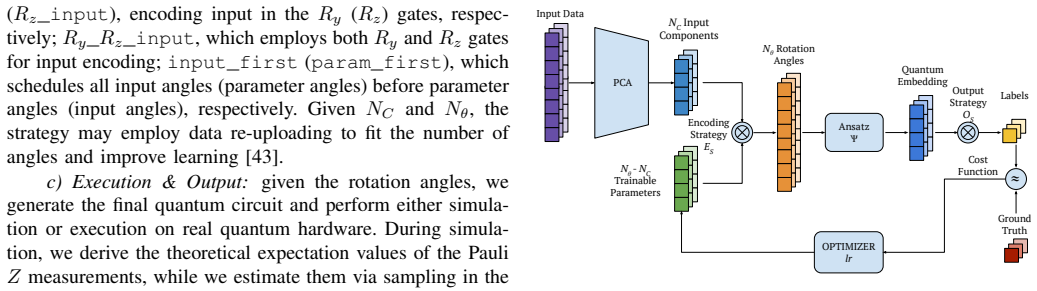
The central object is the RP000 photonic processor itself: a silicon-on-insulator chip operating in the telecom C-band that encodes three qubits into a single photon's momentum degrees of freedom. The algebraic backbone is a (Z₂)³-graded Lie algebra, where two binary momentum parities label the Z₂ × Z₂ grades and a third binary mode serves as an intra-grade index. Mach-Zehnder interferometers implement parametric rotations; thermo-optic phase shifters provide voltage-controlled tuning. The benchmarking pipeline uses principal component analysis for data reduction, multiple encoding strategies for mapping data to rotation angles, and three quantum-classical architectures (plain quantum NN, a
If this is right
- If the graded-symmetry formalism generalizes beyond three qubits, it could provide a natural algebraic route to photonic quantum error correction through parity-check operations, as the authors suggest for future work.
- Room-temperature operation with CMOS-compatible fabrication would remove the cryogenic infrastructure barrier that currently limits superconducting quantum processor deployment, potentially enabling distributed or edge-deployed quantum processors.
- If photonic noise tolerance scales with qubit count, the advantage over superconducting devices observed at three qubits could widen for larger systems where superconducting error accumulation grows.
- The hybrid quantum-classical architectures (Serial QC and Parallel QC) demonstrate that even a small quantum processor can contribute meaningfully to ML pipelines when paired with classical post-processing, suggesting a near-term deployment model where photonic chips serve as quantum feature extractors rather than standalone computers.
Load-bearing premise
The claim of superior noise tolerance over superconducting hardware rests on comparing a 3-qubit photonic chip against the best 3 qubits selected from a 20-qubit superconducting device, using the same circuit structure and shot counts. This comparison may conflate the photonic platform's inherent noise properties with the overhead of transpiling a 3-qubit circuit onto a larger, differently-architected chip, rather than isolating fundamental noise tolerance.
What would settle it
If a superconducting processor with natively 3 qubits (rather than 3 selected from 20) running the same circuits showed comparable or lower MAE/RMSE, the noise-tolerance advantage claimed for the photonic platform would not hold. Similarly, if classical neural networks with slightly more parameters matched the chip's accuracy, the quantum advantage in classification would disappear.
Figures



read the original abstract
We present the design and benchmarking of RP000, a quantum photonic processor capable of encoding a quantum system in the degrees of freedom of single photons, based on standard CMOS-compatible manufacturing processes, and working at room temperature. We benchmark it against machine learning tasks, evaluating three quantum-classical architectures of increasing complexity. Our experimental results and simulations show that RP000 achieves higher accuracy than classical networks of comparable size in multiple use cases. Compared to a superconducting quantum processor, RP000 exhibits superior noise tolerance. These findings demonstrate that RP000 can provide a scalable route toward efficient quantum applications.
Editorial analysis
A structured set of objections, weighed in public.
Referee Report
Summary. The paper presents RP000, a three-qubit photonic quantum processor fabricated on a silicon-on-insulator platform operating at room temperature in the telecom C-band. The chip encodes three qubits in the degrees of freedom of single photons and is benchmarked on supervised machine learning tasks (binary and multi-class classification on STATLOG and YEAST datasets) using three quantum-classical architectures of increasing complexity. The authors report 99.04% average target-state probability in calibration, compare the chip's accuracy against classical neural networks of nominally comparable parameter count, and compare noise tolerance (MAE/RMSE) against a 20-qubit superconducting processor. The central claims are that the chip achieves higher accuracy than classical networks of comparable size and exhibits superior noise tolerance relative to superconducting hardware.
Significance. The experimental calibration results are a genuine strength: 99.04% average target-state probability with ±2% stability over 64 hours without recalibration is a solid hardware result. The room-temperature, CMOS-compatible fabrication and the single-photon encoding approach are noteworthy. The graded Lie-algebraic framework (Section III.c) provides a clean mathematical language for the encoding, and the hardware-software co-design pipeline is well-structured. However, the central ML benchmarking claims — which constitute the paper's main contributions beyond the hardware demonstration — rest on comparisons that are not yet methodologically sufficient to support the stated conclusions.
major comments (3)
- Table II, STATLOG binary classification row: The classical baseline uses H_C = 1 (a single hidden neuron, 11 parameters) and reports 80.16% average accuracy but 99.57% maximum over 30 runs. The 20-percentage-point spread between average and maximum indicates that the classical model is undersized to the point where performance is dominated by initialization luck rather than representational capacity. The quantum chip's 97.74% appears to be from a single run, while the classical result is averaged over 30 runs. This asymmetric reporting methodology biases the comparison. The claim of 'higher accuracy than classical networks of comparable size' is not established by this table. To support the claim, the authors should either (a) report quantum accuracy averaged over multiple runs with different random seeds, or (b) use a classical baseline with adequate capacity (e.g., H_C = 8–16) so that
- Table II, multi-class rows: The classical baselines achieve 31.31% on STATLOG (6 classes) and 31.31% on YEAST, which are barely above majority-class baselines. With only 13–15 parameters, these networks are architecturally inadequate for multi-class classification. The claim that SerialQC 'outstandingly outperforms classical counterparts' (76.95% vs 31.31%) is comparing against a strawman baseline. The classical network should be sized adequately for the task (not merely matched in parameter count to the quantum ansatz) to establish a fair comparison. The paper should either provide adequately sized classical baselines or qualify the claim to reflect that the comparison is against parameter-matched but capacity-limited models.
- Section V, superconducting comparison: The 'superior noise tolerance' claim rests on comparing MAE/RMSE of a 3-qubit photonic chip against a 20-qubit superconducting chip using 'the best qubits' selected for fidelity. This comparison conflates the photonic platform's inherent noise properties with the transpilation overhead of mapping a 3-qubit circuit onto a different architecture. The paper does not report what transpilation was required, whether additional SWAP gates were inserted, or what the effective circuit depth was on the superconducting device. Without this information, the comparison does not isolate fundamental noise tolerance. The authors should either report the transpiled circuit properties or qualify the claim as a platform-level comparison rather than a fundamental noise-tolerance benchmark.
minor comments (7)
- Abstract: The claim 'scalable route toward efficient quantum applications' is not substantiated by a 3-qubit demonstration. The authors themselves note in Section I that scalability is deferred to future work. The abstract should be tempered accordingly.
- Section IV-A, paragraph on Optimization: The k-fold cross-validation is mentioned but the value of k is not specified. Please state the number of folds used.
- Table I: The hyperparameter H_C is described as 'Number of neurons in the classical module that replaces the Ansatz in classical counterparts,' but Table II does not list H_C values for the classical baselines. Including H_C in Table II would help the reader verify parameter-count matching.
- Section V, paragraph on hybrid models: The phrase 'outstandingly outperforms' is subjective and should be replaced with a neutral description of the numerical difference.
- Figure 2: The encoding strategy ES is referenced in the figure caption but the possible values are defined later in Section IV-A. Consider defining ES before or in the figure caption to avoid a forward reference.
- Reference [4]: The note 'The source code will be made available by the authors upon reasonable request' is formatted as a citation. This should be a footnote or data-availability statement rather than a numbered reference.
- Section III, calibration paragraph: The error bar ±0.01% on the 99.04% average is reported without specifying how it was computed (standard deviation across configurations? standard error?). Please clarify the error bar methodology.
Simulated Author's Rebuttal
We thank the referee for a careful and constructive report. The referee correctly identifies the hardware results as a strength and raises three methodological concerns about the ML benchmarking comparisons. We address each below. In brief: (1) we agree the classical baselines in Table II are parameter-matched but capacity-limited, and we will revise to add adequately sized baselines and qualify our claims accordingly; (2) the same applies to the multi-class rows, where we will add stronger baselines and soften the 'outstandingly outperforms' language; (3) we will add transpilation details for the superconducting comparison and qualify the noise-tolerance claim as a platform-level comparison. We believe these revisions fully address the referee's concerns.
read point-by-point responses
-
Referee: Table II, STATLOG binary classification row: asymmetric reporting methodology (quantum single run vs classical 30-run average), undersized classical baseline (H_C=1, 11 parameters) with 20-point avg-max spread, claim of 'higher accuracy than classical networks of comparable size' not established.
Authors: The referee raises a valid concern about reporting asymmetry. To clarify the methodology: the quantum chip result (97.74%) is indeed from a single run with the best hyperparameter configuration found during tuning, while the classical results report both average and maximum over 30 runs. We agree this asymmetry should be corrected. In the revised manuscript, we will (a) report quantum accuracy averaged over multiple runs with different random seeds for the trainable parameters, and (b) add classical baselines with adequate capacity (H_C = 8, 16, 32) so that the comparison includes both parameter-matched and capacity-adequate models. We acknowledge that with H_C = 1, the classical model's performance is heavily influenced by initialization, as the referee correctly identifies. We will also adjust the claim language: rather than stating the quantum model achieves 'higher accuracy than classical networks of comparable size,' we will state that it achieves 'comparable accuracy to classical networks of comparable parameter count, while classical networks with greater capacity can match or exceed this performance.' This accurately reflects the data, including the fact that the classical maximum (99.57%) exceeds the quantum chip result (97.74%) on this task. revision: yes
-
Referee: Table II, multi-class rows: classical baselines (31.31% on both datasets) barely above majority-class baselines, architecturally inadequate with 13-15 parameters, 'outstandingly outperforms' claim is against a strawman baseline.
Authors: We agree with the referee that the multi-class classical baselines with 13-15 parameters are capacity-limited and that the 31.31% accuracy is likely near majority-class performance for these datasets. The comparison as presented is parameter-matched but not capacity-adequate, and the language 'outstandingly outperforms classical counterparts' overstates what the data supports. In the revision, we will: (1) add adequately sized classical baselines (e.g., H_C = 64, 128, 256) for the multi-class tasks to provide a fair comparison; (2) report majority-class baselines for both datasets so readers can contextualize the parameter-matched results; and (3) replace 'outstandingly outperforms classical counterparts' with language that accurately reflects the nature of the comparison, e.g., 'outperforms parameter-matched classical baselines, though adequately sized classical networks may achieve comparable accuracy.' We note that the ParallelQC results (76.10% vs 75.69% avg / 80.75% max on STATLOG multi-class) already show a much closer comparison, which supports a more measured characterization. revision: yes
-
Referee: Section V, superconducting comparison: 'superior noise tolerance' claim conflates photonic platform noise with transpilation overhead of mapping 3-qubit circuit onto 20-qubit architecture; no transpilation details reported.
Authors: The referee is correct that the comparison as currently presented does not isolate the photonic platform's fundamental noise properties from the transpilation overhead of mapping onto the superconducting device. We did select the best qubits on the 20-qubit superconducting chip to minimize connectivity mismatch, but we did not report the transpiled circuit properties, which is a gap. In the revision, we will: (1) report the transpiled circuit depth, gate count, and whether SWAP gates were inserted for the superconducting execution; (2) note the native gate set and connectivity of the superconducting device; and (3) qualify the claim from 'superior noise tolerance' to 'lower error rates in this platform-level comparison,' explicitly acknowledging that the comparison includes transpilation overhead and does not isolate fundamental noise tolerance. We believe this is the honest characterization: the photonic chip shows lower MAE/RMSE on these specific tasks under matched sampling conditions, but attributing this solely to fundamental noise properties would require controlling for transpilation, which we will now report but cannot fully eliminate as a confound given the different native gate sets and connectivity of the two platforms. revision: yes
Circularity Check
No significant circularity found; one self-citation for the algebraic framework is not load-bearing for the experimental claims.
full rationale
The paper's central claims — higher accuracy than classical networks and superior noise tolerance over superconducting hardware — are grounded in independent experimental data from external datasets (STATLOG, YEAST) and an external superconducting device. The derivation chain for these claims runs through standard ML training (PCA, parameter optimization via Adam, cross-entropy loss, k-fold cross-validation) and independent hardware measurements (coincidence counts on the photonic chip, matched-shot comparisons on a superconducting device). None of these steps reduce to their own inputs by construction. The paper does cite Reference [18] (Tamburini, Leone, Sanna, Siagri — overlapping authors) for the graded paraparticle algebra framework, and states 'We extend previous work [18] to show that the same formalism presented in Section II can be used to describe computation encoded in photon's momentum only.' However, this algebraic framework is descriptive: it provides a theoretical language for the chip's mode structure but does not define or constrain the experimental accuracy or noise-tolerance results. The ML benchmarking pipeline (Section IV–V) operates entirely through standard quantum circuit concepts (rotations, CNOTs, Pauli-Z expectation values) without invoking the graded algebra as a load-bearing premise. The classical baselines are independently trained models, not defined in terms of the quantum results. The superconducting comparison uses the same circuit structure but on independent hardware. Concerns about whether the classical baselines are adequately sized or whether single-run vs. averaged reporting is fair are correctness and methodology risks, not circularity — the paper is not defining its outputs in terms of its inputs. The self-citation [18] is minor and non-load-bearing for the central experimental claims, warranting a score of 2.
Axiom & Free-Parameter Ledger
free parameters (4)
- Ansatz rotation angles (N_theta) =
8-10
- PCA components (N_C) =
6-12
- Learning rate (lr) =
0.001-0.01
- Classical hidden layer sizes (H_S, H1_P, H2_P) =
128-512
axioms (3)
- domain assumption The (Z_2)^3-graded Lie algebra framework correctly describes the coupling between optical modes in the photonic chip.
- ad hoc to paper Comparing a 3-qubit photonic chip to a 20-qubit superconducting chip (using best qubits) is a fair benchmark for noise tolerance.
- domain assumption Classical neural networks with 11-13 parameters are appropriate baselines for 8-10 parameter quantum circuits.
invented entities (1)
-
RP000 photonic processor
independent evidence
discussion (0)
Sign in with ORCID, Apple, or X to comment. Anyone can read and Pith papers without signing in.