REVIEW 4 major objections 4 minor 1 cited by
High-Throughput LLM inference on Heterogeneous Clusters
T0 review · 4 major / 4 minor · reviewed 2026-08-16 · deepseek-v4-flash
Pith's one-line read A lightweight profiling model plus a KV-cache-aware request scheduler can lift LLM inference throughput on heterogeneous clusters by 122.5% and 33.6% over round-robin scheduling.
desk verdict A sensible scheduler heuristic and a fragile deployment optimizer; the paper deserves a serious referee but needs a corrected algorithm and stronger ranking evidence. read the letter →
The pith
A machine-rendered reading of the paper's core claim, the machinery that carries it, and where it could break.
The reading
What carries the argument
The load-bearing objects are the linear time model and the workload formula. The linear model says that, for a fixed batch, prefill time is linear in batch size and total input length while each decode iteration is linear in batch size and cached length, giving constants $p^s_1$ through $p^s_8$ that are fitted from a few profiled runs. That model supplies the deployment estimator and the scheduler's per-request processing time $T^s_r$. The workload formula $w^s_r = T^s_r \cdot e^{\theta \cdot kv_{usage}(s)}$ fuses that capacity estimate with current memory pressure: the exponential KV-cache term grows as the instance fills up, so the scheduler favors strong compute under moderate load and shifts toward memory-aware routing under bursts, while the mapper greedily assigns each request to minimize the largest resulting instance workload.
What would settle it
Run the deployment search on a three-machine cluster with three different accelerator types and compare the estimated ranking of tensor-parallel configurations against the measured throughput of each configuration on the same inference engine; if the estimated top configuration is not the measured best, or any adjacent pair is inverted, the core deployment claim fails.
Extended reading notes
Core claim
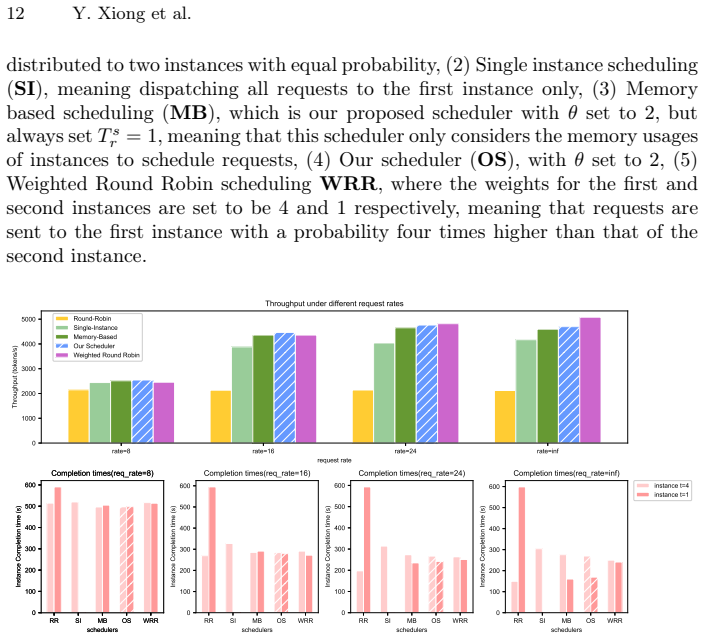
The central claim is that both hard parts of serving on a heterogeneous cluster—choosing how to split each machine's accelerators into instances, and routing requests once those instances are live—can be solved with profiling data instead of exhaustive benchmarking or static weights. For deployment, the paper fits eight constants per machine to a linear model of prefill and decode time, checks memory feasibility, and evaluates every candidate tensor-parallel degree on a few sampled requests; the chosen degree matches the actual best in experiments even though the estimated throughput is far off. For scheduling, it defines the workload of request $r$ on instance $s$ as $T^s_r \cdot e^{\theta \cdot kv_{usage}(s)}$, where $T^s_r$ is the per-request processing time under an ideal batch and $kv_{usage}(s)$ is the fraction of KV cache occupied, then sends each request to the instance that keeps the maximum resulting load smallest. Experiments on two-machine clusters with different GPU types report a 122.5% throughput gain over round-robin in the two-instance setting and a 33.6% gain in the multi-machine setting.
Load-bearing premise
The deployment optimizer's usefulness rests on the claim that its static-batching throughput estimate ranks configurations in the same order as the real engine's continuous batching, but the paper admits the estimate itself is inaccurate and checks the ordering in only one setup with two random seeds.
Editorial extensions
If this is right
- A cluster operator can select the best tensor-parallel degree per machine without running full throughput benchmarks, using only a small profiling pass and an exhaustive search over configurations.
- The scheduler can balance unequal instances without manually assigned weights, which the paper notes are hard to choose when a cluster contains multiple GPU models.
- Round-robin routing degrades sharply as instance capacities diverge, so heterogeneous clusters gain disproportionately from capacity-aware scheduling.
- The workload formula adapts automatically to request bursts: at low occupancy it routes by computing power, and as KV caches fill it routes by available memory.
- The measured gains of 122.5% and 33.6% are concrete improvements over round-robin on the tested clusters, and the paper's comparison shows that naive round-robin can even lag behind sending every request to the stronger instance.
Reading between the lines
- A natural extension is to test whether the order-preserving property of the deployment estimator holds beyond the two random seeds tested; if continuous batching is monotone in instance throughput, the ranking argument could be proven rather than demonstrated.
- The output-length predictor used in experiments is deliberately simple, sampling from the dataset's distribution; coupling the scheduler with a learned predictor would be a direct testable upgrade and could determine whether the reported gains transfer to workloads with skewed output lengths.
- The fixed penalty parameter $\theta = 2$ is a tuning choice; sweeping $\theta$ per cluster and request rate would show whether the scheduler is robust or needs per-deployment calibration.
- The paper treats deployment optimization and request scheduling sequentially, but the size of the reported routing gain suggests the two should be optimized jointly, since configuration choices change instance capacities and therefore the best routing policy.
Signed reviews
Editorial analysis
A structured set of objections, weighed in public.
Referee Report
Summary. The paper proposes a two-part system for serving LLMs on heterogeneous clusters. The first component is an offline deployment-configuration optimizer that profiles per-instance prefill/decode latency models, estimates batch processing times under a static-batching assumption, and exhaustively searches tensor-parallelism degrees. The second component is a runtime request scheduler that uses the same per-instance latency models together with KV-cache utilization to compute request workloads and places each request so as to minimize the maximum instance load. Experiments on two small clusters report scheduler throughput improvements of 122.5% and 33.6% over round-robin scheduling, and a single-machine experiment is used to argue that the static-batching estimator preserves the configuration ranking of vLLM's continuous batching. The core claimed mechanism is that lightweight profiling can replace expensive throughput benchmarks for deployment search.
Significance. If the claimed ranking property and the scheduler gains hold, the work would be practically useful: it outlines a reproducible, lightweight profiling-based alternative to exhaustive benchmark-based configuration search and a workload-aware scheduler for mixed-accelerator clusters. The modeling is clearly specified and the system components are sensible, and the paper honestly concedes in Section 3.2 that the estimator is inaccurate and relies on an order-preserving property. I also credit the authors for designing a deliberately balanced test setup in Section 5.1 to isolate configuration throughput. However, the evidence is currently thin: results are self-reported without code, data, or error bars; the single-machine ranking validation has an internal inconsistency; and the heterogeneous-cluster experiment does not validate the deployment optimizer. These issues matter for the central claims and need to be addressed in revision.
major comments (4)
- [Section 3.2, Algorithm 1] The printed return statement in Algorithm 1, `return ti·(tokenNum/totalTime)`, is inconsistent with the system-throughput derivation in Section 3.2. The system has pi = ui/ti instances, so system throughput is (ui/ti)·(tokenNum/totalTime), not ti·(tokenNum/totalTime). In the single-machine experiment (ui=8) this changes the ranking criterion by a factor that depends on ti, so Figure 4 as documented does not validate the estimator described in the text. Please correct Algorithm 1 and re-run the ranking validation, or explicitly clarify the notation if the printed formula is not what was executed.
- [Section 3.2 and Section 5.1] The load-bearing assumption for the deployment optimizer is the order-preserving property between the static-batching estimator and vLLM's continuous batching; the paper itself states "the estimation is not accurate" in Section 3.2. The evidence in Section 5.1 is limited to one machine, one model, four tensor-parallelism choices, two random seeds, and two request samples. Moreover, the text reports the two estimated rankings as both being "t = 2, t = 8, t = 1, and t = 8", which is not a valid permutation and cannot be consistent with the measured order "t = 2, t = 4, t = 1, t = 8". As printed, the only validation of the ranking assumption is unusable. Please fix the sequence, add more diverse validation (for example, a heterogeneous multi-machine case where the chosen configuration is compared against alternatives), and report the actual estimated and measured throughput values.
- [Section 5.2 and Section 5.3] The headline improvements (122.5% and 33.6%) are single request-rate points, not aggregate results. In Section 5.2 the weighted round-robin baseline is reported as the highest-throughput strategy at request rates 24 and infinity, while the proposed scheduler is best only at rates 8 and 16; the 122.5% figure is quoted for rate 24 alone. The figures appear to report single runs without error bars or multiple seeds, so the claimed gains may not be statistically robust. Please report multiple trials with confidence intervals, show the full request-rate sweep, and state in the abstract and conclusion which rates the headline gains refer to.
- [Section 5.3] Section 5.3 evaluates the scheduler on a two-machine heterogeneous cluster with a fixed deployment (four t=2 V100 instances and one t=1 A800 instance), but it does not compare this deployment against alternative tensor-parallelism configurations or demonstrate that the deployment optimizer selected it. Since deployment configuration optimization is the first contribution claimed in the introduction, the end-to-end system claim lacks its central validation. The authors should either run the configuration optimizer on the heterogeneous cluster and compare predicted versus measured rankings, or explicitly present Section 5.3 as a scheduler-only evaluation and temper the corresponding contribution claims.
minor comments (4)
- [Algorithm 2, lines 15 and 17] The symbols `wchoice_r` and `wc_r` are undefined; they should be a single notation such as `w^c_r`, the workload of request r on the chosen instance c.
- [Equation (5)] Equation (5) omits the per-parameter byte size `bbyte` that appears in Equation (1); as written, KV Size(r) has units of hidden units rather than bytes, which matters for the FP16 deployment described in Section 5.1.
- [Section 5.2, output-length predictor] The predictor uses `numpy.random.normal` to draw output lengths from the fitted mean and standard deviation; this can in principle produce negative output lengths, so the authors should either clamp the predictions or report that no negative values occurred in the experiments.
- [Section 4, output-length predictor discussion] The phrase "Ref [19]" is an unusual citation format and should be written as a standard citation, e.g., "[19]".
Circularity Check
No circularity: fitted timing model is validated against real throughput, and scheduler gains are measured end-to-end; internal inconsistencies are correctness bugs, not circularity.
full rationale
The paper's central claims—deployment-configuration ranking and scheduler throughput gains—are evaluated against real end-to-end runs rather than being forced by the model. The per-instance timing model (Eqs. 3–4) is fitted to prefill/decode latencies, and Algorithm 1 uses it to produce an estimated throughput; the final ranking validation in Sec. 5.1 compares that estimate to actual vLLM throughput on the same hardware. This is a cost-model prediction with an independent measured outcome, not a fitted parameter renamed as a prediction. The scheduler's workload formula (Eqs. 5–8) similarly feeds estimated processing times into a min-max mapper, and the claimed 122.5%/33.6% improvements are measured throughput differences versus round-robin, not outputs of the model. No load-bearing step is justified by a self-citation; the linear-latency assumption is attributed to external prior work [5]. Several non-circular correctness issues exist: Algorithm 1 line 17 returns ti*(tokenNum/totalTime) while Section 3.2 derives system throughput as (ui/ti)*TP_s, and Section 5.1's text lists an estimated order "t = 2, t = 8, t = 1, and t = 8" that cannot match the measured "t = 2, t = 4, t = 1, t = 8"; these should be corrected but do not make the derivation circular.
Assumptions & free parameters
free parameters (4)
- theta (θ) in workload formula =
2
- per-instance profiling constants p^s_1..p^s_8 =
fitted via least squares
- memory model constants φ_usage and δ_engine =
0.9 and 2 GB
- output length predictor mean and standard deviation =
estimated from dataset subset
assumptions (3)
- domain assumption Prefill and decode durations are linear in batch size, input length, and cached length
- ad hoc to paper The ranking of deployment configurations estimated from static batching matches the ranking with vLLM continuous batching
- domain assumption The workload heuristic w = T * exp(θ*kvusage) correctly orders scheduling decisions
Cite this review
Pith. "Pith review of High-Throughput LLM inference on Heterogeneous Clusters." pith.science (2026). https://pith.science/paper/6SNGK4VY
@misc{pith2026250415303,
  author       = {Pith},
  title        = {Pith review of: High-Throughput LLM inference on Heterogeneous Clusters},
  year         = {2026},
  howpublished = {\url{https://pith.science/paper/6SNGK4VY}},
  note         = {Machine review of arXiv:2504.15303}
}
read the original abstract
Nowadays, many companies possess various types of AI accelerators, forming heterogeneous clusters. Efficiently leveraging these clusters for high-throughput large language model (LLM) inference services can significantly reduce costs and expedite task processing. However, LLM inference on heterogeneous clusters presents two main challenges. Firstly, different deployment configurations can result in vastly different performance. The number of possible configurations is large, and evaluating the effectiveness of a specific setup is complex. Thus, finding an optimal configuration is not an easy task. Secondly, LLM inference instances within a heterogeneous cluster possess varying processing capacities, leading to different processing speeds for handling inference requests. Evaluating these capacities and designing a request scheduling algorithm that fully maximizes the potential of each instance is challenging. In this paper, we propose a high-throughput inference service system on heterogeneous clusters. First, the deployment configuration is optimized by modeling the resource amount and expected throughput and using the exhaustive search method. Second, a novel mechanism is proposed to schedule requests among instances, which fully considers the different processing capabilities of various instances. Extensive experiments show that the proposed scheduler improves throughput by 122.5% and 33.6% on two heterogeneous clusters, respectively.
Figures


Figures from the paper (4 more)



Forward citations
Cited by 1 Pith paper
-
Meeting SLOs, Slashing Hours: Automated Enterprise LLM Optimization with OptiKIT
OptiKIT combines automated quantization and SLO-driven serving-parameter tuning to more than double per-GPU throughput on some production workloads while preserving near full-precision accuracy.
Reference graph
Works this paper leans on
-
[1]
Tensorflow serving (2023), https://github.com/tensorflow/serving
work page 2023
-
[2]
Triton inference server (2023), https://github.com/triton-inference-server/server
work page 2023
-
[3]
Deepspeed-fastgen (2024), https://github.com/microsoft/DeepSpeed-MII
work page 2024
-
[4]
arXiv preprint arXiv:2107.03374 (2021)
Chen, M., Tworek, J., Jun, H., et al.: Evaluating large lan guage models trained on code. arXiv preprint arXiv:2107.03374 (2021)
arXiv 2021
-
[5]
arXiv preprint arXiv:2406.1351 1 (2024)
Cheng, K., Hu, W., Wang, Z., et al.: Slice-level schedulin g for high throughput and load balanced llm serving. arXiv preprint arXiv:2406.1351 1 (2024)
-
[6]
DeepSeek-AI, Guo, D., Yang, D., Zhang, H., et al.: Deepsee k-r1: In- centivizing reasoning capability in llms via reinforcemen t learning (2025), https://arxiv.org/abs/2501.12948
arXiv 2025
-
[7]
Advances in Ne ural Information Pro- cessing Systems 36, 18015–18027 (2023)
Jin, Y., Wu, C.F., Brooks, D., Wei, G.Y.: S3: Increasing gp u utilization during generative inference for higher throughput. Advances in Ne ural Information Pro- cessing Systems 36, 18015–18027 (2023)
work page 2023
-
[8]
Kwon, W., Li, Z., Zhuang, S., et al.: Efficient memory manage - ment for large language model serving with pagedattention ( 2023), https://arxiv.org/abs/2309.06180
arXiv 2023
Show all 19 references
-
[9]
Microsoft: Copilot (2023), https://copilot.microsoft.com/
2023
-
[10]
OpenAI: Introducing chatgpt (2022), https://openai.com/blog/chatgpt
2022
-
[11]
OpenAI, Achiam, J., Adler, S., Agarwal, S., et al.: Gpt-4 technical report (2024), https://arxiv.org/abs/2303.08774
2024 arXiv
-
[12]
Venigalla, A.: Training llms at scale with amd mi250 gpus (2023), https://www.databricks.com/blog/training-llms-scale-amd-mi250-gpus
2023
-
[13]
Nature methods 17(3), 261–272 (2020)
Virtanen, P., Gommers, R., Oliphant, T.E., et al.: Scipy 1.0: fundamental algo- rithms for scientific computing in python. Nature methods 17(3), 261–272 (2020)
2020
-
[14]
Wu, B., Zhong, Y., Zhang, Z., et al.: Fast distributed inf erence serving for large language models (2024), https://arxiv.org/abs/2305.05920
2024 arXiv
-
[15]
Xu, D., Zhang, H., Yang, L., et al.: Fast on-device llm inf erence with npus (2024), https://arxiv.org/abs/2407.05858
2024 arXiv
-
[16]
Yang, A., Yang, B., Zhang, B., et al.: Qwen2.5 technical r eport (2025), https://arxiv.org/abs/2412.15115
2025 arXiv
-
[17]
In: 16th USENIX Symposium on Oper- ating Systems Design and Implementation (OSDI 22)
Yu, G.I., Jeong, J.S., Kim, G.W., et al.: Orca: A distribu ted serving system for {Transformer-Based} generative models. In: 16th USENIX Symposium on Oper- ating Systems Design and Implementation (OSDI 22). pp. 521– 538 (2022)
2022
-
[18]
arXiv preprint arXiv:2303.17568 (2023)
Zheng, Q., Xia, X., Zou, X., et al.: Codegeex: A pre-train ed model for code generation with multilingual evaluations on humaneva l-x. arXiv preprint arXiv:2303.17568 (2023)
2023 arXiv
-
[19]
Adva nces in Neural Infor- mation Processing Systems 36, 65517–65530 (2023)
Zheng, Z., Ren, X., Xue, F., et al.: Response length perce ption and sequence scheduling: An llm-empowered llm inference pipeline. Adva nces in Neural Infor- mation Processing Systems 36, 65517–65530 (2023)
2023
Reviewed August 16, 2026 · model on record in the stance chip above.
Discussion (0). Continue with ORCID to comment.