REVIEW 2 major objections 5 minor 106 references
Gauged $U(1)_{L_\mu-L_\tau}$ Scotogenic Model in light of $R_{K^{(*)}}$ Anomaly and AMS-02 Positron Excess
T0 review · 2 major / 5 minor · reviewed 2026-08-14 · deepseek-v4-flash
Pith's one-line read A single gauged mu-minus-tau symmetry, embedded in the scotogenic model with vector-like quarks, can explain both the LHCb $R_{K^{(*)}}$ anomaly and the AMS-02 positron excess at the same time.
desk verdict The model-building and constraint work are genuinely useful, but the AMS-02 positron claim does not survive contact with the paper's own couplings: the advertised Z'H0 channel cannot produce the quoted annihilation rate. read the letter →
The pith
A machine-rendered reading of the paper's core claim, the machinery that carries it, and where it could break.
The reading
What carries the argument
The load-bearing object is the massive $Z'$ gauge boson of $U(1)_{L_\mu-L_\tau}$, together with the singlet scalar $H_0$ that arises when the new symmetry breaks. The $Z'$ does double duty: through heavy vector-like quarks it generates the flavor-changing $Z'bs$ coupling that sets $C_9^\mu$, and through its couplings to muons and taus it mediates leptophilic dark-matter annihilation. The $H_0$ is the second piece of machinery, as its lightness provides a Yukawa-type potential that gives a velocity-dependent Sommerfeld enhancement to the annihilation cross section, converting the freeze-out cross section into the much larger boost factor required by the positron data.
What would settle it
Measure the local dark matter density to a precision that excludes the high side of the current range, say by pinning it at the nominal $0.4\text{ GeV cm}^{-3}$; the paper's own benchmark tables show the required annihilation cross sections would then exceed the CMB limit by factors of about two to three, removing the AMS-02 interpretation. A second decisive check is the LHC search for $Z'\to \mu^+\mu^-$ in the 10 GeV mass range and for $t\to cZ'$ above a branching ratio of roughly $10^{-4}$.
Extended reading notes
Core claim
The paper's central claim is that the $R_{K^{(*)}}$ anomaly and the AMS-02 positron excess can be explained simultaneously within the gauged $U(1)_{L_\mu-L_\tau}$ scotogenic model. Neutrino masses are generated at one loop with $Z_2$-odd right-handed neutrinos and an inert scalar doublet, while spontaneous symmetry breaking of the new gauge group by a singlet scalar produces a massive $Z'$. With heavy vector-like quarks, an effective $Z'bs$ coupling arises, yielding the Wilson coefficient $C_9^\mu\simeq -0.95$ that fits the LHCb data for $Y_Q=0.122$ and $M_Q=10$ TeV. For the Majorana dark-matter fermion $N$, annihilation through $NN\to Z'Z'$ and $NN\to Z'H_0(\to Z'Z')$ produces muon and tau final states that fit the AMS-02 positron flux for $M_N\sim 1$ to 1.5 TeV; the 2 TeV benchmark overshoots the data. A Sommerfeld enhancement driven by a light singlet Higgs $H_0$ with mass around 30 to 75 GeV supplies the large boost factor needed, and the combination satisfies the main existing constraints, with the CMB bound the tightest.
Load-bearing premise
The positron interpretation rests on a light singlet Higgs boson near 30 to 75 GeV providing a large Sommerfeld enhancement to dark-matter annihilation, and on the local dark matter density being near the upper end of its measured uncertainty so that the required cross section slips under the CMB bound.
Editorial extensions
If this is right
- If the model is right, the $R_{K^{(*)}}$ anomaly is a sign of a new $C_9^\mu$ contribution around $-0.95$, produced by $Z'$ exchange whose strength is fixed by the ratio $Y_Q/M_Q$ and is otherwise independent of the $Z'$ mass and gauge coupling.
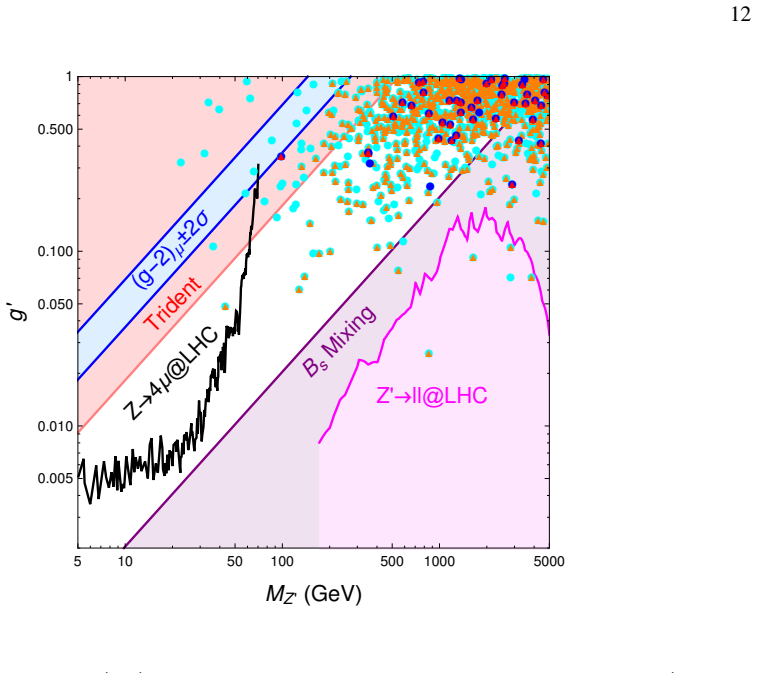
- The viable $Z'$ parameter region is bounded by neutrino trident production and $B_s$ mixing, leaving roughly $550\text{ GeV}\lesssim M_{Z'}/g'\lesssim 4\text{ TeV}$, with very light $Z'$ masses near 10 GeV allowed at $g'\simeq 3\times10^{-3}$.
- Dark matter with mass between about 1 and 1.5 TeV annihilating into $Z'Z'$ or $Z'H_0$ fits the AMS-02 positron spectrum, while a 2 TeV dark matter particle would overshoot the measured flux.
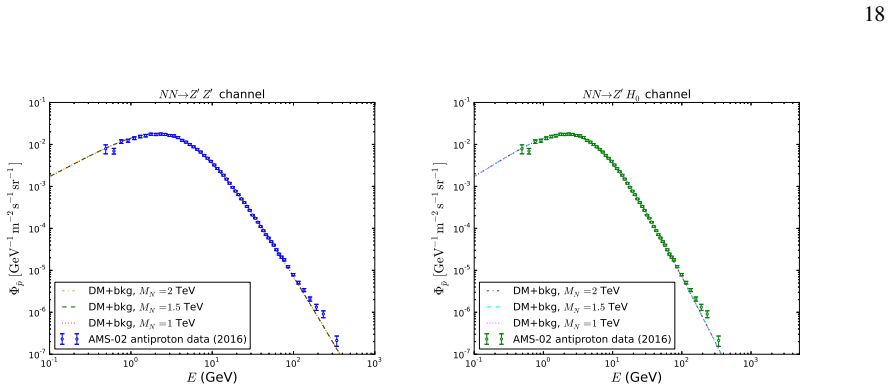
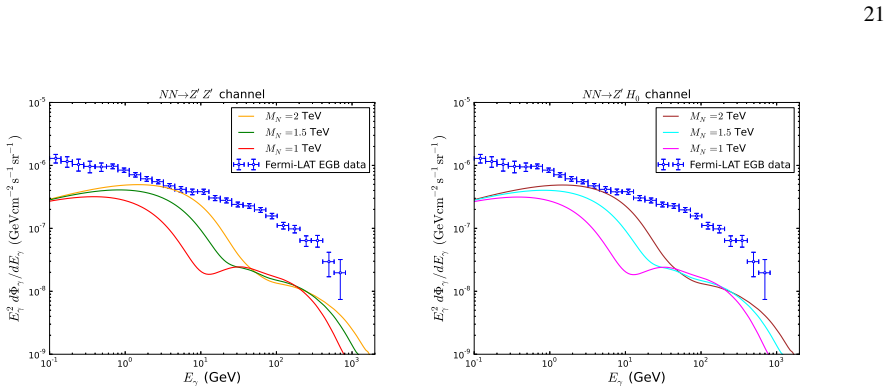
- The benchmark scenarios produce negligible antiproton flux and are marginally compatible with the extragalactic gamma-ray background, so the main tension lies with the CMB energy-deposition limit.
- If confirmed, the framework ties together dark matter, radiative neutrino mass, a flavor anomaly, and a cosmic-ray excess using one new gauge symmetry and a handful of new states.
Reading between the lines
- The positron half of the interpretation is directly testable by cosmic-ray and astrophysical observations without any collider input: a precise measurement of the local dark matter density near its nominal value of $0.4\text{ GeV cm}^{-3}$, rather than the upper end of the uncertainty, would push the required annihilation cross section above the CMB bound by a factor of roughly two to three.
- If the $R_{K^{(*)}}$ anomaly is confirmed by later LHCb data, the model predicts vector-like quarks at the 10 TeV scale with Yukawa couplings near 0.1, making the heavy-quark sector a concrete target for future high-energy colliders; if the anomaly instead fades, the dark-matter and neutrino-mass parts of the model survive without the vector-like quark sector.
- The two-zero texture of the neutrino mass matrix forces an inverted neutrino mass hierarchy, so future long-baseline neutrino oscillation experiments that determine the mass ordering could confirm or exclude this specific realization independently of any dark-matter or flavor measurement.
- The light $H_0$ mediator in the 30 to 75 GeV range with the required Sommerfeld enhancement gives a velocity-dependent annihilation signal that could show up differently in dwarf-spheroidal gamma-ray searches versus the galactic center, a distinction not fully explored in the paper.
Editorial analysis
A structured set of objections, weighed in public.
Referee Report
Summary. This paper studies the gauged U(1)_{L_mu-L_tau} scotogenic model, augmented with vector-like quarks to generate an effective Z' bs coupling, and claims to explain simultaneously the R_K(*) anomaly and the AMS-02 positron excess while satisfying neutrino oscillation, relic density, direct detection, neutrino trident, B_s mixing, Z to 4 mu, antiproton, EGRB and CMB constraints. The R_K(*) explanation is obtained by fixing Y_Q/M_Q to reproduce the global-fit value C9^mu = -0.95. For DM, the paper performs a Monte Carlo scan of the parameter space and identifies NN -> Z'Z' and NN -> Z'H0 (with H0 -> Z'Z') as candidate channels for the positron excess. Benchmarks for these channels are given in Tables III and IV, with the Sommerfeld enhancement used to match the required boost factor. The paper concludes that the two anomalies can be explained simultaneously.
Significance. If correct, the paper would provide a very broad framework: radiative neutrino masses, a leptophilic DM candidate, an L_mu-L_tau gauge boson addressing B anomalies, and a simultaneous fit to cosmic-ray positron data. The paper has genuine strengths: it is implementation-heavy (FeynRules, micrOMEGAs, GALPROP), it considers a wide set of constraints, and it provides explicit benchmark points. The R_K(*) Wilson-coefficient derivation in Eqs. (25)-(27) is standard and the parameter choice is transparently documented. However, the central AMS-02 benchmark is numerically inconsistent: the NN -> Z'H0 cross section with g' = 3e-3 is many orders of magnitude too small to produce the quoted freeze-out cross section, so the paper's only claimed working channel does not actually work. This is a load-bearing error in the central claim, not a presentation issue.
major comments (2)
- [Section V A, Table IV] The benchmark for the NN -> Z'H0 channel is numerically inconsistent. The amplitude contains one N-N-Z' vertex proportional to g' and one N-N-H0 vertex proportional to h_N, so the partial cross section scales as (g' h_N)^2/(16 pi M_N^2). With g' = 3e-3, h_N ~ 0.8 and M_N = 1 TeV, this gives <sigma v>_0 of order 1e-31 cm^3/s at freeze-out, not the 1e-26 cm^3/s quoted in Table IV. Even multiplying by the Sommerfeld factors shown in Fig. 5 (right), which reach at most about 1e4, the local annihilation cross section remains orders of magnitude below the required <sigma v>_BF ~ 7e-24 cm^3/s quoted in the table. If, instead, the quoted <sigma v>_0 is the total annihilation cross section, then it must be dominated by NN -> H0H0 (since g'^2 << h_N^2), in which case the positron flux has been computed from the wrong final state and the claim that NN -> Z'H0 is the source of the AMS-02 signal is unsupported. This invalidates the AMS-02 part of the simultaneous explanation.
- [Section V B 3, Tables III and IV] For all benchmarks, the required annihilation cross section <sigma v>_BF exceeds the CMB-derived limit <sigma v>_CMB by factors of about two to three (for example, Table IV, M_N = 1 TeV: 7.35e-24 vs 3.25e-24 cm^3/s). The paper responds by appealing to a larger local DM density within observational uncertainty, which would reduce the required cross section by 'a factor of several times'. This is an unquantified assumption and not a constraint-satisfying result: at the nominal rho_sun = 0.4 GeV/cm^3 used elsewhere in the paper, the benchmarks are excluded. The conclusion that the model satisfies CMB constraints is therefore not supported by the presented benchmarks.
minor comments (5)
- [Section IV, scan range] The scan range for M_H0 is written as [0, sqrt(4 pi M_Z'/g')], which is dimensionally inconsistent; the intended expression is probably sqrt(4 pi) M_Z'/g' or an equivalent dimensionless-corrected form.
- [Section V A, text after Eq. (33)] 'For a given model parameters in Eq. (33)' is a cross-reference error: Eq. (33) defines the spin-independent direct detection cross section, not the model parameters of the benchmark.
- [Abstract and Section V A] The abstract lists both NN -> Z'Z' and NN -> Z'H0 as channels that can interpret the AMS-02 excess, but Section V A states that NN -> Z'Z' 'is difficult to give desired BF through Sommerfeld enhancement'; the abstract should be made consistent with this conclusion.
- [Equation (50)] The expression for f_eff^{Z'H0} in Eq. (50) has a bracket imbalance; it should presumably read [f_i(E_Z'/2) + 2(E_H0/E_Z') f_i(E_H0/4)] / [1 + 2(E_H0/E_Z')].
- [Figures 1-4] The horizontal-axis labels for the Z' mass are inconsistent ('M'_Z' in some figures, 'M_Z'' in others); please standardize.
Circularity Check
AMS-02 'prediction' is a refit: MH0 is chosen so the Sommerfeld factor equals the AMS-fitted boost factor, so the positron-flux normalization is an input rather than a prediction; independent constraints remain genuine checks.
-
fitted input called prediction
[Table IV caption and Sec. V A (AMS-02 positron flux fit)]
"The values of MH0 have been chosen such that the resulted Sommerfeld enhancement factors are match to fitted boost factors, i.e., SE≃BF."
In Eqs. (34)-(36), BF is introduced as a free parameter in the chi^2 fit to the AMS-02 positron data. The paper then chooses MH0 in Table IV so that the model's Sommerfeld enhancement equals that fitted BF. Since the predicted DM positron flux scales as BF times the freeze-out cross section times the spectrum, and since BF is fixed to the AMS-02 fit, the normalization of the 'predicted' flux in Fig. 6 is forced by the data by construction. The model does not independently predict the excess amplitude; it accommodates it by tuning MH0. The remaining nontrivial content is the spectral shape set by MN and the muon/tau final states, and the independent constraints (antiproton, EGRB, CMB) are genuine external checks, which prevents the whole paper from being fully circular.
full rationale
The R_K(*) part is an explicit fit rather than a disguised prediction: the paper fixes YQ=0.122 and MQ=10 TeV to reproduce the global-fit value C9=-0.95, so the 'explanation' of that anomaly is parameter accommodation, presented transparently. The same is true for the AMS-02 part: BF is fitted to the positron data and MH0 is then chosen so SE=BF, with the paper even stating this in the Table IV caption. Calling the resulting curve 'predicted' is therefore a fitted input called a prediction for the normalization, although the spectral shape and the external constraints (neutrino trident, Bs mixing, Z->4mu, antiproton, EGRB, CMB) are not circular. There is no load-bearing self-citation chain: the model setup uses prior work by other authors, and the Sommerfeld, EGRB, and CMB calculations are standard literature. Because the central claim of simultaneously explaining both anomalies reduces in part to fitting parameters to those anomalies, a partial-circularity score of 6 is appropriate rather than a higher score, since the consistency checks against independent data are genuine and the paper is explicit about its fitting choices.
Assumptions & free parameters
free parameters (10)
- YQ and MQ (vector-like quark Yukawa and mass) =
YQ = 0.122, MQ = 10 TeV
- g' (U(1)_{L_mu-L_tau} gauge coupling) =
g' = 3e-3 for NN -> Z'H0 benchmarks; up to ~0.7 in scan
- MZ' (Z' mass) =
10 to 12 GeV in AMS-02 benchmarks
- MH0 (singlet-like scalar mass) =
29.6, 48.7, 74.7 GeV
- hN (effective DM-S coupling) =
0.77, 0.80, 0.91
- MN (dark matter mass) =
1, 1.5, 2 TeV
- fe+ and f_pbar (background normalizations) =
about 0.78 to 0.81 and 1.28
- phi_e+ and phi_pbar (solar modulation potentials) =
600-620 MV and 1019 MV
- Neutrino sector parameters (lambda5, M0, f_l) =
not specified individually
- alpha (scalar mixing angle) =
scanned in [0.01, 0.1]
assumptions (6)
- domain assumption The U(1)_{L_mu-L_tau} symmetry is gauged and spontaneously broken by the singlet S; the Z2 symmetry stays unbroken.
- domain assumption Only the inverted neutrino mass hierarchy can fit the two-zero texture of the one-loop neutrino mass matrix.
- ad hoc to paper The vector-like quark sector generates the effective Z'bs couplings with the texture in Eq. (24), and the CP-odd part mD is decoupled to set C9' = 0.
- standard math The Sommerfeld enhancement is computed with the semi-analytic formula from Refs. [88,89] for a Yukawa potential.
- domain assumption The Milky Way DM halo is NFW with local density 0.4 GeV/cm^3; propagation parameters are those of the DC case in Ref. [76]; minimal halo mass Mmin = 10^-6 Msun and Maccio concentration model are used.
- ad hoc to paper The CMB constraint can be relaxed by a larger local DM density within observational uncertainty.
invented entities (6)
-
Z' gauge boson
independent evidence
-
H0 singlet-like scalar
independent evidence
-
Heavy vector-like quarks QL, UR, DR, etc.
independent evidence
-
Right-handed neutrinos N_e, N_mu, N_tau
independent evidence
-
Inert scalar doublet eta
independent evidence
-
Scalar singlet S
independent evidence
Cite this review
Pith. "Pith review of Gauged $U(1)_{L_\mu-L_\tau}$ Scotogenic Model in light of $R_{K^{(*)}}$ Anomaly and AMS-02 Positron Excess." pith.science (2026). https://pith.science/paper/6SWTLVH3
@misc{pith2026190807192,
  author       = {Pith},
  title        = {Pith review of: Gauged $U(1)_L_\mu-L_\tau$ Scotogenic Model in light of $R_K^(*)$ Anomaly and AMS-02 Positron Excess},
  year         = {2026},
  howpublished = {\url{https://pith.science/paper/6SWTLVH3}},
  note         = {Machine review of arXiv:1908.07192}
}
abstract
We study the gauged $U(1)_{L_\mu-L_\tau}$ scotogenic model with emphasis on latest measurement of LHCb $R_{K^{(*)}}$ anomaly and AMS-02 positron excess. In this model, neutrino masses are induced at one-loop level with $Z_2$-odd particles, i.e., right-handed neutrinos $N_\ell(\ell=e,\mu,\tau)$ and inert scalar doublet $\eta$ inside the loop. Meanwhile, the gauged $U(1)_{L_\mu-L_\tau}$ symmetry is broken spontaneously by the scalar singlet $S$, resulting to the massive gauge boson $Z'$. Provided certain couplings to quarks induced by heavy vector-like quarks, the gauge boson $Z'$ would contribute to the transition $b\to s \mu^+\mu^-$, hence explain the $R_{K^{(*)}}$ anomaly. As for the Majorana fermion DM $N$, the gauge boson $Z'$ and the singlet Higgs $H_0$ will generate various annihilation channels, among which the $NN\to Z'Z'$ and $NN\to Z'H_0(\to Z'Z')$ channel could be used to interpret the AMS-02 positron excess. We give a comprehensive analysis on model parameter space with consider various current constraints. The combined analysis shows that the $R_{K^{(*)}}$ anomaly and AMS-02 positron excess can be explained simultaneously.
Figures


Figures from the paper (7 more)




Reference graph
Works this paper leans on
-
[1]
As we mentioned in section V A, the relevant limits come from antiproton flux, EGRB measure- ment and impact of energy deposition on CMB anisotropy
AMS-02 antiproton constraint Given the benchmarks to explain the positron excess, we now exam the constraints from other indirect detections. As we mentioned in section V A, the relevant limits come from antiproton flux, EGRB measure- ment and impact of energy deposition on CMB anisotropy. From Eq. (22), the effective coupling ofZ′ ¯didj leads to antiproto...
2016
-
[2]
For calculation of EGRB flux, we follow the procedures in Ref
Fermi-LAT EGRB constraint The next important constraint we consider comes from the EGRB measured by Fermi-LAT collabora- tion [77]. For calculation of EGRB flux, we follow the procedures in Ref. [90, 91]. The flux of at redshiftz is given as dΦEGB dEγ = c(1 +z)2¯ρ2 DMBF⟨σv⟩0 8πM 2 N ∫ ∞ z dz′ (1 +z′)3B(z′,m min) H(z′) dN dE′γ e−τ(z,z′,E′ γ), (38) whereE′ γ ...
-
[3]
Planck CMB constraint The last constraint necessarily need to consider is the effect of DM annihilation on CMB anisotropy. Annihilation of DM to SM particles between recombination and reionization epoch can inject and deposit energy into intergalactic medium (IGM) through produced electrons, positrons and photons via photoion- ization, Coulomb scattering,...
-
[4]
L. M. Krauss, S. Nasri and M. Trodden, Phys. Rev. D 67, 085002 (2003) [hep-ph/0210389]
arXiv 2003
- [5]
-
[6]
Zee, Phys
A. Zee, Phys. Lett. 93B, 389 (1980). A. Zee, Nucl. Phys. B 264, 99 (1986). K. S. Babu, Phys. Lett. B 203, 132 (1988). 24
1980
-
[7]
E. Ma, Phys. Lett. B 662, 49 (2008) [arXiv:0708.3371 [hep-ph]]. P. H. Gu and U. Sarkar, Phys. Rev. D 77, 105031 (2008) [arXiv:0712.2933 [hep-ph]]. M. Aoki, S. Kanemura and O. Seto, Phys. Rev. Lett. 102, 051805 (2009) [arXiv:0807.0361 [hep-ph]]. D. Aristizabal Sierra, J. Kubo, D. Restrepo, D. Suematsu and O. Zapata, Phys. Rev. D 79, 013011 (2009) [arXiv:08...
arXiv 2008
-
[8]
Y . Cai, J. Herrero-Garcia, M. A. Schmidt, A. Vicente and R. R. V olkas, Front. in Phys. 5, 63 (2017) [arXiv:1706.08524 [hep-ph]]
arXiv 2017
Show all 106 references
-
[9]
J. Kubo, E. Ma and D. Suematsu, Phys. Lett. B 642, 18 (2006) [hep-ph/0604114]. T. Toma and A. Vicente, JHEP 1401, 160 (2014) [arXiv:1312.2840 [hep-ph]]. A. Vicente and C. E. Yaguna, JHEP 1502, 144 (2015) [arXiv:1412.2545 [hep-ph]]
2006 arXiv
-
[10]
Kanemura, O
S. Kanemura, O. Seto and T. Shimomura, Phys. Rev. D 84, 016004 (2011) [arXiv:1101.5713 [hep-ph]]. M. Lindner, D. Schmidt and T. Schwetz, Phys. Lett. B 705, 324 (2011) [arXiv:1105.4626 [hep-ph]]. S. Kane- 25 mura, T. Nabeshima and H. Sugiyama, Phys. Rev. D85, 033004 (2012) [arX...
2011 arXiv
- [11]
-
[12]
Heeck and W
J. Heeck and W. Rodejohann, Phys. Rev. D 84, 075007 (2011) [arXiv:1107.5238 [hep-ph]]
2011 arXiv
-
[13]
Das and S
M. Das and S. Mohanty, Phys. Rev. D 89, no. 2, 025004 (2014) [arXiv:1306.4505 [hep-ph]]
2014 arXiv
-
[14]
S. Baek, H. Okada and K. Yagyu, JHEP 1504, 049 (2015) [arXiv:1501.01530 [hep-ph]]
2015 arXiv
- [15]
-
[16]
Biswas, S
A. Biswas, S. Choubey and S. Khan, JHEP 1609, 147 (2016) [arXiv:1608.04194 [hep-ph]]
2016 arXiv
-
[17]
Biswas, S
A. Biswas, S. Choubey and S. Khan, JHEP 1702, 123 (2017) [arXiv:1612.03067 [hep-ph]]
2017 arXiv
-
[18]
S. Lee, T. Nomura and H. Okada, Nucl. Phys. B 931, 179 (2018) [arXiv:1702.03733 [hep-ph]]
2018 arXiv
-
[19]
K. Asai, K. Hamaguchi and N. Nagata, Eur. Phys. J. C 77, no. 11, 763 (2017) [arXiv:1705.00419 [hep-ph]]
2017 arXiv
- [20]
-
[21]
Biswas, S
A. Biswas, S. Choubey, L. Covi and S. Khan, JCAP 1802, no. 02, 002 (2018) [arXiv:1711.00553 [hep-ph]]
2018 arXiv
-
[22]
Nomura and H
T. Nomura and H. Okada, Phys. Rev. D 97, 095023 (2018) [arXiv:1803.04795 [hep-ph]]
2018 arXiv
-
[23]
Kamada, K
A. Kamada, K. Kaneta, K. Yanagi and H. B. Yu, JHEP 1806, 117 (2018) [arXiv:1805.00651 [hep-ph]]
2018 arXiv
-
[24]
Nomura and H
T. Nomura and H. Okada, Phys. Lett. B 783, 381 (2018) [arXiv:1805.03942 [hep-ph]]
2018 arXiv
-
[25]
Banerjee, P
H. Banerjee, P. Byakti and S. Roy, Phys. Rev. D 98, no. 7, 075022 (2018) [arXiv:1805.04415 [hep-ph]]
2018 arXiv
-
[26]
Foldenauer, Phys
P. Foldenauer, Phys. Rev. D 99, no. 3, 035007 (2019) [arXiv:1808.03647 [hep-ph]]
2019 arXiv
-
[27]
S. Baek, N. G. Deshpande, X. G. He and P. Ko, Phys. Rev. D 64, 055006 (2001) [hep-ph/0104141]
2001 arXiv
-
[28]
E. Ma, D. P. Roy and S. Roy, Phys. Lett. B 525, 101 (2002) [hep-ph/0110146]
2002 arXiv
-
[29]
Aaij et al
R. Aaij et al. [LHCb Collaboration], Phys. Rev. Lett.122, no. 19, 191801 (2019) [arXiv:1903.09252 [hep-ex]]. R. Aaij et al. [LHCb Collaboration], JHEP 1708, 055 (2017) [arXiv:1705.05802 [hep-ex]]
2019 arXiv
- [30]
-
[31]
Aaij et al
R. Aaij et al. [LHCb Collaboration], JHEP 1602, 104 (2016) [arXiv:1512.04442 [hep-ex]]
2016 arXiv
-
[32]
Wehle et al
S. Wehle et al. [Belle Collaboration], Phys. Rev. Lett.118, no. 11, 111801 (2017) [arXiv:1612.05014 [hep-ex]]. 26
2017 arXiv
-
[33]
Hiller and M
G. Hiller and M. Schmaltz, Phys. Rev. D 90, 054014 (2014) [arXiv:1408.1627 [hep-ph]]. T. Hurth, F. Mah- moudi and S. Neshatpour, JHEP 1412, 053 (2014) [arXiv:1410.4545 [hep-ph]]. S. L. Glashow, D. Guadag- noli and K. Lane, Phys. Rev. Lett. 114, 091801 (2015) [arXiv:1411.0565 [...
2014 arXiv
-
[34]
Altmannshofer and I
W. Altmannshofer and I. Yavin, Phys. Rev. D 92, no. 7, 075022 (2015) [arXiv:1508.07009 [hep-ph]]. W. Alt- mannshofer, S. Gori, S. Profumo and F. S. Queiroz, JHEP 1612, 106 (2016) [arXiv:1609.04026 [hep-ph]]. P. Ko, T. Nomura and H. Okada, Phys. Rev. D 95, no. 11, 111701 (2017)...
2015 arXiv
-
[35]
D. S. Akerib et al. [LUX Collaboration], Phys. Rev. Lett.118, no. 2, 021303 (2017) [arXiv:1608.07648 [astro- ph.CO]]
2017 arXiv
-
[36]
Aprile et al
E. Aprile et al. [XENON Collaboration], Phys. Rev. Lett. 119, no. 18, 181301 (2017) [arXiv:1705.06655 [astro-ph.CO]]. E. Aprile et al. [XENON Collaboration], Phys. Rev. Lett. 121, no. 11, 111302 (2018) [arXiv:1805.12562 [astro-ph.CO]]
2017 arXiv
-
[37]
Cui et al
X. Cui et al. [PandaX-II Collaboration], Phys. Rev. Lett.119, no. 18, 181302 (2017) [arXiv:1708.06917 [astro- ph.CO]]. 27
2017 arXiv
-
[38]
Adriani et al
O. Adriani et al. [PAMELA Collaboration], Phys. Rev. Lett. 111, 081102 (2013) [arXiv:1308.0133 [astro- ph.HE]]
2013 arXiv
-
[39]
Ackermann et al
M. Ackermann et al. [Fermi-LAT Collaboration], Phys. Rev. Lett.108, 011103 (2012) [arXiv:1109.0521 [astro- ph.HE]]
2012 arXiv
-
[40]
Aguilar et al
M. Aguilar et al. [AMS Collaboration], Phys. Rev. Lett. 110, 141102 (2013)
2013
-
[41]
Accardo et al
L. Accardo et al. [AMS Collaboration], Phys. Rev. Lett. 113, 121101 (2014)
2014
-
[42]
Aguilar et al
M. Aguilar et al. [AMS Collaboration], Phys. Rev. Lett. 113, 121102 (2014)
2014
-
[43]
Aguilar et al
M. Aguilar et al. [AMS Collaboration], Phys. Rev. Lett. 117, no. 9, 091103 (2016)
2016
-
[44]
Cirelli, M
M. Cirelli, M. Kadastik, M. Raidal and A. Strumia, Nucl. Phys. B 813, 1 (2009) Addendum: [Nucl. Phys. B 873, 530 (2013)] [arXiv:0809.2409 [hep-ph]]. P. Meade, M. Papucci, A. Strumia and T. V olansky, Nucl. Phys. B 831, 178 (2010) [arXiv:0905.0480 [hep-ph]]. L. Bergstrom, T. Br...
2009 arXiv
-
[45]
Feng and H
J. Feng and H. H. Zhang, Astrophys. J. 858, no. 2, 116 (2018) [arXiv:1701.02263 [hep-ph]]
2018 arXiv
-
[46]
P. J. Fox and E. Poppitz, Phys. Rev. D 79, 083528 (2009) [arXiv:0811.0399 [hep-ph]]
2009 arXiv
-
[47]
J. P. Lees et al. [BaBar Collaboration], Phys. Rev. D 94, no. 1, 011102 (2016) [arXiv:1606.03501 [hep-ex]]
2016 arXiv
-
[48]
S. N. Gninenko, N. V . Krasnikov and V . A. Matveev, Phys. Rev. D91, 095015 (2015) [arXiv:1412.1400 [hep- ph]]
2015 arXiv
-
[49]
Araki, S
T. Araki, S. Hoshino, T. Ota, J. Sato and T. Shimomura, Phys. Rev. D 95, no. 5, 055006 (2017) [arXiv:1702.01497 [hep-ph]]
2017 arXiv
-
[50]
C. H. Chen and T. Nomura, Phys. Rev. D 96, no. 9, 095023 (2017) [arXiv:1704.04407 [hep-ph]]
2017 arXiv
-
[51]
Kaneta and T
Y . Kaneta and T. Shimomura, PTEP 2017, no. 5, 053B04 (2017) [arXiv:1701.00156 [hep-ph]]
2017 arXiv
-
[52]
Robens and T
T. Robens and T. Stefaniak, Eur. Phys. J. C 76, no. 5, 268 (2016) [arXiv:1601.07880 [hep-ph]]
2016 arXiv
-
[53]
Patra, S
S. Patra, S. Rao, N. Sahoo and N. Sahu, Nucl. Phys. B 917, 317 (2017) [arXiv:1607.04046 [hep-ph]]
2017 arXiv
-
[54]
K. A. Olive et al. [Particle Data Group], Chin. Phys. C 38, 090001 (2014)
2014
-
[55]
Fritzsch, Z
H. Fritzsch, Z. z. Xing and S. Zhou, JHEP 1109, 083 (2011) [arXiv:1108.4534 [hep-ph]]
2011 arXiv
-
[56]
Altmannshofer, S
W. Altmannshofer, S. Gori, M. Pospelov and I. Yavin, Phys. Rev. D 89, 095033 (2014) [arXiv:1403.1269 [hep-ph]]
2014 arXiv
-
[57]
Aebischer, W
J. Aebischer, W. Altmannshofer, D. Guadagnoli, M. Reboud, P. Stangl and D. M. Straub, arXiv:1903.10434 [hep-ph]
1903 arXiv
-
[58]
Altmannshofer, S
W. Altmannshofer, S. Gori, M. Pospelov and I. Yavin, Phys. Rev. Lett. 113, 091801 (2014) [arXiv:1406.2332 [hep-ph]]
2014 arXiv
-
[59]
S. R. Mishra et al. [CCFR Collaboration], Phys. Rev. Lett. 66, 3117 (1991)
1991
-
[60]
Charles et al., Phys
J. Charles et al., Phys. Rev. D 91, no. 7, 073007 (2015) [arXiv:1501.05013 [hep-ph]]
2015 arXiv
-
[61]
Fuyuto, W
K. Fuyuto, W. S. Hou and M. Kohda, Phys. Rev. D 93, no. 5, 054021 (2016) [arXiv:1512.09026 [hep-ph]]
2016 arXiv
-
[62]
Aad et al
G. Aad et al. [ATLAS Collaboration], Eur. Phys. J. C76, no. 1, 12 (2016) [arXiv:1508.05796 [hep-ex]]. 28
2016 arXiv
-
[63]
Chatrchyan et al
S. Chatrchyan et al. [CMS Collaboration], Phys. Rev. Lett. 112, no. 17, 171802 (2014) [arXiv:1312.4194 [hep-ex]]
2014 arXiv
-
[64]
The ATLAS collaboration [ATLAS Collaboration], ATLAS-CONF-2013-055
2013
-
[65]
A. M. Sirunyan et al. [CMS Collaboration], [arXiv:1808.03684 [hep-ex]]
-
[66]
Chatrchyan et al
S. Chatrchyan et al. [CMS Collaboration], JHEP 1212, 034 (2012) [arXiv:1210.3844 [hep-ex]]
2012 arXiv
-
[67]
The ATLAS collaboration [ATLAS Collaboration], ATLAS-CONF-2016-045
2016
-
[68]
Aaboud et al
M. Aaboud et al. [ATLAS Collaboration], JHEP 1710, 182 (2017) [arXiv:1707.02424 [hep-ex]]
2017 arXiv
-
[69]
CMS Collaboration [CMS Collaboration], CMS-PAS-EXO-16-031
-
[70]
Alloul, N
A. Alloul, N. D. Christensen, C. Degrande, C. Duhr and B. Fuks, Comput. Phys. Commun. 185, 2250 (2014) [arXiv:1310.1921 [hep-ph]]
2014 arXiv
-
[71]
Belanger, F
G. Belanger, F. Boudjema, A. Pukhov and A. Semenov, Comput. Phys. Commun. 192, 322 (2015) [arXiv:1407.6129 [hep-ph]]
2015 arXiv
-
[72]
P. A. R. Ade et al. [Planck Collaboration], Astron. Astrophys. 594, A13 (2016) [arXiv:1502.01589 [astro- ph.CO]]
2016 arXiv
-
[73]
Okada and O
N. Okada and O. Seto, Phys. Rev. D 82, 023507 (2010) [arXiv:1002.2525 [hep-ph]]
2010 arXiv
-
[74]
Aguilar et al
M. Aguilar et al. [AMS Collaboration], Phys. Rev. Lett. 122, no. 4, 041102 (2019)
2019
-
[75]
L. J. Gleeson and W. I. Axford, Astrophys. J. 154, 1011 (1968)
1968
-
[76]
J. F. Navarro, C. S. Frenk and S. D. M. White, Astrophys. J. 490, 493 (1997) [astro-ph/9611107]
1997 arXiv
-
[77]
I. V . Moskalenko and A. W. Strong, Astrophys. J.493, 694 (1998) [astro-ph/9710124]
1998 arXiv
-
[78]
A. W. Strong and I. V . Moskalenko, Astrophys. J.509, 212 (1998) [astro-ph/9807150]
1998 arXiv
-
[79]
S. J. Lin, Q. Yuan and X. J. Bi, Phys. Rev. D 91, no. 6, 063508 (2015) [arXiv:1409.6248 [astro-ph.HE]]
2015 arXiv
-
[80]
Ackermann et al
M. Ackermann et al. [Fermi-LAT Collaboration], Astrophys. J. 799, 86 (2015) [arXiv:1410.3696 [astro- ph.HE]]
2015 arXiv
-
[81]
Galli, F
S. Galli, F. Iocco, G. Bertone and A. Melchiorri, Phys. Rev. D 84, 027302 (2011) [arXiv:1106.1528 [astro- ph.CO]]
2011 arXiv
-
[82]
D. P. Finkbeiner, S. Galli, T. Lin and T. R. Slatyer, Phys. Rev. D 85, 043522 (2012) [arXiv:1109.6322 [astro- ph.CO]]
2012 arXiv
-
[83]
T. R. Slatyer, Phys. Rev. D 93, no. 2, 023527 (2016) [arXiv:1506.03811 [hep-ph]]
2016 arXiv
-
[84]
Feldman, Z
D. Feldman, Z. Liu and P. Nath, Phys. Rev. D 79, 063509 (2009) [arXiv:0810.5762 [hep-ph]]
2009 arXiv
-
[85]
M. Ibe, H. Murayama and T. T. Yanagida, Phys. Rev. D 79, 095009 (2009) [arXiv:0812.0072 [hep-ph]]
2009 arXiv
-
[86]
W. L. Guo and Y . L. Wu, Phys. Rev. D79, 055012 (2009) [arXiv:0901.1450 [hep-ph]]
2009 arXiv
-
[87]
Hisano, S
J. Hisano, S. Matsumoto and M. M. Nojiri, Phys. Rev. Lett. 92, 031303 (2004) [hep-ph/0307216]
2004 arXiv
-
[88]
Hisano, S
J. Hisano, S. Matsumoto, M. Nagai, O. Saito and M. Senami, Phys. Lett. B 646, 34 (2007) [hep-ph/0610249]
2007 arXiv
-
[89]
Arkani-Hamed, D
N. Arkani-Hamed, D. P. Finkbeiner, T. R. Slatyer and N. Weiner, Phys. Rev. D 79, 015014 (2009) [arXiv:0810.0713 [hep-ph]]
2009 arXiv
-
[90]
Q. F. Xiang, X. J. Bi, S. J. Lin and P. F. Yin, Phys. Lett. B 773, 448 (2017) [arXiv:1707.09313 [astro-ph.HE]]
2017 arXiv
- [91]
-
[92]
T. R. Slatyer, JCAP 1002, 028 (2010) [arXiv:0910.5713 [hep-ph]]
2010 arXiv
-
[93]
Kawasaki, K
M. Kawasaki, K. Kohri and K. Nakayama, Phys. Rev. D 80, 023517 (2009) [arXiv:0904.3626 [astro-ph.CO]]
2009 arXiv
-
[94]
Q. Yuan, B. Yue, X. J. Bi, X. Chen and X. Zhang, JCAP 1010, 023 (2010) [arXiv:0912.2504 [astro-ph.CO]]
2010 arXiv
-
[95]
Bergstrom, T
L. Bergstrom, T. Bringmann, M. Eriksson and M. Gustafsson, Phys. Rev. Lett. 94, 131301 (2005) [astro- ph/0410359]
2005
-
[96]
Fornengo, L
N. Fornengo, L. Pieri and S. Scopel, Phys. Rev. D 70, 103529 (2004) [hep-ph/0407342]
2004 arXiv
-
[97]
Profumo and T
S. Profumo and T. E. Jeltema, JCAP 0907, 020 (2009) [arXiv:0906.0001 [astro-ph.CO]]
2009 arXiv
-
[98]
A. V . Maccio’, A. A. Dutton and F. C. v. d. Bosch, Mon. Not. Roy. Astron. Soc. 391, 1940 (2008) [arXiv:0805.1926 [astro-ph]]
2008 arXiv
-
[99]
Galli, F
S. Galli, F. Iocco, G. Bertone and A. Melchiorri, Phys. Rev. D 80, 023505 (2009) [arXiv:0905.0003 [astro- ph.CO]]
2009 arXiv
-
[100]
T. R. Slatyer, N. Padmanabhan and D. P. Finkbeiner, Phys. Rev. D80, 043526 (2009) [arXiv:0906.1197 [astro- ph.CO]]
2009 arXiv
-
[101]
Kanzaki, M
T. Kanzaki, M. Kawasaki and K. Nakayama, Prog. Theor. Phys. 123, 853 (2010) [arXiv:0907.3985 [astro- ph.CO]]
2010 arXiv
-
[102]
T. R. Slatyer, Phys. Rev. D 87, no. 12, 123513 (2013) [arXiv:1211.0283 [astro-ph.CO]]
2013 arXiv
-
[103]
Galli, T
S. Galli, T. R. Slatyer, M. Valdes and F. Iocco, Phys. Rev. D 88, 063502 (2013) [arXiv:1306.0563 [astro- ph.CO]]
2013 arXiv
-
[104]
Lopez-Honorez, O
L. Lopez-Honorez, O. Mena, S. Palomares-Ruiz and A. C. Vincent, JCAP 1307, 046 (2013) [arXiv:1303.5094 [astro-ph.CO]]
2013 arXiv
-
[105]
http://nebel.rc.fas.harvard.edu/epsilon
-
[106]
Cirelli et al., JCAP 1103, 051 (2011) Erratum: [JCAP 1210, E01 (2012)] [arXiv:1012.4515 [hep-ph]]
M. Cirelli et al., JCAP 1103, 051 (2011) Erratum: [JCAP 1210, E01 (2012)] [arXiv:1012.4515 [hep-ph]]
2011 arXiv
Reviewed August 14, 2026 · model on record in the stance chip above.
Discussion (0). Continue with ORCID to comment.