REVIEW 4 major objections 6 minor 58 references
Quaternion Tensor Modeling for Joint Color-Polarization Demosaicking
T0 review · 4 major / 6 minor · reviewed 2026-08-15 · deepseek-v4-flash
Pith's one-line read This paper argues that encoding the four polarization angles of a color-polarization mosaic as the components of one quaternion tensor, regularized by low-rank and Stokes-domain total variation, recovers the missing color-polarization…
desk verdict Genuinely new quaternion-tensor formulation for color-polarization demosaicking, with a real mismatch between the stated low-rank model and the ADMM update; worth engaging, but needs a fix and code. read the letter →
The pith
A machine-rendered reading of the paper's core claim, the machinery that carries it, and where it could break.
The reading
What carries the argument
The load-bearing object is the third-order quaternion tensor $\dot{X}=I_{0^\circ}+I_{45^\circ}i+I_{90^\circ}j+I_{135^\circ}k$, whose four components carry the four linear-polarization measurements and whose third mode stacks the RGB channels. Two operators carry the argument: the TQt-SVD / weighted nuclear norm that enforces global low-rank structure across color and polarization, and the orthogonal matrix $W$ of Eq. (15), which transforms coupled spatial gradients into the Stokes domain so the residual of total-intensity imbalance lands in the real part and the physically meaningful components ($\nabla S_0$, $\frac{1}{\sqrt{2}}\nabla S_1$, $\frac{1}{\sqrt{2}}\nabla S_2$) occupy the three imaginary parts. Adaptive component weights derived from local gradient standard deviations normalized by a global intensity-gradient scale tell the regularizer where to denoise and where to hold edges, and the whole model is minimized by ADMM with closed-form subproblems that reduce per-iteration cost to one TQt-SVD plus a Fourier-domain solve.
What would settle it
Record or simulate raw CPFA data with a non-ideal analyzer (extinction ratio well below 100) so the two orthogonal polarization pairs genuinely disagree because of scene structure, then sweep $\eta_C$ from small to large and measure SSIM and AoLP error: if forcing $C$ toward zero removes real structure, the metric curves will peak at a small $\eta_C$, contradicting the paper's single-large-$\eta_C$ deployment.
Extended reading notes
Core claim
The central claim is that the quaternion tensor is the right algebraic home for color-polarization mosaics: writing $\dot{X}=I_{0^\circ}+I_{45^\circ}i+I_{90^\circ}j+I_{135^\circ}k$ with RGB channels stacked along the third mode lets a TQt-weighted nuclear norm capture global structure shared by all four orientations, while an orthogonal Stokes-consistency matrix $W$ maps spatial gradients into $\nabla C$, $\nabla S_0$, $\frac{1}{\sqrt{2}}\nabla S_1$, $\frac{1}{\sqrt{2}}\nabla S_2$, decoupling what direct total variation on angular intensities would blur together. Adaptive quaternion weights built from local gradient statistics and a global intensity-gradient scale let smooth regions be denoised and structural edges preserved, with the unphysical residual $C$ strongly penalized. An alternating-direction method of multipliers algorithm solves the resulting model by closed-form tensor singular-value thresholding, element-wise data updates, component-wise soft shrinkage, and a Fourier-diagonalized linear system. The paper's own experiments show best or near-best peak signal-to-noise ratio, best structural similarity, and lowest angle-of-linear-polarization error against seven prior methods on the two benchmark datasets, and visually cleaner degree-of- and angle-of-linear-polarization maps.
Load-bearing premise
The load-bearing premise is that the residual component $C$ in the Stokes-transformed gradients is non-physical and can be heavily penalized with a single weight $\eta_C$ without removing real scene information; real analyzers are non-ideal and the paper gives no sensitivity analysis for $\eta_C$.
Editorial extensions
If this is right
- If the reported gains hold, quaternion encoding becomes a strong no-training-data baseline for CPDM, beating or matching deep networks on structural fidelity and polarization-angle accuracy.
- Because the Stokes-domain transformation separates total-intensity gradients from polarization-difference gradients, this regularizer should oversmooth physical polarization detail less than applying total variation directly to the four angular intensity images.
- The explicit residual term $C$ gives a measurable handle on total-intensity inconsistency, so its final magnitude can serve as a per-image diagnostic of how far a camera departs from the ideal linear-polarization model.
- The method's per-iteration cost is dominated by a single tensor singular-value decomposition, so it remains practical for high-resolution images and can be used where supervised training data are unavailable.
- The same quaternion-plus-Stokes recipe can be transferred to related sparse multi-channel sampling problems, such as monochrome DoFP demosaicking or joint demosaicking and super-resolution.
Reading between the lines
- A natural test the paper leaves implicit: feeding the output of a learned demosaicker into this model as a post-processing prior could quantify how much of the gain comes from the regularization rather than from the quaternion representation alone.
- Because $W$ is any orthogonal matrix meeting the separation requirement, the same regularizer can be generalized to a learned or data-adaptive Stokes transform, potentially closing part of the gap to deep methods while keeping the physical interpretability.
- The residual $C$, treated by the paper purely as noise and model mismatch, could under real non-ideal analyzers carry scene-correlated signal; sweeping the penalty weight $\eta_C$ over a range of polarizer extinction ratios would reveal where the strong-penalty assumption starts to hurt.
- The measured correlation asymmetry (polarization channels stronger than color channels) suggests that the quaternion-component mode could be repurposed for any family of strongly correlated channels in other sensing modalities, not only polarization angles.
Signed reviews
Editorial analysis
A structured set of objections, weighed in public.
Referee Report
Summary. The paper proposes a quaternion-tensor formulation for joint color-polarization demosaicking (CPDM). Four polarization-angle images are encoded as the components of a third-order quaternion tensor, with RGB channels along the third mode; a low-rank prior is imposed through the quaternion tensor weighted nuclear norm, and spatial gradients are transformed into the Stokes domain via an orthogonal matrix W to enable component-wise adaptive total-variation regularization. An ADMM-based algorithm is derived, and the method is compared against interpolation, optimization, and deep-learning baselines on the Wen and Guo datasets in terms of PSNR, SSIM, and AoLP error. The main claimed contribution is that the joint quaternion-tensor plus adaptive Stokes-domain TV formulation outperforms existing CPDM methods.
Significance. The work is potentially significant for CPDM: the quaternion representation is a natural way to couple the four polarization channels, the correlation analysis in Figures 2–3 is informative, and the orthogonal Stokes-domain decomposition with an explicit residual term is physically interpretable. The paper also provides a complexity analysis and extensive comparisons with representative baselines. However, the central empirical claim is currently weakened by an unresolved mismatch between the stated model and the solver, by test-set tuning of hyperparameters, and by under-specified algorithmic components. If these issues are fixed, the method would be a credible addition to the optimization-based CPDM literature; as written, the reported numbers do not cleanly validate the proposed model.
major comments (4)
- [Section 4.1, Eqs. (26)–(27), Definition 6, model (23)] The claimed closed-form solution of the Z-subproblem is not the proximal map of the weighted nuclear norm defined in Definition 6. For fixed weights w_{i,j}, the minimizer of (26) is singular-value thresholding with thresholds proportional to λ w_{i,j}/ρ0. Equation (27) instead sets γ_ℓ = λ/(ρ0(σ_ℓ(B_Z)+ε_w)), which corresponds to weights w_{i,j} = 1/(σ_j(B_Z)+ε_w) recomputed from the current iterate. These adaptive weights never appear in model (23). Consequently, Algorithm 1 is not shown to minimize the stated objective; it is at best an unstated reweighted-norm heuristic. The authors must either specify the weights in the model, prove that the adaptive threshold is the exact proximal map, or reframe the method as an iteratively reweighted algorithm with a convergence analysis. As written, Tables 2–3 do not validate the model claimed in Eq. (23).
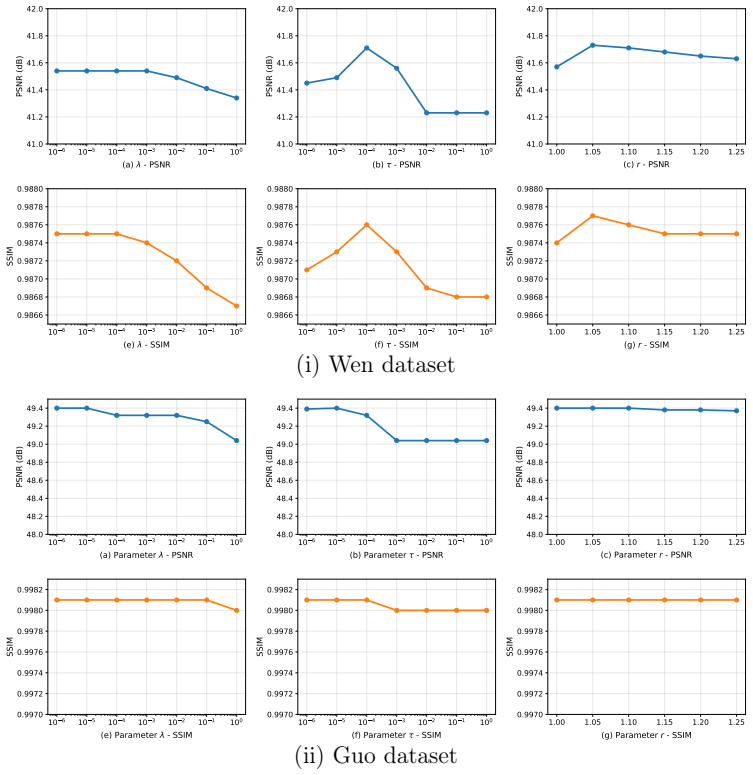
- [Section 5, Fig. 7, and Algorithm 1] The 'penalty parameter step size r' is tuned and reported as a hyperparameter, but r never appears in the ADMM updates (25)–(39) or in Algorithm 1. No rule is given for how r modifies ρ0, ρ1, ρ2. The sensitivity analysis in Fig. 7(c,g) is therefore uninterpretable and the implementation is under-specified. Please state the update rule for the penalty parameters (if any) and report the values of ρ0, ρ1, ρ2, and η_C used in the experiments.
- [Section 5, parameter sensitivity analysis and Tables 2–3] The regularization parameters λ, τ, and r are selected on the same Wen and Guo datasets on which the final average PSNR, SSIM, and AoLP numbers are reported. This is test-set tuning; the reported improvements are therefore optimistic and the comparison with baselines is not on neutral ground. The authors should tune on a separate validation set or use cross-validation, and should report error bars or per-image statistics for the averages in Tables 2–3.
- [Section 3.1 and Algorithm 1] The residual-penalty weight η_C is described only as 'a relatively large positive value', but no concrete value or sensitivity analysis is provided. Since η_C directly controls suppression of the total-intensity inconsistency, and the paper argues that this suppression is important for physical fidelity of DoLP and AoLP, this parameter is load-bearing. Its absence makes the physical-consistency claim non-reproducible.
minor comments (6)
- [Notation, Section 2.1 and Definition 8] The operations ×comp and ⊙comp are used frequently but are not formally defined; please provide a precise definition of multiplication along the quaternion-component mode.
- [Section 4.1, Eq. (36)] There is a typo in 'yielding an solution'; it should be 'yielding a solution'.
- [References] Reference [57] for SSIM points to a protein–protein interface paper, not the SSIM paper; reference [56] for PSNR is also unrelated. Both citations should be corrected.
- [Tables 2 and 3] The tables are difficult to parse because the column headers span multiple metric groups; consider a layout with explicit subheaders for each metric.
- [Section 4.1, Eq. (27)] The notation L(·) is introduced for the transform in the TQt-SVD but is not connected to the transform Q3 from Definition 1; please clarify the relationship.
- [Section 5] The text does not state the number of test images in the Wen and Guo datasets or whether the averages in Tables 2–3 are over all images; please add this information.
Circularity Check
No significant circularity: the proposed model is validated on external datasets and baselines; the only candidate concerns are a solver-model gap and test-set hyperparameter tuning, which are correctness risks rather than circular reductions.
full rationale
The central derivation chain is self-contained with respect to the empirical claim. Model (23) is an inverse-problem formulation whose data-fidelity term (22) is the CPFA sampling operator, and its low-rank quaternion tensor prior and adaptive Stokes-domain TV term are defined as independent modeling choices in Definition 6, Definition 8, and Equations (15)-(21); these priors are not defined in terms of the reported PSNR, SSIM, or AoLP metrics. The TQt-SVD and related quaternion tools cited from the authors' prior work are parameter-free mathematical definitions or standard thresholding constructions used as machinery, not as the target result, so they do not carry the argument in a circular way. Performance is measured on the external Wen and Guo datasets against seven independent baselines, making the claims externally falsifiable. Two issues are real but non-circular and should be weighed in a correctness review rather than the circularity score: (i) the Z-subproblem update in Eq. (27) uses an adaptive threshold equivalent to weights w_l = 1/(sigma_l(B)+epsilon_w) in Definition 6, but model (23) never specifies those weights, so the algorithm is not shown to minimize the stated objective; and (ii) the regularization parameters lambda, tau, and r are tuned on the same datasets later used for evaluation, which risks optimistic reporting but does not make any predicted value equal to a fitted parameter by construction. Neither issue reduces the derivation to its inputs, so the circularity score remains 0.
Assumptions & free parameters
free parameters (5)
- lambda (low-rank regularization weight) =
0.0001
- tau (Stokes TV weight) =
0.001
- r (penalty step size) =
1.05
- eta_C (residual penalty weight) =
not stated; described as relatively large
- rho0, rho1, rho2 (ADMM penalty parameters) =
not stated
assumptions (6)
- standard math The quaternion tensor algebra, TQt-SVD, and weighted nuclear norm from refs [38,40,41,55] extend to third-order tensors with a color dimension and are valid for CPDM.
- domain assumption Linear polarization model with negligible circular polarization: I_theta = 1/2(S0 + cos(2θ)S1 + sin(2θ)S2).
- domain assumption Color polarization images are approximately low-rank in the TQt-rank sense, and the decay observed on full images in Figure 5 transfers to the inverse problem.
- ad hoc to paper The weighted nuclear norm subproblem is solved exactly by adaptive singular value thresholding with gamma = lambda/(rho0*(sigma + epsilon_w)).
- domain assumption The residual C captures only inconsistencies and artifacts and can be strongly penalized without removing physically meaningful signal.
- standard math Periodic boundary conditions and the discrete Fourier transform diagonalize the finite-difference system and commute with quaternion components.
Cite this review
Pith. "Pith review of Quaternion Tensor Modeling for Joint Color-Polarization Demosaicking." pith.science (2026). https://pith.science/paper/6T7G5IPE
@misc{pith2026260802144,
  author       = {Pith},
  title        = {Pith review of: Quaternion Tensor Modeling for Joint Color-Polarization Demosaicking},
  year         = {2026},
  howpublished = {\url{https://pith.science/paper/6T7G5IPE}},
  note         = {Machine review of arXiv:2608.02144}
}
abstract
Division-of-focal-plane (DoFP) color polarization cameras enable snapshot acquisition of color polarization mosaic images, but the inherently sparse sampling pattern makes color polarization demosaicking severely ill-posed. Existing methods often fail to jointly exploit the correlations among polarization channels and the physical constraints inherent in polarization imaging, resulting in noticeable demosaicking artifacts. To address this issue, a quaternion-tensor-based color polarization demosaicking (CPDM) method incorporating Stokes-domain total variation (TV) regularization is proposed. Correlation analysis shows that the correlations among polarization channels are stronger than those among color channels. Accordingly, the color polarization images acquired at $0^\circ$, $45^\circ$, $90^\circ$, and $135^\circ$ are encoded into the four components of a third-order quaternion tensor, with the color channels organized along its third mode. A low-rank prior is then imposed on the quaternion tensor to exploit the global structural redundancy in the color polarization data. Moreover, spatial gradients are mapped to the Stokes domain through an orthogonal transformation to separate intensity, polarization and residual variations, with adaptive quaternion weights enabling component-specific regularization and preserving the energy consistency of the reconstructed Stokes vectors. An efficient optimization algorithm is derived for the resulting model. Extensive experiments demonstrate the superior demosaicking performance of the proposed method.
Figures


Figures from the paper (6 more)




Reference graph
Works this paper leans on
-
[1]
Max Born and Emil Wolf.Principles of optics: electromagnetic theory of propagation, interference and diffraction of light. Elsevier, 2013
work page 2013
-
[2]
J. Scott Tyo, Dennis L. Goldstein, David B. Chenault, and Joseph A. Shaw. Re- view of passive imaging polarimetry for remote sensing applications.Applied Optics, 45(22):5453–5469, 2006
work page 2006
-
[3]
Polarization vision.Scientia Sinica Informationis, 54(7):1620, 2024
Yongqiang Zhao, Xinbo Qiao, Ning Li, and Quan Pan. Polarization vision.Scientia Sinica Informationis, 54(7):1620, 2024
work page 2024
-
[4]
Miao Xu, Chao Wang, Kaikai Wang, Haodong Shi, Yingchao Li, and Huilin Jiang. Po- larization super-resolution imaging method based on deep compressed sensing.Sensors, 22(24):9676, 2022
work page 2022
-
[5]
Yi Wei, Pingli Han, Fei Liu, and Xiaopeng Shao. Enhancement of underwater vision by fully exploiting the polarization information from the stokes vector.Optics Express, 29(14):22275–22287, 2021
work page 2021
-
[6]
Underwater turbid media stokes-based polarimetric recovery.Sensors, 24(5):1367, 2024
Zhenfei Wang, Meixin Hu, and Ketao Zhang. Underwater turbid media stokes-based polarimetric recovery.Sensors, 24(5):1367, 2024
work page 2024
-
[7]
Kong, and Jonathan Cheung-Wai Chan
Ning Li, Yongqiang Zhao, Quan Pan, Seong G. Kong, and Jonathan Cheung-Wai Chan. Illumination-invariant road detection and tracking using lwir polarization characteris- tics.ISPRS Journal of Photogrammetry and Remote Sensing, 180:357–369, 2021
work page 2021
-
[8]
Jiawei Song, Qiqi Fu, Nan Zeng, and Hui Ma. Microstructural characterization of biological tissues based on sequential stokes polarization images during dehydration. Optics and Lasers in Engineering, 177:108142, 2024
work page 2024
Show all 58 references
-
[9]
Mspfusion: A feature transformer for multidimensional spectral-polarization image fusion.Expert Systems With Applications, 275:127079, 2025
Geng Tong, Xinling Yao, Ben Li, Jiaye Fu, Yan Wang, Jia Hao, Shahid Karim, and Yiting Yu. Mspfusion: A feature transformer for multidimensional spectral-polarization image fusion.Expert Systems With Applications, 275:127079, 2025
2025
-
[10]
Dpta-fusion: Dual-branch polarization taylor awareness fusion network for color polarization image fusion.Expert Systems With Applications, 306:130938, 2026
Meiling Gao, Guangyu Zhao, Xuedong He, Jin Duan, and Guangqiu Chen. Dpta-fusion: Dual-branch polarization taylor awareness fusion network for color polarization image fusion.Expert Systems With Applications, 306:130938, 2026
2026
-
[11]
Surface normals and light directions from shading and polarization.IEEE Transactions on Pattern Analysis and Machine Intelligence, 44(9):5618–5630, 2022
Thanh-Trung Ngo, Hajime Nagahara, and Rin-ichiro Taniguchi. Surface normals and light directions from shading and polarization.IEEE Transactions on Pattern Analysis and Machine Intelligence, 44(9):5618–5630, 2022
2022
-
[12]
Bazhyna, Atanas P
Andriy V. Bazhyna, Atanas P. Gotchev, and Karen O. Egiazarian. Lossless compression of Bayer pattern color filter arrays. In Edward R. Dougherty, Jaakko Astola, and Karen O. Egiazarian, editors,Image Processing: Algorithms and Systems IV, volume 5672 ofSPIE Proceedings, pages ...
2006
-
[13]
Sparse representation-based demosaicking method for joint chromatic and polarimetric imagery.Optics and Lasers in Engineering, 164:107526, 2023
Yidong Luo, Junchao Zhang, and Di Tian. Sparse representation-based demosaicking method for joint chromatic and polarimetric imagery.Optics and Lasers in Engineering, 164:107526, 2023
2023
-
[14]
Ratliff, Charles F
Bradley M. Ratliff, Charles F. LaCasse, and J. Scott Tyo. Interpolation strategies for reducing ifov artifacts in microgrid polarimeter imagery.Optics Express, 17(11):9112– 9125, 2009
2009
-
[15]
Bilinear and bicubic interpolation methods for division of focal plane polarimeters.Optics Express, 19(27):26161–26173, 2011
Shengkui Gao and Viktor Gruev. Bilinear and bicubic interpolation methods for division of focal plane polarimeters.Optics Express, 19(27):26161–26173, 2011
2011
-
[16]
Gradient-based interpolation method for division-of- focal-plane polarimeters.Optics Express, 21(1):1137–1151, 2013
Shengkui Gao and Viktor Gruev. Gradient-based interpolation method for division-of- focal-plane polarimeters.Optics Express, 21(1):1137–1151, 2013
2013
-
[17]
Image interpolation for division of focal plane polarimeters with intensity correlation.Optics Express, 24(18):20799– 20807, 2016
Junchao Zhang, Haibo Luo, Bin Hui, and Zheng Chang. Image interpolation for division of focal plane polarimeters with intensity correlation.Optics Express, 24(18):20799– 20807, 2016
2016
-
[18]
Four-direction residual interpolation for demosaick- ing.IEEE Transactions on Circuits and Systems for Video Technology, 26(5):881–890, 2016
Yonghoon Kim and Jechang Jeong. Four-direction residual interpolation for demosaick- ing.IEEE Transactions on Circuits and Systems for Video Technology, 26(5):881–890, 2016
2016
-
[19]
Residual interpolation for division of focal plane polarization image sensors.Optics Express, 25(9):10651–10662, 2017
Ashfaq Ahmed, Xiaojin Zhao, Viktor Gruev, Junchao Zhang, and Amine Bermak. Residual interpolation for division of focal plane polarization image sensors.Optics Express, 25(9):10651–10662, 2017
2017
-
[20]
Ning Li, Yongqiang Zhao, Quan Pan, and Seong G. Kong. Demosaicking dofp im- ages using newton’s polynomial interpolation and polarization difference model.Optics Express, 27(2):1376–1391, 2019
2019
-
[21]
Universal polariza- tion demosaicking using newton polynomial and residual interpolation.IEEE Sensors Journal, 25(7):11508–11520, 2025
Yiming Su, Chunhui Hao, Wen Chen, Yang Lu, and Jiandong Tian. Universal polariza- tion demosaicking using newton polynomial and residual interpolation.IEEE Sensors Journal, 25(7):11508–11520, 2025
2025
-
[22]
Monochrome and color polarization demosaicking using edge-aware residual interpo- lation
Miki Morimatsu, Yusuke Monno, Masayuki Tanaka, and Masatoshi Okutomi. Monochrome and color polarization demosaicking using edge-aware residual interpo- lation. In2020 IEEE International Conference on Image Processing (ICIP), pages 2571–2575, 2020
2020
-
[23]
Polarization image demosaicking using polarization channel difference prior.Optics Express, 29(14):22066–22079, 2021
Rui Wu, Yongqiang Zhao, Nian Li, and Seong G Kong. Polarization image demosaicking using polarization channel difference prior.Optics Express, 29(14):22066–22079, 2021
2021
-
[24]
A new polarization image demosaicking algorithm by exploiting inter-channel correlations with guided filtering.IEEE Transactions on Image Processing, 29:7076–7089, 2020
Shumin Liu, Jiajia Chen, Yuan Xun, Xiaojin Zhao, and Chip-Hong Chang. A new polarization image demosaicking algorithm by exploiting inter-channel correlations with guided filtering.IEEE Transactions on Image Processing, 29:7076–7089, 2020. 28
2020
-
[25]
A hybrid polarization image demosaicking algorithm based on inter-channel correlation
Yang Lu, Jiandong Tian, Yiming Su, Yidong Luo, Junchao Zhang, and Chunhui Hao. A hybrid polarization image demosaicking algorithm based on inter-channel correlation. IEEE Transactions on Computational Imaging, 10:1400–1413, 2024
2024
-
[26]
Adaptive dofp polar- ization image demosaicking based on local gradient and channel correlation.Optics and Laser Technology, 184:112495, 2025
Jianguo Yang, Weiqi Jin, Li Li, Dian Sheng, and Meishu Wang. Adaptive dofp polar- ization image demosaicking based on local gradient and channel correlation.Optics and Laser Technology, 184:112495, 2025
2025
-
[27]
Learning a convolutional demosaicing network for microgrid polarimeter imagery.Optics Letters, 43(18):4534–4537, 2018
Junchao Zhang, Jianbo Shao, Haibo Luo, Xiangyue Zhang, Bin Hui, Zheng Chang, and Rongguang Liang. Learning a convolutional demosaicing network for microgrid polarimeter imagery.Optics Letters, 43(18):4534–4537, 2018
2018
-
[28]
Convolutional demosaicing network for joint chromatic and polarimetric imagery.Optics Letters, 44(22):5646–5649, 2019
Sijia Wen, Yinqiang Zheng, Feng Lu, and Qinping Zhao. Convolutional demosaicing network for joint chromatic and polarimetric imagery.Optics Letters, 44(22):5646–5649, 2019
2019
-
[29]
Two-step color- polarization demosaicking network
Vy Nguyen, Masayuki Tanaka, Yusuke Monno, and Masatoshi Okutomi. Two-step color- polarization demosaicking network. In2022 IEEE International Conference on Image Processing (ICIP), pages 1011–1015, 2022
2022
-
[30]
Color polarization imaging demosaicing based on Stokes vector information complementation and fusion.Optics Express, 32(25):44049–44066, 2024
Yubo Red Zheng, Xiangyue Zhang, Chengdong Wu, Peng Ji, and Jingyu Ru. Color polarization imaging demosaicing based on Stokes vector information complementation and fusion.Optics Express, 32(25):44049–44066, 2024
2024
-
[31]
Active color-aware demosaicing for color polarization images
Junlin Li, Xiangyue Zhang, Hao Wu, Chengdong Wu, and Yaoming Zhuang. Active color-aware demosaicing for color polarization images. In2025 IEEE International Conference on Smart Internet of Things (SmartIoT), pages 146–152, 2025
2025
-
[32]
Polarization uncertainty- guided diffusion model for color polarization image demosaicking
Chenggong Li, Yidong Luo, Junchao Zhang, and Degui Yang. Polarization uncertainty- guided diffusion model for color polarization image demosaicking. InProceedings of the AAAI Conference on Artificial Intelligence, volume 40, pages 6028–6036, 2026
2026
-
[33]
Impact of training data on lmmse demosaicing for colour-polarization filter array
Ronan Dumoulin, Pierre-Jean Lapray, Jean-Baptiste Thomas, and Ivar Farup. Impact of training data on lmmse demosaicing for colour-polarization filter array. In2022 16th International Conference on Signal-Image Technology. Internet-Based Systems (SITIS), pages 275–280, 2022
2022
-
[34]
Linear polarization demo- saicking for monochrome and colour polarization focal plane arrays.Computer Graphics Forum, 40(6):77–89, 2021
Simeng Qiu, Qiang Fu, Congli Wang, and Wolfgang Heidrich. Linear polarization demo- saicking for monochrome and colour polarization focal plane arrays.Computer Graphics Forum, 40(6):77–89, 2021
2021
-
[35]
Sparse representation-based demosaicing method for microgrid polarimeter imagery.Optics Letters, 43(14):3265–3268, 2018
Junchao Zhang, Haibo Luo, Rongguang Liang, Ashfaq Ahmed, Xiangyue Zhang, Bin Hui, and Zheng Chang. Sparse representation-based demosaicing method for microgrid polarimeter imagery.Optics Letters, 43(14):3265–3268, 2018. 29
2018
-
[36]
A sparse representation based joint demo- saicing method for single-chip polarized color sensor.IEEE Transactions on Image Processing, 30:4171–4182, 2021
Sijia Wen, Yinqiang Zheng, and Feng Lu. A sparse representation based joint demo- saicing method for single-chip polarized color sensor.IEEE Transactions on Image Processing, 30:4171–4182, 2021
2021
-
[37]
Learning a non-locally regularized convolutional sparse representation for joint chromatic and polarimetric demosaicking.IEEE Transactions on Image Processing, 33:5029–5044, 2024
Yidong Luo, Junchao Zhang, Jianbo Shao, Jiandong Tian, and Jiayi Ma. Learning a non-locally regularized convolutional sparse representation for joint chromatic and polarimetric demosaicking.IEEE Transactions on Image Processing, 33:5029–5044, 2024
2024
-
[38]
Low-rank quaternion tensor completion for recovering color videos and images.Pattern Recognition, 107:107505, 2020
Jifei Miao, Kit Ian Kou, and Wankai Liu. Low-rank quaternion tensor completion for recovering color videos and images.Pattern Recognition, 107:107505, 2020
2020
-
[39]
William Rowan Hamilton. Ii. on quaternions; or on a new system of imaginaries in algebra.The London, Edinburgh, and Dublin Philosophical Magazine and Journal of Science, 25(163):10–13, 1844
-
[40]
Quaternion tensor singular value decomposition using a flexible transform-based approach.Signal Processing, 206:108910, 2023
Jifei Miao and Kit Ian Kou. Quaternion tensor singular value decomposition using a flexible transform-based approach.Signal Processing, 206:108910, 2023
2023
-
[41]
Quaternion-based weighted nuclear norm minimization for color image denoising.Neurocomputing, 332:283–297, 2019
Yibin Yu, Yulan Zhang, and Shifang Yuan. Quaternion-based weighted nuclear norm minimization for color image denoising.Neurocomputing, 332:283–297, 2019
2019
-
[42]
Liqiao Yang, Yexun Hu, Tai-Xiang Jiang, Yimin Wei, Guisong Liu, and Michael K. Ng. Nonlinear transformed low-rank quaternion tensor total variation for multidimensional color image completion.IEEE Transactions on Image Processing, 35:2470–2483, 2026
2026
-
[43]
Stokes-vector and mueller-matrix polarimetry.Journal of the Optical Society of America A, 33(7):1396–1408, 2016
Rasheed MA Azzam. Stokes-vector and mueller-matrix polarimetry.Journal of the Optical Society of America A, 33(7):1396–1408, 2016
2016
-
[44]
Cambridge university press, 1999
Max Born and Emil Wolf.Principles of Optics: Electromagnetic Theory of Propagation, Interference and Diffraction of Light. Cambridge university press, 1999
1999
-
[45]
Full-stokes polariza- tion feature image fusion via polarization physics-aware diffusion model.Expert Systems With Applications, 329:133082, 2026
Motong Hu, Yue Pan, Donglin Xue, Xiping Xu, and Peiyu Wang. Full-stokes polariza- tion feature image fusion via polarization physics-aware diffusion model.Expert Systems With Applications, 329:133082, 2026
2026
-
[46]
Camera calibration methodbasedonoptimalpolarizationangle.Optics and Lasers in Engineering, 112:128– 135, 2019
Zhenmin Zhu, Xinyun Wang, Quanxin Liu, and Fumin Zhang. Camera calibration methodbasedonoptimalpolarizationangle.Optics and Lasers in Engineering, 112:128– 135, 2019
2019
-
[47]
Survey of demosaicking meth- ods for polarization filter array images.Sensors, 18(11):3688, 2018
Sofiane Mihoubi, Pierre-Jean Lapray, and Laurent Bigué. Survey of demosaicking meth- ods for polarization filter array images.Sensors, 18(11):3688, 2018
2018
-
[48]
Demosaicking dofp images using edge compensation method based on correlation.Optics Express, 31(9):13536– 13551, 2023
Jianqiao Xin, Zheng Li, Shiguang Wu, and Shiyong Wang. Demosaicking dofp images using edge compensation method based on correlation.Optics Express, 31(9):13536– 13551, 2023. 30
2023
-
[49]
A demosaicking method based on an inter-channel correlation model for dofp polarimeter.Optics and Lasers in Engineering, 181:108388, 2024
Yanji Yi, Peng Zhang, Zhiyu Chen, Hui Zhang, Zhendong Luo, Guanglie Zhang, Wen- jung Li, and Yang Zhao. A demosaicking method based on an inter-channel correlation model for dofp polarimeter.Optics and Lasers in Engineering, 181:108388, 2024
2024
-
[50]
Efficient polarization demosaicking via low-cost edge-aware and inter-channel correlation.IEEE Photonics Journal, 17(1):1–11, 2025
Guangsen Liu, Peng Rao, Xin Chen, Yao Li, and Haixin Jiang. Efficient polarization demosaicking via low-cost edge-aware and inter-channel correlation.IEEE Photonics Journal, 17(1):1–11, 2025
2025
-
[51]
Tv regularized low-rank sparse decomposition of infrared polarization component im- age for small target detection under complex backgrounds.Optics Communications, 596:132470, 2025
Yunyou Hu, Xianmeng Meng, Yunxiang Zhang, Zhiguo Fan, and Dandan Zhi. Tv regularized low-rank sparse decomposition of infrared polarization component im- age for small target detection under complex backgrounds.Optics Communications, 596:132470, 2025
2025
-
[52]
Polarized intensity ratio constraint demosaicing for the division of a focal-plane polari- metric image.Remote Sensing, 14(14):3268, 2022
Lei Yan, Kaiwen Jiang, Yi Lin, Hongying Zhao, Ruihua Zhang, and Fangang Zeng. Polarized intensity ratio constraint demosaicing for the division of a focal-plane polari- metric image.Remote Sensing, 14(14):3268, 2022
2022
-
[53]
Anewadaptivewindow-basedguidedfilteringand interpolation for polarization image demosaicing.IET Image Processing, 17(7):2238– 2255, 2023
FeiXie, ShuminLiu, andJiajiaChen. Anewadaptivewindow-basedguidedfilteringand interpolation for polarization image demosaicing.IET Image Processing, 17(7):2238– 2255, 2023
2023
-
[54]
Atkinson and E.R
G.A. Atkinson and E.R. Hancock. Recovery of surface orientation from diffuse polar- ization.IEEE Transactions on Image Processing, 15(6):1653–1664, 2006
2006
-
[55]
Quaternion tensor completion with sparseness for color video recovery.Applied Soft Computing, 154:111322, 2024
Liqiao Yang, Kit Ian Kou, Jifei Miao, Yang Liu, and Pui Man Hoi. Quaternion tensor completion with sparseness for color video recovery.Applied Soft Computing, 154:111322, 2024
2024
-
[56]
Image denoising via local and nonlo- cal circulant similarity.Journal of Visual Communication and Image Representation, 30:117–124, 2015
Fei Chen, Xunxun Zeng, and Meiqing Wang. Image denoising via local and nonlo- cal circulant similarity.Journal of Visual Communication and Image Representation, 30:117–124, 2015
2015
-
[57]
Predict- ing protein-protein interface residues using local surface structural similarity.BMC Bioinformatics, 13(1):41, 2012
Rafael A Jordan, Yasser EL-Manzalawy, Drena Dobbs, and Vasant Honavar. Predict- ing protein-protein interface residues using local surface structural similarity.BMC Bioinformatics, 13(1):41, 2012
2012
-
[58]
Pidsr: Complementary polarized image demosaicing and super-resolution
Shuangfan Zhou, Chu Zhou, Youwei Lyu, Heng Guo, Zhanyu Ma, Boxin Shi, and Imari Sato. Pidsr: Complementary polarized image demosaicing and super-resolution. In Proceedings of the IEEE/CVF Conference on Computer Vision and Pattern Recognition (CVPR), pages 16081–16090, 2025. 31
2025
Reviewed August 15, 2026 · model on record in the stance chip above.
Discussion (0). Continue with ORCID to comment.