When JIMWLK evolution really matters: the example of incoherent diffraction
Pith reviewed 2026-07-01 08:29 UTC · model grok-4.3
The pith
The JIMWLK evolution yields systematically larger cross sections for incoherent diffraction than the Gaussian approximation in all kinematic regimes.
A machine-rendered reading of the paper's core claim, the machinery that carries it, and where it could break.
Core claim
For Wilson-line correlators whose weak-scattering expansion starts with four-gluon exchange, the Gaussian Approximation to JIMWLK evolution is invalid, resulting in smaller cross sections for incoherent diffraction compared to the full JIMWLK calculation in all kinematic regimes of interest.
What carries the argument
Wilson-line correlators with four-gluon exchange, evolved using the JIMWLK equation instead of the Gaussian Approximation.
If this is right
- Incoherent diffraction cross sections are larger with JIMWLK than with the Gaussian Approximation.
- The discrepancy is present in weak scattering and continues into the unitarity regime.
- The Gaussian Approximation is not reliable for observables involving four-gluon correlators.
- Similar discrepancies may appear in other high-energy processes with higher gluon exchanges.
Where Pith is reading between the lines
- Precision predictions for diffraction at electron-ion colliders may require full JIMWLK numerics for accuracy in four-point functions.
- Other observables relying on multi-gluon correlators should be checked for the validity of the Gaussian Approximation.
- This result underscores the importance of using the full evolution equation when the leading exchange involves more than two gluons.
Load-bearing premise
The JIMWLK equation provides the correct evolution for the Wilson-line correlators in incoherent diffraction, and the numerical implementation faithfully captures the difference from the Gaussian Approximation.
What would settle it
A measurement showing that incoherent diffraction cross sections match the Gaussian Approximation rather than the larger JIMWLK results.
Figures


read the original abstract
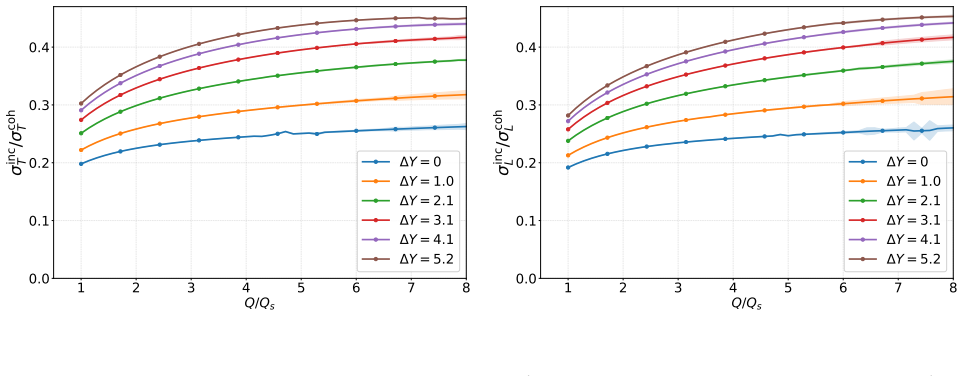
We consider high energy scattering in the effective theory of the Color Glass Condensate. The most convenient degrees of freedom are Wilson lines encoding multiple gluon exchanges, whose evolution with energy follows the JIMWLK equation. Instead of using the latter, very often one resorts to a Gaussian Approximation (GA), which is known to be remarkably accurate in describing a wide class of multi-gluon correlators whose expansion in the weak scattering limit starts with an exchange of only two gluons. Here we demonstrate, both analytically and numerically, that such an approximation is not valid for correlators which start with an exchange of four gluons. As a main example, we focus on incoherent diffraction in photon-nucleus collisions and we show that the discrepancy between the JIMWLK and the GA results is driven by weak scattering and further persists in the regime where unitarity corrections begin to become important. The JIMWLK calculation leads to cross sections which are systematically larger in all kinematic regimes of interest.
Editorial analysis
A structured set of objections, weighed in public.
Referee Report
Summary. The manuscript argues that the Gaussian Approximation (GA) to JIMWLK evolution in the Color Glass Condensate is inaccurate for Wilson-line correlators whose weak-scattering expansion begins at four gluons. Using incoherent diffraction in photon-nucleus collisions as the central example, it provides an analytical demonstration in the weak-field limit and numerical results showing that full JIMWLK evolution produces systematically larger cross sections than the GA in all kinematic regimes, with the discrepancy originating in weak scattering and persisting as unitarity corrections set in.
Significance. If the numerical implementation is robust, the result is significant because it identifies a concrete class of observables (four-gluon-starting correlators) where the commonly employed GA fails, requiring full JIMWLK evolution. This has direct implications for precision predictions of incoherent diffraction at the EIC and similar facilities. The paper earns credit for supplying both an analytical weak-scattering argument (verifiable by direct expansion) and numerical comparisons within the standard CGC framework.
major comments (1)
- [Numerical results section] § on numerical results for incoherent diffraction: The central claim that the JIMWLK-GA discrepancy 'persists in the regime where unitarity corrections begin to become important' rests on the numerical solution of JIMWLK for the relevant four-point Wilson-line correlators. No information is given on lattice volume, number of configurations, rapidity step size, or continuum/discretization convergence tests, leaving open the possibility that the reported systematic difference is affected by uncontrolled numerical artifacts.
minor comments (2)
- [Introduction] The introduction of the specific four-point correlator relevant to incoherent diffraction could be moved earlier, before the weak-scattering expansion, to improve readability.
- [Figures] Figure captions for the cross-section comparisons should explicitly state the photon virtuality Q² and nuclear mass number A values used in each panel.
Simulated Author's Rebuttal
We thank the referee for the positive assessment of our work's significance and for the constructive comment on the numerical implementation. We address the major comment below and will revise the manuscript to incorporate the requested details.
read point-by-point responses
-
Referee: [Numerical results section] § on numerical results for incoherent diffraction: The central claim that the JIMWLK-GA discrepancy 'persists in the regime where unitarity corrections begin to become important' rests on the numerical solution of JIMWLK for the relevant four-point Wilson-line correlators. No information is given on lattice volume, number of configurations, rapidity step size, or continuum/discretization convergence tests, leaving open the possibility that the reported systematic difference is affected by uncontrolled numerical artifacts.
Authors: We agree that the manuscript would benefit from explicit documentation of the numerical parameters to allow readers to assess robustness. The results were generated with a standard JIMWLK lattice implementation whose convergence properties have been validated in prior literature, and the JIMWLK-GA discrepancy appears consistently across the scanned kinematic range. In the revised manuscript we will add a concise paragraph (or subsection) in the numerical results section that specifies the lattice volume, number of configurations, rapidity step size, and the outcomes of continuum and volume convergence tests performed for the four-point correlators. These additions will confirm that the reported systematic difference is not driven by discretization artifacts. revision: yes
Circularity Check
No significant circularity; independent comparison of JIMWLK vs GA
full rationale
The paper derives the discrepancy analytically via weak-field expansion of four-gluon correlators (which differ by construction between full JIMWLK and GA) and numerically by solving the established JIMWLK equation on the lattice. Neither step reduces to a fitted parameter renamed as prediction, a self-definitional loop, or a load-bearing self-citation whose validity is assumed rather than external. The result is self-contained against the known structure of the JIMWLK hierarchy and the documented accuracy of GA for two-gluon dipoles.
Axiom & Free-Parameter Ledger
axioms (1)
- domain assumption Wilson lines encode multiple gluon exchanges and evolve according to the JIMWLK equation in the Color Glass Condensate effective theory
Forward citations
Cited by 1 Pith paper
-
Sub-eikonal stress and model dependence of the small-$x$ gluon D-term
The gluon D-term at small x is a next-to-eikonal stress observable whose sign is not determined by the dipole or saturation profile.
Reference graph
Works this paper leans on
-
[1]
Miller Jr, S
W. Miller Jr, S. Post, and P. Winternitz. Classical and quantum superintegrability with applications. Journal of Physics A: Mathematical and Theoretical, 46(42):423001, 2013
2013
-
[2]
W. Pauli. ¨Uber das Wasserstoffspektrum vom Standpunkt der neuen Quantenmechanik.Zeitschrift f¨ ur Physik A Hadrons and nuclei, 36(5):336–363, 1926. 28
1926
-
[3]
Bohm, Y Ne’eman, and A
A. Bohm, Y Ne’eman, and A. O. Barut.Dynamical Groups And Spectrum Generating Algebras (In 2 Volumes), volume 2. World Scientific, 1988
1988
-
[4]
Baym.Lectures on quantum mechanics
G. Baym.Lectures on quantum mechanics. CRC Press, 2018
2018
-
[5]
A. O. Barut and G. L. Bornzin.SO(4,2)-Formulation of the Symmetry Breaking in Relativistic Kepler Problems with or without Magnetic Charges.Journal of Mathematical Physics, 12(5):841–846, 1971
1971
-
[6]
D’Hoker and L
E. D’Hoker and L. Vinet. Spectrum (super-) symmetries of particles in a Coulomb potential.Nuclear Physics B, 260(1):79–102, 1985
1985
-
[7]
E. G. Kalnins, W. Miller, and S. Post. Wilson polynomials and the generic superintegrable system on the 2-sphere.Journal of Physics A: Mathematical and Theoretical, 40(38):11525, 2007
2007
-
[8]
E. G. Kalnins, W. Miller, and S. Post. Two-variable Wilson polynomials and the generic superintegrable system on the 3-sphere.SIGMA. Symmetry, Integrability and Geometry: Methods and Applications, 7:051, 2011
2011
-
[9]
E. G. Kalnins, W. Miller Jr, and S. Post. Contractions of 2D 2nd order quantum superintegrable systems and the Askey scheme for hypergeometric orthogonal polynomials.SIGMA. Symmetry, Integrability and Geometry: Methods and Applications, 9:057, 2013
2013
-
[10]
V. X. Genest, L. Vinet, and A. Zhedanov. Superintegrability in two dimensions and the Racah–Wilson algebra.Letters in Mathematical Physics, 104(8):931–952, 2014
2014
-
[11]
V. X. Genest, L. Vinet, and A. Zhedanov. The Racah algebra and superintegrable models. InJournal of Physics: Conference Series, volume 512, page 012011. IOP Publishing, 2014
2014
-
[12]
V. X. Genest and L. Vinet. The generic superintegrable system on the 3-sphere and the 9jsymbols of su(1,1).SIGMA. Symmetry, Integrability and Geometry: Methods and Applications, 10:108, 2014
2014
-
[13]
S. Post. Racah polynomials and recoupling schemes ofsu(1,1).SIGMA. Symmetry, Integrability and Geometry: Methods and Applications, 11:057, 2015
2015
-
[14]
Miller and A
W. Miller and A. V. Turbiner. (Quasi)-exact-solvability on the sphereS n.Journal of Mathematical Physics, 56(2), 2015
2015
-
[15]
P. Iliev. The generic quantum superintegrable system on the sphere and Racah operators.Lett. Math. Phys., 107(11):2029–2045, 2017
2029
-
[16]
De Bie, V
H. De Bie, V. X. Genest, W. van de Vijver, and L. Vinet. A higher rank Racah algebra and the� n 2 Laplace–Dunkl operator.Journal of Physics A: Mathematical and Theoretical, 51(2):025203, 2017
2017
-
[17]
P. Iliev. Symmetry algebra for the generic superintegrable system on the sphere.J. High Energy Phys., 2018(2):23, 2018. Id/No 44
2018
-
[18]
Post and S
S. Post and S. Bertrand. The Racah algebra of rank 2: Properties, symmetries and representation.SIGMA. Symmetry, Integrability and Geometry: Methods and Applications, 20:085, 2024
2024
-
[19]
A. V. Turbiner and W. Jr. Miller. (Quasi)-exact-solvability on the sphereS n.Annals of Physics, 350:324– 373, 2014
2014
-
[20]
Cramp´ e, S
N. Cramp´ e, S. Tsujimoto, L. Vinet, and A. Zhedanov. The rank two Jacobi algebra. InAnnales Henri Poincar´ e, pages 1–28. Springer, 2025
2025
-
[21]
Cramp´ e, Q
N. Cramp´ e, Q. Labriet, L. Morey, S. Tsujimoto, L. Vinet, and A. Zhedanov. Algebraic interpretation of the two-variable Jacobi polynomials on the triangle: the pentagonal way.Letters in Mathematical Physics, 116(2):30, 2026
2026
-
[22]
Cramp´ e, L
N. Cramp´ e, L. Frappat, J. Gaboriaud, L. Poulain d’Andecy, E. Ragoucy, and L. Vinet. The Askey-Wilson algebra and its avatars.J. Phys. A, Math. Theor., 54(6):32, 2021. Id/No 063001
2021
-
[23]
E. G. Kalnins, W. jr. Miller, and G. S. Pogosyan. Superintegrability and associated polynomial solutions: Euclidean space and the sphere in two dimensions.J. Math. Phys., 37(12):6439–6467, 1996. 29
1996
-
[24]
E. G. Kalnins, W. jr. Miller, and G. S. Pogosyan. Completeness of multiseparable superintegrability on the complex 2-sphere.J. Phys. A, Math. Gen., 33(38):6791–6806, 2000
2000
-
[25]
Klimyk and N
A.U. Klimyk and N. Ya. Vilenkin. Representations of Lie groups and special functions. InRepresenta- tion Theory and Noncommutative Harmonic Analysis II: Homogeneous Spaces, Representations and Special Functions, pages 137–259. Springer, 1995
1995
-
[26]
P. A. M. Dirac.Lectures on Quantum Mechanics. Dover Publications, Mineola, NY, 2001. Originally delivered at Yeshiva University, New York, 1964
2001
-
[27]
Henneaux and C
M. Henneaux and C. Teitelboim.Quantization of Gauge Systems. Princeton University Press, Princeton, NJ, 1992. Comprehensive treatment of Dirac quantization and constrained systems
1992
-
[28]
Koornwinder
T. Koornwinder. The structure relation for Askey-Wilson polynomials.J. Comput. Appl. Math., 207(2):214– 226, 2007
2007
-
[29]
Koornwinder
T. Koornwinder. Two-variable analogues of the classical orthogonal polynomials. In Richard A. Askey, editor,Theory and Application of Special Functions, pages 435–495. Academic Press, 1975
1975
-
[30]
C. F. Dunkl and Y. Xu.Orthogonal polynomials of several variables, volume 155. Cambridge University Press, 2014
2014
-
[31]
Koekoek, P
R. Koekoek, P. A. Lesky, and R. F. Swarttouw. Hypergeometric orthogonal polynomials. InHypergeometric orthogonal polynomials and theirq-analogues, pages 183–253. Springer, 2010
2010
-
[32]
Bateman project, vol
Higher Transcendental Functions, Magnus Erd´ elyi, and Tricomi Oberhetinger. Bateman project, vol. 2, 1955
1955
-
[33]
Y. I. Granovskii, I. M. Lutzenko, and A. S. Zhedanov. Mutual integrability, quadratic algebras, and dynamical symmetry.Annals of Physics, 217(1):1–20, 1992
1992
-
[34]
Genest, M
V. Genest, M. Ismail, L. Vinet, and A. Zhedanov. Tridiagonalization of the hypergeometric operator and the Racah–Wilson algebra.Proceedings of the American Mathematical Society, 144(10):4441–4454, 2016
2016
-
[35]
Cramp´ e and M
N. Cramp´ e and M. Zaimi. FactorizedA2-Leonard pair.The Ramannujan journal, 66:25, 2025
2025
-
[36]
Cramp´ e, L
N. Cramp´ e, L. Morey, L. Vinet, and M. Zaimi. Contiguity relations for finite families of orthogonal poly- nomials in the Askey scheme.The Ramanujan Journal, 68:68, 2025
2025
-
[37]
Cramp´ e, L
N. Cramp´ e, L. Frappat, and E. Ragoucy. Representations of the rank two Racah algebra and orthogonal multivariate polynomials.Linear Algebra and its Applications, 664:165–215, 2023
2023
-
[38]
De Bie, V
H. De Bie, V. X. Genest, W. van de Vijver, and L. Vinet. A higher rank Racah algebra and the� n 2 Laplace–Dunkl operator.Journal of Physics A: Mathematical and Theoretical, 51(2):025203, 2018
2018
-
[39]
Gaboriaud, L
J. Gaboriaud, L. Vinet, S. Vinet, and A. Zhedanov. The generalized Racah algebra as a commutant.J. Phys.: Conf. Ser., 1194:012034, 2019
2019
- [40]
-
[41]
V. X. Genest, L. Vinet, and A. Zhedanov. The Bannai–Ito algebra and a superintegrable system with reflections on the two-sphere.Journal of Physics A: Mathematical and Theoretical, 47(20):205202, 2014
2014
-
[42]
De Bie, V
H. De Bie, V. X. Genest, S. Tsujimoto, L. Vinet, and A. Zhedanov. The Bannai–Ito algebra and some applications. InJournal of Physics: Conference Series, volume 597, page 012001. IOP publishing, 2015
2015
-
[43]
V. X. Genest, L. Vinet, and A. Zhedanov. A Laplace–Dunkl equation onS 2 and the Bannai–Ito algebra. Communications in Mathematical Physics, 336:243–259, 2015
2015
-
[44]
Tsujimoto, L
S. Tsujimoto, L. Vinet, and A. Zhedanov. Dunkl shift operators and Bannai–Ito polynomials.Advances in Mathematics, 229(4):2123–2158, 2012
2012
-
[45]
Cramp´ e, J
N. Cramp´ e, J. Gaboriaud, L. Poulain d’Andecy, and L. Vinet. Racah algebras, the centralizerZ n(sl2) and its Hilbert-Poincar´ e series.Annales Henri Poincar´ e, 23:2657–2682, 2022
2022
-
[46]
F. W. J. Olver, A. B. Olde Daalhuis, D. W. Lozier, B. I. Schneider, R. F. Boisvert, C. W. Clark, B. R. Miller, and B. V. Saunders, editors.NIST Digital Library of Mathematical Functions. 2020. Release 1.1.8 of 2020-12-15. 30
2020
discussion (0)
Sign in with ORCID, Apple, or X to comment. Anyone can read and Pith papers without signing in.