REVIEW 3 major objections 6 minor 42 references
Optimal Search Segmentation Mechanisms for Online Platform Markets
T0 review · 3 major / 6 minor · reviewed 2026-08-14 · deepseek-v4-flash
Pith's one-line read An online platform that can choose which products to show should display all products to maximize social welfare, but only the top $k^*$ quality products to maximize revenue; the paper proves both under Bertrand competition with…
desk verdict A likely-true top-k revenue theorem with a real proof gap in the dominant-seller case; the rest is solid and the paper deserves engagement. read the letter →
The pith
A machine-rendered reading of the paper's core claim, the machinery that carries it, and where it could break.
The reading
What carries the argument
The load-bearing object is the equilibrium revenue function written in terms of the outside option's demand, $re(\bar q_0)=\sum_{i\in S}\bar q_i/(1-\bar q_i)+1/(\bar q_0+\sum_{i\in S}\bar q_i)-1$, together with the demand-link function $V(x)$, the unique $v\in(0,1)$ satisfying $v e^{v/(1-v)}=x$. Because $V$ is increasing, a higher-quality candidate product is equivalent to a smaller feasible $\bar q_0$, so the decision of whether and which product to add becomes a one-dimensional optimisation over $\bar q_0$. Quasi-convexity of $re(\bar q_0)$ forces the optimum to an endpoint of the feasible interval, meaning the best choice is either to add nothing or to add the highest-quality unselected product; this endpoint logic is what converts subset choice into quality-ordered prefixes. In the Cournot extension the analogous role is played by the Lambert W function through $w_i=W(e^{\theta_i-1})$, and quasi-convexity of a scalar function $g(w)$ in the proof of Lemma 7 drives the top-$k$ replacement argument.
What would settle it
Construct a Bertrand-MNL instance with $n=4$ products where the top product's equilibrium share satisfies $\bar q_1\ge 0.5$ (e.g., choose the highest quality $\theta_1$ large), compute $re(\bar q_0)$ from Theorem 2 over the feasible interval $[\bar q_0^{\min},\bar q_0^{\max}]$, and check whether any interior stationary point has negative second derivative; if so, quasi-convexity fails and the replacement argument in Theorem 4 no longer goes through. Equivalently, enumerate all $2^n$ subsets for such quality vectors and look for a case where the best revenue set is not a quality-ordered prefix.
Extended reading notes
Core claim
The central claim is that under Bertrand price competition with MNL demand, the equilibrium outcome of any displayed set $S$ can be described by a single outside-option demand $\bar q_0$ solving $\sum_{i\in S} V(\bar q_0 e^{\theta_i-1})=1-\bar q_0$, where $V(x)$ is the unique $v\in(0,1)$ with $v e^{v/(1-v)}=x$. Expressing equilibrium revenue as a function $re(\bar q_0)$, the paper proves it is quasi-convex over the feasible interval, so its maximum over choices of which product to add occurs at an endpoint: either add no product or add the highest-quality available one. Iterating this replacement argument yields Theorem 4: revenue maximization displays the top $k^*$ products, and $k^*$ is found in linear time by evaluating the revenue of each quality-ordered prefix. For social welfare in the Bertrand game, the paper proves the welfare function decreases in $\bar q_0$, so adding any product improves welfare and all products should be displayed. The Cournot results use the same top-$k$ structure, now mediated by Lambert-W weights $w_i=W(e^{\theta_i-1})$, with Theorems 6 and 7.
Load-bearing premise
The claim rests on assuming that the equilibrium revenue curve is quasi-convex (no interior valley) over the whole feasible range of outside-option demand, including the case where one seller commands at least half the market; the paper supports this case in Appendix H with graphical intersection and inequality checks rather than a fully algebraic derivation, and if the curve can dip then replacing a lower-quality displayed product with a higher-quality hidden one might not increase revenue.
Editorial extensions
If this is right
- A revenue-maximizing platform can determine its display set in $O(n)$ time: compute the equilibrium revenue for each prefix $\{1,\ldots,k\}$ and pick the best $k^*$.
- No display set that maximizes revenue can skip a high-quality product in favor of a lower-quality one; the optimal display is always a quality-ordered prefix.
- For social welfare under Bertrand competition, search segmentation never helps: hiding any product can only reduce total welfare, so the platform should show all sellers.
- Under Cournot competition, welfare maximization may hide some low-quality products, but the displayed set remains a quality-ordered prefix rather than an arbitrary subset.
- Because quality determines inclusion, sellers have a long-run incentive to improve product quality in order to enter the displayed set, which increases equilibrium revenue and welfare.
Reading between the lines
- The same quality-prefix logic suggests a testable design rule for real platforms using price competition: when the objective is take-rate or commission revenue, ranking or displaying by quality alone should beat display rules based on predicted revenue scores, because prices already incorporate surplus extraction.
- If quasi-convexity fails for some quality vector with a dominant seller, the optimal display might require checking non-prefix sets; a natural computational experiment is to enumerate all subsets for $n\le 8$ and compare the best subset against the top-$k^*$ rule across random quality vectors, especially with large $\theta_1$.
- The welfare/revenue divergence has a regulatory reading: a revenue-maximizing platform will systematically hide low-quality sellers, while a surplus-maximizing regulator would want them shown; comparing displayed sets to quality rankings could reveal which objective the platform is optimizing.
Signed reviews
Editorial analysis
A structured set of objections, weighed in public.
Referee Report
Summary. This paper studies a platform's search segmentation problem under a discriminatory control model: the platform chooses which products to display to a representative buyer, while sellers set prices and engage in Bertrand competition. Buyer demand follows the multinomial logit (MNL) choice model. The authors prove that for social welfare maximization, displaying all products is optimal; for revenue maximization, the optimal mechanism is to display the top k* products by quality, where k* is computable in linear time. They extend the analysis to Cournot competition, where both objectives lead to top-k threshold mechanisms. The results rely on a closed-form characterization of the Bertrand equilibrium using a V function related to the Lambert W function, and on quasi-convexity of equilibrium revenue as a function of the outside-option demand.
Significance. If the central theorems were fully established, the paper would make a valuable contribution: it reduces a combinatorial display-optimization problem with an exponential search space to a linear-time threshold rule and gives a clean economic interpretation via the quality-order mechanism. The equilibrium characterization and the social-welfare result under Bertrand are solid in structure, and the Cournot extension broadens the scope. The paper is transparent about its assumptions and clearly indicates where the q1<0.5 condition is relaxed. However, the revenue-maximization theorem in the dominant-seller regime (q1>=0.5) rests on proof steps in Appendix H that are either asserted from figures or invoke lemmas outside their stated domain. Until those steps are supplied with complete analytic arguments, the headline revenue result is conditional.
major comments (3)
- [Appendix H, Lemma 9] In the proof of Lemma 9, after the derivative expression around Eq. (39), the authors assert that at q0 = q0^min, "the demands satisfy the relation: 2 x q1 = 1 - q0^min". This equality holds only when the two displayed products have identical demand, i.e., identical quality. For a generic quality vector, q2 differs from q1, and the subsequent derivation of re'(q0^min) = A(-3 q0^min - (q0^min)^3) does not follow. Because this endpoint evaluation is the first step toward proving quasi-convexity of the revenue function for the k* = 2 case, the proof of Lemma 9 is invalid as written.
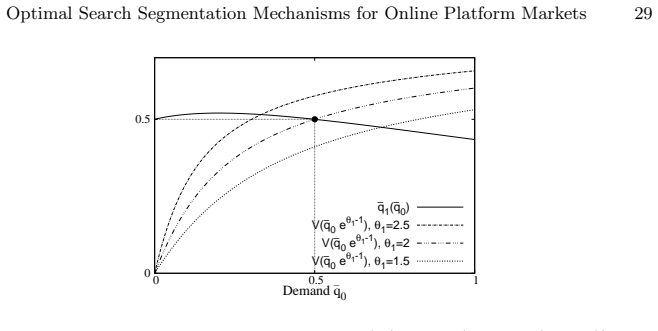
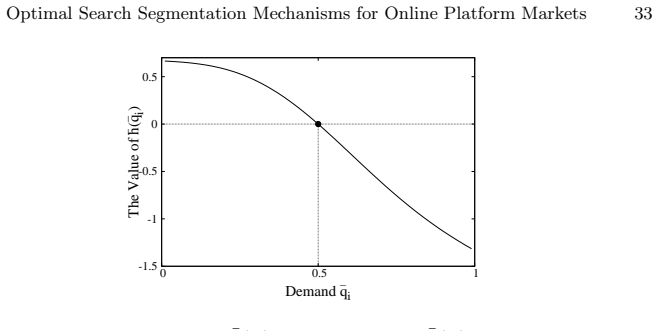
- [Appendix H, Lemmas 9-10 and Theorem 9] The appendix establishes load-bearing facts by appeal to figures rather than analytic derivation: Lemma 9 counts intersections of q1(q0) and V(q0 exp(theta1-1)) by "observing" Figure 4; Lemma 10 asserts hbar(qi) > 0 for 0 <= qi < 0.5 with a plot in Figure 5; and Theorem 9 asserts W(x) >= 2x/(e+x) on [exp(-1), 2 exp(2)] after "tedious calculations" supported only by Figure 6. These inequalities and root counts are necessary for quasi-convexity in the dominant-seller regime and for excluding the interval [q0*, q0^max]. The authors should replace each of these graphical arguments with a complete analytic proof.
- [Appendix H, Theorem 9, Case B] In Case B, the authors construct a virtual product j' and state that Lemma 5 shows the corresponding revenue function reb(q0) is quasi-convex on [q0^min', q0^max'], and then use this statement on [q0*, q0^max']. Lemma 5's own hypothesis is q1 < 0.5. On [q0*, q0^max'], however, q0 >= q0*, so q1 = V(q0 exp(theta1-1)) >= 0.5; the interval is precisely the regime excluded by Lemma 5. Thus a lemma is invoked outside its stated domain. The proof must either extend the quasi-convexity statement to the q1 >= 0.5 regime or provide a different argument for this interval.
minor comments (6)
- [Section 4.2, design rationale] The bullet list says "re(q0) is quasi-concave in q0" but the surrounding text and Lemma 5 state "quasi-convex"; this inconsistency should be corrected.
- [Section 2] The sentence introducing the ordering says "non-decreasing order" but the displayed inequality is theta1 >= theta2 >= ... >= thetan, which is non-increasing. The terminology should match the inequality.
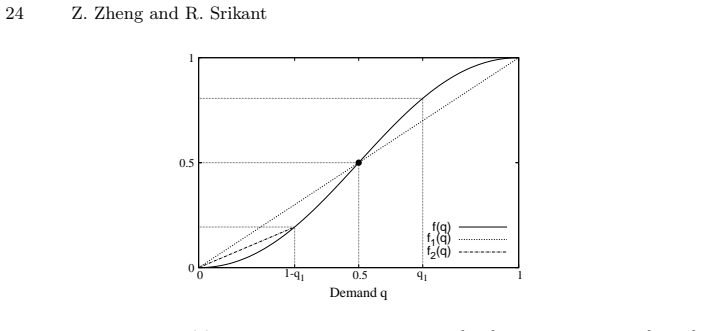
- [Appendix D, proof of Lemma 3] The proof relies on two properties of f(q) (f(q)+f(1-q)=1 and the inequalities f(q) <= q and f(q) <= f2(q)) that are stated after plotting Figure 2 but not proved. These properties are used to bound the expression in (31); provide analytic proofs for completeness.
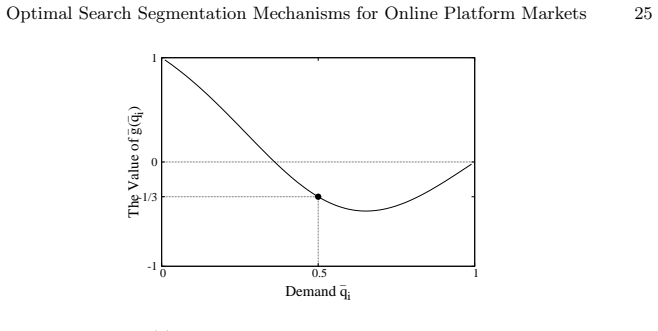
- [Appendix F, proof of Lemma 5] The property that g(q) is decreasing on [0,0.5] with g(0)=1 and g(0.5)=-1/3 is asserted with "We can verify this property by showing the first derivative g'(q) is negative" but the derivative computation is not shown. Include the computation or a reference.
- [Lemma 9 proof] The closed-form expression for q1(q0) (the root of re'(q0)=0) is typeset ambiguously: the denominator 2(q0+2) appears to multiply only the square-root term. Clarify that it multiplies the entire right-hand side.
- [Lemma 2] The proof claims that G(p) is an ordinal potential and that best-response dynamics converge in a finite number of steps because the potential has a finite value. The ordinal potential property (30) is asserted without proof, and a strictly increasing sequence in a finite-valued potential need not be finite in a continuous strategy space. A rigorous convergence argument is needed.
Circularity Check
No circularity: the top-k quality-order results are derived from the model, with no fitted inputs, no self-citation chains, and no target result assumed as an input.
full rationale
The paper derives its central claims from the MNL/Bertrand model rather than from its own prior conclusions. The optimal-display theorems (Theorems 3, 4, 6, 7) are obtained by analyzing the equilibrium revenue and welfare functions, using the Lambert-W function and the equilibrium constraint, with no calibrated or fitted parameters that are later relabeled as predictions. Theorem 1, the existence and uniqueness of the Bertrand equilibrium, is cited from Gallego et al. [21], which is external support and not a self-citation. The Appendix H proof of the dominant-seller case relies on figure-based verifications ('we can observe from the figure') and on Lemma 5 being invoked on an interval where its q1<0.5 hypothesis may fail; these are proof-rigor and correctness concerns, not circularity, because they do not amount to defining the top-k result in terms of itself or fitting a quantity and then predicting that same quantity. No self-definitional, fitted-input, self-citation-load-bearing, or renaming pattern is present in the derivation chain.
Assumptions & free parameters
assumptions (5)
- domain assumption MNL demand: each buyer's Gumbel noise is i.i.d., so purchase probabilities follow the softmax form in Eq. (1).
- domain assumption Bertrand-Nash equilibrium exists, is unique, and is characterized by first-order conditions, cited from Gallego et al. [21].
- ad hoc to paper Quasi-convexity of the revenue function in the q1>=0.5 regime is established by graphical intersection-count arguments in Appendix H.
- domain assumption Rosen's theorem guarantees existence and uniqueness of the Cournot equilibrium.
- domain assumption One representative buyer and no seller capacity constraints.
Cite this review
Pith. "Pith review of Optimal Search Segmentation Mechanisms for Online Platform Markets." pith.science (2026). https://pith.science/paper/6UAFIKEM
@misc{pith2026190807489,
  author       = {Pith},
  title        = {Pith review of: Optimal Search Segmentation Mechanisms for Online Platform Markets},
  year         = {2026},
  howpublished = {\url{https://pith.science/paper/6UAFIKEM}},
  note         = {Machine review of arXiv:1908.07489}
}
read the original abstract
Online platforms, such as Airbnb, hotels.com, Amazon, Uber and Lyft, can control and optimize many aspects of product search to improve the efficiency of marketplaces. Here we focus on a common model, called the discriminatory control model, where the platform chooses to display a subset of sellers who sell products at prices determined by the market and a buyer is interested in buying a single product from one of the sellers. Under the commonly-used model for single product selection by a buyer, called the multinomial logit model, and the Bertrand game model for competition among sellers, we show the following result: to maximize social welfare, the optimal strategy for the platform is to display all products; however, to maximize revenue, the optimal strategy is to only display a subset of the products whose qualities are above a certain threshold. We extend our results to Cournot competition model, and show that the optimal search segmentation mechanisms for both social welfare maximization and revenue maximization also have simple threshold structures. The threshold in each case depends on the quality of all products, the platform's objective and seller's competition model, and can be computed in linear time in the number of products.
Figures

Figures from the paper (3 more)

Reference graph
Works this paper leans on
-
[1]
M. Abolhassani, M. H. Bateni, M. Hajiaghayi, H. Mahini, and A. Sawant. Network cournot competition. In WINE, pages 15–29, 2014. 18 Z. Zheng and R. Srikant
work page 2014
-
[2]
M. Aksoy-Pierson, G. Allon, and A. Federgruen. Price competition under mixed multinomial logit demand functions. Management Science, 59(8):1817–1835, 2013
work page 2013
-
[3]
R. Alijani, S. Banerjee, S. Gollapudi, K. Kollias, and K. Munagala. The segmentation-thickness tradeoff in online marketplaces. In SIGMETRICS, 2019
work page 2019
-
[4]
S. P. Anderson, A. De Palma, and J.-F. Thisse. Discrete choice theory of product differentiation. MIT press, 1992
work page 1992
-
[5]
N. Arnosti, R. Johari, and Y. Kanoria. Managing congestion in decentralized matching markets. In EC, pages 451–451, 2014
work page 2014
-
[6]
S. Banerjee, S. Gollapudi, K. Kollias, and K. Munagala. Segmenting two-sided markets. In WWW, pages 63–72, 2017
work page 2017
-
[7]
K. Bimpikis, S. Ehsani, and R. Ilkili¸ c. Cournot competition in networked markets. Management Science, 65(6):2467–2481, 2019
work page 2019
- [8]
Show all 42 references
-
[9]
Boyd and L
S. Boyd and L. Vandenberghe. Convex optimization. Cambridge university press, 2004
2004
-
[10]
Cannon and L
S. Cannon and L. H. Summers. How uber and the sharing economy can win over regulators. Harvard business review, 13(10):24–28, 2014
2014
-
[11]
Cardell and F
N. Cardell and F. C. Dunbar. Measuring the societal impacts of automobile down- sizing. Transportation Research Part A: General, 14(5):423 – 434, 1980
1980
-
[12]
L. Chen, A. Mislove, and C. Wilson. Peeking beneath the hood of uber. In IMC, pages 495–508, 2015
2015
-
[13]
L. Chen, A. Mislove, and C. Wilson. An empirical analysis of algorithmic pricing on amazon marketplace. In WWW, pages 1339–1349, 2016
2016
-
[14]
R. M. Corless, G. H. Gonnet, D. E. G. Hare, D. J. Jeffrey, and D. E. Knuth. On the lambertw function. Advances in Computational Mathematics , 5(1):329–359, 1996
1996
-
[15]
A. F. Daughety. Cournot oligopoly: characterization and applications . Cambridge university press, 2005
2005
-
[16]
L. Dong, P. Kouvelis, and Z. Tian. Dynamic pricing and inventory control of substitute products. Manufacturing & Service Operations Management, 11(2):317– 339, 2009
2009
-
[17]
P. C. Evans and A. Gawer. The rise of the platform enterprise: a global survey. 2016
2016
-
[18]
Farahat, W
A. Farahat, W. T. Huh, and H. Li. On the relationship between quantity precom- mitment and cournot games. Operations Research, 67(1):109–122, 2019
2019
-
[19]
Freund and R
Y. Freund and R. E. Schapire. Adaptive game playing using multiplicative weights. Games and Economic Behavior , 29(1):79 – 103, 1999
1999
-
[20]
Fudenberg, F
D. Fudenberg, F. Drew, D. K. Levine, and D. K. Levine. The theory of learning in games, volume 2. MIT press, 1998
1998
-
[21]
Gallego, W
G. Gallego, W. T. Huh, W. Kang, and R. Phillips. Price competition with the attraction demand model: Existence of unique equilibrium and its stability. Man- ufacturing & Service Operations Management , 8(4):359–375, 2006
2006
-
[22]
Grbovic and H
M. Grbovic and H. Cheng. Real-time personalization using embeddings for search ranking at airbnb. In KDD, pages 311–320, 2018
2018
-
[23]
P. M. Guadagni and J. D. C. Little. A logit model of brand choice calibrated on scanner data. Marketing Science, 2(3):203–238, 1983
1983
-
[24]
Hanson and K
W. Hanson and K. Martin. Optimizing multinomial logit profit functions. Man- agement Science, 42(7):992–1003, 1996
1996
-
[25]
Kanoria and D
Y. Kanoria and D. Saban. Facilitating the search for partners on matching plat- forms: Restricting agent actions. In EC, pages 117–117, 2017. Optimal Search Segmentation Mechanisms for Online Platform Markets 19
2017
-
[26]
D. M. Kreps and J. A. Scheinkman. Quantity precommitment and bertrand com- petition yield cournot outcomes. The Bell Journal of Economics , 14(2):326–337, 1983
1983
-
[27]
W. Lin, J. Z. F. Pang, E. Bitar, and A. Wierman. Networked cournot competition in platform markets: Access control and efficiency loss. In CDC, pages 4606–4611, 2017
2017
-
[28]
McFadden
D. McFadden. Conditional logit analysis of qualitative choice behaviour. In P. Zarembka, editor, Frontiers in Econometrics , pages 105–142. Academic Press New York, New York, NY, USA, 1974
1974
-
[29]
McFadden
D. McFadden. The choice theory approach to market research. Marketing Science, 5(4):275–297, 1986
1986
-
[30]
P. R. Milgrom and S. Tadelis. How artificial intelligence and machine learning can impact market design. Working paper, National Bureau of Economic Research, 2018
2018
-
[31]
Monderer and L
D. Monderer and L. S. Shapley. Potential games. Games and Economic Behavior , 14(1):124 – 143, 1996
1996
-
[32]
J. Z. F. Pang, H. Fu, W. I. Lee, and A. Wierman. The efficiency of open access in platforms for networked cournot markets. In INFOCOM, pages 1–9, 2017
2017
-
[33]
J. B. Rosen. Existence and uniqueness of equilibrium points for concave n-person games. Econometrica, 33(3):520–534, 1965
1965
-
[34]
Rusmevichientong, D
P. Rusmevichientong, D. Shmoys, C. Tong, and H. Topaloglu. Assortment op- timization under the multinomial logit model with random choice parameters. Production and Operations Management, 23(11):2023–2039, 2014
2023
-
[35]
J. S. Shamma and G. Arslan. Unified convergence proofs of continuous-time ficti- tious play. IEEE Transactions on Automatic Control , 49(7):1137–1141, 2004
2004
-
[36]
Song and Z
J.-S. Song and Z. Xue. Demand management and inventory control for substi- tutable products. Working paper, 2007
2007
-
[37]
Talluri and G
K. Talluri and G. van Ryzin. Revenue management under a general discrete choice model of consumer behavior. Management Science, 50(1):15–33, 2004
2004
-
[38]
X. Vives. Oligopoly pricing: old ideas and new tools . MIT press, 2001
2001
-
[39]
H. C. W. L. Williams. On the formation of travel demand models and economic evaluation measures of user benefit. Environment and Planning A: Economy and Space, 9(3):285–344, 1977. A Monopolistic Market In this section, we consider an online marketplace in the full control model...
1977
-
[40]
We next show that it is not necessary to consider the interval [¯q∗ 0, ¯qmax 0 ] under the assumption of k∗ = 3
This threshold ¯q∗ 0 separates the range [¯qmin 0 , ¯qmax 0 ] into two intervals: [¯qmin 0 , ¯q∗ 0] and [¯q∗ 0, ¯qmax 0 ]. We next show that it is not necessary to consider the interval [¯q∗ 0, ¯qmax 0 ] under the assumption of k∗ = 3. We prove this by showing that the revenue...
-
[41]
To provereb(¯qmax 0 )≥reb(¯q∗ 0), we only need to show that W (exp(θ1− 1))≥ 2 exp(2−θ1) + 1, ∀θ1≥ 0
= ¯q1 1− ¯q1 + 1 ¯q∗ 0 + ¯q1 − 1 = 2 2× ¯q∗ 0 + 1 = 2 exp(2−θ1) + 1. To provereb(¯qmax 0 )≥reb(¯q∗ 0), we only need to show that W (exp(θ1− 1))≥ 2 exp(2−θ1) + 1, ∀θ1≥ 0. We introduce an auxiliary notation x ≜ exp(θ1− 1), and express the above inequality as W (x)≥ 2×x e +x, ∀x≥...
-
[42]
We then have re(¯q0)≤ re(¯qmin 0 ) for ¯q0 ∈ [ ¯qmin 0 , ¯q∗ 0 ] , meaning that it is optimal to select the third product in this case
cannot be the maximum value of re(¯q0) for ¯q0 ∈ [ ¯qmin 0 , ¯q∗ 0 ] , because otherwise the cardinality of the optimal product set would be 1 due to the previous discussion. We then have re(¯q0)≤ re(¯qmin 0 ) for ¯q0 ∈ [ ¯qmin 0 , ¯q∗ 0 ] , meaning that it is optimal to selec...
Reviewed August 14, 2026 · model on record in the stance chip above.
Discussion (0). Continue with ORCID to comment.