REVIEW 2 major objections 4 minor 1 cited by
Evidence of pseudogap and absence of spin magnetism in the time-reversal-symmetry-breaking state of Ba$_{1-x}$K$_x$Fe$_2$As$_2$
T0 review · 2 major / 4 minor · reviewed 2026-08-10 · deepseek-v4-flash
Pith's one-line read High-field NMR shows the time-reversal-symmetry-breaking state in Ba1−xKxFe2As2 at magic doping is preceded by a pseudogap and is free of spin magnetism.
desk verdict The pseudogap NMR data are a genuinely new and useful result; the absence-of-spin-magnetism claim is oversold because the 8 T measurements may not be in the BTRS phase at all. read the letter →
The pith
A machine-rendered reading of the paper's core claim, the machinery that carries it, and where it could break.
The reading
What carries the argument
The load-bearing observable is the 75As nuclear spin-lattice relaxation rate 1/T1T, which is proportional to the q-averaged low-energy dynamic spin susceptibility; a magnetic instability would show up as an enhancement near the transition, and none is observed. This is paired with the NMR linewidth (a measure of the distribution of local fields) and the NMR and muon Knight shifts (measures of the static spin susceptibility). The interpretive machinery is the electron-quadrupling scenario, in which the order parameter is fourth order in fermionic fields, ⟨ΔaΔb*⟩≠0 while the individual pairing fields ⟨Δa⟩=0, so BTRS occurs through interband relative-phase locking without spin order, and the pseudogap at T* marks the precursor formation of non-condensed Cooper pairs.
What would settle it
Measure 75As NMR 1/T1T and linewidth on the same doping at fields of about 1–3 T, where the spontaneous Nernst signal clearly marks $T_c^{{Z2}}$; a peak or step in 1/T1T or line broadening at $T_c^{{Z2}}$ would contradict the claim that the transition is non-magnetic, whereas continued monotonic behavior would confirm it.
Extended reading notes
Core claim
The paper's central claim is that the broken-time-reversal-symmetry state in Ba1−xKxFe2As2 near x≈0.77 is a non-magnetic electronic condensate with a distinct spectral signature: a pseudogap that develops at T* well above $T_c^{{Z2}}$, the temperature where the Z2 symmetry is spontaneously broken. The 75As spin-lattice relaxation rate 1/T1T begins to decrease below T* and keeps decreasing through $T_c^{{Z2}}$ and Tc, with no sign of critical slowing of spin fluctuations, and the NMR linewidth shows no broadening across either transition. Together with NMR and muon-spin-rotation Knight shifts that show no Curie-Weiss behavior, the authors conclude that the spontaneous magnetic fields detected by zero-field muon-spin rotation do not come from spin order or proximity to a magnetic instability, but from persistent real-space currents associated with interband phase locking of the multicomponent order parameter. The pseudogap is interpreted as the fingerprint of non-condensed Cooper pairs that form prior to the fermion-quadrupling ordering, consistent with theory and with specific-heat, transport, and muon-shift data.
Load-bearing premise
The argument assumes that the ordered time-reversal-breaking state still exists, at least in a small residual form, at the 8 T field where the NMR and muon-spin-rotation data were recorded, even though the spontaneous Nernst signal that defines $T_c^{{Z2}}$ could not be resolved at that field.
Editorial extensions
If this is right
- The time-reversal-symmetry-breaking state above Tc in this compound is a fermion-quadrupling condensate rather than a magnetic phase.
- The absence of low-energy spin-fluctuation enhancement rules out proximity to a spin-density-wave or other magnetic instability at the magic doping level.
- The pseudogap T* is a genuine electronic spectral feature observable by NMR, setting the energy scale for pair formation before quadrupling ordering.
- The spontaneous Nernst signal and the spontaneous magnetic fields detected in zero-field muon-spin rotation share a common origin in persistent currents from interband phase locking.
- Other iron-based superconductors with reported pseudogaps and BTRS superconductivity may host quartic states at appropriate doping levels, and NMR pseudogap signatures offer a way to search for them.
Reading between the lines
- A testable extension would be to measure 1/T1T across a range of potassium dopings: if the pseudogap is the universal precursor of quadrupling, its separation from Tc should systematically widen as the magic doping is approached from either side.
- A direct check of the paper's field-extrapolation assumption would be NMR at fields of about 1–3 T, where the spontaneous Nernst signal clearly marks T_c^{Z2}; a feature in 1/T1T or the linewidth there would challenge the non-magnetic interpretation, whereas continued monotonic behavior would strengthen it.
- The same probe combination could distinguish spin-current from orbital-current loop-order candidates in other time-reversal-symmetry-breaking superconductors by looking for the absence of low-energy spin fluctuations at the ordering transition.
- Because the Knight shift is suppressed below T*, the underlying gapped density of states appears spin-singlet-like; fitting the temperature dependence with a Yosida-type form could quantify the gap and test whether it matches the specific-heat anomaly scale.
Signed reviews
Editorial analysis
A structured set of objections, weighed in public.
Referee Report
Summary. This paper reports 75As NMR and transverse-field µSR measurements on Ba1−xKxFe2As2 with x ≈ 0.77, with the aim of probing the electronic spectral properties of the time-reversal-symmetry-breaking (BTRS) state that sets in above Tc. The authors identify a decrease of the spin-lattice relaxation rate 1/T1T below a pseudogap temperature T* that lies above the extrapolated BTRS temperature T_c^Z2 and above Tc, and they associate this with the formation of preformed electron pairs that precede the proposed electron quadrupling condensate. They also find no NMR line broadening and no enhancement of 1/T1T near the extrapolated T_c^Z2 at 8 T, which they interpret as excluding spin magnetism and as evidence that the spontaneous fields seen by zero-field µSR arise from persistent real-space currents rather than from spin order. The paper includes detailed sample characterization, transport, Nernst, and specific-heat data, and a Ginzburg-Landau analysis of field-induced suppression of the BTRS phase.
Significance. If the conclusions hold, this would be the first direct spectroscopic evidence for a pseudogap tied to the proposed fermion quadrupling state above Tc in this material, and it would strengthen the case for nonmagnetic, current-based origin of the spontaneous fields. The paper combines several complementary probes (NMR, µSR, transport, specific heat, STM) and is unusually candid about limitations, explicitly stating in Section II that the quadrupling state cannot be confirmed at the 8 T measurement field and in Appendix F that the mean-field GL analysis is not valid close to Tc. The comparison with literature NMR data (Hirano et al.) and the detailed sample characterization are assets. However, the central absence-of-spin-magnetism conclusion depends on an extrapolation of the BTRS phase boundary to 8 T, and the primary pseudogap evidence in Fig. 4 is presented without visible error bars, so the strength of the claims currently exceeds what the data justify.
major comments (2)
- [Section II and IV] The claim that the NMR data "prove the absence of a magnetic transition at T_c^Z2" (abstract and Section IV) is not supported by the data shown, because all NMR and µSR measurements were taken at 8 T. Section II states that the spontaneous Nernst signal "cannot be resolved at 8 T and beyond" and that the authors "cannot determine whether the quadrupling state is completely suppressed, or if a small quadrupling phase remains." The dashed extrapolation of T_c^Z2 in Fig. 1(d) is not a measurement, and the GL analysis in Appendix F explicitly shows that external fields can restore TRS, with the text concluding that for the parameters examined "weaker fields eliminate the quartic phase" (Section F.3). Consequently, the absence of an NMR anomaly near the extrapolated T_c^Z2 at 8 T does not constrain the zero-field BTRS state. This affects the second central conclusion of the paper and must be addressed, either by adding lower-field NMR data where the Nernst signal is resolvable or by substantially tempering the claims in the abstract and Section IV.
- [Fig. 4 and Section IV] The primary evidence for the pseudogap is the decrease of 1/T1T below T*(NMR) shown in Fig. 4, but no error bars are visible in this figure. The text states that 1/T1T is "constant within error bars" above T* and that the decrease below T* is monotonous, yet without visible uncertainties the reader cannot assess the significance of the trend, the precise location of the kink, or the claimed absence of an enhancement near T_c^Z2. Please add error bars (or state explicitly how the scatter defines the uncertainty and why the trend is statistically significant) so that the central pseudogap claim can be independently evaluated.
minor comments (4)
- [Section IV] The doping level is given as x = 0.776(1) in the first paragraph of Section IV and in Fig. 4, but as x = 0.766(1) in Section II, the Methods, and Fig. 2. Please correct the typo.
- [Fig. 2 and Section III] In Fig. 2(b)-(d) the vertical dotted lines are labeled Tc and T*, but the text discusses crossing T_c^Z2; please also mark T_c^Z2 (or explain why it is not marked, given that the measurements are at 8 T).
- [Appendix B.2] The sentence "we compare this to the quadrupole frequencies measured by Hirano et al. ." has a missing citation number and an extra period; please fix the reference formatting.
- [Section II] The phrase "The theoretical analysis ... demonstrates the mechanism of suppression of the quadrupling state when the external magnetic field exceeds a certain value" is stronger than what the finite-element simulations support, since they are performed for specific parameter sets; suggest "is consistent with" or "illustrates".
Circularity Check
No significant circularity: the central NMR/µSR results are new measurements interpreted within an existing framework; nothing reduces to its inputs by construction.
full rationale
The paper's central empirical content—75As NMR spectra, 1/T1T, linewidth, Knight shift, and 8 T µSR Knight-shift data—is presented as new measurements, not as consequences of the quadrupling theory. The pseudogap assignment is made by identifying a slope change in measured 1/T1T and comparing it with transport and specific-heat anomalies; the electron-quadrupling framework is then used as an interpretive hypothesis, not as the source of the data points. The absence-of-spin-magnetism conclusion rests on the observed monotonic 1/T1T and absence of line broadening, which are direct experimental facts; while the 8 T field may suppress or weaken the zero-field BTRS phase—the paper explicitly says 'we cannot determine whether the quadrupling state is completely suppressed, or if a small quadrupling phase remains at that field'—that is a validity or extrapolation concern, not a circularity. The theoretical finite-element GL analysis is parameterized from a microscopic model and used to test consistency with the observed field suppression; it does not define the measured quantities. Self-citations are present (Refs. [4,5,9,19,20,21]) for prior evidence of T_c^Z2 and the quadrupling scenario, but those prior results are independent experimental or Monte-Carlo results rather than the present paper's own fitted inputs, and the present paper's claims do not reduce to them by construction. No equation is declared to be predicted by another equation that contains it, and no fitted parameter is renamed as a prediction. Accordingly, no specific circular step can be exhibited.
Assumptions & free parameters
free parameters (4)
- T*(NMR) =
~12 K at 8 T, ~10.5 K at 16 T
- High-temperature gap Delta_PG =
76 K for x=0.766(1)
- Two-Gaussian NMR decomposition parameters =
linewidths and positions of peaks A and B
- Ginzburg-Landau simulation coefficients =
u_GammaM=0.5, u_GammaGamma'=0.4875, K^(1)=1.0, K^(2)=0.1 or 0.95, K^(3)=0.015, e=0.5, B0=0.6
assumptions (5)
- standard math 1/T1T is proportional to the q-summed dynamic spin susceptibility (Eq. 2)
- domain assumption The Knight shift is proportional to the static spin susceptibility with a temperature-independent orbital offset
- domain assumption The two NMR spectral peaks arise from K-rich and K-poor nanoclusters and do not affect global electronic properties
- domain assumption The drop in 1/T1T below T* reflects a loss of low-energy electronic density of states, not a change in the magnetic-fluctuation background
- domain assumption The BTRS transition at T_c^Z2 and the electron quadrupling interpretation from previous work [4,5] are correct
invented entities (2)
-
Electron quadrupling (quartic) order parameter with non-zero <Delta_a Delta_b*> and zero <Delta_a>
independent evidence
-
Persistent real-space loop currents near defects
independent evidence
Cite this review
Pith. "Pith review of Evidence of pseudogap and absence of spin magnetism in the time-reversal-symmetry-breaking state of Ba$_{1-x}$K$_x$Fe$_2$As$_2$." pith.science (2026). https://pith.science/paper/6UNHE37W
@misc{pith2026250111936,
  author       = {Pith},
  title        = {Pith review of: Evidence of pseudogap and absence of spin magnetism in the time-reversal-symmetry-breaking state of Ba$_1-x$K$_x$Fe$_2$As$_2$},
  year         = {2026},
  howpublished = {\url{https://pith.science/paper/6UNHE37W}},
  note         = {Machine review of arXiv:2501.11936}
}
abstract
Muon-spin-rotation ($\mu$SR) experiments and the observation of a spontaneous Nernst effect indicate time-reversal symmetry breaking (BTRS) at $T_{\rm c}^{\rm Z2}$ above the superconducting transition temperature $T_{\rm c}$ in Ba$_{1-x}$K$_x$Fe$_2$As$_2$, with $x\approx0.8$. Further studies have pointed out that BTRS is caused by the formation of a new state of matter associated with the condensation of pairs of electron pairs. Despite exhibiting multiple unconventional effects that warrant further investigation, the electronic spectral properties of this electron quadrupling state remain largely unexplored. Here, we present detailed $^{75}$As nuclear magnetic resonance (NMR) measurements of Ba$_{1-x}$K$_x$Fe$_2$As$_2$, with $x = 0.77$, which has $T_{\rm c}^{\rm Z2}$ > $T_{\rm c}$ according to measurements of the spontaneous Nernst effect. The NMR data obtained in this work provide the first direct electronic spectral characteristics of the electron quadrupling state by indicating that it evolves from a pseudogap that sets in at $T^*$ well above $T_{\rm c}^{\rm Z2}$. This pseudogap behavior is consistent with $\mu$SR Knight-shift, specific-heat, and transport data indicating the formation of a bound state of electrons. According to a theory of electron quadrupling condensates, such bound-state formations should precede the onset of BTRS correlations between pairs of electron pairs. The second important insight from NMR data is the absence of spin-related magnetism. The temperature dependence of the spin-lattice relaxation rate $1/T_1T$ and the evolution of the NMR linewidth prove the absence of a magnetic transition at $T_{\rm c}^{\rm Z2}$ and rule out even a proximity to some magnetic instability. This indicates that the spontaneous magnetic fields detected in this compound are not caused by spin magnetism but are associated with persistent real-space currents.
Figures


Figures from the paper (14 more)




Forward citations
Cited by 1 Pith paper
-
Neutron Spin Resonance Near a Lifshitz Transition in Overdoped Ba$_{0.4}$K$_{0.6}$Fe$_2$As$_2$
An incommensurate neutron spin resonance with downward dispersion is observed in hole-overdoped Ba0.4K0.6Fe2As2 near the Lifshitz transition.
Reference graph
Works this paper leans on
-
[1]
X-ray measurements 2 04 06 08 01 001 201 40101 1 02 1 03 1 04 1 05 B a0 .234K0 .766Fe2 As2 I ntensity (counts)2 Θ (deg) side A side Bc-axis13.65467 /s849113.65574 /s8491 Figure 5: 2Θ X-ray scans measured from both sides of the sample used for the NMR measurements. The obtained c- axis parameter corresponds to x = 0.766(1) [40], indicating that the doping ...
-
[2]
Susceptibility 0 2 4 6 8 1 01 21 4- 10 4π χ, B| |c = 0.5 mT, NMR sample χ' /χ' (2K), BA C| |c = 10 μT μS R sample 4π χ, B| |c = 0.5 mT, STM sample M agnetic susceptibilityT emperature (K)F CZ FCB a1 -xKx Fe2 As2 Figure 6: Temperature-dependent magnetic susceptibility of the single crystals used for the NMR and STM measurements as well as of the stack of t...
-
[3]
Sample orientation For the NMR measurements, we utilized the angu- lar dependence of the 75As Knight shift to orient the Ba1−xKxFe2As2 sample in magnetic field. At 10 K and 8 T, the angular-dependent shift yields a squared-sine-type behavior, where the maximum of the shift corresponds to a field orientation parallel to the crystallographic c axis. Fig. 7 ...
-
[4]
Confirmation of bulk potassium stoichiometry In order to confirm the potassium doping level of our sample by means of NMR, we determined the quadrupole frequency νQ by measuring the central transition and the higher-frequency satellite transition at 20 K and 8 T (in- set of Fig. 8). Since, in the present case, the c axis is the principle axis of the elect...
-
[5]
Superconducting transitions probed by RF penetration As a confirmation of the superconducting phase dia- gram of our NMR sample as determined by means of the transport measurements presented in the main text, we also probed the shift ∆ f of the resonance frequency fres of the NMR circuit at temperatures across the supercon- ducting transition and magnetic...
-
[6]
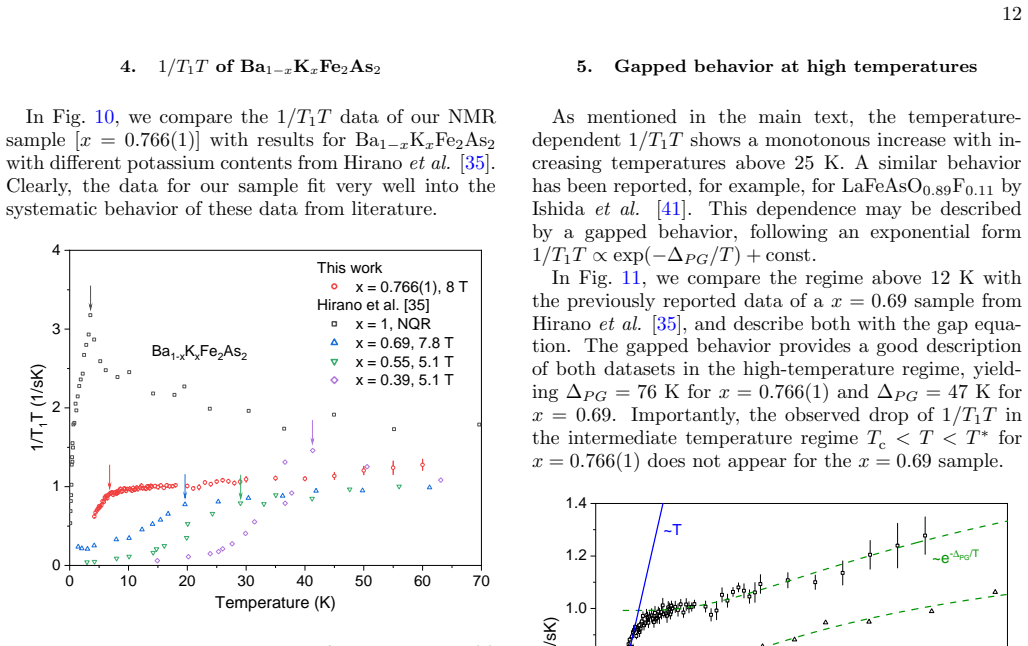
1/T1T of Ba 1−xKxF e2As2 In Fig. 10, we compare the 1 /T1T data of our NMR sample [ x = 0 .766(1)] with results for Ba 1−xKxFe2As2 with different potassium contents from Hirano et al. [35]. Clearly, the data for our sample fit very well into the systematic behavior of these data from literature. 0 1 02 03 04 05 06 07 001 2 3 4 T his work x = 0.766(1), 8 T...
-
[7]
A similar behavior has been reported, for example, for LaFeAsO 0.89F0.11 by Ishida et al
Gapped behavior at high temperatures As mentioned in the main text, the temperature- dependent 1/T1T shows a monotonous increase with in- creasing temperatures above 25 K. A similar behavior has been reported, for example, for LaFeAsO 0.89F0.11 by Ishida et al. [41]. This dependence may be described by a gapped behavior, following an exponential form 1/T1...
-
[8]
1/T1T and specific-heat data at 16 T In Fig. 12, we show the temperature dependence of 1/T1T for a field of 16 T and compare it to our specific- heat data recorded at the same field. The 1 /T1T data at 16 T reveal a similar pseudogap behavior as observed at 8 T, but at a slightly lower temperature of about 10.5 K, which also coincides with the onset tempe...
Show all 65 references
-
[9]
(b), Histogram showing the height distribution of the As-lattice points in (b)
spa- tial periodicity originating from surface reconstruction (bright regions). (b), Histogram showing the height distribution of the As-lattice points in (b). The STM topography image [Fig. 14(a)] of the sample with x = 0 .771(1) shows that the As-terminated sur- face compris...
-
[10]
The portion of differ- ent regions can be estimated by measuring the areas of these two peaks
spatial order have different heights compared to the dark regions, a histogram of the mea- sured heights at the lattice points exhibits two peaks, with the lower and higher peaks corresponding to dark and bright regions, respectively. The portion of differ- ent regions can be ...
-
[11]
Microscopic derivations of the model Within the quasiclassical approximation, the model de- pends on various parameters of each Fermi surface (the partial densities of states νa and the Fermi velocities v(a) F ), where the index a = 1 , 2, 3 labels the different bands. While t...
2000
-
[12]
Ground state and time-reversal symmetry The superconducting ground state is the state which minimizes the potential energy (F5) and that is constant in space: Ψ 0 := argmin V (Ψ), with Ψ † 0Ψ0 = const. ̸= 0. The breakdown of time-reversal symmetry typically oc- curs due to a c...
-
[13]
Simulations in an external field Superconductors in an external magnetic field B0 ˆz are characterized by the total (Gibbs) free energy G =R Ω F −2B · B0 ˆz. In order to numerically investigate the properties in an external field, the vector potential A and the superconducting...
-
[14]
This is clearly seen in Figs
Symmetry restoration at fields significantly larger than Hc1 The subdominant component ψ1 is more suppressed by applied field than the dominant component ψ2. This is clearly seen in Figs. 18 and 17, in particular with parame- ter set (b). Since one of the components disappears...
2023
-
[15]
Iguchi, R
Y. Iguchi, R. Shi, K. Kihou, C. Lee, M. Barkman, A. Ben- fenati, V. Grinenko, E. Babaev, and K. Moler, Supercon- ducting vortices carrying a temperature-dependent frac- tion of the flux quantum, Science 380, 1244 (2023)
2023
-
[16]
Q. Z. Zhou, B. R. Chen, B. K. Xiang, I. Timoshuk, J. Ga- raud, Y. Li, K. Y. Liang, Q. S. He, Z. J. Li, P. H. Zhang, K. Z. Yao, H. X. Yao, E. Babaev, V. Grinenko, and Y. H. Wang, Observation of single-quantum vortex splitting in the Ba 1−xKxFe2As2 superconductor, arXiv:2408.059...
2024 arXiv
-
[17]
Zheng, Q
Y. Zheng, Q. Hu, H. Ji, I. Timoshuk, H. Xu, Y. Li, Y. Gao, X. Yu, R. Wu, X. Lu, V. Grinenko, E. Babaev, N. F. Q. Yuan, B. Lv, C.-M. Yim, and H. Ding, Direct observation of quantum vortex fractionalization in multi- band superconductors, arXiv:2407.18610 (2024)
2024 arXiv
-
[18]
Grinenko, D
V. Grinenko, D. Weston, F. Caglieris, C. Wuttke, C. Hess, T. Gottschall, I. Maccari, D. Gorbunov, S. Zherlitsyn, J. Wosnitza, A. Rydh, K. Kihou, C.- H. Lee, R. Sarkar, S. Dengre, J. Garaud, A. Char- nukha, R. H¨ uhne, K. Nielsch, B. B¨ uchner, H.-H. Klauss, and E. Babaev, Stat...
2021
-
[19]
Shipulin, N
I. Shipulin, N. Stegani, I. Maccari, K. Kihou, C.-H. Lee, Q. Hu, Y. Zheng, F. Yang, Y. Li, C.-M. Yim, R. H¨ uhne, H.-H. Klauss, M. Putti, F. Caglieris, E. Babaev, and V. Grinenko, Calorimetric evidence for two phase transi- tions in Ba 1−xKxFe2As2 with fermion pairing and qua-...
2023
-
[20]
Halcrow, I
C. Halcrow, I. Shipulin, F. Caglieris, Y. Li, J. Wosnitza, H.-H. Klauss, S. Zherlitsyn, V. Grinenko, and E. Babaev, Probing electron quadrupling order through ultrasound, arXiv:2404.03020 (2024)
2024
-
[21]
A. A. Aczel, E. Baggio-Saitovitch, S. L. Budko, P. C. Canfield, J. P. Carlo, G. F. Chen, P. Dai, T. Goko, W. Z. Hu, G. M. Luke, J. L. Luo, N. Ni, D. R. Sanchez- Candela, F. F. Tafti, N. L. Wang, T. J. Williams, W. Yu, and Y. J. Uemura, Muon-spin-relaxation stud- ies of magneti...
2008
-
[22]
S. Avci, O. Chmaissem, D. Y. Chung, S. Rosenkranz, E. A. Goremychkin, J. P. Castellan, I. S. Todorov, J. A. Schlueter, H. Claus, A. Daoud-Aladine, D. D. Khalyavin, M. G. Kanatzidis, and R. Osborn, Phase diagram of Ba1−xKxFe2As2, Phys. Rev. B 85, 184507 (2012)
2012
-
[23]
Grinenko, R
V. Grinenko, R. Sarkar, K. Kihou, C. H. Lee, I. Morozov, S. Aswartham, B. B¨ uchner, P. Chekhonin, W. Skrotzki, K. Nenkov, R. H¨ uhne, K. Nielsch, S. L. Drechsler, V. L. Vadimov, M. A. Silaev, P. Volkov, I. Eremin, H. Luetkens, and H. H. Klauss, Superconductivity with broken t...
2020
-
[24]
Chubukov, Pairing mechanism in Fe-based supercon- ductors, Annul
A. Chubukov, Pairing mechanism in Fe-based supercon- ductors, Annul. Rev. Cond. Mat. Phys. 3, 57 (2012)
2012
-
[25]
Hardy, A
F. Hardy, A. E. B¨ ohmer, L. de’ Medici, M. Capone, G. Giovannetti, R. Eder, L. Wang, M. He, T. Wolf, P. Schweiss, R. Heid, A. Herbig, P. Adelmann, R. A. Fisher, and C. Meingast, Strong correlations, strong coupling, and s-wave superconductivity in hole-doped BaFe2As2 single c...
2016
-
[26]
J. K. Dong, S. Y. Zhou, T. Y. Guan, H. Zhang, Y. F. Dai, X. Qiu, X. F. Wang, Y. He, X. H. Chen, and S. Y. Li, Quantum criticality and nodal superconductivity in the feas-based superconductor KFe2As2, Phys. Rev. Lett. 104, 087005 (2010)
2010
-
[27]
Y. P. Wu, D. Zhao, A. F. Wang, N. Z. Wang, Z. J. Xiang, X. G. Luo, T. Wu, and X. H. Chen, Emergent Kondo Lat- tice Behavior in Iron-Based Superconductors A Fe2As2 (A = K, Rb, Cs), Phys. Rev. Lett. 116, 147001 (2016)
2016
-
[28]
Drechsler, H
S.-L. Drechsler, H. Rosner, V. Grinenko, S. Aswartham, I. Morozov, M. Liu, A. Boltalin, K. Kihou, C. H. Lee, T. Kim, D. Evtushinsky, J. M. Tomczak, S. John- ston, and S. Borisenko, Strongly hole-overdoped Fe-based pnictide superconductors: KFe 2As2 and CsFe 2As2, J. Supercond....
2018
-
[29]
Grinenko, P
V. Grinenko, P. Materne, R. Sarkar, H. Luetkens, K. Kihou, C. H. Lee, S. Akhmadaliev, D. V. Efre- mov, S.-L. Drechsler, and H.-H. Klauss, Superconductiv- ity with broken time-reversal symmetry in ion-irradiated Ba027K0.73Fe2A2 single crystals, Phys. Rev. B95, 214511 (2017)
2017
-
[30]
Garaud and E
J. Garaud and E. Babaev, Domain walls and their exper- imental signatures in s + is superconductors, Phys. Rev. Lett. 112, 017003 (2014)
2014
-
[31]
Maiti and A
S. Maiti and A. V. Chubukov, s + is state with bro- ken time-reversal symmetry in Fe-based superconduc- tors, Phys. Rev. B 87, 144511 (2013)
2013
-
[32]
Benfenati, M
A. Benfenati, M. Barkman, T. Winyard, A. Wormald, M. Speight, and E. Babaev, Magnetic signatures of do- main walls in s + is and s + id superconductors: Ob- servability and what that can tell us about the super- conducting order parameter, Phys. Rev. B 101, 054507 (2020)
2020
-
[33]
T. A. Bojesen, E. Babaev, and A. Sudbø, Time rever- sal symmetry breakdown in normal and superconducting states in frustrated three-band systems, Phys. Rev. B88, 220511 (2013)
2013
-
[34]
T. A. Bojesen, E. Babaev, and A. Sudbø, Phase tran- sitions and anomalous normal state in superconductors with broken time-reversal symmetry, Phys. Rev. B 89, 104509 (2014)
2014
-
[35]
Maccari and E
I. Maccari and E. Babaev, Effects of intercomponent couplings on the appearance of time-reversal symmetry breaking fermion-quadrupling states in two-component london models, Phys. Rev. B 105, 214520 (2022)
2022
-
[36]
Zheng, A
Y.-G. Zheng, A. Luo, Y.-C. Shen, M.-G. He, Z.-H. Zhu, Y. Liu, W.-Y. Zhang, H. Sun, Y. Deng, Z.-S. Yuan, and P. J.-W., Counterflow superfluidity in a two-component mott insulator, Nat. Phys. (2025)
2025
-
[37]
Garaud and E
J. Garaud and E. Babaev, Effective model and magnetic properties of the resistive electron quadrupling state, Phys. Rev. Lett. 129, 087602 (2022)
2022
-
[38]
Maiti, M
S. Maiti, M. Sigrist, and A. Chubukov, Spontaneous cur- rents in a superconductor with s+is symmetry, Phys. Rev. B 91, 161102(R) (2018)
2018
-
[39]
V. L. Vadimov and M. A. Silaev, Polarization of the spon- taneous magnetic field and magnetic fluctuations in s +is 22 anisotropic multiband superconductors, Phys. Rev. B98, 104504 (2018)
2018
-
[40]
Babaev, A
E. Babaev, A. Sudbø, and N. Ashcroft, A superconductor to superfluid phase transition in liquid metallic hydrogen, Nature 431, 666 (2004)
2004
-
[41]
Yosida, Paramagnetic Susceptibility in Superconduc- tors, Phys
K. Yosida, Paramagnetic Susceptibility in Superconduc- tors, Phys. Rev. 110, 769 (1958)
1958
-
[42]
N. Xu, P. Richard, X. Shi, A. van Roekeghem, T. Qian, E. Razzoli, E. Rienks, G.-F. Chen, E. Ieki, K. Nakayama, T. Sato, T. Takahashi, M. Shi, and H. Ding, Possi- ble nodal superconducting gap and Lifshitz transition in heavily hole-doped Ba 0.1K0.9Fe2As2, Phys. Rev. B 88, 2205...
2013
-
[43]
Korringa, Nuclear magnetic relaxation and resonnance line shift in metals, Physica 16, 601 (1950)
J. Korringa, Nuclear magnetic relaxation and resonnance line shift in metals, Physica 16, 601 (1950)
1950
-
[44]
Grafe, D
H.-J. Grafe, D. Paar, G. Lang, N. J. Curro, G. Behr, J. Werner, J. Hamann-Borrero, C. Hess, N. Leps, R. Klin- geler, and B. B¨ uchner,75As NMR Studies of Supercon- ducting LaFeAsO 0.9F0.1, Phys. Rev. Lett. 101, 047003 (2008)
2008
-
[45]
Grinenko, R
V. Grinenko, R. Sarkar, P. Materne, S. Kamusella, A. Ya- mamshita, Y. Takano, Y. Sun, T. Tamegai, D. V. Efre- mov, S.-L. Drechsler, J.-C. Orain, T. Goko, R. Scheuer- mann, H. Luetkens, and H.-H. Klauss, Low-temperature breakdown of antiferromagnetic quantum critical behav- ior...
2018
-
[46]
S. W. Zhang, L. Ma, Y. D. Hou, J. Zhang, T.-L. Xia, G. F. Chen, J. P. Hu, G. M. Luke, and W. Yu, 75as NMR study of single crystals of the heavily overdoped pnictide superconductors Ba 1−xKxFe2As2 (x = 0.7 and 1), Phys. Rev. B 81, 012503 (2010)
2010
-
[47]
Zhang, F
G. Zhang, F. Martelli, and S. Torquato, The structure factor of primes, J. Phys. A 51, 115001 (2018)
2018
-
[48]
Carretta and G
P. Carretta and G. Prando, Iron-based superconductors: tales from the nuclei, Riv. Nuovo Cimento 43, 1 (2020)
2020
-
[49]
Hirano, Y
M. Hirano, Y. Yamada, T. Saito, R. Nagashima, T. Kon- ishi, T. Toriyama, Y. Ohta, H. Fukazawa, Y. Kohori, Y. Furukawa, K. Kihou, C.-H. Lee, A. Iyo, and H. Eisaki, Potential Antiferromagnetic Fluctuations in Hole-Doped Iron-Pnictide Superconductor Ba 1−xKxFe2As2 Studied by 75As...
2012
-
[50]
A. Shi, T. Arai, S. Kitagawa, T. Yamanaka, K. Ishida, A. E. B¨ ohmer, C. Meingast, T. Wolf, M. Hirata, and T. Sasaki, Pseudogap behavior of the nuclear spin–lattice relaxation rate in FeSe probed by 77Se-NMR, J. Phys. Soc. Jpn. 87, 013704 (2018)
2018
-
[51]
B. L. Kang, M. Z. Shi, D. Zhao, S. J. Li, J. Li, L. X. Zheng, D. W. Song, L. P. Nie, T. Wu, and X. H. Chen, NMR evidence for universal pseudogap behav- ior in quasi-two-dimensional FeSe-based superconduc- tors, Chin. Phys. Lett. 39, 127401 (2023)
2023
-
[52]
Matsuura, M
K. Matsuura, M. Roppongi, Q. Mingwei, Q. Sheng, Y. Cai, K. Yamakaw, Z. Guguchia, R. P. Day, K. M. Kojima, A. Damascelli, Y. Sugimura, M. Saito, T. Tak- enaka, K. Ishihara, Y. Mizukami, K. Hashimoto, Y. Gu, S. Guo, L. Fu, G. Zhaog, G. Dai, C. Jing, J. W. Beare, G. M. Lukee, Y. ...
2023
-
[53]
B. D. Faeth, S.-L. Yang, J. K. Kawasaki, J. N. Nelson, P. Mishra, C. T. Parzyck, C. Li, D. G. Schlom, and K. M. Shen, Incoherent cooper pairing and pseudogap behavior in single-layer FeSe/SrTiO 3, Phys. Rev. X 11, 021054 (2021)
2021
-
[54]
Kihou, T
K. Kihou, T. Saito, K. Fujita, S. Ishida, M. Naka- jima, K. Horigane, H. Fukazawa, Y. Kohori, S.-i. Uchida, J. Akimitsu, A. Iyo, C.-H. Lee, and H. Eisaki, Single- crystal growth of Ba 1−xKxFe2As2 by KAs self-flux method, J. Phys. Soc. Jpn. 85, 034718 (2016)
2016
-
[55]
Ishida, Y
K. Ishida, Y. Nakai, S. Kitagawa, and T. Iye, NMR stud- ies on iron-pnictide superconductors: LaFeAs(O 1−xFx) and BaFe2(As1−xPx)2, C. R. Phys. 12, 515 (2011)
2011
-
[56]
Stanev and Z
V. Stanev and Z. Tesanovic, Three-band superconduc- tivity and the order parameter that breaks time-reversal symmetry, Phys. Rev. B 81, 134522 (2010)
2010
-
[57]
Marciani, L
M. Marciani, L. Fanfarillo, C. Castellani, and L. Ben- fatto, Leggett modes in iron-based superconductors as a probe of time-reversal symmetry breaking, Phys. Rev B 88, 214508 (2013)
2013
-
[58]
Garaud, M
J. Garaud, M. Silaev, and E. Babaev, Microscopically derived multi-component Ginzburg–Landau theories for s+is superconducting state, Physica C 533, 63 (2017)
2017
-
[59]
Yerin, S.-L
Y. Yerin, S.-L. Drechsler, and G. Fuchs, Ginzburg- Landau Analysis of the Critical Temperature and the Upper Critical Field for Three-Band Superconductors, J. Low Temp. Phys. 173, 247 (2013)
2013
-
[60]
N. H. Aase, C. S. Johnsen, and A. Sudbø, Constrained weak-coupling superconductivity in multiband supercon- ductors, Phys. Rev B 108, 024509 (2023)
2023
-
[61]
Hecht, New development in freefem++, J
F. Hecht, New development in freefem++, J. Numer. Math. 20, 251 (2012)
2012
-
[62]
Nocedal and S
J. Nocedal and S. J. Wright, Numerical Optimization, Springer Series in Operations Research (Springer New York, 1999)
1999
-
[63]
Garaud, E
J. Garaud, E. Babaev, T. A. Bojesen, and A. Sudbø, Lattices of double-quanta vortices and chirality inversion in px + ipy superconductors, Phys. Rev B 94, 104509 (2016)
2016
-
[64]
Carlstr¨ om, J
J. Carlstr¨ om, J. Garaud, and E. Babaev, Length scales, collective modes, and type-1.5 regimes in three-band su- perconductors, Phys. Rev. B 84, 134518 (2011)
2011
-
[66]
Note that the competition between kinetic and poten- tial phase-locking terms can be made more explicit by eliminating the mixed-gradient term via another field re- definition, at the cost of a more complex potential, see details for example in [23]
Reviewed August 10, 2026 · model on record in the stance chip above.
Discussion (0). Continue with ORCID to comment.