REVIEW 4 major objections 5 minor 1 cited by
Robust translational invariance in topological bands against lattice potentials and disorders
T0 review · 4 major / 5 minor · reviewed 2026-08-12 · deepseek-v4-flash
Pith's one-line read Continuous magnetic translational symmetry survives a lattice of point potentials inside a single Landau level, because the projected bandwidth collapses faster than exponentially as the lattice spacing drops below the magnetic length.
desk verdict The central quantitative claim is undercut by a form-factor exponent error: Eq. (3) is the Husimi range, not the spectral bandwidth, so the fundamental lengths are unsupported, though the qualitative robustness idea may survive. read the letter →
The pith
A machine-rendered reading of the paper's core claim, the machinery that carries it, and where it could break.
The reading
What carries the argument
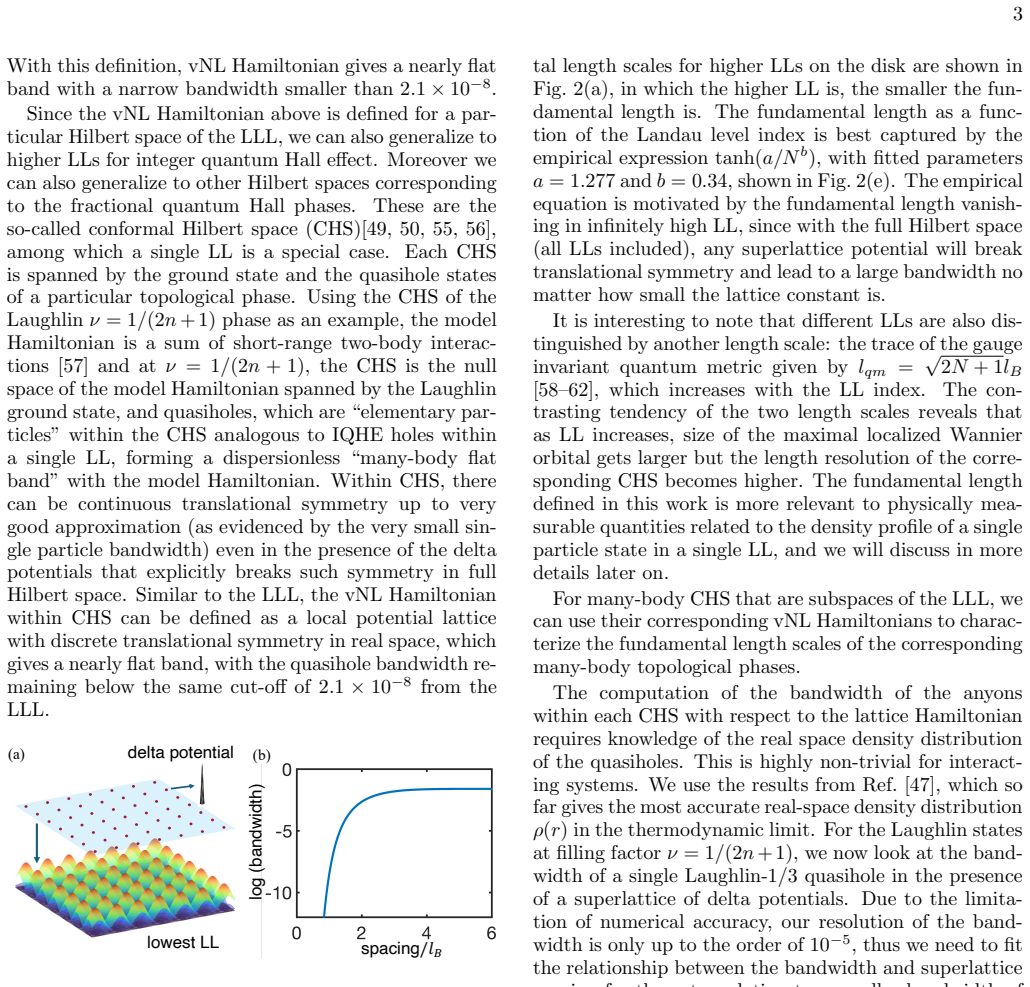
The von Neumann lattice (vNL) Hamiltonian, defined as $H_{\rm vNL}=\sum_X |X\rangle\langle X|$, is a lattice of projection operators onto coherent states that equals the projection of a delta-potential lattice into the Landau level; its analytic bandwidth is given in terms of elliptic $\theta$ functions, $\Delta E = \frac{2}{\pi t^2}\,\theta[2,0,e^{-8\pi^2/t^2}] \theta[3,0,e^{-8\pi^2/t^2}]$, which controls the exponential suppression. The generalization to interacting phases uses the conformal Hilbert space (CHS) of a topological phase, spanned by the ground state and quasihole states, with the quasihole real-space density profile $\rho(r)$ as the input that determines how the bandwidth depends on lattice spacing.
What would settle it
Exact diagonalization of a single Laughlin-1/3 quasihole on a torus with a periodic array of delta potentials of spacing $a=1.7\ell_B$ should give a bandwidth below $10^{-7}$; if the computed bandwidth is orders of magnitude larger, the extrapolation from the density profiles is wrong. A high-resolution STM measurement of the local density of states of a fractional quantum Hall droplet under a fine tip-potential array would directly test the predicted robustness.
Extended reading notes
Core claim
Within the Hilbert subspace of a single Landau level, a superlattice of delta-function potentials yields a projected Hamiltonian whose bandwidth decreases faster than exponentially with the ratio $t/\ell_B$, so for $t \lesssim \ell_B$ the spectrum is flat to better than $2.1\times10^{-8}$ in units of the potential strength. Consequently the continuous magnetic translational invariance of the truncated space is restored to excellent approximation even though the potential breaks it in real space. For fractional quantum Hall phases, the same argument applies inside the conformal Hilbert space of a phase: each phase has a fundamental length $a_\nu$ below which quasihole dynamics are insensitive to the potential. For Laughlin states these lengths track the composite-fermion scale, approximately $\sqrt{m}\,\ell_B$ for filling $1/m$, while the Moore-Read $e/2$ quasihole subspace at $\nu=1/2$ has a smaller fundamental length than the Laughlin-1/2 subspace, indicating greater sensitivity to disorder. The paper also shows that short-wavelength components of a random disorder potential have negligible effect on anyon dynamics, because their wavelengths fall below the relevant fundamental length.
Load-bearing premise
The quantitative length scales claimed for fractional quantum Hall phases depend on an earlier computation of quasihole charge distributions and on a fitted extrapolation to a very small bandwidth cutoff; if that input is inaccurate, the specific numbers shift, though the qualitative robustness below the magnetic length is an analytic result.
Editorial extensions
If this is right
- Short-wavelength disorder potentials in realistic samples have negligible effect on the dynamics of anyons in fractional quantum Hall states, provided the disorder is weaker than the incompressibility gap and its wavelength is below the phase's fundamental length.
- Anyonic braiding and interferometry can be performed in the presence of fine-grained impurities without compromising the exchange statistics, as long as the spatial separations between braiding paths exceed the relevant fundamental length.
- The fundamental length provides a quantitative measure of quasihole size that is distinct from the quantum metric length; low-filling Laughlin states have larger fundamental lengths and are therefore more robust to disorder than integer quantum Hall states.
- The von Neumann Hamiltonian gives a nearly flat many-body band within each conformal Hilbert space, enabling selective superlattice engineering that perturbs different topological phases differently based on their fundamental lengths.
- The exponential suppression of bandwidth implies that LL mixing and higher-order perturbation effects remain negligible even when the cyclotron gap is comparable to the potential strength, protecting the robustness of the translational invariance.
Reading between the lines
- If the mechanism is general, flat Chern bands with non-commutative geometry should show the same blindness to fine-grained one-body potentials, since the suppression is a property of the projected Hilbert space rather than of the specific Landau-level wavefunctions.
- Because the absolute fundamental lengths depend on the chosen bandwidth cutoff, the physically robust statements are the ratios between phases; experiments and numerics should focus on measuring these ratios rather than absolute values.
- A direct testable extension would place a periodic array of tip-induced potentials with spacing just below the predicted fundamental length over a $\nu=1/3$ sample and measure quasihole mobility or interferometric visibility; it should remain essentially unchanged compared to a clean sample.
- The smaller fundamental length of the Moore-Read quasihole subspace suggests that non-Abelian anyons may be more susceptible to disorder pinning than Abelian ones at the same filling, which could be probed by intentionally introducing short-wavelength disorder in a $\nu=5/2$ sample.
Editorial analysis
A structured set of objections, weighed in public.
Referee Report
Summary. The paper claims that a periodic array of delta-function potentials, when projected into a single Landau level (LL), produces an effective Hamiltonian that is extremely close to the identity for lattice spacings below the magnetic length, so that continuous magnetic translational invariance survives inside the LL Hilbert space even though the potential breaks it in the full Hilbert space. It defines a 'fundamental length' for each LL and for fractional quantum Hall (FQH) conformal Hilbert spaces by imposing a bandwidth cutoff, extracts values for Laughlin-1/2, 1/3, 1/4, 1/5 and Moore-Read quasiholes from real-space density profiles, and concludes that short-wavelength disorder has negligible effect on anyon dynamics below these length scales.
Significance. If correct, the paper would introduce a useful hierarchy of disorder length scales for topological quantum Hall systems and would have concrete implications for anyon braiding experiments. The manuscript includes an analytic supplementary derivation, explicit formulas for the diagonal of the projected delta lattice, and a separate check of Landau-level mixing effects; these are valuable elements. However, the central quantitative result is built on a variational/diagonal quantity rather than the spectral bandwidth of the projected operator, and the FQH fundamental lengths depend on an unspecified fitting and extrapolation procedure and on density profiles from a same-group reference. The qualitative idea is defensible and potentially interesting, but the quantitative claims in their present form are not established.
major comments (4)
- [Main text, 'Lattice potential in the LLL'; Supplementary Eq. (S3)] Equation (3) is not the spectral bandwidth of the LLL-projected delta-potential lattice. The supplementary derivation computes the range of the diagonal element <x,y|H'|x,y>, i.e. the variational range of the coherent-state expectation, and then asserts that this is the bandwidth. For a periodic potential the projected operator is PVP = t^{-2} Σ_{n,m} e^{-π^2(n^2+m^2)/t^2} T_{nm}, so the first harmonics have amplitude t^{-2}e^{-π^2/t^2}, and T_{10}+T_{-10} has spectral range 4. The exact bandwidth is therefore of order t^{-2}e^{-π^2/t^2}, not t^{-2}e^{-2π^2/t^2} as in Eq. (3). At t=ℓ_B the exact bandwidth is roughly 10^{-4}, six orders of magnitude larger than the value implied by Eq. (3); at t=1.7ℓ_B it is of order 0.05. Consequently the 2.1×10^{-8} benchmark, the statement a_LLL=ℓ_B, and every fundamental length in Fig. 2(a),(b),(e),(f) that is calibrated against this cutoff are not supported by the presented calculation.
- [Main text, 'Fundamental length scales of conformal Hilbert spaces'] The extraction of the FQH fundamental lengths is not reproducible as reported. The text states that the bandwidth-spacing relation is fitted and then extrapolated to 2.1×10^{-8}, but it does not specify the fitting function, the number of data points, the fitting range, or any uncertainty estimate for the Laughlin-1/2, 1/3, 1/4, 1/5, or Moore-Read cases. Since the quoted values a_ν ≈ 1.5, 1.7, 2.0, 2.2 ℓ_B and the Moore-Read value 1.29 ℓ_B are central quantitative outputs, the absence of this information prevents assessment and verification.
- [Main text, 'Fundamental length scales of conformal Hilbert spaces'; Ref. [47]] All FQH quasihole fundamental lengths are derived from the real-space density profiles ρ(r) of Ref. [47], which is by the same group, and no independent check or error propagation is provided. Because the bandwidths in Fig. 2(b),(f) are computed directly from these density profiles, any systematic error in ρ(r) propagates linearly into a_{1/2}, a_{1/3}, a_{1/4}, a_{1/5}, and the Moore-Read value. The paper should include a sensitivity analysis or a comparison with an independent calculation of the quasihole density profile.
- [Main text, 'Lattice potential in the LLL'; Supplementary Fig. S1] The claim that the variational bandwidth 'will converge to the exact bandwidth from exact diagonalization' and has been 'numerically verified both on the disk and torus geometry' is not backed by a direct comparison in the manuscript. The supplementary figure compares the disk and torus results of the same diagonal-range quantity; it does not compare that quantity with the spectrum of PVP obtained by exact diagonalization. Given the large difference between the diagonal range and the true spectral bandwidth noted in the first comment, this verification is essential rather than auxiliary.
minor comments (5)
- [Abstract] The abstract says the dynamics of anyonic excitations are robust against the 'long wavelength' part of the disorder, while the main text and summary state that the 'short wavelength' part (large wavevector) has negligible effects. This is a physically important inconsistency and should be corrected.
- [Main text, 'Fundamental length scales of conformal Hilbert spaces'] The empirical tanh fit for higher-LL fundamental lengths is reported with R²=0.9997, but no parameter uncertainties or residual information are given; with only a few Landau-level data points, standard errors are needed to support the fitted curve.
- [Supplementary Sec. II] The statement that the cutoff 2.1×10^{-8} is chosen 'so that the fundamental length of the LLL is the magnetic length' should be presented as a calibration convention, not as an independent determination, and the main text should carry the same transparency.
- [Main text, Eq. (4)] The equality H_vNL = Σ_X |X><X| = 2π P_LLL Σ δ(x-x0)δ(y-y0) P_LLL needs a clarifying statement about normalization, convergence, and the domain of the lattice sum; as written, the prefactor 2π appears without derivation.
- [Fig. 2 caption] In Fig. 2(a) and 2(e), the labels for the different Landau levels and the distinction between numerical crosses and fitted lines are difficult to parse; please enlarge symbols and define every symbol in the caption.
Circularity Check
Core LLL exponential robustness is analytic and independent; however the absolute 'fundamental length' is fixed by the chosen cutoff (a_LLL = ℓ_B by construction), and the FQH length values inherit the authors' own prior density profiles from Ref. [47] via unspecified fitting.
-
self definitional
[Supplementary II.B and main text 'Fundamental length scales of conformal Hilbert spaces']
"In the main text, we choose 2.1 × 10⁻⁸ as the cutoff benchmark for square superlattice due to some physical consideration: in the LLL, this cutoff gives the fundamental length as the magnetic length, the only microscopic length scale in the system. In this way, we define the fundamental length of the LLL as equal to ℓB, thus fixing the overall constant factor."
The main text says 'Naturally, the fundamental length for LLL is aLLL = ℓB' as if it were a result, but the supplementary reveals that this equality is imposed by selecting the bandwidth cutoff 2.1 × 10⁻⁸. Every other fundamental length in Fig. 2(a,b,e,f) is then obtained by reading off crossing points of fitted/extrapolated bandwidth curves against this same cutoff, so the absolute length scale is a calibration convention rather than an independent prediction. The physical content that remains independent is the exponential bandwidth suppression and the cutoff-insensitivity of length ratios, as the supplementary itself acknowledges.
-
self citation load bearing
[Main text, 'Fundamental length scales of conformal Hilbert spaces', FQH paragraph]
"The computation of the bandwidth of the anyons within each CHS with respect to the lattice Hamiltonian requires knowledge of the real space density distribution of the quasiholes. This is highly non-trivial for interacting systems. We use the results from Ref. [47], which so far gives the most accurate real-space density distribution ρ(r) in the thermodynamic limit."
Ref. [47] is co-authored by two members of the present group (G. Ji and B. Yang). The Laughlin-1/2, 1/3, 1/4, 1/5 and Moore-Read fundamental lengths in Fig. 2(b),(f) are all computed from these density profiles, then fitted and extrapolated to the 2.1 × 10⁻⁸ cutoff with no error bars. Thus the quantitative FQH claims inherit the authors' own prior modeling choices. This is load-bearing input rather than a logical equivalence, and the LLL analytic claim does not depend on it, so it contributes a moderate self-citation load rather than full circularity.
full rationale
The central LLL result is not circular: Eq. (3) and its exponential suppression are derived analytically from the projected delta-lattice Hamiltonian and the coherent-state (von Neumann lattice) construction, and the qualitative claim that short-wavelength potentials have negligible effect in a single Landau level stands on its own. The main circularity-adjacent issue is the definition of the absolute 'fundamental length': the benchmark 2.1 × 10⁻⁸ is chosen precisely so that the LLL fundamental length equals the magnetic length, and this convention is then used to normalize all higher-LL and FQH lengths. The paper is transparent about this in the supplementary, and it argues that only ratios are physical, which weakens the circularity. A second concern is that all FQH quantitative lengths depend on real-space quasihole densities taken from Ref. [47], a same-group paper, with the fitted extrapolation to the cutoff unspecified. This makes the FQH numbers dependent on the authors' prior results, but not by construction. I therefore do not treat Eq. (3)'s variational-vs-exact bandwidth question as circularity; that is a mathematical accuracy issue outside this pass. Overall, the analytic LLL robustness claim is independent, while the absolute length-scale predictions are partly conventional and partly inherited from self-cited input, giving a score of 4.
Assumptions & free parameters
free parameters (3)
- Bandwidth cutoff benchmark =
2.1 x 10^-8
- tanh fit parameters for higher LL fundamental length =
a = 1.277, b = 0.34
- Bandwidth-spacing fitting model for Laughlin quasiholes =
not stated
assumptions (5)
- domain assumption Projection to a single Landau level; LL mixing neglected to leading order.
- domain assumption The variational bandwidth of coherent states |X> equals the exact bandwidth of the projected Hamiltonian at small spacing.
- domain assumption The quasihole density profiles from Ref. [47] are accurate in the thermodynamic limit.
- domain assumption The CHS of a FQH phase is spanned by the ground state and quasihole states of a model Hamiltonian.
- domain assumption The ratio of fundamental lengths is insensitive to the bandwidth cutoff and the shape of the periodic potential.
invented entities (1)
-
Fundamental length scale of a conformal Hilbert space (a_LL, a_{1/3}, etc.)
independent evidence
Cite this review
Pith. "Pith review of Robust translational invariance in topological bands against lattice potentials and disorders." pith.science (2026). https://pith.science/paper/6UZ742KC
@misc{pith2026241116862,
  author       = {Pith},
  title        = {Pith review of: Robust translational invariance in topological bands against lattice potentials and disorders},
  year         = {2026},
  howpublished = {\url{https://pith.science/paper/6UZ742KC}},
  note         = {Machine review of arXiv:2411.16862}
}
read the original abstract
We theoretically show that the continuous magnetic translational invariance within the Hilbert (sub-)space of a single Landau level (LL) can persist even in the presence of a superlattice electrostatic potential modulation, while such invariance is broken in the full real-space Hilbert space. This is due to the interplay of the superlattice constant and the fundamental length scale of the quantum Hall fluids. In particular for the lowest LL (LLL), when the spacing of superlattice is below the magnetic length, continuous magnetic translational symmetry is very robust. For the fractional quantum Hall phases, the continuous translational symmetry is preserved when the superlattice spacing is below the corresponding fundamental lengths which we can now quantitatively define, which is different from the length scale from the quantum metric. Moreover, our analysis implies that the dynamics of the anyonic excitations can be robust against the long wavelength part of the disorder, and we discuss the related experimental ramifications.
Figures


Forward citations
Cited by 1 Pith paper
-
Flat bands on spherical surface: from Landau levels to giant-quantum-number orbitals
On a zero-field sphere, each angular-momentum shell behaves like a flat band with inversion symmetry, so a local potential creates equal density at opposite poles and projected interactions become long-ranged.
Reference graph
Works this paper leans on
-
[47]
Universal Mod- elling of Emergent Oscillations in Fractional Quantum Hall Fluids,
G. Ji, K. Bose, A. C. Balram, B. Yang, “Universal Mod- elling of Emergent Oscillations in Fractional Quantum Hall Fluids,” Physical Review B, 110(7), 075113 (2024)
work page 2024
-
[1]
K. V. Klitzing, G. Dorda, and M. Pepper, “New method for high-accuracy determination of the fine-structure con- stant based on quantized Hall resistance,” Physical Re- view Letters, 5(6), 494 (1980)
work page 1980
-
[2]
Two- dimensional magnetotransport in the extreme quantum limit,
D. C. Tsui, H. L. Stormer, and A. C. Gossard, “Two- dimensional magnetotransport in the extreme quantum limit,” Physical Review Letters, 48(22), 1559 (1982)
work page 1982
-
[3]
Topological orders in rigid states,
X. G. Wen, “Topological orders in rigid states,” Inter- national Journal of Modern Physics B, 4(02), 239-271, (1990)
work page 1990
-
[4]
S. Das Sarma, and A. Pinczuk, “Perspectives in Quan- tum Hall Effects: Novel Quantum Liquids in Low- Dimensional Semiconductor Structures,” (Weinheim: Wiley-VCH) (1996). 6
work page 1996
-
[5]
Correlation energy and spin polarization in the 2D electron gas,
C. Attaccalite, S. Moroni, P. Gori-Giorgi, and G. B. Bachelet, “ Correlation energy and spin polarization in the 2D electron gas,” Physical Review Letters, 88(25), 256601 (2002)
work page 2002
-
[6]
Topological phases and the quantum spin Hall effect in three dimensions,
R. Roy, “Topological phases and the quantum spin Hall effect in three dimensions,” Physical Review B, 79(19), 195322. (2009)
work page 2009
-
[7]
Colloquium: Transport in strongly correlated two dimensional electron fluids,
B. Spivak, S. V. Kravchenko, S. A. Kivelson,and X. P. A. Gao, “Colloquium: Transport in strongly correlated two dimensional electron fluids,” Reviews of Modern Physics, 82(2), 1743 (2010)
work page 2010
Show all 66 references
-
[8]
Topological phases in two- dimensional materials: a review,
Y. Ren, Z. Qiao, and Q. Niu. “Topological phases in two- dimensional materials: a review,” Reports on Progress in Physics, 79(6), 066501 (2016)
2016
-
[9]
Composite fermions,
J. K. Jain, “Composite fermions,” Cambridge University Press (2007)
2007
-
[10]
Colloquium: Zoo of quantum-topological phases of matter,
X. G. Wen, “Colloquium: Zoo of quantum-topological phases of matter,” Reviews of Modern Physics, 89(4), 041004 (2017)
2017
-
[11]
Choreographed entanglement dances: Topo- logical states of quantum matter,
X. G. Wen, “Choreographed entanglement dances: Topo- logical states of quantum matter,” Science, 363(6429), eaal3099 (2019)
2019
-
[12]
Fault-tolerant quantum computation by anyons,
A. Y. Kitaev, “Fault-tolerant quantum computation by anyons,” Annals of Physics, 303(1), 2-30 (2003)
2003
-
[13]
Non-Abelian anyons and topological quantum computation,
C. Nayak, S. H. Simon, A. Stern, M. Freedman,and S. D. Sarma, “Non-Abelian anyons and topological quantum computation,” Reviews of Modern Physics, 80(3), 1083 (2008)
2008
-
[14]
Fractional statistics and frac- tional quantized Hall effect,
R. Tao, and Y. S. Wu, “Fractional statistics and frac- tional quantized Hall effect,” Physical Review B, 31(10), 6859 (1985)
1985
-
[15]
Fractional statistics in the fractional quantum Hall effect,
G. S. Jeon, K. L. Graham, and J. K. Jain, “Fractional statistics in the fractional quantum Hall effect,” Physical Review Letters, 91(3), 036801 (2003)
2003
-
[16]
Spin-statistics re- lation and Abelian braiding phase for anyons in the frac- tional quantum Hall effect,
H. Q. Trung, Y. Wang, and B. Yang, “Spin-statistics re- lation and Abelian braiding phase for anyons in the frac- tional quantum Hall effect,” Physical Review B,107(20), (2023)
2023
-
[17]
Fermions in the low- est Landau level. Bosonization, W ∞ algebra, droplets, chiral bosons,
S. Iso, D. Karabali, and B. Sakita, “ Fermions in the low- est Landau level. Bosonization, W ∞ algebra, droplets, chiral bosons,” Physics Letters B, 296(1-2), 143-150 (1992)
1992
-
[18]
W ∞-ALGEBRA for Fermions in the Low- est Landau Level,
Y. S. Myung, “W ∞-ALGEBRA for Fermions in the Low- est Landau Level,” Modern Physics Letters A, 9(06), 549-555 (1994)
1994
-
[19]
I. J. R. Aitchison, and N. E. Mavromatos, “Anyons,” Contemporary Physics, 32(4), 219-233 (1991)
1991
-
[20]
The noncommutative geometry of the quantum Hall effect,
J. Bellissard, A. van Elst, and H. Schulz-Baldes, “The noncommutative geometry of the quantum Hall effect,” Journal of Mathematical Physics, 35(10), 5373-5451 (1994)
1994
-
[21]
Noncommutative superspace, supermatrix and lowest Landau level,
M. Hatsuda, S. Iso, and H. Umetsu, “Noncommutative superspace, supermatrix and lowest Landau level,” Nu- clear Physics B 671, 217-242 (2003)
2003
-
[22]
The origin of holomorphic states in Landau levels from non-commutative geometry and a new formula for their overlaps on the torus,
F. D. M. Haldane, “The origin of holomorphic states in Landau levels from non-commutative geometry and a new formula for their overlaps on the torus,” Journal of Mathematical Physics, 59(8) (2018)
2018
-
[23]
Composite fermion theory: A microscopic derivation without Landau level projection,
B. Yang, “Composite fermion theory: A microscopic derivation without Landau level projection,” Physical Review B, 106(24), 245126 (2022)
2022
-
[24]
Quantum Hall conductances and lo- calization in a magnetic field,
I. Dana, and J. Zak, “Quantum Hall conductances and lo- calization in a magnetic field,” Physical Review B, 32(6), 3612 (1985)
1985
-
[25]
Symmetry and localiza- tion for magnetic Schroedinger operators: Landau levels, Gabor frames and all that,
M. Moscolari, and G. Panati, “Symmetry and localiza- tion for magnetic Schroedinger operators: Landau levels, Gabor frames and all that,” Acta Applicandae Mathe- maticae 162(1), 105-120. (2019)
2019
-
[26]
Symmetry breaking and Landau quantization in topological crystalline insulators,
M. Serbyn, and L. Fu, “Symmetry breaking and Landau quantization in topological crystalline insulators,” Phys- ical Review B, 90(3), 035402 (2014)
2014
-
[27]
Weyl fermions with arbitrary monopoles in magnetic fields: Landau levels, longitudinal magnetotransport, and density-wave order- ing,
X. Li, B. Roy, and D. Das Sarma, “Weyl fermions with arbitrary monopoles in magnetic fields: Landau levels, longitudinal magnetotransport, and density-wave order- ing,” Physical Review B, 94(19), 195144 (2016)
2016
-
[28]
Topological Landau Lattice,
Y. X. Zhao, Y. Lu, and H. Z. Lu, “Topological Landau Lattice,” arXiv:1706.09783. (2017)
2017 arXiv
-
[29]
Anyons, Zitterbewegung and dynamical phase transitions in topologically nontrivial systems,
F. Luni´ c, “Anyons, Zitterbewegung and dynamical phase transitions in topologically nontrivial systems,” arXiv:2208.04270. (2022)
2022 arXiv
-
[30]
Magnetic subband structure of electrons in hexagonal lattices,
F. H. Claro, and G. H. Wannier, “Magnetic subband structure of electrons in hexagonal lattices,” Physical Re- view B, 19(12), 6068 (1979)
1979
-
[31]
The effective action for edge states in higher-dimensional quantum Hall sys- tems,
D. Karabali, and V. P. Nair, “The effective action for edge states in higher-dimensional quantum Hall sys- tems,” Nuclear Physics B, 679(3), 427-446 (2004)
2004
-
[32]
Localized wavefunctions and magnetic band structure for lateral semiconductor superlattices,
G. S. Kliros, and P. C. Divari, “Localized wavefunctions and magnetic band structure for lateral semiconductor superlattices,” International Journal of Modern Physics B, 20(32), 5427-5442 (2006)
2006
-
[33]
Parafermions, induced edge states, and domain walls in fractional quantum Hall effect spin transitions,
J. Liang, G. Simion, and Y. Lyanda-Geller, “Parafermions, induced edge states, and domain walls in fractional quantum Hall effect spin transitions,” Physical Review B, 100(7), 075155 (2019)
2019
-
[34]
Restoration of the continuous phase transition in the vortex state due to lattice translational symmetry: Large-N limit,
S. A. Ktitorov, B. N. Shalaev, and L. Jastrabik, “Restoration of the continuous phase transition in the vortex state due to lattice translational symmetry: Large-N limit,” Physical Review B,49(21), 15248 (1994)
1994
-
[35]
F. D. M. Haldane, E. H. Rezayi, and K. Yang, “Sponta- neous breakdown of translational symmetry in quantum hall systems: Crystalline order in high Landau levels. Physical Review Letters, 85(25), 5396 (2000)
2000
-
[36]
Condensation of lattice defects and melting transitions in quantum Hall phases,
G. Y. Cho, O. Parrikar, Y. You, R. G. Leigh, and T. L. Hughes, “Condensation of lattice defects and melting transitions in quantum Hall phases,” Physical Review B, 91(3), 035122 (2015)
2015
-
[37]
Topological lattice models with constant Berry curva- ture,
D. Varjas, A. Abouelkomsan, K. Yang, and E. Bergholtz, “Topological lattice models with constant Berry curva- ture,” SciPost Physics, 12(4), 118 (2022)
2022
-
[38]
On the completeness of a system of coherent states,
A. M. Perelomov, “On the completeness of a system of coherent states,” Theoretical and Mathematical Physics 6, 156–164 (1971)
1971
-
[39]
Field theory in a strong magnetic field and the quan- tum Hall effect: Integer Hall effect,
N. Imai, K. Ishikawa, T. Matsuyama, and I. Tanaka, “Field theory in a strong magnetic field and the quan- tum Hall effect: Integer Hall effect,” Physical Review B 42(16), 10610, (1990)
1990
-
[40]
Flux state in von Neumann lat- tices and the fractional hall effect,
K. Ishikawa, N. Maeda. “Flux state in von Neumann lat- tices and the fractional hall effect,” Progress of Theoret- ical Physics 97(3), 507-525 (1997)
1997
-
[41]
Balian-Low theorem for Landau levels,
Zak J, “Balian-Low theorem for Landau levels,” Physical Review Letters, 79(4), 533 (1997)
1997
-
[42]
Vogel, V
K. Vogel, V. M. Akulin,and W. P. Schleich,”Quantum state engineering of the radiation field,” Physical Review Letters, 71(12), 1816 (1993)
1993
-
[43]
Robust quantum state engineering using coherent states on a truncated von Neumann lattice,
L. K. Stergioulas, and A. Vourdas, “Robust quantum state engineering using coherent states on a truncated von Neumann lattice,” Journal of Modern Optics, 45(6), 1155-1161 (1998). 7
1998
-
[44]
Hofstadter butterfly and integer quantum Hall effect in three dimensions,
M. Koshino, H. Aoki, K. Kuroki, S. Kagoshima, and T. Osada, “Hofstadter butterfly and integer quantum Hall effect in three dimensions,” Physical Review Let- ters, 86(6), 1062 (2001)
2001
-
[45]
Landau levels, molecular orbitals, and the Hofstadter butterfly in finite systems,
J. G. Analytis, S. J. Blundell, and A. Ardavan, “Landau levels, molecular orbitals, and the Hofstadter butterfly in finite systems,” American Journal of Physics, 72(5), 613-618 (2004)
2004
-
[46]
Polaritonic Hofstadter butterfly and cavity control of the quantized Hall conductance,
V. Rokaj, M. Penz, M. A. Sentef, M. Ruggenthaler,and A. Rubio, “Polaritonic Hofstadter butterfly and cavity control of the quantized Hall conductance,” Physical Re- view B, 105(20), 205424 (2022)
2022
-
[48]
Non-Abelian quasiholes in lattice Moore-Read states and parent Hamiltonians,
S. Manna, J. Wildeboer, G. Sierra, and A. E. Nielsen, “Non-Abelian quasiholes in lattice Moore-Read states and parent Hamiltonians,” Physical Review B, 98(16), 165147 (2018)
2018
-
[49]
Anyons in conformal Hilbert spaces: Statis- tics and dynamics of gapless excitations in fractional quantum Hall systems,
B. Yang, “Anyons in conformal Hilbert spaces: Statis- tics and dynamics of gapless excitations in fractional quantum Hall systems,” International Journal of Mod- ern Physics B, 36(21), 2230003 (2022)
2022
-
[50]
Geometric fluctuation of con- formal Hilbert spaces and multiple graviton modes in fractional quantum Hall effect,
Y. Wang ,and B. Yang, “Geometric fluctuation of con- formal Hilbert spaces and multiple graviton modes in fractional quantum Hall effect,” Nature Communications 14(1), 2317 (2023)
2023
-
[51]
Emergent dynamics of scale-free interactions in fractional quantum Hall fluids,
B. Yang, “ Emergent dynamics of scale-free interactions in fractional quantum Hall fluids,” Physical Review B, 110(12), L121108 (2023)
2023
-
[52]
Visualizing broken symmetry and topological defects in a quantum Hall ferromagnet,
X. Liu, G. Farahi, and C. L. Chiu, et al, “Visualizing broken symmetry and topological defects in a quantum Hall ferromagnet,” Science, 375(6578), 321-326 (2022)
2022
-
[53]
High-resolution tun- neling spectroscopy of fractional quantum Hall states,
Y. Hu, Y. C. Tsui, and M. He, et al, “High-resolution tun- neling spectroscopy of fractional quantum Hall states,” Nature Physics, 1-8 (2025)
2025
-
[54]
Robust translational invariance in topological bands against lattice potentials and disorders
The supplementary materials for “Robust translational invariance in topological bands against lattice potentials and disorders” (2024)
2024
-
[55]
Conformal symmetry and universal properties of quantum Hall states,
A. Cappelli, G. V. Dunne, C. A. Trugenberger, and G. R. Zemba, “Conformal symmetry and universal properties of quantum Hall states,” Nuclear Physics B, 398(3), 531- 567 (1993)
1993
-
[56]
Local conformal symmetry in physics and cosmology,
I. Bars, P. Steinhardt, and N. Turok, “Local conformal symmetry in physics and cosmology,” Physical Review D, 89(4), 043515 (2014)
2014
-
[57]
Landau level mix- ing and levitation of extended states in two dimensions,
F. D. M. Haldane, and K. Yang, “Landau level mix- ing and levitation of extended states in two dimensions,” Physical Review Letters, 78(2) 298 (1997)
1997
-
[58]
Electron localization in the quantum hall regime,
R. Resta, “Electron localization in the quantum hall regime,” Physical Review Letters, 95(19), 196805 (2005)
2005
-
[59]
Geometric mass acquisition via a quantum metric: An effective-band-mass theorem for the helicity bands,
M. Iskin, “Geometric mass acquisition via a quantum metric: An effective-band-mass theorem for the helicity bands,” Physical Review A, 99(5), 053603 (2019)
2019
-
[60]
Probing localization and quantum geometry by spectroscopy,
T. Ozawa, and N. Goldman, “Probing localization and quantum geometry by spectroscopy,” Physical Review Research, 1(3), 032019 (2019)
2019
-
[61]
Ex- act landau level description of geometry and interaction in a flatband,
J. Wang, J. Cano, A. J. Millis, Z. Liu, and B. Yang, “Ex- act landau level description of geometry and interaction in a flatband,” Physical Review Letters, 127(24), 246403 (2021)
2021
-
[62]
Quantum metric on the Brillouin zone in correlated electron sys- tems and its relation to topology for Chern insulators,
T. Kashihara, Y. Michishita, and R. Peters, “Quantum metric on the Brillouin zone in correlated electron sys- tems and its relation to topology for Chern insulators,” Physical Review B, 107(12), 125116 (2023)
2023
-
[63]
The- ory of the breakdown of the quantum Hall effect,
V. Tsemekhman, K. Tsemekhman, and C. Wexler, “The- ory of the breakdown of the quantum Hall effect,” Phys- ical Review B, 55(16), R10201 (1997)
1997
-
[64]
Laterally modulated 2D electron system in the extreme quantum limit,
S. Melinte, M. Berciu, and C. Zhou, et al, “Laterally modulated 2D electron system in the extreme quantum limit,” Physical Review Letters, 92(3), 036802 (2004)
2004
-
[65]
Integer quantum Hall effect and correlated disorder,
A. A. Greshnov, and G. G. Zegrya, “Integer quantum Hall effect and correlated disorder,” Semiconductors 41, 1329-1334 (2007)
2007
-
[66]
Superlattice-induced electron percolation within a single Landau level,
N. Roy, B. Peng, and B. Yang, “Superlattice-induced electron percolation within a single Landau level,” Phys- ical Review B, 110(19), 195116 (2024). 1 Supplementary materials for “Robust translational invariance in Landau Levels against lattice potentials and disorders” I. A. ...
2024
Reviewed August 12, 2026 · model on record in the stance chip above.
Discussion (0). Continue with ORCID to comment.