REVIEW 3 major objections 5 minor 106 references
Updated morphological cuts identify galaxy mergers with purity matching machine-learning methods and better hold up at high redshift.
Reviewed by Pith at T0; open to challenge. T0 means a machine referee read the full paper against a public rubric. the ladder, T0–T4 →
T0 review · grok-4.5
2026-07-13 04:39 UTC pith:6V4NJ52S
load-bearing objection Clean re-optimisation of classic G-M20/G-C cuts that matches ML precision on the same mocks and is more robust than CNNs at high z, with the honest caveat that it only catches pre-mergers. the 3 major comments →
Performance of morphological classifiers for galaxy mergers compared to current machine learning methods
The pith
A machine-rendered reading of the paper's core claim, the machinery that carries it, and where it could break.
Core claim
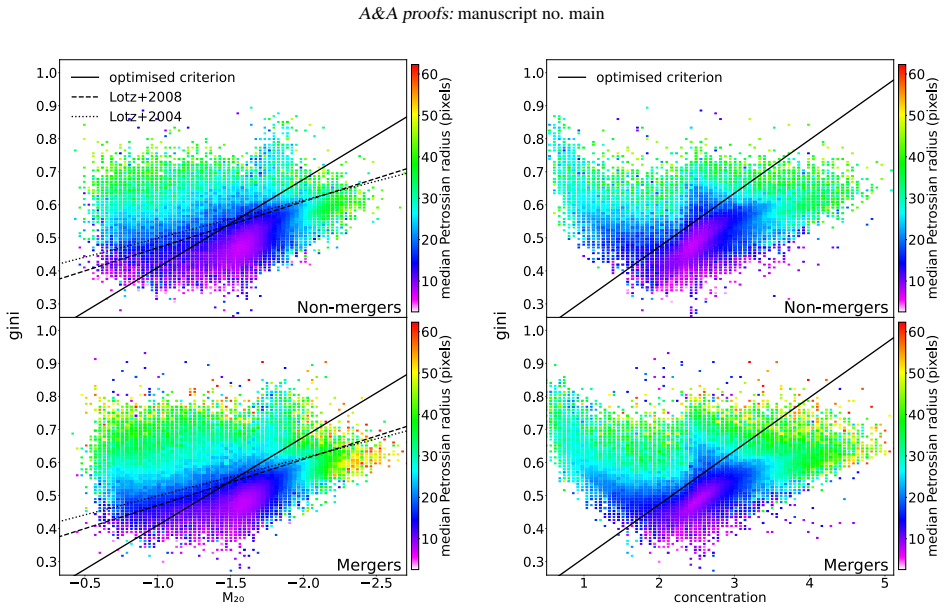
Linear cuts optimised by MCMC in Gini–M20 and Gini–concentration space—G > (−0.267 ± 0.081)M20 + (0.143 ± 0.012) and G > (0.162 ± 0.048)C − (0.149 ± 0.12)—classify mergers with precisions of 69.5 percent and 72.3 percent on unseen IllustrisTNG mock HSC-SSP images, matching the purity range of six state-of-the-art ML models trained on identical data, while remaining more robust than CNN-based methods for 0.52 < z < 1.
What carries the argument
MCMC-optimised linear separators in two-dimensional Gini–M20 and Gini–concentration morphological space, using reciprocal accuracy as the likelihood and a validation set to avoid over-fitting.
Load-bearing premise
The simulation merger trees that supply the training labels (major mergers only, fixed time window around coalescence) are assumed to be an unbiased ground truth equally fair to both morphological cuts and the machine-learning models being compared.
What would settle it
Apply the published G–M20 and G–C cuts to an independent set of mock images whose merger trees are built with a different algorithm or a different mass-ratio and time window, and check whether the reported precisions and high-z robustness relative to the same ML models still hold.
Editorial analysis
A structured set of objections, weighed in public.
Referee Report
Summary. The paper optimises linear merger cuts in G–M20 and G–C space with MCMC (validation-set regularisation and truncated-Gaussian priors) on the same IllustrisTNG mock HSC-SSP training set used by Margalef-Bentabol et al. (2024). The resulting criteria G > (−0.267 ± 0.081)M20 + (0.143 ± 0.012) and G > (0.162 ± 0.048)C − (0.149 ± 0.12) yield precisions of 69.5 % and 72.3 % on held-out IllustrisTNG images—inside the 69.1–80.1 % range of six ML models trained on identical data—while recall remains low (36.4 % and 23.6 %). Subclass analysis shows the cuts select only pre-mergers; post- and ongoing mergers occupy the same locus as non-mergers. Transfer tests to Horizon-AGN and HSC-SSP, plus a robustness metric ρ, indicate that the morphological classifiers maintain precision better than the CNN-based models for 0.52 < z < 1. The authors conclude that simple morphological cuts remain competitive for high-purity samples and that new statistics are required for post-mergers.
Significance. If the reported precisions and robustness hold, the work supplies practical, publicly usable linear cuts that recover purity comparable to contemporary CNNs and transformers while being far cheaper to apply and more stable under domain shift. The explicit extension of the MB24 merger challenge, the shared train/test split, the MCMC optimisation with validation regularisation, and the open segmentation code are concrete strengths that make the comparison reproducible and the criteria immediately usable for large surveys. The clear demonstration that G, M20 and C are blind to post-mergers is itself a useful negative result that motivates new morphological statistics.
major comments (3)
- §5.3–5.4 and Table 2: the HSC-SSP evaluation yields precisions of 98–100 % while recall stays <50 %. The text correctly attributes this to the addition of ~1000 “clear non-mergers,” yet still reports these numbers as headline performance and includes them in the robustness table. Because the visual ground truth is demonstrably biased, the HSC-SSP metrics cannot support claims of real-data performance. Either re-evaluate on a less biased visual sample or move the HSC-SSP numbers to a clearly labelled “biased-sample” appendix and base all robustness conclusions solely on Horizon-AGN.
- §3.4, Eq. (13) and Table 1: the likelihood is the reciprocal of accuracy (exponentiated) and the priors/initial conditions are set by visual inspection of the “turnover region” (Appendix B). Accuracy is a poor objective for an unbalanced morphological distribution; maximising precision (or F1) subject to a minimum recall would better match the paper’s own emphasis on purity. The visual prior selection should be replaced by, or at least compared against, a fully data-driven prior (e.g., from a logistic-regression or SVM fit) so that the final slopes and intercepts are not sensitive to the eye-fit step.
- §5.2 and Figs. 12–14: the central claim that the classifiers “select only pre-mergers” is well supported, but the paper never quantifies how much of the low recall is simply the fraction of the merger sample that is post/ongoing (0.1 Gyr before to 0.3 Gyr after). A simple breakdown of recall by the four time bins already shown in Fig. 14, together with the fraction of the training set that falls into each bin, would make the pre-merger-only conclusion quantitative rather than qualitative and would strengthen the comparison with ML methods that can recover post-mergers.
minor comments (5)
- Throughout: “IlustrisTNG”, “Simualtions”, “Petrossian”, “liens”, “form this work” and similar typos should be corrected.
- Fig. 3 caption and §4.1: the confusion-matrix cells are described as containing “precision, recall, and number,” but the vertical normalisation is actually the fraction of predicted labels (precision) while the horizontal is the fraction of true labels (recall). Clarify the wording so that readers do not confuse the two.
- Eq. (16): the robustness metric ρ is defined only for precision. A parallel definition for recall (or F1) would make the redshift-dependence discussion more complete.
- Appendix A: the morphological histograms for Horizon-AGN show a small tail of extremely low M20; a brief comment on whether these objects are real or segmentation artefacts would be useful.
- Table 2: bolding the highest value in each column is helpful, but the morphological rows should also be highlighted when they fall inside the ML range so that the “consistent with” claim is immediately visible.
Circularity Check
No significant circularity: MCMC cuts are fitted on training data and evaluated on held-out/transfer sets; claimed precisions and robustness are independent measurements, not forced by construction.
full rationale
The paper optimizes linear separators in G–M20 and G–C space via MCMC on the MB24 IllustrisTNG training split (likelihood = inverse accuracy, with validation-set rejection of overfits and explicit priors), then reports precision/recall/accuracy/F1 on the held-out IllustrisTNG test split, Horizon-AGN mocks, and HSC-SSP observations. The reported numbers (e.g., 69.5 % / 72.3 % precision) are therefore ordinary out-of-sample metrics, not algebraic identities of the fitted parameters. The robustness statistic ρ is a simple post-hoc ratio of those precisions and does not enter the optimization. Comparison to the six MB24 ML models uses the identical train/test split by design for fairness; shared merger-tree labels are a common experimental condition, not a self-definitional reduction of the morphological result. Literature cuts (Lotz et al.) are re-evaluated on the same data and shown to be slightly inferior, confirming the new cuts are not a renaming. No uniqueness theorem, ansatz smuggled via self-citation, or fitted constant re-labeled as a prediction appears in the derivation chain. The work is therefore self-contained against its external benchmarks.
Axiom & Free-Parameter Ledger
free parameters (3)
- G-M20 slope and intercept =
m=-0.267, c=0.143
- G-C slope and intercept =
m=0.162, c=-0.149
- segmentation deblend distance threshold =
32 pixels
axioms (3)
- domain assumption Major-merger labels from SubLink/AdaptaHOP trees (mass ratio >1:4, -0.8 to +0.3 Gyr around coalescence) are the ground truth for both morphological and ML classifiers.
- domain assumption Gini, M20 and concentration computed by statmorph on the central segmented source are sufficient statistics for the morphological comparison.
- domain assumption Mock HSC-SSP images (PSF convolution + Poisson noise + real backgrounds) are realistic enough for transfer tests to real HSC data.
read the original abstract
Aims. Non-parametric morphological statistics can be used for efficient classification of galaxy mergers. This work aims to compare the performance of morphological merger classifiers to state-of-the-art machine learning (ML) models. A secondary aim is to produce updated criteria for mergers based on non-parametric morphological statistics. Methods. The Gini coefficient (G), $M_{20}$ statistic, and concentration ($C$) were calculated for mock Hyper Suprime-Cam Subaru Strategic Program (HSC-SSP) images based on the IllustrisTNG and Horizon-AGN simulations, and observations from HSC-SSP. The IllustrisTNG images were used to find the line which best separates mergers and non-mergers in 2D morphological space with a Markov Chain Monte-Carlo (MCMC) method. Results. Based on the MCMC results, we classified galaxies with $G>(-0.267\pm0.081)M_{20}+(0.143\pm0.012)$ or $G>(0.162\pm0.048)C-(0.149\pm0.12)$ as mergers, these criteria had precisions of 69.5\% and 72.3\% respectively when applied to previously unseen IllustrisTNG mock HSC-SSP images. The precisions of the morphological classifications are consistent with state-of-the-art ML methods. The morphological classifiers were found to be effective at selecting only pre-mergers; post-merger galaxies are indistinguishable from non-mergers in terms of their $G$, $M_{20}$, and $C$ values. Morphological classifiers displayed a similar robustness to new data to ML methods up to a redshift of $\sim0.52$ and maintained robustness better than ML methods based on convolutional neural networks in the redshift range $0.52<z<1$. Conclusions. This work presents updated morphological classifiers which achieve similar precisions to ML based merger classifiers with a high robustness to new data. New morphological statistics are needed to identify the features of post-merger galaxies.
Figures




Reference graph
Works this paper leans on
-
[1]
Detection of the 2175 A UV Bump at z>7: Evidence for Rapid Dust Evolution in a Merging Reionisation-Era Galaxy. arXiv e-prints , keywords =. doi:10.48550/arXiv.2502.21119 , archivePrefix =. 2502.21119 , primaryClass =
-
[2]
The major merger-active galactic nucleus connection up to the cosmic noon
The major merger-active galactic nucleus connection up to the cosmic noon. arXiv e-prints , keywords =. doi:10.48550/arXiv.2602.19997 , archivePrefix =. 2602.19997 , primaryClass =
work page internal anchor Pith review Pith/arXiv arXiv doi:10.48550/arxiv.2602.19997
-
[3]
Galaxy morphologies at cosmic noon with JWST: A foundation for exploring gas transport with bars and spiral arms. , keywords =. doi:10.1051/0004-6361/202554725 , archivePrefix =. 2503.21738 , primaryClass =
-
[4]
A New Approach to Galaxy Morphology. I. Analysis of the Sloan Digital Sky Survey Early Data Release. , keywords =. doi:10.1086/373919 , archivePrefix =. astro-ph/0301239 , primaryClass =
-
[5]
Evidence for Multiple Mergers among Ultraluminous IR Galaxies (ULIRGs): Remnants of Compact Groups?
Evidence for Multiple Mergers among Ultraluminous Infrared Galaxies: Remnants of Compact Groups?. , keywords =. doi:10.1086/312461 , archivePrefix =. astro-ph/9912151 , primaryClass =
work page internal anchor Pith review Pith/arXiv arXiv doi:10.1086/312461
-
[6]
Galaxy Zoo: CANDELS barred discs and bar fractions. , keywords =. doi:10.1093/mnras/stu1817 , archivePrefix =. 1409.1214 , primaryClass =
-
[7]
The ATLAS ^ 3D project - VI. Simulations of binary galaxy mergers and the link with fast rotators, slow rotators and kinematically distinct cores. , keywords =. doi:10.1111/j.1365-2966.2011.19113.x , archivePrefix =. 1105.4076 , primaryClass =
-
[8]
The unorthodox evolution of major merger remnants into star-forming spiral galaxies
The unorthodox evolution of major merger remnants into star-forming spiral galaxies. , keywords =. doi:10.1093/mnras/stx1516 , archivePrefix =. 1610.03850 , primaryClass =
work page internal anchor Pith review Pith/arXiv arXiv doi:10.1093/mnras/stx1516
-
[9]
Galaxy Zoo JWST: Up to 75% of discs are featureless at $3<z<7$
Galaxy Zoo JWST: up to 75 per cent of discs are featureless at 3 < z < 7. , keywords =. doi:10.1093/mnras/staf506 , archivePrefix =. 2503.21869 , primaryClass =
work page internal anchor Pith review Pith/arXiv arXiv doi:10.1093/mnras/staf506
-
[10]
, year = 1996, month = jan, volume =
Luminous Infrared Galaxies. , year = 1996, month = jan, volume =. doi:10.1146/annurev.astro.34.1.749 , adsurl =
-
[11]
Automated distant galaxy merger classifications from Space Telescope images using the Illustris simulation. , keywords =. doi:10.1093/mnras/stz1059 , archivePrefix =. 1809.02136 , primaryClass =
-
[12]
Quasi-Stellar Objects, Ultraluminous IR Galaxies, and Mergers
Quasi-Stellar Objects, Ultraluminous Infrared Galaxies, and Mergers. , keywords =. doi:10.1086/321520 , archivePrefix =. astro-ph/0103332 , primaryClass =
work page internal anchor Pith review Pith/arXiv arXiv doi:10.1086/321520
-
[13]
Properties of galaxies reproduced by a hydrodynamic simulation. , keywords =. doi:10.1038/nature13316 , archivePrefix =. 1405.1418 , primaryClass =
-
[14]
E pur si muove: Galilean-invariant cosmological hydrodynamical simulations on a moving mesh. , keywords =. doi:10.1111/j.1365-2966.2009.15715.x , archivePrefix =. 0901.4107 , primaryClass =
-
[15]
Star Formation in Galaxies Along the Hubble Sequence. , keywords =. doi:10.1146/annurev.astro.36.1.189 , archivePrefix =. astro-ph/9807187 , primaryClass =
-
[16]
Galactic Stellar and Substellar Initial Mass Function. , keywords =. doi:10.1086/376392 , archivePrefix =. astro-ph/0304382 , primaryClass =
-
[17]
The evolution of large-scale structure in a universe dominated by cold dark matter. , keywords =. doi:10.1086/163168 , adsurl =
-
[18]
Populating a cluster of galaxies - I. Results at z=0. , keywords =. doi:10.1046/j.1365-8711.2001.04912.x , archivePrefix =. astro-ph/0012055 , primaryClass =
-
[19]
The Journal of Open Source Software , year = 2016, month = oct, volume =
SEP: Source Extractor as a library. The Journal of Open Source Software , year = 2016, month = oct, volume =. doi:10.21105/joss.00058 , adsurl =
-
[20]
Galaxy pairs in the Sloan Digital Sky Survey - XIV. Galaxy mergers do not lie on the fundamental metallicity relation. , keywords =. doi:10.1093/mnras/staa1025 , archivePrefix =. 2004.06121 , primaryClass =
work page internal anchor Pith review Pith/arXiv arXiv doi:10.1093/mnras/staa1025 2004
-
[21]
Planck 2015 results. XIII. Cosmological parameters. , keywords =. doi:10.1051/0004-6361/201525830 , archivePrefix =. 1502.01589 , primaryClass =
-
[22]
Substructures in hydrodynamical cluster simulations. , keywords =. doi:10.1111/j.1365-2966.2009.15034.x , archivePrefix =. 0808.3401 , primaryClass =
-
[23]
Introducing the Illustris Project: simulating the coevolution of dark and visible matter in the Universe. , keywords =. doi:10.1093/mnras/stu1536 , archivePrefix =. 1405.2921 , primaryClass =
-
[24]
Introducing the Illustris project: the evolution of galaxy populations across cosmic time. , keywords =. doi:10.1093/mnras/stu1654 , archivePrefix =. 1405.3749 , primaryClass =
-
[25]
The Illustris simulation: the evolving population of black holes across cosmic time. , keywords =. doi:10.1093/mnras/stv1340 , archivePrefix =. 1408.6842 , primaryClass =
-
[26]
Galaxy interactions trigger rapid black hole growth: An unprecedented view from the Hyper Suprime-Cam survey. , keywords =. doi:10.1093/pasj/psx135 , archivePrefix =. 1706.07436 , primaryClass =
work page internal anchor Pith review Pith/arXiv arXiv doi:10.1093/pasj/psx135
-
[27]
The Open Journal of Astrophysics , keywords =
RMS asymmetry: a robust metric of galaxy shapes in images with varied depth and resolution. The Open Journal of Astrophysics , keywords =. doi:10.33232/001c.123524 , archivePrefix =. 2404.05792 , primaryClass =
-
[28]
Galaxy merger challenge: A comparison study between machine learning-based detection methods
Galaxy merger challenge: A comparison study between machine learning-based detection methods. , keywords =. doi:10.1051/0004-6361/202348239 , archivePrefix =. 2403.15118 , primaryClass =
work page internal anchor Pith review Pith/arXiv arXiv doi:10.1051/0004-6361/202348239
-
[29]
emcee: The MCMC Hammer. , keywords =. doi:10.1086/670067 , archivePrefix =. 1202.3665 , primaryClass =
-
[30]
The Hyper Suprime-Cam software pipeline. , keywords =. doi:10.1093/pasj/psx080 , archivePrefix =. 1705.06766 , primaryClass =
-
[31]
First results from the IllustrisTNG simulations: a tale of two elements - chemical evolution of magnesium and europium. , keywords =. doi:10.1093/mnras/sty618 , archivePrefix =. 1707.03401 , primaryClass =
-
[32]
First results from the IllustrisTNG simulations: the stellar mass content of groups and clusters of galaxies. , keywords =. doi:10.1093/mnras/stx3112 , archivePrefix =. 1707.03406 , primaryClass =
-
[33]
First results from the IllustrisTNG simulations: matter and galaxy clustering. , keywords =. doi:10.1093/mnras/stx3304 , archivePrefix =. 1707.03397 , primaryClass =
-
[34]
First results from the IllustrisTNG simulations: the galaxy colour bimodality. , keywords =. doi:10.1093/mnras/stx3040 , archivePrefix =. 1707.03395 , primaryClass =
-
[35]
First results from the IllustrisTNG simulations: radio haloes and magnetic fields. , keywords =. doi:10.1093/mnras/sty2206 , archivePrefix =. 1707.03396 , primaryClass =
-
[36]
ERGO-ML I: inferring the assembly histories of IllustrisTNG galaxies from integral observable properties via invertible neural networks. , keywords =. doi:10.1093/mnras/stac3295 , archivePrefix =. 2202.06967 , primaryClass =
work page internal anchor Pith review Pith/arXiv arXiv doi:10.1093/mnras/stac3295
-
[37]
Communications in Applied Mathematics and Computational Science , keywords =
Ensemble samplers with affine invariance. Communications in Applied Mathematics and Computational Science , keywords =. doi:10.2140/camcos.2010.5.65 , adsurl =
-
[38]
The Symmetry, Color, and Morphology of Galaxies
The Symmetry, Color, and Morphology of Galaxies. , keywords =. doi:10.1086/134004 , archivePrefix =. astro-ph/9710234 , primaryClass =
work page internal anchor Pith review Pith/arXiv arXiv doi:10.1086/134004
-
[39]
The Asymmetry of Galaxies: Physical Morphology for Nearby and High-Redshift Galaxies. , keywords =. doi:10.1086/308300 , archivePrefix =. astro-ph/9907399 , primaryClass =
-
[40]
Core condensation in heavy halos: a two-stage theory for galaxy formation and clustering. , keywords =. doi:10.1093/mnras/183.3.341 , adsurl =
-
[41]
Galaxy Formation through Hierarchical Clustering. , keywords =. doi:10.1086/170483 , adsurl =
-
[42]
Convolutional neural network identification of galaxy post-mergers in UNIONS using IllustrisTNG
Convolutional neural network identification of galaxy post-mergers in UNIONS using IllustrisTNG. , keywords =. doi:10.1093/mnras/stab806 , archivePrefix =. 2103.09367 , primaryClass =
work page internal anchor Pith review Pith/arXiv arXiv doi:10.1093/mnras/stab806
-
[43]
Dancing in the dark: galactic properties trace spin swings along the cosmic web. , keywords =. doi:10.1093/mnras/stu1227 , archivePrefix =. 1402.1165 , primaryClass =
-
[44]
Surface Brightness and Evolution of Galaxies. , keywords =. doi:10.1086/18230110.1086/182253 , adsurl =
-
[45]
Classifying merger stages with adaptive deep learning and cosmological hydrodynamical simulations
Classifying merger stages with adaptive deep learning and cosmological hydrodynamical simulations. , keywords =. doi:10.1051/0004-6361/202452659 , archivePrefix =. 2502.06254 , primaryClass =
work page internal anchor Pith review Pith/arXiv arXiv doi:10.1051/0004-6361/202452659
-
[46]
Galaxy mergers in UNIONS - I. A simulation-driven hybrid deep learning ensemble for pure galaxy merger classification. , keywords =. doi:10.1093/mnras/stae1885 , archivePrefix =. 2407.18396 , primaryClass =
work page internal anchor Pith review Pith/arXiv arXiv doi:10.1093/mnras/stae1885
-
[47]
Planck 2013 results. XVI. Cosmological parameters. , keywords =. doi:10.1051/0004-6361/201321591 , archivePrefix =. 1303.5076 , primaryClass =
-
[48]
The Hyper Suprime-Cam SSP Survey: Overview and survey design. , keywords =. doi:10.1093/pasj/psx066 , archivePrefix =. 1704.05858 , primaryClass =
-
[49]
The origin and implications of dark matter anisotropic cosmic infall on -0.5ex _ * haloes. , keywords =. doi:10.1111/j.1365-2966.2004.07883.x , archivePrefix =. astro-ph/0402405 , primaryClass =
-
[50]
Towards improving galaxy formation models using subhaloes
Building merger trees from cosmological N-body simulations. Towards improving galaxy formation models using subhaloes. , keywords =. doi:10.1051/0004-6361/200911787 , archivePrefix =. 0902.0679 , primaryClass =
-
[51]
, year = 1955, month = jan, volume =
The Luminosity Function and Stellar Evolution. , year = 1955, month = jan, volume =. doi:10.1086/145971 , adsurl =
doi:10.1086/145971 1955
-
[52]
Radiative Transfer in a Clumpy Universe. II. The Ultraviolet Extragalactic Background. , keywords =. doi:10.1086/177035 , archivePrefix =. astro-ph/9509093 , primaryClass =
-
[53]
Self-regulated growth of supermassive black holes by a dual jet-heating active galactic nucleus feedback mechanism: methods, tests and implications for cosmological simulations. , keywords =. doi:10.1111/j.1365-2966.2011.20236.x , archivePrefix =. 1108.0110 , primaryClass =
-
[54]
Cooling Functions for Low-Density Astrophysical Plasmas. , keywords =. doi:10.1086/191823 , adsurl =
-
[55]
Initial Conditions for Large Cosmological Simulations
Initial Conditions For Large Cosmological Simulations. , keywords =. doi:10.1086/590370 , archivePrefix =. 0804.3536 , primaryClass =
work page internal anchor Pith review Pith/arXiv arXiv doi:10.1086/590370
-
[56]
Seven-year Wilkinson Microwave Anisotropy Probe (WMAP) Observations: Cosmological Interpretation. , keywords =. doi:10.1088/0067-0049/192/2/18 , archivePrefix =. 1001.4538 , primaryClass =
-
[57]
A new high resolution code called RAMSES
Cosmological hydrodynamics with adaptive mesh refinement. A new high resolution code called RAMSES. , keywords =. doi:10.1051/0004-6361:20011817 , archivePrefix =. astro-ph/0111367 , primaryClass =
-
[58]
Using transfer learning to detect galaxy mergers. , keywords =. doi:10.1093/mnras/sty1398 , archivePrefix =. 1805.10289 , primaryClass =
-
[59]
The nearly universal merger rate of dark matter haloes in CDM cosmology. , keywords =. doi:10.1111/j.1365-2966.2008.13075.x , archivePrefix =. 0710.4567 , primaryClass =
-
[60]
Morphological signatures of mergers in the TNG50 simulation and the Kilo-Degree Survey: the merger fraction from dwarfs to Milky Way-like galaxies. , keywords =. doi:10.1093/mnras/stac3334 , archivePrefix =. 2211.05785 , primaryClass =
work page internal anchor Pith review Pith/arXiv arXiv doi:10.1093/mnras/stac3334
-
[61]
North Ecliptic Pole merging galaxy catalogue
North Ecliptic Pole merging galaxy catalogue. , keywords =. doi:10.1051/0004-6361/202141013 , archivePrefix =. 2202.10780 , primaryClass =
work page internal anchor Pith review Pith/arXiv arXiv doi:10.1051/0004-6361/202141013
-
[62]
LSST: From Science Drivers to Reference Design and Anticipated Data Products. , keywords =. doi:10.3847/1538-4357/ab042c , archivePrefix =. 0805.2366 , primaryClass =
-
[63]
Are Adversarial Robustness and Common Perturbation Robustness Independent Attributes ?
Are Adversarial Robustness and Common Perturbation Robustness Independent Attributes ?. arXiv e-prints , keywords =. doi:10.48550/arXiv.1909.02436 , archivePrefix =. 1909.02436 , primaryClass =
work page internal anchor Pith review Pith/arXiv arXiv doi:10.48550/arxiv.1909.02436 1909
-
[64]
III The triggering of active galactic nuclei peaks immediately after coalescence
Galaxy evolution in the post-merger regime. III The triggering of active galactic nuclei peaks immediately after coalescence. The Open Journal of Astrophysics , keywords =. doi:10.33232/001c.129235 , archivePrefix =. 2412.02804 , primaryClass =
-
[65]
Active galactic nuclei and galaxy interactions. , keywords =. doi:10.1111/j.1365-2966.2007.11367.x , archivePrefix =. astro-ph/0701192 , primaryClass =
-
[66]
Overview of the Euclid mission
Euclid: I. Overview of the Euclid mission. , keywords =. doi:10.1051/0004-6361/202450810 , archivePrefix =. 2405.13491 , primaryClass =
-
[67]
Galaxy Zoo: the properties of merging galaxies in the nearby Universe - local environments, colours, masses, star formation rates and AGN activity. , keywords =. doi:10.1111/j.1365-2966.2009.15786.x , archivePrefix =. 0903.5057 , primaryClass =
-
[68]
Observational evidence for AGN feedback in early-type galaxies. , keywords =. doi:10.1111/j.1365-2966.2007.12487.x , archivePrefix =. 0709.3015 , primaryClass =
-
[69]
Effect of galaxy mergers on star-formation rates. , keywords =. doi:10.1051/0004-6361/201936337 , archivePrefix =. 1908.10115 , primaryClass =
-
[70]
Shock-induced star formation in a model of the Mice. , keywords =. doi:10.1111/j.1365-2966.2004.07725.x , archivePrefix =. astro-ph/0402248 , primaryClass =
-
[71]
Toward First-Principle Simulations of Galaxy Formation: II. Shock-Induced Starburst at a Collision Interface during the First Encounter of Interacting Galaxies. , keywords =. doi:10.1093/pasj/61.3.481 , archivePrefix =. 0805.0167 , primaryClass =
work page internal anchor Pith review Pith/arXiv arXiv doi:10.1093/pasj/61.3.481
-
[72]
The optical morphologies of galaxies in the IllustrisTNG simulation: a comparison to Pan-STARRS observations. , keywords =. doi:10.1093/mnras/sty3345 , archivePrefix =. 1809.08239 , primaryClass =
-
[73]
The Astropy Project: Sustaining and Growing a Community-oriented Open-source Project and the Latest Major Release (v5.0) of the Core Package. , keywords =. doi:10.3847/1538-4357/ac7c74 , archivePrefix =. 2206.14220 , primaryClass =
-
[74]
and Haberland, Matt and Reddy, Tyler and Cournapeau, David and Burovski, Evgeni and Peterson, Pearu and Weckesser, Warren and Bright, Jonathan and
Virtanen, Pauli and Gommers, Ralf and Oliphant, Travis E. and Haberland, Matt and Reddy, Tyler and Cournapeau, David and Burovski, Evgeni and Peterson, Pearu and Weckesser, Warren and Bright, Jonathan and. Nature Methods , year =
-
[75]
The Astropy Project: Building an Open-science Project and Status of the v2.0 Core Package. , keywords =. doi:10.3847/1538-3881/aabc4f , archivePrefix =. 1801.02634 , primaryClass =
-
[76]
Astropy: A community Python package for astronomy. , keywords =. doi:10.1051/0004-6361/201322068 , archivePrefix =. 1307.6212 , primaryClass =
-
[77]
Constraining the major merger history of z -0.5ex 3-9 galaxies using JADES: dominant in situ star formation. , keywords =. doi:10.1093/mnras/staf813 , archivePrefix =. 2502.01721 , primaryClass =
-
[78]
Dynamically Close Galaxy Pairs and Merger Rate Evolution in the CNOC2 Redshift Survey. , keywords =. doi:10.1086/324543 , archivePrefix =. astro-ph/0109428 , primaryClass =
-
[79]
A Direct Measurement of Galaxy Major and Minor Merger Rates and Stellar Mass Accretion Histories at Z < 3 Using Galaxy Pairs in the REFINE Survey. , keywords =. doi:10.3847/1538-4357/ac9b1a , archivePrefix =. 2207.03984 , primaryClass =
work page internal anchor Pith review Pith/arXiv arXiv doi:10.3847/1538-4357/ac9b1a
-
[80]
The ALHAMBRA survey: Accurate merger fractions by PDF analysis of photometric close pairs
The ALHAMBRA survey: accurate merger fractions derived by PDF analysis of photometrically close pairs. , keywords =. doi:10.1051/0004-6361/201424913 , archivePrefix =. 1409.1142 , primaryClass =
work page internal anchor Pith review Pith/arXiv arXiv doi:10.1051/0004-6361/201424913
discussion (0)
Sign in with ORCID, Apple, or X to comment. Anyone can read and Pith papers without signing in.