Location-aware Beam Alignment for mmWave Communications
Pith reviewed 2026-05-25 09:32 UTC · model grok-4.3
The pith
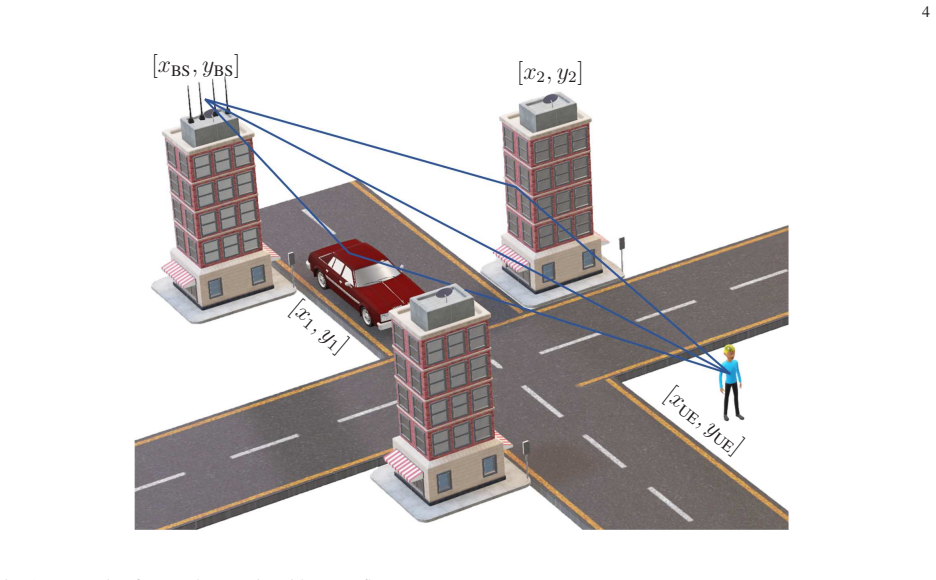
Location information of UE and reflecting points lets mmWave systems search only small sets of beams inside known error boundaries.
A machine-rendered reading of the paper's core claim, the machinery that carries it, and where it could break.
Core claim
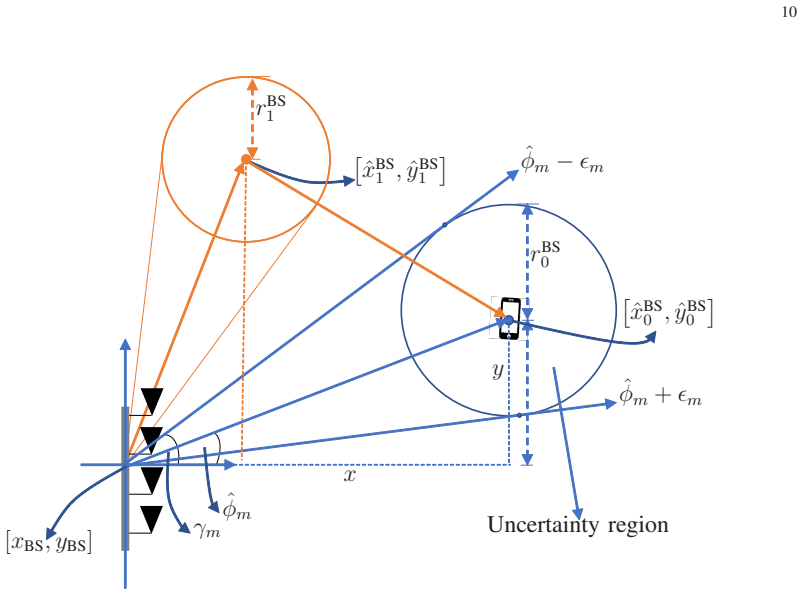
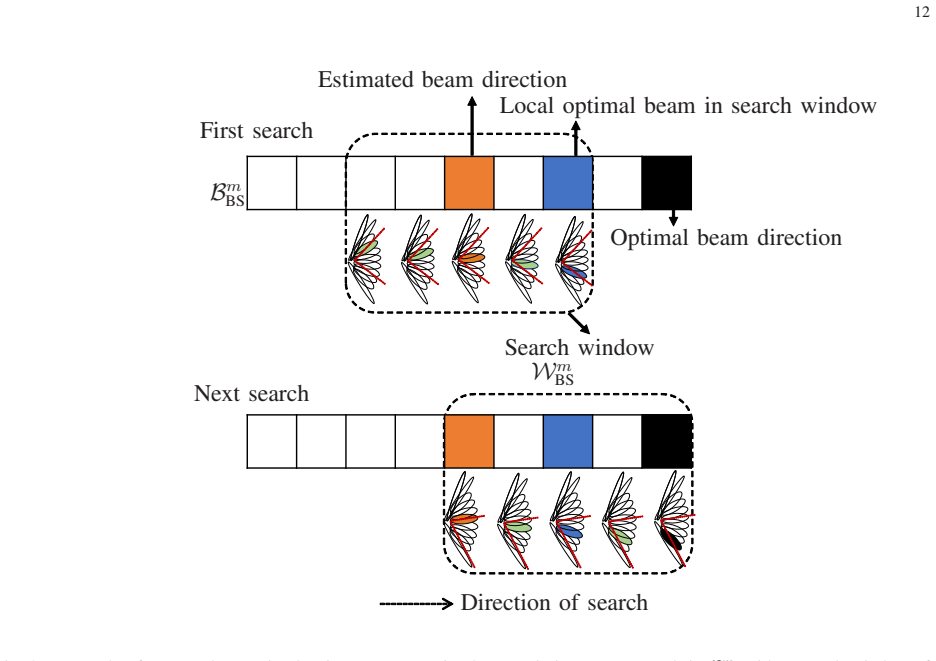
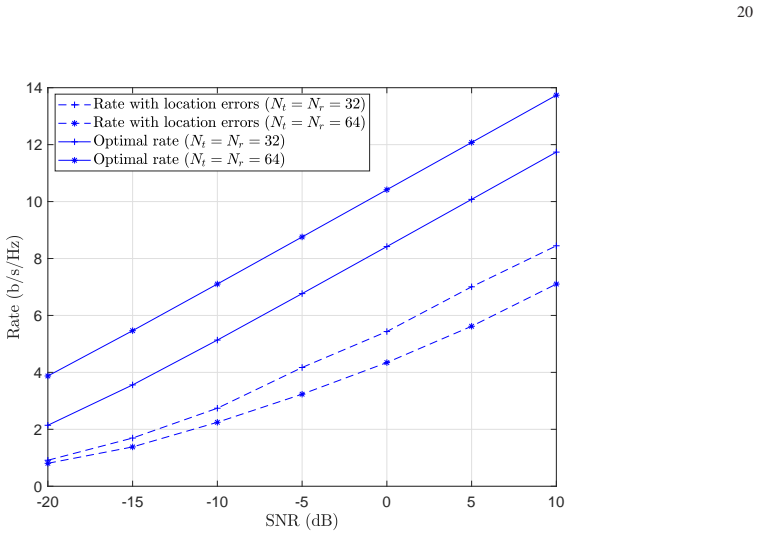
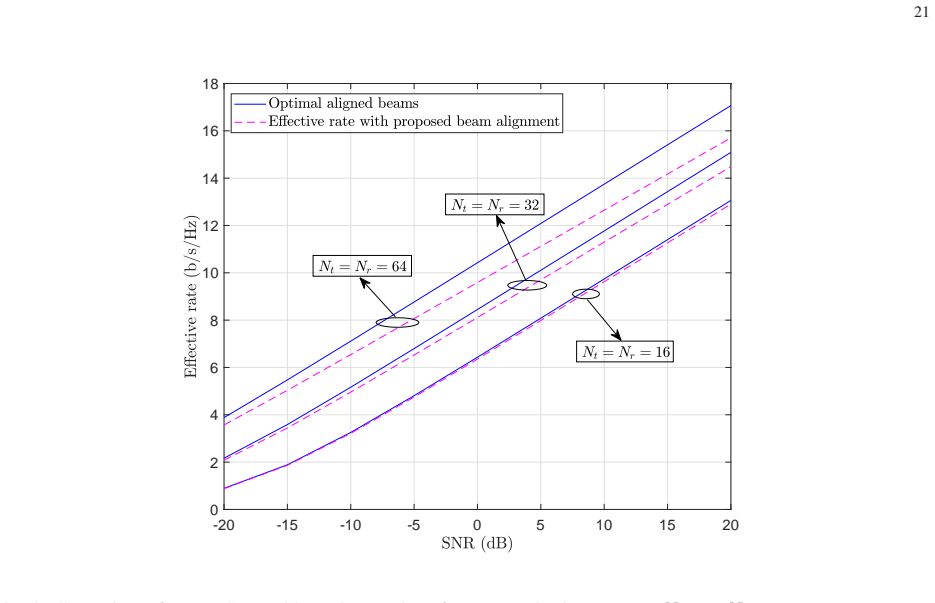
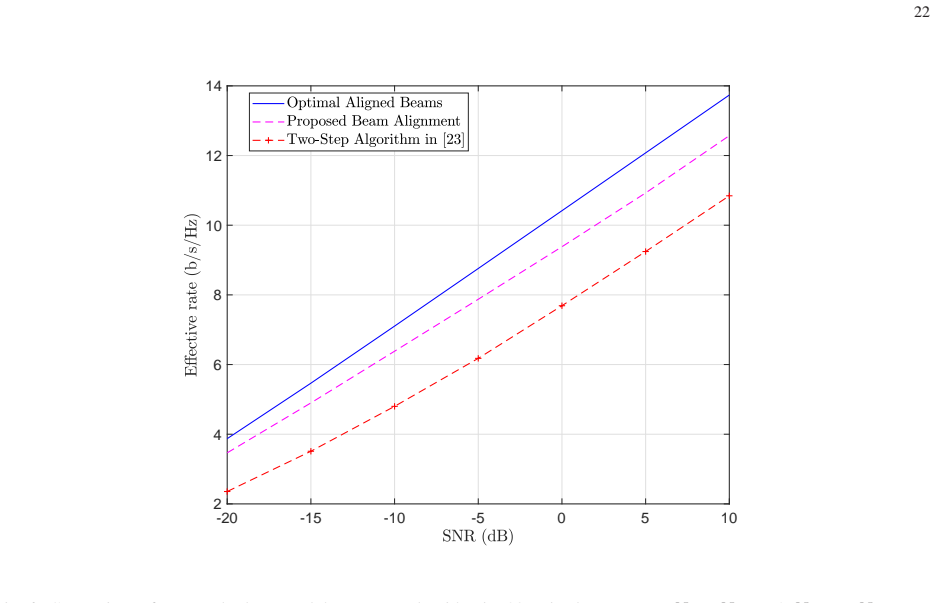
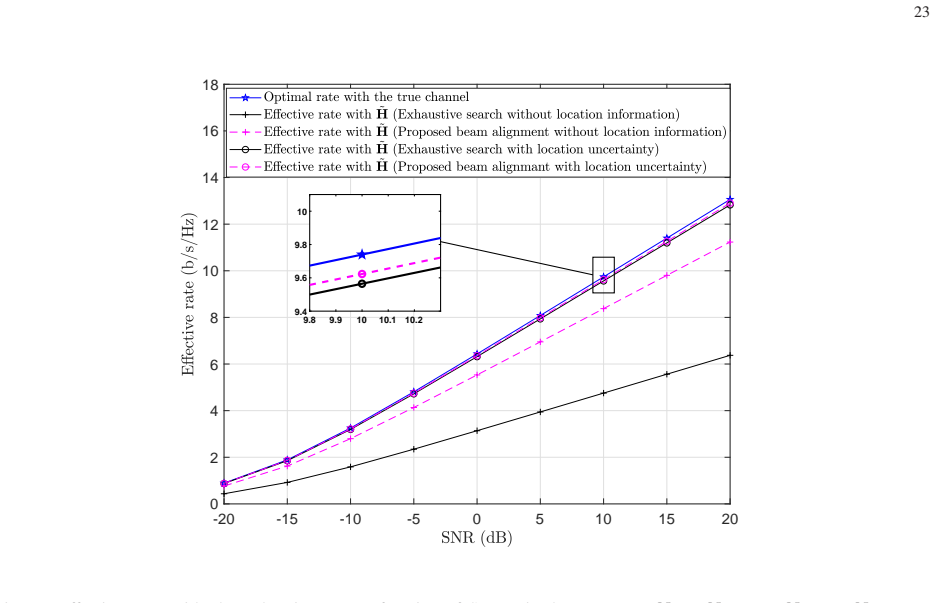
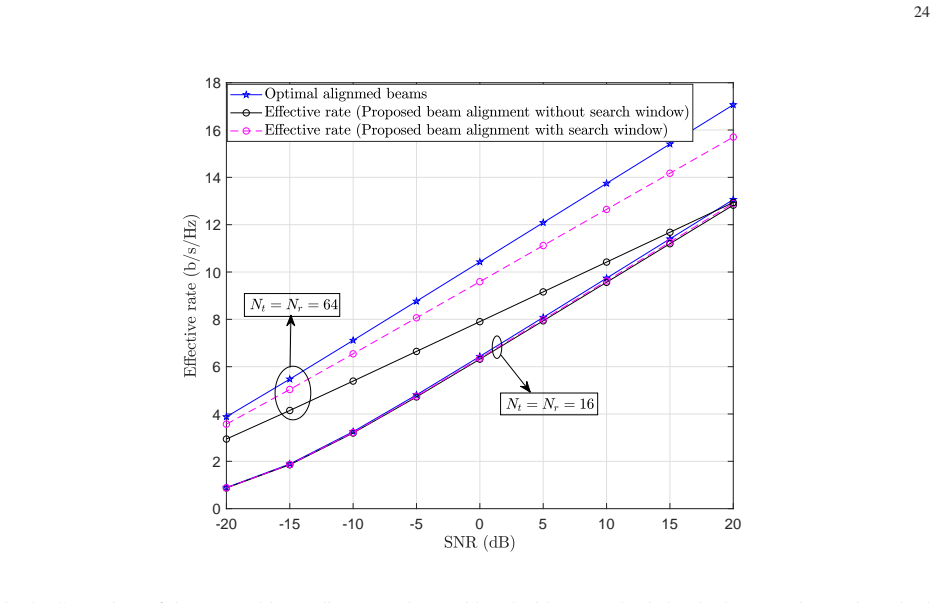
The proposed scheme allows the UE and the base station to perform a coordinated beam search from a small set of beams within the error boundary of the location information, the selected beams are then used to guide the search of future beams, and an intelligent search scheme within a small window determines the direction of the actual beam. The algorithm is verified on simulation with some location uncertainty.
What carries the argument
Error-bounded location region that restricts the initial coordinated beam set, followed by reuse of selected beams to guide subsequent searches and an intelligent windowed search to resolve the final direction.
If this is right
- The number of beam pairs that must be measured drops because the search starts inside a small error-bounded region.
- Beams chosen in one alignment step directly constrain the candidates examined in later steps.
- The windowed intelligent search further limits the final measurements needed to identify the active beam.
- The procedure remains functional under the simulated levels of location uncertainty.
Where Pith is reading between the lines
- If location updates can be obtained cheaply, the same bounded-search logic could be reapplied periodically to track moving users.
- Integration with existing positioning services would determine whether the assumed error boundaries are realistic in real deployments.
- The approach could be tested against conventional exhaustive or hierarchical codebook searches to quantify the exact saving in measurement time.
Load-bearing premise
Sufficiently accurate location information for the UE and potential reflecting points is available with known error boundaries small enough to produce a useful reduction in search space.
What would settle it
A simulation or measurement run in which location error boundaries are enlarged beyond the values used in the paper's trials, checking whether the number of beams that must be tested returns to the exhaustive-search level.
Figures
read the original abstract
Beam alignment is required in millimeter wave communication to ensure high data rate transmission. However, with narrow beamwidth in massive MIMO, beam alignment could be computationally intensive due to the large number of beam pairs to be measured. In this paper, we propose an efficient beam alignment framework by exploiting the location information of the user equipment (UE) and potential reflecting points. The proposed scheme allows the UE and the base station to perform a coordinated beam search from a small set of beams within the error boundary of the location information, the selected beams are then used to guide the search of future beams. To further reduce the number of beams to be searched, we propose an intelligent search scheme within a small window of beams to determine the direction of the actual beam. The proposed beam alignment algorithm is verified on simulation with some location uncertainty.
Editorial analysis
A structured set of objections, weighed in public.
Referee Report
Summary. The paper proposes a location-aware beam alignment framework for mmWave communications that exploits UE and reflecting-point location information to reduce search overhead. The scheme performs a coordinated initial search over a small set of beams inside the location-error boundary, uses the outcomes to guide subsequent searches, and applies an intelligent search inside a small window to identify the final beam direction. The approach is stated to have been verified via simulation that includes some location uncertainty.
Significance. If the method can be shown to deliver a substantial, quantifiable reduction in the number of beam measurements while remaining robust to realistic positioning errors, it would address a practical bottleneck in mmWave systems. The geometric use of location error boundaries is a plausible way to prune the codebook, but the significance cannot be assessed without evidence that the pruned set remains smaller than standard exhaustive or hierarchical searches across plausible error radii.
major comments (2)
- [Abstract] Abstract: the claim that the algorithm 'is verified on simulation with some location uncertainty' is unsupported by any quantitative results, error bars, simulation parameters, or comparison against baseline beam-alignment methods. Without these data it is impossible to determine whether the proposed reduction in searched beams is realized.
- [Abstract] Abstract (scheme description): the central efficiency claim rests on the error boundary being small enough that the initial coordinated search plus guided/intelligent window search is cheaper than exhaustive or hierarchical search. No analysis is supplied of the boundary radius (or reflecting-point uncertainty) at which the searched set size becomes comparable to standard methods, nor of how uncertainty compounds when multiple reflecting points are considered.
minor comments (1)
- [Abstract] Abstract: the phrase 'intelligent search scheme within a small window' is underspecified; a brief indication of how the window is sized or how the search direction is chosen would improve clarity.
Simulated Author's Rebuttal
We thank the referee for the constructive feedback on the abstract. We agree that the abstract requires strengthening with quantitative details from our simulations and will revise accordingly. Below we provide point-by-point responses to the major comments.
read point-by-point responses
-
Referee: [Abstract] Abstract: the claim that the algorithm 'is verified on simulation with some location uncertainty' is unsupported by any quantitative results, error bars, simulation parameters, or comparison against baseline beam-alignment methods. Without these data it is impossible to determine whether the proposed reduction in searched beams is realized.
Authors: We agree the abstract is too terse. Section IV of the manuscript presents Monte Carlo simulations with location errors of 1-5 m, comparing the proposed method against exhaustive search and hierarchical codebook search. Results show average measurement reductions of 60-80% with success rates above 95% and include error bars. We will revise the abstract to report these key metrics (e.g., mean measurements, robustness to uncertainty) and simulation parameters. revision: yes
-
Referee: [Abstract] Abstract (scheme description): the central efficiency claim rests on the error boundary being small enough that the initial coordinated search plus guided/intelligent window search is cheaper than exhaustive or hierarchical search. No analysis is supplied of the boundary radius (or reflecting-point uncertainty) at which the searched set size becomes comparable to standard methods, nor of how uncertainty compounds when multiple reflecting points are considered.
Authors: Simulations in the manuscript evaluate performance across multiple error radii and reflector counts, but we acknowledge the absence of an explicit crossover analysis. We will add a new figure and brief derivation in the revised version that plots searched beam count versus error radius (single and multiple reflectors) and identifies the radius at which the method equals exhaustive/hierarchical search, thereby quantifying the operating regime. revision: yes
Circularity Check
No circularity; scheme rests on independent geometric assumptions and simulation verification.
full rationale
The paper's core proposal uses location information and error boundaries to define a reduced beam search set, followed by guided and windowed search. These steps are defined directly from geometric inputs (UE/reflector positions and uncertainty radii) without any reduction to fitted parameters, self-citations, or self-definitional loops. Verification occurs via simulation under stated uncertainty, with no equations or claims that rename inputs as outputs or import uniqueness from prior author work. The derivation chain remains self-contained against external benchmarks.
Axiom & Free-Parameter Ledger
free parameters (2)
- location error boundary
- search window size
axioms (2)
- domain assumption Location information of UE and potential reflecting points is available with bounded error.
- domain assumption Reflecting points can be identified or mapped in advance.
Reference graph
Works this paper leans on
-
[1]
Locati on-aware coordinated beam alignment in mmwave communication,
I. Orikumhi, J. Kang, C. Park, J. Yang, and S. Kim, “Locati on-aware coordinated beam alignment in mmwave communication,” in 2018 56th Annual Allerton Conference on Communication, Con trol, and Computing (Allerton) , Oct. 2018, pp. 386–390
work page 2018
-
[2]
Millimeter wave mobile communications for 5G cellular: It will work!
T. S. Rappaport, S. Sun, R. Mayzus, H. Zhao, Y . Azar, K. Wan g, G. N. Wong, J. K. Schulz, M. Samimi, and F. Gutierrez, “Millimeter wave mobile communications for 5G cellular: It will work!” IEEE Access , vol. 1, pp. 335–349, 2013
work page 2013
-
[3]
Energy efficient beam-alig nment in millimeter wave networks,
M. Hussain and N. Michelusi, “Energy efficient beam-alig nment in millimeter wave networks,” in 2017 51st Asilomar Conference on Signals, Systems, and Computers , Oct. 2017, pp. 1219–1223
work page 2017
-
[4]
Bea m alignment for millimetre wave links with motion predictio n of autonomous vehicles,
I. Mavromatis, A. Tassi, R. J. Piechocki, and A. Nix, “Bea m alignment for millimetre wave links with motion predictio n of autonomous vehicles,” in Antennas, Propagation RF Technology for Transport and Auto nomous Platforms 2017 , Feb. 2017, pp. 1–8
work page 2017
-
[5]
A robust time- domain beam alignment scheme for multi-user wideband mmWave systems,
X. Song, S. Haghighatshoar, and G. Caire, “A robust time- domain beam alignment scheme for multi-user wideband mmWave systems,” in WSA 2018; 22nd International ITG W orkshop on Smart Antennas , Mar. 2018, pp. 1–7
work page 2018
-
[6]
The impact of beamwidth on temporal channel variation in vehicular channels and its implications,
V . V a, J. Choi, and R. W. Heath, “The impact of beamwidth on temporal channel variation in vehicular channels and its implications,” IEEE Trans. V eh. Technol., vol. 66, no. 6, pp. 5014–5029, Jun. 2017
work page 2017
-
[7]
Coverage analysis for millimeter wave cellular networks with imperfect beam alignment,
M. Cheng, J. B. Wang, Y . Wu, X. G. Xia, K. K. Wong, and M. Lin, “Coverage analysis for millimeter wave cellular networks with imperfect beam alignment,” IEEE Trans. V eh. Technol., pp. 1–1, 2018
work page 2018
-
[8]
Millimeter wave beam alignment: Large deviations analysis and design insights,
C. Liu, M. Li, S. V . Hanly, I. B. Collings, and P . Whiting, “ Millimeter wave beam alignment: Large deviations analysis and design insights,” IEEE J. Sel. Areas Commun. , vol. 35, no. 7, pp. 1619–1631, Jul. 2017
work page 2017
-
[9]
S. Noh, M. D. Zoltowski, and D. J. Love, “Multi-resolutio n codebook and adaptive beamforming sequence design for millimeter wave beam alignment,” IEEE Trans. Wireless Commun. , vol. 16, no. 9, pp. 5689–5701, Sep. 2017
work page 2017
-
[10]
A tutorial on beam management for 3GPP NR at mmWave frequencies,
M. Giordani, M. Polese, A. Roy, D. Castor, and M. Zorzi, “ A tutorial on beam management for 3GPP NR at mmWave frequencies,” arXiv preprint arXiv:1804.01908 , 2018
-
[11]
Initial access frameworks for 3GPP NR at mmWave fre quencies,
——, “Initial access frameworks for 3GPP NR at mmWave fre quencies,” in 2018 17th Annual Mediterranean Ad Hoc Networking W orkshop (Med-Hoc-Net), Jun. 2018, pp. 1–8
work page 2018
-
[12]
Directional cell search for millimeter wave cellular systems,
C. N. Barati, S. A. Hosseini, S. Rangan, P . Liu, T. Koraki s, and S. S. Panwar, “Directional cell search for millimeter wave cellular systems,” in 2014 IEEE 15th International W orkshop on Signal Processing Advances in Wireless Communications (SPAWC), Jun. 2014, pp. 120–124
work page 2014
-
[13]
Design and analysis of transmit beamforming for millimete r wave base station discovery,
C. Liu, M. Li, I. B. Collings, S. V . Hanly, and P . Whiting, “Design and analysis of transmit beamforming for millimete r wave base station discovery,” IEEE Trans. Wireless Commun. , vol. 16, no. 2, pp. 797–811, Feb. 2017
work page 2017
-
[14]
Analysis of broadcast signaling for millimeter wave cel l discovery,
Y . Li, J. Luo, M. H. Castaneda, N. Vucic, W. Xu, and G. Cair e, “Analysis of broadcast signaling for millimeter wave cel l discovery,” in 2017 IEEE 86th V ehicular Technology Conference (VTC-Fall) , Sep. 2017, pp. 1–5
work page 2017
-
[15]
M illimeter wave cell search for initial access: Analysis, de sign, and implementation,
S. Habib, S. A. Hassan, A. A. Nasir, and H. Mehrpouyan, “M illimeter wave cell search for initial access: Analysis, de sign, and implementation,” in 2017 13th International Wireless Communications and Mobil e Computing Conference (IWCMC) , Jun. 2017, pp. 922–927
work page 2017
-
[16]
Initial access in mill imeter wave cellular systems,
C. N. Barati, S. A. Hosseini, M. Mezzavilla, T. Korakis, S. S. Panwar, S. Rangan, and M. Zorzi, “Initial access in mill imeter wave cellular systems,” IEEE Trans. Wireless Commun. , vol. 15, no. 12, pp. 7926–7940, Dec. 2016
work page 2016
-
[17]
On the initial access design in millimeter wave cellula r networks,
Y . Li, J. G. Andrews, F. Baccelli, T. D. Novlan, and J. Zha ng, “On the initial access design in millimeter wave cellula r networks,” in 2016 IEEE Globecom W orkshops (GC Wkshps) , Dec. 2016, pp. 1–6
work page 2016
-
[18]
Millimeter wave beamforming for wireless backhaul and access in small cell networks,
S. Hur, T. Kim, D. J. Love, J. V . Krogmeier, T. A. Thomas, a nd A. Ghosh, “Millimeter wave beamforming for wireless backhaul and access in small cell networks,” IEEE Trans. Commun. , vol. 61, no. 10, pp. 4391–4403, Oct. 2013. 30
work page 2013
-
[19]
Bayesian tree searc h for beamforming training in millimeter wave wireless communication systems,
W. C. Chen, H. T. Chiu, and R. H. Gau, “Bayesian tree searc h for beamforming training in millimeter wave wireless communication systems,” in 2018 IEEE Wireless Communications and Networking Conferen ce (WCNC) , Apr. 2018, pp. 1–6
work page 2018
-
[20]
R. D. Taranto, S. Muppirisetty, R. Raulefs, D. Slock, T. Svensson, and H. Wymeersch, “Location-aware communicatio ns for 5G networks: How location information can improve scala bility, latency, and robustness of 5G,” IEEE Signal Process. Mag., vol. 31, no. 6, pp. 102–112, Nov. 2014
work page 2014
-
[21]
5G mmWave downlink vehicular positioning,
H. Wymeersch, N. Garcia, H. Kim, G. Seco-Granados, S. Ki m, F. Went, and M. Fröhle, “5G mmWave downlink vehicular positioning,” in 2018 IEEE Global Communications Conference (GLOBECOM) . IEEE, 2018, pp. 206–212
work page 2018
-
[22]
Position aided beam alignment for millimeter wave backhaul systems with large phased arra ys,
G. C. Alexandropoulos, “Position aided beam alignment for millimeter wave backhaul systems with large phased arra ys,” in 2017 IEEE 7th International W orkshop on Computational Adva nces in Multi-Sensor Adaptive Processing (CAMSAP) , Dec. 2017, pp. 1–5
work page 2017
-
[23]
Robust Location-Aided Beam Alignment in Millimeter Wave Massive MIMO
F. Maschietti, D. Gesbert, P . de Kerret, and H. Wymeersc h, “Robust location-aided beam alignment in millimeter wav e massive MIMO,” arXiv preprint arXiv:1705.01002 , 2017
work page internal anchor Pith review Pith/arXiv arXiv 2017
-
[24]
Position and orientation estimati on through millimeter-wave MIMO in 5G systems,
A. Shahmansoori, G. E. Garcia, G. Destino, G. Seco-Gran ados, and H. Wymeersch, “Position and orientation estimati on through millimeter-wave MIMO in 5G systems,” IEEE Trans. Wireless Commun. , vol. 17, no. 3, pp. 1822–1835, Mar. 2018
work page 2018
-
[25]
Initial beam association in millimeter wave cellula r systems: Analysis and design insights,
A. Alkhateeb, Y . H. Nam, M. S. Rahman, J. Zhang, and R. W. H eath, “Initial beam association in millimeter wave cellula r systems: Analysis and design insights,” IEEE Trans. Wireless Commun. , vol. 16, no. 5, pp. 2807–2821, May 2017
work page 2017
-
[26]
Chan nel estimation and hybrid precoding for millimeter wave cellular systems,
A. Alkhateeb, O. E. Ayach, G. Leus, and R. W. Heath, “Chan nel estimation and hybrid precoding for millimeter wave cellular systems,” IEEE J. Sel. Topics Signal Process. , vol. 8, no. 5, pp. 831–846, Oct. 2014
work page 2014
-
[27]
Codeboo k design for beam alignment in millimeter wave communicatio n systems,
J. Zhang, Y . Huang, Q. Shi, J. Wang, and L. Yang, “Codeboo k design for beam alignment in millimeter wave communicatio n systems,” IEEE Trans. Commun. , vol. 65, no. 11, pp. 4980–4995, Nov. 2017
work page 2017
-
[28]
Loca tion-aided mm-wave channel estimation for vehicular communication,
N. Garcia, H. Wymeersch, E. G. Ström, and D. Slock, “Loca tion-aided mm-wave channel estimation for vehicular communication,” in 2016 IEEE 17th International W orkshop on Signal Processing Advances in Wireless Communications (SPAWC), Jul. 2016, pp. 1–5
work page 2016
-
[29]
3rd Generation Partnership Project, 3GPP , Document RP250456, Mar
Study on Downlink Multiuser Superposition Transmission fo r LTE . 3rd Generation Partnership Project, 3GPP , Document RP250456, Mar. 2015
work page 2015
-
[30]
Music, maximum likelihood, a nd cramer-rao bound,
P . Stoica and A. Nehorai, “Music, maximum likelihood, a nd cramer-rao bound,” IEEE Transactions on Acoustics, Speech, and Signal Processing , vol. 37, no. 5, pp. 720–741, 1989
work page 1989
-
[31]
H. V . Poor, An introduction to signal detection and estimation . Springer Science & Business Media, 2013
work page 2013
-
[32]
S. M. Kay, Fundamentals of statistical signal processing : estimatio n theory . Englewood Cliffs, N.J : PTR Prentice-Hall, 1993
work page 1993
-
[33]
Kronecker products and matrix calculus in s ystem theory,
J. Brewer, “Kronecker products and matrix calculus in s ystem theory,” IEEE Trans. Circuits Syst. , vol. 25, no. 9, pp. 772–781, 1978
work page 1978
-
[34]
Graham, Kronecker products and matrix calculus with applications
A. Graham, Kronecker products and matrix calculus with applications . Courier Dover Publications, 2018
work page 2018
discussion (0)
Sign in with ORCID, Apple, or X to comment. Anyone can read and Pith papers without signing in.