REVIEW 2 major objections 3 minor 1 cited by
Cored surface brightness profiles of dwarf galaxies cannot exclude cuspy dark matter halos, because weak three-dimensional cores project to the same flat profiles as strong cores.
Reviewed by Pith at T0; open to challenge. T0 means a machine referee read the full paper against a public rubric. the ladder, T0–T4 →
Cored stellar surface-density profiles in dwarf galaxies do not by themselves rule out cuspy dark-matter halos, because weak 3D cores project to strong 2D cores and can have positive distribution functions in cuspy potentials.
T0 review reviewed 2026-08-03 challenge →
load-bearing objection The paper's central message—cored stellar surface-density profiles don't rule out cuspy dark matter halos—is correct and useful, but the abstract oversells the strong-core exclusion and the empirical fits never check DF positivity. the 2 major comments →
Cored galaxies in cuspy dark matter halos
The pith
A machine-rendered reading of the paper's core claim, the machinery that carries it, and where it could break.
The reading
Core claim
Under spherical symmetry and monotonic decrease, the paper proves that every finite-central-density stellar profile projects to a surface brightness profile that is a strong core in two dimensions. Because the Eddington-inversion test for a physical distribution function acts on the three-dimensional density, the observed 2D flatness cannot distinguish weak from strong cores and cannot exclude a cuspy dark halo. Explicit positive-DF models built from mono-energetic and power-law-in-energy distribution functions demonstrate weakly cored stellar profiles in cuspy halos while projecting flat. Fits to ultra-faint dwarfs and to Fornax are consistent with either type of core, so photometric data a
What carries the argument
The central machinery is a classification of spherical stellar density profiles by two central numbers: the slope b0 = −dρ/dr at r = 0 and the log-slope γ0 = −d log ρ/d log r at r = 0; strong cores have b0 = γ0 = 0, weak cores have b0 ≠ 0 and γ0 = 0. Two classical tools carry the argument: the Abel projection, which maps 3D density to 2D surface density, and Eddington inversion, which derives the phase-space distribution function f(E) from density and potential. The paper shows that for monotonic spherical densities the projection always erases the strong/weak distinction, and that the sufficient condition dρ/dΨ ≠ 0 for f(E) ≥ 0 involves only 3D quantities, so the 2D core shape carries no in
Load-bearing premise
The argument assumes spherical symmetry, stationary equilibrium, and a monotonically decreasing stellar density; real dwarf galaxies are flattened, often tidally perturbed, and possibly out of equilibrium, so the projection and Eddington-inversion identities need not hold for them.
What would settle it
Compute the Eddington-inverted distribution function for a strong-core tracer—a spherical stellar profile that is exactly flat at the center—embedded in a cuspy dark matter halo; the paper predicts the distribution function goes negative. A single explicit model with such a core that yields a non-negative distribution function throughout would refute the central classification. Observationally, a dwarf galaxy with an independently confirmed strong three-dimensional stellar core and a cuspy dark halo would do the same.
If this is right
- If the paper is right, a cored stellar surface brightness profile is not evidence against a cuspy cold-dark-matter halo; it is expected for weak 3D cores embedded in such halos.
- Conversely, a 2D surface brightness profile that is not a strong core would necessarily imply a cuspy 3D stellar distribution, a crisp and testable prediction.
- Distinguishing cuspy from cored dark halos photometrically requires measuring the curvature of the surface brightness profile, not just its central flatness, and enforcing distribution-function positivity.
- The ultra-faint dwarf sample analyzed, and even Fornax, cannot discriminate between weak and strong stellar cores, so high-quality surface photometry alone leaves the dark halo's inner slope ambiguous.
- Strong 3D cores cannot be embedded in cuspy halos with positive DF; a galaxy shown to have a true strong core would still point toward a cored dark matter halo.
Where Pith is reading between the lines
- Editorial inference: the same projection degeneracy likely affects other spherical tracer populations used to infer potentials, such as globular clusters or stellar halos, wherever only projected density is observed.
- Editorial inference: the paper implicitly shifts the burden of proof in the core-cusp debate from the central surface brightness plateau to higher-order profile curvature and kinematic data; future deep surveys could test this by measuring the second derivative of the projected density.
- Editorial inference: because real dwarfs are flattened and tidally disturbed, departures from spherical symmetry could either weaken or strengthen the degeneracy; a natural extension is to redo the classification for axisymmetric Abel inversion.
- Editorial inference: claims that cored ultra-faint dwarf profiles challenge the cold-dark-matter model are premature under this analysis; the viable discriminating tests are kinematic, using velocity dispersions and anisotropy, rather than photometric.
Editorial analysis
A structured set of objections, weighed in public.
Referee Report
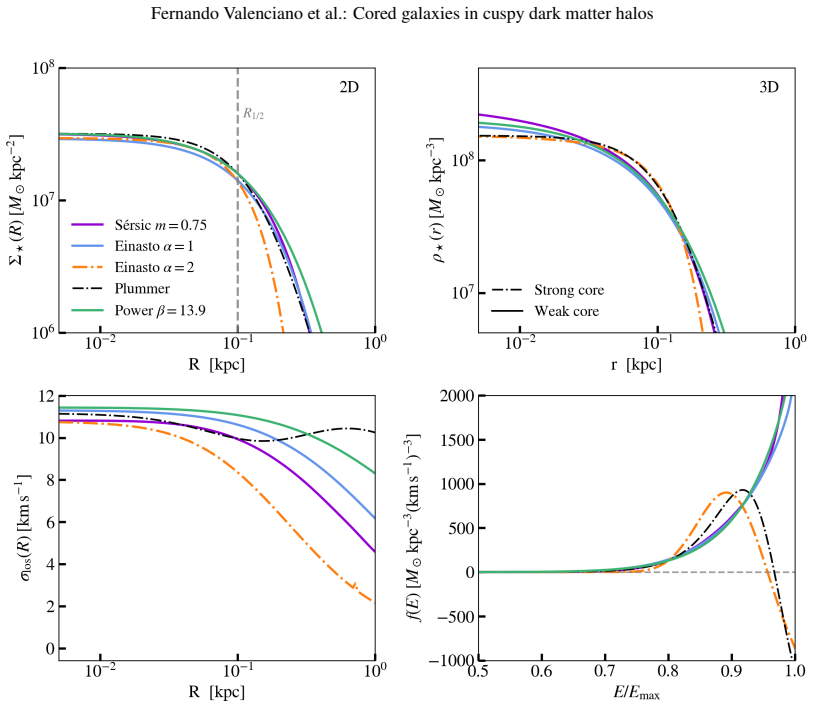
Summary. The paper investigates whether cored stellar surface-density profiles in dwarf galaxies can be used to infer cored (rather than cuspy) dark matter halos. The authors introduce a classification of spherical 3D stellar density profiles into strong cores (finite central density, zero central slope), weak cores (finite central density, nonzero/divergent central slope), and cusps of varying strength. They prove that any continuous, monotonically decreasing spherical 3D profile projects to a strong core in 2D, so that the observed flatness of surface brightness profiles does not directly constrain the 3D stellar slope. Using the Eddington inversion, they show that weak 3D cores can be embedded in cuspy (Hernquist/NFW) halos with positive distribution functions, while strong 3D cores cannot (under the dρ/dΨ=0 sufficient condition). They provide explicit positive-DF families (mono-energetic and power-potential) and illustrate their claims with Fig. 2. The empirical part fits Plummer, Einasto, Sérsic, and power-potential models to six UFDs from Richstein et al. (2024) and to a Gaia-based Fornax surface-density profile, concluding that weak and strong cores are difficult to distinguish and that the data are consistent with cuspy DM halos. The central theoretical result is the demonstration that strong 2D cores do not exclude cuspy halos; the empirical inference is presented as supporting evidence.
Significance. If the theoretical result stands, it resolves a recurring confusion in the core-cusp debate: the flatness of projected stellar profiles is not a direct diagnostic of the DM central slope. The paper's explicit construction of positive-DF weak-core tracers in cuspy potentials is a useful counterexample to claims that cored stellar profiles are incompatible with cuspy CDM halos. The classification into strong/weak cores and the projection theorem are clean, analytic, and likely to be widely cited. The authors are appropriately careful to state that their condition is sufficient, not necessary, and they include an appendix (B) showing that weak cores can still yield negative DFs if the slope transition is sharp. The empirical fits are secondary; the main value is the theoretical clarification.
major comments (2)
- [Sec. 3.2, 3.3; Tables E.1, F.1; Abstract] The claim that 'all examined systems are individually consistent with weakly cored profiles and, thus, with embeddings in cuspy DM halos' (Sec. 3.2) is not established by the analysis shown. Consistency with a cuspy halo requires that the best-fit weak-core model, when embedded in the assumed Hernquist/NFW potential, yields f(E)>=0 via Eddington inversion. The paper only checks positivity for one representative parameter set (Fig. 2, M_h=1e9 Msun, r_s=1 kpc, R_1/2=0.1 kpc). The fitted profiles in Secs. 3.2-3.3 use different half-light radii, halo assumptions, and model parameters, and none are passed through the Eddington test. Appendix B explicitly shows that a weak core is not sufficient: a sharp inner-to-outer transition can drive d^2rho/dPsi^2<0 and hence f(E)<0. Therefore the 'thus' in Sec. 3.2 does not follow; the abstract's 'even for Fornax' conclusion is unsupported. I request th
- [Sec. 3.3; Table F.1] The Fornax analysis is presented as decisive evidence that even high-quality data cannot distinguish weak from strong cores, but the fit itself is fragile. The double-Sérsic model in Table F.1 has enormous uncertainties (inner I0 = 3.21 +/- 18.13, Rs = 0.90 +/- 1.89, m = 0.72 +/- 0.80), and the text acknowledges sensitivity to binning and background subtraction. More importantly, the Einasto best fit has alpha=1.08, which is a strong core and would be inconsistent with a cuspy halo according to the paper's own dρ/dΨ=0 argument; the only weak-core model consistent with a cuspy halo is the Sérsic fit with m=0.81, whose DF positivity is not checked. Thus the statement that 'Fornax is consistent with a cuspy DM halo' hinges on one unverified model and a fit whose statistical preference over the strong-core model is not quantified beyond a chi-square difference. The conclusion should be softe
minor comments (3)
- [Sec. 2.1, Eq. (4)] For weak cores with 0<alpha<1, b(r) ~ r^{alpha-1} diverges as r->0, so b0 is not a finite number. The classification 'b0 != 0' should be phrased as 'b0 is nonzero or divergent' (or define b0 in the extended reals) to avoid confusion with the finite b0 for alpha=1.
- [Abstract and Conclusions] The abstract states that 'cored surface density profiles in nearby dwarf galaxies cannot be taken as strong evidence against cuspy DM halos' without the spherical-symmetry and stationarity caveats. The Conclusions do state this limitation, but the abstract and title overgeneralize. Please qualify the abstract with 'within spherically symmetric, stationary models' or equivalent.
- [Sec. 3.2, Table E.1] The statement that 'all models provide a good fit' is not reflected by the AICc values for some systems (e.g., Sgr II has chi2_nu ~ 1.5-1.8 for all models), and the power-potential model with beta ~ 50 is an extremely concentrated profile that may be physically implausible. A brief comment on the acceptable fit quality and the role of the fixed r_s=1 kpc in the power-potential fits would help the reader interpret the comparison.
Circularity Check
No significant circularity: the core argument is a standard Abel-projection/Eddington-inversion calculation, with positive-DF examples constructed explicitly rather than fitted; self-citations are attribution only.
full rationale
The derivation chain is self-contained and first-principles. The classification of strong/weak cores and cusps (Sec. 2.1, Eqs. 1-8) is defined before, and independently of, the DF analysis. The projection results follow from the Abel transform (Eq. 9) and the asymptotic calculation in Appendix A; the claim that all finite-central-density 3D profiles project to strong 2D cores is a standard mathematical consequence, not an output manufactured from the conclusion. The DF-positivity condition is the external Eddington inversion (Eq. 24) plus the sufficient-negativity condition attributed to Lacroix et al. (2018); neither is supplied by the present authors. The central existence claims are proved constructively: Sec. 3.1 starts from a manifestly non-negative mono-energetic DF (Eq. 31) and a power-law DF (Eq. 37), computes the resulting densities (Eqs. 32, 35, 38-39), and then verifies that they are weak 3D cores projecting to strong 2D cores. The non-trivial conclusion—that these densities are weak cores—is the result of the calculation, not an input. The UFD and Fornax sections (Secs. 3.2-3.3, Appendices E-F) are fits to external photometric data; no fitted parameter is renamed as a prediction, and the paper explicitly draws a negative conclusion about the discriminative power of photometry alone. The self-citations to Errani et al. (2024, 2025b) for the mono-energetic DF are not load-bearing, because the needed profile is written out explicitly in Eq. (32)/(35). One caveat, flagged here per the review rule: Sec. 3.2 states that 'all examined systems are individually consistent with weakly cored profiles and, thus, with embeddings in cuspy DM halos,' but the best-fit Einasto/Sérsic profiles are not individually passed through the Eddington inversion; Appendix B itself admits 'the existence of a weak core is not sufficient to guarantee DF positivity.' This is an evidentiary gap in the empirical generalization, not circularity, and the independently constructed power-potential fits provide a positive-DF family consistent with each data set.
Axiom & Free-Parameter Ledger
free parameters (3)
- DM halo scale radius r_s in UFD power-potential fits =
1 kpc (fixed by hand)
- Hernquist halo parameters in Fig. 2 =
M_h = 10^9 M_sun, r_s = 1 kpc
- Fornax binning/background-subtraction scheme =
not quantified
axioms (7)
- domain assumption Spherical symmetry and stationarity of the stellar and DM distributions; monotonic decrease of the stellar density
- domain assumption Stellar component is a massless tracer of the DM potential (no self-gravity)
- standard math Eddington inversion formula (Eq. 24) and the sufficient condition dρ/dΨ=0 ⇒ f(E)<0 (Lacroix et al. 2018)
- domain assumption Hernquist/NFW profile as representative of the CDM halo inner cusp (γ=1)
- standard math Any isotropic DF can be expressed as a continuous limit of a sum of mono-energetic DFs
- standard math Central slope-anisotropy inequality γ(r) ≥ 2β(r) for separable spherical systems
- ad hoc to paper Central potential expansion Ψ(r) ≈ Ψ(0)(1 − a_Ψ r^{2−γ}) with 0 ≤ γ < 2
invented entities (1)
-
None
no independent evidence
Cite this review
Pith. "Pith review of Cored galaxies in cuspy dark matter halos." pith.science (2026). https://pith.science/paper/6VTYCMAY
@misc{pith2026251215886,
  author       = {Pith},
  title        = {Pith review of: Cored galaxies in cuspy dark matter halos},
  year         = {2026},
  howpublished = {\url{https://pith.science/paper/6VTYCMAY}},
  note         = {Machine review of arXiv:2512.15886}
}
abstract
We investigate constraints on the inner stellar density profile from photometric data of dwarf spheroidal and ultra-faint dwarf galaxies. Our aim is to clarify under what conditions cored stellar profiles require dark matter halos that are also cored, deviating from the cuspy profiles expected for cold dark matter halos. We consider a variety of spherically symmetric stellar profiles, which we classify as "strong" or "weak" cores and cusps according to the behavior of the slope ($b_0$) and logarithmic slope ($\gamma_0$) at their centers. We explore which profiles lead to unphysical negative distribution functions when embedded in a cuspy halo, treating isotropic and anisotropic kinematics separately. We find that weakly-cored stellar profiles in 3D (i.e., $b_0 \neq 0$, $\gamma_0=0$) can be consistent with cuspy dark matter profiles, but strong 3D cores ($b_0=\gamma_0=0$) are not. However, both weak and strong 3D cores yield nearly indistinguishable inner profiles in projection, which implies that ruling out a dark matter cusp from photometric data alone is highly challenging. As an example, we study the profiles of ultra-faint dwarf galaxies and find that they are consistent with both weak and strong 3D cores. This is not just a result of the limited numbers of stars in these systems, since we reach the same conclusion even for Fornax, one of the most luminous and best-studied dwarf spheroidal companions of the Milky Way. We conclude that, based on current data and analysis techniques, cored surface density profiles in nearby dwarf galaxies cannot be taken as strong evidence against the presence of cuspy dark matter halos.
Figures


Forward citations
Cited by 1 Pith paper
-
Thermal emission from dark matter-heated neutron stars in the Galactic Center
DM-heated neutron stars in the Galactic Center reach equilibrium temperatures of 10^4-10^6 K but their emission is below detection thresholds due to extinction.
Reference graph
Works this paper leans on
-
[1]
An, J. H. & Evans, N. W. 2006, ApJ,642, 752 Arroyo-Polonio, J. M., Pascale, R., Battaglia, G., et al. 2025, A&A,699, A347 Baes, M. & van Hese, E. 2007, A&A,471, 419 Baes, M. & van Hese, E. 2011, A&A,534, A69 Battaglia, G., Taibi, S., Thomas, G. F., & Fritz, T. K. 2022, A&A,657, A54 Battaglia, G., Tolstoy, E., Helmi, A., et al. 2006, A&A,459, 423 Binney, J...
arXiv 2006
-
[2]
Fixingα 1 =1 andα 2 =2, the behavior near the center corresponds to a weak core
the outer one. Fixingα 1 =1 andα 2 =2, the behavior near the center corresponds to a weak core. However, the subsequent transition to the steeper outer component can become arbitrarily sharp, de- pending on the ratio of scale radii a≡ r1 r2 . For small values ofa, the outer scale radiusr 2 becomes large, producing an abrupt change in slope. In this regime...
2006
This paper was first reviewed by deepseek-v4-flash on August 3, 2026.
discussion (0)
Sign in with ORCID, Apple, or X to comment. Anyone can read and Pith papers without signing in.