Coupled spin dynamics in epitaxial trilayer heterostructures of ferrimagnetic garnet
Pith reviewed 2026-06-26 23:38 UTC · model grok-4.3
The pith
Two YIG layers separated by a 4 nm paramagnetic YIAG film couple through dipolar forces to form hybrid magnon modes unlike those in single YIG layers.
A machine-rendered reading of the paper's core claim, the machinery that carries it, and where it could break.
Core claim
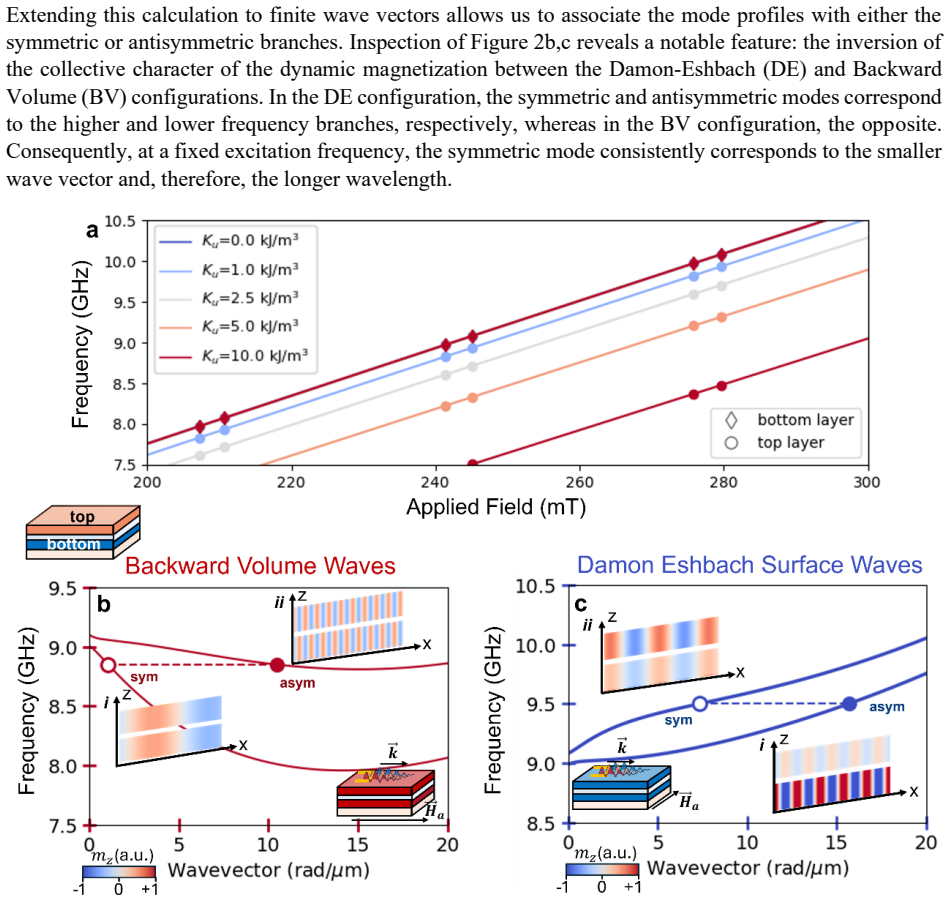
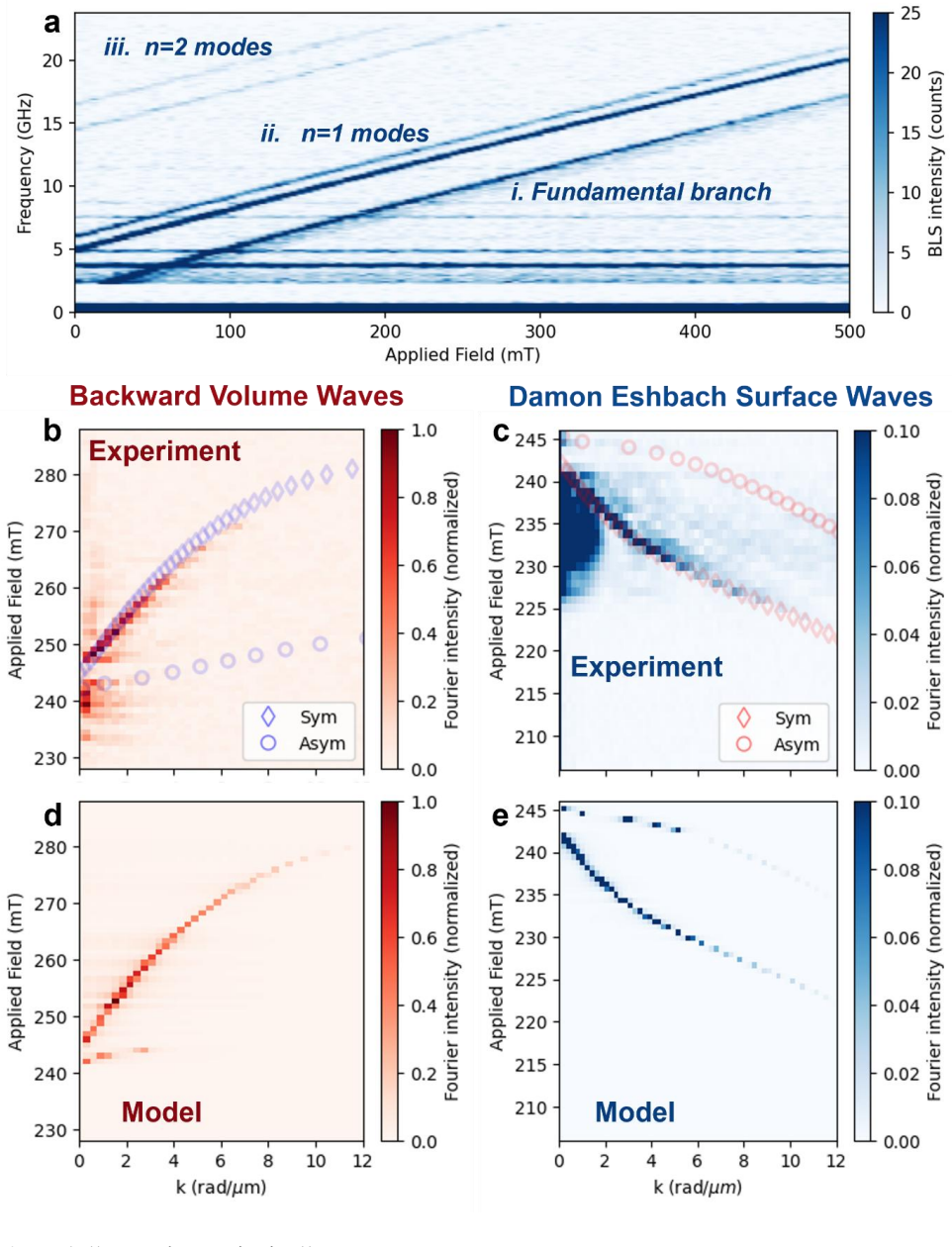
In the YIG/YIAG/YIG trilayer the two YIG films are exchange-decoupled by the 4 nm paramagnetic interlayer but remain coupled by dipolar fields, which generates a set of hybrid magnon modes whose frequencies and spatial profiles are distinct from the modes of an isolated YIG film; these modes are observed in both FMR and BLS and reproduced by reciprocal-space spin-wave theory and micromagnetic calculations.
What carries the argument
Dipolar coupling across the paramagnetic YIAG separator that produces hybrid magnon modes.
If this is right
- The hybrid modes can be described by an analytical reciprocal space model of spin-wave dynamics.
- Micromagnetic simulations of a dipolarly coupled heterostructure reproduce the observed spectra.
- The low damping of YIG is preserved in the trilayer structure.
- The lattice coherence is maintained across the interfaces.
Where Pith is reading between the lines
- This architecture could allow independent control of magnon modes in stacked layers without direct magnetic contact.
- Similar dipolar coupling might be engineered in other garnet-based multilayers to create tunable magnonic devices.
- Measuring the dependence of mode splitting on YIAG thickness would quantify the strength of the dipolar interaction.
Load-bearing premise
The YIAG interlayer is assumed to be purely paramagnetic, thereby fully eliminating exchange coupling between the YIG layers while leaving their intrinsic damping and lattice match intact.
What would settle it
Detection of exchange-split modes or a measurable rise in damping constant in the trilayer relative to a single YIG film would indicate that the YIAG layer is not providing the claimed pure dipolar coupling.
Figures
read the original abstract
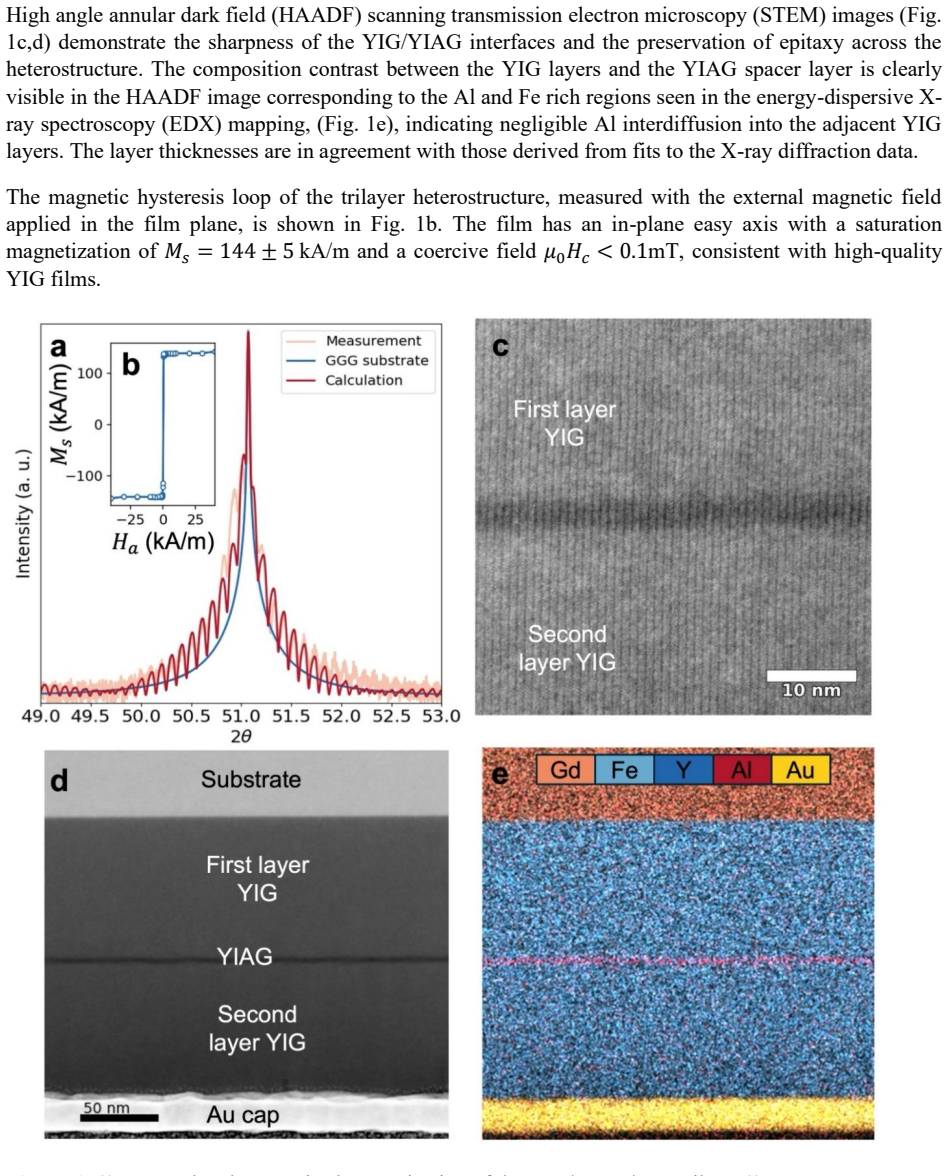
The magnetization dynamics of an all-garnet trilayer consisting of Y3Fe5O12/Y3Fe3Al2O12/Y3Fe5O12 (YIG/YIAG/YIG) is analysed. The two magnetic YIG layers, separated by a 4 nm thick paramagnetic YIAG layer, are coupled via dipolar interactions leading to the formation of hybrid magnon modes distinct from the modes found in a single YIG layer. The YIAG exchange-decouples the YIG layers while enabling lattice coherence, maintaining the low damping of the YIG. Both ferromagnetic resonance and micro-Brillouin light scattering measurements were used to characterize the sample and its hybrid dynamics, which showed excellent agreement with an analytical reciprocal space model of spin-wave dynamics and with micromagnetic modeling of a dipolarly coupled magnetic heterostructure.
Editorial analysis
A structured set of objections, weighed in public.
Referee Report
Summary. The manuscript analyzes magnetization dynamics in an epitaxial all-garnet YIG/YIAG/YIG trilayer, asserting that the 4 nm paramagnetic YIAG spacer exchange-decouples the two YIG layers while permitting dipolar coupling that produces hybrid magnon modes distinct from those in a single YIG film. FMR and micro-BLS data are reported to show excellent agreement with both a reciprocal-space analytical model and micromagnetic simulations that assume purely dipolar interlayer coupling, while preserving the low intrinsic damping of YIG.
Significance. If the central claim holds, the work establishes a route to engineer hybrid magnon modes in low-damping garnet heterostructures without exchange transmission, which is relevant for magnonic devices. The use of two independent experimental probes (FMR, micro-BLS) compared against both analytic and numerical models that are not fitted to the same dataset strengthens the dipolar-coupling interpretation.
major comments (2)
- [Abstract and §4] Abstract and §4 (Results): the repeated assertion of 'excellent agreement' between measured spectra and both the analytic model and micromagnetic simulations is not accompanied by quantitative metrics (e.g., rms frequency deviation, reduced χ², or tabulated resonance positions with uncertainties). Without these, the strength of support for the hybrid-mode claim cannot be evaluated.
- [§2] §2 (Sample growth and characterization): the claim that the 4 nm YIAG layer is purely paramagnetic, fully exchange-decouples the YIG layers, and simultaneously maintains epitaxial coherence and YIG's intrinsic damping is central to the interpretation, yet the manuscript provides no direct experimental test (e.g., temperature-dependent magnetization, comparison with a control bilayer, or exchange-stiffness extraction) that would exclude residual exchange or moment in the spacer.
minor comments (2)
- [Figure 3] Figure 3 and associated text: the micro-BLS intensity maps would benefit from explicit indication of the expected acoustic and optical mode branches from the analytic model overlaid on the data.
- [Eq. (3)] Notation: the definition of the dipolar coupling strength in the analytic model (Eq. (3)) should be cross-referenced to the micromagnetic parameters used in the simulations for direct comparison.
Simulated Author's Rebuttal
We thank the referee for the positive evaluation and the recommendation of minor revision. We address each major comment below with the strongest honest response supported by the manuscript content.
read point-by-point responses
-
Referee: [Abstract and §4] Abstract and §4 (Results): the repeated assertion of 'excellent agreement' between measured spectra and both the analytic model and micromagnetic simulations is not accompanied by quantitative metrics (e.g., rms frequency deviation, reduced χ², or tabulated resonance positions with uncertainties). Without these, the strength of support for the hybrid-mode claim cannot be evaluated.
Authors: We agree that quantitative metrics would allow a more rigorous evaluation of the agreement. The manuscript currently relies on visual comparison of spectra and mode dispersions. In revision we will add a table listing experimental resonance positions (with uncertainties) alongside analytic and micromagnetic predictions for the principal hybrid modes, together with the root-mean-square frequency deviation between experiment and each model. revision: yes
-
Referee: [§2] §2 (Sample growth and characterization): the claim that the 4 nm YIAG layer is purely paramagnetic, fully exchange-decouples the YIG layers, and simultaneously maintains epitaxial coherence and YIG's intrinsic damping is central to the interpretation, yet the manuscript provides no direct experimental test (e.g., temperature-dependent magnetization, comparison with a control bilayer, or exchange-stiffness extraction) that would exclude residual exchange or moment in the spacer.
Authors: The manuscript supports the paramagnetic character of the 4 nm YIAG spacer through the observation of hybrid modes whose frequencies and field dependence match calculations performed under the explicit assumption of purely dipolar coupling (no exchange term across the spacer). The measured damping remains at the intrinsic YIG level, and XRD confirms epitaxial registry. We acknowledge that a temperature-dependent magnetization measurement or a control bilayer would constitute a more direct test. Such data are not present in the current dataset; we will therefore expand the discussion in §2 to cite prior literature on the paramagnetic response of YIAG at room temperature and to clarify the indirect nature of the evidence, while noting that a dedicated control study lies beyond the scope of this work. revision: partial
Circularity Check
No significant circularity detected
full rationale
The paper's central claim rests on experimental FMR and micro-BLS data showing agreement with independent analytic reciprocal-space spin-wave models and micromagnetic simulations that assume purely dipolar coupling across a paramagnetic spacer. No load-bearing step reduces by the paper's own equations to a fitted parameter renamed as prediction, a self-definitional loop, or a self-citation chain. The models are standard and externally falsifiable; the derivation chain is self-contained against the reported measurements.
Axiom & Free-Parameter Ledger
axioms (1)
- domain assumption Standard reciprocal-space spin-wave equations and micromagnetic dipolar interaction terms apply directly to the epitaxial trilayer geometry.
Reference graph
Works this paper leans on
-
[1]
Molecular-Field-Coefficient Modeling of Temperature-Dependent Ferrimagnetism in a Complex Oxide
Gross, Miela J., Tingyu Su, Jackson J. Bauer, and Caroline A. Ross. “Molecular-Field-Coefficient Modeling of Temperature-Dependent Ferrimagnetism in a Complex Oxide.” Phys. Rev. Appl. 21 014060 (2024). https://doi.org/10.1103/PhysRevApplied.21.014060
-
[2]
Dionne, G.F., Molecular Field Coefficients of Substituted Yttrium Iron Garnets, Journal of Applied Physics 41, 4874 (1970); https://doi.org/10.1063/1.1658555
discussion (0)
Sign in with ORCID, Apple, or X to comment. Anyone can read and Pith papers without signing in.