REVIEW 3 major objections 6 minor 17 references
Eliminating Impulsive Noise in Pilot-Aided OFDM Channels via Dual of Penalized Atomic Norm
T0 review · 3 major / 6 minor · reviewed 2026-08-14 · deepseek-v4-flash
Pith's one-line read One convex estimator recovers both sparse OFDM channel delays and impulsive-noise locations from a single dual problem.
desk verdict Useful extension of atomic norm to impulsive noise, but the advertised SDP is dimensionally inconsistent for every P tested (even P), so the empirical claims rest on a fixable indexing error. read the letter →
The pith
A machine-rendered reading of the paper's core claim, the machinery that carries it, and where it could break.
The reading
What carries the argument
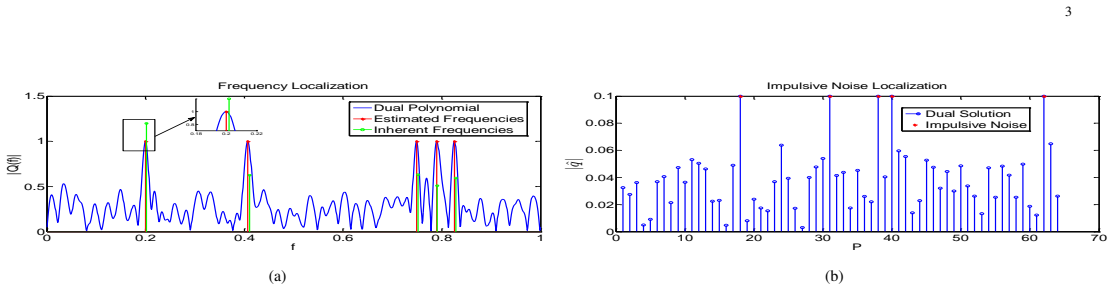
The load-bearing object is the dual polynomial $Q(f)$ built from the SDP dual variable $\hat{q}$, together with the semidefinite constraint that controls its sup norm. Positive trigonometric polynomial theory converts the infinite-dimensional constraint $\|q\|_A^* \le 1$ into a linear matrix inequality involving a Hermitian Toeplitz matrix $Q_0$ with trace constraints $\operatorname{tr}[\Theta_k Q_0] = \delta_k$, yielding the SDP (8). The dual variable then acts as a certificate: contact points $|Q(f)| = 1$ locate the continuous frequencies, and saturation of the $\ell^\infty$ bound $|\hat{q}| = \lambda$ locates impulsive noise.
What would settle it
Solve the SDP (8) for $P = 64$ with a single true frequency $f = 0.37$ and no impulsive noise, then evaluate the dual polynomial: the true $f$ should be a contact point $|Q(f)| = 1$. If the even-$P$ reindexing $J = \{-m, \dots, m\}$ is not equivalent to the original $0, \dots, P-1$ indexing, the contact point will be displaced or missing.
Extended reading notes
Core claim
The paper's central claim is that the dual of the penalized atomic norm minimization, reformulated as the semidefinite program (8), simultaneously recovers the sparse time-dispersive OFDM channel and the support of impulsive noise. Under the observation model $y = h + w + z$, where $h$ is a sum of sinusoidal atoms at continuous frequencies $f_k$ and $z$ is sparse on the pilot index set, the dual optimum $\hat{q}$ defines a trigonometric polynomial $Q(f) = \sum_{k=-m}^{m} \hat{q}(k) e^{j2\pi f k}$. The channel frequencies are estimated as the points where $|Q(f)| = 1$, the impulsive-noise support as the indices where $|\hat{q}| = \lambda$, and the path gains then follow from a least-squares fit. The authors support this claim with simulations showing simultaneous localization of both entities and with phase-transition plots for $P = 64$ and $P = 128$ pilots.
Load-bearing premise
For even numbers of pilots, the paper assumes without proof that the pilot indexes $0, \dots, P-1$ can be re-centered as $-m, \dots, m$ with no loss or reordering of the measurements; if that reindexing is not equivalent, the SDP solved is not the stated estimation problem.
Editorial extensions
If this is right
- Channel delays are estimated on a continuous dictionary, so the basis-mismatch error of grid-based compressed sensing is removed.
- One SDP simultaneously gives the channel frequency support and the impulsive-noise support, so no separate blanking or nonlinearity block is needed before demodulation.
- The estimator's success depends on the number of scatters $s$, impulsive entries $r$, and pilots $P$, rather than on the statistical power of the impulse noise.
- Once the frequencies are known, the path gains are obtained by least squares, and the whole channel estimate is available at polynomial-time cost $O(P^3)$.
Reading between the lines
- The dual-polynomial contact rule suggests a direct statistical support test: count exceedances of $|Q(f)| = 1$ or $|\hat{q}| = \lambda$ and compare against a threshold calibrated by the Gaussian variance, though the paper does not derive false-alarm rates.
- Because the method estimates frequencies on $[0,1)$ without a grid, the same dual construction could carry to two-dimensional delay-Doppler estimation if the atomic set is replaced by time-frequency atoms; this is not developed in the paper.
- The phase-transition plots define an empirical recoverable region in the $(s,r)$ plane, but the paper gives no proof of a phase transition; proving one under a minimum-separation condition would turn the empirical region into a guarantee.
- The even-$P$ reindexing deserves direct numerical scrutiny: for $P = 64$ or $P = 128$ the SDP (8) may be solving a symmetric-index observation model rather than the original pilot model, and the paper offers no construction proving they coincide.
Signed reviews
Editorial analysis
A structured set of objections, weighed in public.
Referee Report
Summary. The manuscript proposes a penalized atomic norm minimization (PANM) estimator for pilot-aided OFDM channel estimation when the received pilots are corrupted by both Gaussian and impulsive noise. The authors formulate a convex primal problem (6), derive its dual (7), and then convert the dual into a semidefinite program (8) using positive trigonometric polynomial theory. They propose to estimate the continuous multipath delays from the points where the dual polynomial Q(f) satisfies |Q(f)|=1 and to localize impulsive noise from the entries of the dual solution with |q|=lambda. The numerical section reports simultaneous frequency and impulse localization, phase-transition diagrams for P=64 and P=128, and an MSE comparison against penalized l1 minimization.
Significance. If the SDP equivalence were correct, the paper would offer a gridless approach to jointly estimate a sparse continuous-domain channel and an impulsive-noise support, avoiding basis mismatch and bypassing the need for detailed impulsive-noise power modeling. The experimental design is reasonable in spirit: ground-truth MSE is used, phase transitions are averaged over 100 trials, and an external PLM benchmark is included. The main claimed contribution, however, rests entirely on the exactness of the SDP reformulation in Eq. (8), and that reformulation contains a load-bearing indexing error. As written, the estimator tested in Section V is not the exact dual of the stated PANM. No recovery theorem is provided; the contribution is algorithmic and experimental, and it is incremental relative to Refs. [8] and [9].
major comments (3)
- [IV, Eqs. (8) and (9)] The SDP (8) is not equivalent to the dual problem (7) as written. After the 'without loss of generality' reindexing J={-m,...,m}, the trace constraints tr[Theta_k Q0]=delta_k are imposed only for k in J, but in the PTP/Gram-matrix parametrization the index k is a Toeplitz lag, not a vector-entry index. For a P-by-P matrix the lags range over {-(P-1),...,P-1}; constraining only k with |k|<=m leaves, for example, the lags k=+(m+1),...,+(P-1) and their negatives unconstrained, and no argument shows these are redundant. For even P the mismatch is worse: with m=P/2-1 the set J has P-1 elements, while y and q are P-dimensional, so the constraint system and the dual polynomial in (9) omit one measurement coordinate. Since all experiments in Section V use P=64 and P=128, the estimator that was implemented and tested is not the dual of the stated PANM. The reindexing should be applied only to the atomic vectors, while the trace constraints should run over the lags 0,...,P-1, or equivalently over the full difference set of the reindexed vector positions. This is a fixable formulation error, but it is load-bearing because it invalidates the empirical claims as stated.
- [III Eq. (6) and IV Eq. (7)] There is a dimensional inconsistency in the noise constraint. The paper denotes the noise variance by sigma_np^2 in Section II and uses that same symbol in the SNR definition SNR=10 log10(1/sigma_np^2) in Section V; Eq. (6) uses the right-hand side sigma_np^2. The dual objective in Eq. (7), however, contains sigma_np ||q||_2. If the primal constraint is ||y-h~-z~||_2 <= sigma_np^2, the dual should contain sigma_np^2 ||q||_2; if the intended primal constraint is ||y-h~-z~||_2 <= sigma_np, then Eq. (6) should be changed. This discrepancy changes the numerical estimator and all simulation results that depend on the noise-level parameter, so it must be corrected and the experiments rerun.
- [V, Experiments; IV recovery procedure] The paper does not specify how the frequencies are extracted from the dual polynomial Q(f) in the noisy experiments. The stated rule 'find values of f for which |Q(f)|=1' is an exact condition; under Gaussian noise the estimated dual polynomial does not necessarily attain the value 1, so a thresholding or peak-picking rule is needed. Without specifying that rule, the simulation results in Figs. 1-3 cannot be reproduced, and the reported phase-transition success rates are unverifiable. The authors should state the exact detection criterion, for example local maxima of |Q(f)| above a threshold or interpolation to |Q(f)|=1, and describe how the number of detected sources is determined.
minor comments (6)
- [II, Eq. (2)] The subscript notation y_n(n) appears to be a typo; the received signal should be denoted simply y(n) or consistent with the later vector notation.
- [II and IV, notation] The symbol J is overloaded: it is defined as {0,...,P-1} in Section II and then redefined as {-m,...,m} in Section IV. The paper should either use distinct names or explicitly give the bijection between the two index sets, especially because the reindexing is central to the SDP formulation.
- [IV, Eq. (7)] The paper asserts that Slater's condition holds for the primal-dual pair, but gives no justification; since sigma_np>0 in all experiments the condition is likely satisfied, yet a brief verification would make the duality argument rigorous.
- [V, first experiment text] There are small typos: 'forall i={1,...,s}' should be 'forall k in {1,...,s}', and 'The gain of each frequencies can be calculated by (IV)' should refer to the least-squares procedure described at the end of Section IV rather than to an equation.
- [V, parameter choice] The regularization parameter lambda=0.1 is fixed without sensitivity analysis. The phase-transition and MSE results can depend strongly on lambda, so the paper should include at least a brief study of the influence of lambda or a justification for the chosen value.
- [VI, complexity claim] The statement that solving (8) with CVX has complexity O(P^3) is not supported; an interior-point solver for a P-by-P variable SDP with P constraints typically has complexity far exceeding a single O(P^3) bound. The complexity claim should be corrected or removed.
Circularity Check
No circularity: the derivation is self-contained; the even-P index-set mismatch is a correctness concern, not a circular one.
full rationale
The paper's derivation chain is not circular. The recovery rules—estimating frequencies from |Q(f)|=1 and impulsive-noise support from |q|=λ—are consequences of the standard dual-certificate construction for atomic-norm problems and complementary slackness; the estimated quantities are not used to define the optimization problem. The SDP (8) is obtained from the dual (7) using positive trigonometric polynomial theory from Dumitrescu [11], an external reference, and the atomic-norm SDP characterization is taken from Tang et al. [8], also external. No self-citation is load-bearing: the authors do not rely on their own prior uniqueness theorems or ansatze to justify the central claim. The parameter λ=0.1 is a fixed regularization choice, not a fitted input that is later renamed as a prediction, and performance is evaluated against synthetic ground truth and compared with penalized l1 minimization [16], so success is not forced by construction. The even-P index-set issue (for even P, m=P/2-1 gives |J|=P-1 while y and q are P-dimensional) is an internal consistency or correctness flaw in the tested regime, but it does not make any derived quantity equal to an input by definition, nor does it involve a fitted parameter masquerading as a prediction. Therefore no circular step is present, and the appropriate circularity score is 0.
Assumptions & free parameters
free parameters (1)
- lambda (regularization parameter) =
0.1
assumptions (6)
- domain assumption The baseband channel is a sparse combination of s Diracs with s small and delays in [0, Lcp Ts - Tg).
- domain assumption Impulsive noise z is exactly sparse with r nonzero entries on the pilot index set; entries outside the support are zero.
- domain assumption Gaussian noise variance sigma_np is known exactly.
- domain assumption Sources satisfy the minimum separation |f_k - f_j| >= 1.5/P.
- standard math Slater's condition holds so the dual of (6) has zero gap.
- standard math The PTP theory and Tang et al.'s Toeplitz SDP exactly characterize the atomic norm and its dual.
Cite this review
Pith. "Pith review of Eliminating Impulsive Noise in Pilot-Aided OFDM Channels via Dual of Penalized Atomic Norm." pith.science (2026). https://pith.science/paper/6WLOW27Q
@misc{pith2026190807729,
  author       = {Pith},
  title        = {Pith review of: Eliminating Impulsive Noise in Pilot-Aided OFDM Channels via Dual of Penalized Atomic Norm},
  year         = {2026},
  howpublished = {\url{https://pith.science/paper/6WLOW27Q}},
  note         = {Machine review of arXiv:1908.07729}
}
read the original abstract
In this paper, we propose a novel estimator for pilot-aided orthogonal frequency division multiplexing (OFDM) channels in an additive Gaussian and impulsive perturbation environment. Due to sensor failure which might happen because of man-made noise, a number of measurements in high rate communication systems is often corrupted by impulsive noise. High power impulsive noise is generally an obstacle for OFDM systems as valuable information will be completely lost. To overcome this concern, an objective function based on a penalized atomic norm minimization (PANM) is provided in order to promote the sparsity of time dispersive channels and impulsive noise. The corresponding dual problem of the PANM is then converted to tractable semidefinite programming. It has shown that one can simultaneously estimate the time dispersive channels in a continuous dictionary and the location of impulsive noise using the dual problem. Several numerical experiments are carried out to evaluate the performance of the proposed estimator.
Figures


Reference graph
Works this paper leans on
-
[8]
Compressed sensing off the grid,
G. Tang, B. N. Bhaskar, P. Shah, and B. Recht, “Compressed sensing off the grid,” IEEE Trans. Inf. Theory , vol. 59, no. 11, pp. 7465–7490, Nov. 2013
2013
-
[9]
Atomic norm denoising with applications to line spectral estimation,
B. N. Bhaskar, G. Tang, and B. Recht, “Atomic norm denoising with applications to line spectral estimation,” IEEE Transactions on Signal Processing, vol. 61, no. 23, pp. 5987–5999, 2013
work page 2013
-
[1]
Measurements and models of radio frequency impulsive noise for indoor wireless communications,
K. L. Blackard, T. S. Rappaport, and C. W. Bostian, “Measurements and models of radio frequency impulsive noise for indoor wireless communications,” IEEE J. Sel. Areas commun , vol. 11, no. 7, pp. 991– 1001, Sep.1993
work page 1993
-
[2]
Analysis and comparison of several simple impulsive noise mitigation schemes for OFDM receivers,
S. V . Zhidkov, “Analysis and comparison of several simple impulsive noise mitigation schemes for OFDM receivers,” IEEE Trans Commun , vol. 56, no. 1, pp. 5–9, Jan. 2008
work page 2008
-
[3]
Pilot-based channel estimation for OFDM systems by tracking the delay-subspace,
O. Simeone, Y . Bar-Ness, and U. Spagnolini, “Pilot-based channel estimation for OFDM systems by tracking the delay-subspace,” IEEE Wireless Commun, vol. 3, no. 1, pp. 315–325, Jan. 2004
work page 2004
-
[4]
Multiple emitter location and signal parameter estimation,
R. Schmidt, “Multiple emitter location and signal parameter estimation,” IEEE Trans. Antennas Propag , vol. 34, no. 3, pp. 276–280, Mar. 1986
work page 1986
-
[5]
P. Cheng, Z. Chen, Y . Rui, Y . J. Guo, L. Gui, M. Tao, and Q. Zhang, “Channel estimation for OFDM systems over doubly selective channels: A distributed compressive sensing based approach,” IEEE Trans Com- mun, vol. 61, no. 10, pp. 4173–4185, Oct. 2013
work page 2013
-
[6]
Sensitivity to basis mismatch in compressed sensing,
Y . Chi, L. L. Scharf, A. Pezeshki, and A. R. Calderbank, “Sensitivity to basis mismatch in compressed sensing,” IEEE Trans. Signal Process , vol. 59, no. 5, pp. 2182–2195, May. 2011
work page 2011
Show all 17 references
-
[7]
Estimation of sparse time dispersive channels in pilot aided OFDM using atomic norm,
S. Pejoski and V . Kafedziski, “Estimation of sparse time dispersive channels in pilot aided OFDM using atomic norm,” IEEE Wireless Commun. Lett , vol. 4, no. 4, pp. 397–400, Aug. 2015
2015
-
[10]
Quantized spectral compressed sensing: Cramer– rao bounds and recovery algorithms,
H. Fu and Y . Chi, “Quantized spectral compressed sensing: Cramer– rao bounds and recovery algorithms,” IEEE Transactions on Signal Processing, vol. 66, no. 12, pp. 3268–3279, 2018
2018
-
[11]
Dumitrescu, Positive trigonometric polynomials and signal processing applications
B. Dumitrescu, Positive trigonometric polynomials and signal processing applications. Springer, 2017
2017
-
[12]
Compressive estimation of doubly selective channels in multicarrier systems: Leakage effects and sparsity-enhancing processing,
G. Taubock, F. Hlawatsch, D. Eiwen, and H. Rauhut, “Compressive estimation of doubly selective channels in multicarrier systems: Leakage effects and sparsity-enhancing processing,” IEEE J. Sel. Top. Signal Process, vol. 4, no. 2, pp. 255–271, Apr. 2010
2010
-
[13]
A comparison of pilot-aided channel estimation methods for OFDM systems,
M. Morelli and U. Mengali, “A comparison of pilot-aided channel estimation methods for OFDM systems,” IEEE Trans. Signal Process , vol. 49, no. 12, pp. 3065–3073, Dec. 2001
2001
-
[14]
Boyd and L
S. Boyd and L. Vandenberghe, Convex optimization. Cambridge univer- sity press, 2004
2004
-
[15]
CVX: Matlab software for disciplined convex programming,
M. Grant, S. Boyd, and Y . Ye, “CVX: Matlab software for disciplined convex programming,” 2008
2008
-
[16]
Signal recovery from incomplete measurements in the presence of outliers,
B. Popilka, S. Setzer, and G. Steidl, “Signal recovery from incomplete measurements in the presence of outliers,” Inv. Prob. Imaging , vol. 1, no. 4, p. 661, Dec. 2007
2007
-
[17]
Super-resolution delay-doppler estimation for OFDM passive radar,
L. Zheng and X. Wang, “Super-resolution delay-doppler estimation for OFDM passive radar,” IEEE Trans. Signal Process , vol. 65, no. 9, pp. 2197–2210, May. 2017
2017
Reviewed August 14, 2026 · model on record in the stance chip above.
Discussion (0). Continue with ORCID to comment.