REVIEW 2 major objections 3 minor 6 cited by
Light-Cone Sum Rules for $B\to K\pi$ Form Factors and Applications to Rare Decays
T0 review · 2 major / 3 minor · reviewed 2026-08-14 · deepseek-v4-flash
Pith's one-line read The K* width rescales every B→K* form factor by a universal 9 percent.
desk verdict Solid LCSR paper with a real universal finite-width effect; the 20% rate enhancement is directionally right but the quoted ±0.01 on W_K* undersells the line-shape model uncertainty. read the letter →
The pith
A machine-rendered reading of the paper's core claim, the machinery that carries it, and where it could break.
The reading
What carries the argument
The carrying object is the light-cone sum rule for the correlation function of a $\bar d\gamma_\mu s$ interpolating current with a $b\to s$ (axial)vector or tensor current, written in terms of $B$-meson light-cone distribution amplitudes (the momentum-fraction distributions of the light quark in the $B$ meson on the light cone). Projecting out the $P$-wave gives equations of the form $\int_{s_{\rm th}}^{s_0} ds\, e^{-s/M^2}\,\omega_i(s,q^2)\, f_+^*(s)\, F_i^{(\ell=1)}(s,q^2)=P_i^{\rm OPE}(q^2,\sigma_0,M^2)$ for each form factor. The finite-width result comes from the ratio $W_{K^*} = 2m_{K^*} f_{K^*}\, e^{-m_{K^*}^2/M^2}/I_{K^*}(s_0,M^2)$, where $I_{K^*}$ is the integral over the $K\pi$ invariant mass of $|f_+(s)|^2$ weighted by the Breit-Wigner line shape of the $K^*(892)$. Universality holds because $I_{K^*}$ multiplies every form factor with the same coefficient, so its finite-width correction factorizes and cancels in the ratio to the narrow-width limit; the $z$-expansion then provides the $q^2$ dependence.
What would settle it
Take the measured $\tau\to K\pi\nu$ spectrum (or a future higher-statistics version), extract $|f_+(s)|^2$ directly, recompute the integral $I_{K^*}(s_0,M^2)$, and compare the resulting $W_{K^*}$ with $1.09\pm0.01$; a deviation beyond the propagation of the $s_0$ and $M^2$ uncertainty would invalidate the claimed universality. Alternatively, a lattice QCD calculation of the P-wave $B\to K\pi$ form factor integrated over the $K^*(892)$ window, compared against the narrow-width form factor, would settle the ratio directly.
Extended reading notes
Core claim
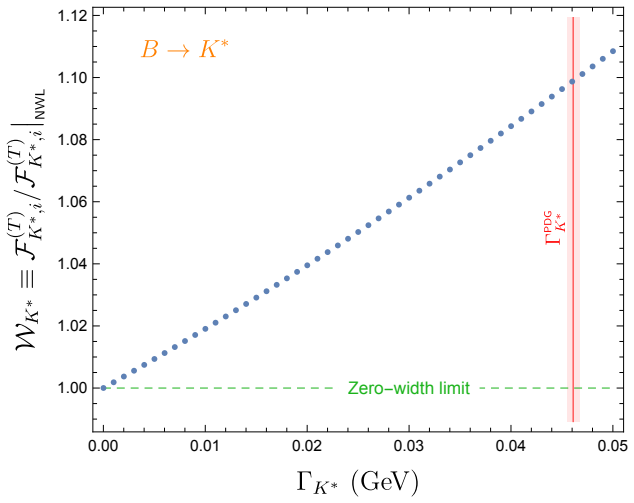
The paper claims that a non-vanishing $K^*(892)$ width produces a universal correction to every $B\to K^*$ form factor obtained from the new sum rules: $W_{K^*}=1.09\pm0.01$ (Eq. 99), independent of the form-factor helicity and of $q^2$. Equivalently, the factorizable parts of $B\to K^*X$ rates are increased by about 20% relative to the narrow-width approximation (Eq. 113). The paper further claims that its $B\to K\pi$ sum rules reduce analytically to the known $B\to K^*$ sum rules in the narrow-width limit, and that the updated operator-product expansion, with two- and three-particle higher-twist $B$-meson distribution amplitudes, yields $B\to K^*$ form factors with lower central values than earlier determinations, mainly because of the twist-four two-particle contribution $g_+(\omega)$. It also obtains a lower effective threshold $s_0$ from a two-point sum rule whose hadronic side uses the measured $K\pi$ spectral density.
Load-bearing premise
The numerical value $W_{K^*}=1.09\pm0.01$ rests on the hadronic model for the $K\pi$ vector form factor $f_+(s)$ in the $K^*(892)$ resonance region, whose line shape is taken from fits to the $\tau\to K\pi\nu$ spectrum; if that line shape is wrong, the universal factor changes.
Editorial extensions
If this is right
- Factorizable rates for $B\to K^*\ell\ell$, $B\to K^*\nu\nu$, $B\to K^*\gamma$, and related modes computed from narrow-width LCSR form factors should be multiplied by $|W_{K^*}|^2\simeq 1.20$.
- Form-factor-ratio observables, such as $P'_5$ in $B\to K^*\mu\mu$, are insensitive to the finite-width correction because the factor cancels.
- Updated narrow-width predictions for the $B\to K^*$ form factors at $q^2=0$ are lower than previous LCSR and lattice central values, with the twist-four $g_+(\omega)$ contribution identified as the main cause.
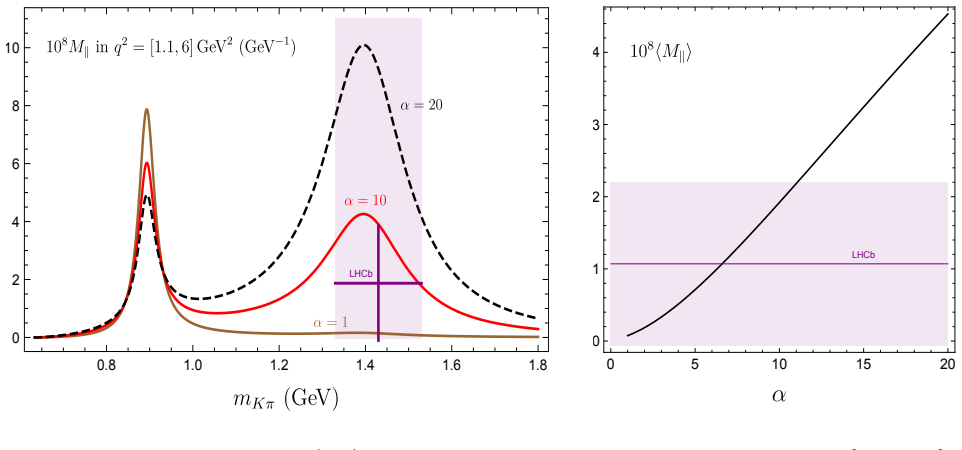
- Measurements of $B\to K\pi\mu\mu$ angular moments in the $K^*(1410)$ window constrain the relative $K^*(1410)$ contribution $\alpha$; current data give $\alpha\lesssim 4$--$5$, which caps any $K^*(1410)$-driven suppression of the $B\to K^*$ form factors at about ten percent.
Reading between the lines
- Editorial extension: the same ratio construction should apply to the $\rho$ channel, where the paper notes a similar width effect for $B\to\rho$ form factors; a quantitative $W_\rho$ from the pion form factor would shift $B\to\rho\ell\ell$ and $B\to\rho\gamma$ predictions in the same direction.
- Editorial extension: because $W_{K^*}$ is $q^2$- and helicity-independent, global fits of $b\to s\ell\ell$ data that normalise to branching fractions will have their New Physics pull weakened by roughly the 20% rate increase, a consequence the paper does not quantify.
- Editorial extension: a precision extraction of $f_+(s)$ from future $\tau\to K\pi\nu$ data could replace the resonance model used here in $I_{K^*}$, turning Eq. (99) into a first-principles prediction with a smaller model error.
Signed reviews
Editorial analysis
A structured set of objections, weighed in public.
Referee Report
Summary. The paper derives light-cone sum rules (LCSRs) for the P-wave B→Kπ form factors using B-meson light-cone distribution amplitudes, covering vector, axial-vector, timelike-helicity, and tensor currents. The sum rules are shown to reduce analytically to the known B→K* LCSRs in the narrow-width limit, and the OPE side is updated with a more complete set of two- and three-particle twist-4 contributions. The numerical analysis determines the B→K* form factors in the narrow-width limit, finding central values consistent with but lower than previous determinations, and introduces a universal finite-width factor W_K* = 1.09 ± 0.01 that increases factorizable B→K*X rates by about 20%. Applications include the angular distribution of B→Kπℓℓ and constraints on the K*(1410) contribution from LHCb data.
Significance. If the central claim holds, the paper provides a systematic way to go beyond the narrow-width approximation in LCSR determinations of B→K* form factors, with a concrete phenomenological consequence for b→sℓℓ rate predictions. The analytic derivation is careful: the narrow-width reduction is shown explicitly, the OPE coefficients are documented, the numerical inputs are propagated through Gaussian scans, and the results are cross-checked against earlier LCSR determinations. The use of Belle τ→Kπν data to constrain the Kπ vector form factor and the threshold parameter is a useful step. The main weakness is that the headline finite-width correction W_K* is assigned an uncertainty that does not yet include the model dependence of the Kπ line shape, which is directly relevant to the claimed 20% rate enhancement.
major comments (2)
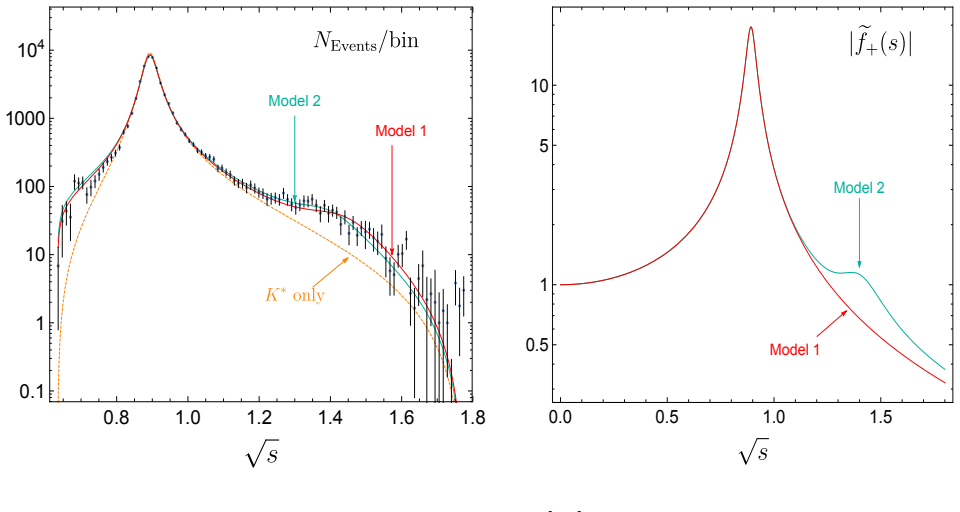
- [Section 5.6, Eqs. (45) and (99)] The quoted result W_K* = 1.09 ± 0.01 propagates only variations of the sum-rule parameters (m_K*, Γ_K*, s0, M²) through the integral I_K*(s0,M²), but not the uncertainty in the Breit-Wigner model of the Kπ vector form factor f+(s), Eq. (40), from which I_K* is computed. The difference between Belle Model 1 and Model 2 in Table 8 already shifts W_K* by about 0.005, i.e. half the quoted error, and plausible alternative line shapes (barrier factors, coupled channels, different s-dependent widths) are not probed. Since the 20% rate enhancement is the paper's headline phenomenological claim, the uncertainty in W_K* needs to include the f+(s) model dependence or be stated as a model-dependent estimate.
- [Section 5.6, Eq. (100) and Appendix F.2] The linearized expression W_K* = 1 − (Γ_K*/m_K*) Δ_K*(s0,M²) is presented as a robustness check that is 'less dependent on the details of the hadronic model', but it is not an independent cross-check: its O(Γ) coefficient inherits the assumed s-dependent width through ρ'(m_R²) in Eq. (59). For a fixed-width Breit-Wigner, ρ'(m_R²) would be 1/(2m_R²) ≈ 0.62 GeV⁻², whereas Eq. (59) gives ρ'(m_K*²) ≈ 3.5 GeV⁻², changing the sign and size of the logarithmic term in Δ_R, Eq. (56). The claimed robustness of the linearized check is therefore not established by the derivation.
minor comments (3)
- [Section 7, Conclusions] The text refers to 'the K∗(980) and the K∗(1410)' in the resonance model and later to 'the K∗(890) contribution'; these should be K∗(892) (and, where intended, K*(800) for the scalar), since the vector P-wave Kπ resonance under discussion is the K∗(892).
- [Figure 2 caption] The caption states that the red vertical band corresponds to the physical (PDG) width, while the numerical input in Table 2 uses the Belle fit values m_K* = 895.4(2) MeV and Γ_K* = 46.1(6) MeV; the caption should identify the source of the band consistently.
- [Section 5.4 and Appendix E] The 42×42 correlation matrix is said to be available from the authors upon request; for reproducibility it would be preferable to include it as an ancillary file with the submission, as is done for the OPE coefficients.
Circularity Check
No significant circularity: the finite-width correction is computed from external inputs; self-citations are rederived and non-load-bearing.
full rationale
The paper's central new result, the universal finite-width factor W_K* = 1.09 ± 0.01 in Eq. (99), is not fitted to B->K* data and is not equivalent to any input by construction. It is defined in Eq. (97) as the ratio of the finite-width integral I_K*(s0,M^2) to its narrow-width limit; the OPE side of the sum rules cancels in this ratio, and the numerical value is obtained by evaluating the hadronic integral with the externally measured Belle tau->K pi nu K pi vector form factor (Eq. (40), Section 5.2), PDG masses, and the SVZ-determined threshold s0. The universality in helicity and q^2 follows algebraically from the one-resonance form of the sum rule (Eq. (96)), where the width-dependent integral I_K* is common to all form-factor helicities; this is a transparent derivation, not a self-fulfilling definition. The narrow-width limit is rederived analytically (Section 4.2, Appendix A) rather than imported, and the OPE side is recalculated from B-meson LCDAs with stated inputs. Citations to the authors' earlier Refs. [12,19] supply the method and the phase-unitarity condition, but the text re-derives the dispersion-relation framework and the NWL reduction explicitly, so these self-citations are not load-bearing in an unverified way. The skeptic's concern that W_K* inherits the Breit-Wigner line-shape model in Eq. (36) is a legitimate model-uncertainty issue, but it is not circularity: the model parameters come from external Belle data, and different line shapes would change the estimate without making the derivation tautological. No step reduces a claimed prediction to a fitted parameter renamed as a prediction, and no uniqueness theorem or ansatz is smuggled in solely via self-citation.
Assumptions & free parameters
free parameters (6)
- λB (inverse moment of B-meson LCDA) =
460 ± 110 MeV
- R (ratio of LCDA moments λE²/λH²) =
0.4 (+0.5, -0.3)
- Effective threshold s0 =
1.26 ± 0.18 GeV² (M² = 1 GeV²); 1.31 ± 0.12 (M² = 1.25); 1.35 ± 0.09 (M² = 1.5)
- Borel mass M² =
1.0, 1.25, 1.5 GeV²
- f_K* (K* decay constant) =
206 MeV (Model 1), 203 MeV (Model 2)
- f_K*(1410) (excited resonance decay constant) =
85 MeV
assumptions (7)
- domain assumption Quark-hadron duality: the hadronic spectral function integrated up to s0 equals the OPE dispersion integral after Borel transformation.
- domain assumption Light-cone OPE of the correlation function in terms of B-meson LCDAs up to twist-4, neglecting NLO alpha_s corrections.
- domain assumption The three models for B-meson LCDAs (Model I, IIA, IIB) from Ref. [24], with EOM constraints, describe the two- and three-particle DAs.
- domain assumption The Kpi vector form factor f+(s) is a sum of Breit-Wigner resonances with energy-dependent widths, as in Eq. (40), with parameters from the Belle tau → K pi nu fit.
- ad hoc to paper The phase convention Eq. (47) tan(delta_Kpi - phi_R) = sqrt(s) Gamma_R/(m_R^2 - s) enforces Im[F_i^(1) f+^*] = 0 per resonance.
- domain assumption Isospin symmetry: the b→s current is an isosinglet and the I = 3/2 component of Kpi does not contribute, giving the 3/2 factor in Eq. (21).
- ad hoc to paper For the K*(1410) constraints (Section 6.4), non-local hadronic contributions H are approximated by form factors times effective Wilson coefficients at leading order.
Cite this review
Pith. "Pith review of Light-Cone Sum Rules for $B\to K\pi$ Form Factors and Applications to Rare Decays." pith.science (2026). https://pith.science/paper/6WR7AUZ7
@misc{pith2026190802267,
  author       = {Pith},
  title        = {Pith review of: Light-Cone Sum Rules for $B\to K\pi$ Form Factors and Applications to Rare Decays},
  year         = {2026},
  howpublished = {\url{https://pith.science/paper/6WR7AUZ7}},
  note         = {Machine review of arXiv:1908.02267}
}
abstract
We derive a set of light-cone sum rules relating the hadronic form factors relevant for $B\to K\pi\ell^+\ell^-$ decays to the $B$-meson light-cone distribution amplitudes (LCDAs). We obtain the sum rule relations for all $B\to K\pi$ form factors of (axial)vector and (pseudo)tensor $b\to s$ currents with a $P$-wave $K\pi$ system. Our results reduce to the known light-cone sum rules for $B\to K^*$ form factors in the limit of a single narrow-width resonance. We update the operator-product expansion for the underlying correlation function by including a more complete set of $B$-meson LCDAs with higher twists, and produce numerical results for all $B\to K^*$ form factors in the narrow-width limit. We then use the new sum rules to estimate the effect of a non-vanishing $K^*$ width in $B\to K^*$ transitions, and find that this effect is universal and increases the factorizable part of the rate of $B\to K^*X$ decays by a factor of $20\%$. This effect, by itself, goes in the direction of increasing the current tension in the differential $B\to K^*\mu\mu$ branching fractions. We also discuss $B\to K\pi$ transitions outside the $K^*$ window, and explain how measurements of $B\to K\pi\ell\ell$ observables above the $K^*$ region can be used to further constrain the $B\to K^*$ form factors.
Figures

Figures from the paper (2 more)

Forward citations
Cited by 6 Pith papers
-
Light-cone sum rules with $B$-meson distribution amplitudes for the $B\to p$ form factors in $B$-mesogenesis models
New light-cone sum-rule form factors predict B+→p + dark-antiproton rates and lower limits showing that Belle II/BaBar bounds must reach 10⁻⁸–10⁻⁷ for a decisive test of B-mesogenesis.
-
Investigating non-local contributions in $B_{s} \to \phi \bar{\ell} \ell$ including higher-twist effects
Including twist-5 and twist-6 B_s-meson distribution amplitudes enhances the charm-loop non-local form factors in B_s to phi l+l- by about an order of magnitude, producing a larger but still Standard-Model-consistent ...
-
Precision calculations of $B\to K^*$ form factors from SCET sum rules beyond leading-power contributions
New subleading-power corrections to B to K* form factors from SCET sum rules yield SM branching fractions BR(Bbar0 to Kbar*0 nu nubar)=8.09(96)e-6 and F_L=0.44(4).
-
Improved global determination of two-meson distribution amplitudes from multi-body $B$ decays
An improved global fit of two-meson distribution amplitudes in the PQCD framework yields better convergence of the Gegenbauer expansion and resolves the Bs→K*Kbar* polarization puzzle, though the headline results are ...
-
Analysis of the $B_{(s)}\rightarrow T(J^P=2^-)$ transition in light cone QCD sum rules
LCSR computation of B(s) -> T(2^-) l+ l- form factors and branching ratios using B-meson DAs up to twist-4, yielding BRs of order 10^-7 to 10^-8.
-
Summary of Working Group 5: Physics with Heavy Flavours
These conference proceedings record the heavy-flavour physics results and theoretical interpretations presented at DIS2019, organized into spectroscopy, production, top physics, and decays.
Reference graph
Works this paper leans on
-
[1]
Global analysis of b→s𝓁𝓁 anoma- lies,
S. Descotes-Genon, L. Hofer, J. Matias and J. Virto, “Global analysis of b→s𝓁𝓁 anoma- lies,” JHEP 1606, 092 (2016) [arXiv:1510.04239 [hep-ph]]
arXiv 2016
-
[2]
Review of Lepton Universality tests in B decays,
S. Bifani, S. Descotes-Genon, A. Romero Vidal and M. H. Schune, “Review of Lepton Universality tests in B decays,” J. Phys. G 46 (2019) no.2, 023001 [arXiv:1809.06229 [hep-ex]]
arXiv 2019
-
[3]
Review of lattice results concerning low-energy particle physics,
S. Aoki et al. , “Review of lattice results concerning low-energy particle physics,” Eur. Phys. J. C 77, no. 2, 112 (2017) [arXiv:1607.00299 [hep-lat]]
arXiv 2017
-
[4]
Σ +→ pγ Decay in QCD,
I.I. Balitsky, V.M. Braun and A.V. Kolesnichenko, “Σ +→ pγ Decay in QCD,” Sov. J. Nucl. Phys. 44 (1986) 1028
1986
-
[5]
Radiative Decay Σ +→pγ in Quan- tum Chromodynamics,
I.I. Balitsky, V.M. Braun and A.V. Kolesnichenko, “Radiative Decay Σ +→pγ in Quan- tum Chromodynamics,” Nucl. Phys. B 312 (1989) 509
1989
-
[6]
B meson exclusive decays into baryons,
V.L. Chernyak and I.R. Zhitnitsky, “B meson exclusive decays into baryons,” Nucl. Phys. B 345 (1990) 137
1990
-
[7]
QCD Calculation of the $B \rightarrow \pi,K$ Form Factors
V. M. Belyaev, A. Khodjamirian and R. Ruckl, “QCD calculation of the B→π,K form factors,” Z. Phys. C 60, 349 (1993) [hep-ph/9305348]
work page Pith review arXiv 1993
-
[8]
Light-cone sum rules for B→π form factors revisited,
G. Duplancic, A. Khodjamirian, T. Mannel, B. Melic and N. Offen, “Light-cone sum rules for B→π form factors revisited,” JHEP 0804, 014 (2008) [arXiv:0801.1796 [hep-ph]]
arXiv 2008
Show all 91 references
-
[9]
Exclusive semileptonic and rare B meson decays in QCD,
P. Ball and V. M. Braun, “Exclusive semileptonic and rare B meson decays in QCD,” Phys. Rev. D 58, 094016 (1998) [hep-ph/9805422]
1998 arXiv
-
[10]
Bd,s→ρ,ω,K ∗,φ decay form-factors from light-cone sum rules revisited,
P. Ball and R. Zwicky, “ Bd,s→ρ,ω,K ∗,φ decay form-factors from light-cone sum rules revisited,” Phys. Rev. D 71, 014029 (2005) [hep-ph/0412079]
2005 arXiv
-
[11]
B-meson distribution amplitude from the B→π form-factor,
A. Khodjamirian, T. Mannel and N. Offen, “B-meson distribution amplitude from the B→π form-factor,” Phys. Lett. B 620 (2005) 52 [hep-ph/0504091]
2005 arXiv
-
[12]
Form-factors from light-cone sum rules with B-meson distribution amplitudes,
A. Khodjamirian, T. Mannel and N. Offen, “Form-factors from light-cone sum rules with B-meson distribution amplitudes,” Phys. Rev. D 75, 054013 (2007) [hep-ph/0611193]
2007 arXiv
-
[14]
QCD calculations of B → π,K form factors with higher-twist corrections,
C. D. L, Y. L. Shen, Y. M. Wang and Y. B. Wei, “QCD calculations of B → π,K form factors with higher-twist corrections,” JHEP 1901 (2019) 024 [arXiv:1810.00819 [hep-ph]]. 69
2019 arXiv
-
[15]
B → P and B → V Form Factors from B-Meson Light-Cone Sum Rules beyond Leading Twist,
N. Gubernari, A. Kokulu and D. van Dyk, “ B → P and B → V Form Factors from B-Meson Light-Cone Sum Rules beyond Leading Twist,” JHEP 1901 (2019) 150 [arXiv:1811.00983 [hep-ph]]
2019 arXiv
-
[16]
Precision calculations of B→V form factors in QCD,
J. Gao, C. D. L¨ u, Y. L. Shen, Y. M. Wang and Y. B. Wei, “Precision calculations of B→V form factors in QCD,” arXiv:1907.11092 [hep-ph]
1907 arXiv
-
[17]
Lattice QCD calculation of form factors describing the rare decays B→K∗𝓁+𝓁− and Bs→φ𝓁+𝓁−,
R. R. Horgan, Z. Liu, S. Meinel and M. Wingate, “Lattice QCD calculation of form factors describing the rare decays B→K∗𝓁+𝓁− and Bs→φ𝓁+𝓁−,” Phys. Rev. D 89, no. 9, 094501 (2014) [arXiv:1310.3722 [hep-lat]]
2014 arXiv
-
[18]
B→ V𝓁 +𝓁− in the Standard Model from light-cone sum rules,
A. Bharucha, D. M. Straub and R. Zwicky, “ B→ V𝓁 +𝓁− in the Standard Model from light-cone sum rules,” JHEP 1608, 098 (2016) [arXiv:1503.05534 [hep-ph]]
2016 arXiv
-
[19]
B → ππ Form Factors from Light- Cone Sum Rules with B-meson Distribution Amplitudes,
S. Cheng, A. Khodjamirian and J. Virto, “ B → ππ Form Factors from Light- Cone Sum Rules with B-meson Distribution Amplitudes,” JHEP 1705, 157 (2017) [arXiv:1701.01633 [hep-ph]]
2017 arXiv
-
[20]
Disentangling the Decay Observables in B− → π+π−𝓁−¯ν𝓁,
S. Faller, T. Feldmann, A. Khodjamirian, T. Mannel and D. van Dyk, “Disentangling the Decay Observables in B− → π+π−𝓁−¯ν𝓁,” Phys. Rev. D 89, no. 1, 014015 (2014) [arXiv:1310.6660 [hep-ph]]
2014 arXiv
-
[21]
QCD Factorization Theorem for B → ππ𝓁ν Decays at Large Dipion Masses,
P. B¨ oer, T. Feldmann and D. van Dyk, “QCD Factorization Theorem for B → ππ𝓁ν Decays at Large Dipion Masses,” JHEP 1702, 133 (2017) [arXiv:1608.07127 [hep-ph]]
2017 arXiv
-
[22]
Form factors in ¯B0→ππ𝓁¯ν𝓁 from QCD light-cone sum rules,
C. Hambrock and A. Khodjamirian, “Form factors in ¯B0→ππ𝓁¯ν𝓁 from QCD light-cone sum rules,” Nucl. Phys. B 905, 373 (2016) [arXiv:1511.02509 [hep-ph]]
2016 arXiv
-
[23]
Timelike-helicity B→ ππ form factor from light-cone sum rules with dipion distribution amplitudes,
S. Cheng, A. Khodjamirian and J. Virto, “Timelike-helicity B→ ππ form factor from light-cone sum rules with dipion distribution amplitudes,” Phys. Rev. D96, no. 5, 051901 (2017), [arXiv:1709.00173 [hep-ph]]
2017 arXiv
-
[24]
Higher-twist B-meson Distribution Amplitudes in HQET,
V. M. Braun, Y. Ji and A. N. Manashov, “Higher-twist B-meson Distribution Amplitudes in HQET,” JHEP 1705, 022 (2017) [arXiv:1703.02446 [hep-ph]]
2017 arXiv
-
[25]
Charm-loop effect in B→K(∗)𝓁+𝓁− and B→K∗γ,
A. Khodjamirian, T. Mannel, A. A. Pivovarov and Y.-M. Wang, “Charm-loop effect in B→K(∗)𝓁+𝓁− and B→K∗γ,” JHEP 1009, 089 (2010) [arXiv:1006.4945 [hep-ph]]
2010 arXiv
-
[26]
TheB→Kπ𝓁𝓁 andBs →KK𝓁𝓁 distributions at low hadronic recoil,
D. Das, G. Hiller, M. Jung and A. Shires, “TheB→Kπ𝓁𝓁 andBs →KK𝓁𝓁 distributions at low hadronic recoil,” JHEP 1409, 109 (2014) [arXiv:1406.6681 [hep-ph]]
2014 arXiv
-
[27]
B → Kπ𝓁𝓁 in and outside the K∗ window,
D. Das, G. Hiller and M. Jung, “ B → Kπ𝓁𝓁 in and outside the K∗ window,” arXiv:1506.06699 [hep-ph]. 70
-
[28]
Factorization in B→ Kπ𝓁 +𝓁− decays,
B. Grinstein and D. Pirjol, “Factorization in B→ Kπ𝓁 +𝓁− decays,” Phys. Rev. D 73, 094027 (2006) [hep-ph/0505155]
2006 arXiv
-
[29]
QCD factorization for B→ ππ decays: Strong phases and CP violation in the heavy quark limit,
M. Beneke, G. Buchalla, M. Neubert and C. T. Sachrajda, “QCD factorization for B→ ππ decays: Strong phases and CP violation in the heavy quark limit,” Phys. Rev. Lett. 83, 1914 (1999) [hep-ph/9905312]
1999 arXiv
-
[30]
B→M1M2: Factorization, charming penguins, strong phases, and polarization,
C. W. Bauer, D. Pirjol, I. Z. Rothstein and I. W. Stewart, “ B→M1M2: Factorization, charming penguins, strong phases, and polarization,” Phys. Rev. D 70, 054015 (2004) [hep-ph/0401188]
2004 arXiv
-
[31]
Three-body non-leptonic B decays and QCD factor- ization,
S. Kr¨ ankl, T. Mannel and J. Virto, “Three-body non-leptonic B decays and QCD factor- ization,” Nucl. Phys. B 899, 247 (2015) [arXiv:1505.04111 [hep-ph]]
2015 arXiv
-
[32]
Charmless Non-Leptonic Multi-Body B decays,
J. Virto, “Charmless Non-Leptonic Multi-Body B decays,” PoS FPCP 2016, 007 (2017) [arXiv:1609.07430 [hep-ph]]
2017 arXiv
-
[33]
CP Violation in Multibody B Decays from QCD Factorization,
R. Klein, T. Mannel, J. Virto and K. K. Vos, “CP Violation in Multibody B Decays from QCD Factorization,” JHEP 1710, 117 (2017) [arXiv:1708.02047 [hep-ph]]
2017 arXiv
-
[34]
Analyzing b→ u transitions in semileptonic ¯Bs→K∗+(→Kπ)𝓁−¯ν𝓁 decays,
T. Feldmann, B. M¨ uller and D. van Dyk, “Analyzing b→ u transitions in semileptonic ¯Bs→K∗+(→Kπ)𝓁−¯ν𝓁 decays,” Phys. Rev. D 92, no. 3, 034013 (2015) [arXiv:1503.09063 [hep-ph]]
2015 arXiv
-
[35]
Descotes-Genon, A
S. Descotes-Genon, A. Khodjamirian, J. Virto and K. K. Vos, in preparation
-
[36]
Study of τ−→KSπ−ντ decay at Belle,
D. Epifanov et al. [Belle Collaboration], “Study of τ−→KSπ−ντ decay at Belle,” Phys. Lett. B 654, 65 (2007) [arXiv:0706.2231 [hep-ex]]
2007 arXiv
-
[37]
Review of Particle Physics,
M. Tanabashi et al. (Particle Data Group), “Review of Particle Physics,” Phys. Rev. D 98, 030001 (2018)
2018
-
[38]
Model-independent description of B → π𝓁ν decays and a determination of |Vub|,
C. Bourrely, I. Caprini and L. Lellouch, “Model-independent description of B → π𝓁ν decays and a determination of |Vub|,” Phys. Rev. D 79, 013008 (2009), Erratum: [Phys. Rev. D 82, 099902 (2010)], [arXiv:0807.2722 [hep-ph]]
2009 arXiv
-
[39]
Decay constants of heavy-light vector mesons from QCD sum rules,
P. Gelhausen, A. Khodjamirian, A. A. Pivovarov and D. Rosenthal, “Decay constants of heavy-light vector mesons from QCD sum rules,” Phys. Rev. D 88, 014015 (2013) Erratum: [Phys. Rev. D 89, 099901 (2014)] Erratum: [Phys. Rev. D 91, 099901 (2015)] [arXiv:1305.5432 [hep-ph]]
2013 arXiv
-
[40]
Aoki et al
S. Aoki et al. [Flavour Lattice Averaging Group], arXiv:1902.08191 [hep-lat]. See latest up- date in: http://flag.unibe.ch/Media?action=AttachFile&do=get&target=FLAG webupdate.pdf. 71
1902 arXiv
-
[41]
B-Meson Decay Constants from Improved Lattice Nonrelativistic QCD with Physical u, d, s, and c Quarks,
R. J. Dowdall et al. [HPQCD Collaboration], “B-Meson Decay Constants from Improved Lattice Nonrelativistic QCD with Physical u, d, s, and c Quarks,” Phys. Rev. Lett. 110 (2013) no.22, 222003 [arXiv:1302.2644 [hep-lat]]
2013 arXiv
-
[42]
Mass of the b quark and B -meson decay con- stants from Nf=2+1+1 twisted-mass lattice QCD,
A. Bussone et al. [ETM Collaboration], “Mass of the b quark and B -meson decay con- stants from Nf=2+1+1 twisted-mass lattice QCD,” Phys. Rev. D93 (2016) no.11, 114505 [arXiv:1603.04306 [hep-lat]]
2016 arXiv
-
[43]
B- and D-meson leptonic decay constants from four-flavor lattice QCD,
A. Bazavov et al. , “B- and D-meson leptonic decay constants from four-flavor lattice QCD,” Phys. Rev. D 98 (2018) no.7, 074512 [arXiv:1712.09262 [hep-lat]]
2018 arXiv
-
[44]
New methods for B meson decay constants and form factors from lattice NRQCD,
C. Hughes, C. T. H. Davies and C. J. Monahan, “New methods for B meson decay constants and form factors from lattice NRQCD,” Phys. Rev. D 97 (2018) no.5, 054509 [arXiv:1711.09981 [hep-lat]]
2018 arXiv
-
[45]
The B meson distribution amplitude in QCD,
V. M. Braun, D. Y. Ivanov and G. P. Korchemsky, “The B meson distribution amplitude in QCD,” Phys. Rev. D 69, 034014 (2004) [hep-ph/0309330]
2004 arXiv
-
[46]
Search for B+ → 𝓁+ν𝓁γ decays with hadronic tagging using the full Belle data sample,
A. Heller et al. [Belle Collaboration], “Search for B+ → 𝓁+ν𝓁γ decays with hadronic tagging using the full Belle data sample,” Phys. Rev. D 91, no. 11, 112009 (2015) [arXiv:1504.05831 [hep-ex]]
2015 arXiv
-
[47]
B-meson distribution amplitude from B → γ𝓁ν,
M. Beneke and J. Rohrwild, “ B-meson distribution amplitude from B → γ𝓁ν,” Eur. Phys. J. C 71, 1818 (2011), [arXiv:1110.3228 [hep-ph]]
2011 arXiv
-
[48]
Soft contribution to B→ γ𝓁ν𝓁 and the B-meson distribution amplitude,
V. M. Braun and A. Khodjamirian, “Soft contribution to B→ γ𝓁ν𝓁 and the B-meson distribution amplitude,” Phys. Lett. B 718, 1014 (2013), [arXiv:1210.4453 [hep-ph]]
2013 arXiv
-
[49]
Soft-collinear factorization in B decays,
M. Beneke, “Soft-collinear factorization in B decays,” Nucl. Part. Phys. Proc. 261-262, 311 (2015), [arXiv:1501.07374 [hep-ph]]
2015 arXiv
-
[50]
NNLO vertex corrections to non-leptonic B decays: Tree amplitudes,
M. Beneke, T. Huber and X. Q. Li, “NNLO vertex corrections to non-leptonic B decays: Tree amplitudes,” Nucl. Phys. B 832, 109 (2010) [arXiv:0911.3655 [hep-ph]]
2010 arXiv
-
[51]
QCD corrections to B→ π form factors from light-cone sum rules,
Y. M. Wang and Y. L. Shen, “QCD corrections to B→ π form factors from light-cone sum rules,” Nucl. Phys. B 898, 563 (2015), [arXiv:1506.00667 [hep-ph]]
2015 arXiv
-
[52]
B→ π𝓁νl Width and |Vub| from QCD Light-Cone Sum Rules,
A. Khodjamirian, T. Mannel, N. Offen and Y.-M. Wang, “ B→ π𝓁νl Width and |Vub| from QCD Light-Cone Sum Rules,” Phys. Rev. D 83, 094031 (2011), [arXiv:1103.2655 [hep-ph]]
2011 arXiv
-
[53]
Precision Tau Physics,
A. Pich, “Precision Tau Physics,” Prog. Part. Nucl. Phys. 75, 41 (2014) [arXiv:1310.7922 [hep-ph]]. 72
2014 arXiv
-
[54]
Combined analysis of the decays τ−→KSπ−ντ and τ−→K−ηντ,
R. Escribano, S. Gonz´ alez-Sol´ ıs, M. Jamin and P. Roig, “Combined analysis of the decays τ−→KSπ−ντ and τ−→K−ηντ,” JHEP 1409, 042 (2014) [arXiv:1407.6590 [hep-ph]]
2014 arXiv
-
[55]
Electroweak radiative corrections to semileptonic tau decays,
J. Erler, “Electroweak radiative corrections to semileptonic tau decays,” Rev. Mex. Fis. 50, 200 (2004) [hep-ph/0211345]
2004 arXiv
-
[56]
The CKM parameters in the SMEFT,
S. Descotes-Genon, A. Falkowski, M. Fedele, M. Gonz´ alez-Alonso and J. Virto, “The CKM parameters in the SMEFT,” JHEP 1905, 172 (2019) [arXiv:1812.08163 [hep-ph]]
2019 arXiv
-
[57]
SU(3) breaking of leading-twist K and K∗ distribution ampli- tudes: A Reprise,
P. Ball and R. Zwicky, “SU(3) breaking of leading-twist K and K∗ distribution ampli- tudes: A Reprise,” Phys. Lett. B 633, 289 (2006) [hep-ph/0510338]
2006 arXiv
-
[58]
QCD and Resonance Physics. Theoretical Foundations,
M. A. Shifman, A. I. Vainshtein and V. I. Zakharov, “QCD and Resonance Physics. Theoretical Foundations,” Nucl. Phys. B 147, 385 (1979)
1979
-
[59]
QCD and Resonance Physics: Applications,
M. A. Shifman, A. I. Vainshtein and V. I. Zakharov, “QCD and Resonance Physics: Applications,” Nucl. Phys. B 147 (1979) 448
1979
-
[60]
The ratios of the light quark masses,
H. Leutwyler, “The ratios of the light quark masses,” Phys. Lett. B 378 (1996) 313, [hep-ph/9602366]
1996 arXiv
-
[61]
Condensates in quantum chromodynamics,
B. L. Ioffe, “Condensates in quantum chromodynamics,” Phys. Atom. Nucl. 66 (2003) 30, Yad. Fiz. 66 (2003) 32, [hep-ph/0207191]
2003 arXiv
-
[62]
B -meson light-cone distribution amplitude: Perturbative constraints and asymptotic behavior in dual space,
T. Feldmann, B. O. Lange and Y. M. Wang, “B -meson light-cone distribution amplitude: Perturbative constraints and asymptotic behavior in dual space,” Phys. Rev. D 89, no. 11, 114001 (2014) [arXiv:1404.1343 [hep-ph]]
2014 arXiv
-
[63]
Form-factors of γ∗ρ→π andγ∗γ→π0 transitions and light cone sum rules,
A. Khodjamirian, “Form-factors of γ∗ρ→π andγ∗γ→π0 transitions and light cone sum rules,” Eur. Phys. J. C 6 (1999) 477 [hep-ph/9712451]
1999 arXiv
-
[64]
Patterns of New Physics in b→ s𝓁+𝓁− transitions in the light of recent data,
B. Capdevila, A. Crivellin, S. Descotes-Genon, J. Matias and J. Virto, “Patterns of New Physics in b→ s𝓁+𝓁− transitions in the light of recent data,” JHEP 1801 (2018) 093 [arXiv:1704.05340 [hep-ph]]
2018 arXiv
-
[65]
Emerging patterns of New Physics with and without Lepton Flavour Universal contributions,
M. Alguer, B. Capdevila, A. Crivellin, S. Descotes-Genon, P. Masjuan, J. Matias and J. Virto, “Emerging patterns of New Physics with and without Lepton Flavour Universal contributions,” arXiv:1903.09578 [hep-ph]
1903 arXiv
-
[66]
Implications from clean observ- ables for the binned analysis of B→K∗µ+µ− at large recoil,
S. Descotes-Genon, J. Matias, M. Ramon and J. Virto, “Implications from clean observ- ables for the binned analysis of B→K∗µ+µ− at large recoil,” JHEP 1301, 048 (2013) [arXiv:1207.2753 [hep-ph]]. 73
2013 arXiv
-
[67]
Optimizing the basis of B→ K∗𝓁𝓁 ob- servables in the full kinematic range,
S.Descotes-Genon, T.Hurth, J.Matias, J.Virto, “Optimizing the basis of B→ K∗𝓁𝓁 ob- servables in the full kinematic range,” JHEP1305, 137 (2013) [arXiv:1303.5794 [hep-ph]]
2013 arXiv
-
[68]
Differential branching fraction and angular moments analysis of the decay B0→ K+π−µ+µ− in the K∗ 0,2(1430)0 region,
R. Aaij et al. [LHCb Collaboration], “Differential branching fraction and angular moments analysis of the decay B0→ K+π−µ+µ− in the K∗ 0,2(1430)0 region,” JHEP 1612 (2016) 065 [arXiv:1609.04736 [hep-ex]]
2016 arXiv
-
[69]
Symmetries and Asymmetries of B → K∗µ+µ− Decays in the Standard Model and Beyond,
W. Altmannshofer, P. Ball, A. Bharucha, A. J. Buras, D. M. Straub and M. Wick, “Symmetries and Asymmetries of B → K∗µ+µ− Decays in the Standard Model and Beyond,” JHEP 0901 (2009) 019 [arXiv:0811.1214 [hep-ph]]
2009 arXiv
-
[70]
Long-distance effects in B→K∗𝓁𝓁 from analyticity,
C. Bobeth, M. Chrzaszcz, D. van Dyk and J. Virto, “Long-distance effects in B→K∗𝓁𝓁 from analyticity,” Eur. Phys. J. C 78 (2018) no.6, 451 [arXiv:1707.07305 [hep-ph]]
2018 arXiv
-
[71]
Differential branching fraction and angular analysis of the decay B0→K∗0µ+µ−,
R. Aaij et al. [LHCb Collaboration], “Differential branching fraction and angular analysis of the decay B0→K∗0µ+µ−,” JHEP 1308, 131 (2013) [arXiv:1304.6325 [hep-ex]]
2013 arXiv
-
[72]
Generalised helicity formalism, higher moments and the B → KJK(→ Kπ)¯𝓁1𝓁2 angular distributions,
J. Gratrex, M. Hopfer and R. Zwicky, “Generalised helicity formalism, higher moments and the B → KJK(→ Kπ)¯𝓁1𝓁2 angular distributions,” Phys. Rev. D 93 (2016) no.5, 054008 [arXiv:1506.03970 [hep-ph]]
2016 arXiv
-
[73]
Angular analyses of exclusive B→ X𝓁1𝓁2 with complex helicity amplitudes,
B. Dey, “Angular analyses of exclusive B→ X𝓁1𝓁2 with complex helicity amplitudes,” Phys. Rev. D 92, 033013 (2015) [arXiv:1505.02873 [hep-ex]]
2015 arXiv
-
[74]
Angular analysis of theB0→K∗0µ+µ− decay using 3 fb−1 of integrated luminosity,
R. Aaij et al. [LHCb Collaboration], “Angular analysis of theB0→K∗0µ+µ− decay using 3 fb−1 of integrated luminosity,” JHEP 1602 (2016) 104 [arXiv:1512.04442 [hep-ex]]
2016 arXiv
-
[75]
Calculation of two loop virtual corrections tob→s𝓁+𝓁− in the standard model,
H. H. Asatryan, H. M. Asatrian, C. Greub and M. Walker, “Calculation of two loop virtual corrections tob→s𝓁+𝓁− in the standard model,” Phys. Rev. D 65, 074004 (2002) [hep-ph/0109140]
2002 arXiv
-
[76]
Exact NLO Matching and Analyticity in b→s𝓁𝓁,
H. M. Asatrian, C. Greub, J. Virto, “Exact NLO Matching and Analyticity in b→s𝓁𝓁,” arXiv:1912.09099 [hep-ph]
1912 arXiv
-
[77]
Systematic approach to exclusive B→V𝓁 +𝓁−, Vγ decays,
M. Beneke, T. Feldmann and D. Seidel, “Systematic approach to exclusive B→V𝓁 +𝓁−, Vγ decays,” Nucl. Phys. B 612, 25 (2001) [hep-ph/0106067]
2001 arXiv
-
[78]
Complete Anatomy of ¯Bd→ ¯K∗0(→Kπ)𝓁+𝓁− and its angular distribution,
J. Matias, F. Mescia, M. Ramon, J. Virto, “Complete Anatomy of ¯Bd→ ¯K∗0(→Kπ)𝓁+𝓁− and its angular distribution,” JHEP 1204, 104 (2012) [arXiv:1202.4266 [hep-ph]]
2012 arXiv
-
[79]
The B→ K∗ form factors on the lattice,
A. Agadjanov, V. Bernard, U. G. Meiner and A. Rusetsky, “The B→ K∗ form factors on the lattice,” Nucl. Phys. B 910 (2016) 387 [arXiv:1605.03386 [hep-lat]]. 74
2016 arXiv
-
[80]
Symmetry breaking corrections to heavy to light B meson form-factors at large recoil,
M. Beneke and T. Feldmann, “Symmetry breaking corrections to heavy to light B meson form-factors at large recoil,” Nucl. Phys. B 592, 3 (2001), [hep-ph/0008255]
2001 arXiv
-
[81]
Asymptotics of heavy meson form-factors,
A. G. Grozin and M. Neubert, “Asymptotics of heavy meson form-factors,” Phys. Rev. D 55, 272 (1997) [hep-ph/9607366]
1997 arXiv
-
[82]
Factorization, the light cone distribution am- plitude of the B meson and the radiative decay B→ γ𝓁ν𝓁,
S. Descotes-Genon and C. T. Sachrajda, “Factorization, the light cone distribution am- plitude of the B meson and the radiative decay B→ γ𝓁ν𝓁,” Nucl. Phys. B 650 (2003) 356 [hep-ph/0209216]
2003 arXiv
-
[83]
Three-particle contributions to the renormalisation of B-meson light-cone distribution amplitudes,
S. Descotes-Genon and N. Offen, “Three-particle contributions to the renormalisation of B-meson light-cone distribution amplitudes,” JHEP 0905 (2009) 091 [arXiv:0903.0790 [hep-ph]]
2009 arXiv
-
[84]
Evolution equation for the B-meson distribution ampli- tude in the heavy-quark effective theory in coordinate space,
H. Kawamura and K. Tanaka, “Evolution equation for the B-meson distribution ampli- tude in the heavy-quark effective theory in coordinate space,” Phys. Rev. D 81 (2010) 114009 [arXiv:1002.1177 [hep-ph]]
2010 arXiv
-
[85]
Renormalisation of heavy-light light ray operators,
M. Knodlseder and N. Offen, “Renormalisation of heavy-light light ray operators,” JHEP 1110 (2011) 069 [arXiv:1105.4569 [hep-ph]]
2011 arXiv
-
[86]
Light-Cone Distribution Ampli- tudes for Heavy-Quark Hadrons,
G. Bell, T. Feldmann, Y. M. Wang and M. W. Y. Yip, “Light-Cone Distribution Ampli- tudes for Heavy-Quark Hadrons,” JHEP 1311, 191 (2013) [arXiv:1308.6114 [hep-ph]]
2013 arXiv
-
[87]
Radiative leptonic decay B→γ𝓁ν𝓁 with subleading power corrections,
M. Beneke, V. M. Braun, Y. Ji and Y. B. Wei, “Radiative leptonic decay B→γ𝓁ν𝓁 with subleading power corrections,” JHEP 1807 (2018) 154 [arXiv:1804.04962 [hep-ph]]
2018 arXiv
-
[88]
Factorization and dispersion relations for radiative leptonic B decay,
Y. M. Wang, “Factorization and dispersion relations for radiative leptonic B decay,” JHEP 1609, 159 (2016) [arXiv:1606.03080 [hep-ph]]
2016 arXiv
-
[89]
Subleading-power corrections to the radiative leptonic B→γ𝓁ν decay in QCD,
Y. M. Wang and Y. L. Shen, “Subleading-power corrections to the radiative leptonic B→γ𝓁ν decay in QCD,” JHEP 1805, 184 (2018) [arXiv:1803.06667 [hep-ph]]
2018 arXiv
-
[90]
QCD Sum Rules for Quark-Gluon Three-Body Compo- nents in the B Meson,
T. Nishikawa and K. Tanaka, “QCD Sum Rules for Quark-Gluon Three-Body Compo- nents in the B Meson,” Nucl. Phys. B 879, 110 (2014) [arXiv:1109.6786 [hep-ph]]
2014 arXiv
-
[91]
Evolution Equations for QCD String Operators,
I. I. Balitsky and V. M. Braun, “Evolution Equations for QCD String Operators,” Nucl. Phys. B 311, 541 (1989)
1989
-
[92]
Narrow-width approximation accuracy,
C. F. Uhlemann and N. Kauer, “Narrow-width approximation accuracy,” Nucl. Phys. B 814 (2009) 195 [arXiv:0807.4112 [hep-ph]]. 75
2009 arXiv
Reviewed August 14, 2026 · model on record in the stance chip above.
Discussion (0). Continue with ORCID to comment.