REVIEW 4 major objections 3 minor 45 references
Lithium-ion battery modelling for nonisothermal conditions
T0 review · 4 major / 3 minor · reviewed 2026-08-12 · deepseek-v4-flash
Pith's one-line read A nonisothermal lithium-ion battery model built from coupled heat, mass, and charge fluxes is shown to pass the steady-state entropy-balance consistency check.
desk verdict Solid incremental NET battery model with a genuinely useful electrolyte entropy-balance check; the full-cell 'second law' validation is partly by construction and the abstract oversells it. read the letter →
The pith
A machine-rendered reading of the paper's core claim, the machinery that carries it, and where it could break.
The reading
What carries the argument
The load-bearing object is the five-layer nonequilibrium thermodynamic model in which each electrode surface is a two-dimensional Gibbs excess surface with its own jump conditions, while each bulk layer is a one-dimensional continuum. The machinery consists of the entropy production for every layer, the associated Onsager flux–force relations, which are linear relations between fluxes and their thermodynamic driving forces, and the energy balance; in the electrolyte the coupling is described by a $4\times4$ matrix of Onsager coefficients in the chosen solvent frame. The key identity is the steady-state entropy balance $$\int \$\sigma$\,dx = $J_s^{{\mathrm{out}}$} - $J_s^{{\mathrm{in}}$},$$ applied layer by layer and to the whole cell. It serves both as a consistency test and, in the bulk electrodes, as an independent equation for the unknown partial molar entropy of lithium. At the electrode surfaces, Peltier heats, the reversible heat of charge transfer across the interface, act as singular heat sources or sinks that produce the temperature jumps carrying the thermal signature.
What would settle it
Apply the same steady-state entropy-balance test to a cell in which the partial molar entropy of lithium in a bulk electrode has been measured independently; if the entropy-flux difference does not equal $\int \sigma\,dx$, the claimed consistency result is falsified, and direct measurement of the surface Kapitza resistances would in addition test the hot-spot prediction.
Extended reading notes
Core claim
The central claim is that the five-layer cell model—bulk anode, anode surface, electrolyte, cathode surface, bulk cathode—solved for a graphite/LiFePO4 cell with a LiPF6 electrolyte reproduces the entropy balance exactly when all coupling coefficients are included. At steady state the identity $$\int \$\sigma$\,dx = $J_s^{{\mathrm{out}}$} - $J_s^{{\mathrm{in}}$}$$ holds for the electrolyte layer, for each electrode surface, and for the total cell; in the bulk electrode layers, where the partial molar entropy of lithium is not known, the identity is used as the equation that determines that property. The model explains the cell's thermal signature by Peltier heats of opposite sign at the two surfaces and by Soret-type heat-of-transfer terms, that is, heat carried by diffusing species, in the electrolyte. It also shows that salt and solvent coupling causes significant concentration polarization, that thermal polarization is negligible in this cell, and that a zero measurable heat flux need not coincide with a zero temperature gradient. In the base case nearly all entropy production is at the electrode surfaces.
Load-bearing premise
The load-bearing premise is that the unmeasured electrode-surface thermal conductivities, set by the scaling law $\lambda_s = \lambda/(\delta k_i)$ with $k_i=14$ for the anode and $k_i=110$ for the cathode, are close enough to the real Kapitza resistances that the predicted interface temperature jumps are reliable.
Editorial extensions
If this is right
- The entropy-balance identity can be used as a routine diagnostic for any electrochemical cell model: any mismatch between the two sides of the equation signals an inconsistency in the flux–force relations or boundary conditions.
- In the base case almost all entropy production occurs at the electrode surfaces, so thermal-management efforts should target surface transport properties and Peltier heats rather than bulk electrode dissipation.
- Neglecting reversible heat or spreading it uniformly across the cell changes the required heat flux by about 30 percent, so reversible heat must be placed at the correct electrode surfaces to predict local temperatures.
- Salt and solvent coupling in the electrolyte produces a concentration polarization of roughly $100\ \mathrm{mol\,m^{-3}}$, dominating thermal polarization, so voltage-loss predictions need the full Onsager coupling matrix.
- A zero measurable heat flux does not imply a zero temperature gradient; models that use Fourier's law alone can mislocate heat sources and sinks.
Reading between the lines
- If the surface Kapitza resistances are measured and differ from the scaling-law values, the model's local hot-spot predictions can be updated; this is the fastest experimental check of the surface description.
- The same entropy-balance consistency test could be applied to fuel cells, electrolyzers, or other electrochemical devices with dynamic boundaries, where it would expose heat- or entropy-accounting errors that energy-balance checks miss.
- The large partial molar entropies of lithium inferred at the two surfaces, $275$ and $321\ \mathrm{J\,mol^{-1}\,K^{-1}}$, suggest that the measured Peltier heats may contain phase-transition contributions; separating those could change the predicted reversible heat distribution.
- Because thermal polarization is negligible while concentration polarization dominates in this cell, future studies of similar electrolytes should prioritize accurate transference and Onsager coefficients over refined bulk thermal conductivities.
Editorial analysis
A structured set of objections, weighed in public.
Referee Report
Summary. The manuscript develops a one-dimensional nonequilibrium-thermodynamics (NET) model of a five-layer LiC6 | LiPF6/EC:DEC | LiFePO4 battery cell at steady state. The model couples heat, mass, and charge transport in the bulk electrode and electrolyte layers, and treats the electrode/electrolyte interfaces as two-dimensional Gibbs-excess surfaces with jump conditions and Peltier heats. The authors extend an earlier model by including lithium diffusion in the electrodes, and they compute profiles of temperature, concentration, electric potential, heat flux, and cumulative entropy production. The central claim is that the model is consistent with the second law, demonstrated by equality between the steady-state entropy production computed from entropy fluxes and that obtained by integrating the flux-force products. The paper also compares the results with common approximations for reversible heat effects and studies the sensitivity of surface temperature jumps to surface thermal conductivities.
Significance. The paper provides a useful, well-structured NET framework for nonisothermal battery modeling, and the public GitHub repository is a valuable contribution for testing and further application. The electrolyte-layer consistency check in Table 10 is a genuine numerical verification of the entropy balance, and the comparison of local versus averaged reversible-heat models identifies a practically relevant modeling choice. The main scientific value lies in the demonstration of coupled transport effects on concentration polarization and in the explicit treatment of surface Peltier heats. However, the broader second-law consistency claim is partly constructed rather than independently verified: the bulk electrode checks are obtained by using the entropy balance to fix unknown partial molar entropies, and the surface checks inherit the measured Peltier-heat input. The paper would be substantially strengthened by an honest reclassification of which entries of the consistency table are independent verifications and which are parameter calibrations.
major comments (4)
- [Section 5.2.3, Eqs. (44)-(45), Table 10] The claimed second-law consistency check for the bulk electrode layers is not an independent test. Equation (44) solves for the unknown partial molar entropy S_L^{a,o} by imposing the equality between the entropy flux difference and the integrated entropy production, and Eq. (45) does the same for S_L^{c,o}; the text itself states that the bulk electrode model is 'by design in agreement with the second law'. The total-cell row of Table 10 therefore contains no independent information for two of the five layers. The abstract and conclusions should be revised to attribute the independent verification to the electrolyte layer only, and to present Eqs. (44)-(45) as a calibration of boundary entropies, not as a validation.
- [Section 5.2.2, Eqs. (40), (42)] The anode and cathode surface consistency checks are partly calibrated as well. S_L^{a,e} and S_L^{c,e} are obtained by rearranging the definitions of the measured Peltier heats, Eqs. (12) and (28), so the entropy flux differences across the surfaces are not independent of the measured Peltier data. The equal entries in the two columns for the surface rows of Table 10 therefore have a partly constructed logical status. Please state explicitly which entries of Table 10 are genuine checks and which follow from the way the partial molar entropies were obtained; an independent calorimetric estimate of S_L would substantially strengthen the claim.
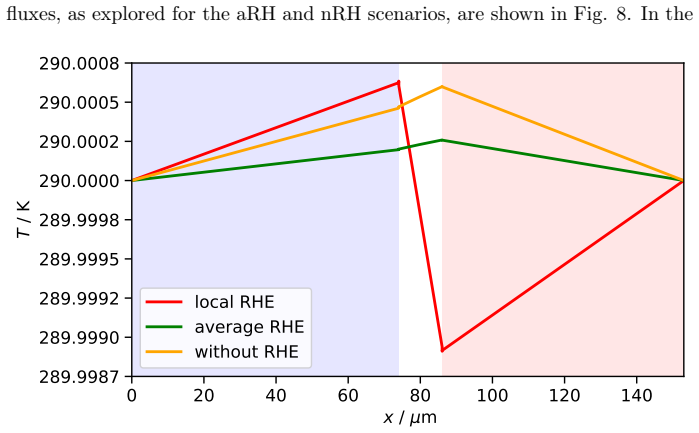
- [Section 5.5, Eq. (46)] The surface thermal conductivities are not measured but assigned through the scaling relation lambda_s = lambda/(delta * k_i) with k_i = 14 and 110 taken from ref. [6]. The temperature jumps at both electrode surfaces--and hence the predicted hot and cold spots at the surfaces--depend sensitively on these factors, as the sensitivity study in Fig. S5 shows. This does not threaten the entropy-balance identity itself, but it limits the predictive content of the quantitative surface temperature values in Figs. 4 and 5. The manuscript should report the results as a function of k_i or provide an uncertainty range for lambda_s, especially because the abstract highlights the relevance of the work for avoiding local hot spots.
- [Table 10 and Table 9] The units and prefactors in the central consistency table are inconsistent. The header states 'W cm^-2 K^-1', but Section 5.2.1 reports the electrolyte values as 5.75 x 10^-2 W m^-2 K^-1, and the text states that total-cell dissipation is 9.8 W m^-2. Moreover, the mean electrolyte entropy production in Table 9 is 47.93 W m^-3 K^-1, which, over the 12 um electrolyte thickness, gives 5.75 x 10^-4 W m^-2 K^-1, not the 5.75 x 10^-2 W m^-2 K^-1 quoted in Section 5.2.1. Since Table 10 is the central evidence for the consistency claim, the authors should correct the units or prefactors and re-verify all entries for internal consistency.
minor comments (3)
- [Section 5.1.1 and Fig. 5] Surface temperatures are reported to six decimal places even though the authors acknowledge unrealistically high precision; consider rounding the reported values to a precision consistent with the input material data.
- [Section 4.2] The GitHub repository link is useful, but for reproducibility the code should be archived with a versioned identifier (for example, a Zenodo DOI) so that the exact version used in the paper can be cited.
- [Introduction, ref. [2]] Reference [2], cited in the context of hot spots and thermal runaway, appears to concern an agglomerate cathode model; a thermal-safety review reference would be more appropriate for that sentence.
Circularity Check
The second-law consistency claim is partly built in: Section 5.2.3 uses the entropy balance to fix outer-boundary Li molar entropies (Eqs. 44–45), so the bulk-electrode and total-cell agreement in Table 10 is imposed, not independently verified.
-
fitted input called prediction
[Section 5.2.3, Eqs. (44)–(45) and Table 10]
"We now utilize the entropy balance to estimate the partial molar entropy of lithium on the left-hand side of the anode bulk phase, S^{a,o}_L. From Eq. (37): ... Following this procedure, we ensure that the outcome for the anode bulk phase obeyed the entropy balance. The same approach was next applied to the cathode bulk phase. ... The model for transport in the bulk electrode is now by design in agreement with the second law of thermodynamics, cf. Table 10."
The identity being tested, Eq. (37), is used as the fitting equation: Eq. (44) solves it for the unknown boundary entropy S^{a,o}_L and Eq. (45) for S^{c,o}_L. The flux-difference and the sigma-integral for those two layers therefore agree by construction, not by independent computation. These fitted values are then summed into the 'Total cell' row of Table 10, making the total-cell 'consistency' agreement algebraic. The abstract's statement that the model was 'shown to be consistent with the second law' is thus partly a restatement of the fitting procedure.
-
self definitional
[Section 5.2.2, Eqs. (39)–(42)]
"The partial molar entropy of Li was determined, using the definition of the Peltier heat of the electrode surface, Eq. (12). We used the experimental value of Π_{s,a} and estimates of π_e and π_a as reported from experiments [24] (cf. Appendix: Material Properties) to obtain: S^{a,e}_L = 1/T^{a,e} (π_e − π_a − Π_{s,a}) (40). Likewise, at the cathode surface ... S^{c,e}_L = 1/T^{c,e} (Π_{s,c} + π_e − π_c) (42)."
Eq. (12) defines the Peltier heat through the entropy-flux difference of the surface: Π^{s,a} = T (J_s^{e,a} − J_s^{a,e})/(j/F) = π_e − π_a − T S_L^a. Eq. (40) is just this definition rearranged to set S_L^{a,e}, and Eq. (42) similarly inverts Eq. (28) for the cathode. Inserting those values into the flux-difference expressions (39) and (41) makes the surface entropy-flux differences coincide with the surface entropy production by construction. Hence the anode- and cathode-surface rows in Table 10 are calibrated, not independent checks; only the electrolyte row tests the model.
full rationale
The paper does contain a genuinely independent consistency check: Section 5.2.1 compares the electrolyte entropy-flux difference (computed from boundary heat fluxes alone) with the integral of the local flux-force products, and the two agree to the reported precision. The temperature, concentration and potential profiles are also driven by experimentally measured transport coefficients and Peltier heats, so those results are not circular. However, the central advertised claim—full-cell agreement with the second law—is only partly independent. For the two bulk electrode layers the paper explicitly uses the entropy balance, Eq. (37), to solve for the unknown outer-boundary molar entropies (Eqs. 44–45) and then reports the resulting agreement in Table 10, with the text stating the layers are 'by design in agreement with the second law'. For the two electrode surfaces, the partial molar entropies used in the flux-difference expressions are obtained by inverting the Peltier-heat definitions (Eqs. 40 and 42), so those surface rows are also tied to the entropy-production expression by construction. Only the electrolyte comparison is an independent test of the advertised consistency. The unmeasured Kapitza surface conductivities (Eq. 46, Section 5.5) affect predicted local temperature jumps and are a data-availability concern rather than a circularity, and the self-citations to prior work in the group are backed by external experimental data, so they are not the load-bearing circular step. Overall the paper discloses the by-design construction clearly, but the abstract's wording overstates the independence of the consistency demonstration; the partial circularity warrants a score of 6.
Assumptions & free parameters
free parameters (4)
- Anode surface thermal scaling factor ka =
14
- Cathode surface thermal scaling factor kc =
110
- Partial molar entropy of Li in anode bulk left boundary Sa,o_L =
Not reported in text; solved via Eq. (44)
- Partial molar entropy of Li in cathode bulk right boundary Sc,o_L =
Not reported in text; solved via Eq. (45)
assumptions (7)
- domain assumption Local equilibrium holds in bulk phases and at surfaces; entropy production is sum of flux-force products.
- domain assumption Onsager reciprocal relations connect the coupling coefficients (e.g., lLD = lDL).
- ad hoc to paper Electrolyte is a reacting mixture in equilibrium: LiPF6 + 3 DEC <-> Li+*3DEC + PF6-, with EC as frame of reference.
- ad hoc to paper Adsorption equilibrium at electrode surfaces (delta a,s mu_L,T = 0); no adsorption terms in excess entropy production.
- domain assumption Electroneutrality holds everywhere, so current density j is independent of position.
- domain assumption Infinite lithium storage capacity in electrodes; no depletion/accumulation, so J_L = j/F in the bulk electrodes.
- ad hoc to paper Surface thermal conductivity is given by scaling relation lambda_s = lambda/(delta * ki) with ki from prior work; no direct measurements.
Cite this review
Pith. "Pith review of Lithium-ion battery modelling for nonisothermal conditions." pith.science (2026). https://pith.science/paper/6WSKF7I6
@misc{pith2026241114506,
  author       = {Pith},
  title        = {Pith review of: Lithium-ion battery modelling for nonisothermal conditions},
  year         = {2026},
  howpublished = {\url{https://pith.science/paper/6WSKF7I6}},
  note         = {Machine review of arXiv:2411.14506}
}
read the original abstract
A nonequilibrium thermodynamic model is presented for the nonisothermal lithium-ion battery cell. Coupling coefficients, all significant for transport of heat, mass, charge and chemical reaction, were used to model profiles of temperature, concentration and electric potential for each layer of the cell. Electrode surfaces were modelled with excess properties. Extending earlier works, we included lithium diffusion in the electrodes, and explained the cell's thermal signature due to Peltier and Soret effects. We showed that the model is consistent with the second law of thermodynamics, meaning that the entropy production computed at steady state from entropy fluxes is equal to the integral over the sum of flux-force products. The procedure is beneficial in electrochemical cell modelling as it reveals inconsistencies. The model was solved for typical lithium-ion battery materials. The coupling coefficients for transport of salts and solvents lead to significant concentration polarization. Thermal polarization is then negligible. We show that a zero-valued heat flux is not necessarily synonymous with a zero temperature gradient. Results are important for efforts that aim to avoid local hot spots. A program code is made available for testing and applications. The program is designed to solve dynamic boundary value problems posed by the electrode surfaces.
Figures


Figures from the paper (5 more)


Reference graph
Works this paper leans on
-
[6]
L. Spitthoff, A. F. Gunnarshaug, D. Bedeaux, O. Burheim, S. Kjelstrup, Peltier effects in lithium-ion battery modeling, The Journal of Chemical Physics 154 (11) (2021) 114705.doi:10.1063/5.0038168
-
[1]
F. Degen, Lithium-ion battery cell production in europe: Scenarios for reducing energy consumption and greenhouse gas emissions until 2030, Journal of Industrial Ecology 27 (3) (2023) 964–976. arXiv: https://onlinelibrary.wiley.com/doi/pdf/10.1111/jiec.13386, doi:https://doi.org/10.1111/jiec.13386. URL https://onlinelibrary.wiley.com/doi/abs/10.1111/jiec. 13386
-
[2]
W. Sun, B. A. Peppley, K. Karan, An improved two-dimensional agglom- erate cathode model to study the influence of catalyst layer structural pa- rameters, Electrochimica Acta 50 (2015) 3359–3374
work page 2015
-
[3]
Z. An, L. Jia, Y. Ding, C. Dang, X. Li, A review on lithium-ion power battery thermal management technologies and thermal safety, J. Thermal Science 26 (2017) 391—-412
work page 2017
- [4]
-
[5]
F. Cai, S. Cai, Z. Tu, Proton exchange membrane fuel cell (pemfc) op- eration in high current density (hcd): Problem, progress and perspective, Energy Conversion and Management 307 (2024) 118348
work page 2024
-
[7]
Ø. Gullbrekken, A. F. Gunnarshaug, A. Lervik, S. Kjelstrup, S. K. Schnell, Effect of the ion, solvent, and thermal interaction coefficients on bat- tery voltage, Journal of the American Chemical Society 146 (7) (2024) 4592–4604, pMID: 38340142. arXiv:https://doi.org/10.1021/jacs. 41 3c11589, doi:10.1021/jacs.3c11589. URL https://doi.org/10.1021/jacs.3c11589
doi:10.1021/jacs 2024
-
[8]
J. Dawlaty, S. Perkin, M. Salanne, A. P. Willard, The chemical physics of electrode - electrolyte interfaces, J. Chem. Phys. 159 (2023) 150401
work page 2023
Show all 45 references
-
[9]
Nyman, T
A. Nyman, T. G. Zavalis, R. Elger, M. Behm, G. Lindbergh, Analysis of the polarization in a li-ion battery cell by numerical simulations, Journal of The Electrochemical Society 157 (11) (2010) A1236.doi:10.1149/1.3486161. URL https://dx.doi.org/10.1149/1.3486161
2010 doi
-
[10]
A. A. Wang, S. E. J. O’Kane, F. B. Planella, J. L. Houx, K. O’Regan, M. Zyskin, J. Edge, C. W. Monroe, S. J. Cooper, D. A. Howey, E. Kendrick, J. M. Foster, Review of parameterisation and a novel database (liiondb) for continuum li-ion battery models, Progress in Energy 4 (3) ...
2022 doi
-
[11]
Andersson, M
M. Andersson, M. Streb, J. Y. Ko, V. Löfqvist Klass, M. Klett, H. Ek- ström, M. Johansson, G. Lindbergh, Parametrization of physics-based battery models from input-output data: A review of methodology and current research, Journal of Power Sources 521 (2022) 230859. doi:https:...
2022
-
[12]
K. D. Fong, J. Self, B. D. McCloskey, K. A. Persson, Onsager transport coefficients and transference numbers in polyelectrolyte solutions and poly- merized ionic liquids, Macromolecules 53 (21) (2020) 9503–9512.arXiv: https://doi.org/10.1021/acs.macromol.0c02001, doi:10.1021/a...
2020 doi
-
[13]
Kjelstrup, D
S. Kjelstrup, D. Bedeaux, Non-equilibrium Thermodynamics of Heteroge- neous Systems, 2nd Edition, World Scientific, 2020. 42
2020
-
[14]
J. Liu, S. Yadav, M. Salman, S. Chavan, S. Kim, Review of thermal coupled battery models and parameter identification for lithium-ion battery heat generation in EV battery thermal management system, Int. J. Heat and Mass Transfer 218 (2024) 124748. URL https://doi.org/10.1016/...
2024
-
[15]
T. F. Fuller, M. Doyle, J. Newman, Simulation and optimization of the dual lithium ion insertion cell, Journal of The Electrochemical Society 141 (1) (1994) 1–10. doi:10.1149/1.2054684
1994 doi
-
[16]
Bedeaux, A
D. Bedeaux, A. Albano, P. Mazur, Boundary conditions and nonequilib- rium thermodynamics, Physica A (82) (1976) 438–462
1976
-
[17]
Albano, D
A. Albano, D. Bedeaux, Non-equilibrium electrothermodynamics of polar- izable multicomponent fluids with an interface, Physica A (147) (1987) 407–435
1987
-
[18]
T. W. Maltby, B. Hafskjold, D. Bedeaux, S. Kjelstrup, O. Wilhelmsen, Local equilibrium in liquid phase shock waves, Phys. Rev. E 107 (2023) 035108. doi:10.1103/PhysRevE.107.035108. URL https://link.aps.org/doi/10.1103/PhysRevE.107.035108
2023 doi
-
[19]
Korthauer, Lithium-Ion Batteries: Basics and Applications, Springer Berlin Heidelberg, 2018
R. Korthauer, Lithium-Ion Batteries: Basics and Applications, Springer Berlin Heidelberg, 2018. doi:10.1007/978-3-662-53071-9. URL http://link.springer.com/10.1007/978-3-662-53071-9
2018 doi
-
[20]
Kjelstrup, A
S. Kjelstrup, A. F. Gunnarshaug, Ø. Gullbrekken, S. K. Schnell, A. Lervik, Transport coefficients for ion and solvent coupling. the case of the lithium- ion battery electrolyte, J. Chem. Phys. 159 (2023) 034104
2023
-
[21]
Bärwolff, Numerik für Ingenieure, Physiker und Informatiker, Springer Nature, 2020
G. Bärwolff, Numerik für Ingenieure, Physiker und Informatiker, Springer Nature, 2020. doi:https://doi.org/10.1007/978-3-662-61734-2
2020 doi
-
[22]
Virtanen, R
P. Virtanen, R. Gommers, T. E. Oliphant, M. Haberland, T. Reddy, D. Cournapeau, E. Burovski, P. Peterson, W. Weckesser, J. Bright, S. J. 43 van der Walt, M. Brett, J. Wilson, K. J. Millman, N. Mayorov, A. R. J. Nelson, E. Jones, R. Kern, E. Larson, C. J. Carey, İ. Polat, Y. Fe...
2020
-
[23]
Burton S., H
G. Burton S., H. Kenneth E., M. Jorge J., Documentation for minpack subroutine hybrd, University of Utah Mathematics Department (1980)
1980
-
[24]
A. F. Gunnarshaug, P. J. S. Vie, S. Kjelstrup, Review—reversible heat ef- fects in cells relevant for lithium-ion batteries, Journal of The Electrochem- ical Society 168 (5) (2021) 050522.doi:10.1149/1945-7111/abfd73
2021 doi
-
[25]
A. A. Wang, A. B. Gunnarsdóttir, J. Fawdon, M. Pasta, C. P. Grey, C. W. Monroe, Potentiometric mri of a superconcentrated lithium elec- trolyte: Testing the irreversible thermodynamics approach, ACS En- ergy Letters 6 (9) (2021) 3086–3095.arXiv:https://doi.org/10.1021/ acsener...
2021 doi
-
[26]
T. Jung, A. A. Wang, C. W. Monroe, Overpotential from cosol- vent imbalance in battery electrolytes: LiPF 6 in emc:ec, ACS Omega 8 (23) (2023) 21133–21144.arXiv:https://doi.org/10.1021/acsomega. 3c02088, doi:10.1021/acsomega.3c02088. URL https://doi.org/10.1021/acsomega.3c02088
2023 doi
-
[27]
A. F. Gunnarshaug, O. S. Burheim, S. Kjelstrup, Reversible heat effects of lithium metal- and porous lithium iron phosphate electrodes, Electrochhim. Acta 462 (2023) 142739.doi:10.1016/j.electacta.2023.142739
2023
-
[29]
Z. An, L. Jia, L. Wei, C. Dang, Q. Peng, Investigation on lithium-ion bat- tery electrochemical and thermal characteristic based on electrochemical- thermal coupled model, Applied Thermal Engineering 137 (2018) 792–807. doi:https://doi.org/10.1016/j.applthermaleng.2018.04.014....
2018 doi
-
[30]
Damay, C
N. Damay, C. Forgez, M.-P. Bichat, G. Friedrich, Thermal mod- eling of large prismatic lifepo4/graphite battery. coupled ther- mal and heat generation models for characterization and simu- lation, Journal of Power Sources 283 (2015) 37–45. doi:https: //doi.org/10.1016/j.jpowso...
2015 doi
-
[31]
S. Du, M. Jia, Y. Cheng, Y. Tang, H. Zhang, L. Ai, K. Zhang, Y. Lai, Study on the thermal behaviors of power lithium iron phos- phate (lfp) aluminum-laminated battery with different tab configura- tions, International Journal of Thermal Sciences 89 (2015) 327–336. doi:https://...
2015 doi
-
[33]
Richter, S
F. Richter, S. Kjelstrup, P. J. Vie, O. S. Burheim, Ther- mal conductivity and internal temperature profiles of li-ion sec- ondary batteries, Journal of Power Sources 359 (2017) 592–600. doi:https://doi.org/10.1016/j.jpowsour.2017.05.045. URL https://www.sciencedirect.com/scie...
2017 doi
-
[34]
Chase, M.W., Nist-janaf thermochemical tables, fourth edition, J
J. Chase, M.W., Nist-janaf thermochemical tables, fourth edition, J. Phys. Chem. Ref. Data, Monograph 9 (1998)
1998
-
[35]
Moses, W
E. Moses, W. André, I.-T. Ellen, A novel method for measuring the effective conductivity and the contact resistance of porous electrodes for lithium- ion batteries, Electrochemistry Communications 34 (13) (2013) 130–133. doi:https://doi.org/10.1016/j.elecom.2013.05.037
2013 doi
-
[36]
E. M. Hansen, E. Egner, S. Kjelstrup, Peltier effects in electrode carbon, Metallurgical and Materials Transactions B 29 (1) (1998) 69–76. doi: 10.1007/s11663-998-0008-z. URL https://doi.org/10.1007/s11663-998-0008-z
1998 doi
-
[37]
Persson, V
K. Persson, V. A. Sethuraman, L. J. Hardwick, Y. Hinuma, Y. S. Meng, A. Van Der Ven, V. Srinivasan, R. Kostecki, G. Ceder, Lithium diffusion in graphitic carbon, The Journal of Physical Chemistry Letters 1 (8) (2010) 1176–1180. doi:10.1021/jz100188d
2010 doi
-
[38]
Molenda, A
J. Molenda, A. Kulka, A. Milewska, W. Zając, K. Świerczek, Structural, transport and electrochemical properties of LiFePO4 substituted in lithium and iron sublattices (al, zr, w, mn, co and ni), Materials 6 (5) (2013) 1656–
2013
-
[39]
Morgan, A
D. Morgan, A. V. der Ven, G. Ceder, Li conductivity in LixMPO4 (m = mn, fe, co, ni) olivine materials, Electrochemical and Solid-State Letters 7 (2) (2003) A30.doi:10.1149/1.1633511. 46
2003 doi
-
[40]
A. Wang, S. Kadam, H. Li, S. Shi, Y. Qi, Review on modeling of the anode solid electrolyte interphase (sei) for lithium-ion batteries, npj Computa- tional Materials 4 (1) (2018) 15.doi:10.1038/s41524-018-0064-0. URL https://doi.org/10.1038/s41524-018-0064-0
2018 doi
-
[41]
G. Pan, J. Ding, W. Wang, X. Wei, Molecular simulations of the thermal and transport properties of molten alkali carbonates, En- ergy Procedia 105 (2017) 4377–4382, 8th International Conference on Applied Energy, ICAE2016, 8-11 October 2016, Beijing, China. doi:https://doi.org...
2017 doi
-
[42]
Allart, M
D. Allart, M. Montaru, H. Gualous, Model of lithium intercalation into graphite by potentiometric analysis with equilibrium and entropy change curves of graphite electrode, Journal of The Electrochemical Society 165 (2) (2018) A380. doi:10.1149/2.1251802jes. URL https://dx.doi...
2018 doi
-
[43]
H. Ge, T. Aoki, N. Ikeda, S. Suga, T. Isobe, Z. Li, Y. Tabuchi, J. Zhang, Investigating lithium plating in lithium-ion batteries at low temperatures using electrochemical model with nmr assisted parameterization, Journal of The Electrochemical Society 164 (6) (2017) A1050. doi...
2017 doi
-
[44]
Z.-X. Chi, W. Zhang, F.-Q. Cheng, J.-T. Chen, A.-M. Cao, L.-J. Wan, Op- timizing the carbon coating on LiFePO4 for improved battery performance, RSC Adv. 4 (2014) 7795–7798.doi:10.1039/C3RA47702A. URL http://dx.doi.org/10.1039/C3RA47702A
2014 doi
-
[45]
Matsui, T
H. Matsui, T. Nakamura, Y. Kobayashi, M. Tabuchi, Y. Yamada, Open-circuit voltage study on LiFePO 4 olivine cathode, Jour- nal of Power Sources 195 (19) (2010) 6879–6883. doi:https: 47 //doi.org/10.1016/j.jpowsour.2010.04.072. URL https://www.sciencedirect.com/science/article/...
2010 doi
-
[46]
Heubner, M
C. Heubner, M. Schneider, A. Michaelis, Investigation of charge transfer kinetics of li-intercalation in LiFePO4, Journal of Power Sources 288 (2015) 115–120. doi:https://doi.org/10.1016/j.jpowsour.2015.04.103. URL https://www.sciencedirect.com/science/article/pii/ S0378775315...
2015 doi
-
[1687]
URL https://www.mdpi.com/1996-1944/6/5/1656
doi:10.3390/ma6051656. URL https://www.mdpi.com/1996-1944/6/5/1656
1996 doi
Reviewed August 12, 2026 · model on record in the stance chip above.
Discussion (0). Continue with ORCID to comment.