REVIEW 4 major objections 5 minor 18 references
ValueSim: Generating Backstories to Model Individual Value Systems
T0 review · 4 major / 5 minor · reviewed 2026-08-07 · deepseek-v4-flash
Pith's one-line read ValueSim claims that how a person's data is narrated matters more than how much data is used: a generated backstory, processed through parallel cognitive, affective, and behavioral modules, predicts that person's answers to new value…
desk verdict ValueSim is a plausible backstory-based persona simulation framework with consistent but thinly supported empirical gains; the central claim hinges on backstory fidelity that is asserted but never checked. read the letter →
The pith
A machine-rendered reading of the paper's core claim, the machinery that carries it, and where it could break.
The reading
What carries the argument
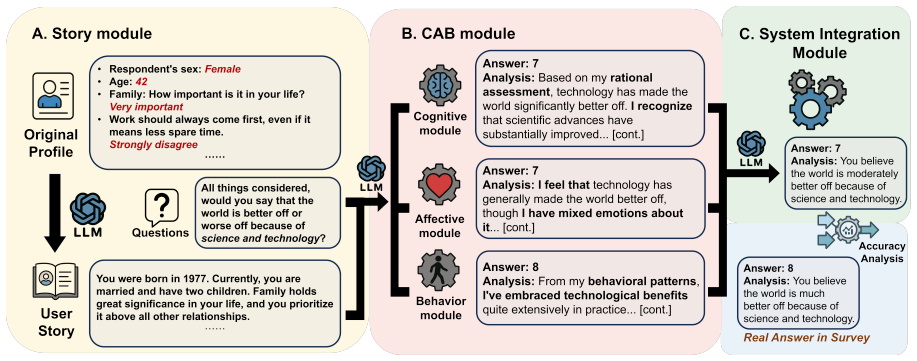
The load-bearing machinery is the backstory itself plus a three-module simulation architecture. The story module takes up to 232 structured question-answer pairs and reorganizes them into a continuous second-person narrative, with explicit instructions to preserve every data point verbatim, so the model can integrate related beliefs instead of reading disconnected facts. The cognitive-affective-behavioral (CAB) module then runs three parallel prompts—one reasoning about the person's belief structures and analytical style, one about emotional patterns and value alignments, one about behavioral tendencies and habits—each producing its own answer and analysis. A coordinator module reads the three analyses and reconciles conflicts to produce the final response, mirroring the Cognitive-Affective Personality System's idea that personality is a dynamic network of parallel cognitive-affective units.
What would settle it
Ask a different LLM (or a human writer) to produce the backstory from the same profiles while keeping ValueSim's downstream modules fixed; if the reported accuracy gain over RAG disappears or reverses, then the gain depends on the story-writing model's own biases rather than on narrative representation. A second check is to generate backstories from profiles whose answers have been randomly shuffled within a respondent; if accuracy stays high, the story is encoding general demographic regularities rather than the individual's actual value structure.
Extended reading notes
Core claim
The paper's core claim is that how a person's information is presented to an LLM matters at least as much as how much information is given: turning a structured profile into a narrative backstory improves prediction of that person's answers to unseen value questions, and decomposing the prediction into cognitive, affective, and behavioral sub-answers with a final integration step improves it further. The authors argue the backstory works because values are formed and expressed through life experiences rather than isolated demographic facts, and the three modules work because real decisions integrate parallel mental systems. They support this with accuracy and mean-absolute-error comparisons against full-profile prompting and retrieval-augmented generation, showing ValueSim ahead on both metrics across all tested models, with the largest gains in happiness and social-value domains, and with ablations showing that removing either the story module or the CAB module degrades performance. They also report that accuracy improves as more profile items are supplied, with the steepest gains before roughly 100 items, so the framework refines its persona simulation as interaction history grows.
Load-bearing premise
The one load-bearing premise is that the generated backstory is a faithful, undistorted transcription of the person's profile and value system; the paper itself concedes that translating raw information into a coherent narrative may result in hallucinations or misportrayal of certain elements of a person's profile.
Editorial extensions
If this is right
- ValueSim's reported accuracy gain over RAG implies that semantic-similarity retrieval is a weaker way to load persona information than an integrated narrative, because retrieved fragments omit the connections between values that the story preserves.
- The accuracy curve with profile size implies that a few dozen well-chosen profile items capture most of the benefit, so personalized value simulation may be feasible with limited, privacy-friendly data collection rather than hundreds of questions.
- The improvement with added interaction history implies LLM-based personal agents could become more faithful to a user over time by accumulating ordinary answers and regenerating backstories, without retraining the model.
- If the framework works, social-science survey simulation can move from group-level demographic stereotypes to individual-level value prediction, letting researchers test counterfactual questions on the same simulated respondent.
Reading between the lines
- The paper does not isolate how much of the gain comes from the narrative format versus from the story-writing model's own world knowledge filling gaps; a backstory can add plausible details that push predictions toward the answer the LLM already expects, and a direct test would compare human-written backstories or backstories generated by a different model on the same profiles.
- Because the same class of LLM both writes the backstory and answers the questions, the reported accuracy may partly reflect self-consistency within the model rather than fidelity to the actual respondent; measuring against cross-model story generation would separate these effects.
- A practical extension the authors leave implicit is using the framework to generate synthetic respondents for pilot surveys or to audit algorithmic fairness by probing how a model's value simulation shifts across demographic subgroups.
Editorial analysis
A structured set of objections, weighed in public.
Referee Report
Summary. ValueSim proposes a framework for simulating an individual's value-based responses by first converting their structured survey profile (up to 232 question-answer pairs from the World Values Survey) into a narrative backstory, then using a CAPS-inspired architecture with parallel cognitive, affective, and behavioral modules, and finally a coordinator module that integrates the three module outputs into a final predicted answer. The authors construct a benchmark from WVS Wave 7, evaluate on 100 simulated users with four LLMs (GPT-3.5-Turbo, Llama-3.1-8B, Qwen-2.5-7B, DeepSeek-V3), and report that ValueSim improves MAE and top-1 accuracy over Full-Info and RAG baselines. They also present ablations removing the story module and the CAB module, and a profile-scale experiment showing improved performance with more profile items.
Significance. The paper targets an important problem: moving beyond group-level alignment to individualized value simulation, and it does so with a simple, psychologically motivated method that could be widely applicable. The held-out evaluation design is sound in principle: target answers are not part of the profile used to generate backstories, and no parameters are fitted to test labels, so the prediction is not circular in the usual fitting sense. The paper also has several concrete strengths: it tests four different LLM families, reports per-dimension results, includes ablations, provides full prompts in appendices, and acknowledges limitations explicitly. If the reported gains are real, the paper would provide a useful recipe for improving LLM-based persona simulation. However, the central empirical claims currently rest on an unverified intermediate representation and a small, incompletely described sample, so the significance is conditional on addressing those issues.
major comments (4)
- [§5.1, Table 1, Table 3, Limitations] All headline numbers come from only 100 simulated users, but the paper does not specify how these 100 users were sampled from the 97,220 available, nor does it report confidence intervals or per-user variance. The claim that ValueSim 'significantly outperforms' baselines is supported only by a paired t-test with no information about what is paired (users? questions?) or how many units enter the test. Given that the dimension-level accuracy in Table 3 shows several cases where ValueSim is worse than RAG (e.g., GPT-3.5-Turbo Tech: RAG 0.249 vs. ValueSim 0.173; Qwen-2.5-7B Tech: RAG 0.098 vs. ValueSim 0.127; DeepSeek-V3 Econ.Int: RAG 0.363 vs. ValueSim 0.331), the aggregate improvement may not be robust. The authors should report the sampling procedure, per-fold results, confidence intervals, and the exact test statistic, or scale up the evaluation.
- [§3.2.2, Appendix C, Limitations] The paper asserts in §3.2.2 that the narrative transformation maintains 'complete fidelity to the original 232 profile elements,' but no fidelity audit is provided. The Appendix C example backstory includes interpretive sentences such as 'Your life is shaped by family, work, and a cautious but hopeful view of the world' that go beyond the raw survey responses, and the Limitations section concedes that 'translating the raw information about a person into a coherent backstory... may result in hallucinations or misportrayal of certain elements of a person's profile.' This matters because the same LLM family that writes the backstory later uses it to predict held-out answers. The reported gains over Full Info and RAG could therefore stem not from faithful narrative encoding but from the storyteller performing implicit feature selection or injecting plausible inferences correlated with the target value dimension. A concrete fidelity check is needed: measure what fraction of the 232 profile items actually appear in the generated backstories, measure how much non-profile content is added, and test whether the results change when backstories are generated by a different model than the one used for prediction.
- [§5.3, Appendix B.1] The profile-scale experiment varies the number of profile items (0, 58, 116, 174, 232) by random sampling, but the backstory generation prompt in Appendix B.1 instructs the model to include 'EVERY SINGLE DATA POINT' and 'no exceptions.' The paper does not explain how a backstory can be generated from a partial profile under this instruction, nor what happens in the 0-item condition. If the story module is bypassed or the prompt is modified for partial profiles, the monotonic improvement curves in Figures 2 and 3 could be an artifact of prompt construction rather than a property of the framework. Please clarify the exact procedure for partial-profile backstories and confirm that the 0-item condition uses the same downstream modules.
- [§4.2, §5.2, Table 2] There are discrepancies and undefined comparisons that need clarification. First, §4.2 says 'We evaluated SimVBG' although the method is called ValueSim; this naming inconsistency also appears in the Limitations section. Second, the ablation 'w/o story module' is described as replacing the story with the original profile information while maintaining the parallel question-answering structure, but this is not the same as the Full Info baseline used in Table 1, which uses a different prompt (Appendix D.1). Third, the reported ValueSim MAE for GPT-3.5-Turbo differs between Table 1 (0.260) and Table 2 (0.264); please confirm that both tables use the same evaluation setup and report the source of the discrepancy.
minor comments (5)
- [Title and Throughout] The manuscript inconsistently refers to the method as 'ValueSim' and 'SimVBG'; please standardize the name throughout.
- [Throughout] There are several typographical errors, including 'Methdology' in the Section 3 heading, 'themaelves' in the Appendix C backstory, and 'V alueSim' in Tables 1 and 3. These should be corrected.
- [§2.3] The related work paragraph contains an unfinished citation placeholder '(?)' in the sentence 'the LLM-related studies using WVS data focus on studying groups of people (?), rather than individuals'; please fill in the missing citation or remove the placeholder.
- [Data Availability] The paper states that a benchmark is self-constructed from WVS Wave 7, but no code, benchmark construction scripts, or generated backstory data are released. Given that reproducibility is a stated goal, please provide a public repository or describe how to obtain the exact splits and prompts.
- [Tables 1 and 3] The 'Chance' rows differ between the MAE table and the accuracy table, and the definition of chance is not stated. Please clarify whether chance corresponds to the most frequent answer, random guessing, or something else, and report it consistently.
Circularity Check
No circularity: ValueSim's predictions target held-out WVS questions, no parameters are fitted to test labels, and the cited self-works are not load-bearing.
full rationale
The paper's derivation chain is not circular by the standards of this review. ValueSim generates a backstory from a user's training question-answer pairs (up to 232 items) and then predicts answers to held-out test questions from the same individual. The target answers are explicitly excluded from the profile used to generate the backstory: 'For a new question qnew not present in P, the task is to predict the user’s response' (Section 3.1), and the data split is '20% as test questions, 80% as training questions' (Section 5.3). No model parameters are fitted to the test labels; the framework is prompt-based with temperature set to zero. The reported gains over Full Info and RAG are empirical comparisons, not identities forced by construction. The main residual concern—that backstory fidelity is asserted but not audited ('maintain complete fidelity to the original 232 profile elements,' Section 3.2.2; limitations concede possible 'hallucinations or misportrayal')—is a correctness or robustness risk about the intermediate representation, not a circularity in which the prediction is equivalent to its input. Self-citations (e.g., Ye et al. 2025, Xie et al. 2024) appear only in related-work context and do not carry the central argument. No step in the paper reduces to its own inputs by definition, by fitted-parameter renaming, or by a load-bearing self-citation chain.
Assumptions & free parameters
free parameters (3)
- test_set_size =
100
- RAG_top_k =
3
- profile_scale_increments =
0, 58, 116, 174, 232
assumptions (4)
- domain assumption Narrative backstories better support LLM comprehension of a person's values than structured QA lists
- domain assumption Decomposing simulation into cognitive, affective, and behavioral modules plus a coordinator improves fidelity over monolithic prompting
- domain assumption The 9-category reorganization of WVS dimensions preserves the psychological structure needed for prediction
- domain assumption WVS self-reported responses are reliable ground truth for 'individual value systems'
Cite this review
Pith. "Pith review of ValueSim: Generating Backstories to Model Individual Value Systems." pith.science (2026). https://pith.science/paper/6XLLUO5U
@misc{pith2026250523827,
  author       = {Pith},
  title        = {Pith review of: ValueSim: Generating Backstories to Model Individual Value Systems},
  year         = {2026},
  howpublished = {\url{https://pith.science/paper/6XLLUO5U}},
  note         = {Machine review of arXiv:2505.23827}
}
read the original abstract
As Large Language Models (LLMs) continue to exhibit increasingly human-like capabilities, aligning them with human values has become critically important. Contemporary advanced techniques, such as prompt learning and reinforcement learning, are being deployed to better align LLMs with human values. However, while these approaches address broad ethical considerations and helpfulness, they rarely focus on simulating individualized human value systems. To address this gap, we present ValueSim, a framework that simulates individual values through the generation of personal backstories reflecting past experiences and demographic information. ValueSim converts structured individual data into narrative backstories and employs a multi-module architecture inspired by the Cognitive-Affective Personality System to simulate individual values based on these narratives. Testing ValueSim on a self-constructed benchmark derived from the World Values Survey demonstrates an improvement in top-1 accuracy by over 10% compared to retrieval-augmented generation methods. Further analysis reveals that performance enhances as additional user interaction history becomes available, indicating the model's ability to refine its persona simulation capabilities over time.
Figures


Reference graph
Works this paper leans on
-
[1]
Backstory Generation: First, a comprehensive backstory is generated based on the user profile, creating a natural narrative that incorporates all demographic and value-related information
-
[2]
Multi-dimensional Analysis: Three parallel modules—cognitive, affective, and behavioral—analyze the question from different psychological perspectives. This approach is inspired by psychological and neuroscience research on human decision-making processes, which often involve different and sometimes contradictory mental systems
-
[3]
Below we provide the detailed prompts used in each component of our framework
Integrated Response: Finally, a coordinator module synthesizes the analyses from the three per- spectives to generate a cohesive final response. Below we provide the detailed prompts used in each component of our framework. B.1 Backstory Generation Module Unlike typical user simulations that rely on structured profiles, ValueSim transforms structured data...
-
[4]
arXiv preprint arXiv:2411.10109
Generative agent simulations of 1,000 people. arXiv preprint arXiv:2411.10109. Luiz Pessoa. 2008. On the relationship between emo- tion and cognition.Nature reviews neuroscience, 9(2):148–158. Kaja Primc, Marko Ogorevc, Renata Slabe-Erker, Tjaša Bartolj, and Nika Murovec. 2021. How does schwartz’s theory of human values affect the proenvi- ronmental behav...
arXiv 2008
-
[5]
Angelina Wang, Jamie Morgenstern, and John P Dick- erson
Characterchat: Learning towards conversa- tional ai with personalized social support.arXiv preprint arXiv:2308.10278. Angelina Wang, Jamie Morgenstern, and John P Dick- erson. 2025. Large language models that replace human participants can harmfully misportray and flatten identity groups.Nature Machine Intelligence, pages 1–12. Xintao Wang, Yunze Xiao, Je...
arXiv 2025
-
[6]
Use second-person format throughout (e.g., "You believe..." "You were born in...")
-
[7]
Group related information together for coherence, but never at the expense of omitting details
-
[8]
Format the backstory in clear paragraphs focusing on different aspects (demographics, beliefs, political views, etc.)
Show all 18 references
-
[9]
Please rearrange and reorganize the sequence of this information to ensure it forms a coherent backstory
-
[10]
YOU MUST INCLUDE EVERY SINGLE DATA POINT from the original information - no exceptions
-
[11]
Do not summarize or generalize multiple data points - maintain the specific values, numbers, and exact responses
-
[12]
Each information point in the data consists of a question, possible options, and the person’s actual answer
-
[13]
Focus primarily on the person’s actual responses when creating the backstory
-
[17]
If the backstory becomes lengthy, that is acceptable - completeness is more important than brevity
-
[18]
Core Value Orientations
Please directly output the final backstory without returning any unnecessary content or explanations. Review your work carefully before submitting to ensure NO INFORMATION HAS BEEN OMITTED. This person’s Information: {profile_text} 14 B.2 Multi-dimensional Analysis Modules The...
1973
-
[2003]
Dan P McAdams
The role of affect in decision making.Hand- book of affective science, 619(642):3. Dan P McAdams. 2001. The psychology of life stories. Review of general psychology, 5(2):100–122. Walter Mischel and Yuichi Shoda. 1995. A cognitive- affective system theory of personality: recon...
2001 arXiv
-
[2023]
InInternational Conference on Machine Learning, pages 337–371
Using large language models to simulate mul- tiple humans and replicate human subject studies. InInternational Conference on Machine Learning, pages 337–371. PMLR. Gal Ariely and Eldad Davidov. 2011. Can we rate public support for democracy in a comparable way? cross-national ...
2011 arXiv
-
[2024]
Fei Liu and 1 others
Deepseek-v3 technical report.arXiv preprint arXiv:2412.19437. Fei Liu and 1 others. 2020. Learning to summarize from human feedback. InProceedings of the 58th Annual Meeting of the Association for Computational Linguistics, pages 583–592. George Loewenstein, Jennifer S Lerner,...
2020 arXiv
Reviewed August 7, 2026 · model on record in the stance chip above.
Discussion (0). Sign in to comment.