REVIEW 4 major objections 5 minor 26 references
GEFM: Graph-Enhanced EEG Foundation Model
T0 review · 4 major / 5 minor · reviewed 2026-08-12 · deepseek-v4-flash
Pith's one-line read The paper proposes an EEG foundation model that adds a graph neural network stage with distance-weighted electrode edges, and reports gains on all three downstream tasks.
desk verdict Plausible GNN-plus-BENDR extension, but gains are not isolated from a parameter-heavy linear adjuster and missing variance reporting. read the letter →
The pith
A machine-rendered reading of the paper's core claim, the machinery that carries it, and where it could break.
The reading
What carries the argument
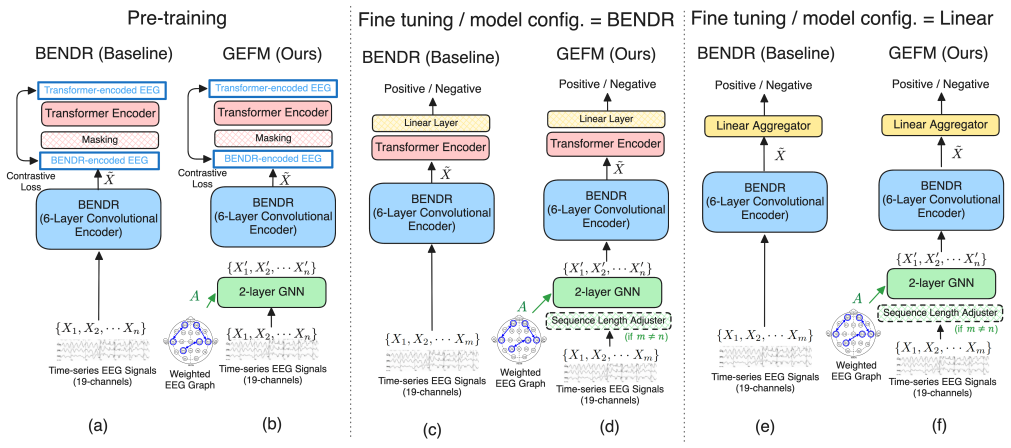
The central object is the channel graph that a two-layer GNN consumes before temporal encoding. Each EEG electrode is one node, the graph is fully connected, and edge weights are $W_{uv}=1/D_{uv}$ with $D_{uv}=\arccos\big((x_u x_v+y_u y_v+z_u z_v)/r^2\big)$, the geodesic distance between electrodes on a spherical scalp model. A linear layer (or padding) first maps every channel's signal to the fixed length the GNN requires. The GNN output then enters the unchanged BENDR encoder and masked-autoencoder pre-training objective, so the graph stage is the only new mechanism carrying spatial context into an otherwise temporal model.
What would settle it
Run GEFM and the BENDR baseline with matched parameter counts: add a two-layer dense module plus the same linear sequence adjuster to the baseline but with no graph edges. If that non-graph model reaches or exceeds GEFM's MMI, P300, and ERN scores, the paper's attribution to inter-channel relationship learning fails.
Extended reading notes
Core claim
GEFM inserts a two-layer GNN before the BENDR encoder, a convolutional encoder from a masked-autoencoder EEG model: each electrode is a node, the graph is fully connected, and edges are weighted by the reciprocal of the geodesic distance between electrodes on a spherical scalp model. A linear layer standardizes variable-length signals before the GNN, and the combined model is pre-trained with the same masked contrastive task as the base model. In the reported experiments, only the GCN (graph convolutional network) with edge weights outperformed the base model on all three tasks, raising MMI accuracy from 0.646 to 0.849, P300 AUROC from 0.577 to 0.616, and ERN AUROC from 0.522 to 0.538. The paper concludes that adding inter-channel relationship learning improves EEG foundation model performance.
Load-bearing premise
The load-bearing premise is that the reported gains come from inter-channel relationship learning rather than from the extra trainable parameters and the newly added linear sequence-adjustment layer that the GEFM wrapper introduces.
Editorial extensions
If this is right
- If the reported results hold, EEG foundation models can incorporate inter-channel structure by inserting a graph stage before an existing temporal encoder, without redesigning the pre-training objective.
- The linear sequence-length adjuster is the better of the two tested strategies, so future variable-length EEG foundation models should favor a learned projection over padding.
- Graph enhancement pays off more when the downstream head keeps the Transformer encoder, suggesting the spatial-mixed features need a high-capacity temporal reader.
- Among the tested GNNs, GCN with edge weights is the recommended architecture for this graph-enhanced EEG foundation model.
Reading between the lines
- The paper does not run a parameter-matched ablation, so the most direct extension is to add the same two-layer module and linear adjuster to the baseline without any graph edges; if that model matches GEFM, the graph itself is not the cause.
- Permuting or randomizing the edge weights in fine-tuning would test whether the anatomical geodesic distances, rather than mere channel mixing, drive the improvement.
- Because the graph stage is inserted before the convolutional encoder, the same insertion can likely be applied to other EEG foundation models with convolutional front ends, a transfer the paper sketches but does not evaluate.
Editorial analysis
A structured set of objections, weighed in public.
Referee Report
Summary. The paper proposes GEFM, a graph-enhanced EEG foundation model that inserts a two-layer GNN and a sequence-length adjustment layer before the BENDR encoder to capture inter-channel relationships alongside temporal dynamics. The authors pre-train GEFM on a one-tenth subset of the TUEG dataset and evaluate it on three downstream tasks (MMI, P300, ERN) using GCN, GAT, and GraphSAGE, with linear or padding-based sequence-length adjustment, and with two base configurations (BENDR and Linear). The main claim is that GCN with edge weights and a linear adjuster consistently outperforms the original BENDR baseline on all three tasks, and the paper attributes this gain to learning inter-channel relationships.
Significance. If the reported results were reliable, adding graph-based inter-channel modeling to an EEG foundation model would be a timely and useful contribution, addressing a gap in existing foundation-model literature that focuses almost exclusively on temporal dynamics. The paper uses publicly available datasets, follows the established BENDR evaluation protocol, and provides a clear architectural description that should be easy to reproduce. However, the current evidence does not substantiate the central mechanistic claim: the comparison is confounded with a large increase in trainable parameters, the winning configuration was selected on the same test results used for the headline claims, and no variance or significance information is given. The paper is therefore better viewed as a promising preliminary exploration than as a validated demonstration.
major comments (4)
- [III.B, IV.B.2, IV.C.1] The central claim that GCN with edge weights outperforms the baseline because of inter-channel relationship learning is confounded. Section III.B inserts a two-layer GNN and a sequence-length adjustment layer before the BENDR Encoder, and Section IV.B.2 specifies that the adjustment is a linear layer of size m×n. For MMI (n=15,360 at 256 Hz, m=1,536), this linear layer alone introduces roughly 23.6M parameters, and the GCN adds more. No ablation is reported that trains a control with the same added capacity but without graph-based channel mixing (for example, a per-channel linear projection or an MLP applied channel-independently). Without such a control, the statement in Section IV.C.1 that 'only GCN with edge weights consistently outperformed the baseline across all three downstream tasks' cannot be attributed to the graph mechanism.
- [IV.C, Tables II and III] The winning configuration appears to have been selected after inspecting test performance across 14 GEFM rows in Tables II and III, and no standard deviations, confidence intervals, or significance tests are reported. The winning margins on P300 (0.616 vs 0.577) and ERN (0.538 vs 0.522) are within 0.05 absolute, and the P300 baseline itself differs between Table II (0.577) and Table III (0.568). It is therefore possible that the reported advantage is due to selection on test-set noise. The authors should report per-fold results, error bars, and ideally use a held-out validation set for configuration selection or account for multiple comparisons.
- [IV.A.1 and IV.C] The pre-training protocol is not controlled between the baseline and GEFM. Section IV.A.1 states that the pre-training dataset was downsampled to one-tenth of its original size, while Section IV.C says 'The baseline corresponds to the original BENDR [5]'. If the baseline is the original BENDR pre-trained on the full TUEG corpus (or a different version), while GEFM was pre-trained on one-tenth of TUEG v2, then the comparison combines changes in architecture with changes in pre-training data. The authors should either pre-train the baseline on the same downsampled data or clearly state the pre-training protocol for each model; otherwise the relative contribution of the GNN to the performance gap is unidentifiable.
- [IV.C.2, Table II] The reported improvement percentages do not match the table values. Section IV.C.2 states that on P300 the baseline achieved 0.568 and GEFM improved by 8.53%, but Table II lists the baseline BENDR P300 as 0.577, and (0.616−0.568)/0.568 = 8.45%, not 8.53%. Similarly, for ERN the text reports a 3.11% improvement, while (0.538−0.522)/0.522 = 3.07%. These inconsistencies affect the quantitative results discussion and need to be corrected.
minor comments (5)
- [IV.B.1] There is a typo: 'Graph Attention Netowrks' should be 'Graph Attention Networks'.
- [IV.C.3] The text says 'in the smallest cases as small as one-tenth' for the ratio of adjusted to original sequence length, but for P300 and ERN the sequence length before adjustment is 512 while the target is 15,360, giving a ratio of about 1/30. The statement should be corrected.
- [IV.A.2 and IV.A.3] Table I lists 64 channels for MMI and P300 and 56 for ERN, but the preprocessing section states that only 19 channels from the 10/20 scheme are used. It should be clarified that Table I reports original dataset channel counts and that the experiments use a common set of 19 channels.
- [Abstract and IV.C] The abstract claims GEFM 'consistently outperformed baseline methods across all tasks', but the comparisons are only against a single baseline (BENDR) with two fine-tuning configurations. The phrasing could be clarified to avoid implying a broader set of baselines.
- [IV.B.2] The description of the linear sequence-length adjuster as 'a linear layer of size m×n' is ambiguous about whether the projection is applied per channel or jointly across channels; specifying the exact tensor shape would improve reproducibility.
Circularity Check
No significant circularity: GEFM is an empirical comparison against an external BENDR baseline, with no derivation that reduces to its own inputs.
full rationale
The paper makes no formal derivation of a prediction from first principles; its contribution is architectural and empirical, so the circularity patterns requiring an exhibited reduction do not apply. The central comparison is against BENDR, an external prior model cited from independent earlier work, on three public benchmark datasets, and the reported accuracies/AUROC values are directly measured rather than reconstructed from fitted inputs. The GNN edge weights are adopted from EEG-GCNN, an external source, and are not defined in terms of the results claimed here. No load-bearing step is justified only by a self-citation: the authors do not invoke their own prior results to force a unique choice or to supply an otherwise missing premise. The most substantial concern raised by the paper's own setup is that the linear sequence-length adjuster adds a large number of trainable parameters before the GNN and is not ablated against a parameter-matched non-graph control, so the attribution of gains to inter-channel relationship learning is not fully isolated. That is a soundness/ablation limitation, not a definitional circularity: it does not make any equation, claimed prediction, or fitted parameter equivalent to an input by construction. Similarly, the absence of variance reporting and the inconsistency in the P300 baseline values between tables are reporting-quality issues, not circular reasoning. Because hard rule 1 requires quoting a specific reduction for a positive circularity finding, and no such reduction can be exhibited, the appropriate finding is no significant circularity with score 0.
Assumptions & free parameters
free parameters (4)
- Best configuration selection (GCN with edge weights, BENDR base, linear adjuster) =
selected post hoc from Table II
- Pre-training dataset subsample ratio =
1/10 of TUEG
- Sequence length target n =
20s or 60s at 256 Hz (5120 or 15360 samples)
- Number of GNN layers and hidden dimensions =
unspecified in paper
assumptions (3)
- domain assumption Closer EEG channels interact more strongly, encoded as edge weights equal to the reciprocal of geodesic scalp distance.
- domain assumption A fixed set of 19 channels from the 10/20 scheme is sufficient to represent inter-channel relationships across all downstream datasets.
- ad hoc to paper Downsampling TUEG to one-tenth of its size still yields a representative pre-training corpus for a foundation model.
Cite this review
Pith. "Pith review of GEFM: Graph-Enhanced EEG Foundation Model." pith.science (2026). https://pith.science/paper/6XPAX4DT
@misc{pith2026241119507,
  author       = {Pith},
  title        = {Pith review of: GEFM: Graph-Enhanced EEG Foundation Model},
  year         = {2026},
  howpublished = {\url{https://pith.science/paper/6XPAX4DT}},
  note         = {Machine review of arXiv:2411.19507}
}
read the original abstract
Electroencephalography (EEG) signals provide critical insights for applications in disease diagnosis and healthcare. However, the scarcity of labeled EEG data poses a significant challenge. Foundation models offer a promising solution by leveraging large-scale unlabeled data through pre-training, enabling strong performance across diverse tasks. While both temporal dynamics and inter-channel relationships are vital for understanding EEG signals, existing EEG foundation models primarily focus on the former, overlooking the latter. To address this limitation, we propose Graph-Enhanced EEG Foundation Model (GEFM), a novel foundation model for EEG that integrates both temporal and inter-channel information. Our architecture combines Graph Neural Networks (GNNs), which effectively capture relational structures, with a masked autoencoder to enable efficient pre-training. We evaluated our approach using three downstream tasks and experimented with various GNN architectures. The results demonstrate that our proposed model, particularly when employing the GCN architecture with optimized configurations, consistently outperformed baseline methods across all tasks. These findings suggest that our model serves as a robust foundation model for EEG analysis.
Figures

Reference graph
Works this paper leans on
-
[5]
D. Kostas, S. Aroca-Ouellette, and F. Rudzicz, “Bendr: Using trans- formers and a contrastive self-supervised learning task to learn from massive amounts of eeg data,” Frontiers in Human Neuroscience , vol. 15, p. 653659, 2021
work page 2021
-
[1]
Llama: Open and efficient foundation language models,
H. Touvron, T. Lavril, G. Izacard, X. Martinet, M.-A. Lachaux, T. Lacroix, B. Rozi`ere, N. Goyal, E. Hambro, F. Azhar, et al., “Llama: Open and efficient foundation language models,” arXiv preprint arXiv:2302.13971, 2023
arXiv 2023
-
[2]
Llama 2: Open foundation and fine-tuned chat models,
H. Touvron, L. Martin, K. Stone, P. Albert, A. Almahairi, Y . Babaei, N. Bashlykov, S. Batra, P. Bhargava, S. Bhosale, et al. , “Llama 2: Open foundation and fine-tuned chat models,” arXiv preprint arXiv:2307.09288, 2023
arXiv 2023
-
[3]
Internimage: Exploring large-scale vision foundation models with deformable convolutions,
W. Wang, J. Dai, Z. Chen, Z. Huang, Z. Li, X. Zhu, X. Hu, T. Lu, L. Lu, H. Li, et al., “Internimage: Exploring large-scale vision foundation models with deformable convolutions,” in Proceedings of the IEEE/CVF conference on computer vision and pattern recognition, pp. 14408–14419, 2023
work page 2023
-
[4]
Florence: A new foundation model for computer vision,
L. Yuan, D. Chen, Y .-L. Chen, N. Codella, X. Dai, J. Gao, H. Hu, X. Huang, B. Li, C. Li, et al., “Florence: A new foundation model for computer vision,” arXiv preprint arXiv:2111.11432 , 2021
arXiv 2021
-
[6]
Neuro-GPT: Towards A Foundation Model For EEG,
W. Cui, W. Jeong, P. Th ¨olke, T. Medani, K. Jerbi, A. A. Joshi, and R. M. Leahy, “Neuro-GPT: Towards A Foundation Model For EEG,” in 2024 IEEE International Symposium on Biomedical Imaging (ISBI), pp. 1–5, IEEE, 2024
work page 2024
-
[7]
Semi-supervised classification with graph convolutional networks,
T. N. Kipf and M. Welling, “Semi-supervised classification with graph convolutional networks,” arXiv preprint arXiv:1609.02907 , 2016
arXiv 2016
-
[8]
P. Veli ˇckovi´c, G. Cucurull, A. Casanova, A. Romero, P. Lio, and Y . Bengio, “Graph attention networks,” arXiv preprint arXiv:1710.10903, 2017
arXiv 2017
Show all 26 references
-
[9]
Inductive representation learning on large graphs,
W. Hamilton, Z. Ying, and J. Leskovec, “Inductive representation learning on large graphs,” Advances in neural information processing systems, vol. 30, 2017
2017
-
[10]
Bert: Pre-training of deep bidirectional transformers for language understanding,
J. Devlin, “Bert: Pre-training of deep bidirectional transformers for language understanding,” arXiv preprint arXiv:1810.04805 , 2018
2018 arXiv
-
[11]
wav2vec 2.0: A framework for self-supervised learning of speech representations,
A. Baevski, Y . Zhou, A. Mohamed, and M. Auli, “wav2vec 2.0: A framework for self-supervised learning of speech representations,” Ad- vances in neural information processing systems , vol. 33, pp. 12449– 12460, 2020
2020
-
[12]
Maeeg: Masked auto-encoder for eeg representation learning,
H.-Y . S. Chien, H. Goh, C. M. Sandino, and J. Y . Cheng, “Maeeg: Masked auto-encoder for eeg representation learning,” in NeurIPS 2022 Workshop on Learning from Time Series for Health , 2022
2022
-
[13]
Language models are unsupervised multitask learners,
A. Radford, J. Wu, R. Child, D. Luan, D. Amodei, I. Sutskever, et al., “Language models are unsupervised multitask learners,” OpenAI blog, vol. 1, no. 8, p. 9, 2019
2019
-
[14]
Graph neural network-based eeg classification: A survey,
D. Klepl, M. Wu, and F. He, “Graph neural network-based eeg classification: A survey,” IEEE Transactions on Neural Systems and Rehabilitation Engineering, 2024
2024
-
[15]
Eeg-gcnn: Augmenting electroencephalogram-based neurological disease diagnosis using a domain-guided graph convolutional neural network,
N. Wagh and Y . Varatharajah, “Eeg-gcnn: Augmenting electroencephalogram-based neurological disease diagnosis using a domain-guided graph convolutional neural network,” in Proceedings of the Machine Learning for Health NeurIPS Workshop (E. Alsentzer, M. B. A. McDermott, F. Fal...
2020
-
[16]
K- BERT: Enabling Language Representation with Knowledge Graph,
W. Liu, P. Zhou, Z. Zhao, Z. Wang, Q. Ju, H. Deng, and P. Wang, “K- BERT: Enabling Language Representation with Knowledge Graph,” in Proceedings of the AAAI Conference on Artificial Intelligence, vol. 34, pp. 2901–2908, 2020
2020
-
[17]
CoLAKE: Contextualized Language and Knowledge Embedding,
T. Sun, Y . Shao, X. Qiu, Q. Guo, Y . Hu, X.-J. Huang, and Z. Zhang, “CoLAKE: Contextualized Language and Knowledge Embedding,” in Proceedings of the 28th International Conference on Computational Linguistics, pp. 3660–3670, 2020
2020
-
[18]
QA- GNN: Reasoning with Language Models and Knowledge Graphs for Question Answering,
M. Yasunaga, H. Ren, A. Bosselut, P. Liang, and J. Leskovec, “QA- GNN: Reasoning with Language Models and Knowledge Graphs for Question Answering,” in Proceedings of the 2021 Conference of the North American Chapter of the Association for Computational Linguistics: Human Langu...
2021
-
[19]
GreaseLM: Graph REASoning enhanced language models,
X. Zhang, A. Bosselut, M. Yasunaga, H. Ren, P. Liang, C. D. Manning, and J. Leskovec, “GreaseLM: Graph REASoning enhanced language models,” in International Conference on Learning Representations , 2022
2022
-
[20]
The temple university hospital eeg data corpus,
I. Obeid and J. Picone, “The temple university hospital eeg data corpus,” Frontiers in Neuroscience, vol. 10, p. 196, 2016
2016
-
[21]
Physiobank, physiotoolkit, and physionet: Components of a new research resource for complex physiologic signals,
A. L. Goldberger, L. A. Amaral, L. Glass, J. M. Hausdorff, P. C. Ivanov, R. G. Mark, J. E. Mietus, G. B. Moody, C.-K. Peng, and H. E. Stanley, “Physiobank, physiotoolkit, and physionet: Components of a new research resource for complex physiologic signals,” circulation, vol. 1...
2000
-
[22]
Bci2000: a general-purpose brain-computer interface (bci) system,
G. Schalk, D. J. McFarland, T. Hinterberger, N. Birbaumer, and J. R. Wolpaw, “Bci2000: a general-purpose brain-computer interface (bci) system,” IEEE Transactions on biomedical engineering, vol. 51, no. 6, pp. 1034–1043, 2004
2004
-
[23]
Documenting, modelling and exploiting p300 amplitude changes due to variable target delays in donchin’s speller,
L. Citi, R. Poli, and C. Cinel, “Documenting, modelling and exploiting p300 amplitude changes due to variable target delays in donchin’s speller,” Journal of Neural Engineering, vol. 7, no. 5, p. 056006, 2010
2010
-
[24]
Objective and subjective evaluation of online error correction dur- ing p300-based spelling,
P. Margaux, M. Emmanuel, D. S ´ebastien, B. Olivier, and M. J ´er´emie, “Objective and subjective evaluation of online error correction dur- ing p300-based spelling,” Advances in Human-Computer Interaction , vol. 2012, no. 1, p. 578295, 2012
2012
-
[25]
10/20, 10/10, and 10/5 systems revisited: Their validity as relative head-surface-based positioning systems,
V . Jurcak, D. Tsuzuki, and I. Dan, “10/20, 10/10, and 10/5 systems revisited: Their validity as relative head-surface-based positioning systems,” Neuroimage, vol. 34, no. 4, pp. 1600–1611, 2007
2007
-
[26]
Gnnex- plainer: Generating explanations for graph neural networks,
Z. Ying, D. Bourgeois, J. You, M. Zitnik, and J. Leskovec, “Gnnex- plainer: Generating explanations for graph neural networks,” Advances in neural information processing systems , vol. 32, 2019
2019
Reviewed August 12, 2026 · model on record in the stance chip above.
Discussion (0). Continue with ORCID to comment.