A Deep Image Compression Framework for Face Recognition
Pith reviewed 2026-05-25 10:52 UTC · model grok-4.3
The pith
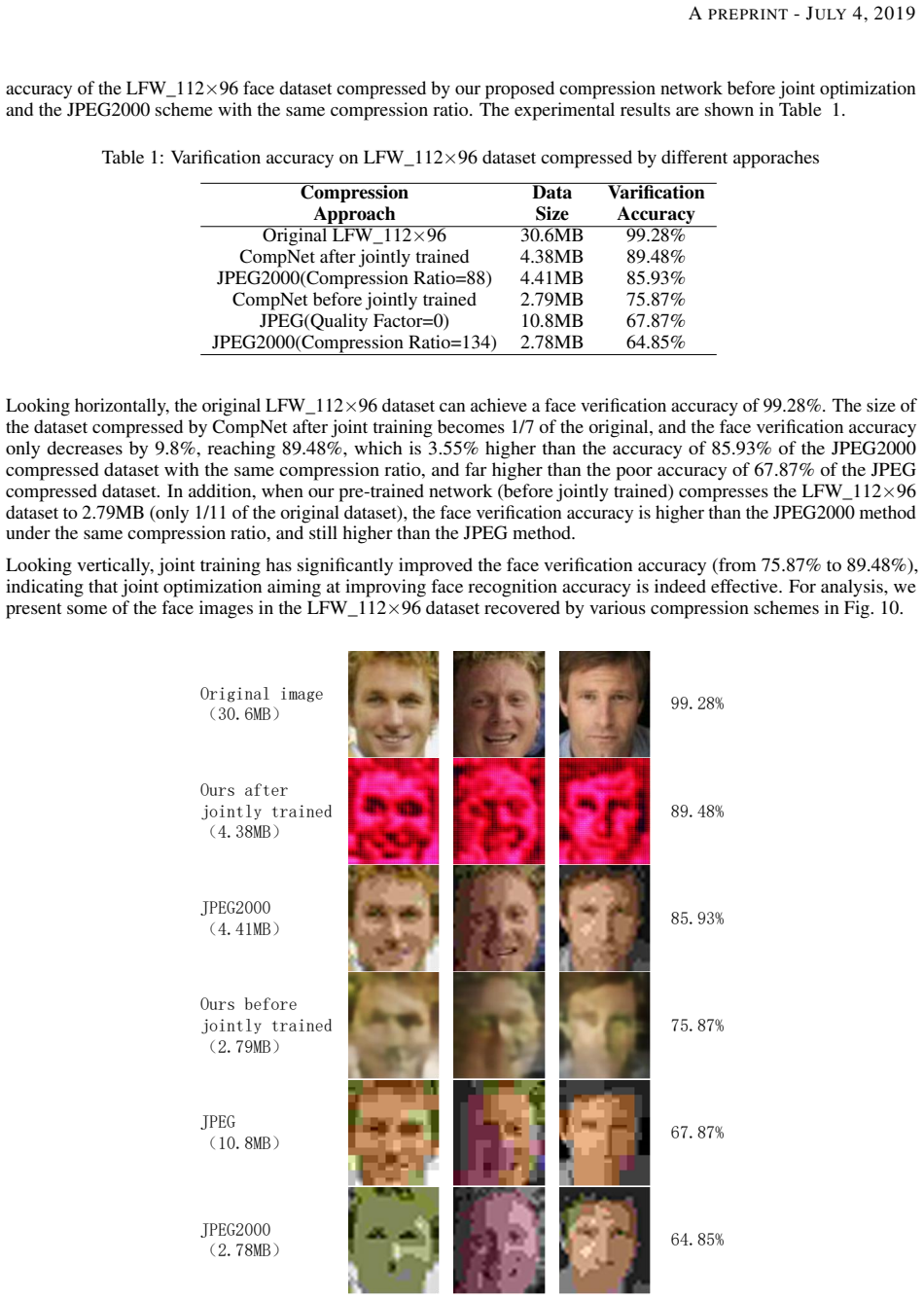
Jointly trained deep autoencoder compression yields higher face verification accuracy on LFW than JPEG or JPEG2000.
A machine-rendered reading of the paper's core claim, the machinery that carries it, and where it could break.
Core claim
The paper claims that its deep convolutional autoencoder compression network, when jointly optimized with an existing face recognition network, produces reconstructed images whose face verification accuracy on the LFW dataset exceeds that of images compressed by JPEG2000 and is substantially higher than that of images compressed by JPEG.
What carries the argument
deep convolutional autoencoder compression network jointly optimized with a face recognition network, which extracts compact features for encoding and reconstructs images tuned to preserve recognition performance
If this is right
- Face recognition pipelines can store and transmit more images with less accuracy loss than with standard codecs.
- The compact representation produced by the autoencoder can be saved using ordinary codecs such as PNG.
- Joint training makes the reconstructed images more suitable for recognition than images from separate compression steps.
- The framework achieves measurable gains on a standard benchmark dataset after compression.
Where Pith is reading between the lines
- The same joint-training idea could be tested on other recognition tasks such as object or scene classification to see if task-specific compression generalizes.
- Storage and bandwidth savings in large biometric databases would follow directly if the accuracy advantage holds at scale.
- Extending the approach to video sequences of faces would require checking whether temporal consistency is preserved under the same optimization.
- Different recognition network architectures could be substituted to test whether the compression benefit depends on the particular recognition model used.
Load-bearing premise
Joint optimization of the autoencoder and face recognition network will keep identity-discriminating features in the reconstructed images without adding artifacts that reduce recognition accuracy.
What would settle it
Running the LFW verification test on images compressed by the framework and finding accuracy no higher than JPEG2000 would falsify the claimed advantage.
Figures


read the original abstract
Face recognition technology has advanced rapidly and has been widely used in various applications. Due to the extremely huge amount of data of face images and the large computing resources required correspondingly in large-scale face recognition tasks, there is a requirement for a face image compression approach that is highly suitable for face recognition tasks. In this paper, we propose a deep convolutional autoencoder compression network for face recognition tasks. In the compression process, deep features are extracted from the original image by the convolutional neural networks to produce a compact representation of the original image, which is then encoded and saved by existing codec such as PNG. This compact representation is utilized by the reconstruction network to generate a reconstructed image of the original one. In order to improve the face recognition accuracy when the compression framework is used in a face recognition system, we combine this compression framework with a existing face recognition network for joint optimization. We test the proposed scheme and find that after joint training, the Labeled Faces in the Wild (LFW) dataset compressed by our compression framework has higher face verification accuracy than that compressed by JPEG2000, and is much higher than that compressed by JPEG.
Editorial analysis
A structured set of objections, weighed in public.
Referee Report
Summary. The paper proposes a deep convolutional autoencoder compression network for face images that extracts compact deep features, encodes them with an existing codec such as PNG, and reconstructs the image. The framework is jointly optimized with an existing face recognition network to preserve identity-discriminating features. Experiments claim that LFW images compressed by this method after joint training achieve higher face verification accuracy than the same images compressed by JPEG2000 and much higher accuracy than those compressed by JPEG.
Significance. If the central empirical claim holds under bitrate-matched conditions and the joint optimization demonstrably avoids recognition-harming artifacts, the work could contribute to task-specific learned compression for recognition pipelines. The manuscript provides no indication of released code, parameter-free derivations, or machine-checked proofs.
major comments (3)
- [Abstract] Abstract: the central claim that the jointly trained framework yields higher LFW verification accuracy than JPEG2000 (and much higher than JPEG) is presented without any quantitative accuracy values, standard deviations, number of pairs tested, or verification protocol details; this prevents assessment of effect size and statistical reliability.
- [Abstract] Abstract (and results): the accuracy comparison with JPEG and JPEG2000 reports no bitrates, bits-per-pixel, or file-size statistics for any method; without explicit rate matching or rate-distortion curves, observed accuracy gaps could arise from unequal compression ratios rather than superior feature preservation by the autoencoder or joint training.
- [Abstract] Abstract: the joint-optimization procedure is described at a high level but no loss function, weighting between reconstruction and recognition losses, or training details (e.g., which layers are frozen) are supplied, leaving the mechanism that supposedly preserves identity features unexamined.
minor comments (1)
- [Abstract] The abstract states that the compact representation is 'encoded and saved by existing codec such as PNG' while comparing against lossy codecs JPEG and JPEG2000; this choice of lossless PNG for the learned representation should be clarified with respect to rate.
Simulated Author's Rebuttal
We thank the referee for the careful reading and constructive feedback on our manuscript. We address each major comment below and will revise the manuscript accordingly to improve clarity and completeness.
read point-by-point responses
-
Referee: [Abstract] Abstract: the central claim that the jointly trained framework yields higher LFW verification accuracy than JPEG2000 (and much higher than JPEG) is presented without any quantitative accuracy values, standard deviations, number of pairs tested, or verification protocol details; this prevents assessment of effect size and statistical reliability.
Authors: We agree that the abstract would benefit from including the quantitative results. In the revised manuscript we will update the abstract to report the specific LFW verification accuracies achieved by each method, along with the standard LFW protocol details (6000 pairs, 10-fold cross validation) and any reported standard deviations from our experiments. revision: yes
-
Referee: [Abstract] Abstract (and results): the accuracy comparison with JPEG and JPEG2000 reports no bitrates, bits-per-pixel, or file-size statistics for any method; without explicit rate matching or rate-distortion curves, observed accuracy gaps could arise from unequal compression ratios rather than superior feature preservation by the autoencoder or joint training.
Authors: This observation is correct and highlights an important point for fair evaluation. While the experiments compare the methods under their respective typical operating points, we will add explicit bitrate (bpp) and file-size statistics for all codecs in the revised abstract and results section, and include a rate-distortion analysis to demonstrate that the accuracy advantage holds under matched rates where possible. revision: yes
-
Referee: [Abstract] Abstract: the joint-optimization procedure is described at a high level but no loss function, weighting between reconstruction and recognition losses, or training details (e.g., which layers are frozen) are supplied, leaving the mechanism that supposedly preserves identity features unexamined.
Authors: We acknowledge that additional detail on the joint training would strengthen the abstract. In the revision we will expand the abstract description to include the form of the combined loss, the weighting coefficients between reconstruction and recognition terms, and the training protocol (e.g., which layers remain trainable). These details are already present in the body of the paper and will now be summarized at the abstract level as well. revision: yes
Circularity Check
No circularity; empirical accuracy claim rests on external LFW benchmark testing.
full rationale
The paper trains a convolutional autoencoder jointly with a face recognition network and reports higher LFW verification accuracy versus JPEG/JPEG2000 baselines. This is a standard empirical procedure whose outcome is not forced by construction: the accuracy metric is computed on held-out external data, the joint loss does not redefine any quantity in terms of itself, and no fitted parameter is relabeled as a prediction. No load-bearing self-citation, uniqueness theorem, or ansatz smuggling appears in the derivation chain. The result is therefore self-contained against the stated benchmark.
Axiom & Free-Parameter Ledger
Reference graph
Works this paper leans on
-
[1]
Compression artifacts reduction by a deep convolutional network
Chao Dong, Yubin Deng, Chen Change Loy, and Xiaoou Tang. Compression artifacts reduction by a deep convolutional network. In Proceedings of the IEEE International Conference on Computer Vision , pages 576–584, 2015
work page 2015
-
[2]
Soft-to-hard vector quantization for end-to-end learning compressible representations
Eirikur Agustsson, Fabian Mentzer, Michael Tschannen, Lukas Cavigelli, Radu Timofte, Luca Benini, and Luc V Gool. Soft-to-hard vector quantization for end-to-end learning compressible representations. In Advances in Neural Information Processing Systems, pages 1141–1151, 2017. 9 A PREPRINT - J ULY 4, 2019
work page 2017
-
[3]
Generative Adversarial Networks for Extreme Learned Image Compression
Eirikur Agustsson, Michael Tschannen, Fabian Mentzer, Radu Timofte, and Luc Van Gool. Generative adversarial networks for extreme learned image compression. arXiv preprint arXiv:1804.02958, 2018
-
[4]
Lossy Image Compression with Compressive Autoencoders
Lucas Theis, Wenzhe Shi, Andrew Cunningham, and Ferenc Huszár. Lossy image compression with compressive autoencoders. arXiv preprint arXiv:1703.00395, 2017
work page internal anchor Pith review Pith/arXiv arXiv 2017
-
[5]
Full resolution image compression with recurrent neural networks
George Toderici, Damien Vincent, Nick Johnston, Sung Jin Hwang, David Minnen, Joel Shor, and Michele Covell. Full resolution image compression with recurrent neural networks. In Proceedings of the IEEE Conference on Computer Vision and Pattern Recognition, pages 5306–5314, 2017
work page 2017
-
[6]
An end-to-end compression framework based on convolutional neural networks
Feng Jiang, Wen Tao, Shaohui Liu, Jie Ren, Xun Guo, and Debin Zhao. An end-to-end compression framework based on convolutional neural networks. IEEE Transactions on Circuits and Systems for Video Technology , 28(10):3007–3018, 2017
work page 2017
-
[7]
Cosface: Large margin cosine loss for deep face recognition
Hao Wang, Yitong Wang, Zheng Zhou, Xing Ji, Dihong Gong, Jingchao Zhou, Zhifeng Li, and Wei Liu. Cosface: Large margin cosine loss for deep face recognition. In Proceedings of the IEEE Conference on Computer Vision and Pattern Recognition, pages 5265–5274, 2018
work page 2018
-
[8]
Deep Image Compression via End-to-End Learning
Haojie Liu, Chen Tong, Shen Qiu, Yue Tao, and Ma Zhan. Deep image compression via end-to-end learning. arXiv preprint arXiv:1806.01496, 2018
work page internal anchor Pith review Pith/arXiv arXiv 2018
-
[9]
Deep residual learning for image recognition
Kaiming He, Xiangyu Zhang, Shaoqing Ren, and Jian Sun. Deep residual learning for image recognition. In Proceedings of the IEEE conference on computer vision and pattern recognition , pages 770–778, 2016
work page 2016
-
[10]
Normface: l 2 hypersphere embedding for face verification
Feng Wang, Xiang Xiang, Jian Cheng, and Alan Loddon Yuille. Normface: l 2 hypersphere embedding for face verification. In Proceedings of the 25th ACM international conference on Multimedia , pages 1041–1049. ACM, 2017
work page 2017
-
[11]
Sphereface: Deep hypersphere embedding for face recognition
Weiyang Liu, Yandong Wen, Zhiding Yu, Ming Li, Bhiksha Raj, and Le Song. Sphereface: Deep hypersphere embedding for face recognition. InProceedings of the IEEE conference on computer vision and pattern recognition, pages 212–220, 2017
work page 2017
-
[12]
Arcface: Additive angular margin loss for deep face recognition
Jiankang Deng, Jia Guo, Niannan Xue, and Stefanos Zafeiriou. Arcface: Additive angular margin loss for deep face recognition. In Proceedings of the IEEE Conference on Computer Vision and Pattern Recognition , pages 4690–4699, 2019
work page 2019
-
[13]
Joint face detection and alignment using multitask cascaded convolutional networks
Kaipeng Zhang, Zhanpeng Zhang, Zhifeng Li, and Yu Qiao. Joint face detection and alignment using multitask cascaded convolutional networks. IEEE Signal Processing Letters, 23(10):1499–1503, 2016. 10
work page 2016
discussion (0)
Sign in with ORCID, Apple, or X to comment. Anyone can read and Pith papers without signing in.