REVIEW 3 major objections 5 minor 1 cited by
The Independent Atom Model -- Pixel Counting Method for Ion-Molecule Collisions
T0 review · 3 major / 5 minor · reviewed 2026-08-04 · deepseek-v4-flash
Pith's one-line read Proton-impact ionization of biomolecules collapses onto one atomic-composition curve.
desk verdict A solid methods summary and compilation of the authors' own IAM-PCM results, with one genuinely new parametrization; but the 'prediction' in Eq. (25) is really an interpolation, and the scaling rests on an assumption the authors themselves question. read the letter →
The pith
A machine-rendered reading of the paper's core claim, the machinery that carries it, and where it could break.
The reading
What carries the argument
The central object is the IAM-PCM weight factor s_{x|j}, the fractional contribution of atom j to the union of overlapping atomic cross-section disks, computed by pixel counting; it converts the simple additivity-rule sum into a molecular cross section that depends on molecular orientation and projectile energy. The scaling claim rides on N_IAM, a linear composition number derived from the relative sizes of atomic net ionization cross sections, and on the effective projectile charge Q_eff(E) = 1 - alpha exp(-beta E^0.4), which bends the high-energy Bethe form down to capture-dominated energies. Together these define Eq. (25), the parametrization that is the paper's headline result.
What would settle it
Measure the net ionization cross section of a nucleotide not in the fit set, for example deoxyguanosine triphosphate (dGTP, C10H16N5O13P3, N_IAM = 36.5 by Eq. (20)), for 10 keV to 10 MeV protons and compare with Eq. (25) using the nucleotide alpha and beta from Table I. The paper's claim is that the reduced cross section sigma/N_IAM stays on the same narrow band as the six fitted nucleotides; a deviation outside the claimed ~2% would falsify the parametrization. A second decisive test is complete-coincidence proton-on-methane and proton-on-ammonia electron-production measurements at about 1 Me
Extended reading notes
Core claim
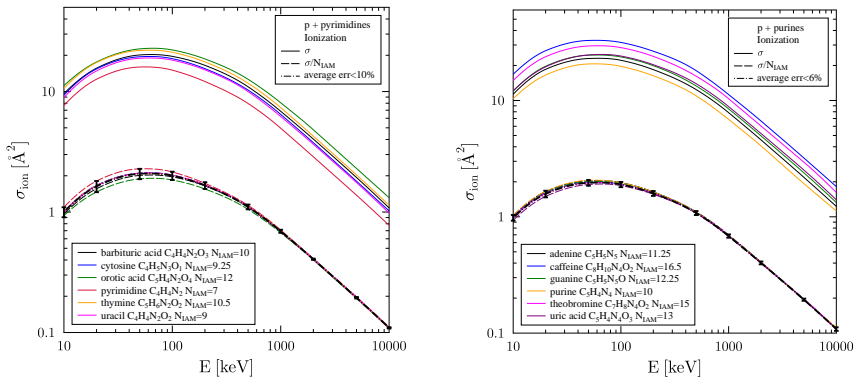
The paper's central claim is that net electron-production (ionization) cross sections for proton collisions with biomolecules obey a universal reduced scaling: when the molecular cross section is divided by N_IAM = 0.25 n_H + n_C + n_N + n_O + 0.9 n_F + 1.5 n_P, all molecules within a family fall on one curve at high energies, and the modified Bethe form sigma_ion^mod(E) = N_IAM [1 - alpha exp(-beta E^0.4)]^2 (100 ln E + 120)/E reproduces the per-family curves from 10 keV to 10 MeV. The authors also argue that the IAM-PCM can be conceptualized equivalently by associating each pixel in the pixelized atomic cross-section disks with a scattering event, taking only one event per projectile path
Load-bearing premise
The load-bearing premise is the single-scattering condition—that a proton whose path crosses m atomic pixels counts exactly one scattering event with weight 1/m—and the paper itself flags this condition, together with the ad hoc renormalization of multiple capture into single capture, as the spot to relax.
Editorial extensions
If this is right
- Net ionization cross sections for any molecule in the four families—pyrimidines, purines, amino acids, and nucleotides—can be estimated directly from its chemical formula and the family's two fitted parameters, with no molecular scattering calculation.
- Composition rather than electronic structure orders electron production: a molecule with larger N_IAM has proportionally larger ionization cross section, with the reported spread kept to under 10% (pyrimidines), 6% (purines, amino acids), and 2% (nucleotides).
- The ratios of q-fold to single electron production, sigma_q/sigma_1, are predicted to be nearly universal for the ten-electron molecules HF, H2O, NH3, CH4 above about 100 keV, independent of N_IAM; this is directly testable with complete coincidence experiments.
- Relaxing the single-scattering assumption—the paper's stated next step—would change the weight factors and could remove the apparent overcorrection seen for multiply-charged projectiles.
- For radiation-damage and hadron-therapy modelling, the parametrization turns a library of molecular targets into a closed-form input from atomic composition alone.
Reading between the lines
- If the N_IAM scaling is real, it likely extends to other planar bio-relevant heterocycles such as imidazoles or thiophenes because their valence structure is similar; computing the reduced curve for one such molecule would test this extension cheaply.
- The formula can be inverted: measured cross sections for a few molecules in a family could fix alpha and beta independently of any particular atomic-collision code, making Eq. (25) an empirical predictive tool.
- Methane's failure to join the reduced biomolecular curve suggests the scaling applies to molecules with a conjugated or at least multi-heavy-atom core; finding the smallest molecule that still collapses would map the boundary of the effect.
- The pixel-scattering reinterpretation ties the weight factor to a mean number of atoms encountered per projectile path; that number could be compared directly with molecular geometry to check the single-scattering condition without new scattering data.
Signed reviews
Editorial analysis
A structured set of objections, weighed in public.
Referee Report
Summary. The manuscript reviews the independent atom model with pixel counting (IAM-PCM) and presents a new conceptualization in which pixels in an impact-parameter area decomposition represent scattering events. The method is applied to proton collisions with ten-electron systems and a range of biomolecules (pyrimidines, purines, amino acids, nucleotides). The central new claim is that net ionization cross sections, divided by a composition-dependent parameter N_IAM (Eq. (20)), collapse onto a common reduced curve, and that this curve is accurately reproduced by a simple parametrized Bethe-type formula, Eq. (25), with per-family fitted parameters alpha and beta (Table I) and Bethe constants A=100, B=120 read from the authors' TC-BGM atomic cross sections. The paper also discusses charge-state correlated capture and ionization cross sections, comparing with experiments for H2O, CH4, NH3, and HF.
Significance. If fully established, the paper would provide an extremely economical, composition-only description of net ionization cross sections for biologically relevant molecules under proton impact over 10 keV to 10 MeV, which is directly relevant to hadron therapy and radiation dosimetry. The formal derivation of the IEM multiple-capture/ionization probabilities (Eqs. (7)-(11)) is standard and internally consistent, and the scaling collapse is demonstrated with quoted error bands in Figs. 6-7. The authors are also candid about model assumptions, explicitly flagging the single-scattering condition and the ad hoc renormalization of multiple capture in Sec. IV. However, the paper's headline claim of 'remarkable accuracy' for Eq. (25) is currently a statement about the quality of a fit to the authors' own calculations, not an independently validated prediction. The physical status of the scaling law rests on the contested single-scattering assumption, and the available experimental validation is mixed, with factor-of-two discrepancies in some ratios. The manuscript would be strengthened by a predictive test that separates the model's internal consistency from a robust physics claim.
major comments (3)
- [Sec. IIIC, Eqs. (20)-(25), Table I] The central claim that Eq. (25) captures the scaling 'with remarkable accuracy' is a statement about a fit to the authors' own IAM-PCM calculations. The parameters alpha and beta are fitted per molecular family (Table I), and A=100, B=120 are read off the TC-BGM atomic curves. The reduced cross sections in Figs. 6-7 are the very data used to determine the family parameters and N_IAM. No independent test is presented (e.g., a molecule held out from the fitting, or comparison with experimental net-ionization data for a biomolecule not already used to set parameters). Please either provide such a test or explicitly characterize Eq. (25) as an interpolation formula for the IAM-PCM results rather than a validated prediction.
- [Sec. IIA and Sec. IV] The scaling collapse and all molecular cross sections inherit the single-scattering condition formalized in Eqs. (2)-(6), where each of m pixels along a projectile path contributes with weight 1/m and multiple scattering is excluded. In Sec. IV the authors state that IAM-PCM 'appears to overcorrect additivity rule predictions of net cross sections' and question whether the single-scattering condition needs to be relaxed. Since the paper provides no diagnostic that distinguishes a physical scaling law from a property of this assumption, the central claim remains conditional. The only external checks cited are a private communication (Ref. [15]) and data with factor-of-two discrepancies (Fig. 4, right panel). A quantitative sensitivity study (e.g., comparing the 1/m weighting with a first-hit alternative, or estimating the magnitude of multiple scattering) would be needed to support the ph
- [Sec. IIIB, Eq. (20)] The coefficients in N_IAM (0.25 for H, 0.9 for F, 1.5 for P, 1 for C/N/O) are said to 'follow from the atomic cross sections,' but no derivation or fitting procedure is supplied. Together with the per-family alpha and beta, these coefficients form a five-parameter atomic weighting plus two-parameter family fit. The paper should state how the weights were obtained (e.g., from high-energy ratios of the atomic cross sections in Fig. 1) and ideally provide a table of those ratios. Without this, the 'single parameter' characterization is misleading and the parametrization is not independently reproducible.
minor comments (5)
- [Eq. (25)] The expression (100 ln E + 120)/E is dimensionally awkward if E is in keV. Please specify that E is to be taken in keV inside the logarithm, or introduce a dimensionless ratio E/E0 with E0=1 keV.
- [Figs. 6-7] The reported 'average err' values (10%, 6%, 2%) are not defined. Please state how the average is calculated (e.g., over energy points, over molecules) and whether it is a maximum deviation or a root-mean-square band width.
- [Fig. 4, right panel] Several experimental data points appear without error bars. Adding error bars would clarify the claimed factor-of-two discrepancies and the 'complete coincidence count' argument for Werner et al.
- [Sec. IIB, Eqs. (17)-(18)] The ad hoc renormalization of multiple capture into single capture is clearly labeled, but it may help to note explicitly that this procedure preserves net capture and does not alter net ionization cross sections, so that readers understand which results are affected.
- [Throughout] There are a few typographical errors: 'endavours' (p. 2), 'reasonabe' (p. 7), 'purins' (Sec. IIIC) and 'multply-charged' (Sec. IV). Also, the phrase 'This book' in the Introduction indicates a book-chapter origin; the journal submission may need adjustments in style.
Circularity Check
No significant circularity: the parametrization is openly fitted, and the scaling law is a stated property of the IAM-PCM model.
full rationale
The paper does not present Eq. (25) as a derivation from first principles. It explicitly states that alpha and beta are fitted for each molecular group (Table I), and that A=100, B=120 were taken from the same TC-BGM atomic calculations that generate the IAM-PCM molecular data. The 'remarkable accuracy' claimed for the parametrization is therefore a goodness-of-fit statement, not an independent prediction, but the text consistently describes it as a 'parametrization' and a 'scaling behaviour', not as an unverified external constraint. The reduced cross-section scaling of Eq. (21) with N_IAM from Eq. (20) is a genuine model result: since the IAM-PCM molecular cross section is a weighted sum of atomic cross sections, choosing the N_IAM coefficients from the high-energy atomic cross-section ratios makes the high-energy limit of the reduced curve universal by construction, but the non-trivial content is the coalescence of the reduced curves at lower energies, which is demonstrated numerically for many molecules and for charge-state-correlated ratios sigma_q/sigma_1 that do not depend on N_IAM at all. The single-scattering condition is indeed load-bearing, but it is presented as the defining model assumption of IAM-PCM, not as a derived result, and the authors flag in Sec. IV that it may overcorrect additivity-rule predictions and that relaxing it is under study; that is a validity limitation, not circularity. Self-citations document the development of the method and are not used as an external uniqueness theorem or as the sole support for the scaling claim. No load-bearing step reduces by definition to its own input.
Assumptions & free parameters
free parameters (4)
- N_IAM weights (H: 0.25, F: 0.9, P: 1.5, C/N/O: 1) =
0.25, 0.9, 1.5, 1
- alpha per molecular family =
1.3450 (amino acids), 1.3217 (pyrimidines), 1.2933 (purines), 1.2563 (nucleotides)
- beta per molecular family =
0.19025, 0.18316, 0.17470, 0.16625 keV^-0.4
- Bethe constants A=100, B=120 =
100, 120
assumptions (6)
- domain assumption Semiclassical straight-line projectile path with frozen molecular geometry
- domain assumption Hartree independent-electron density factorization (Eq. 8) and IEM binomial statistics (Eq. 11)
- ad hoc to paper Single-scattering condition: at most one pixel per projectile path contributes, multiple scattering 'deemed non-existent'
- ad hoc to paper Statistical 1/m weighting of pixels along the path rather than classical first-hit choice
- ad hoc to paper Multiple capture contributions are renormalized into single capture (Eqs. 17-18)
- domain assumption Atomic target potentials from optimized potential method DFT; exchange exact, correlation and response neglected
Cite this review
Pith. "Pith review of The Independent Atom Model -- Pixel Counting Method for Ion-Molecule Collisions." pith.science (2026). https://pith.science/paper/6XUXGSUA
@misc{pith2026250907822,
  author       = {Pith},
  title        = {Pith review of: The Independent Atom Model -- Pixel Counting Method for Ion-Molecule Collisions},
  year         = {2026},
  howpublished = {\url{https://pith.science/paper/6XUXGSUA}},
  note         = {Machine review of arXiv:2509.07822}
}
read the original abstract
The independent atom model - pixel counting method (IAM-PCM) for the description of ion-molecule collisions is reviewed. The method was introduced (in 2016) to improve on the simple additivity rule according to which scattering cross sections for a molecular target can be obtained by summing up the cross sections of the constituent atoms. The key idea of the IAM-PCM is the inclusion of weight factors in the summation, to be determined from a geometrical interpretation of the resultant cross section as a combined area of overlapping atomic contributions, which is calculated via a pixelization technique. We argue here that the IAM-PCM can be conceptualized in a different but equivalent way by associating each pixel in the area decomposition with a scattering event. The calculation of net and charge-state correlated capture and ionization cross sections is explained, and results for 10 keV to 10 MeV proton impact are discussed for a number of targets ranging from compact ten-electron systems to large biomolecules. A previously observed scaling behaviour of the net ionization cross sections is revisited and shown to be captured by a simple parametrization with remarkable accuracy.
Figures


Figures from the paper (5 more)




Forward citations
Cited by 1 Pith paper
-
A generalized independent atom model approach for net ionization of molecules by multiply-charged heavy-ion impact
A mean-free-path extension to the independent atom model (xPCM) adds double-scattering events and predicts larger net ionization cross sections for highly charged projectiles.
Reference graph
Works this paper leans on
-
[15]
M. A. Bernal, (2025), private communication
work page 2025
-
[1]
Theory of heavy ion collision physics for hadron therapy,
D. Belkić, “Theory of heavy ion collision physics for hadron therapy,” inState-of-the-Art Reviews on Energetic Ion-Atom and Ion-Molecule Collisions(World Scientific Publishing, Singapore,
-
[2]
Belkić, Zeitschrift für Medizinische Physik31, 122 (2021), special Issue: Ion Beam Therapy, Part I
D. Belkić, Zeitschrift für Medizinische Physik31, 122 (2021), special Issue: Ion Beam Therapy, Part I
work page 2021
-
[3]
M. Murakami, T. Kirchner, M. Horbatsch, and H. J. Lüdde, Phys. Rev. A85, 052704 (2012)
work page 2012
-
[4]
T. Kirchner, M. Murakami, M. Horbatsch, and H. J. Lüdde, Adv. Quant. Chem.65, 315 (2013)
work page 2013
- [5]
-
[6]
H. J. Lüdde, A. Achenbach, T. Kalkbrenner, H.-C. Jankowiak, and T. Kirchner, Eur. Phys. J. D70, 82 (2016)
work page 2016
-
[7]
H. J. Lüdde, M. Horbatsch, and T. Kirchner, Eur. Phys. J. B91, 99 (2018)
work page 2018
Show all 40 references
-
[8]
H. J. Lüdde, M. Horbatsch, and T. Kirchner, J. Phys. B52, 195203 (2019)
2019
-
[9]
H. J. Lüdde, M. Horbatsch, and T. Kirchner, The European Physical Journal D73, 249 (2019)
2019
-
[10]
H. J. Lüdde, T. Kalkbrenner, M. Horbatsch, and T. Kirchner, Phys. Rev. A101, 062709 22 (2020)
2020
-
[11]
H. J. Lüdde, A. Jorge, M. Horbatsch, and T. Kirchner, Atoms8, 59 (2020)
2020
-
[12]
Jorge, M
A. Jorge, M. Horbatsch, C. Illescas, and T. Kirchner, Phys. Rev. A99, 062701 (2019)
2019
-
[13]
H. J. Lüdde, M. Horbatsch, and T. Kirchner, Phys. Rev. A106, 022813 (2022)
2022
-
[14]
de Oliveira, Luca A., de Farias, Jhaison C., and Bernal, Mario A., Eur. Phys. J. D78, 147 (2024)
2024
-
[16]
H. J. Lüdde, inMany-Particle Quantum Dynamics in Atomic and Molecular Fragmentation, edited by J. Ullrich and V. P. Shevelko (Springer, Berlin, 2003) pp. 205–220
2003
-
[17]
Horbatsch, Phys
M. Horbatsch, Phys. Rev. A49, 4556 (1994)
1994
-
[18]
D. R. Schultz, R. E. Olson, C. O. Reinhold, S. Kelbch, C. Kelbch, H. Schmidt-Böcking, and J. Ullrich, Journal of Physics B: Atomic, Molecular and Optical Physics23, 3839 (1990)
1990
-
[19]
M. E. Rose,Elementary Theory of Angular Momentum(Dover Publications, Mineola, N.Y., 1995)
1995
-
[20]
Zapukhlyak, T
M. Zapukhlyak, T. Kirchner, H. J. Lüdde, S. Knoop, R. Morgenstern, and R. Hoekstra, J. Phys. B38, 2353 (2005)
2005
-
[21]
Kirchner, H
T. Kirchner, H. J. Lüdde, M. Horbatsch, and R. M. Dreizler, Phys. Rev. A61, 052710 (2000)
2000
-
[22]
I. Bray, I. B. Abdurakhmanov, J. J. Bailey, A. W. Bray, D. V. Fursa, A. S. Kadyrov, C. M. Rawlins, J. S. Savage, A. T. Stelbovics, and M. C. Zammit, Journal of Physics B: Atomic, Molecular and Optical Physics50, 202001 (2017)
2017
-
[23]
Hill, Dipti, K
C. Hill, Dipti, K. Heinola, A. Dubois, N. Sisourat, A. Taoutioui, H. Agueny, K. Tőkési, I. Ziaeian, C. Illescas, A. Jorge, L. Méndez, A. Kadyrov, N. Antonio, A. Kotian, T. Kirchner, A. Leung, J. Ko, J. Lee, O. Marchuk, M. O’Mullane, E. Litherland-Smith, G. Pokol, O. Asztalos, ...
2023
-
[24]
N. A. Mori, H. Umer, L. H. Scarlett, I. Bray, and D. V. Fursa, Journal of Physics B: Atomic, Molecular and Optical Physics57, 225201 (2024)
2024
-
[25]
Fedus and G
K. Fedus and G. P. Karwasz, Phys. Rev. A100, 062702 (2019)
2019
-
[26]
Werner, K
U. Werner, K. Beckord, J. Becker, and H. O. Lutz, Phys. Rev. Lett.74, 1962 (1995)
1962
-
[27]
A. C. Tavares, H. Luna, W. Wolff, and E. C. Montenegro, Phys. Rev. A92, 032714 (2015)
2015
-
[28]
H. Luna, W. Wolff, E. C. Montenegro, and L. Sigaud, Phys. Rev. A99, 012709 (2019)
2019
-
[29]
Wolff, H
W. Wolff, H. Luna, E. C. Montenegro, and L. C. Rodrigues Junior, Phys. Rev. A102, 052821 23 (2020)
2020
-
[30]
MolView: http://molview.org [Online; accessed 2025-06-05]
2025
-
[31]
Illescas, L
C. Illescas, L. Méndez, S. Bernedo, and I. Rabadán, International Journal of Molecular Sciences 24(2023), 10.3390/ijms24032172
2023 doi
-
[32]
Champion, M
C. Champion, M. Galassi, P. Weck, S. Incerti, R. Rivarola, O. Fojón, J. Hanssen, Y. Iriki, and A. Itoh, Nuclear Instruments and Methods in Physics Research Section B: Beam Interactions with Materials and Atoms314, 66 (2013), eighth International Symposium on Swift Heavy Ions i...
2013
-
[33]
A. Itoh, Y. Iriki, M. Imai, C. Champion, and R. D. Rivarola, Phys. Rev. A88, 052711 (2013)
2013
-
[34]
Roy Chowdhury, J
M. Roy Chowdhury, J. M. Monti, D. Misra, P. F. Weck, R. D. Rivarola, and L. C. Tribedi, New Journal of Physics24, 073035 (2022)
2022
-
[35]
Sarkadi, Journal of Physics B: Atomic, Molecular and Optical Physics49, 185203 (2016)
L. Sarkadi, Journal of Physics B: Atomic, Molecular and Optical Physics49, 185203 (2016)
2016
-
[36]
Tabet, S
J. Tabet, S. Eden, S. Feil, H. Abdoul-Carime, B. Farizon, M. Farizon, S. Ouaskit, and T. D. Märk, Phys. Rev. A82, 022703 (2010)
2010
-
[37]
Champion, P
C. Champion, P. F. Weck, H. Lekadir, M. E. Galassi, O. A. Fojón, P. Abufager, R. D. Rivarola, and J. Hanssen, Physics in Medicine & Biology57, 3039 (2012)
2012
-
[38]
P. d. Vera, I. Abril, R. Garcia-Molina, and A. V. Solov’yov, Journal of Physics: Conference Series438, 012015 (2013)
2013
-
[39]
Paredes, C
S. Paredes, C. Illescas, and L. Méndez, Eur. Phys. J. D69, 178 (2015). 24
2015
-
[2019]
Chapter 11, pp
Chap. Chapter 11, pp. 285–336
Reviewed August 4, 2026 · model on record in the stance chip above.
Discussion (0). Continue with ORCID to comment.