Real-Space Mapping of Electronic Conductivity in Complex Materials
Pith reviewed 2026-06-26 13:32 UTC · model grok-4.3
The pith
KuboMap defines a nonnegative real-space conductivity density from the Kubo-Greenwood formula whose integral recovers the total conductivity.
A machine-rendered reading of the paper's core claim, the machinery that carries it, and where it could break.
Core claim
KuboMap is a real-space representation of electronic conductivity derived from the Kubo-Greenwood formula that defines a nonnegative conductivity density whose spatial integral recovers the total conductivity and whose form is guided by Mott's picture of transport through spatially overlapping electronic states, thereby providing a direct map of the transport-active regions of a material.
What carries the argument
KuboMap, the nonnegative conductivity density constructed from the Kubo-Greenwood formula so that its volume integral equals the total conductivity.
If this is right
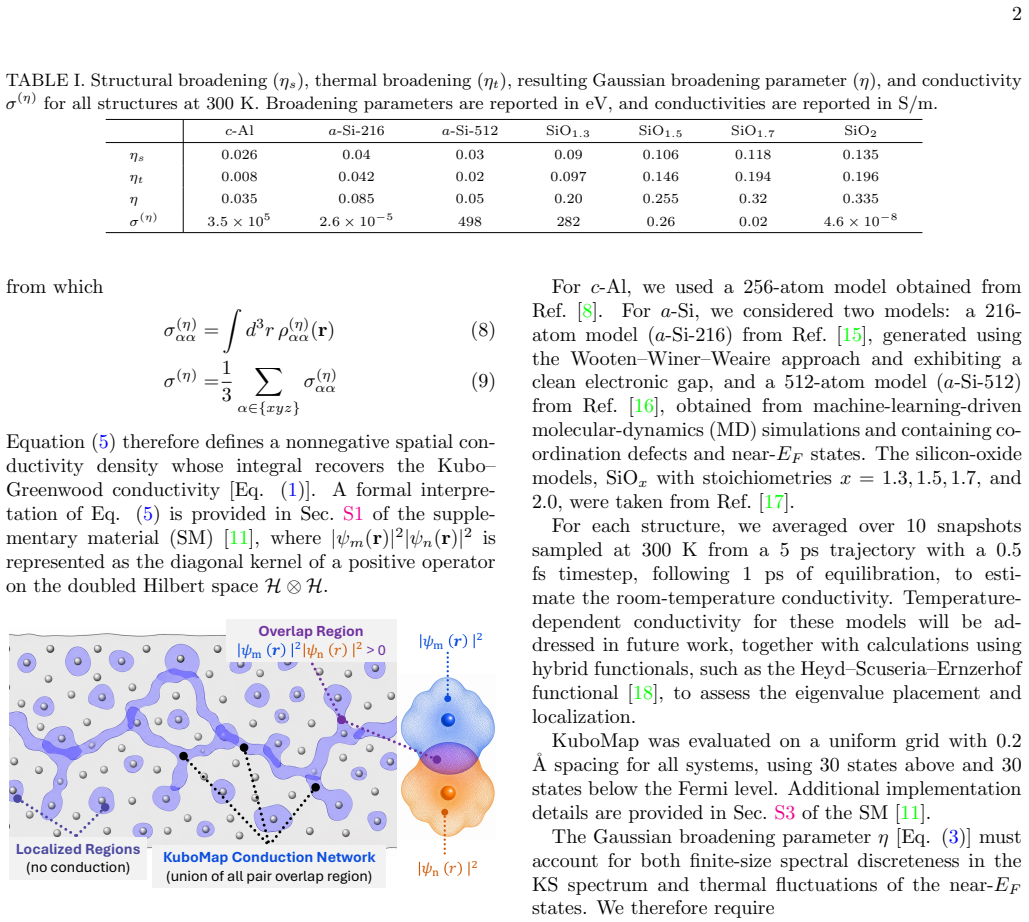
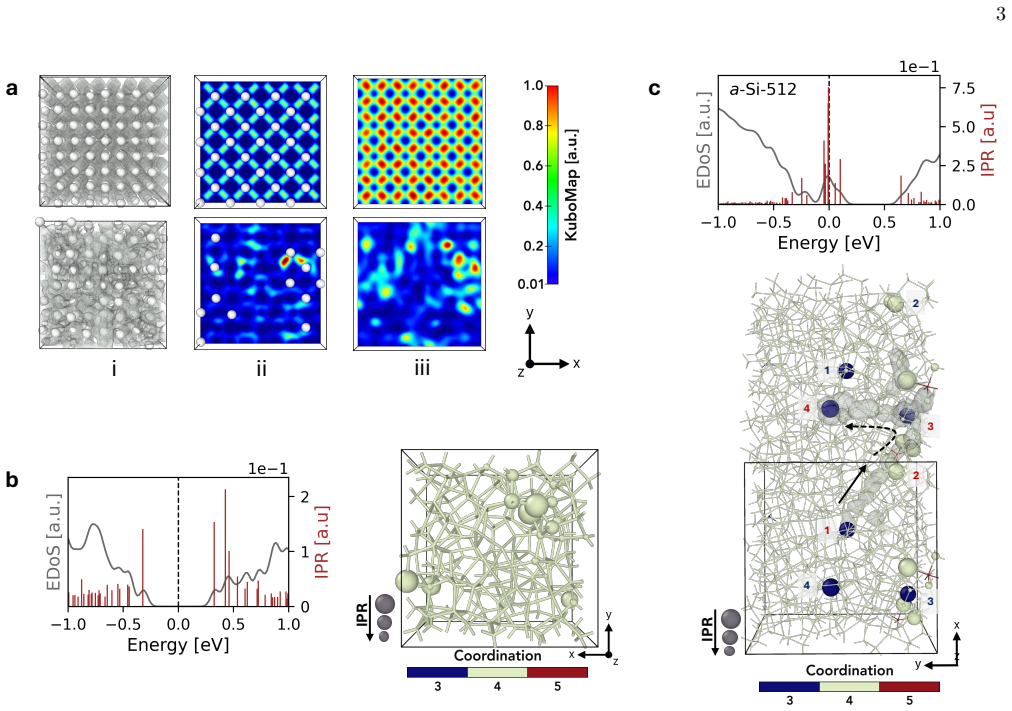
- In aluminum the map recovers an extended metallic conduction network.
- In amorphous silicon the map separates an insulating defect-free network from a defective structure whose near-Fermi states form connected hopping pathways.
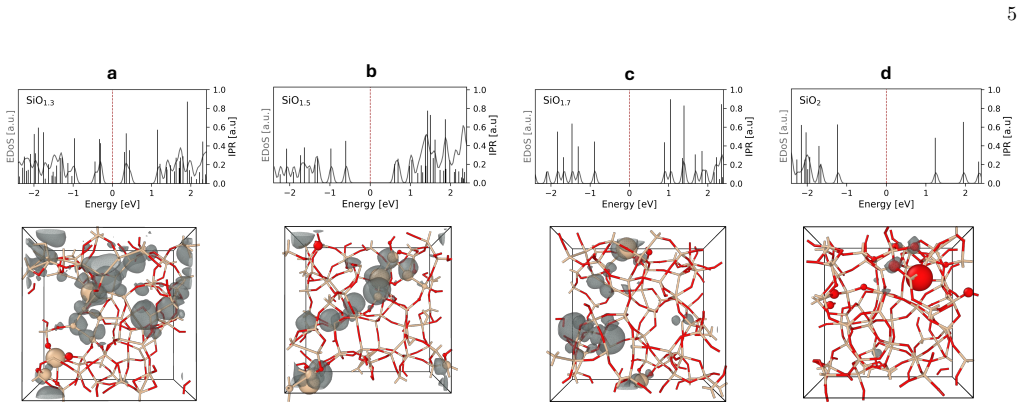
- In silicon oxides the map shows conduction disappearing as added oxygen disrupts silicon-rich transport networks.
- The construction supplies a physically transparent route from the Kubo-Greenwood formula to explicit real-space transport pathways.
Where Pith is reading between the lines
- The same density construction could be used to rank candidate defect configurations by how much they open or close transport channels.
- Because the density is nonnegative and additive, it offers a natural starting point for coarse-graining conductivity onto larger length scales without recomputing the full Kubo-Greenwood expression.
- The method might be combined with molecular-dynamics trajectories to track how thermal motion rearranges the active conduction regions over time.
Load-bearing premise
The spatial form of the conductivity density follows from Mott's picture of transport occurring through spatially overlapping electronic states.
What would settle it
A direct numerical check in which the volume integral of the KuboMap density differs from the Kubo-Greenwood conductivity computed for the same system would falsify the construction.
Figures
read the original abstract
We introduce KuboMap, a real-space representation of electronic conductivity derived from the Kubo-Greenwood formula. KuboMap defines a nonnegative conductivity density whose spatial integral recovers the total conductivity and whose form is guided by Mott's picture of transport through spatially overlapping electronic states. This construction provides a direct map of the transport-active regions of a material. Applied to aluminum, KuboMap recovers an extended metallic conduction network. Applied to amorphous silicon, it distinguishes an insulating defect-free network from a defective structure in which localized near-Fermi states form connected hopping-like pathways. In silicon-oxides, it captures the loss of conduction as increasing oxygen content disrupts Silicon-rich transport networks. KuboMap provides a physically transparent route from Kubo--Greenwood conductivity to real-space transport pathways in complex materials.
Editorial analysis
A structured set of objections, weighed in public.
Referee Report
Summary. The manuscript introduces KuboMap, a real-space representation of electronic conductivity derived from the Kubo-Greenwood formula. It defines a nonnegative conductivity density whose spatial integral recovers the total conductivity, with its form guided by Mott's picture of transport through spatially overlapping electronic states. Applications to aluminum recover an extended metallic network; to amorphous silicon distinguish defect-free insulating networks from defective ones with connected hopping pathways; and to silicon oxides show disruption of silicon-rich networks with increasing oxygen content.
Significance. If the density construction is shown to follow rigorously from the Kubo-Greenwood formula with a unique or physically preferred partitioning, the method could provide a transparent route to visualizing transport-active regions in complex materials, complementing global conductivity calculations with local structural information. The three applications illustrate potential utility across metallic, amorphous, and oxide systems.
major comments (1)
- [Theory/derivation section] The abstract states that the conductivity density form is 'guided by' Mott's overlapping-states picture rather than derived uniquely from operator identities in the Kubo-Greenwood formula. The manuscript must supply the explicit definition (likely in the methods or theory section) together with a proof of nonnegativity and a demonstration that the chosen partitioning is not one of multiple possible decompositions that integrate to the same total conductivity.
minor comments (1)
- [Abstract] The abstract is concise but the main text should include the explicit functional form of the conductivity density and any numerical implementation details for reproducibility.
Simulated Author's Rebuttal
We thank the referee for the constructive feedback on the theoretical foundations of KuboMap. We address the single major comment below and will revise the manuscript to strengthen the presentation of the definition, nonnegativity, and physical motivation for the partitioning.
read point-by-point responses
-
Referee: [Theory/derivation section] The abstract states that the conductivity density form is 'guided by' Mott's overlapping-states picture rather than derived uniquely from operator identities in the Kubo-Greenwood formula. The manuscript must supply the explicit definition (likely in the methods or theory section) together with a proof of nonnegativity and a demonstration that the chosen partitioning is not one of multiple possible decompositions that integrate to the same total conductivity.
Authors: The explicit definition of the conductivity density is already stated in the Theory section (Eq. 3), constructed as a sum over pairwise state overlaps weighted by the Kubo-Greenwood matrix elements and localized via a position operator. Nonnegativity follows directly because each term is proportional to the square of the overlap integral between states, which is nonnegative. While the partitioning is not mathematically unique (alternative weightings of the same total conductivity exist), we will add a dedicated paragraph demonstrating that this specific form is the one that recovers Mott's overlapping-states criterion for transport, thereby providing the physically preferred decomposition for mapping active regions. The revised manuscript will include the explicit definition, the nonnegativity proof, and the discussion of why this choice is selected over other possible decompositions. revision: yes
Circularity Check
No significant circularity: KuboMap is an explicit construction with integral property by definition and form chosen via physical guidance.
full rationale
The abstract presents KuboMap as a real-space density derived from the Kubo-Greenwood formula such that its spatial integral recovers the total conductivity by construction; this is the standard property of any density function and does not constitute a claimed independent prediction that reduces to the input. The specific functional form is stated to be guided by Mott's overlapping-states picture rather than asserted as a unique first-principles derivation, so no self-definitional loop or fitted-input-renamed-as-prediction is present. No self-citations, uniqueness theorems, or ansatzes smuggled via prior author work appear in the supplied text. The material applications illustrate the resulting maps but do not rely on any tautological reduction. The derivation chain is therefore self-contained against external benchmarks.
Axiom & Free-Parameter Ledger
Reference graph
Works this paper leans on
-
[1]
Kubo, Journal of the Physical Society of Japan12, 570 (1957)
R. Kubo, Journal of the Physical Society of Japan12, 570 (1957)
1957
-
[2]
D. A. Greenwood, Proceedings of the Physical Society 71, 585 (1958)
1958
-
[3]
P. W. Anderson, Phys. Rev.109, 1492 (1958)
1958
-
[4]
N. F. Mott, The Philosophical Magazine: A Journal of Theoretical Experimental and Applied Physics19, 835 (1969)
1969
-
[5]
Mott, Journal of Non-Crystalline Solids1, 1 (1968)
N. Mott, Journal of Non-Crystalline Solids1, 1 (1968)
1968
-
[6]
K. N. Subedi, K. Prasai, and D. A. Drabold, physica status solidi (b)258, 2000438 (2021)
2021
-
[7]
Nepal, C
K. Nepal, C. Ugwumadu, F. Kraft, Y. Al-Majali, and D. Drabold, Carbon231, 119711 (2025)
2025
-
[8]
Hussein, C
R. Hussein, C. Ugwumadu, K. Nepal, R. Tutchton, K. Kappagantula, and D. Drabold, Journal of Non- Crystalline Solids682, 124106 (2026)
2026
-
[9]
S. K. Bose, O. Jepsen, and O. K. Andersen, Phys. Rev. B48, 4265 (1993)
1993
-
[10]
N. K. Hindley, Journal of Non-Crystalline Solids5, 17 (1970)
1970
-
[11]
See Supplemental Material at [URL inserted by pub- lisher] for additional KuboMap details for the models
-
[12]
Kresse and J
G. Kresse and J. Furthm¨ uller, Phys. Rev. B54, 11169 (1996)
1996
-
[13]
P. E. Bl¨ ochl, Phys. Rev. B50, 17953 (1994)
1994
-
[14]
J. P. Perdew, K. Burke, and M. Ernzerhof, Phys. Rev. Lett.77, 3865 (1996)
1996
-
[15]
B. R. Djordjevi´ c, M. F. Thorpe, and F. Wooten, Phys. Rev. B52, 5685 (1995)
1995
-
[16]
J. D. Morrow, C. Ugwumadu, D. A. Drabold, S. R. El- liott, A. L. Goodwin, and V. L. Deringer, Angewandte Chemie International Edition63, e202403842 (2024)
2024
-
[17]
Ugwumadu, K
C. Ugwumadu, K. Subedi, R. Thapa, P. Apsangi, S. Swain, M. Kozicki, and D. Drabold, Journal of Non- Crystalline Solids: X18, 100179 (2023)
2023
-
[18]
J. Heyd, G. E. Scuseria, and M. Ernzerhof, The Journal of Chemical Physics118, 8207 (2003)
2003
-
[19]
P. B. Allen and J. L. Feldman, Phys. Rev. B48, 12581 (1993)
1993
-
[20]
D. A. Drabold, P. A. Fedders, S. Klemm, and O. F. Sankey, Phys. Rev. Lett.67, 2179 (1991)
1991
-
[21]
K. N. Subedi, K. Kappagantula, F. Kraft, A. Nittala, and D. A. Drabold, Phys. Rev. B105, 104114 (2022)
2022
-
[22]
mit.edu/~6.777/matprops/matprops.htm(assessed on: 07-06-2026)
Massachusetts Institute of Technology (MIT) Material Property Database (Amorphous Silicon),https://www. mit.edu/~6.777/matprops/matprops.htm(assessed on: 07-06-2026)
2026
-
[23]
Lewis, Phys
A. Lewis, Phys. Rev. Lett.29, 1555 (1972)
1972
-
[24]
J. K. Srivastava, M. Prasad, and J. B. Wagner, Journal of The Electrochemical Society132, 955 (1985)
1985
-
[25]
Ugwumadu, A
C. Ugwumadu, A. Gautam, Y. G. Lee, and D. A. Drabold, physica status solidi (b)263, e202500316 (2026)
2026
-
[26]
Ugwumadu, D
C. Ugwumadu, D. A. Drabold, and R. M. Tutchton, Phys. Rev. Mater.10, 053804 (2026)
2026
-
[27]
C. Ugwumadu, D. A. Drabold, and R. M. Tutchton, Zen- odo https://doi.org/10.5281/zenodo.20762302 (2026). Supplemental Material for ‘Real-Space Mapping of Electronic Conductivity in Complex Materials’ C. Ugwumadu*1, D. A. Drabold†2, and R. M. Tutchton‡1 1Quantum & Condensed Matter (T-4) Group, Los Alamos National Laboratory, Los Alamos, NM, USA 2Department...
discussion (0)
Sign in with ORCID, Apple, or X to comment. Anyone can read and Pith papers without signing in.