STARIXNet: Multivariate and Multi-attribute Deep Learning Approach to Real-Time Resource Allocation in Cloud Platforms
Reviewed by Pith2026-06-29 22:29 UTCgrok-4.3pith:6YIBUV6Iopen to challenge →
The pith
STARIXNet is a lightweight neural network that improves real-time resource allocation for cloud microservices by modeling multiple metrics and prioritizing stability over pure prediction accuracy.
A machine-rendered reading of the paper's core claim, the machinery that carries it, and where it could break.
Core claim
STARIXNet captures spatio-temporal relationships across multiple quasi-dependent system metrics by modeling seasonal, temporal, auto-regressive, integrated, and exogenous patterns, then uses a stability-first aggregation policy to produce scaling decisions that favor service continuity and cost efficiency over raw forecast precision.
What carries the argument
The STARIXNet neural network together with its stability-first aggregation policy for turning multivariate pattern outputs into scaling actions.
If this is right
- Scaling decisions become feasible in real time at large scale because the model remains lightweight.
- Service stability improves because the policy explicitly ranks continuity above forecast precision.
- Compute costs drop in the 10 to 50 percent range when the method runs on production microservices.
- The same framework can replace univariate CPU-only rules without requiring complex alternative solvers.
Where Pith is reading between the lines
- Similar pattern-capture plus stability aggregation could be tested on other resource types such as storage or network bandwidth.
- The approach may reduce reliance on hand-tuned thresholds once the network is trained on representative traces.
- Extending the input metrics to include application-level signals could further tighten the stability-cost trade-off.
Load-bearing premise
The learned relationships among the selected metrics and the stability-first policy will transfer to new production workloads without creating unacceptable delays in resource adjustments.
What would settle it
Deployment in a different production environment produces repeated under-provisioning events or scaling delays that violate service-level targets.
Figures


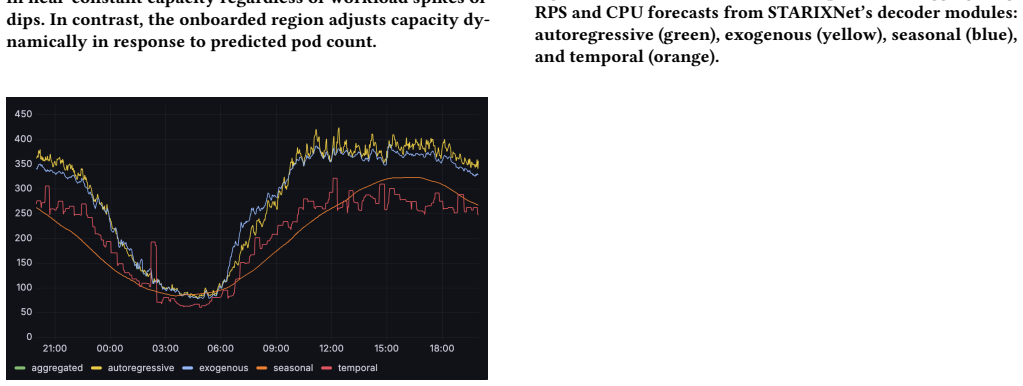
read the original abstract
Intelligent scaling of microservices in cloud platforms is crucial for mitigating escalating compute costs while avoiding service disruptions. Current solutions are limited to the univariate space, typically focusing on CPU usage alone to drive scaling decisions. Moreover, they address the problem as a purely forecasting task, focusing on prediction precision while neglecting the greater risks of underestimation and delays in system responsiveness. Alternative solutions are computationally complex, making them impractical for large-scale, real-time deployments. To address these challenges, we present STARIXNet, a lightweight neural network that guides resource allocation decisions in the multivariate space by capturing spatio-temporal relationships among multiple system metrics. STARIXNet models multiple quasi-dependent attributes, in particular the (S)easonal, (T)emporal, (A)uto-(R)egressive (I)ntegrated, and e(X)ogenous patterns, then implements an aggregation policy to finalize scaling decisions, prioritizing service stability, followed by cost-efficiency, over raw forecast accuracy. We empirically demonstrate the performance of STARIXNet by benchmarking against existing solutions in real-world settings. STARIXNet is deployed for critical production microservices at Walmart achieving tangible savings ranging from 10\% to 50\%, in addition to intangible benefits through improved service stability and customer experience.
Editorial analysis
A structured set of objections, weighed in public.
Referee Report
Summary. The paper introduces STARIXNet, a lightweight neural network for real-time multivariate resource allocation in cloud microservices. It models spatio-temporal relationships among multiple system metrics via seasonal, temporal, auto-regressive integrated, and exogenous patterns, applies a stability-first aggregation policy, and claims empirical benchmarking plus deployment at Walmart yielding 10-50% cost savings and improved stability.
Significance. If the performance claims and deployment results hold with proper validation, the work could have practical significance for cost reduction and reliability in large-scale cloud environments by moving beyond univariate CPU-only or purely forecasting-based methods while emphasizing real-time feasibility.
major comments (2)
- [Abstract] Abstract: The central claim that STARIXNet 'is deployed for critical production microservices at Walmart achieving tangible savings ranging from 10% to 50%' is presented with zero supporting data, baselines, metrics, measurement methodology, or validation details. This assertion is load-bearing for the paper's contribution and generalizability statements yet supplies no evidence.
- [Abstract] Abstract: No architecture diagram, equations, pseudocode, or description of the aggregation policy (stability-first ordering) or how underestimation risks are mitigated appears, preventing assessment of whether the multivariate spatio-temporal modeling is technically sound or novel relative to existing approaches.
minor comments (1)
- [Abstract] Abstract: The forced acronym expansion for STARIXNet (with 'X' for exogenous) is unclear; a more standard naming or explicit definition would improve readability.
Simulated Author's Rebuttal
We thank the referee for their thoughtful review and constructive feedback on the abstract. We address each major comment below, indicating where revisions will be made to the manuscript.
read point-by-point responses
-
Referee: [Abstract] Abstract: The central claim that STARIXNet 'is deployed for critical production microservices at Walmart achieving tangible savings ranging from 10% to 50%' is presented with zero supporting data, baselines, metrics, measurement methodology, or validation details. This assertion is load-bearing for the paper's contribution and generalizability statements yet supplies no evidence.
Authors: We acknowledge the concern that the deployment claim lacks supporting details in the provided abstract. The full manuscript includes empirical benchmarking results against existing solutions in real-world settings, which form the basis for the performance claims. However, specific proprietary metrics, baselines, and measurement methodology from the Walmart production deployment cannot be disclosed in detail due to confidentiality agreements. We will revise the abstract to qualify the claim (e.g., noting it as based on internal evaluations) and expand the experimental section with additional non-proprietary details on the benchmarking methodology and stability metrics where feasible. revision: partial
-
Referee: [Abstract] Abstract: No architecture diagram, equations, pseudocode, or description of the aggregation policy (stability-first ordering) or how underestimation risks are mitigated appears, preventing assessment of whether the multivariate spatio-temporal modeling is technically sound or novel relative to existing approaches.
Authors: The full manuscript contains a description of the STARIXNet architecture, the modeling of seasonal/temporal/autoregressive/integrated/exogenous patterns, and the stability-first aggregation policy in the methods section. To address the referee's point and improve accessibility, we will add an architecture diagram as a new figure, include the key model equations in the main text, provide pseudocode for the aggregation policy in an appendix, and explicitly detail how the stability prioritization mitigates underestimation risks (e.g., via conservative scaling thresholds). These changes will allow better evaluation of technical soundness and novelty. revision: yes
- Detailed proprietary data, baselines, metrics, and measurement methodology from the Walmart production deployment cannot be provided due to confidentiality constraints.
Circularity Check
No derivation chain or equations present; empirical claims cannot exhibit circularity
full rationale
The abstract and description contain no equations, derivations, first-principles results, or modeling steps that could reduce to inputs by construction. STARIXNet is described as a lightweight neural network capturing spatio-temporal patterns with an aggregation policy, but no mathematical chain, fitted parameters renamed as predictions, or self-citation load-bearing arguments appear. The central claims concern empirical benchmarking and Walmart deployment savings; these are assertions of performance rather than derivations. No self-definitional, fitted-input, or ansatz-smuggling patterns are identifiable. This is the expected non-finding for a paper whose contribution is architectural and empirical rather than deductive.
Axiom & Free-Parameter Ledger
Reference graph
Works this paper leans on
-
[1]
Empirical prediction models for adaptive resource provisioning in the cloud.Future Generation Computer Systems, 2012
Saeed Islam, Joseph Keung, Kevin Lee, and Anna Liu. Empirical prediction models for adaptive resource provisioning in the cloud.Future Generation Computer Systems, 2012
2012
-
[2]
A review of auto- scaling techniques for elastic applications in cloud environments.Journal of grid computing, 12:559–592, 2014
Tania Lorido-Botran, Jose Miguel-Alonso, and Jose A Lozano. A review of auto- scaling techniques for elastic applications in cloud environments.Journal of grid computing, 12:559–592, 2014
2014
-
[3]
Autonomous resource provisioning for multi-service web applications
Zhongjie Chen, Jiani Deng, Junqiang Wu, and Jiahui Chen. Autonomous resource provisioning for multi-service web applications. InIEEE International Conference on Web Services (ICWS), 2018
2018
-
[4]
Effective resource management through vm allocation in cloud data center
Rohit Ahuja, Sheetal Garg, Raman Singh, and Ivan Perl. Effective resource management through vm allocation in cloud data center. InProceedings of the 18th Innovations in Software Engineering Conference, pages 1–6, 2025
2025
-
[5]
Integrating system state into spatio temporal graph neural network for microservice workload prediction
Yang Luo, Mohan Gao, Zhemeng Yu, Haoyuan Ge, Xiaofeng Gao, Tengwei Cai, and Guihai Chen. Integrating system state into spatio temporal graph neural network for microservice workload prediction. InProceedings of the 30th ACM SIGKDD Conference on Knowledge Discovery and Data Mining, pages 5521–5531, 2024
2024
-
[6]
Kae-informer: A knowledge auto-embedding informer for forecasting long-term workloads of microservices
Qin Hua, Dingyu Yang, Shiyou Qian, Hanwen Hu, Jian Cao, and Guangtao Xue. Kae-informer: A knowledge auto-embedding informer for forecasting long-term workloads of microservices. InProceedings of the ACM Web Conference 2023, pages 1551–1561, 2023
2023
-
[7]
Softs: Scalable off-the-shelf forecasting with multivariate mlps
Jiawei Han, Fan Xu, Xiaoyang Zhang, and Siqi Ma. Softs: Scalable off-the-shelf forecasting with multivariate mlps. InNeurIPS, 2024
2024
-
[8]
Ming Mao and Marty Humphrey. Auto-scaling to minimize cost and meet appli- cation deadlines in cloud workflows.Proceedings of the International Conference for High Performance Computing, Networking, Storage and Analysis, pages 1–12, 2010
2010
-
[9]
Abel C. H. Chen. Efficiency analysis of microservices based on queueing models. 2023 IEEE International Conference on Machine Learning and Applied Network Technologies (ICMLANT), pages 1–5, 2023
2023
-
[10]
Efficiency analysis of microservices based on queueing models
Abel CH Chen, Michael CH Hsiang, and Mei-Ying Wang. Efficiency analysis of microservices based on queueing models. In2023 IEEE International Conference on Machine Learning and Applied Network Technologies (ICMLANT), pages 1–5. IEEE, 2023
2023
-
[11]
An architecture to automate performance tests on microservices
Ronaldo Mello, Eduardo Fernandes, Carlos de Oliveira, and Anderson de Souza. An architecture to automate performance tests on microservices. InProceedings STARIXNet: Multivariate and Multi-attribute Deep Learning Approach to Real-Time Resource Allocation in Cloud Platforms of the 18th International Conference on Information Integration and Web-based Appli...
2017
-
[12]
Adaptive scaling of kuber- netes pods
David Balla, Csaba Simon, and Markosz Maliosz. Adaptive scaling of kuber- netes pods. InNOMS 2020-2020 IEEE/IFIP Network Operations and Management Symposium, pages 1–5. IEEE, 2020
2020
-
[13]
Workload prediction using arima model and its impact on cloud applications’ qos
Rodrigo N Calheiros and Rajkumar Buyya. Workload prediction using arima model and its impact on cloud applications’ qos. InIEEE Transactions on Cloud Computing, volume 3, pages 449–458. IEEE, 2015
2015
-
[14]
Improving resource provisioning in cloud computing environments using workload prediction models.Concurrency and Computation: Practice and Experience, 23(17):2361–2375, 2011
Jian Li and Yanmin Xia. Improving resource provisioning in cloud computing environments using workload prediction models.Concurrency and Computation: Practice and Experience, 23(17):2361–2375, 2011
2011
-
[15]
Ahpa: adaptive horizontal pod autoscaling systems on alibaba cloud container service for kubernetes
Zhiqiang Zhou, Chaoli Zhang, Lingna Ma, Jing Gu, Huajie Qian, Qingsong Wen, Liang Sun, Peng Li, and Zhimin Tang. Ahpa: adaptive horizontal pod autoscaling systems on alibaba cloud container service for kubernetes. InProceedings of the AAAI conference on artificial intelligence, volume 37, pages 15621–15629, 2023
2023
-
[16]
Machine learning for predictive resource scaling of microservices on kubernetes platforms
Adam Rubak and Javid Taheri. Machine learning for predictive resource scaling of microservices on kubernetes platforms. InProceedings of the IEEE/ACM 16th International Conference on Utility and Cloud Computing, pages 1–8, 2023
2023
-
[17]
Modeling long- and short-term temporal patterns with deep neural networks
Guokun Lai, Wei-Cheng Chang, Yiming Yang, and Hanxiao Liu. Modeling long- and short-term temporal patterns with deep neural networks. InACM SIGIR, 2018
2018
-
[18]
Auto-scaling microservices on iaas under sla with cost-effective framework
Issaret Prachitmutita, Wachirawit Aittinonmongkol, Nasoret Pojjanasuksakul, Montri Supattatham, and Praisan Padungweang. Auto-scaling microservices on iaas under sla with cost-effective framework. In2018 Tenth International Conference on Advanced Computational Intelligence (ICACI), pages 583–588. IEEE, 2018
2018
-
[19]
Hansel: A lightweight, highly available neural service level autoscaler
Yue Yan, Vishwas Sharma, Dong Yu, and Jun Wei. Hansel: A lightweight, highly available neural service level autoscaler. InACM Symposium on Cloud Computing, 2021
2021
-
[20]
An efficient deep learning model for cloud resource usage prediction using cnn-lstm.Cluster Computing, 2021
Ismail Ouhame, Abdellatif Ezzati, and Driss Aboutajdine. An efficient deep learning model for cloud resource usage prediction using cnn-lstm.Cluster Computing, 2021
2021
-
[21]
Adaptive ai- based auto-scaling for kubernetes
Laszlo Toka, Gergely Dobreff, Balazs Fodor, and Balazs Sonkoly. Adaptive ai- based auto-scaling for kubernetes. In2020 20th IEEE/ACM International Sympo- sium on Cluster, Cloud and Internet Computing (CCGRID), pages 599–608. IEEE, 2020
2020
-
[22]
A deep recurrent- reinforcement learning method for intelligent autoscaling of serverless functions
Siddharth Agarwal, Maria A Rodriguez, and Rajkumar Buyya. A deep recurrent- reinforcement learning method for intelligent autoscaling of serverless functions. IEEE Transactions on Services Computing, 2024
2024
-
[23]
Online resource allocation using decom- positional reinforcement learning
Gerald Tesauro and Nicholas K Jong. Online resource allocation using decom- positional reinforcement learning. InProceedings of the AAAI Conference on Artificial Intelligence, 2007
2007
-
[24]
Firm: An intelligent fine-grained resource management framework for cloud datacenters
Chen Xu, Pan Li, Kun Ren, and Fan Wu. Firm: An intelligent fine-grained resource management framework for cloud datacenters. InIEEE INFOCOM 2020. IEEE, 2020
2020
-
[25]
Morpheus: Robust autoscaling with meta-learning in production cloud platforms
Shuchen Xue, Zhenhua Qin, Wenxue Zhou, Guangyu Xue, and Chunming Guo. Morpheus: Robust autoscaling with meta-learning in production cloud platforms. InProceedings of the 28th ACM SIGKDD International Conference on Knowledge Discovery and Data Mining, pages 3695–3705, 2022
2022
-
[26]
The use of fast fourier transform for the estimation of power spectra: A method based on time averaging over short, modified periodograms
Peter Welch. The use of fast fourier transform for the estimation of power spectra: A method based on time averaging over short, modified periodograms. IEEE Transactions on audio and electroacoustics, 15(2):70–73, 2003
2003
-
[27]
Practical approach to asynchronous multivariate time series anomaly detection and localization
Ahmed Abdulaal, Zhuanghua Liu, and Tomer Lancewicki. Practical approach to asynchronous multivariate time series anomaly detection and localization. In Proceedings of the 27th ACM SIGKDD conference on knowledge discovery & data mining, pages 2485–2494, 2021
2021
-
[28]
John Wiley & Sons, 2015
George EP Box, Gwilym M Jenkins, Gregory C Reinsel, and Greta M Ljung.Time series analysis: forecasting and control. John Wiley & Sons, 2015
2015
-
[29]
Workload prediction using arima model and its impact on cloud applications’ qos.IEEE transactions on cloud computing, 3:449–458, 2014
Rodrigo N Calheiros, Enayat Masoumi, Rajiv Ranjan, and Rajkumar Buyya. Workload prediction using arima model and its impact on cloud applications’ qos.IEEE transactions on cloud computing, 3:449–458, 2014
2014
-
[30]
Deepar: Probabilistic forecasting with autoregressive recurrent networks.International journal of forecasting, 36(3):1181–1191, 2020
David Salinas, Valentin Flunkert, Jan Gasthaus, and Tim Januschowski. Deepar: Probabilistic forecasting with autoregressive recurrent networks.International journal of forecasting, 36(3):1181–1191, 2020
2020
-
[31]
Temporal fusion transformers for interpretable multi-horizon time series forecasting.International journal of forecasting, 37(4):1748–1764, 2021
Bryan Lim, Sercan Ö Arık, Nicolas Loeff, and Tomas Pfister. Temporal fusion transformers for interpretable multi-horizon time series forecasting.International journal of forecasting, 37(4):1748–1764, 2021
2021
-
[32]
Optscaler: Unified predictive and reactive autoscaling for cloud resource management
Fangzhou Zou, Xun Li, and Jie Liang. Optscaler: Unified predictive and reactive autoscaling for cloud resource management. InVLDB 2024, 2024
2024
-
[33]
Machine learning based adaptive auto-scaling policy for resource orchestration in kuber- netes clusters
Abhishek Dixit, Rohit Kumar Gupta, Ankur Dubey, and Rajiv Misra. Machine learning based adaptive auto-scaling policy for resource orchestration in kuber- netes clusters. InInternational Conference on Internet of Things and Connected Technologies, pages 1–16. Springer, 2021. A Reproducibility Information A.1 Code Access The initial release of the code, alo...
2021
discussion (0)
Sign in with ORCID, Apple, or X to comment. Anyone can read and Pith papers without signing in.