REVIEW 2 major objections 4 minor 35 references
Time-dependent approach to the uniqueness of the Sommerfeld solution of the diffraction problem by a half-plane
T0 review · 2 major / 4 minor · reviewed 2026-08-14 · deepseek-v4-flash
Pith's one-line read Time-dependent uniqueness pins down Sommerfeld's half-plane diffraction solution
desk verdict Fills a real gap in half-plane diffraction uniqueness, but the Green identity step on the slit domain needs spelling out before the central claim is airtight. read the letter →
The pith
A machine-rendered reading of the paper's core claim, the machinery that carries it, and where it could break.
The reading
What carries the argument
The functional class $M$: functions whose Fourier-Laplace transform in time is holomorphic in the upper half-plane with values in $H^1(Q)$. Membership in $M$ gives the needed trace and boundary properties so that the stationary problem is well-posed, and it replaces the ad hoc radiation and edge regularity conditions. The other load-bearing object is the Fourier-Laplace transform itself, which converts the time-dependent problem into a stationary Helmholtz problem with complex wavenumber, enabling the Sobolev-space uniqueness argument.
What would settle it
Construct a nontrivial solution of the homogeneous stationary problem (with zero boundary data and complex wavenumber) that lies in the Fourier-Laplace image of a function in $M$, showing that the uniqueness step fails. Since the proof uses the decay of boundary integrals along a sequence of radii $R_j$, one could test the argument by numerically constructing a solution that has nonzero boundary traces that decay slower than $o(R^{-1/2})$ in $L^2$ norm along every sequence of radii, which would invalidate equation (6.3).
Extended reading notes
Core claim
The central claim is that the Sommerfeld half-plane solution is not an arbitrary choice among many stationary solutions, but the forced limit of a unique time-dependent evolution. Working with the scattered wave $u_s$ rather than the total wave, the authors apply a Fourier-Laplace transform in time to obtain a family of stationary Helmholtz problems with complex wavenumber. They prove (Theorem 6.1) that the time-dependent problem (1.8)-(1.10) admits a unique solution in the space $M$ of distributions whose Fourier-Laplace transform is holomorphic in the upper half-plane and belongs to $H^1(Q)$ pointwise. The uniqueness proof uses the Castro-Kapanadze theorem for wedges, extended to the angle-$2\pi$ slit domain, with a Green's identity argument that selects a subsequence of radii $R_j$ on which the boundary terms vanish. Once uniqueness is established, the previously proven limiting amplitude principle identifies the Sommerfeld formula as the unique physical limit.
Load-bearing premise
The uniqueness proof relies on extending the wedge uniqueness theorem of Castro-Kapanadze from wedges of arbitrary aperture angle to the limiting case of a slit with angle $2\pi$, without re-proving the theorem for that degenerate domain; if the extension requires edge conditions that are not captured by the $H^1$ regularity of the Fourier-Laplace transform, the central uniqueness claim collapses.
Editorial extensions
If this is right
- The Sommerfeld solution is the unique physical limit of the time-dependent problem, so no additional radiation or edge conditions are needed beyond the time-dependent formulation.
- The same scheme can be applied to other diffraction problems by half-planes (e.g., Neumann or impedance boundary conditions) to justify their classical formulas as limiting amplitudes.
- The uniqueness result fills the gap in the earlier work of Komech et al., making the limiting amplitude principle rigorous for the half-plane case.
- The proof demonstrates that the regularity of the Fourier-Laplace transform encodes the edge behavior, suggesting a general principle for selecting physical solutions in diffraction problems with screens.
- The method shows that the ill-posedness of the stationary problem is resolved once it is embedded in a time-dependent evolution with an appropriate solution class.
Reading between the lines
- The argument suggests that the choice of solution class $M$ is not an artifact but captures the physical causality of the scattering process, since the Fourier-Laplace transform encodes the fact that the scattered wave vanishes for negative times.
- One could test the robustness of the uniqueness by varying the functional class (e.g., weaker or stronger Sobolev regularity) and checking whether the limiting amplitude remains the Sommerfeld solution.
- The same technique of reducing nonstationary to stationary problems with complex wavenumber might apply to diffraction by multiple half-planes or by screens with finite extent, where the radiation conditions are harder to guess a priori.
Signed reviews
Editorial analysis
A structured set of objections, weighed in public.
Referee Report
Summary. The paper studies the two-dimensional time-dependent diffraction of a plane wave by an opaque half-plane with Dirichlet boundary conditions. The authors interpret the classical Sommerfeld stationary solution as the limiting amplitude, as t tends to infinity, of a solution to the time-dependent problem (1.5)-(1.6). They define a class M of generalized solutions whose Fourier-Laplace transforms are holomorphic in the upper half-plane with values in C^2(Q) ∩ H^1(Q), and they prove in Theorem 6.1 that the mixed problem (1.8)-(1.10) admits a unique solution in M. The existence part is taken from the authors' earlier paper [11]; the new contribution is the uniqueness proof, which passes to the Fourier-Laplace transform and adapts the Castro-Kapanadze uniqueness theorem [10] to the slit domain with interior angle 2π. The paper also gives explicit estimates for the Fourier-Laplace transform of the solution and shows that it belongs to H^1(Q).
Significance. If the main theorem is correct, the paper provides a natural way to obtain the radiation and edge conditions for the Sommerfeld half-plane problem from a well-posed time-dependent setting, without imposing those conditions a priori. This closes a gap left by the authors' previous work, which treated wedges with nonzero aperture angle but excluded the half-plane case. The explicit Fourier-Laplace estimates in Section 5 are a useful technical contribution, and the connection between the stationary uniqueness and the time-dependent class M is conceptually appealing. However, the uniqueness proof in Section 6 contains a load-bearing gap: the first Green identity is used on a non-Lipschitz slit domain without justifying the absence of a boundary contribution from the screen tip. Because this step is essential for the conclusion that the difference of two solutions vanishes, the paper needs a substantial revision before the central claim can be accepted.
major comments (2)
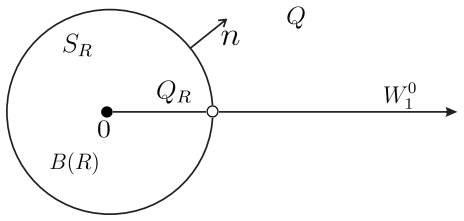
- [Section 6, equations (6.1)-(6.3)] The first Green identity is applied on the domain Q_R = Q ∩ B(R), which has a reentrant corner of interior angle 2π at the screen tip and another non-Lipschitz point where the slit meets ∂B(R). The paper does not justify that the integration-by-parts formula holds for functions in H^1(Q_R) without an additional boundary contribution from the tip. For a solution of (Δ+ω^2)ŵ_s = 0 with zero Dirichlet data on the screen, such a tip term will vanish if one has the standard edge asymptotics ŵ_s = O(r^{1/2}) and ∇ŵ_s = O(r^{-1/2}), but this estimate is not stated or proved in the manuscript. Without a proof or a precise reference for the Green formula on slit domains, or an argument showing that the inner boundary term tends to zero, the step leading to (6.1)-(6.2) is not rigorous and the conclusion ŵ_s ≡ 0 does not follow.
- [Section 6, after equation (6.2)] The text states that the left-hand side integrands in (6.1) and (6.2) are non-negative. This is false for (6.2) when Re ω > 0, since the integrand there is -2(Re ω)(Im ω)|ŵ_s|^2, which is negative. The final conclusion can still be recovered by taking absolute values and using that the prefactor is nonzero and that the boundary term tends to zero along the sequence R_j, but the monotonicity argument as written is incorrect and needs to be repaired.
minor comments (4)
- [Section 6, first paragraph of Theorem 6.1] The assertion that arbitrary solutions in M satisfy all the conditions of Proposition 5.7 is not justified, because the exponential estimates (5.6) are proved only for the explicitly constructed solution, not for the whole class M. The subsequent argument only uses H^1(Q), so the overstatement should be removed or qualified.
- [Section 4, Corollary 4.3] The definition of A_i in Corollary 4.3 appears inconsistent with (1.1): the limiting amplitude of u_i should be e^{-iω_0 ρ cos(φ-α)}, not e^{-iω_0 ρ cos(φ+α)}. Please check the sign in the exponential.
- [Introduction and Conclusion] The claim that the approach obtains the regularity edge condition 'in a natural way' would be clearer if the paper explicitly identified which edge condition is obtained (for example, the r^{1/2} behavior at the tip) and where in the proof it enters.
- [Throughout] There are several typographical errors, including 'exept' for 'except', 'nostationary' for 'nonstationary', 'Schawrtz' for 'Schwarz', and an apparent notation slip 'Âω_s' in the sentence preceding (6.2).
Circularity Check
No circularity: the new uniqueness theorem is proved by an independent Green-identity argument; self-citations supply context and prior existence/LAP, not the load-bearing reduction.
full rationale
The paper's genuinely new claim is Theorem 6.1: uniqueness in the class M. Its proof is self-contained in the relevant sense: it takes a difference of two M-solutions, applies the Fourier-Laplace transform, uses the H^1 regularity of the transform, and runs a Green-identity/Rellich argument modeled on the external theorem [10] by Castro and Kapanadze. No parameter is fitted and no same-author theorem is invoked to force the conclusion; the boundary condition and the Helmholtz equation with complex frequency do the work. The self-citations that do occur are not circular in the prohibited sense. Existence of a solution and the limiting amplitude property are quoted from the authors' earlier paper [11], and the introduction openly says that the present paper 'makes up for this omission.' The uniqueness argument does not reduce to [11]; it uses only the explicit regularity estimates for the Fourier-Laplace transform proved in Section 5. Remark 4.1's reference to [26] for the Sommerfeld-type representation is also not load-bearing for uniqueness: even if that representation were an ansatz, the present paper proves that any M-solution is unique, and the displayed formula is only used to exhibit existence. The limiting amplitude identification is not a renamed fit either: the Sommerfeld amplitude A is defined independently in Section 2, and the time-dependent solution is shown to satisfy the defining equations; taking its limit is a substantive verification, inherited from [11] rather than manufactured here. The only serious concern is the unstated assumption that Green's first identity holds on the non-Lipschitz slit domain Q_R with a reentrant corner of angle 2π at the tip, with no boundary contribution from the origin. That is a potential correctness gap in the proof of Theorem 6.1, but it is not circularity: it does not make the theorem equivalent to its inputs by definition or by self-citation. Accordingly, the circularity score is 0.
Assumptions & free parameters
assumptions (4)
- domain assumption The existence and limiting amplitude principle for the half-plane problem as established in [11, Theorems 3.2, 4.1].
- domain assumption Uniqueness for the stationary Helmholtz problem with complex wavenumber in H^1(Q) for wedges of arbitrary angle, from [10, Theorem 2.1], extended to the half-plane (angle 2π).
- standard math Standard properties of the Fourier-Laplace transform on tempered distributions supported on R+, including analyticity in C+.
- standard math Green's first identity and Sobolev trace theory for domains with piecewise smooth boundary, including the half-plane with a slit.
Cite this review
Pith. "Pith review of Time-dependent approach to the uniqueness of the Sommerfeld solution of the diffraction problem by a half-plane." pith.science (2026). https://pith.science/paper/6YJWATGE
@misc{pith2026190801663,
  author       = {Pith},
  title        = {Pith review of: Time-dependent approach to the uniqueness of the Sommerfeld solution of the diffraction problem by a half-plane},
  year         = {2026},
  howpublished = {\url{https://pith.science/paper/6YJWATGE}},
  note         = {Machine review of arXiv:1908.01663}
}
abstract
We consider the Sommerfeld problem of diffraction by an opaque half-plane with a real wavenumber interpreting it as the limiting case, as time tends to infinity, of the corresponding time-dependent diffraction problem. We prove that the Sommerfeld formula for the solution is the limiting amplitude of the solution of this time-dependent problem which belongs to a certain functional class and is unique in it. For the proof of uniqueness of solution to the time-dependent problem we reduce it, after the Fourier-Laplace transform in $t$, to a stationary diffraction problem with a complex wavenumber. This permits us to use the proof of uniqueness in the Sobolev space $H^1$. Thus we avoid imposing the radiation and regularity conditions on the edge from the beginning and instead obtain it in a natural way.
Figures


Reference graph
Works this paper leans on
-
[10]
Wave diffraction by wedges having arbitrary aperture angle
Castro LP, Kapanadze D. Wave diffraction by wedges having arbitrary aperture angle. Journal of Mathematical Analysis and Applications . 2015; 421(2):1295–1314. DOI:10.1016/j.jmaa.2014.07.080
-
[11]
Sommerfeld’s solution as the limiting amplitude and asymp- totics for narrow wedges
Komech AI, Merzon AE, Esquivel Navarrete A, De La Paz M´ endez JE, Vil- lalba Vega TJ. Sommerfeld’s solution as the limiting amplitude and asymp- totics for narrow wedges. Mathematical Methods in the Applied Sciences . 2018. https://doi.org/10.1002/mma.5075
-
[1]
Mathematische theorie der diffraction
Sommerfeld A. Mathematische theorie der diffraction. Mathematische Annalen. 1896; 47:317–374
-
[2]
Optics (Lectures on theoretical physics, Vol
Sommerfeld A. Optics (Lectures on theoretical physics, Vol. 4). New York, Academic Press, 1954
work page 1954
- [3]
-
[4]
A uniqueness and a new solution for Sommerfeld’s and other diffraction problems
Peters A.S., Stoker J.J. A uniqueness and a new solution for Sommerfeld’s and other diffraction problems. Communications on Pure and Applied Mathematics. 1954. 7(3):565-585. DOI:10.1002/cpa.3160070307
- [5]
-
[6]
Dos Santos A. F., Teixeira F.S. The Sommerfeld problem revisted: solution spaces and the edges conditions. Journal of Mathematical Analysis and Applications . 1989; 143: 341-357
work page 1989
Show all 35 references
-
[7]
Eidus, The principle of limit amplitude, Russian Mathematical Surveys 24 (1969), no
D.M. Eidus, The principle of limit amplitude, Russian Mathematical Surveys 24 (1969), no. 3, 24–97
1969
-
[8]
Morawetz, The limiting amplitude principle, Comm
C. Morawetz, The limiting amplitude principle, Comm. Pure Appl. Math. 15 (1962), 349–361. 20
1962
-
[9]
B. R. Vainberg, Asymptotic Methods in Equations of Mathematical Physics, Gordon and Breach, New York, 1989
1989
-
[12]
Sur une m´ ethode nouvelle dans le probl´ eme plan des vibra- tions ´ elastiques.Trudy Seismological Institute Academy of Nauk SSSR
Smirnov VI, Sobolev SL. Sur une m´ ethode nouvelle dans le probl´ eme plan des vibra- tions ´ elastiques.Trudy Seismological Institute Academy of Nauk SSSR. 1932; 20:1–37
1932
-
[13]
Theory of diffraction of plane waves
Sobolev SL. Theory of diffraction of plane waves. Proceedings of Seismological Insti- tute, Russian Academy of Science, Leningrad . 1934; 41(1):75–95
1934
-
[14]
Sobolev, General theory of diffraction of waves on Riemann surfaces, Tr
S.L. Sobolev, General theory of diffraction of waves on Riemann surfaces, Tr. Fiz.- Mat. Inst. Steklova 9 (1935), 39-105. [Russian] (English translation: S.L. Sobolev, General theory of diffraction of waves on Riemann surfaces, p. 201-262 in: Selected Works of S.L. Sobolev, Vol....
1935
-
[15]
Sobolev, Some questions in the theory of propagations of oscillations, Chap XII, in: Differential anf Integral Equations of Mathematical Physics, F.Frank and P
S.L. Sobolev, Some questions in the theory of propagations of oscillations, Chap XII, in: Differential anf Integral Equations of Mathematical Physics, F.Frank and P. Mizes (eds), Leningrad-Moscow (1937) pp 468-617.[Russian]
1937
-
[16]
Diffraction and reflection of pulses by wedges and cor- ners
Keller J, Blank A. Diffraction and reflection of pulses by wedges and cor- ners. Communications on Pure and Applied Mathematics . 1951; 4(1):75–95. DOI:10.1002/cpa.3160040109
1951 doi
-
[17]
The diffraction of an arbitrary pulse by a wedge
Kay I. The diffraction of an arbitrary pulse by a wedge. Communications on Pure and Applied Mathematics 1953; 6:521-546
1953
-
[18]
On the diffraction and reflection of waves and pulses by wedges and corners
Oberhettinger F. On the diffraction and reflection of waves and pulses by wedges and corners. Journal of Research National Bureau of Standarts . 1958; 61(2):343–365
1958
-
[19]
Diffracion at Poligons and Polyhedrons
Borovikov V.A. Diffracion at Poligons and Polyhedrons. Moscow: Nauka, (1966)
1966
-
[20]
Time domains scattering by an impedance wedge for skew incidence
Bernard JML, Pelosi G, Manara G, Freni A. Time domains scattering by an impedance wedge for skew incidence. Proceeding conference ICEAA 1991: 11-14
1991
-
[21]
Bernard JML. Progresses on the diffraction by a wedge: transient solution for line source illumination, single face contribution to scattered field, anew consequence of reciprocity on the spectral function. Revue Technique Thomson 1993;25(4):1209– 1220
1993
-
[22]
On the time domain scattering by a passive classical frequency dependent-shaped region in a lossy dispersive medium
Bernard JML. On the time domain scattering by a passive classical frequency dependent-shaped region in a lossy dispersive medium. Annals of Telecommunica- tion 1994; 49(11-12):673-683. 21
1994
-
[23]
Time-dependent plane wave diffraction by a half-plane: explicit solu- tion for Rawlins’ mixed initial boundary value problem
Rottbrand K. Time-dependent plane wave diffraction by a half-plane: explicit solu- tion for Rawlins’ mixed initial boundary value problem. Z.Angew. Math. Mech. 1998; 78(5): 321-335
1998
-
[24]
Exact solution for time-dependent diffraction of plane waves by semi- infinite soft/hard wedges and half-planes, 1998
Rottbrand K. Exact solution for time-dependent diffraction of plane waves by semi- infinite soft/hard wedges and half-planes, 1998. Preprint 1984 Technical University Darmstadt
1998
-
[25]
Time-dependent scattering of gener- alized plane waves by wedges
Komech AI, Merzon AE, De la Paz Mendez JE. Time-dependent scattering of gener- alized plane waves by wedges. Mathematical Methods in the Applied Sciences . 2015; 38:4774-4785. DOI:10.1002/mma.3391
2015 doi
-
[26]
On Sommerfeld representation and unique- ness in scattering by wedges
Komech AI, Mauser NJ, Merzon AE. On Sommerfeld representation and unique- ness in scattering by wedges. Mathematical Methods in the Applied Sciences . 2005; 28(2):147-183. DOI:10.1002/mma.553
2005 doi
-
[27]
DN-Scattering of a plane wave by wedges
De la Paz M´ endez JE, Merzon AE. DN-Scattering of a plane wave by wedges. Mathematical Methods in the Applied Sciences . 2011; 34(15):1843-1872. DOI:10.1002/mma.1484
2011 doi
-
[28]
Scattering of a plane wave by hard-soft wedges
De la Paz Mendez JE, Merzon AE. Scattering of a plane wave by hard-soft wedges. Recent Progress in Operator Theory and its Applications. Series: Operator Theory: Advances and Applications. 2012; 220:207-227
2012
-
[29]
An explicit formula for the nonstationary diffracted wave scattered on a NN-wedge
Esquivel Navarrete A, Merzon AE. An explicit formula for the nonstationary diffracted wave scattered on a NN-wedge. Acta Applicandae Mathematicae . 2015; 136(1):119–145. DOI:10.1007/s10440-014-9943-7
2015 doi
-
[30]
On the Keller- Blank solution to the scattering problem of pulses by wedges
Merzon AE, Komech AI, De la Paz M´ endez JE, Villalba Vega TJ. On the Keller- Blank solution to the scattering problem of pulses by wedges. Mathematical Methods in the Applied Sciences . 2015; 38:2035–2040. DOI:10.1002/mma.3202
2015 doi
-
[31]
Limiting amplitude principle in the scattering by Wedges
Komech AI, Merzon AE. Limiting amplitude principle in the scattering by Wedges. Mathematical Methods in the Applied Sciences . 2006; 29:1147-1185. DOI:10.1002/mma.719
2006 doi
-
[32]
Elliptic boundary value problems on manifolds with piecewise smooth boundary
Komech AI. Elliptic boundary value problems on manifolds with piecewise smooth boundary. Mathematics of the USSR-Sbornik . 1973; 21(1):91-135
1973
-
[33]
Elliptic differential equations with constant coefficients in a cone.Moscow University Mathematics Bulletin
Komech AI. Elliptic differential equations with constant coefficients in a cone.Moscow University Mathematics Bulletin . 1974; 29(2):140-145
1974
-
[34]
A method of complex characteristics for elliptic problems in angles and its applications
Komech A, Merzon A, Zhevandrov P. A method of complex characteristics for elliptic problems in angles and its applications. American Mathematical Society Translation. 2002; 206(2):125-159
2002
-
[35]
A Riemann surface approach for diffraction from rational wedges
Ehrhardt T, Nolasco AP, Speck FO. A Riemann surface approach for diffraction from rational wedges. Operators and Matrices. 2014; 8(2):301–355. DOI:10.7153/oam-08- 17. 22
2014 doi
Reviewed August 14, 2026 · model on record in the stance chip above.
Discussion (0). Continue with ORCID to comment.